
A carbon filter is one of the most important parts of a grow tent ventilation system because it helps remove unwanted odors before air leaves the growing area. However, like any filtration device, a carbon filter does not work forever. Over time, the activated carbon inside the filter becomes less effective as it traps more odor molecules.
On average, a quality carbon filter lasts around 12 to 24 months, but the actual lifespan can vary depending on several factors. The type of plants you grow, humidity levels, airflow speed, filter size, and the quality of the activated carbon all affect how long your filter continues to perform effectively.
Many growers replace their carbon filters too early, while others wait until odors become noticeable outside the grow area. Understanding the signs of a worn-out filter can help you maintain better odor control and avoid unnecessary replacements.
In this guide, I’ll explain how long a carbon filter lasts, what factors shorten or extend its lifespan, how to tell when it needs replacement, and the best practices to get the most use from your filter.
How Long Does a Carbon Filter Last?
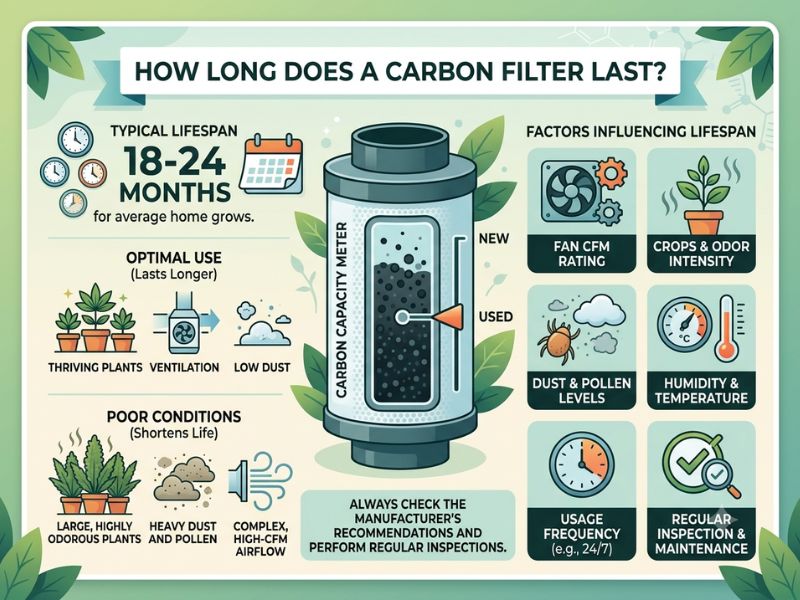
A quality carbon filter typically lasts 12 to 24 months in a grow tent, but the exact lifespan depends on how the filter is used and the conditions inside your growing environment.
Some filters may continue working effectively for longer, while others may lose performance sooner. The activated carbon inside the filter gradually becomes saturated as it traps odor molecules, reducing its ability to remove smells over time.
For most indoor grow setups, replacing the carbon filter every 1–2 years is a reasonable guideline. However, instead of replacing it based only on time, you should also monitor its actual performance.
Average Carbon Filter Lifespan
The typical lifespan can vary depending on usage:
| Usage Type | Expected Lifespan |
| Continuous 24/7 operation | 12–18 months |
| Moderate daily use | 18–24 months |
| Low-odor or occasional use | 24+ months |
These are general estimates. A high-quality filter with a thick carbon bed may last longer than a smaller, lower-quality filter.
Why Carbon Filters Stop Working Over Time
Carbon filters work through a process called adsorption, where odor molecules attach to the surface of activated carbon. As more molecules are trapped, the available surface area decreases.
Eventually:
- The carbon becomes saturated.
- Odor removal becomes less effective.
- Smells may begin escaping from the exhaust air.
The filter may still move air, but its ability to control odors gradually declines.
Does Running the Fan 24/7 Reduce Filter Life?
Yes. A carbon filter that operates continuously processes more air and captures more odor molecules compared to a filter used only part-time.
Continuous operation can shorten lifespan because:
- More air passes through the carbon.
- More particles are collected.
- The carbon reaches saturation faster.
However, many growers run their exhaust fans continuously because maintaining stable temperature and humidity is important. In these cases, choosing a larger, higher-quality carbon filter can help extend service life.
Can a Carbon Filter Last Longer Than Two Years?
Yes, under certain conditions, a carbon filter can last longer than two years.
Factors that may extend lifespan include:
- Low odor production
- Lower airflow rates
- Larger filter size
- High-quality activated carbon
- Clean growing environment
However, even if a filter is still functioning after several years, its odor-removal efficiency may be significantly reduced.
Bottom Line
Most grow tent carbon filters last between 12 and 24 months, depending on airflow, humidity, odor levels, and filter quality. The best approach is to monitor performance and replace the filter when odor control starts decreasing rather than relying only on a fixed replacement schedule.
In the next section, we’ll look at the main factors that affect how quickly a carbon filter wears out.
Factors That Affect Carbon Filter Lifespan
Several factors determine how long a carbon filter remains effective in a grow tent. Two growers can use the same filter model and get very different results because their airflow, environment, and maintenance habits may not be the same.
Understanding these factors helps you maximize the lifespan of your carbon filter and maintain reliable odor control.
1. Odor Strength
The amount of odor produced by your plants is one of the biggest factors affecting carbon filter lifespan.
Plants with stronger aromas release more odor molecules into the airflow. As these molecules pass through the filter, the activated carbon captures them and gradually becomes saturated.
Higher odor levels can shorten filter life because:
- More odor molecules are trapped.
- Carbon reaches its absorption capacity faster.
- The filter loses effectiveness sooner.
If odor production is high, using a larger filter with more activated carbon can help extend replacement intervals.
2. Humidity Levels
Humidity plays an important role in carbon filter performance. Excess moisture can reduce the efficiency of activated carbon because water molecules can occupy some of the carbon’s available surface area.
High humidity conditions may:
- Reduce odor absorption capacity.
- Shorten filter lifespan.
- Increase the chance of mold or moisture buildup inside the filter.
Maintaining proper humidity levels inside the grow tent helps protect the filter and improves overall ventilation performance.
3. Airflow Speed (CFM)
The speed at which air moves through the carbon filter affects how much time the air spends in contact with the activated carbon.
If airflow is too high:
- Air passes through the carbon too quickly.
- Odor molecules have less contact time.
- Filtration efficiency may decrease.
A properly matched fan and filter combination provides enough airflow while allowing effective odor removal.
4. Carbon Quality
Not all carbon filters are made with the same quality materials. The type and amount of activated carbon inside the filter greatly affect how long it lasts.
Higher-quality filters usually have:
- More activated carbon.
- Better carbon density.
- Greater surface area.
- More efficient odor absorption.
A premium filter may cost more upfront but often provides better performance and a longer lifespan.
5. Filter Size
The physical size of the carbon filter affects how much activated carbon it contains.
Larger filters generally last longer because they have:
- More carbon material.
- Greater odor-trapping capacity.
- More surface area for adsorption.
For example, an 8-inch carbon filter typically contains more carbon than a 4-inch filter and can handle higher airflow for a longer period.
6. How Often the Fan Runs
A carbon filter running continuously will process much more air than one used only part-time.
A 24/7 ventilation system:
- Filters more air.
- Captures more odor molecules.
- Reaches saturation faster.
If your setup requires continuous exhaust, selecting a properly sized filter with enough carbon capacity is important.
7. Air Quality and Dust Levels
Dust and airborne particles can reduce filter performance over time. Although many carbon filters include an outer pre-filter, excessive dust can still affect airflow.
Factors that can shorten filter life include:
- Dusty rooms.
- Poor tent cleanliness.
- Dirty intake air.
- Lack of pre-filter maintenance.
Keeping the growing area clean helps protect the carbon filter.
Bottom Line
Carbon filter lifespan depends on more than just time. Odor intensity, humidity, airflow speed, filter quality, size, operating hours, and air cleanliness all influence how long it will remain effective.
By controlling these factors and choosing a properly sized filter, you can extend its lifespan and maintain better odor control throughout your grow cycle.
Average Carbon Filter Lifespan by Usage
How often you run your exhaust system has a major impact on how long your carbon filter lasts. A filter that operates continuously processes more air and captures more odor molecules compared to one used only a few hours per day.
The table below provides a general estimate of carbon filter lifespan based on usage patterns.
| Fan Usage | Expected Carbon Filter Lifespan |
| 24/7 continuous operation | 12–18 months |
| 12–18 hours per day | 18–24 months |
| Occasional use | 24+ months |
These estimates can vary depending on filter quality, odor intensity, humidity, and airflow rate.
Continuous Operation (24/7)
Many indoor growers run their exhaust fans continuously to maintain stable temperature, humidity, and air exchange.
When a carbon filter runs 24 hours a day:
- More air passes through the activated carbon.
- More odor molecules are captured.
- The carbon becomes saturated faster.
A high-quality filter used continuously often lasts around 12 to 18 months.
To extend lifespan in a 24/7 setup:
- Choose a larger carbon filter.
- Match the filter with the correct fan CFM.
- Keep humidity under control.
- Clean the outer pre-filter regularly.
Part-Time Operation
Some growers reduce fan operation during certain periods, especially when temperature and humidity are already controlled.
A filter used around 12–18 hours per day generally experiences less airflow exposure.
Benefits include:
- Slower carbon saturation.
- Longer service life.
- Reduced wear on ventilation equipment.
With moderate use, many carbon filters can last approximately 18 to 24 months.
Occasional Operation
A carbon filter used only occasionally may last more than two years, especially in environments with lower odor levels.
However, limited use does not guarantee unlimited lifespan. Carbon can still lose effectiveness over time due to:
- Moisture exposure.
- Dust buildup.
- Environmental conditions.
Regularly checking odor control performance is more reliable than relying only on the calendar.
Why Usage Time Matters
A carbon filter does not wear out because of running time alone. It wears out because the activated carbon is gradually filled with trapped odor molecules.
More operating hours mean:
- More air filtration.
- More odor exposure.
- Faster carbon saturation.
This is why a continuously running filter usually reaches the end of its useful life sooner than a part-time system.
Choosing the Right Filter for Your Usage
If your exhaust fan runs continuously, consider investing in:
- A larger carbon filter.
- Higher-quality activated carbon.
- A filter with a higher CFM rating than your minimum requirement.
This gives the carbon more capacity and reduces how quickly it becomes saturated.
Bottom Line
A carbon filter used 24/7 typically lasts around 12–18 months, while moderate or occasional use can extend lifespan to 18–24 months or longer. The best way to determine replacement time is to monitor odor control performance rather than depending only on usage hours.
Signs Your Carbon Filter Needs Replacement
A carbon filter does not suddenly stop working when it reaches the end of its lifespan. Instead, its odor-removal ability gradually decreases as the activated carbon becomes saturated.
Knowing the warning signs can help you replace the filter before odors escape and your ventilation system becomes less effective.
1. Odors Start Escaping From the Exhaust
The most obvious sign that a carbon filter needs replacement is noticing odors outside the grow area.
If your ventilation system was previously controlling smells but you start noticing odors from the exhaust outlet, possible causes include:
- Saturated activated carbon
- Incorrect airflow direction
- Air leaks in duct connections
- A filter that is too small for the fan
First, check your installation and seals. If everything is working correctly, the filter may be reaching the end of its useful life.
2. The Filter No Longer Controls Odors Effectively
A carbon filter can continue moving air even after its odor-removing ability decreases.
Signs of reduced filtration performance include:
- Stronger smells near the exhaust area
- Odors returning after previously being controlled
- Less noticeable improvement after running the ventilation system
When the carbon inside becomes saturated, replacing the filter is usually the only effective solution.
3. The Filter Has Been Used Beyond Its Expected Lifespan
Even if you do not notice strong odors, a filter that has been running continuously for a long time may have reduced efficiency.
Consider replacement if:
- The filter has operated for 18–24 months or more.
- It runs 24/7.
- The environment produces strong odors.
- The filter has been exposed to high humidity.
A preventative replacement schedule can help maintain consistent performance.
4. Reduced Airflow Through the System
A noticeable decrease in airflow can indicate a problem with the filter.
Possible causes include:
- A clogged outer pre-filter
- Dust buildup
- Saturated carbon
- Restricted ducting
Before replacing the filter, clean the pre-filter and inspect the ventilation system. A dirty pre-filter can reduce airflow without the carbon itself being exhausted.
5. Visible Damage to the Filter
Physical damage can reduce filter performance.
Inspect for:
- Cracked housing
- Damaged end caps
- Loose connections
- Wet or damaged carbon material
A damaged filter may allow air to bypass the carbon layer, reducing odor control.
6. Increased Humidity Problems
A carbon filter does not remove humidity directly, but a restricted filter can reduce exhaust performance.
If airflow decreases, you may notice:
- Higher humidity levels
- Slower air exchange
- Increased heat buildup
Check the entire ventilation system before replacing the filter, as the issue may be caused by the fan, ducting, or environmental conditions.
How to Confirm Your Carbon Filter Is Worn Out
Before buying a replacement, check:
Check for Air Leaks
Make sure odors are not escaping from:
- Duct connections
- Tent openings
- Fan connections
Clean the Pre-Filter
A dirty pre-filter can make a good carbon filter appear ineffective.
Check Fan Performance
Make sure the inline fan is still operating correctly and moving enough air.
If the system is properly installed and odors remain, the carbon filter is likely saturated.
Bottom Line
The main sign that a carbon filter needs replacement is reduced odor control. If smells begin escaping despite proper installation and ventilation, the activated carbon may no longer be effective.
Regular inspection, proper sizing, and maintenance can help extend filter life, but once the carbon becomes saturated, replacing the filter is the only way to restore full odor filtration performance.
How to Extend Carbon Filter Life
A carbon filter is an important investment in your grow tent ventilation system, and proper maintenance can help it last longer. While activated carbon eventually becomes saturated and needs replacement, several practices can slow down the process and maintain effective odor control.
1. Use the Correctly Sized Carbon Filter
One of the best ways to extend filter life is choosing the correct size from the beginning.
A filter that is too small for your exhaust fan can cause:
- Faster carbon saturation
- Reduced odor removal
- Increased airflow speed through the carbon
A properly sized filter allows air to move through the activated carbon at the correct rate, giving odor molecules enough contact time to be trapped.
2. Match the Filter With the Exhaust Fan
The carbon filter and inline fan should work together as a balanced system.
If your fan moves more air than the filter can handle:
- Air passes through too quickly.
- Odor removal efficiency decreases.
- Carbon may wear out faster.
Choose a filter with a CFM rating equal to or higher than your fan’s actual airflow capacity.
3. Maintain Proper Humidity Levels
Excess moisture can reduce activated carbon performance. Water vapor can occupy some of the carbon’s surface area, making it less effective at capturing odor molecules.
To protect your filter:
- Keep humidity within the recommended range for your setup.
- Use proper exhaust ventilation.
- Avoid placing humidifiers directly near the filter.
- Prevent water or condensation from reaching the filter.
A dry carbon filter generally lasts longer than one exposed to excessive moisture.
4. Clean the Pre-Filter Regularly
Most carbon filters include an outer fabric pre-filter that catches dust and larger particles before they reach the carbon.
A dirty pre-filter can:
- Restrict airflow.
- Increase fan workload.
- Reduce overall ventilation efficiency.
Clean the pre-filter periodically by:
- Removing the fabric cover.
- Washing it according to manufacturer instructions.
- Allowing it to dry completely.
- Reinstalling it securely.
Never run the system without the pre-filter because it helps protect the activated carbon.
5. Avoid Excessive Airflow
More airflow does not always mean better filtration.
Running a fan at maximum speed with an undersized filter can reduce contact time between air and carbon.
For better performance:
- Use a variable-speed fan when possible.
- Adjust airflow according to your tent requirements.
- Avoid pushing more CFM through the filter than it is designed to handle.
Balanced airflow improves both odor control and filter lifespan.
6. Keep the Growing Area Clean
Dust and airborne particles can reduce ventilation performance over time.
To reduce contamination:
- Keep intake areas clean.
- Remove dust regularly.
- Clean the grow tent interior.
- Prevent debris from entering the ventilation system.
A cleaner environment reduces the workload on the filter.
7. Install the Filter Correctly
Proper installation helps the filter work efficiently.
Best practices:
- Install the filter near the top of the tent.
- Ensure all air passes through the carbon.
- Seal duct connections properly.
- Maintain slight negative pressure.
Air leaks can force the system to work harder and reduce effective odor control.
8. Choose a Quality Carbon Filter
Not all carbon filters perform the same. Higher-quality filters often contain better activated carbon and more carbon material.
A quality filter provides:
- Better odor absorption.
- Longer service life.
- More consistent performance.
A cheaper filter may need replacement sooner, making it less cost-effective over time.
Bottom Line
The best ways to extend carbon filter life are choosing the right size, maintaining proper humidity, cleaning the pre-filter, controlling airflow, and keeping the ventilation system sealed.
A well-maintained carbon filter can provide reliable odor control for 12–24 months or longer, depending on your grow tent conditions and usage. Proper care not only saves money but also keeps your ventilation system performing efficiently.
Can You Clean and Reuse a Carbon Filter?
Many growers wonder if a carbon filter can be cleaned and reused instead of replacing it. The short answer is: you can clean parts of a carbon filter, but you cannot restore exhausted activated carbon once it is saturated.
The outer components can be maintained, but the carbon inside the filter gradually loses its odor-removing ability over time.
What Parts of a Carbon Filter Can Be Cleaned?
Most carbon filters have two main parts:
- Outer pre-filter
- Activated carbon layer
The outer pre-filter can usually be cleaned and reused, but the activated carbon cannot be effectively cleaned at home.
Cleaning the Pre-Filter
The pre-filter collects:
- Dust
- Hair
- Airborne particles
- Other debris
Cleaning it helps maintain airflow and reduces strain on your exhaust fan.
General maintenance steps:
- Remove the fabric pre-filter.
- Wash it according to the manufacturer’s instructions.
- Allow it to dry completely.
- Reinstall it before operating the system.
A clean pre-filter helps the carbon filter work more efficiently.
Can You Replace the Activated Carbon?
Some carbon filters allow the activated carbon media to be replaced, but most common grow tent filters are designed as sealed units.
Replacing carbon inside a sealed filter is usually not practical because:
- Proper carbon density is difficult to maintain.
- Airflow distribution may become uneven.
- The filter may not perform like a factory-built unit.
For most growers, replacing the entire filter is the easiest and most reliable solution.
Why Can’t Activated Carbon Be Restored Easily?
Activated carbon works through adsorption, where odor molecules attach to the carbon’s microscopic pores.
Over time:
- These pores become filled.
- The carbon loses available surface area.
- Odor removal performance decreases.
Cleaning the outside of the filter does not remove the trapped molecules inside the carbon.
Can You Wash a Carbon Filter?
No. You should not wash the activated carbon portion of a carbon filter.
Adding water can:
- Damage the carbon structure.
- Reduce filtration ability.
- Create moisture problems inside the filter.
- Shorten its remaining lifespan.
Only the removable outer pre-filter should be cleaned.
Can Heating Reactivate Carbon?
In industrial settings, activated carbon can sometimes be regenerated using specialized high-temperature processes.
However, this is not practical for home growers because it requires:
- Controlled high temperatures.
- Specialized equipment.
- Proper handling procedures.
A used grow tent carbon filter cannot normally be restored at home.
When Should You Replace Instead of Clean?
Replace the carbon filter when:
- Odors are escaping despite proper setup.
- The filter has reached its expected lifespan.
- Cleaning the pre-filter does not improve airflow.
- The activated carbon has become saturated.
A clean pre-filter can improve airflow, but it cannot restore odor removal capacity.
Bottom Line
You can clean and reuse the outer pre-filter, but you cannot effectively clean and reuse the activated carbon inside the filter once it becomes saturated.
Regular pre-filter maintenance, proper airflow, and humidity control can extend filter life, but eventually the entire carbon filter will need replacement to maintain effective odor control.
Frequently Asked Questions
How often should I replace my carbon filter?
Most grow tent carbon filters should be replaced every 12–24 months, depending on usage and environmental conditions.
You may need to replace it sooner if:
- Odors begin escaping.
- The filter runs 24/7.
- The growing environment produces strong odors.
- Humidity levels are consistently high.
Instead of replacing only by time, monitor whether the filter is still controlling odors effectively.
Can a carbon filter last 5 years?
A carbon filter may still physically exist after 5 years, but it is unlikely to provide the same level of odor control as a newer filter.
Activated carbon gradually becomes saturated as it captures odor molecules. After several years, the filter may still move air, but its filtration performance is usually reduced.
For reliable odor control, most growers replace filters within the recommended lifespan.
Does humidity damage carbon filters?
High humidity can reduce carbon filter effectiveness over time.
Moisture can compete with odor molecules for space on the activated carbon surface, reducing adsorption capacity.
To protect your filter:
- Maintain proper humidity levels.
- Ensure good exhaust airflow.
- Keep water away from the filter.
- Avoid placing humidifiers directly below it.
How do I know if my carbon filter is working?
A working carbon filter should significantly reduce odors from the exhaust air.
You can check performance by:
- Comparing odors inside and outside the grow area.
- Inspecting duct connections for leaks.
- Checking that air is moving through the filter correctly.
- Confirming the fan is pulling air through the carbon.
If odors are noticeable outside the tent despite proper installation, the filter may be saturated or the ventilation system may have an issue.
Do bigger carbon filters last longer?
Generally, yes. Larger carbon filters usually contain more activated carbon, which gives them greater odor-trapping capacity.
A larger filter can provide:
- More carbon surface area.
- Longer contact time.
- Better airflow capacity.
- Longer service life.
However, the filter must still match your exhaust fan. A very large filter paired with an undersized fan may not provide better performance.
Does running a carbon filter 24/7 shorten its lifespan?
Yes, continuous operation usually shortens lifespan because more air passes through the filter over time.
However, running an exhaust fan continuously is common because it helps maintain:
- Stable temperature.
- Better humidity control.
- Consistent air exchange.
If your fan runs constantly, choosing a higher-capacity filter can help extend replacement intervals.
Should I replace my carbon filter if it still has airflow?
Not necessarily. Airflow alone does not mean the filter is working properly.
A carbon filter can continue allowing air to pass through even after the activated carbon becomes less effective.
The main factor is odor control. If odors are no longer being removed, replacement is usually needed.
Can I extend the life of my carbon filter?
Yes. You can extend filter life by:
- Cleaning the pre-filter regularly.
- Maintaining proper humidity.
- Matching the fan and filter correctly.
- Avoiding excessive airflow.
- Keeping the grow area clean.
- Using a quality carbon filter.
Proper installation and maintenance can help your filter reach its expected lifespan.
Conclusion
A carbon filter usually lasts 12–24 months, but its actual lifespan depends on odor levels, humidity, airflow, filter quality, and operating time.
The best way to know when replacement is needed is to monitor performance. If odors begin escaping despite proper installation and maintenance, the activated carbon is likely saturated.
Choosing the right filter size, maintaining clean airflow, and controlling humidity will help you get the longest possible life from your carbon filter while keeping your grow tent ventilation system effective.

I’m Maya L. Greenwood, a lifelong plant lover who believes anyone can grow something beautiful with the right guidance. After years of testing soil mixes, pruning methods, irrigation tricks, and pest-safe solutions, I started EasyGardenTips.com to turn hard-won lessons into step-by-step advice. From seed starting and container gardens to composting and seasonal checklists, my goal is to make gardening simple, sustainable, and fun.