
Choosing the right carbon filter size is important for maintaining effective odor control and proper airflow in a grow tent. A filter that is too small may restrict airflow and fail to remove odors efficiently, while an oversized filter can increase costs without providing much extra benefit for a small setup.
Many beginners choose a carbon filter based only on their grow tent size, but the most important factors are the inline fan size, CFM rating, and ventilation design. The carbon filter and exhaust fan need to work together as a balanced system to ensure air passes through enough activated carbon for effective odor removal.
A properly sized carbon filter allows your exhaust fan to operate efficiently while maintaining negative pressure inside the tent. It also reduces strain on the fan, minimizes noise, and helps extend the lifespan of your ventilation equipment.
In this guide, I’ll explain how to choose the right carbon filter size for a grow tent, how to match it with your inline fan, and what size filter works best for different tent sizes.
What Size Carbon Filter Do I Need?
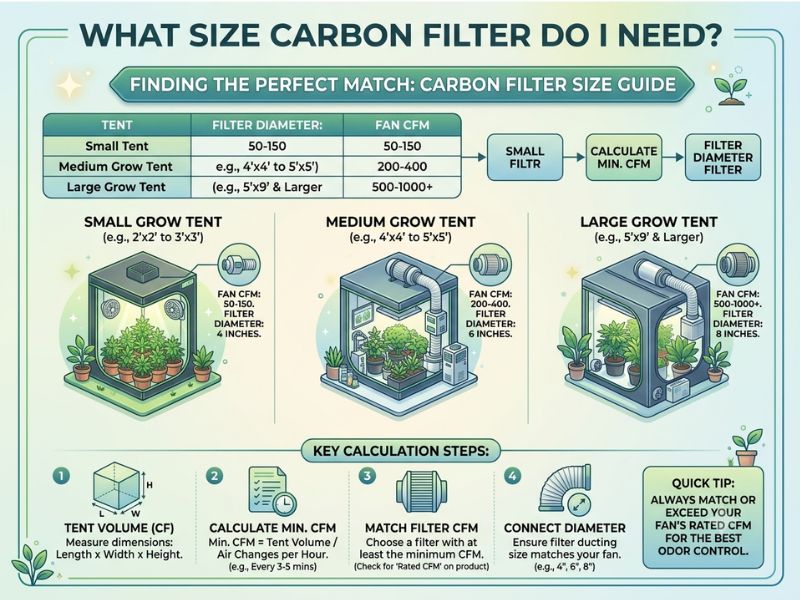
The right carbon filter size depends mainly on your inline exhaust fan size, CFM rating, and grow tent ventilation needs. While tent size can help estimate your requirements, the carbon filter should always be matched with the exhaust system rather than chosen by tent dimensions alone.
In most cases, the best approach is to choose a carbon filter that has:
- The same diameter as your inline fan.
- A CFM rating equal to or higher than your fan.
- Enough activated carbon capacity for effective odor removal.
For example, if you have a 6-inch inline fan rated at 400 CFM, you should use a 6-inch carbon filter that can handle at least 400 CFM.
Why Carbon Filter Size Matters
A carbon filter works by forcing air through activated carbon, where odor molecules become trapped. For this process to work effectively, air needs enough contact time with the carbon material.
If the filter is too small:
- Air moves through too quickly.
- Odor removal becomes less effective.
- Airflow resistance increases.
- The fan may become louder.
If the filter is properly sized:
- Air passes through the carbon at the correct speed.
- Odors are removed more efficiently.
- The exhaust system works smoothly.
Should You Choose a Bigger Carbon Filter?
In many cases, choosing a slightly larger carbon filter is beneficial. A larger filter usually contains more activated carbon, which provides:
- Better odor absorption.
- Lower airflow restriction.
- Longer filter lifespan.
- Quieter fan operation.
However, the filter should still match your fan and ventilation requirements. A very large filter on a small tent with a low-powered fan may not provide any noticeable advantage.
Common Carbon Filter Sizes
Most grow tent carbon filters come in standard sizes:
4-inch carbon filters
- Best for small grow tents.
- Commonly paired with smaller inline fans.
- Suitable for low to moderate airflow requirements.
6-inch carbon filters
- The most popular size for medium grow tents.
- Works well with many common indoor setups.
- Provides a good balance between airflow and filtration.
8-inch carbon filters
- Used for larger tents requiring higher airflow.
- Suitable for powerful inline fans.
- Better for larger growing areas.
10-inch and larger carbon filters
- Designed for commercial or very large grow spaces.
- Used with high-CFM ventilation systems.
The Best Rule to Follow
Instead of asking only, “What size carbon filter do I need for my tent?” ask:
“What size carbon filter matches my exhaust fan?”
Your tent size determines how much airflow you need, but your exhaust fan and CFM determine the carbon filter size.
A properly matched system looks like this:
Grow Tent → Carbon Filter → Inline Fan → Exhaust Duct
When the filter and fan work together correctly, you get better odor control, efficient airflow, and a quieter ventilation system.
In the next section, we’ll look at how to choose the right carbon filter size based on inline fan diameter and CFM rating.
How to Choose the Right Carbon Filter Size
Choosing the right carbon filter requires matching three important factors: filter diameter, CFM rating, and activated carbon capacity. These factors determine how efficiently the filter removes odors while allowing your exhaust system to maintain proper airflow.
Match the Carbon Filter Diameter With Your Inline Fan
The easiest way to choose a carbon filter is to match its diameter with your inline exhaust fan.
Common combinations include:
- 4-inch fan → 4-inch carbon filter
- 6-inch fan → 6-inch carbon filter
- 8-inch fan → 8-inch carbon filter
- 10-inch fan → 10-inch carbon filter
Using the same diameter prevents airflow restrictions and makes installation easier.
For example, connecting a 6-inch inline fan to a 4-inch carbon filter creates a bottleneck. The smaller filter opening restricts airflow, causing the fan to work harder and potentially increasing noise.
Match the Carbon Filter CFM Rating With Your Fan
CFM (cubic feet per minute) measures how much air your fan can move in one minute. Your carbon filter must be able to handle the airflow produced by your exhaust fan.
A general guideline:
| Inline Fan Size | Typical Fan CFM | Carbon Filter Size |
| 4-inch | 100–200 CFM | 4-inch filter |
| 6-inch | 250–450 CFM | 6-inch filter |
| 8-inch | 400–700 CFM | 8-inch filter |
| 10-inch | 700+ CFM | 10-inch filter |
These numbers are general estimates. Actual airflow depends on duct length, bends, carbon filter thickness, and other restrictions.
Consider Airflow Resistance
A carbon filter naturally creates some resistance because air must pass through the activated carbon layer. This is why your filter should not be smaller than your fan capacity.
A properly sized filter allows:
- Better airflow
- Lower fan strain
- Reduced noise
- More effective odor removal
A filter that is too restrictive can cause the fan to lose performance and may prevent proper ventilation.
Choose a Filter With Enough Activated Carbon
The amount of activated carbon inside the filter affects how well it removes odors.
A high-quality filter usually has:
- A thicker carbon bed
- More carbon material
- Better airflow design
- Longer service life
Two filters may have the same diameter but perform differently if one contains less activated carbon.
For stronger odor control, a longer and thicker filter is usually better than a small compact model.
Don’t Choose a Carbon Filter Based Only on Tent Size
Grow tent size is useful for estimating airflow needs, but it should not be the only factor.
For example:
A 4×4 grow tent may work with different filter sizes depending on:
- Fan CFM
- Plant type
- Temperature conditions
- Humidity levels
- Duct design
A tent with high heat output may require a stronger ventilation system than a similar-sized tent in a cooler environment.
When in Doubt, Choose Slightly Larger
If you are between two carbon filter sizes, choosing the larger option is often better.
A larger filter can provide:
- More contact time with activated carbon
- Less airflow restriction
- Quieter operation
- Longer replacement intervals
However, make sure your inline fan can still move enough air through the filter.
Bottom Line
The best carbon filter size is the one that matches your inline fan diameter and CFM rating. Tent size helps determine your ventilation needs, but the filter and fan should always be treated as one system.
For most setups, choose a carbon filter with the same diameter as your exhaust fan and a CFM rating equal to or higher than the fan’s airflow capacity. This ensures better odor control and efficient ventilation performance.
Carbon Filter Size Chart by Grow Tent Size
Grow tent size can help you estimate the carbon filter you need, but remember that the inline fan CFM rating is the most important factor. A larger tent usually requires more airflow, which means a larger fan and carbon filter.
The chart below provides general recommendations for common grow tent sizes.
| Grow Tent Size | Recommended Carbon Filter Size | Typical Fan Size |
| 2×2 ft | 4-inch carbon filter | 4-inch inline fan |
| 2×3 ft | 4-inch carbon filter | 4-inch inline fan |
| 2×4 ft | 4–6 inch carbon filter | 4–6 inch inline fan |
| 3×3 ft | 6-inch carbon filter | 6-inch inline fan |
| 4×4 ft | 6-inch carbon filter | 6-inch inline fan |
| 5×5 ft | 6–8 inch carbon filter | 6–8 inch inline fan |
| 4×8 ft | 8-inch carbon filter | 8-inch inline fan |
| 5×10 ft | 8–10 inch carbon filter | 8–10 inch inline fan |
These recommendations assume a typical indoor grow tent setup with standard ventilation requirements.
2×2 Grow Tent
A small 2×2 grow tent usually works well with a 4-inch carbon filter paired with a 4-inch inline fan.
Typical requirements:
- Low to moderate airflow
- Small exhaust system
- Compact ventilation setup
A 4-inch filter provides enough odor control without creating unnecessary airflow resistance.
2×4 Grow Tent
A 2×4 grow tent may use either a 4-inch or 6-inch carbon filter, depending on the heat produced by your lighting system and your ventilation needs.
A 6-inch setup can be beneficial if:
- You use stronger grow lights.
- The tent runs warm.
- You need higher airflow.
3×3 Grow Tent
A 3×3 grow tent is commonly paired with a 6-inch carbon filter.
A 6-inch filter provides:
- Better airflow capacity
- Improved odor control
- More flexibility for fan speed adjustment
This size is popular because it provides enough ventilation capacity without being oversized.
4×4 Grow Tent
A 4×4 grow tent typically works well with a 6-inch carbon filter.
For many setups:
- 6-inch inline fan
- 6-inch carbon filter
- Proper ducting
provide sufficient airflow and odor control.
If the environment is hot or humid, moving to an 8-inch system may provide additional capacity.
5×5 Grow Tent
A 5×5 grow tent often benefits from a 6-inch or 8-inch carbon filter.
Choose an 8-inch filter if:
- You have high-powered lighting.
- You need stronger airflow.
- The tent is located in a warm environment.
A larger filter can also help reduce airflow restriction and fan noise.
4×8 Grow Tent
Large tents like a 4×8 usually require an 8-inch carbon filter.
These setups typically need:
- Higher CFM airflow
- Larger exhaust fans
- More carbon capacity
An 8-inch filter provides better odor control and allows efficient ventilation across a larger growing area.
5×10 Grow Tent
A 5×10 grow tent often requires an 8-inch or 10-inch carbon filter depending on the ventilation system.
Large setups may require:
- Higher CFM fans
- Multiple ventilation points
- Larger carbon capacity
A properly sized filter prevents airflow restrictions and helps maintain effective odor control.
Important Note About Tent Size Charts
A carbon filter size chart is only a starting point. Your final choice should consider:
- Inline fan CFM
- Grow light heat output
- Climate and room temperature
- Duct length and bends
- Desired noise level
- Odor intensity
A slightly oversized carbon filter paired with a variable-speed fan is often a good choice because it provides better filtration while allowing quieter operation.
Bottom Line
For most home grow tents:
- Small tents (2×2 to 2×4): 4-inch carbon filter
- Medium tents (3×3 to 4×4): 6-inch carbon filter
- Large tents (5×5 and above): 8-inch or larger carbon filter
Always confirm your final choice by matching the filter with your inline fan’s CFM rating for the best performance.
Does a Bigger Carbon Filter Work Better?
A bigger carbon filter can provide better performance in many situations, but bigger does not automatically mean better for every grow tent setup. The ideal filter size depends on your exhaust fan, airflow requirements, and odor control needs.
A larger carbon filter usually contains more activated carbon, which gives air more surface area to pass through. This can improve odor removal and reduce airflow restrictions.
Benefits of Using a Larger Carbon Filter
More Activated Carbon Capacity
The main advantage of a larger carbon filter is that it typically contains more activated carbon.
More carbon means:
- More surface area for trapping odor molecules
- Longer contact time between air and carbon
- Better odor absorption
- Longer filter lifespan
This is especially useful in environments where strong odors are a concern.
Less Airflow Restriction
A larger filter usually creates less resistance compared to a smaller filter handling the same amount of airflow.
For example, a 6-inch carbon filter connected to a powerful 6-inch fan will generally allow smoother airflow than a smaller filter being pushed beyond its capacity.
Lower restriction can result in:
- Better fan efficiency
- Lower operating noise
- Improved ventilation performance
Quieter Operation
When a carbon filter is too small for the fan, the fan has to work harder to move air through the restricted system. This can increase noise.
A properly sized larger filter allows the fan to operate more comfortably, which can reduce:
- Motor strain
- Air turbulence
- Fan noise
Can a Carbon Filter Be Too Big?
Yes, a carbon filter can be oversized for a particular setup, although this is usually less problematic than using one that is too small.
A very large filter may:
- Cost more than necessary
- Take up extra space
- Add unnecessary weight
- Provide little additional benefit with a small fan
For example, pairing a small 4-inch inline fan with a large commercial carbon filter may not improve performance because the fan may not move enough air through the larger carbon bed.
Bigger Filter vs Better Quality Filter
A larger filter is not always better than a higher-quality smaller filter.
A good carbon filter should have:
- High-quality activated carbon
- Sufficient carbon thickness
- Proper airflow design
- Durable construction
A well-made 6-inch filter can outperform a low-quality 8-inch filter with poor carbon material.
When Should You Choose a Larger Carbon Filter?
Consider a larger filter if:
- You are between two sizes.
- Your tent produces strong odors.
- You want quieter operation.
- You plan to upgrade your fan later.
- You want longer filter life.
Many growers choose a slightly larger filter with a variable-speed fan because they can reduce fan speed while maintaining excellent filtration.
Bottom Line
A bigger carbon filter can work better because it provides more activated carbon, better airflow capacity, and less restriction. However, the best filter is one that matches your inline fan and ventilation requirements.
For most grow tents, choosing a filter that is slightly larger than the minimum requirement can provide better odor control, quieter operation, and longer service life without sacrificing airflow performance.
Common Carbon Filter Size Mistakes to Avoid
Choosing the wrong carbon filter size can reduce odor control, restrict airflow, and put unnecessary strain on your ventilation system. Many growers focus only on the grow tent size and overlook important factors like fan CFM, duct size, and airflow resistance.
Avoiding these common mistakes will help your carbon filter perform efficiently.
Buying a Carbon Filter Based Only on Tent Size
One of the biggest mistakes is choosing a carbon filter only by looking at the grow tent dimensions.
While tent size helps estimate ventilation needs, it does not determine the exact filter size. Two identical tents can require different filters depending on:
- Grow light heat output
- Room temperature
- Fan capacity
- Plant density
- Climate conditions
The carbon filter should always be matched with the inline exhaust fan, not just the tent size.
Using a Carbon Filter Smaller Than the Fan
A common mistake is connecting a powerful exhaust fan to a smaller carbon filter.
For example:
Incorrect setup:
8-inch inline fan → 6-inch carbon filter
This creates airflow restriction and may cause:
- Reduced airflow
- Increased fan noise
- Lower odor removal efficiency
- Higher motor strain
The filter should have enough capacity to handle the fan’s airflow.
Ignoring CFM Ratings
CFM is one of the most important specifications when choosing a carbon filter.
A filter with a lower CFM rating than your fan may not provide enough contact time between air and activated carbon.
Always check:
- Fan CFM rating
- Filter CFM rating
- Airflow restrictions from ducting and bends
Ideally, the carbon filter should be rated equal to or higher than the fan’s airflow capacity.
Choosing the Cheapest Filter Available
Price is important, but the cheapest carbon filter is not always the best option.
Low-quality filters may contain:
- Less activated carbon
- Lower-grade carbon material
- Thinner carbon layers
- Poor airflow design
A quality filter provides better odor removal and usually lasts longer.
Oversizing the Filter Without Considering the Fan
Although a larger filter is often beneficial, it still needs to match your ventilation system.
For example:
A small 4-inch fan connected to a large commercial filter may not move enough air through the carbon bed.
The result:
- Poor airflow
- Inefficient filtration
- Wasted money
A balanced system always performs better than mismatched equipment.
Using Incorrect Duct Size
The duct diameter should match both the fan and carbon filter.
Problems occur when growers use:
- Small ducting with a large fan
- Adapters that reduce airflow
- Long restrictive duct runs
Incorrect duct size increases resistance and reduces the effectiveness of the entire ventilation system.
Ignoring Future Upgrades
Some growers choose the smallest possible filter for their current setup but later upgrade their lighting or ventilation.
If you plan future upgrades, choosing a slightly larger carbon filter can provide more flexibility.
A larger filter paired with a variable-speed fan allows you to increase airflow capacity later without replacing the entire system.
Not Considering Humidity Levels
High humidity environments can reduce carbon filter performance over time.
If your grow area naturally has higher humidity, you may benefit from:
- A larger carbon filter
- Better ventilation capacity
- More frequent filter inspections
The exhaust system needs to remove humid air effectively to protect the carbon filter.
Bottom Line
The most common carbon filter sizing mistakes are choosing based only on tent size, ignoring CFM ratings, and mismatching the filter with the exhaust fan.
The best approach is to select a carbon filter that matches your fan diameter, CFM requirements, and growing environment. A properly sized filter will provide better odor control, quieter operation, and longer-lasting performance.
How Carbon Filter Size Affects Fan Performance
The size of your carbon filter has a direct impact on how well your inline exhaust fan performs. A properly matched filter allows your fan to move air efficiently, while an incorrectly sized filter can reduce airflow, increase noise, and affect the overall ventilation system.
The carbon filter and exhaust fan should always be treated as a single system rather than separate components.
A Small Carbon Filter Can Restrict Airflow
When a carbon filter is too small for the exhaust fan, it creates additional resistance. The fan has to work harder to pull air through the limited carbon surface area.
This can lead to:
- Lower actual airflow than the fan’s rated CFM
- Increased fan noise
- Higher energy consumption
- Reduced ventilation efficiency
For example, a powerful 8-inch fan connected to a small carbon filter may not deliver the airflow expected because the filter becomes the limiting point in the system.
A Properly Sized Filter Improves Fan Efficiency
A correctly sized carbon filter allows air to move through the activated carbon at the right speed.
Benefits include:
- Better odor removal
- More consistent airflow
- Reduced motor strain
- Lower operating noise
The fan can operate closer to its designed performance without fighting excessive resistance.
A Larger Filter Can Help Reduce Noise
Noise is often caused by fans working against airflow restrictions.
When the carbon filter is too restrictive:
- The fan motor works harder.
- Air turbulence increases.
- The system may produce more humming or rushing sounds.
A slightly larger carbon filter can reduce this resistance, allowing quieter operation.
This is one reason many growers choose a larger filter paired with a variable-speed inline fan.
Carbon Filter Pressure Drop Explained
Every carbon filter creates a pressure drop, meaning the fan loses some airflow capacity while pulling air through the filter.
The amount of pressure drop depends on:
- Filter size
- Carbon thickness
- Carbon density
- Airflow speed
- Filter condition
A larger filter usually has a lower pressure drop because air has more space to pass through the carbon.
Fan Speed and Carbon Filter Size Relationship
A variable-speed fan gives you more control over your ventilation system.
For example:
A larger carbon filter with a controllable fan allows you to:
- Run lower speeds for quiet operation.
- Increase airflow when temperatures rise.
- Maintain effective odor control.
This setup is often more efficient than using a small filter with a fan running at maximum speed.
Can a Carbon Filter Reduce Fan CFM?
Yes. The advertised CFM of an inline fan is usually measured without restrictions. Once you add:
- Carbon filter
- Ducting
- Bends
- Exhaust outlets
the actual airflow decreases.
A properly sized carbon filter minimizes this airflow loss.
Choosing the Right Balance
The goal is not to choose the biggest filter possible. The goal is to create a balanced ventilation system where:
- Fan capacity matches airflow needs.
- Filter capacity matches fan output.
- Ducting allows smooth airflow.
- Negative pressure is maintained.
A balanced system provides better performance than individual oversized or undersized components.
Bottom Line
Carbon filter size directly affects fan performance. A filter that is too small can restrict airflow, increase noise, and reduce odor control. A properly sized or slightly larger filter allows your fan to operate more efficiently while improving filtration performance.
When choosing a carbon filter, always consider the relationship between filter size, fan CFM, and airflow resistance to create an effective grow tent ventilation system.
Frequently Asked Questions
What size carbon filter do I need for a 4×4 grow tent?
A 6-inch carbon filter is commonly used for a 4×4 grow tent when paired with a properly sized 6-inch inline fan.
However, the final choice depends on:
- Fan CFM rating
- Grow light heat output
- Room temperature
- Duct length and restrictions
For hotter environments or higher airflow needs, an 8-inch system may provide additional capacity.
Can a carbon filter be too big?
Yes, a carbon filter can be oversized, but it is usually less problematic than using one that is too small.
A very large filter may:
- Cost more than needed
- Take up extra space
- Add unnecessary weight
- Require a stronger fan to maximize performance
The best choice is a filter that matches your inline fan and airflow requirements.
Should carbon filter CFM be higher than fan CFM?
Ideally, the carbon filter CFM rating should be equal to or higher than the fan’s airflow capacity.
A filter with a higher CFM rating provides:
- Better airflow
- More contact time with activated carbon
- Less restriction
- Improved odor removal
Avoid using a filter with a lower CFM rating than your fan because it can reduce filtration efficiency.
Do I need a bigger carbon filter for high humidity?
High humidity does not always require a larger carbon filter, but it may affect filter performance.
In humid environments, consider:
- A larger ventilation system
- Better airflow
- Higher-quality carbon filters
- Proper humidity control
The exhaust fan is primarily responsible for removing humidity, while the carbon filter handles odor removal.
How long does a carbon filter last?
Most quality carbon filters last around 12–24 months depending on:
- Airflow rate
- Odor intensity
- Humidity levels
- Filter quality
- Continuous usage
A filter exposed to strong odors and high airflow may need replacement sooner.
Should my carbon filter be bigger than my inline fan?
A slightly larger carbon filter than your fan can be beneficial because it creates less airflow resistance and provides more activated carbon.
However, the difference should be reasonable. A very large filter paired with a weak fan may not improve performance.
Does a bigger carbon filter remove more odor?
Generally, yes. A larger filter usually contains more activated carbon, which provides more surface area for trapping odor molecules.
However, performance also depends on:
- Carbon quality
- Airflow speed
- Proper installation
- Fan and filter matching
A high-quality properly sized filter will outperform an incorrectly sized larger one.
Conclusion
Choosing the right carbon filter size is about creating a balanced ventilation system. The filter should match your inline fan diameter, handle the required CFM, and provide enough activated carbon for effective odor control.
For most grow tents, a good approach is to choose a carbon filter that is the same size as your exhaust fan or slightly larger. This helps maintain efficient airflow, reduces noise, and improves the lifespan of your ventilation system.
A properly sized carbon filter will keep your grow tent ventilation system running smoothly while providing reliable odor control throughout the growing cycle.

I’m Maya L. Greenwood, a lifelong plant lover who believes anyone can grow something beautiful with the right guidance. After years of testing soil mixes, pruning methods, irrigation tricks, and pest-safe solutions, I started EasyGardenTips.com to turn hard-won lessons into step-by-step advice. From seed starting and container gardens to composting and seasonal checklists, my goal is to make gardening simple, sustainable, and fun.