Best Side Lighting for Grow Tent: 3 Picks for Deeper Coverage
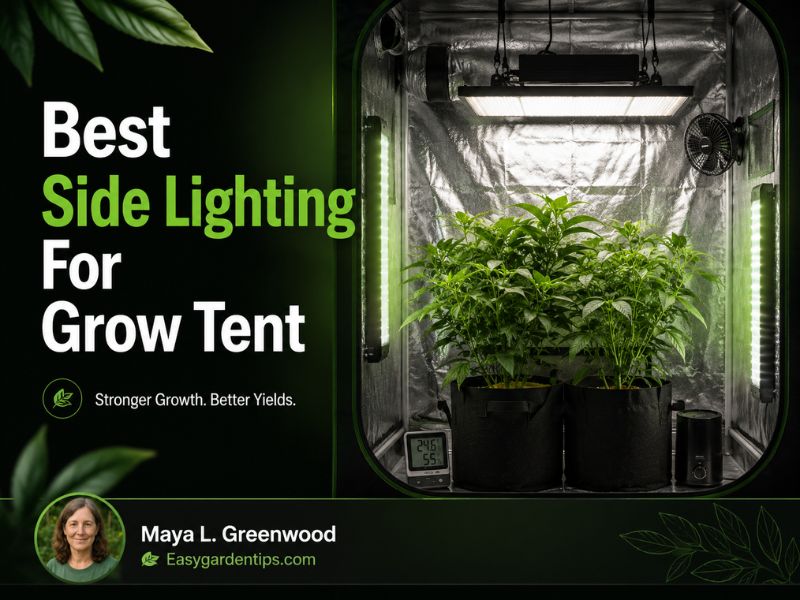
The best side lighting for grow tent use should solve a specific problem that a strong overhead fixture sometimes cannot: getting useful light into the lower and middle portions of a dense canopy.
As plants become larger, upper leaves intercept much of the light coming from above. Lower leaves, branches, flowers, and fruiting sites can therefore receive substantially less light even when the top of the canopy is well illuminated. Research on inter-canopy and sub-canopy LED lighting has shown that supplemental fixtures placed within or alongside plant canopies can improve light distribution, although results vary by crop, spectrum, intensity, plant architecture, and total daily light.
Side lighting should therefore be treated as supplemental lighting, not an excuse to undersize the primary grow light.
My first recommendation is the AC Infinity IONBEAM S16 Full Spectrum Grow Light Bars. The four 16-inch bars use Samsung LM301H EVO diodes, magnetic grow-tent mounting, an IP65-rated housing, and a digital controller with ten intensity levels and scheduling. AC Infinity specifically designs the S16 for inter-canopy and supplemental positioning where an overhead fixture has difficulty reaching.
The Spider Farmer Glow30 Full Spectrum Side Lighting Kit is my second choice. Its four compact 13-inch bars consume about 32 watts total, use a full spectrum including red wavelengths, include adjustable mounting hardware, and carry IP65 protection for humid growing environments.
The VIVOSUN LumaRay 16-Inch 4-Bar Side Lighting Kit takes third place. It is the highest-powered system of the three at 50 watts total and uses a full spectrum with a strong 600–700 nm red component, a 120-degree beam angle, magnetic or pole mounting, and app/controller-compatible dimming.
3 Side Lighting Systems for Grow Tents
| Image | Product Name | Check Price |
|---|---|---|
Best Choice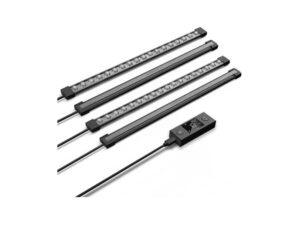 | AC Infinity IONBEAM S16 Full Spectrum LED Bars | Check Price |
Second Best | Spider Farmer Glow30 Full Spectrum Side Lighting Kit | Check Price |
Third Choice | VIVOSUN LumaRay 16-Inch 4-Bar Side Lighting Kit | Check Price |
I ranked these products using current Amazon rating and review confidence first, then considered the specifications that matter for practical side-lighting installation:
- Full-spectrum output
- Bar length and number of bars
- Dimming
- Mounting flexibility
- Water and dust resistance
- Heat output
- Power consumption
- Controller integration
- Distance from foliage
- Ability to target lower and middle canopy zones
Side lighting should be adjustable because the ideal output changes with the crop, growth stage, canopy density, distance, and strength of the overhead fixture.
1. AC Infinity IONBEAM S16 Full Spectrum LED Bars
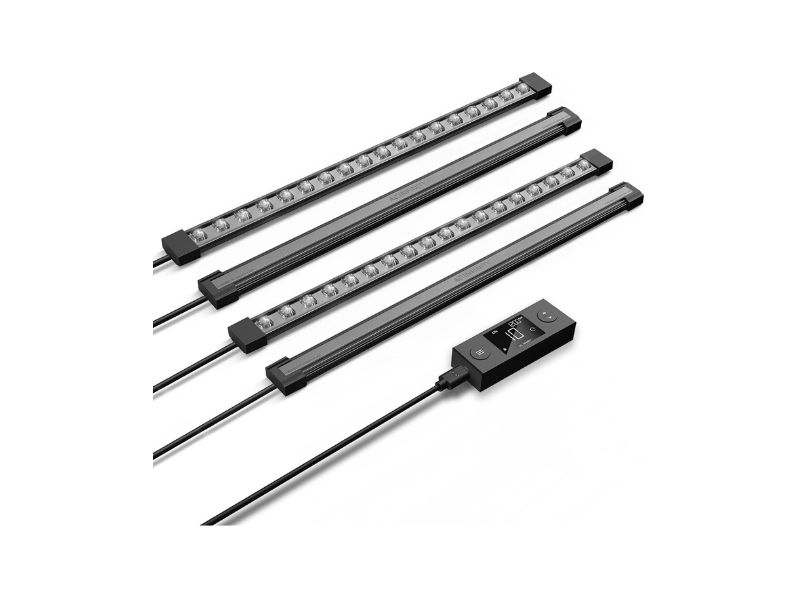
Key Features
- Four 16-inch LED bars
- Samsung LM301H EVO LEDs
- Full-spectrum output
- 3.14 µmol/J diode-level PPE specification
- Ten intensity levels
- Digital timer/controller
- Magnetic tent mounting
- IP65 protection
The IONBEAM S16 takes first place because its entire design is centered around inter-canopy and supplemental lighting rather than simply adapting a generic plant strip light to the side of a tent.
AC Infinity supplies four 16-inch bars that can mount magnetically to grow-tent poles or against tent fabric using the included steel mounting bars. This makes it relatively easy to place two bars on opposite sides of a canopy or position all four around a larger plant group.
The current S16 uses Samsung LM301H EVO diodes, and AC Infinity specifies 3.14 µmol/J PPE at the diode level. The included controller provides ten intensity settings and daily scheduling, which is particularly useful for side lighting because running supplemental bars at maximum output from the moment they are installed is rarely necessary.
The IP65-rated housing is another meaningful advantage. Side lights sit much closer to foliage, watering activity, and humid air than most overhead fixtures. IP65 construction does not mean you should spray the bars with water, but it provides more environmental protection than an ordinary indoor LED strip.
What I Like
- Purpose-built for inter-canopy use
- Excellent mounting flexibility
- Ten-level dimming
- IP65 housing
- Strong controller integration
What I Do Not Like
- Four separate bars create more cable management than one overhead fixture
- Premium features may be unnecessary for a very small or open canopy
The IONBEAM S16 is my strongest overall choice when you want a side-lighting system that can move with the canopy instead of being permanently fixed to one wall position.
2. Spider Farmer Glow30 Full Spectrum Side Lighting Kit
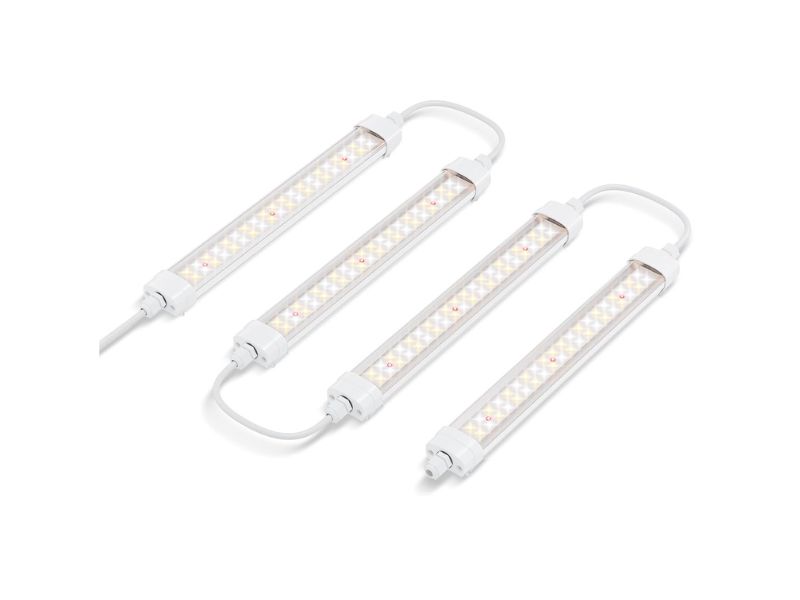
Key Features
- Four approximately 13.5-inch bars
- 32W total system power
- Full-spectrum output
- 650–665 nm red component
- 180 LEDs total
- IP65 light-bar construction
- Adjustable 360-degree mounting clips
- Low-profile design
Spider Farmer’s Glow30 takes second place because it provides useful supplemental coverage while keeping power consumption and physical size relatively modest.
The system contains four bars measuring approximately 13.54 inches each, with eight watts per bar and about 32 watts total. Spider Farmer specifies a spectrum incorporating 3000–3500K, 5000–5500K, and 650–665 nm red output.
The mounting system is especially useful for side lighting. Spider Farmer supplies clips with rotating spacers that allow the bars to be angled rather than forcing every fixture to point straight horizontally into the canopy. Adhesive-backed mounting material, straps, and cable ties are also included.
Its 32W total load makes it easier to add supplemental light without dramatically increasing tent heat or electrical demand. That does not mean the system produces no heat; every electrical light ultimately contributes heat to the growing environment. But the additional load is comparatively modest.
What I Like
- Compact four-bar design
- Modest 32W power draw
- Adjustable mounting angle
- IP65 protection
- Full spectrum rather than red-only supplementation
What I Do Not Like
- Shorter bars cover less vertical canopy per fixture
- Less sophisticated dimming/control than the AC Infinity system
The Glow30 is particularly attractive for smaller tents or growers who want to experiment with side lighting without adding a high-powered supplemental system.
3. VIVOSUN LumaRay 16-Inch 4-Bar Side Lighting Kit
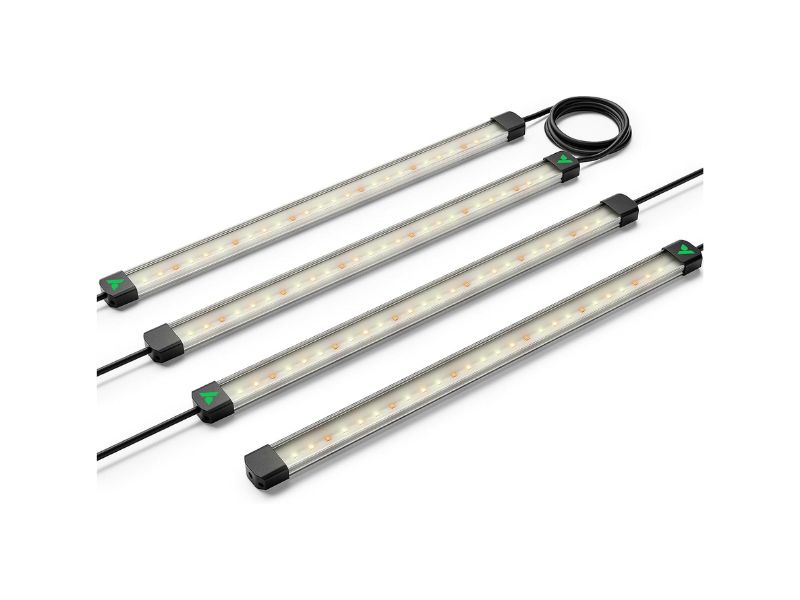
Key Features
- Four 16-inch bars
- 50W total input
- Full spectrum plus 660 nm deep red
- 60% red-spectrum ratio
- 120-degree coverage angle
- Magnetic and pole mounting
- App/controller-compatible dimming
- Gallium nitride power supply
The VIVOSUN LumaRay takes third place but is arguably the most interesting option when stronger supplemental output and flexible smart control matter more than accumulated Amazon feedback.
VIVOSUN specifies a 50W total input for the four-bar version, with full-spectrum output plus 660 nm deep red and a strong red-spectrum emphasis. The optical cover provides a 120-degree coverage angle, helping each bar illuminate a wider section of nearby foliage.
Installation is particularly flexible. The bars can attach to tent support poles or against the tent wall using the supplied magnetic mounting system. VIVOSUN also provides specific side-lighting distance guidance and recommends keeping the fixture more than two inches from plant material.
Dimming is available through compatible GrowHub hardware and the VIVOSUN app. Depending on the controller configuration, output can be adjusted through staged or more granular settings.
What I Like
- Higher 50W total output
- Wide 120-degree coverage
- Strong red-spectrum component
- Multiple mounting methods
- Smart-control compatibility
What I Do Not Like
- Highest power consumption of the three
- Some smart-control functionality requires compatible additional hardware
Choose LumaRay when you want stronger side lighting and expect to integrate the bars into a broader VIVOSUN-controlled grow environment.
Side Lighting Comparison
| Product | Bars | Bar Length | Total Power | Dimming | Environmental Protection | Main Strength |
| AC Infinity IONBEAM S16 | 4 | 16 in. | Supplemental class | 10 levels | IP65 | Best overall control and mounting |
| Spider Farmer Glow30 | 4 | 13.5 in. | 32W | Basic system control | IP65 | Compact and low power |
| VIVOSUN LumaRay | 4 | 16 in. | 50W | App/controller capable | Grow-environment design | Stronger supplemental output |
These specifications show why simply comparing wattage is not enough. AC Infinity emphasizes diode efficiency and control, Spider Farmer prioritizes compact low-load supplementation, and VIVOSUN uses more total power with a strong red-spectrum emphasis.
What Is Grow Tent Side Lighting?
Side lighting places LED fixtures along the side or within the vertical profile of a plant canopy rather than relying only on an overhead fixture.
Other terms include:
- Inter-canopy lighting
- Intra-canopy lighting
- Supplemental lighting
- Under-canopy lighting
- Vertical lighting
These approaches are not identical.
Side Lighting
Usually shines horizontally inward from tent walls or poles.
Inter-Canopy Lighting
Places fixtures within gaps in the canopy so light reaches leaves from the side.
Under-Canopy Lighting
Positions fixtures beneath the upper canopy and aims upward or horizontally toward lower foliage.
Research in greenhouse crops has shown that intra-canopy LEDs can improve the spatial distribution of light because LEDs are compact enough to operate closer to foliage than many traditional fixtures.
Why Overhead Lighting Creates a Light Gradient
Leaves absorb and reflect incoming photons.
When a dense plant canopy develops, upper leaves intercept much of the light coming from the overhead fixture.
As you move deeper into the canopy, available light often decreases.
This is why a PPFD reading directly at the top of a plant can be substantially different from a measurement several inches below the canopy.
The issue is not that the overhead light suddenly becomes weak.
The plant itself is shading its lower structure.
Inter-canopy research exists largely because conventional top lighting creates this uneven vertical distribution in dense crops.
Does Side Lighting Increase Yield?
It can under suitable conditions, but it is not guaranteed.
Controlled-environment studies in crops such as tomatoes, peppers, cucumbers, and other dense-canopy plants have reported improvements from inter-canopy illumination when lower plant regions were light-limited. However, the magnitude of any benefit depends on crop architecture, total light, spectrum, placement, temperature, and other environmental variables.
This is why I would not buy a side-light bar based solely on a manufacturer’s percentage-yield claim.
A supplemental fixture is most useful when there is a real light-distribution problem to correct.
Side Lighting Does Not Replace the Main Grow Light
The primary overhead fixture should still be sized for the usable canopy.
Side lights are better viewed as a way to improve vertical light distribution.
If a 4×4 canopy needs a properly sized overhead fixture, attaching four small side bars does not allow you to replace that fixture with a weak 2×2 light.
Start with adequate overhead coverage.
Then evaluate whether the lower canopy remains heavily shaded.
How to Know Whether You Need Side Lighting
Side lighting is most useful when:
- Plants are tall
- Canopy is dense
- Lower foliage remains healthy enough to use additional light
- Upper leaves heavily shade lower sites
- The tent has unused wall or pole space
- The main fixture already covers the top canopy adequately
It is less useful when:
- Plants are very small
- Canopy is open
- Lower growth has been deliberately removed
- Primary lighting is already insufficient
- Heat or environmental control is already near its limit
Do not add lights just because open tent poles look like unused equipment space.
Measure Before You Add More Light
A quantum PAR meter is the most direct way to evaluate photosynthetic photon flux density around the canopy.
Take readings:
- At the upper canopy
- At middle-canopy level
- Near lower productive foliage
- Near tent edges
University of Minnesota Extension emphasizes that plant growth depends on usable light quantity and duration and that different plants have very different light requirements.
Even without a PAR meter, visible signs can suggest poor lower-canopy lighting, but measurements are much more useful than guessing.
PPFD vs DLI
Two lighting concepts are useful here.
PPFD
Photosynthetic photon flux density describes the instantaneous concentration of photosynthetically active photons reaching a surface.
Side lighting changes PPFD locally.
A shaded lower leaf can therefore receive substantially more photons after a side bar is installed nearby.
DLI
Daily light integral represents the total photosynthetically active light received over an entire day.
A moderate side light operating many hours can add meaningful daily light even if its instantaneous intensity is far below that of the overhead fixture.
This is why both intensity and photoperiod need to be considered.
Full Spectrum vs Red Supplemental Lighting
All three products selected here provide broader full-spectrum supplementation, although VIVOSUN emphasizes red wavelengths more heavily.
Full-Spectrum Bars
A broad spectrum is versatile because the bars can be used during:
- Vegetative growth
- Flowering
- Propagation
- General inter-canopy supplementation
AC Infinity and Spider Farmer both design the selected systems around broad full-spectrum output.
Red-Heavy Side Lighting
Red photons are highly relevant to photosynthesis and are commonly used in horticultural LEDs.
VIVOSUN’s LumaRay places a strong emphasis on the 600–700 nm region and includes 660 nm deep-red output.
Red-heavy supplementation can be useful, but spectrum should not be considered separately from intensity, duration, and plant response.
Why I Prefer Full Spectrum for General Side Lighting
A general-purpose side-light system may stay in the tent through several stages of plant development.
Full-spectrum bars give the grower more flexibility.
Instead of buying separate red, blue, UV, and IR strips immediately, one full-spectrum system can fill shaded areas without turning the lighting setup into several overlapping spectral systems.
Specialized wavelengths can be useful in advanced setups, but they are not necessary for every grower.
Where Should Side Lights Be Mounted?
Start by identifying where the canopy actually becomes shaded.
For many plants, the useful mounting zone is somewhere around the middle to lower-middle canopy.
Place the light:
- Beside foliage, not against it
- Aimed inward
- Away from irrigation spray
- Where leaves cannot grow directly onto the fixture
- Where cords will not become tangled in branches
The goal is to illuminate shaded plant surfaces, not the reflective wall on the opposite side of the tent.
Side Lighting on Two Opposite Walls
For a rectangular tent, a simple arrangement is:
Left wall → canopy ← right wall
This allows both sides of the plant group to receive additional light.
Using all bars on one side can create a new directional imbalance.
With a four-bar system, one practical approach is to place two bars on each long side of the tent.
Four-Side Lighting
A larger square tent gives more options.
In a 4×4, you could place:
- One bar on each wall
- Two bars on opposite walls
- Bars on all four corner poles
- Two heights on two sides
The best layout depends on the actual plant architecture.
Do not design the lighting geometry before the plants exist.
Vertical vs Horizontal Bar Placement
Both can work.
Horizontal Bars
Useful when the shaded zone forms a relatively consistent horizontal band.
For example, several plants may have a dense upper canopy with productive growth just below it.
Vertical Bars
Useful with taller plants where the shaded area extends over a greater height.
A vertical bar can spread light across several levels of foliage.
The AC Infinity magnetic system and VIVOSUN mounting options allow considerable flexibility in orientation.
How Close Should Side Lights Be to Plants?
Follow the manufacturer’s specific guidance first.
VIVOSUN recommends keeping its LumaRay side bars more than 2 inches from plant material and provides different output guidance at distances from roughly 2 to 10 inches.
AC Infinity’s IONBEAM guidance similarly treats close placement as part of the product design but pairs distance with intensity adjustment.
Do not interpret a minimum safe distance as the ideal distance for every plant.
Start farther away or dimmer and adjust based on measurements and plant response.
Why Side Lighting Can Cause Local Light Stress
Supplemental bars sit much closer to leaves than overhead fixtures.
That means one small area can receive considerably more light than expected.
Possible signs of excessive local intensity include:
- Bleaching
- Pale patches
- Leaf curling
- Localized stress facing the bar
University of Minnesota notes that excessive light can bleach or scorch plant tissue, just as insufficient light can cause weak growth.
The solution is not necessarily removing the system.
Try:
- Lower intensity
- More distance
- A different angle
- Shorter operating duration
Use Dimming Instead of Constantly Moving Fixtures
Dimming is particularly valuable for inter-canopy lighting because the distance between leaves and fixtures changes constantly.
A branch can grow several inches toward a side bar while the fixture itself remains fixed.
AC Infinity provides ten intensity levels, while VIVOSUN supports dimming through compatible controller/app configurations.
Check clearance regularly as plants grow.
Should Side Lights Run on the Same Schedule as the Main Light?
For most general-purpose supplemental lighting, synchronizing them with the main photoperiod is the simplest approach.
This prevents accidental extension of the plant’s intended light period.
The AC Infinity controller provides daily schedule programming, making synchronized operation relatively easy.
Some advanced horticultural strategies intentionally use supplemental lighting during specific portions of the day, but that should be based on crop requirements rather than convenience. Research on intra-canopy lighting has shown that timing can influence crop responses.
Can Side Lighting Be Too Powerful?
Yes.
Supplemental does not mean unlimited.
When you add side lighting, total plant light increases.
A canopy that already receives its appropriate daily light may not benefit from simply adding several more hours of high-intensity side illumination.
Extra light also means:
- More electrical consumption
- More heat
- Higher transpiration demand
- Potentially greater irrigation demand
The whole environment may need adjustment.
Side Lighting and Tent Heat
LED side bars are relatively efficient, but their electrical power ultimately becomes heat in the grow space.
The Spider Farmer Glow30 adds about 32 watts, while the VIVOSUN 4-bar LumaRay adds about 50 watts.
Those numbers are modest compared with a large overhead fixture, but they are not zero.
After installing supplemental lighting, monitor:
- Canopy temperature
- Tent air temperature
- Humidity
- Water use
before assuming the existing ventilation setting remains perfect.
Side Lighting and Humidity
Adding light can increase plant activity and potentially alter transpiration.
At the same time, physical bars and cables can slightly obstruct local airflow when installed inside dense foliage.
Maintain good circulation around the side lights.
Do not mount several bars in a way that traps still humid air between the tent wall and canopy.
IP65 Is Valuable in a Grow Tent
Both AC Infinity and Spider Farmer specify IP65 protection for their selected side-light bars.
This improves resistance to dust and water ingress compared with an unprotected indoor fixture.
Still:
IP65 does not mean submersible.
Keep bars and power connections away from:
- Direct spray
- Reservoir openings
- Irrigation leaks
- Standing runoff
- Humidifier discharge
The power connection often deserves even more protection than the light bar itself.
Cable Management Matters More With Side Lights
Four side bars can mean several wires running near plant branches.
Secure excess cable to:
- Tent poles
- Frame bars
- Dedicated cable-management points
VIVOSUN’s installation instructions specifically include wire mounts and recommend securing excess cables to tent poles or fabric.
Avoid loose cable loops inside the canopy where branches can become tangled.
Side Lighting in a 2×2 Grow Tent
A small 2×2 rarely needs a huge supplemental system.
Before adding side lighting, ask whether the overhead fixture already provides sufficient coverage for such a small canopy.
If side lighting is still useful, compact bars such as the Spider Farmer Glow30 are attractive because they occupy relatively little wall space.
One or two bars may be enough depending on the plant structure.
You do not need to install every included bar simply because the package contains four.
Side Lighting in a 2×4 Grow Tent
A 2×4 is particularly well suited to side lighting because the canopy often forms a long rectangular row.
A practical arrangement is:
2 bars along one 4-foot side
2 bars along the opposite 4-foot side
AC Infinity’s four 16-inch bars and VIVOSUN’s four 16-inch bars both suit this kind of distributed layout.
Position them according to the actual plant height rather than spacing them perfectly for appearance.
Side Lighting in a 3×3 Grow Tent
A 3×3 provides enough wall space for several arrangements.
You might use:
- One bar on each side
- Two opposite pairs
- Vertical bars on corner poles
Because the tent is square, the best configuration depends strongly on whether one large plant or several smaller plants occupy the canopy.
Side Lighting in a 4×4 Grow Tent
A 4×4 can benefit from supplemental bars when the canopy is dense enough to shade productive lower areas.
However, four short bars will not evenly illuminate every inch of a large 4×4 side wall.
Think of them as targeted supplemental fixtures, not a second complete lighting layer.
For extensive four-side supplementation, larger systems or multiple kits may be necessary—but only after confirming through measurement that additional light is actually useful.
Side Lighting for Tall Plants
Tall plants are one of the clearest cases for vertical supplemental lighting.
The distance from upper canopy to lower foliage may be several feet.
An overhead light naturally creates a strong top-to-bottom gradient.
Mounting bars vertically along side poles can provide illumination across a taller section of plant material.
Inter-canopy research in tall greenhouse crops uses similar logic: moving some supplemental photons closer to lower leaves reduces dependence on light penetrating through the entire upper canopy.
Side Lighting for Short, Flat Canopies
A short, evenly trained canopy may need much less side supplementation.
If the plant layer is shallow and the overhead fixture provides uniform PPFD, relatively little productive tissue may exist below the primary light zone.
In that case, upgrading the overhead light or improving its distribution might be more useful than attaching side bars.
Side lighting is not an automatic upgrade for every tent.
Side Lighting vs Under-Canopy Lighting
These terms are closely related but not identical.
Side Lighting
Illuminates foliage horizontally.
Advantages:
- Easy pole mounting
- Lower chance of water falling onto upward-facing fixtures
- Easy to reposition
- Works with tall vertical canopies
Under-Canopy Lighting
Places fixtures beneath plant foliage and often directs light upward.
Advantages:
- Direct access to heavily shaded lower tissue
- Useful when side access is limited
Disadvantages:
- Closer to irrigation/runoff
- More likely to occupy floor or pot space
- Requires careful fixture protection
For most home grow tents, side-mounted bars are simpler to install and maintain.
Side Lighting vs More Powerful Overhead Lighting
Before buying supplemental bars, ask whether the actual problem is:
A. Not enough total light
or
B. Poor light distribution through the canopy
If the entire canopy is below target intensity, upgrade or reposition the overhead fixture.
If the top receives plenty of light while deeper productive regions remain heavily shaded, side lighting becomes much more logical.
This distinction can save a lot of unnecessary equipment.
Can Reflective Walls Replace Side Lighting?
Reflective Mylar helps return stray light toward the canopy.
It does not deliver the same direct photons as a nearby LED bar.
A highly reflective wall can improve overall light utilization but cannot completely eliminate self-shading inside dense plants.
Use reflective walls first because they are already part of most grow tents.
Add side lighting when the internal canopy itself is blocking light.
Common Side-Lighting Mistakes
Adding Side Lights Before Sizing the Main Light
The overhead fixture remains the foundation.
Running Supplemental Bars at Full Power Immediately
Start conservatively and measure.
Mounting Too Close to Leaves
Plants can grow into side fixtures surprisingly quickly.
Lighting Only One Side
This can create uneven exposure.
Ignoring Cable Management
Loose wires can become entangled in branches.
Blocking Circulation Fans
Leave airflow paths open.
Mounting Near Irrigation Spray
Even protected fixtures should be kept away from direct water.
Assuming More Watts Equal More Yield
Crop response depends on the total lighting and environmental system.
Extending the Photoperiod Accidentally
Synchronize timers unless you have a deliberate reason not to.
Installing Bars Where No Productive Foliage Exists
Light empty stems only wastes electricity.
Ignoring Heat After Installation
Supplemental LEDs still contribute heat.
Buying Specialized Spectrum Before Fixing Coverage
Get placement and intensity right first.
Frequently Asked Questions
1. What is the best side lighting for grow tent use?
AC Infinity IONBEAM S16 is my first choice because it combines four 16-inch full-spectrum bars, magnetic mounting, ten-level dimming, scheduling, IP65 protection, and efficient Samsung LM301H EVO LEDs.
It is specifically designed for inter-canopy and supplemental grow-tent lighting rather than being a general household LED strip.
2. Does side lighting really help plants?
It can help when productive lower or middle foliage is receiving substantially less light than the upper canopy.
Research on several controlled-environment crops has found benefits from inter-canopy illumination, but results depend on crop, intensity, spectrum, placement, and total light.
3. Is AC Infinity IONBEAM good for side lighting?
Yes. The S16 is specifically designed for supplemental and inter-canopy use.
Its magnetic mounting system allows the bars to attach to tent poles or tent-wall positions, while the controller provides ten intensity settings.
4. Is Spider Farmer Glow30 good for side lighting?
Yes. Glow30 uses four compact full-spectrum bars and is specifically designed for side, under-canopy, and supplemental use.
The system consumes approximately 32 watts total and includes adjustable mounting hardware.
5. Is VIVOSUN LumaRay good for side lighting?
Yes. The four-bar LumaRay is a purpose-built 50W side-lighting system with 16-inch bars, full-spectrum plus deep-red output, and flexible mounting.
It also supports dimming through compatible VIVOSUN control hardware.
6. Do side lights replace the main grow light?
No. They should normally supplement a properly sized overhead grow light.
If the entire canopy lacks sufficient light, correcting the primary lighting system should come first.
7. Where should side lights be mounted?
Mount them beside the shaded productive portion of the canopy and aim them inward.
Middle and lower-middle canopy positions are common starting points, but the correct height depends on actual plant structure.
8. How close should side lights be to plants?
Follow the manufacturer guidance and start conservatively.
VIVOSUN specifically recommends keeping its LumaRay bars more than two inches from plant material and adjusting output according to distance.
9. Should side lighting be vertical or horizontal?
Either orientation can work.
Vertical mounting suits taller plants, while horizontal bars work well when the shaded region forms a consistent band across several plants.
10. Should side lights run at the same time as the main grow light?
Running them on the same basic light schedule is the simplest approach for general supplementation.
Controllers such as the one supplied with AC Infinity IONBEAM can automate daily scheduling.
11. Does side lighting add heat?
Yes. Every powered LED contributes some heat to the grow environment.
The Spider Farmer Glow30 draws about 32W total, while the four-bar VIVOSUN LumaRay system draws about 50W.
12. Is 32 watts enough for side lighting?
It can be useful as supplemental lighting at close range, but wattage alone cannot determine whether it is enough.
Distance, spectrum, canopy size, photoperiod, and existing overhead light all affect the result.
13. Is red light better for side lighting?
Red wavelengths are useful for photosynthesis, but a red-heavy spectrum is not automatically better in every situation.
For general-purpose supplementation, a broad full spectrum offers more flexibility across plant stages. VIVOSUN’s LumaRay combines full-spectrum output with a strong deep-red component.
14. Do side lights need to be waterproof?
Water resistance is valuable because side bars operate close to plants and humid air, but you should still keep electrical equipment away from direct irrigation.
AC Infinity and Spider Farmer specify IP65 protection for the selected bars.
15. Can I put side lights in a 2×2 tent?
Yes, but verify that side lighting is actually needed first.
A well-sized overhead fixture can already provide strong coverage in such a small footprint, so only install supplemental bars if the plant structure creates meaningful lower-canopy shading.
16. How should I arrange side lights in a 2×4 tent?
Two bars on each long side is a practical starting layout for a four-bar system.
Adjust their vertical position according to the canopy rather than mounting them permanently at equal heights.
17. Can side lights bleach leaves?
Yes, especially if a powerful bar is positioned very close to foliage.
Excessive light can cause bleaching or scorching, so use dimming, distance, and observation to prevent localized overexposure.
18. When is side lighting not worth buying?
Skip it when the plants are short and open, the entire canopy already receives appropriate light, or the main fixture itself is undersized.
Supplemental bars are best used to correct a vertical light-distribution problem, not simply to increase the amount of equipment in the tent.
Conclusion
Choosing the best side lighting for grow tent use starts with identifying whether the lower canopy actually needs additional light.
A strong overhead fixture should remain the primary lighting system. Side bars become valuable when upper leaves are receiving adequate intensity but dense foliage prevents enough light from reaching productive middle and lower plant zones. Research on inter-canopy lighting supports the basic concept of placing efficient LEDs closer to shaded foliage, although actual crop responses depend on the complete lighting and environmental strategy.
The AC Infinity IONBEAM S16 is my first recommendation. Its four 16-inch bars, Samsung LM301H EVO LEDs, magnetic mounting, IP65 construction, ten intensity settings, and programmable controller make it the easiest of these systems to adapt as plants change size.
Spider Farmer Glow30 is the better choice when you want compact supplemental bars and a modest 32W total load. Its four adjustable 13-inch fixtures are easy to fit into smaller tents and can target specific shaded canopy zones.
VIVOSUN LumaRay is the stronger-output alternative, using 50 watts across four 16-inch bars, full-spectrum plus 660 nm deep-red light, flexible mounting, and compatible smart dimming.
Whichever system you choose, start dim, keep the bars safely separated from foliage, maintain airflow around the fixtures, and measure the canopy when possible.
The goal is not to make every wall of the tent glow. It is to deliver useful supplemental light precisely where the overhead fixture and upper canopy are leaving productive plant tissue in the shade.

I’m Maya L. Greenwood, a lifelong plant lover who believes anyone can grow something beautiful with the right guidance. After years of testing soil mixes, pruning methods, irrigation tricks, and pest-safe solutions, I started EasyGardenTips.com to turn hard-won lessons into step-by-step advice. From seed starting and container gardens to composting and seasonal checklists, my goal is to make gardening simple, sustainable, and fun.