3 Best LED Grow Lights for Vegetable Seedlings Indoors
Weak indoor light can turn healthy vegetable starts into tall, thin seedlings before transplant season even begins. The best LED grow lights for vegetable seedlings should provide enough consistent overhead illumination to encourage compact stems, healthy leaves, and uniform growth without forcing delicate seedlings under excessive intensity.
The right fixture depends heavily on scale. A few tomato or pepper seedlings can thrive beneath a compact adjustable lamp, while a full nursery flat benefits from a broader dimmable panel, and several trays are much easier to manage with long linear fixtures.
My primary recommendation is the GooingTop 6000K Full Spectrum LED Grow Light for small home seed-starting setups. I would choose it for a few tomato, pepper, lettuce, herb, or brassica seedlings because it combines five brightness levels, a flexible gooseneck, clamp mounting, and 4/8/12-hour automatic timing in a compact fixture. Its current Amazon listing shows a 4.5-star rating with 21,990 ratings.
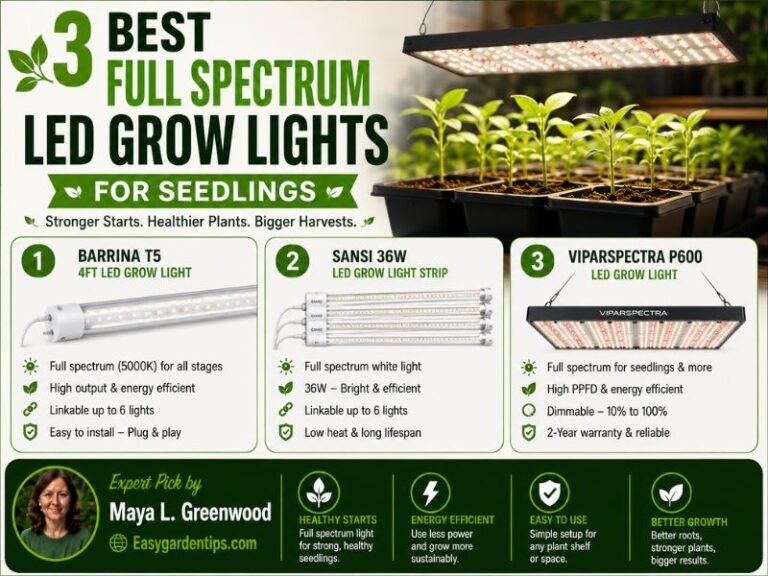
I would choose the Spider Farmer SF1000 LED Grow Light for a full seedling tray or vegetables that will remain indoors for several weeks. The current listing specifies 100W full-spectrum output, dimming, and 2.5 µmol/J system PPE, and explicitly positions the fixture for seed starting and vegetables.
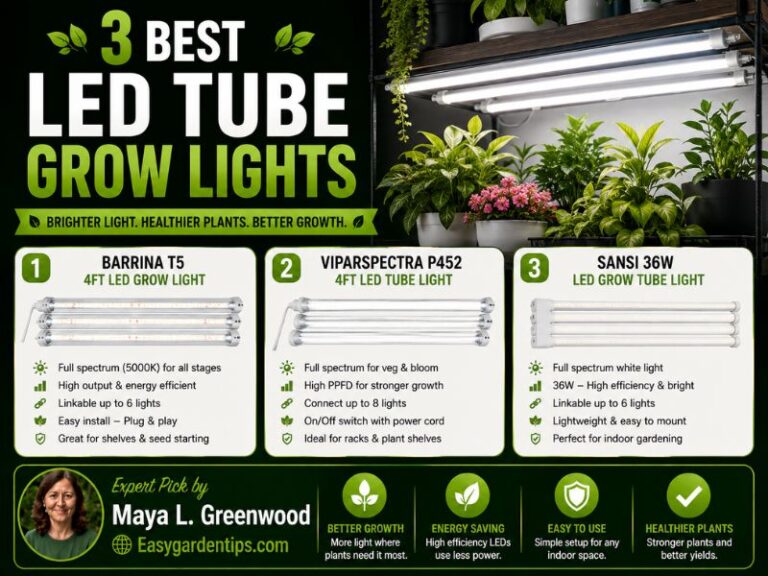
For multiple nursery flats or a dedicated seedling rack, I would choose the Barrina T5 4FT Grow Lights. The selected eight-pack provides 160W total output from eight 20W four-foot fixtures, making it much easier to spread light evenly across long rectangular trays and several shelves.
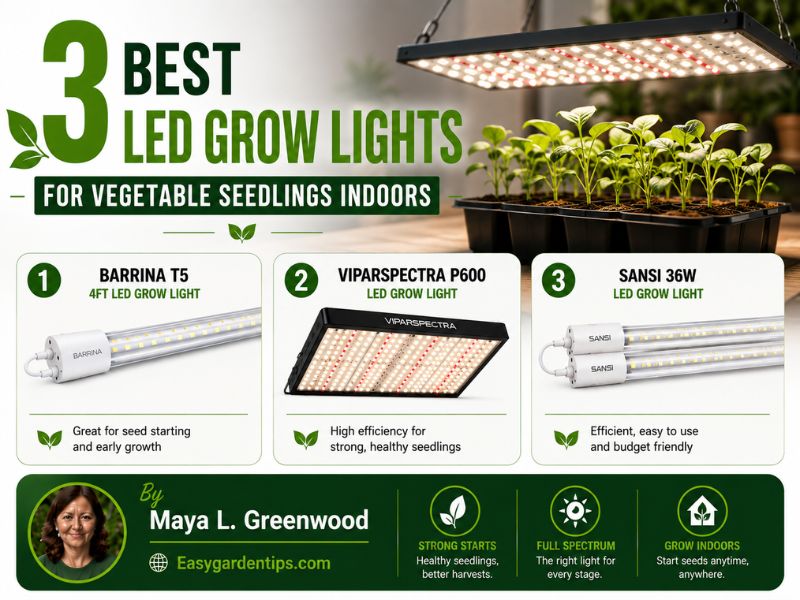
3 Best LED Grow Lights for Vegetable Seedlings Reviewed
| Image | Product Name | Check Price |
|---|---|---|
Best Choice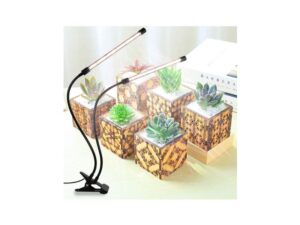 | GooingTop 6000K Full Spectrum LED Grow Light | Check Price |
Second Best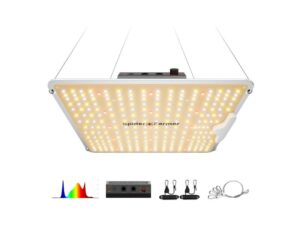 | Spider Farmer SF1000 LED Grow Light | Check Price |
Third Choice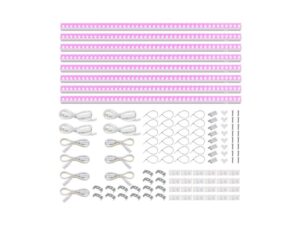 | Barrina T5 4FT Grow Lights | Check Price |
1. GooingTop 6000K Full Spectrum LED Grow Light
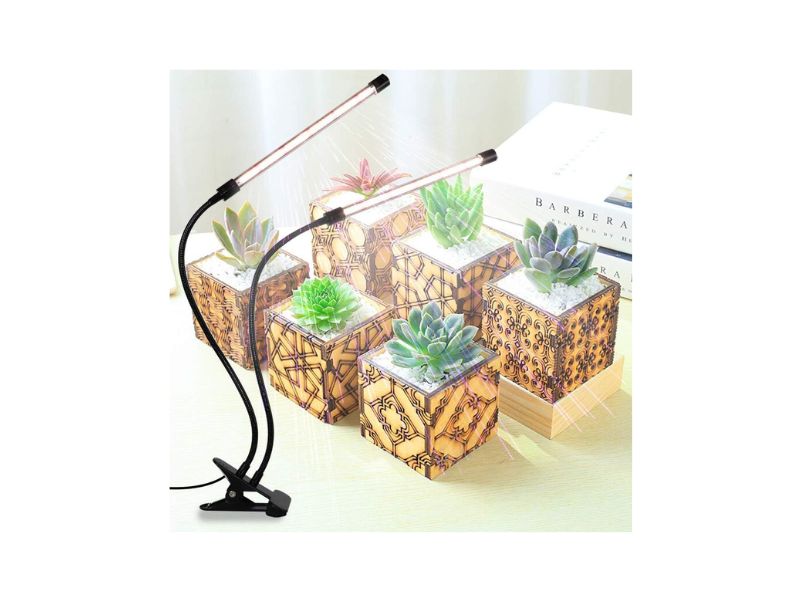
Key Features
- 6000K full-spectrum-style output
- White and red LEDs
- Five brightness levels
- 4/8/12-hour automatic timer
- Flexible gooseneck
- Strong clamp mount
- Compact design
- Good for small vegetable-starting areas
The GooingTop is my primary recommendation because many home gardeners do not need a full grow tent or a 100W panel to start a few vegetable plants.
Its advantage is adjustability.
New seedlings initially occupy very little space. A flexible gooseneck allows the lamp to stay directly above the small canopy instead of illuminating an entire table that contains only a handful of plants.
Amazon currently lists the fixture as a 6000K full-spectrum grow lamp with five-level dimming and automatic 4-, 8-, and 12-hour timing.
That combination works particularly well for:
- Tomato seedlings
- Pepper seedlings
- Lettuce
- Basil
- Parsley
- Broccoli
- Kale
- Cabbage
- Small herb starts
The five brightness settings are especially useful.
Vegetable seedlings change rapidly.
A plant with only cotyledons has a very different canopy from the same plant several weeks later with multiple true leaves.
Rather than moving immediately to a stronger fixture, you can increase brightness and adjust lamp height as growth progresses.
This makes the GooingTop relatively forgiving for beginners.
If seedlings begin stretching and leaning heavily toward the lamp, they may need more usable light.
Possible adjustments include:
- Increasing brightness
- Moving the lamp closer
- Repositioning it more directly overhead
- Increasing daily illumination when the current schedule is too short
The reverse problem is excessive intensity.
If leaves begin to bleach or show unusual stress directly beneath the LEDs, move the fixture farther away or reduce brightness.
The flexible neck makes those adjustments simple.
The clip design is another advantage.
It can attach to a:
- Table
- Shelf
- Desk
- Workbench
- Plant stand
That means you do not need hanging cables or a permanent seed-starting rack.
This is particularly convenient in an apartment or kitchen-counter setup.
The built-in timer provides up to 12 hours per cycle.
That is convenient, although many vegetable seedlings grown entirely under artificial light are commonly given longer daily photoperiods.
If strong natural daylight supplements the lamp, 12 hours may be adequate as part of the total daily light exposure.
If the lamp is the sole light source, an external timer can provide a longer schedule when needed.
Coverage is the biggest limitation.
The GooingTop is excellent for a compact group of seedlings but not for several full nursery flats.
Once your growing area becomes wider, the Spider Farmer or Barrina becomes much more practical.
What I Like
- Excellent for a few vegetable seedlings
- Five brightness settings
- Very easy height adjustment
- Built-in timer
- No hanging system required
- Compact enough for countertops
What I Do Not Like
- Small coverage area
- Maximum built-in timer cycle is 12 hours
- Limited headroom for several large tomato plants
- Not suitable for multiple nursery flats
For a beginner starting a small group of vegetables indoors, the GooingTop offers an excellent balance of simplicity, dimming, and placement control. It is the option I would choose when a compact setup matters more than maximum coverage.
2. Spider Farmer SF1000 LED Grow Light
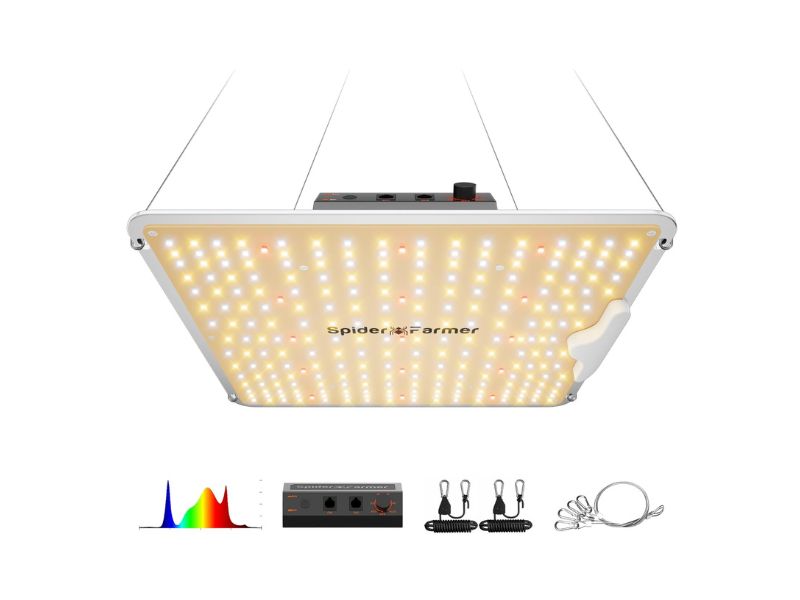
Key Features
- 100W actual power class
- Full-spectrum LED output
- Dimmable
- Published 2.5 µmol/J system PPE
- Broad panel coverage
- Designed for seed starting and vegetables
- Suitable beyond the early seedling stage
The Spider Farmer SF1000 is the better choice when the seedlings will remain indoors long enough to become substantial transplants.
Its current U.S. Amazon listing specifies 100W dimmable full-spectrum output with a 2.5 µmol/J system PPE and directly identifies seed starting and vegetables among its intended applications.
That gives it much more growth headroom than a small clip lamp.
A tray of newly emerged tomatoes looks tiny during the first week.
A month later, the same seedlings may have broad leaves, thick stems, and a canopy that covers nearly the entire tray.
The SF1000 can continue supporting those plants as they grow rather than becoming undersized halfway through the seed-starting period.
It is particularly well suited to:
- Tomatoes
- Peppers
- Eggplants
- Broccoli
- Cabbage
- Kale
- Herbs
- Full nursery flats
The dimmer is one of the most important features.
A 100W grow light at full intensity can be considerably more light than freshly emerged seedlings need if hung close to the canopy.
Instead of assuming maximum brightness is always better, start conservatively.
Increase output gradually as the plants develop.
Watch for plant structure.
If seedlings are receiving inadequate light, you may notice:
- Long stems
- Wide internodes
- Leaning
- Pale growth
- Weak plants that fall over
If intensity is excessive, possible symptoms include:
- Bleached leaves
- Upward curling
- Pale patches directly beneath the fixture
- Stressed-looking new growth
Dimming and hanging height should be adjusted together.
The 2.5 µmol/J PPE figure is also useful.
PPE measures how efficiently the fixture converts electricity into photosynthetically active photons.
That provides more meaningful horticultural information than comparing fixtures only by wattage.
The panel design also helps cover an entire tray more evenly.
Coverage consistency matters because seedlings at the edges should not become tall and weak while plants in the center remain compact.
A properly positioned panel can produce a much more uniform growing environment than a single narrow lamp.
The SF1000 requires a more permanent setup than the GooingTop.
You need somewhere to hang it above the seedlings.
An adjustable hanging system is useful because the fixture will need to move as plants grow.
I would also use an external timer to automate the daily light schedule.
The main advantage is that you are unlikely to outgrow the fixture during the seedling stage.
That makes it particularly appealing for peppers and tomatoes that spend several weeks indoors before outdoor temperatures become suitable.
What I Like
- Strong 100W growth headroom
- Dimmable output
- Published 2.5 µmol/J PPE
- Excellent for a full tray
- Suitable for seedlings through later vegetative growth
- Broad overhead coverage
What I Do Not Like
- Requires hanging space
- More fixture than a few seedlings need
- An external timer is useful
- Maximum output may be excessive for tiny seedlings at close range
The SF1000 is the light I would choose for a gardener who wants to produce sturdy, transplant-ready tomatoes, peppers, and other vegetables without upgrading the grow light halfway through the season.
3. Barrina T5 4FT Grow Lights
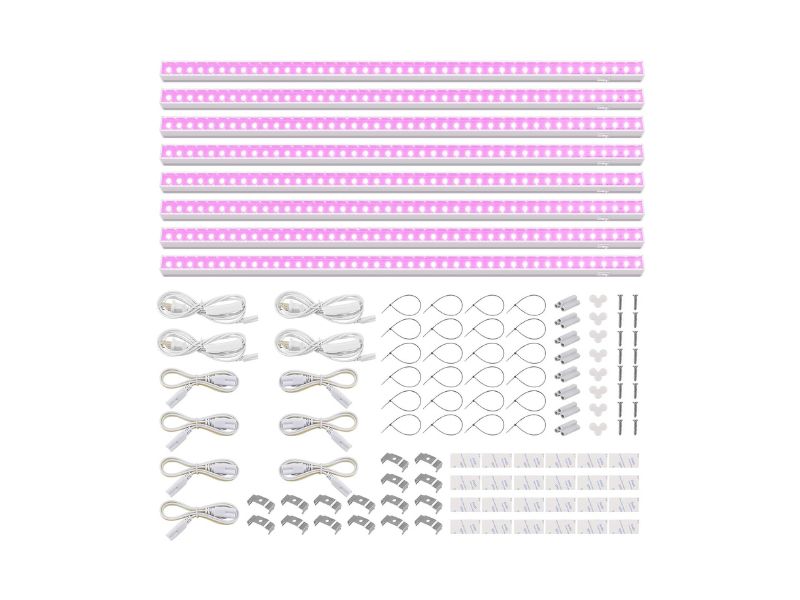
Key Features
- Eight 4-foot LED bars
- 20W per fixture
- 160W total package power
- Full-spectrum grow-light design
- Separate on/off controls
- Plug-and-play installation
- Flexible mounting
- Designed for seedlings and greenhouse use
The Barrina T5 system is the strongest choice for gardeners starting vegetables at scale.
The current Amazon listing includes eight 4-foot fixtures at 20W each, giving the package a total rating of 160W. The listing specifically identifies seedlings among its intended uses.
The key advantage is not simply total wattage.
It is fixture shape.
Vegetable nursery trays are rectangular.
Long linear grow lights naturally match that geometry.
Several bars installed parallel to each other can spread light across a long shelf much more evenly than one compact lamp positioned in the middle.
That makes Barrina particularly useful for:
- Multiple tomato trays
- Pepper seedlings
- Onion starts
- Leeks
- Lettuce
- Broccoli
- Kale
- Cabbage
- Herbs
The eight-fixture package also lets you divide the lights across multiple growing levels.
For example, a wire shelving rack could use several bars above each shelf.
That can create a complete seed-starting station without buying individual lamps for every tray.
Another benefit is vertical efficiency.
The slim T5-style bars can mount close to the underside of a shelf, leaving more vertical room for tall tomato or pepper seedlings.
This matters more than it seems.
A bulky hanging fixture can consume valuable headroom in a compact rack.
The Barrina system does not provide the same convenient percentage dimmer as the Spider Farmer.
Instead, effective intensity can be adjusted through:
- Fixture height
- Number of active bars
- Spacing between bars
- Daily photoperiod
That requires slightly more planning, but it works very well once the rack is configured.
The separate on/off controls are useful too.
If one shelf becomes empty after seedlings are transplanted, unnecessary lights can be switched off.
I would pair the entire system with an appropriately rated timer.
Manually switching several light bars every morning and evening becomes inconvenient very quickly.
One automated schedule makes a rack much easier to manage.
What I Like
- Excellent for multiple vegetable trays
- Very good rectangular coverage
- Eight fixtures can be split between shelves
- Slim design preserves vertical growing room
- Suitable for high-volume seed starting
- Simple plug-and-play format
What I Do Not Like
- Requires installation
- No simple percentage dimmer
- External timer recommended
- Excessive for only a few seedlings
The Barrina T5 system is the product I would choose when vegetable seed starting has become a dedicated seasonal operation with several nursery flats or multiple shelves.
LED Grow Lights for Vegetable Seedlings Comparison
| Product | Format | Output Class | Dimming | Timer | Coverage | Best Use |
| GooingTop 6000K | Clip/gooseneck | Compact | 5 levels | 4/8/12 hr | Small | A few seedlings |
| Spider Farmer SF1000 | Panel | 100W | Yes | External recommended | Medium | Full nursery tray |
| Barrina T5 4FT | 8 linear bars | 160W total | By fixture arrangement | External recommended | Large | Multi-shelf seedling rack |
The GooingTop is the easiest small-scale option, the Spider Farmer provides much more growth headroom for a full tray, and Barrina offers the most useful coverage for a dedicated vegetable propagation rack.
How to Choose the Best LED Grow Lights for Vegetable Seedlings
Start With the Size of Your Growing Area
The number of seedlings should determine the fixture.
For several small pots, a clip light may be sufficient.
For one full nursery flat, a broad panel makes more sense.
For multiple trays, long light bars are easier to distribute.
Do not buy a large fixture simply because its wattage number looks impressive.
Prioritize Even Coverage
Vegetable seedlings should develop at roughly similar rates across the tray.
If the center plants are compact while corner seedlings become tall and thin, light distribution may be uneven.
Broad panels and multiple parallel bars help reduce that problem.
Uniformity is particularly important for nursery flats containing dozens of individual cells.
Why Vegetable Seedlings Become Leggy
Leggy seedlings typically develop long, thin stems because they are stretching toward inadequate light.
Common signs include:
- Tall weak stems
- Long spaces between leaves
- Leaning
- Pale foliage
- Plants falling over
Insufficient usable light is one of the first things I would investigate.
Possible corrections include increasing intensity, reducing fixture distance, or improving coverage.
Full-Spectrum LEDs Work Well
Broad full-spectrum white grow lights are practical for vegetable seedlings.
They provide plant-useful wavelengths while making leaf color easy to inspect.
You do not need an intensely purple red-and-blue fixture to raise good vegetable transplants.
For seed starting, overall intensity and coverage usually matter more than chasing unusual spectrum marketing claims.
Is 6000K Good for Vegetable Seedlings?
Yes.
Cool-white lighting around 5000K–6000K is commonly used during vegetative growth.
The GooingTop selected here uses a 6000K full-spectrum-style arrangement with white and red LEDs.
It works particularly well for a compact seed-starting area.
How Many Hours Should Vegetable Seedlings Get?
A long daily photoperiod is common for indoor vegetable seedlings.
A practical starting point for many setups is roughly 14–18 hours of light followed by a genuine dark period.
The correct schedule depends on:
- Fixture intensity
- Crop
- Natural daylight
- Seedling stage
Higher intensity does not mean plants should receive light continuously 24 hours per day.
Why a Timer Helps
A timer makes the lighting schedule consistent.
Instead of manually switching lights every day, automation creates a repeatable photoperiod.
The GooingTop includes an internal timer.
Spider Farmer and Barrina setups are easier to manage with an external outlet timer.
How Close Should Grow Lights Be?
There is no universal distance.
A small clip lamp can operate much closer to seedlings than a 100W panel.
Fixture output, beam spread, and dimmer setting all influence the correct height.
Start with the manufacturer’s guidance and adjust according to plant response.
Best LED Grow Light for Tomato Seedlings
For a handful of tomatoes, the GooingTop can work.
For a full tray, I would choose the Spider Farmer SF1000.
Tomatoes grow rapidly and can quickly exceed the useful coverage of a small clip lamp.
The SF1000’s dimmer also lets you increase intensity as tomato plants become larger.
Best LED Grow Light for Pepper Seedlings
Peppers often remain indoors longer than tomatoes because they grow more slowly and need warm outdoor conditions before transplanting.
That makes additional lighting headroom valuable.
For one substantial tray, I prefer the SF1000.
For several pepper flats, Barrina’s broad rack coverage is more practical.
Best Grow Light for Lettuce Seedlings
Lettuce seedlings generally respond well to moderate, even lighting.
A few plants can grow under GooingTop.
For large flats, Barrina bars provide better uniformity.
Extreme center brightness is less important than ensuring seedlings across the entire tray receive adequate light.
Best Grow Light for Broccoli, Kale, and Cabbage
Brassica seedlings can become lanky quickly when grown in warm conditions with inadequate light.
Strong overhead coverage helps keep plants more compact.
One tray is well suited to the Spider Farmer SF1000.
Multiple flats fit naturally under Barrina bars.
Best Grow Light for Onions and Leeks
Onions and leeks are often grown densely in long trays.
That makes linear fixtures particularly effective.
Barrina’s four-foot bars can spread light evenly across several densely planted containers rather than creating one bright center zone.
Do Seeds Need Light Before Germination?
It depends on the species.
Many common vegetable seeds can germinate without strong light.
Once shoots emerge, however, adequate illumination becomes important quickly.
Have the lights installed before germination rather than waiting until seedlings already begin stretching.
Heat Mats and Grow Lights Are Different
A seedling heat mat warms the growing medium.
A grow light supplies photons for photosynthesis.
Warm-season crops such as tomatoes, peppers, and eggplants may benefit from suitable germination temperatures.
After emergence, strong light becomes increasingly important.
Warm conditions combined with weak light can encourage excessive stretching.
PPF, PPFD, and PPE Explained
PPF measures total photosynthetically active photon output.
PPFD measures how densely those photons reach a growing surface.
PPE measures photon output efficiency per unit of electrical energy.
The Spider Farmer SF1000 publishes 2.5 µmol/J system PPE.
For seedlings, PPFD at actual canopy height is generally more useful than looking at wattage alone.
Wattage Is Not Everything
A stronger fixture is not automatically better.
Consider:
- Fixture efficiency
- Coverage area
- Hanging distance
- Dimming
- Plant stage
- Daily light duration
A compact lamp can work very well over a few seedlings.
A 100W panel becomes useful when the canopy is larger.
Rotate Trays if Needed
If seedlings on one side consistently lean or grow taller, rotate the tray periodically.
However, frequent rotation should not be used as a substitute for poor lighting design.
Improving overhead coverage is the better long-term solution.
Add Gentle Air Movement
Once seedlings become established, gentle air movement can help create a healthier growing environment.
A small fan can:
- Reduce stagnant humidity
- Encourage sturdier stems
- Improve air circulation
Avoid blasting newly emerged seedlings with strong airflow.
Watch Watering Under Strong Lights
As seedlings receive more light and grow faster, their water use can increase.
At the same time, consistently saturated seed-starting mix can contribute to root and disease problems.
Check the medium rather than watering solely according to a fixed calendar.
Raise the Light as Seedlings Grow
Fast-growing tomatoes can gain height quickly.
Check light clearance every few days.
A fixture that was ideally positioned last week may be too close today.
Adjustable hangers, goosenecks, or shelf mounting make this much easier.
Do Not Skip Hardening Off
Indoor LEDs can produce excellent seedlings, but those plants are still not immediately adapted to outdoor sun and wind.
Before transplanting, gradually expose seedlings to outdoor conditions.
Hardening off helps reduce:
- Sunburn
- Wilting
- Wind stress
- Transplant shock
Common Vegetable Seedling Grow-Light Mistakes
Keeping the Light Too Far Away
This encourages stretching and weak stems.
Running a Powerful Light Too Close
Excessive intensity can stress delicate leaves.
Using One Small Lamp Over Several Trays
Coverage becomes uneven.
Leaving Lights On 24 Hours
Provide a daily dark period.
Forgetting to Raise the Fixture
Seedlings can reach the light quickly.
Choosing Only by Wattage
PPFD, efficiency, and coverage matter too.
Ignoring Edge Seedlings
Check the entire tray, not only plants directly under the fixture center.
Frequently Asked Questions
What are the best LED grow lights for vegetable seedlings?
GooingTop is my primary choice for small setups; larger trays benefit from broader fixtures.
The GooingTop offers adjustable intensity and positioning, while Spider Farmer SF1000 is stronger for full trays and Barrina T5 works better for several shelves.
Are LED grow lights good for vegetable seedlings?
Yes, LEDs provide efficient, controllable overhead light for indoor vegetable propagation.
Their low-profile designs, dimming options, and broad full-spectrum output make them particularly practical for seedling trays.
How many hours should vegetable seedlings be under LED lights?
Around 14–18 hours daily is a practical starting range for many seedlings.
Give seedlings a real dark period and adjust the schedule according to fixture intensity and available daylight.
Should grow lights stay on 24 hours?
No, vegetable seedlings should normally receive a regular dark period.
Continuous lighting is usually unnecessary and should not be used to compensate for insufficient intensity.
How close should LED grow lights be to seedlings?
Distance depends on fixture output, dimmer level, and coverage pattern.
A compact clip light can usually sit closer than a 100W panel. Follow product guidance and adjust gradually according to plant response.
What color LED light is good for vegetable seedlings?
Cool-white or balanced full-spectrum LEDs work very well for seedling growth.
The GooingTop uses a 6000K white/red configuration, while the Spider Farmer provides a broader full-spectrum horticultural output.
Is 6000K good for vegetable seedlings?
Yes, 6000K-style lighting is well suited to early vegetative growth.
It provides a cool-white appearance while supporting a compact indoor seed-starting setup.
Is 100W too strong for vegetable seedlings?
Not when the light is dimmed or positioned at an appropriate distance.
The Spider Farmer SF1000 is a 100W dimmable fixture, so output can be reduced when seedlings are small.
What grow light is best for tomato seedlings?
The Spider Farmer SF1000 is my preferred choice for a full tomato tray.
Its 100W dimmable platform provides useful growth headroom as tomatoes quickly become larger.
What grow light is best for pepper seedlings?
A dimmable panel works particularly well for peppers kept indoors several weeks.
The SF1000 can begin at reduced intensity and increase output as pepper seedlings mature.
What grow light is best for multiple vegetable trays?
The Barrina T5 system is my preferred option for several trays on shelving.
Its eight four-foot fixtures can be distributed across multiple shelves and provide broad rectangular coverage.
Are T5 LED lights good for vegetable seedlings?
Yes, their long linear shape works especially well over rectangular nursery flats.
Barrina’s selected package provides eight 20W four-foot fixtures for a total package rating of 160W.
Can regular LED shop lights grow vegetable seedlings?
They can when they deliver sufficient usable light at canopy level.
Dedicated grow lights make horticultural suitability easier to judge, but plants ultimately respond to intensity, spectrum, and daily light exposure.
Why are my seedlings tall and skinny?
Insufficient usable light is one of the most common causes of leggy seedlings.
Move a suitable fixture closer, increase intensity gradually, or improve coverage if seedlings are strongly stretching toward the light.
Can too much LED light damage seedlings?
Yes, excessive intensity can cause bleaching, curling, and other stress symptoms.
Powerful fixtures should be dimmed or raised during early seedling growth.
Should grow lights be directly above seedlings?
Yes, overhead lighting generally promotes straighter and more uniform growth.
Strong side lighting can cause seedlings to lean heavily toward the fixture.
Do vegetable seedlings need a heat mat?
Heat mats help germination, while grow lights support growth after seedlings emerge.
Warm-season vegetables may benefit from suitable root-zone warmth during germination, but the heat mat does not replace adequate lighting.
Should I use a timer?
Yes, a timer makes the daily light schedule much easier to keep consistent.
The GooingTop includes built-in timing, while Spider Farmer and Barrina setups can use an appropriately rated external timer.
When should I raise the grow light?
Raise it whenever plant growth reduces safe clearance or causes excessive intensity.
Fast-growing tomatoes and similar crops may require fixture-height checks every few days.
When can vegetable seedlings stop using grow lights?
Continue until seedlings begin transitioning outdoors through proper hardening off.
Do not move indoor-grown seedlings directly from artificial light into a full day of intense outdoor sun.
Conclusion
The best LED grow lights for vegetable seedlings should help produce compact stems, healthy leaves, and uniform plants that are ready for transplanting rather than tall seedlings that have spent weeks stretching toward weak window light.
The GooingTop 6000K remains my primary recommendation for a small home setup. Its five brightness settings, flexible gooseneck, clamp mounting, and automatic timer make it easy to position over a modest group of tomatoes, peppers, herbs, lettuce, or brassicas.
For a full nursery tray, I would choose the Spider Farmer SF1000. Its 100W dimmable full-spectrum output and 2.5 µmol/J system PPE provide substantially more growth headroom for seedlings that will remain indoors for several weeks.
The Barrina T5 system is the strongest choice for a dedicated seedling rack. Its eight four-foot 20W fixtures can be distributed across several shelves and provide broad coverage that matches the shape of nursery flats particularly well.
For a few vegetable starts, I would choose GooingTop. For one substantial tomato or pepper tray, I would move to the Spider Farmer SF1000. For several nursery flats or a multi-level propagation rack, the Barrina T5 system is the most practical of these three.

I’m Maya L. Greenwood, a lifelong plant lover who believes anyone can grow something beautiful with the right guidance. After years of testing soil mixes, pruning methods, irrigation tricks, and pest-safe solutions, I started EasyGardenTips.com to turn hard-won lessons into step-by-step advice. From seed starting and container gardens to composting and seasonal checklists, my goal is to make gardening simple, sustainable, and fun.