3 Best Timer for LED Grow Lights for Reliable Daily Cycles
A consistent light-and-dark schedule is one of the easiest ways to make an indoor growing setup easier to manage. The best timer for LED grow lights should switch fixtures reliably every day, handle the actual electrical load safely, and provide enough scheduling flexibility for seedlings, vegetables, houseplants, or a dedicated grow rack.
Complex automation is not always necessary. For one grow light, a grounded mechanical timer can provide everything most growers need, while a multi-outlet timer strip becomes much more practical when several LED fixtures need to operate on the same schedule.
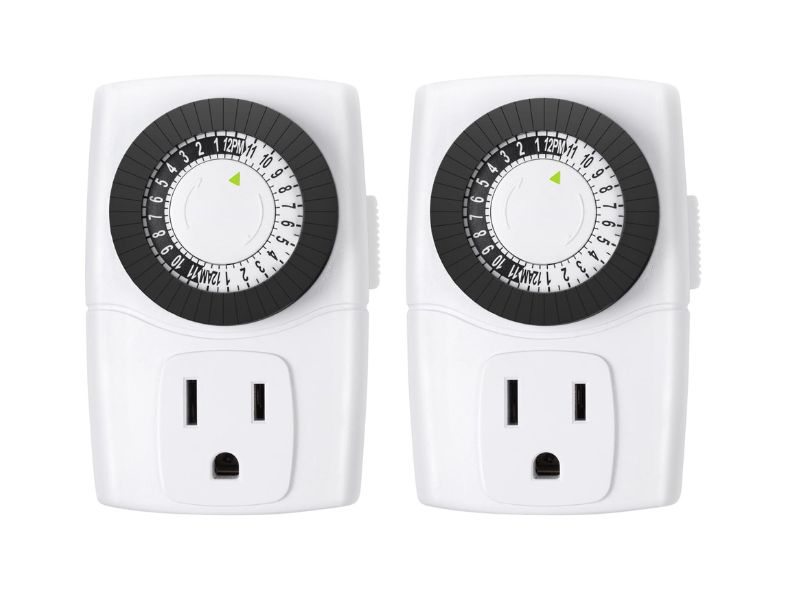
My primary recommendation is the BN-LINK U47 Indoor Mini 24-Hour Mechanical Outlet Timer. I would choose it for most single LED grow lights because it combines a 24-hour repeating schedule, 30-minute programming intervals, grounded three-prong outlet, and 15A/1875W electrical rating without requiring Wi-Fi or an app.
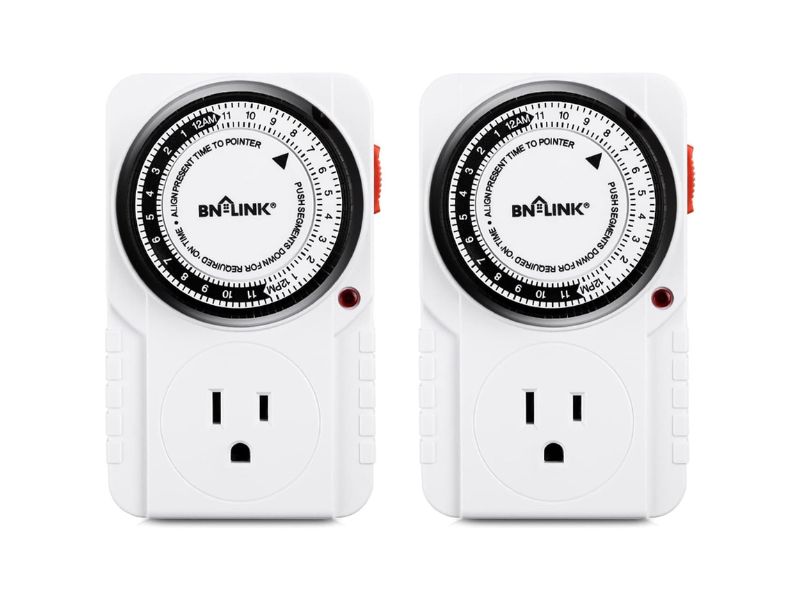
I would choose the BN-LINK Heavy Duty 24-Hour Mechanical Timer when finer timing adjustments matter. Its 15-minute programming intervals, grounded design, indicator light, and 15A/1875W capacity make it particularly useful for grow panels, seedling lights, and fixed daily schedules.
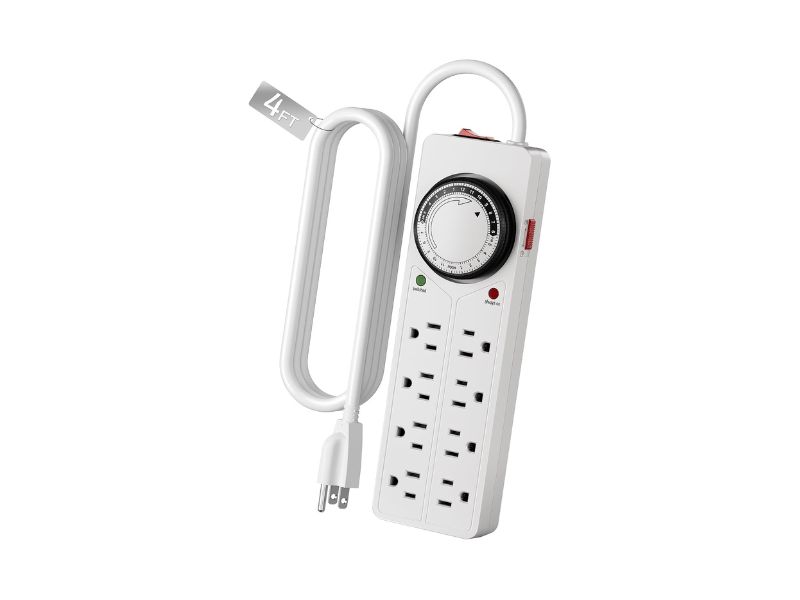
For several LED fixtures operating together, I would choose the BN-LINK 8-Outlet Timer Power Strip. It combines four timer-controlled outlets with four always-on outlets, allowing grow lights to follow one schedule while equipment that needs continuous power can use separate outlets.
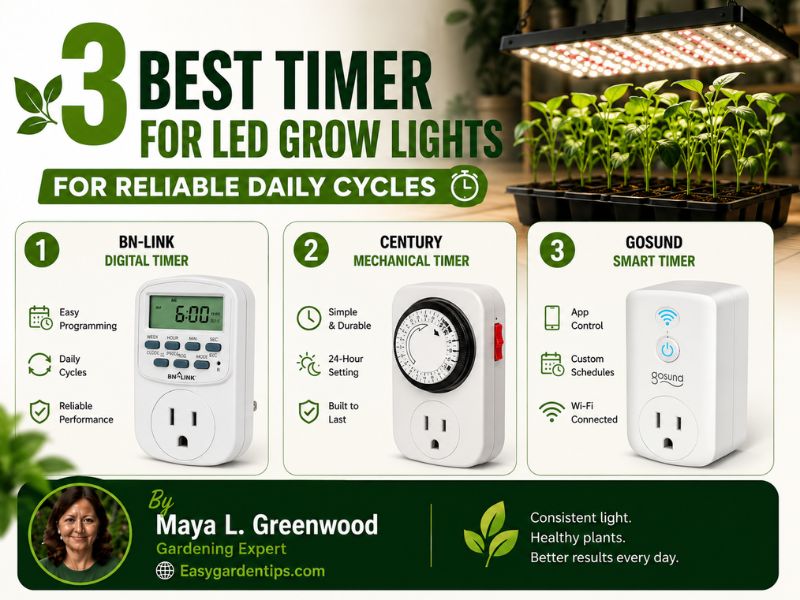
3 Best Timers for LED Grow Lights Reviewed
| Image | Product Name | Check Price |
|---|---|---|
Best Choice | BN-LINK U47 Indoor Mini 24-Hour Mechanical Outlet Timer | Check Price |
Second Best | BN-LINK Heavy Duty 24-Hour Mechanical Timer | Check Price |
Third Choice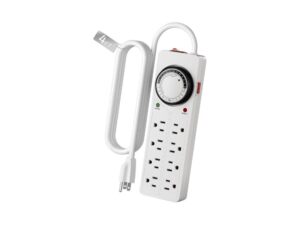 | BN-LINK 8-Outlet Timer Power Strip | Check Price |
1. BN-LINK U47 Indoor Mini 24-Hour Mechanical Outlet Timer
Key Features
- 24-hour repeating schedule
- 30-minute programming intervals
- Grounded three-prong outlet
- 15A / 1875W rating
- Simple mechanical dial
- No Wi-Fi or smartphone required
- ETL-listed product line
- Two-pack configuration
The BN-LINK U47 is my primary recommendation because a normal LED grow-light schedule does not require complicated automation.
If you want your lights to switch on every morning and turn off every evening, a mechanical timer can accomplish that with very little setup.
The U47 uses a repeating 24-hour mechanical dial with 30-minute intervals and supports grounded plugs. Its current Amazon listing specifies a 15A/1875W maximum electrical rating.
That provides substantial capacity for many household LED grow lights.
A typical seed-starting light might draw only a few dozen watts, while a larger indoor panel might consume 100W, 200W, or more.
What matters is the fixture’s actual input power, not a model name or an advertised equivalent-watt figure.
For example, a grow light with “1000” in the model name might actually consume around 100W.
Always check the electrical label or manufacturer’s specifications.
The timer’s 30-minute programming resolution is sufficient for normal plant schedules.
Plants do not require lighting to begin at exactly 6:03 a.m.
A schedule such as:
ON: 6:00 a.m.
OFF: 10:00 p.m.
provides a straightforward 16-hour lighting period.
The mechanical design also removes several possible complications.
It does not depend on:
- Wi-Fi
- Smartphone apps
- Cloud accounts
- Firmware
- Smart-home hubs
Once programmed and connected to power, it simply repeats the schedule.
That simplicity is useful for:
- Seedling grow lights
- Vegetable starts
- Orchid lights
- Houseplant lights
- Herb shelves
- Small grow tents
The grounded three-prong configuration is another important advantage.
If your LED fixture has a grounded plug, the timer should preserve that grounding connection rather than forcing you to use an unsafe adapter.
The two-pack format is useful when lights are located in separate areas.
One timer can control a seedling fixture while another handles a houseplant lamp elsewhere.
The biggest limitation is scheduling flexibility.
The U47 is designed around a repeating daily cycle rather than complex weekday/weekend programs.
If you need different schedules on different days, a digital or smart timer would be more suitable.
What I Like
- Simple daily automation
- Grounded three-prong connection
- Strong electrical capacity
- No Wi-Fi dependence
- Easy 30-minute programming
- Useful two-pack configuration
What I Do Not Like
- Same basic pattern repeats every day
- 30-minute increments are less precise than digital scheduling
- No remote control
For a normal single grow light, the BN-LINK U47 provides exactly what I want from a timer: simple, repeatable daily switching without unnecessary complexity.
2. BN-LINK Heavy Duty 24-Hour Mechanical Timer
Key Features
- 24-hour repeating timer
- 15-minute programming intervals
- Grounded three-prong connection
- 15A / 1875W capacity
- Indicator light
- Integrated mechanical programming pins
- ETL listed
- Specifically suitable for grow-light applications
The BN-LINK Heavy Duty timer is the model I would choose when I want mechanical simplicity with finer schedule control.
Its current Amazon listing specifies 15-minute programming intervals, a three-prong grounded outlet, indicator light, and 15A/1875W electrical rating. Grow lights are explicitly included among its intended applications.
The 15-minute increments give you more flexibility than the U47’s 30-minute intervals.
That may be useful when you want to coordinate artificial lighting with natural daylight.
For example, plants near a bright window may receive useful sunlight during the afternoon but need supplemental LED light early in the morning and later in the evening.
A timer with finer intervals gives you more control over those transitions.
The indicator light is also useful.
When troubleshooting a dark fixture, you can quickly determine whether the timer is currently supplying power.
If the indicator says the outlet should be active but the LED fixture remains off, you know to check the lamp, cord, connection, or fixture switch.
The electrical capacity provides considerable headroom for many common LED panels.
Still, I would not treat 1875W as a target operating load.
Use the grow light’s actual input specification and keep every component of the electrical system appropriately rated.
That includes:
- Timer
- Extension cord
- Power strip
- Outlet
- Circuit
If several grow lights are connected through another approved device, add their actual loads together.
For example:
Two 100W grow lights = approximately 200W combined load.
Do not use advertising descriptions such as “1000W equivalent” when calculating electrical demand.
The mechanical timer also eliminates app and network dependency.
That makes it attractive for a grow area that follows the same photoperiod every day.
For seedlings, you might use a long daily schedule.
For supplemental houseplant lighting, the timer could run for fewer hours depending on natural daylight.
The plants only care that the schedule and total light exposure suit their needs.
They do not benefit specifically from smart technology.
What I Like
- Fine 15-minute intervals
- Grounded design
- High electrical rating
- Useful indicator light
- Straightforward mechanical programming
- Explicit grow-light suitability
What I Do Not Like
- No app control
- No advanced weekly scheduling
- Must be adjusted physically
The BN-LINK Heavy Duty timer is the option I would choose when I want a traditional mechanical grow-light timer with finer programming than a basic 30-minute model.
3. BN-LINK 8-Outlet Timer Power Strip
Key Features
- Eight total outlets
- Four timer-controlled outlets
- Four always-on outlets
- Daily repeating mechanical schedule
- Surge-protector format
- 1875W / 10A listed configuration
- Four-foot cord
- Designed for grow-light and aquarium applications
- ETL listed
The BN-LINK timer power strip is the most practical selection for a growing station that uses several electrical devices.
Its current Amazon listing provides eight outlets divided into four timer-controlled outlets and four always-on outlets. It is specifically marketed for applications including grow lights.
That layout works particularly well for a seedling rack.
For example, the timer-controlled side can run:
- Grow light 1
- Grow light 2
- Grow light 3
- Grow light 4
The always-on side can remain available for compatible equipment that needs continuous power.
The exact operating schedule of fans, controllers, or other equipment should be determined separately rather than assuming every device should follow the lights.
The biggest advantage is synchronization.
Imagine a four-shelf seedling rack with one LED fixture on every shelf.
Using four separate mechanical timers can create unnecessary clutter.
The timers may also drift slightly relative to one another.
A timer strip lets all four fixtures switch together.
That produces:
- Cleaner cable management
- One schedule to adjust
- Fewer separate timer plugs
- Easier troubleshooting
The current Amazon product summary lists the strip at 1875W/10A, with a four-foot cord and four timed plus four always-on outlets.
When using several LED fixtures, calculate the combined actual load.
Four 40W seedling bars would total approximately:
40W × 4 = 160W.
Four 250W fixtures would total:
250W × 4 = 1000W.
Both examples illustrate why total actual consumption matters more than the number of outlets.
Having an unused socket does not automatically mean additional electrical load is safe.
The distinction between timed and always-on outlets also requires attention.
I would label the cables.
Accidentally connecting a grow light to an always-on outlet could leave it illuminated continuously.
Conversely, connecting equipment that needs continuous power to a timed outlet could cause unwanted shutdowns.
The timer strip is therefore best for growers willing to organize their rack properly.
For one tabletop lamp, it is unnecessary.
For several shelves, it can significantly simplify the entire electrical layout.
What I Like
- Four synchronized timed outlets
- Four additional always-on outlets
- Excellent for multi-light racks
- Reduces cable and timer clutter
- Centralizes the lighting schedule
- Useful surge-protector format
What I Do Not Like
- Excessive for one grow light
- Total electrical load must be calculated carefully
- Timed and always-on outlets should be clearly identified
The BN-LINK timer power strip is my preferred option for a multi-light seedling rack or indoor plant shelf where several LED fixtures need to follow exactly the same schedule.
Best Timer for LED Grow Lights Comparison
| Product | Timer Type | Programming | Controlled Outlets | Electrical Rating | Best Use |
| BN-LINK U47 | Mechanical | 24-hour, 30-min intervals | 1 per timer | 15A / 1875W | Single LED grow light |
| BN-LINK Heavy Duty | Mechanical | 24-hour, 15-min intervals | 1 per timer | 15A / 1875W | More precise daily schedules |
| BN-LINK Timer Power Strip | Mechanical strip | Daily repeating | 4 timed + 4 always on | 10A / 1875W listed | Multi-light grow racks |
The U47 is the easiest choice for one fixture, the Heavy Duty model provides finer scheduling, and the timer power strip becomes much more practical when several grow lights need to switch simultaneously.
How to Choose the Best Timer for LED Grow Lights
Check the Grow Light’s Actual Power Draw
Electrical compatibility should come first.
Look for the grow light’s:
- Input wattage
- Voltage
- Current draw
Do not confuse actual wattage with marketing model numbers.
A timer needs to handle the real connected electrical load.
Add Loads When Running Multiple Grow Lights
If several lights share one timer strip, add their input power together.
For example:
4 × 50W LED bars = 200W total
The combined total—not each fixture individually—is what matters to the timer and upstream electrical equipment.
Mechanical Timers Are Excellent for Fixed Schedules
Mechanical timers work particularly well when the same schedule repeats daily.
Advantages include:
- No internet dependency
- No account
- Fast setup
- Physical controls
- Predictable operation
For seedlings or plants following a fixed photoperiod, this can be all you need.
When 15-Minute Intervals Matter
Plants generally do not require quarter-hour precision.
However, 15-minute control can be useful when coordinating grow lights with:
- Natural window light
- Household electricity routines
- Other environmental equipment
- Specific morning/evening schedules
The BN-LINK Heavy Duty timer provides that finer mechanical control.
When 30-Minute Intervals Are Enough
For most grow-light applications, 30-minute timing is entirely adequate.
A seedling does not meaningfully care whether its artificial daylight lasts exactly 15 hours 45 minutes instead of 16 hours.
Consistency and appropriate total light exposure matter much more.
Timer for Vegetable Seedlings
Vegetable seedlings often receive relatively long daily photoperiods.
A schedule such as:
ON: 6 a.m.
OFF: 10 p.m.
provides 16 hours of artificial light followed by eight hours of darkness.
The proper duration should still be adjusted for crop, fixture intensity, and any natural daylight.
Timer for Houseplant Grow Lights
Houseplants receiving window light may need only supplemental LED illumination.
A timer can provide morning or evening light automatically so you do not have to remember to switch the fixture manually.
The exact duration depends on plant type and available natural light.
Timer for LED Seedling Racks
This is where the BN-LINK Timer Power Strip becomes particularly useful.
Four timed outlets allow several LED fixtures to follow one schedule.
For a multi-level propagation rack, that is much cleaner than putting a separate timer on every shelf.
Timer for T5 LED Grow Lights
T5-style LED bars are often used several at a time.
Add their actual power consumption and make sure the timer system comfortably accommodates the combined load.
A timer strip works particularly well when several bars should switch together.
Timer for 100W LED Grow Lights
A single genuine 100W LED fixture represents a relatively modest load compared with the 15A/1875W rating published for the first two BN-LINK timers.
Still, confirm voltage compatibility and follow the grow-light manufacturer’s electrical instructions.
Timer for 200W or 300W Grow Lights
The same principle applies.
A timer should be selected according to the fixture’s actual electrical draw, not its advertised equivalent output.
As power increases, also verify:
- Extension cords
- Power strips
- Receptacles
- Circuit capacity
Use Grounded Timers With Grounded Grow Lights
If the grow light has a three-prong plug, preserve the grounding connection.
Do not remove the ground pin just to fit a two-prong timer.
Both single-outlet BN-LINK selections use grounded three-prong connections.
Plants Still Need Darkness
A timer is useful because it makes a dark period automatic.
Running grow lights continuously is generally unnecessary for ordinary seedling and houseplant setups.
The ideal light/dark cycle depends on the crop, but consistent darkness is part of a normal growing routine.
Mechanical vs Smart Timer
A mechanical timer is usually better when you want:
- One fixed daily schedule
- Simple operation
- No Wi-Fi
A smart timer becomes more attractive when you want:
- Remote control
- Different schedules
- App-based changes
- Smart-home integration
For plant growth itself, neither technology is inherently superior.
Use the Timer’s Manual Override Carefully
Some timers let you manually force power on.
That can be useful while:
- Watering
- Inspecting plants
- Repotting
- Photographing seedlings
Afterward, make sure the timer has returned to automatic operation.
Otherwise, a grow light could remain on beyond its intended schedule.
Check the Timer After a Power Outage
Mechanical timer clocks can lose alignment when power is unavailable.
After a substantial outage, verify:
- Current dial time
- ON/OFF program
- Fixture operation
Do not assume the original schedule is still correctly synchronized.
Keep Timers Away From Water
Growing plants means watering.
Keep timers, plugs, power strips, and connections away from:
- Standing water
- Dripping pots
- Runoff trays
- Humidifier discharge
- Wet floors
Place power equipment where accidental irrigation cannot reach it.
Avoid Daisy-Chaining Power Strips
Do not create complicated chains of power strips simply because you need more outlets.
If your grow-light installation has expanded significantly, redesign the electrical layout using appropriately rated equipment.
The timer strip reviewed here already provides eight integrated outlets, reducing the need for additional adapters.
Common LED Grow-Light Timer Buying Mistakes
Choosing by Grow-Light Model Number
Use actual input watts.
Ignoring the Timer’s Amp Rating
Check electrical compatibility before connecting equipment.
Using an Ungrounded Timer
Preserve grounding when the fixture requires it.
Connecting Too Many Lights
Add the combined electrical load.
Running Grow Lights 24/7
Use an appropriate day/night schedule.
Buying a Separate Timer for Every Rack Light
A timer strip can simplify multi-light installations.
Placing the Timer Near Water
Keep electrical equipment dry.
Forgetting to Reset After an Outage
Verify clock alignment and schedule.
Frequently Asked Questions
What is the best timer for LED grow lights?
The BN-LINK U47 is my primary recommendation for most single LED grow lights.
It provides a grounded three-prong connection, 24-hour repeating schedule, 30-minute intervals, and a 15A/1875W electrical rating without requiring Wi-Fi.
Do LED grow lights need a timer?
A timer is not mandatory, but it makes a consistent daily photoperiod much easier.
Automatic switching prevents forgotten lights and keeps plant routines more predictable.
Is a mechanical timer good for grow lights?
Yes, mechanical timers work very well for simple schedules that repeat every day.
They are especially useful for seedlings, herbs, houseplants, and grow tents that do not require complicated weekly programming.
Is a 15-minute timer better than a 30-minute timer?
It offers finer control, but plants rarely require quarter-hour scheduling precision.
The BN-LINK Heavy Duty timer gives you 15-minute intervals when more precise scheduling is convenient.
Can a timer control a 100W grow light?
Yes, when the timer’s voltage and electrical capacity comfortably exceed the fixture’s actual load.
Both single-outlet BN-LINK models publish ratings far above a typical 100W LED fixture.
Can a timer control a 300W LED grow light?
Generally yes with an appropriately rated timer and compatible electrical system.
Use the grow light’s actual wall draw and verify every component in the circuit.
Can one timer control multiple grow lights?
Yes, provided the total connected load remains within the timer’s specifications.
The BN-LINK timer power strip specifically provides four outlets controlled by one timer.
What timer is best for multiple grow lights?
The BN-LINK 8-Outlet Timer Power Strip is my preferred multi-light option here.
Four outlets share the timer schedule while another four remain continuously powered.
How do I calculate grow-light load?
Add the actual input wattage of every fixture connected to the timer.
Do not use replacement-equivalent wattage or model names when estimating electrical load.
Should LED grow lights stay on 24 hours?
No, most ordinary indoor growing setups should include a regular dark period.
Set the timer according to the crop, light intensity, growth stage, and available natural light.
Is 16 hours of grow light okay for seedlings?
A 16-hour light period is a commonly practical starting schedule for many seedlings.
Actual requirements vary, so adjust according to crop and light intensity rather than treating one schedule as universal.
Should grow lights turn on at the same time daily?
A reasonably consistent schedule creates a stable indoor growing environment.
The exact minute matters much less than maintaining an appropriate daily light-and-dark pattern.
Can I use a three-prong grow light with these timers?
Yes, these selected BN-LINK timers provide grounded three-prong connections.
That allows compatible grounded grow-light plugs to retain their intended grounding path.
What does 15A/1875W mean?
It describes the timer’s listed maximum electrical load under its specified operating conditions.
The U47 and Heavy Duty BN-LINK models publish this rating.
Can I plug several T5 LED grow lights into one timer?
Yes when the combined actual electrical load stays within every component’s rating.
A multi-outlet timer strip is particularly convenient for synchronized T5 bars.
What happens to a mechanical timer during a power outage?
Its clock may become misaligned with real time after power is interrupted.
Check the timer after an outage and correct its current-time position if necessary.
Can fans use the same timer as grow lights?
Only if you intentionally want their operating schedule to match the lights.
Some growers prefer airflow on a different schedule. The timer power strip’s always-on outlets make separate operation easier.
Can I use a grow-light timer near watering trays?
Keep timers and electrical connections away from water and irrigation runoff.
Place the electrical system above or away from areas where water can drip, pool, or travel along cables.
Is a smart timer necessary for LED grow lights?
No, a mechanical timer is sufficient for a simple repeating daily schedule.
Smart control is mainly useful when you want remote access or frequently changing schedules.
Do grow-light timers consume much electricity?
The LED fixtures normally account for far more electricity than the timer itself.
When estimating operating costs, focus primarily on actual grow-light wattage and daily runtime.
Conclusion
The best timer for LED grow lights should reliably maintain your plant schedule while safely handling the actual electrical load of the connected fixtures. For most indoor growers, I would prioritize grounded connections, adequate amp capacity, simple programming, and the correct number of controlled outlets rather than advanced features that may never be used.
The BN-LINK U47 remains my primary recommendation for a single LED grow light. Its 24-hour repeating cycle, 30-minute intervals, grounded three-prong connection, and 15A/1875W rating make it simple and practical for seedlings, vegetables, houseplants, herbs, and small grow tents.
The BN-LINK Heavy Duty timer is the better choice when finer 15-minute programming matters. It retains the grounded 15A/1875W design while adding more precise mechanical scheduling and a useful indicator light.
For several grow lights, the BN-LINK 8-Outlet Timer Power Strip is considerably more convenient. Its four timed outlets and four always-on outlets make it easy to synchronize a multi-shelf lighting system without filling the wall with separate timers.
For most single fixtures, I would choose the BN-LINK U47. If I wanted finer mechanical scheduling, I would use the BN-LINK Heavy Duty timer. For a multi-light seedling or indoor growing rack, the BN-LINK Timer Power Strip is the most practical of these three.

I’m Maya L. Greenwood, a lifelong plant lover who believes anyone can grow something beautiful with the right guidance. After years of testing soil mixes, pruning methods, irrigation tricks, and pest-safe solutions, I started EasyGardenTips.com to turn hard-won lessons into step-by-step advice. From seed starting and container gardens to composting and seasonal checklists, my goal is to make gardening simple, sustainable, and fun.