3 Best 100 Watt LED Grow Light for Indoor Plants
A good 100W LED grow light can provide far more usable plant light than a small decorative grow lamp without creating the heat, space demands, and electricity use of a much larger fixture. For seedlings, vegetables, herbs, houseplants, and compact grow tents, 100 watts is one of the most practical starting points.
The best 100 watt LED grow light should offer real 100W-class power, useful canopy coverage, adjustable intensity, full-spectrum output, and enough efficiency to support plants beyond the earliest seedling stage.
My primary recommendation is the MARS HYDRO TS600 100W LED Grow Light. I would choose it for most compact indoor gardens because the current 2026 version combines 100W actual power, newly added dimming, a reflective hood, updated diode layout, and full-spectrum output for seedlings through later plant growth.
I would choose the Spider Farmer SF1000 100W LED Grow Light when efficiency and precise intensity control are the priorities. Its current listing specifies 100W power, dimmable full-spectrum output, and 2.5 µmol/J system PPE, making it particularly attractive for seedling trays and compact 2×2-style growing areas.
The Spider Farmer SF1000D 100W LED Grow Light is another strong choice when you want a dimmable 100W panel with an updated diode layout and improved PPFD distribution. Spider Farmer positions the current version for approximately 3×3 vegetative and 2×2 flowering coverage.
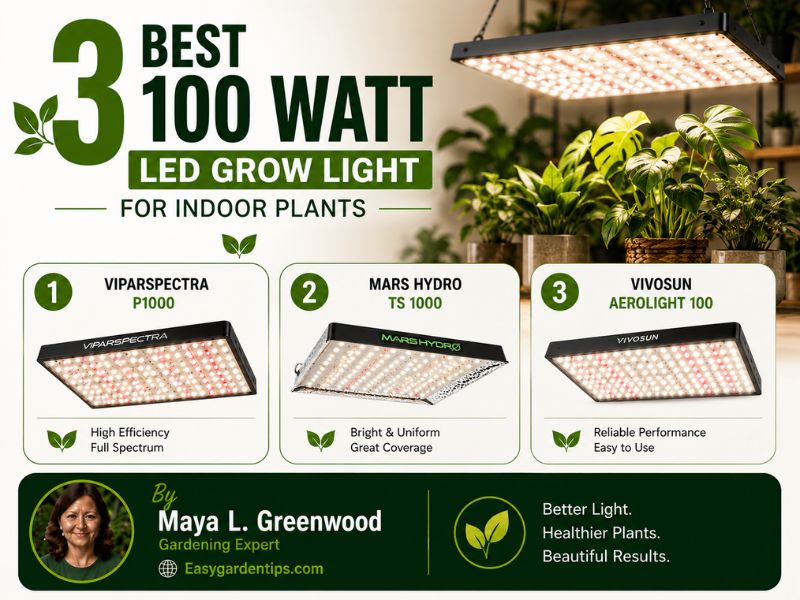
3 Best 100 Watt LED Grow Lights Reviewed
| Image | Product Name | Check Price |
|---|---|---|
Best Choice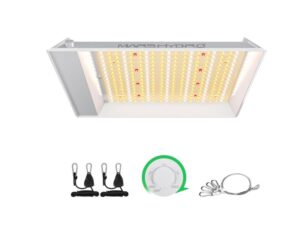 | MARS HYDRO TS600 100W LED Grow Light | Check Price |
Second Best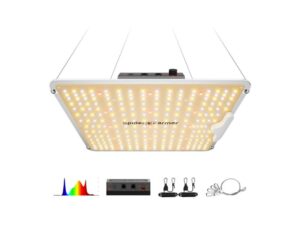 | Spider Farmer SF1000 100W LED Grow Light | Check Price |
Third Choice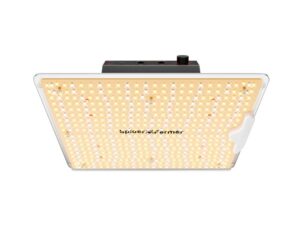 | Spider Farmer SF1000D 100W LED Grow Light | Check Price |
1. MARS HYDRO TS600 100W LED Grow Light
Key Features
- 100W actual power
- Full-spectrum LED output
- Dimmable 2026 version
- Updated diode arrangement
- Patented reflective hood
- Seedling-to-bloom positioning
- Compact grow-tent format
- Fanless design
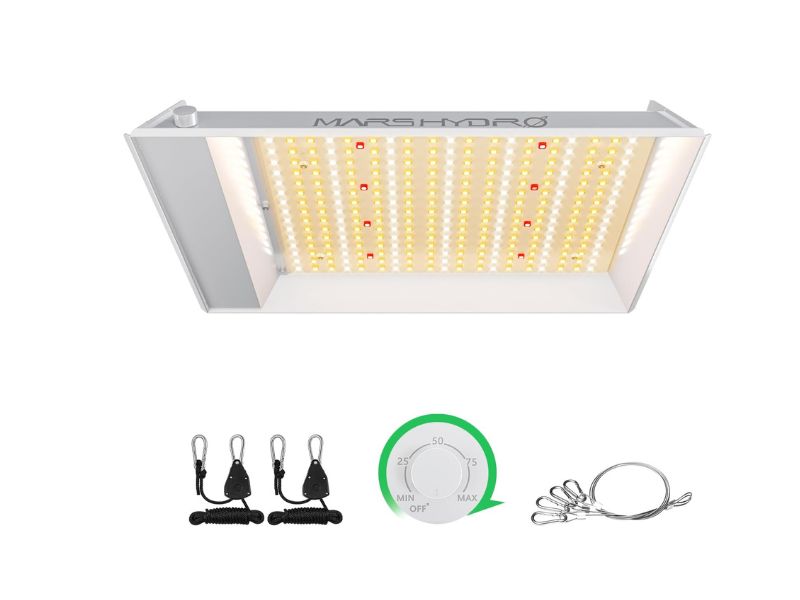
The MARS HYDRO TS600 is my primary recommendation because it provides the core features most growers need without turning a compact 100W fixture into an overly complicated system.
The current Amazon listing identifies the TS600 as a 100-watt grow light and specifically highlights the newer dimming function added to the 2026 version.
Dimming matters considerably at this power level.
A true 100W LED can provide far more intensity than newly emerged seedlings require when placed close to the canopy at maximum output.
With a dimmer, you can begin at lower intensity and gradually increase light as plants develop.
That makes one fixture useful for:
- Vegetable seedlings
- Tomatoes
- Peppers
- Lettuce
- Basil
- Herbs
- Houseplants
- Compact flowering plants
The TS600 also uses a reflective hood surrounding the LED board.
The purpose is to redirect some light that would otherwise spill sideways and push more of it toward the growing footprint.
That can be particularly useful in an open growing setup where reflective tent walls are absent.
For a compact 2×2-style space, this gives the TS600 a straightforward physical format.
Instead of several separate bars, you hang one fixture over the center of the canopy and adjust its height as plants grow.
The updated diode layout is intended to improve evenness across the growing area. Amazon’s current listing specifically describes it as an updated design with more even full-spectrum coverage.
Coverage is important because a grow light should not simply produce one extremely bright center spot.
You want useful illumination across the actual leaves.
This matters particularly with nursery trays.
If center seedlings remain short while edge seedlings stretch, the fixture may not be covering the area evenly enough.
The TS600’s fanless construction is another advantage.
There is no small cooling fan creating noise or adding another moving part.
That makes it easier to use in:
- Bedrooms
- Offices
- Living areas
- Small apartments
Fanless does not mean heat-free.
A 100W fixture still adds heat to the growing space.
Maintain airflow around both the LED board and canopy.
For seedlings, I would start below maximum intensity and follow the manufacturer’s hanging guidance.
As the seedlings grow, gradually increase output or adjust the fixture lower if they are stretching.
If leaves begin bleaching or curling upward, reduce intensity or raise the light.
The TS600 also works well for gardeners who want to continue using the same fixture after the seed-starting stage.
A weak tabletop lamp can become inadequate once tomatoes or peppers develop large leaves.
A 100W fixture gives considerably more headroom.
What I Like
- True 100W-class power
- Current version includes dimming
- Reflective hood helps control light spill
- Full-spectrum output
- Useful from seedlings through later growth
- Quiet fanless design
What I Do Not Like
- Too much light for a tiny seedling group at maximum output
- Reflective hood makes it less open than a bar fixture
- One 100W light is still limited for large mature canopies
The MARS HYDRO TS600 is the 100W model I would choose for most buyers because it combines dimming, broad full-spectrum use, compact installation, and a proven design without requiring a smart controller or complex setup.
2. Spider Farmer SF1000 100W LED Grow Light
Key Features
- 100W actual power
- Full-spectrum LED panel
- Dimmable output
- Published 2.5 µmol/J system PPE
- Seed-starting and vegetable compatibility
- Compact 2×2/3×3-stage-dependent format
- Passive cooling
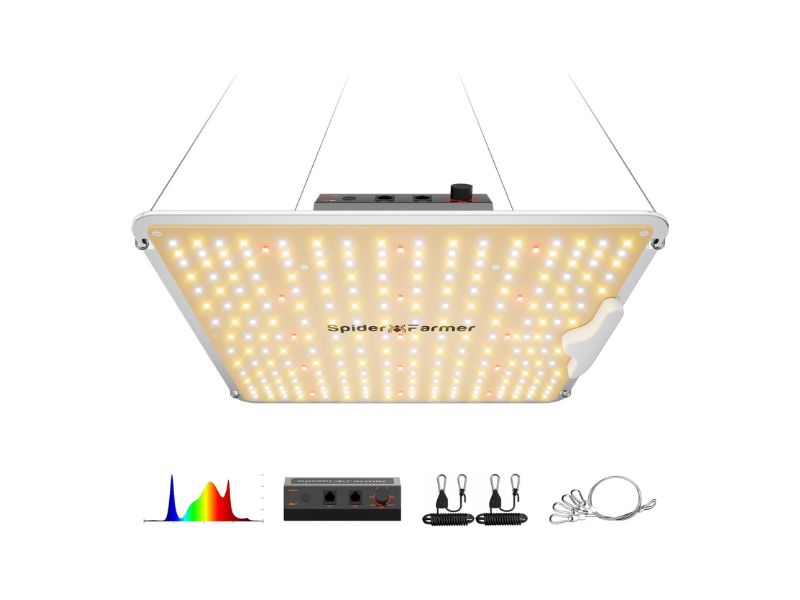
The Spider Farmer SF1000 is the model I would choose when photon efficiency is one of the top priorities.
Its current Amazon listing specifies a 100W dimmable full-spectrum system with 2.5 µmol/J system PPE.
PPE stands for photosynthetic photon efficacy.
It measures how efficiently the fixture converts electrical energy into photosynthetically useful photons.
That is much more informative than a marketing statement claiming the light is equivalent to a much higher-wattage older fixture.
Two grow lights can both consume 100 watts but produce different amounts of useful plant light.
The SF1000 is particularly well suited to:
- Full seedling trays
- Tomato starts
- Pepper seedlings
- Herbs
- Leafy vegetables
- Compact indoor plants
- Small grow tents
Dimming makes the fixture much easier to manage over young plants.
At the seedling stage, you may need only a fraction of maximum intensity.
Several weeks later, a full tray of tomatoes or peppers may benefit from considerably greater output.
One dimmable panel can handle both situations.
The broad panel-style design also produces a more useful footprint than a narrow spotlight.
For seedling trays, that means plants near the edges have a better chance of receiving adequate light.
A common mistake is judging grow lights by how bright they appear to human eyes.
Our eyes measure brightness very differently from plants.
Terms such as PPFD and PPE provide more useful information.
PPFD describes how many photosynthetically active photons actually reach a given area of the canopy.
PPFD changes with:
- Fixture height
- Dimmer setting
- Measurement location
- Reflective walls
- Canopy size
That is why even a good 100W fixture needs to be positioned correctly.
The SF1000 is also passively cooled.
There is no traditional fan constantly running on the fixture, which keeps the setup quiet.
Again, ventilation is still necessary.
All consumed electrical energy ultimately contributes to the thermal load of the room or tent.
The main drawback is that 100W may be unnecessary if you only start five or six seedlings.
A compact adjustable grow light can handle a tiny group more efficiently.
The SF1000 begins to make much more sense when the growing area approaches a full tray or when seedlings will remain indoors long enough to become larger plants.
What I Like
- Strong 2.5 µmol/J system PPE
- Dimmable output
- Broad panel coverage
- Excellent seedling-to-vegetative flexibility
- Full-spectrum design
- Quiet passive operation
What I Do Not Like
- More fixture than a handful of plants needs
- Requires overhead mounting
- External timer may be useful
- Still limited for large mature growing spaces
The Spider Farmer SF1000 is my preferred alternative when I want strong published efficiency and a dimmable 100W panel capable of supporting plants well beyond germination.
3. Spider Farmer SF1000D 100W LED Grow Light
Key Features
- 100W LED grow light
- Full-spectrum output
- Dimmable design
- Upgraded diode configuration
- Enhanced PPFD distribution
- Approx. 3×3 vegetative coverage
- Approx. 2×2 flowering coverage
- Suitable from seedling through later growth
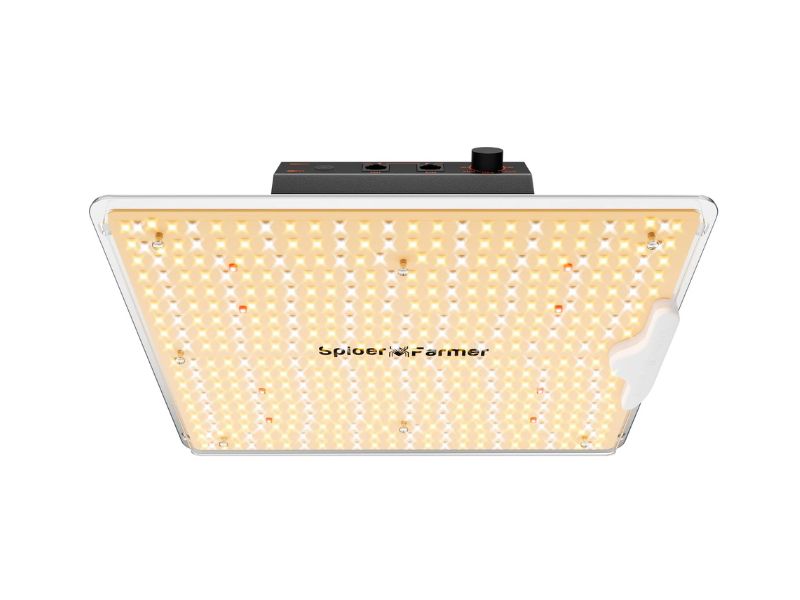
The SF1000D is a strong alternative for buyers who want a straightforward 100W Spider Farmer panel with a particular focus on canopy distribution.
Its current Amazon listing describes it as a 100W dimmable full-spectrum fixture with upgraded diodes and enhanced PPFD, designed around approximately 3×3 vegetative and 2×2 flowering footprints.
The phrase enhanced PPFD matters more than simply making the fixture brighter.
PPFD is the density of photosynthetically active photons reaching a specific point in the growing area.
A poorly distributed grow light may provide high PPFD in the center but much weaker intensity at the edges.
That creates uneven plants.
Improved diode distribution can help produce a more balanced canopy.
This is particularly helpful for:
- Seedling flats
- Several herb pots
- Compact tomato plants
- Pepper seedlings
- Leafy vegetables
- Small tent gardens
Dimming again plays a major role.
New seedlings need far less light than mature plants.
I would begin at reduced output and increase intensity gradually as plants produce more true leaves.
Plant response should guide the final setup.
If seedlings become:
- Tall and thin
- Strongly tilted toward the fixture
- Pale
- Widely spaced between leaves
they may be receiving too little usable light.
If foliage shows:
- Bleaching
- Upward curling
- Pale patches
- Obvious stress
the light may be too intense or too close.
The SF1000D also gives growers room to continue beyond the seedling stage.
Instead of replacing a small propagation lamp after several weeks, the same 100W fixture can continue supporting vegetative growth.
The listed 3×3 vegetative / 2×2 flowering distinction is important.
Vegetative plants can often use a broader area because they generally require less intense lighting than demanding mature flowering or fruiting crops.
That is why grow-light manufacturers frequently list larger vegetative than flowering footprints.
The biggest downside is product-family confusion.
Spider Farmer sells several similarly named SF1000 variants.
For this review, the exact product is the SF1000D associated with ASIN B084L1Y7KR.
Check the exact listing before purchasing so you know which version you are getting.
What I Like
- True 100W-class fixture
- Dimmable full-spectrum output
- Enhanced PPFD distribution
- Useful 2×2 flowering footprint
- Suitable through multiple plant stages
- Good compact grow-tent format
What I Do Not Like
- Similar Spider Farmer names can be confusing
- Smaller current rating history than SF1000
- Requires hanging and height adjustment
The SF1000D is the option I would choose when I want a simple dimmable 100W panel with a strong emphasis on even canopy illumination.
100 Watt LED Grow Light Comparison
| Product | Actual Power | Dimming | Published Efficiency | Coverage Focus | Main Strength |
| MARS HYDRO TS600 | 100W | Yes | — | Approx. 2×2-class | Reflective hood + simple design |
| Spider Farmer SF1000 | 100W | Yes | 2.5 µmol/J system PPE | 2×2/3×3 stage dependent | Published efficiency |
| Spider Farmer SF1000D | 100W | Yes | — | 3×3 veg / 2×2 bloom | Enhanced PPFD distribution |
All three are genuine 100W-class grow lights, but their strengths differ. The TS600 emphasizes simplicity and directed coverage, SF1000 emphasizes system efficiency, and SF1000D emphasizes improved canopy distribution.
How to Choose the Best 100 Watt LED Grow Light
Confirm Actual Power Draw
Grow-light model names can be misleading.
A product called “SF1000” does not consume 1000 watts.
The SF1000 reviewed here is a 100W fixture.
Likewise, the current TS600 listing identifies the fixture at 100 watts.
Always use actual input wattage when calculating:
- Electricity use
- Heat output
- Timer capacity
- Circuit load
Is 100W Enough for a 2×2 Grow Tent?
For many compact indoor setups, yes.
A quality 100W full-spectrum light is well suited to seedlings, herbs, leafy greens, and moderate plant growth in roughly 2×2 feet.
For demanding mature fruiting plants, evaluate the manufacturer’s PPFD map rather than assuming every 100W light performs identically.
Is 100W Enough for a 3×3 Grow Tent?
It depends on the growth stage.
Spider Farmer lists the SF1000D around 3×3 vegetative and 2×2 flowering coverage.
That distinction is important.
A 100W fixture can spread usable light over a broader vegetative canopy, but a demanding mature canopy generally requires higher intensity.
Dimming Is One of the Most Useful Features
All three selected products offer dimming in their current configurations.
That matters because young seedlings often need much lower PPFD than larger plants.
Dimming lets the fixture grow with the plants.
Rather than changing lights, you can adjust intensity as the canopy develops.
What Is PPE?
PPE measures plant-light output efficiency.
The Spider Farmer SF1000 publishes 2.5 µmol/J system PPE.
Higher PPE generally means the fixture produces more useful photosynthetic photons for each unit of electrical energy consumed.
What Is PPFD?
PPFD measures photon density at the plant canopy.
It is affected by:
- Hanging distance
- Dimming
- Fixture geometry
- Reflective surfaces
- Measurement location
This is why the highest wattage is not automatically the best choice.
A well-positioned efficient 100W fixture can outperform a more powerful light that is mounted incorrectly.
Full Spectrum Is the Most Versatile Option
All three selected fixtures use broad full-spectrum output.
This allows one grow light to support:
- Seedlings
- Vegetative plants
- Herbs
- Greens
- Mature plants
Full-spectrum white light also makes plant inspection easier than intense purple lighting.
Best 100W LED Grow Light for Seedlings
For seedlings, I would favor either the MARS HYDRO TS600 or Spider Farmer SF1000 because both provide dimming.
Start at reduced intensity and gradually increase output.
A 100W fixture should not automatically be used at maximum brightness over freshly emerged seedlings.
Best 100W Grow Light for Vegetable Seedlings
A full tray of tomatoes, peppers, eggplants, or brassicas can quickly outgrow a small clip lamp.
A 100W panel gives much more headroom.
The SF1000’s 2.5 µmol/J published PPE makes it particularly attractive when electricity-to-photon efficiency matters.
Best 100W Grow Light for Tomatoes
Tomatoes grow rapidly and can become leggy under weak indoor light.
For a full tray, I would choose the SF1000 or TS600.
Both can be dimmed early and increased as the plants become larger.
Best 100W Grow Light for Peppers
Peppers often remain indoors longer than many other seedlings.
A 100W dimmable fixture works particularly well because it can continue supporting them for weeks.
For a few peppers, lower output may be sufficient.
Best 100W Grow Light for Herbs
A 100W fixture is more than enough potential output for many compact herb gardens.
Use the dimmer instead of automatically operating at maximum intensity.
Basil, parsley, cilantro, and similar crops can all benefit from broad even coverage.
Best 100W Grow Light for Lettuce
Lettuce generally benefits more from uniform moderate illumination than a strong center hotspot.
The SF1000D’s emphasis on improved PPFD distribution is particularly relevant to a flat, even lettuce canopy.
How Far Should a 100W Grow Light Be From Plants?
There is no universal distance.
Use the manufacturer’s recommended height as your starting point.
Then watch the plants.
If seedlings stretch, increase usable light.
If leaves bleach or curl, decrease intensity.
Dimming and fixture height should be adjusted together.
How Long Should a 100W Grow Light Run?
The correct photoperiod depends on:
- Plant species
- Growth stage
- PPFD
- Natural daylight
Vegetable seedlings commonly receive a long artificial-light day, often around 14–18 hours, followed by darkness.
Do not assume the fixture should remain on 24 hours.
Use a Timer
A timer simplifies daily operation.
A schedule such as:
ON: 6:00 a.m.
OFF: 10:00 p.m.
creates 16 hours of light and eight hours of darkness.
The exact schedule should still be adjusted for the plant and light intensity.
Electricity Use of a 100W LED Grow Light
At full power:
100W = 0.1 kW
If the light runs for 16 hours:
0.1 × 16 = 1.6 kWh per day
Over 30 days:
1.6 × 30 = 48 kWh
Multiply 48 by your local electricity rate to estimate monthly cost.
Dimming may reduce actual consumption.
Heat Still Matters
A 100W LED is efficient but not heat-free.
The fixture still adds approximately 100 watts of energy to the indoor environment while running.
Maintain airflow around:
- LED board
- Driver
- Plant canopy
Passive cooling works best when warm air can move away from the fixture.
Common 100W Grow Light Buying Mistakes
Confusing Model Number With Wattage
Always verify actual power.
Buying Without Dimming
Dimming dramatically improves seedling flexibility.
Assuming All 2×2 Claims Are Equal
Compare PPFD maps and fixture efficiency.
Hanging the Light Too High
Insufficient canopy PPFD can cause stretching.
Hanging It Too Close
Efficient LEDs can still cause light stress.
Choosing Only by Lumens
Lumens measure human visual brightness rather than plant-useful photon output.
Frequently Asked Questions
What is the best 100 watt LED grow light?
The MARS HYDRO TS600 is my primary recommendation for most compact indoor gardens.
Its current 100W version adds dimming while retaining the full-spectrum reflective-hood design that works well for seedlings through later growth.
Is 100 watts enough for indoor plants?
Yes, 100W can provide substantial light for seedlings, herbs, greens, and compact plants.
It is particularly practical for small grow areas where larger 200W or 300W fixtures would be unnecessary.
Is 100W enough for a 2×2 tent?
Yes, a quality 100W fixture is well suited to many 2×2 indoor-growing applications.
Actual suitability depends on crop, PPFD target, fixture height, and growth stage.
Is 100W enough for a 3×3 tent?
It can work for vegetative growth, but mature high-light crops may need more intensity.
Spider Farmer lists SF1000D around 3×3 vegetative and 2×2 flowering coverage.
Is 100W too strong for seedlings?
It can be at full output and close range, so dimming is valuable.
Start seedlings at lower intensity and increase output as plants develop larger leaves.
Which 100W grow light is most efficient here?
The Spider Farmer SF1000 publishes 2.5 µmol/J system PPE.
That provides a useful system-level efficiency specification for comparing electrical input with plant-light output.
Which 100W light has a reflective hood?
The MARS HYDRO TS600 uses a patented reflective-hood design.
The current listing also highlights updated diode distribution and newly added dimming.
Which 100W light focuses on PPFD uniformity?
The Spider Farmer SF1000D specifically emphasizes enhanced PPFD distribution.
Its current listing positions it for 3×3 vegetative and 2×2 flowering use.
Is 100W good for tomato seedlings?
Yes, a dimmable 100W panel gives tomato seedlings substantial growth headroom.
Start at reduced output and increase intensity as tomato plants grow.
Is 100W good for pepper seedlings?
Yes, especially because peppers can remain indoors for many weeks.
A dimmable 100W fixture can continue supporting them as their canopy expands.
Can I grow lettuce with a 100W grow light?
Yes, 100W provides more than enough potential output for a compact lettuce canopy.
Focus on even distribution rather than maximizing center intensity.
Can I grow herbs under 100 watts?
Yes, herbs are an excellent match for a dimmable 100W full-spectrum fixture.
Several pots can share one light when coverage is arranged properly.
What is 2.5 µmol/J?
It is a measure of photosynthetic photon output produced per unit of electrical energy.
Spider Farmer publishes 2.5 µmol/J system PPE for the current SF1000.
Is PPFD more useful than wattage?
Yes, PPFD tells you how much plant-useful photon density actually reaches the canopy.
Wattage only tells you electrical consumption.
How far should a 100W LED be from seedlings?
The correct distance depends on the fixture, dimmer setting, and plant stage.
Follow the manufacturer’s guidance and adjust based on seedling response.
How many hours should a 100W grow light run?
The correct duration depends on the plant and canopy-level light intensity.
Seedlings often use long photoperiods, while mature plants can require different schedules.
How much electricity does a 100W grow light use?
At full power for 16 hours, it consumes about 1.6 kWh per day.
That equals approximately 48 kWh over 30 days.
Are 100W LED grow lights hot?
They produce less radiant heat than many older technologies but still add about 100W of heat load.
Provide reasonable airflow around the fixture and plants.
Do I need a timer?
A timer is strongly useful for keeping daily light schedules consistent.
An appropriately rated mechanical or digital timer works well with these fixtures.
Should I leave a 100W grow light on 24 hours?
No, most plants should receive an appropriate daily dark period.
Improve intensity and placement rather than trying to compensate with continuous lighting.
Conclusion
The best 100 watt LED grow light should deliver usable full-spectrum photons evenly across the canopy while giving you enough control to adapt the fixture to seedlings, herbs, vegetables, and larger plants.
The MARS HYDRO TS600 remains my primary recommendation. Its 100W actual power, 2026 dimming update, reflective hood, full-spectrum output, updated diode layout, and quiet fanless design make it a practical all-around choice for compact indoor gardens.
The Spider Farmer SF1000 is the alternative I would choose when published efficiency matters most. Its 100W draw and 2.5 µmol/J system PPE provide a strong technical foundation for seedling trays, vegetables, and compact tents.
The Spider Farmer SF1000D rounds out the group with a 100W dimmable platform, upgraded diode design, enhanced PPFD distribution, and approximately 3×3 vegetative/2×2 flowering positioning.
For most buyers searching specifically for a dependable 100 watt LED grow light, I would start with the MARS HYDRO TS600. If efficiency is my top priority, I would choose the Spider Farmer SF1000, while the SF1000D is an appealing alternative when even PPFD distribution is especially important.

I’m Maya L. Greenwood, a lifelong plant lover who believes anyone can grow something beautiful with the right guidance. After years of testing soil mixes, pruning methods, irrigation tricks, and pest-safe solutions, I started EasyGardenTips.com to turn hard-won lessons into step-by-step advice. From seed starting and container gardens to composting and seasonal checklists, my goal is to make gardening simple, sustainable, and fun.