10 Best Full Spectrum Led Grow Lights for Indoor Plants: Guide
Choosing the best full spectrum led grow lights for indoor plants can be surprisingly difficult because plant size, available space, light coverage, controls, and installation style all matter. A small tabletop lamp may be perfect for one pot but inadequate for a tall indoor tree or a shelf full of seedlings.
LEOTER Grow Light is my first choice because its four flexible heads, three spectrum modes, ten brightness levels, and automatic timer give beginners unusually useful control. The 80-LED arrangement covers common indoor plant needs, while the clamp and goosenecks make it practical for desks, shelves, and small plant groupings.
yadoker Grow Light is my alternative and second choice because its adjustable floor design is better suited to large plants and indoor trees. The pole extends to 61 inches, uses a décor-friendly walnut grain finish, and runs on 5V low voltage with 8-, 12-, and 16-hour timer choices.
My third choice is MIEEMCLUX 5-Head LED Grow Light. It rounds out my top three with a useful alternative for buyers whose priorities differ from the first two choices.
MIEEMCLUX Heads LED Grow Lights Indoor is my third choice for buyers who need broader coverage from a floor-standing setup. Its five heads, 450 LEDs, individual head control, and timer options from three to 18 hours make it a flexible choice for several tall plants or a wider growing area.
.amz-product-card:hover{transform:translateY(-3px)!important;box-shadow:0 10px 26px rgba(20,70,110,.12)!important;border-color:#bdd7ea!important;}
Best Full Spectrum Led Grow Lights for Indoor Plants
I selected these products for their relevance to indoor plant lighting, useful differences in size and mounting style, and the amount of practical product information supplied. Customer-feedback evidence was also considered when available, along with brand and design diversity so the list includes compact lamps, floor stands, halo lights, and linkable bar fixtures rather than ten nearly identical choices.
| # | Image | Product | Price on Amazon |
|---|---|---|---|
| 1 |  |
LEOTER Grow Light | Check Price |
| 2 |  |
yadoker Grow Light | Check Price |
| 3 |  |
MIEEMCLUX 5-Head LED Grow Light | Check Price |
| 4 |  |
Yehsence 8-in-1/800 LED Full Spectrum Grow Light | Check Price |
| 5 |  |
GLOWRIUM 48W Full Spectrum Grow Light | Check Price |
| 6 |  |
Hemonee Four-Head LED Grow Light | Check Price |
| 7 |  |
GooingTop 6000K Full Spectrum Indoor Plant Growing Lamp | Check Price |
| 8 |  |
Aokrean Full Spectrum Plant Light | Check Price |
| 9 |  |
Barrina T5 1-Foot Full Spectrum Grow Lights | Check Price |
| 10 |  |
Kullsinss 6.3-Inch Full Spectrum Plant Light | Check Price |
LEOTER Grow Light
LEOTER Grow Light is a strong all-around option for someone caring for several small or medium-sized plants near a desk, shelf, or side table. Its four light heads use 80 LEDs divided among red, blue, yellow, and white light, and the stated 380nm–800nm full-spectrum range is intended to support plants from rooting and sprouting through later growth.
The three lighting modes are useful because not every plant or growth stage needs the same visual balance. You can select full spectrum for general use or use the red-and-blue mode when you want a more specialized setting. Ten brightness levels provide more control than a simple on/off lamp, which helps when moving a light closer to a plant or accommodating shade-tolerant foliage.
Its 3-, 9-, and 12-hour circular memory timer can turn the lamp on and off daily without constant manual intervention. The timer needs to be reset after power interruption or changes to the schedule, so it is not completely maintenance-free. The USB connector works with the included adapter, and the metal clamp gives the lamp more placement flexibility than a fixed base.
Pros
- Four 360-degree adjustable gooseneck heads.
- Three spectrum modes and ten brightness levels.
- Automatic 3-, 9-, and 12-hour timer.
- USB and AC power flexibility.
- Heat sink intended to improve heat dissipation.
Cons
- Best suited to compact plant groupings rather than a large floor display.
- Timer settings must be reset when required after power or schedule changes.
- A clamp installation is less convenient if no suitable edge is nearby.
My Opinion
LEOTER earns the top position because it balances adjustability, spectrum control, timer convenience, and easy placement in one compact format. It is my best fit for beginners with several tabletop plants and limited floor space.
yadoker Grow Light
yadoker Grow Light takes a different approach from clamp-mounted lamps by using a tall, freestanding pole for large indoor plants, floor planters, and indoor trees. The height adjusts from 13.7 to 61 inches, allowing the light to remain useful as a plant grows instead of becoming limited to a small pot or low shelf.
The walnut grain finish gives it a more furniture-friendly appearance than many utilitarian plant lamps. Its aluminum construction is also intended to dissipate heat more effectively than plastic, which matters when the fixture operates for long daily periods in a living room or office. The 5V low-voltage design is another practical advantage for indoor spaces with children or pets, although ordinary cord management is still necessary.
Brightness can be adjusted across ten levels, so a buyer can start gently with a nearby plant and increase intensity as needed. The 8-, 12-, and 16-hour timer choices are particularly useful for maintaining a predictable routine while away from home. Because this is a single tall lamp rather than several independently positioned heads, coverage may be less adaptable for a broad collection of plants with very different heights.
Pros
- Height adjusts from 13.7 to 61 inches.
- Attractive walnut grain aluminum finish.
- Ten brightness levels for different plant situations.
- 8-, 12-, and 16-hour automatic timer choices.
- 5V low-voltage power for indoor use.
Cons
- Single-pole coverage is less flexible than a multi-head lamp.
- May be excessive for one small tabletop plant.
- Requires enough floor or planter space for stable placement.
My Opinion
yadoker is the most convincing alternative for tall plants and buyers who want a grow light that blends into home décor. Choose it when height and appearance matter more than independently aiming several light heads.
MIEEMCLUX 5-Head LED Grow Light
MIEEMCLUX Heads LED Grow Lights Indoor is built for wider coverage than a typical single-head or halo lamp. Five round heads contain a combined 450 LEDs, and the larger head design is intended to spread light across tall plants, multiple pots, microgreens, or a compact indoor growing area.
The stand-and-head arrangement gives this model a useful middle ground between a single floor lamp and several separate fixtures. Each head can be positioned with an adjustable gooseneck, and the heavy-duty clamp can also be used around plant stands, shelves, tables, or grow tent frames. That makes it suitable for buyers who want to change their setup instead of committing to one permanent arrangement.
A display-based timer offers 3-, 6-, 9-, 12-, 15-, and 18-hour settings. That range is helpful for matching different routines, especially when a plant area needs a longer daily schedule. All heads can be dimmed together, while individual heads can be dimmed, switched off, or used selectively. The trade-off is a larger, more involved setup than a simple one-pot light, and five heads may be unnecessary if only one small plant needs supplemental illumination.
Pros
- Five heads and 450 LEDs provide broad coverage.
- Timer offers six daily duration choices.
- Heads can be controlled together or selectively.
- Eleven brightness levels support gradual adjustment.
- Useful for tall plants, microgreens, and several pots.
Cons
- More equipment than needed for a single small plant.
- Multiple heads require more positioning and cord organization.
- Customer-feedback volume is lower than some established compact lamps.
My Opinion
MIEEMCLUX is a flexible choice when coverage is the main concern. Its independent head control makes it especially appealing for a mixed collection where every plant does not need the same amount of light.
Yehsence 8-in-1/800 LED Full Spectrum Grow Light
Yehsence 8-in-1/800 LEDs Full Spectrum LED Grow Lights Indoor is the broadest multi-head option in this group. Eight light heads, each measuring up to 8.3 inches long and containing 100 LEDs, are intended to cover a large plant display or several plants arranged across a floor area. Each head can be adjusted for direction and brightness, giving the buyer considerable control over where light lands.
The enhanced full-spectrum design adds red and blue light to regular full-spectrum output. According to the supplied information, this is especially useful for flowers and plants where color development matters, including dark-hued varieties and deep red succulents. That focus may appeal to collectors, although buyers mainly seeking a discreet lamp for one leafy plant may find the eight-head layout unnecessarily large.
The tripod is reinforced to support the light strips, while the shade uses flame-retardant material intended to handle higher temperatures better. The 4-, 8-, and 12-hour timer settings provide basic scheduling, but they offer fewer choices than several competing models. Since all eight heads add visual and physical presence, careful placement is important in living areas where floor space is limited.
Pros
- Eight individually adjustable light heads.
- 800 total LEDs for extensive coverage.
- Enhanced red and blue output for color-focused plant care.
- Reinforced tripod supports the multi-head arrangement.
- Automatic 4-, 8-, and 12-hour timing.
Cons
- Large setup may overwhelm a small room or single plant.
- Timer selection is less varied than some alternatives.
- More light heads mean more positioning and storage considerations.
My Opinion
Yehsence makes the most sense for a broad indoor display, multiple plants, or a collector who wants directional control and added red-blue emphasis. It is less attractive for buyers prioritizing a minimalist footprint.
GLOWRIUM 48W Full Spectrum Grow Light
GLOWRIUM 48W Grow Lights Indoor combines a tall adjustable stand with a larger lamp head and flexible gooseneck. The four-section pole extends up to 79 inches, which gives it the greatest stated height range among the floor-standing options here and makes it suitable for plants that have already grown well above tabletop level.
Rather than offering only a few fixed brightness steps, this lamp provides stepless dimming. That can make small adjustments easier when the plant is close to the light or when the fixture needs to serve plants with different light preferences. Three lighting modes are available for different growth stages, while the frosted diffuser is intended to provide softer, more comfortable light in a home environment.
The timer includes 3-, 9-, 12-, and 16-hour cycles, giving users a broad range of daily schedules. A built-in plant-care assistant adds light measurement, watering and fertilizer reminders, growth records, and care recommendations. Those tools may be helpful for a beginner who wants one place to track routine tasks, though they do not replace observing leaf color, stretching, soil condition, or plant response.
Pros
- Stand extends up to 79 inches.
- Stepless brightness adjustment.
- Large head and flexible neck support broader, targeted coverage.
- Four automatic timer durations.
- 24V low-voltage system and frosted diffuser.
Cons
- Tall stand requires adequate floor clearance and stability.
- Care-assistant functions may be unnecessary for simple plant setups.
- More elaborate than needed for a single small pot.
My Opinion
GLOWRIUM is a thoughtful choice for buyers who want a tall, polished lamp with fine brightness control and built-in care reminders. Its height range makes it particularly useful for large plants that keep growing.
Hemonee Four-Head LED Grow Light
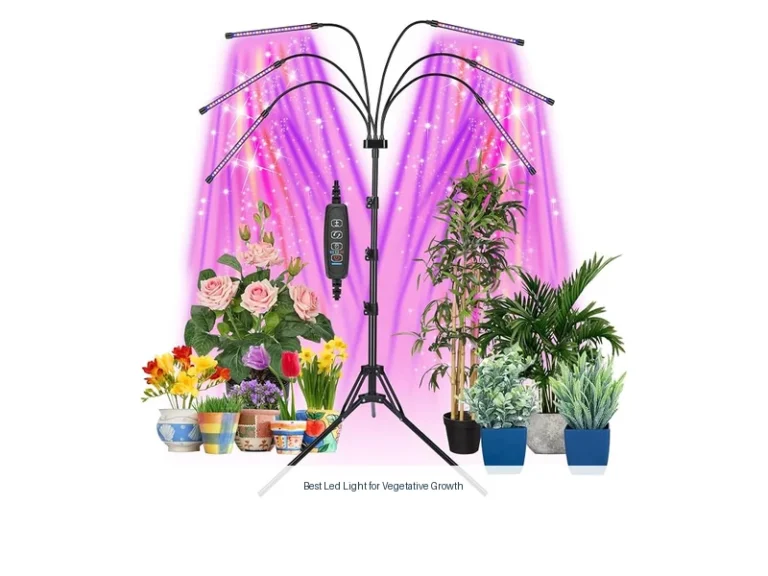
Hemonee LED Grow Lights Indoor uses four light heads on a tripod that adjusts from 15 to 63 inches. The flexible goosenecks rotate 360 degrees, so the lamp can be aimed at plants positioned around a stand rather than forcing every pot into one fixed direction. Assembly is intended to take about two minutes and does not require hanging the fixture from a shelf or table.
Three spectrum modes cover red plus blue, white, or a mixed white-red-blue setting. Ten brightness levels range from 10% to 100%, which gives the buyer room to start conservatively and make changes as the plant responds. Each LED head can be controlled independently, a useful feature when four plants differ in height or when one section of the display needs less illumination.
One of the more distinctive conveniences is the dual-controller arrangement. An inline controller handles nearby adjustments, while the RF remote is stated to work up to 30 meters away. Automatic 4-, 8-, and 12-hour schedules reduce daily effort. The aviation-grade heat sink and aluminum shell are intended to improve heat dissipation, but buyers should still leave space around the lamp and avoid pressing the heads directly against foliage.
Pros
- Adjustable 15- to 63-inch tripod.
- Four independently controllable heads.
- Three spectrum modes and ten brightness settings.
- Inline and RF remote controllers.
- Automatic 4-, 8-, and 12-hour timer.
Cons
- Requires floor space for the tripod.
- Timer choices are fewer than those on several multi-head competitors.
- Customer-feedback volume is limited compared with long-established models.
My Opinion
Hemonee is a good fit for someone who values remote control and separate head adjustment. Its simple assembly and broad height range make it practical for a changing indoor plant display.
GooingTop 6000K Full Spectrum Indoor Plant Growing Lamp
GooingTop Grow Light is a compact clamp lamp aimed at small houseplants, seedlings, and tabletop pots. It uses ten red LEDs and 74 white LEDs with a stated 6000K color temperature, producing a soft, flicker-free light with a color rendering index of up to 95. That makes it more visually comfortable in a living or working area than a strongly colored red-blue lamp.
The flexible gooseneck and strong clamp allow the light to be aimed around a plant instead of illuminating only one fixed spot. It can run through USB or an AC power plug, which gives buyers more placement options near a desk or shelf. At approximately 10W of power draw, it is positioned as an economical small-plant lamp rather than a high-coverage fixture for a large collection.
Its timer cycles are 4, 8, or 12 hours on a 24-hour schedule based on the time selected. This is convenient for maintaining consistency, but there are fewer schedule options than on some newer lamps. The product also includes a stated 365-day warranty and 24-hour customer service, adding useful ownership support. The main limitation is scale: one compact spotlight will not evenly cover a broad floor display without careful positioning or additional fixtures.
Pros
- 6000K white light with 74 white and 10 red LEDs.
- High stated color rendering index of 95.
- USB or AC power options.
- Flexible neck and strong clamp.
- 4-, 8-, and 12-hour timer.
- Stated 365-day warranty.
Cons
- Small coverage area compared with multi-head floor lamps.
- Only three timer durations are available.
- Less suitable for large plants or multiple widely spaced pots.
My Opinion
GooingTop is a sensible low-power choice for a desk plant, a small shelf, or a seedling area where soft white light and compact installation are priorities. It should not be mistaken for a whole-room growing system.
Aokrean Full Spectrum Plant Light
Aokrean Grow Lights offers two installation methods: the light can be inserted into soil or used with its included stand. That flexibility is useful when a plant changes location, but the stand has an important stability requirement: it needs to be pressed down by the flower pot. Buyers should plan to position the pot so it securely anchors the base rather than expecting a completely independent floor stand.
The lamp provides white, warm white and red, or mixed lighting modes, along with ten brightness levels. Those controls allow a buyer to adjust both the appearance of the light and its intensity for different indoor plants. The pole extends and rotates up to 26 inches, giving enough reach for many tabletop plants while keeping the overall design relatively unobtrusive.
A 3-, 9-, and 12-hour cycle timer switches the lamp on and off daily after it is set. The halo-style form also works as a decorative accent in a home, floor planter, or hanging arrangement. Because the maximum height is lower than the tall floor lamps in this list, it is best paired with small to medium plants. Its non-wireless design also means the power cable must reach a nearby outlet or suitable power source.
Pros
- Can be inserted into soil or used with the stand.
- Three lighting modes and ten brightness levels.
- Adjustable pole reaches up to 26 inches.
- Automatic 3-, 9-, and 12-hour timer.
- Decorative halo form suits home interiors.
Cons
- Stand must be stabilized by the flower pot.
- Not wireless.
- Shorter reach limits use with very tall plants.
My Opinion
Aokrean is appealing when a buyer wants a compact, decorative lamp with two placement methods. It works best for tabletop or planter-based use, provided the pot can reliably hold the stand in place.
Barrina T5 1-Foot Full Spectrum Grow Lights
Barrina T5 Grow Lights take the most modular approach in this lineup. The package includes four 1-foot fixtures using 5000K white full-spectrum light, making them suitable for shelves, cabinets, propagation areas, and other spaces where a long bar can sit close to plants. Their shape is better suited to rows of plants than to a single decorative floor pot.
The four fixtures contain 96 LEDs in total and use 20W, with the supplied information positioning them as a higher-output replacement for general 120W plant lights. Each fixture has its own surface switch, so the lights can be used separately or together according to the needs of the plants below them. That is helpful for a shelf with seedlings at different stages or for reducing unnecessary light in an unoccupied section.
Installation accessories include double-sided tape, clips, cable ties, connectors, and power cords. Up to 16 lights can be linked in series, offering a practical expansion path for a larger rack. However, the fixtures are non-magnetic, and the supplied guidance cautions against mounting them on uncured plaster or dusty, greasy, rough surfaces. A buyer should confirm the mounting surface and plan cable routing before installation.
Pros
- Four 1-foot fixtures for shelf and rack layouts.
- 5000K white full-spectrum light.
- Separate on/off control for each fixture.
- Up to 16 lights can be linked in series.
- Installation hardware is included.
Cons
- Bar format is less suitable for a single freestanding plant.
- Non-magnetic construction limits mounting options.
- Surface condition matters when using tape or clips.
My Opinion
Barrina is the strongest choice for organized shelves, plant racks, and propagation areas. Its linkable design and separate switches are more useful for structured growing spaces than for casual decorative plant care.
Kullsinss 6.3-Inch Full Spectrum Plant Light
Kullsinss 6.3in Grow Lights uses a halo-style head with 80 LEDs and a stated 380nm–760nm range. The light is intended to support indoor plants through germination, vegetative growth, flowering, and fruiting, while the faux woodgrain finish gives it a warmer decorative appearance than a plain metal or plastic pole.
The height adjusts from 10 to 65 inches, which is a substantial range for a soil-inserted light. That makes the lamp useful for a plant that starts small and grows taller over time. There is one important compatibility detail: the product is supplied without a base, so installation requires inserting the pole into soil. A pot with sufficiently stable soil is therefore essential, and this is not the best choice for buyers who need a freestanding base outside the planter.
Five dimming levels and three spectrum modes—white, warm white plus red, and mixed light—provide basic customization. The automatic timer offers 6-, 12-, and 16-hour settings. Heat dissipation is intended to keep the lamp safe for plants, but the head should still be positioned so leaves are not pressed against it and the pole remains secure as the plant grows.
Pros
- Height adjusts from 10 to 65 inches.
- 80 LEDs cover a stated 380nm–760nm range.
- Three spectrum modes and five brightness levels.
- 6-, 12-, and 16-hour automatic timer.
- Decorative faux woodgrain design.
Cons
- No base is included.
- Requires stable soil insertion.
- Fewer brightness levels than several competing lamps.
My Opinion
Kullsinss is a good-looking option for one tall planter when soil insertion is acceptable. Its height range is impressive, but buyers wanting a self-supporting base should choose a tripod or stand-mounted alternative.
How I Selected These Indoor Plant Lights
The selection emphasizes practical differences rather than treating every full-spectrum lamp as interchangeable. I compared the stated spectrum ranges and modes, number and arrangement of LEDs, brightness control, timer choices, mounting method, height range, and intended coverage. A clamp lamp, a soil-inserted halo light, a floor tripod, and a linkable T5 bar solve different problems, so the ranking reflects versatility and likely usefulness for the audience rather than one specification alone.
Customer-feedback volume and rating information supplied for the products were also considered as context, but they do not prove that a lamp will suit every plant or room. Products with limited customer-feedback volume were not automatically excluded; instead, their placement reflects the narrower evidence base and the strengths of their stated design.
Selection takeaway: Coverage and placement matter as much as spectrum. A compact clamp lamp can be the better purchase for a few shelf plants, while a multi-head stand or linked bar system is more appropriate for a wider collection.
I also looked for ownership details that affect daily use: whether the timer repeats automatically, whether brightness can be changed gradually, whether the fixture can be repositioned as plants grow, and whether installation requires a particular surface or pot. These details often determine satisfaction more than the word “full spectrum” on the product title.
Important limitation: The supplied information does not provide independent PPFD maps, measured coverage charts, or hands-on performance testing. Treat the rankings as a practical comparison of documented features and buyer fit, not as a laboratory measurement of plant growth.
How to Choose an Indoor Plant Grow Light
The right lamp depends first on the plant area, not on the largest LED count. Measure the available space, estimate how many plants need light, decide whether the lamp must move as plants grow, and then choose the control and mounting style that will be easiest to use consistently.
- Match coverage to the plant group: Use a clamp or halo lamp for one or a few nearby pots, and consider multi-head or bar fixtures for wider shelves.
- Check height and placement: Tall plants need an adjustable pole or stand, while shelf plants may benefit from low-profile bars.
- Prioritize usable controls: Dimming, repeat timers, and independently controlled heads reduce daily adjustment.
- Plan stability and cables: Confirm whether the lamp needs a clamp edge, stable soil, a pot to anchor the base, or clear floor space.
- Consider room comfort: White or diffused light may blend better into living spaces than a strongly colored red-blue setting.
Coverage, distance, and plant size
LED count alone does not tell you how evenly a fixture will illuminate a plant. A wide head, multiple adjustable heads, or several linkable bars can spread light more effectively than one concentrated spotlight. Conversely, a broad fixture may waste light if it is placed over only one small pot.
Height adjustment is valuable because plants change shape and size. A lamp that can move upward may remain useful longer, but the light should still be positioned according to the plant’s response. Stretching, leaning toward the lamp, pale new growth, or leaf stress can indicate that the placement or brightness needs attention.
Timer and dimming controls
Consistent scheduling is usually more useful than a timer with many options that is difficult to operate. Select a cycle that fits your household routine and observe how the plant responds. Dimming is especially helpful when a lamp is close to delicate foliage or when one fixture serves plants with different needs.
Memory timers are convenient, but check how each product behaves after a power interruption. Some schedules may need to be reset. For a plant collection that must remain unattended during travel, confirm the timer operation before leaving rather than assuming every automatic mode works identically.
Power, construction, and stability
Low-voltage designs can be useful indoors, but voltage alone does not eliminate ordinary electrical precautions. Keep cords away from water, protect connections from spills, and use a stable outlet or power adapter suitable for the lamp. Aluminum housings and heat sinks may help with heat management, but air should still circulate around the fixture.
Installation style is equally important. A clamp requires a suitable edge, a soil-inserted lamp requires stable potting media, and a tripod needs enough floor space. A stand that depends on a flower pot for stability should be positioned so the pot cannot be easily bumped or tipped.
How to Set Up a Grow Light for Indoor Plants
Start by placing the lamp where the light can reach the plant without forcing leaves into the fixture. Remove loose packaging, secure the stand or clamp, and route the cable away from watering areas. If the product uses a soil stake, insert it deeply enough for stability without damaging major roots.
- Group plants with similar height and light preferences when possible.
- Position the lamp so the main foliage receives reasonably even illumination.
- Begin with a moderate brightness level rather than the maximum setting.
- Set a timer that fits the room’s natural light and your daily schedule.
- Observe the plant for several days before making a major brightness or distance change.
Do not use a timer schedule as a substitute for observation. A room with strong window light may need less supplemental lighting than a dark corner. Likewise, a lamp placed farther away may cover more area but deliver less useful intensity to individual leaves.
How to Use Full-Spectrum Lighting Effectively
“Full spectrum” describes the intended range or blend of light, but plants still respond to placement, duration, intensity, water, nutrition, temperature, and airflow. Use the spectrum mode that best suits the situation, then judge the setup by plant condition rather than assuming the most intense setting is always best.
For seedlings and small houseplants
Keep the fixture positioned to avoid a narrow beam that lights only the top leaves. A multi-head lamp can aim at several small pots, while a bar system may work better above a shelf. Start with moderate brightness and adjust gradually if stems become unusually elongated or growth leans strongly toward one side.
For tall plants and indoor trees
Choose a fixture with enough height range to reach the upper foliage. A single lamp may not illuminate a very broad canopy evenly, so repositioning or adding coverage may be necessary. The pole, tripod, or clamp should remain stable as the plant grows and as the lamp is raised.
For flowering or color-focused plants
Red and blue modes may be useful when the product specifically provides them, particularly for buyers interested in flowering or richer color. Avoid assuming that an enhanced red-blue mode is automatically superior for every plant; a balanced setting may be more comfortable in a living space and more suitable for general observation.
Maintenance, Safety, and Storage
Indoor grow lights require little plant-specific maintenance, but dust and poor cable placement can reduce convenience and safety. Unplug the fixture before cleaning. Use a soft, dry cloth on accessible surfaces, keep vents or heat-dissipation areas clear, and never spray cleaner directly onto the lamp or power connection.
Inspect goosenecks, clamps, tripod joints, and soil stakes periodically. A loose clamp can allow a lamp head to drop onto leaves, while a gradually tilting stake can change the coverage pattern. Keep water, fertilizer, and damp hands away from electrical connections, and leave the fixture off while watering if splashing is likely.
For seasonal storage, allow the lamp to cool, remove soil from inserted poles, and avoid sharply bending flexible necks or cables. Keep small connectors and adapters together with the fixture. Linkable bar systems deserve extra care because losing one connector or power cord can complicate a future installation.
Common Mistakes to Avoid
Many disappointing setups result from choosing a lamp based only on LED count or the phrase “full spectrum.” The fixture must also fit the plant area, remain stable, and run on a schedule the owner can maintain.
- Using a small spotlight to cover an entire shelf or large plant.
- Placing leaves directly against the light head.
- Ignoring a stand’s need for a stable pot or adequate floor space.
- Mounting tape or clips on dusty, greasy, rough, or uncured surfaces.
- Running the maximum brightness immediately without observing the plant.
- Assuming every timer retains its schedule after a power interruption.
- Leaving cords near watering areas or allowing them to become trip hazards.
Choose the fixture around the physical growing area first, then adjust spectrum, brightness, and schedule. More LEDs or a taller stand cannot compensate for poor positioning and unstable installation.
Frequently Asked Questions
What does full spectrum mean for indoor plant lights?
Full spectrum generally refers to a blend or range of wavelengths intended to resemble useful parts of natural sunlight. In this selection, products describe ranges such as 380nm–800nm or 380nm–760nm, while others use white light with added red or blue LEDs. The exact output and coverage can still vary considerably between fixtures.
Are full-spectrum LED lamps suitable for all growth stages?
The listed products are presented as suitable for stages ranging from germination and seedlings to vegetative growth, flowering, and fruiting. Actual results also depend on light distance, duration, plant type, water, nutrition, and room conditions. A lamp’s full-spectrum label does not guarantee identical performance for every plant.
Which type is best for one small houseplant?
A compact clamp or halo lamp is usually the most practical format for one small plant because it takes little floor space and can be aimed directly at the foliage. GooingTop, Aokrean, and LEOTER offer compact placement approaches, while a large eight-head tripod would likely be excessive for a single small pot.
Which style works best for several tall indoor plants?
A multi-head floor lamp or adjustable tall stand is generally better because it can cover a wider area and rise above lower foliage. yadoker suits a single tall plant or indoor tree, while MIEEMCLUX and Yehsence offer more directional heads for multiple plants.
Do I need a timer for indoor plant lighting?
A timer is not mandatory, but it makes a consistent routine much easier. Automatic schedules help avoid forgetting to turn the lamp on or leaving it on indefinitely. Check the available cycle lengths and confirm whether the schedule needs to be reset after an interruption.
Can a grow light replace sunlight completely?
These products are intended to provide supplemental or artificial light when natural sunlight is inadequate, but the best setup depends on the plant and environment. A lamp may support growth in a dark room, yet intensity, coverage, airflow, temperature, water, and nutrition still matter. Do not assume every compact lamp can replace a sunny window for every species.
Final Thoughts
The best full spectrum led grow lights for indoor plants should match the size of the collection and the way the lamp will be installed. LEOTER Grow Light is my top all-around pick, yadoker Grow Light is the better tall-plant alternative, and MIEEMCLUX Heads LED Grow Lights Indoor is the strongest choice for broader, adjustable coverage. Choose the one that fits your space, routine, and plant size rather than selecting by LED count alone.

I’m Maya L. Greenwood, a lifelong plant lover who believes anyone can grow something beautiful with the right guidance. After years of testing soil mixes, pruning methods, irrigation tricks, and pest-safe solutions, I started EasyGardenTips.com to turn hard-won lessons into step-by-step advice. From seed starting and container gardens to composting and seasonal checklists, my goal is to make gardening simple, sustainable, and fun.