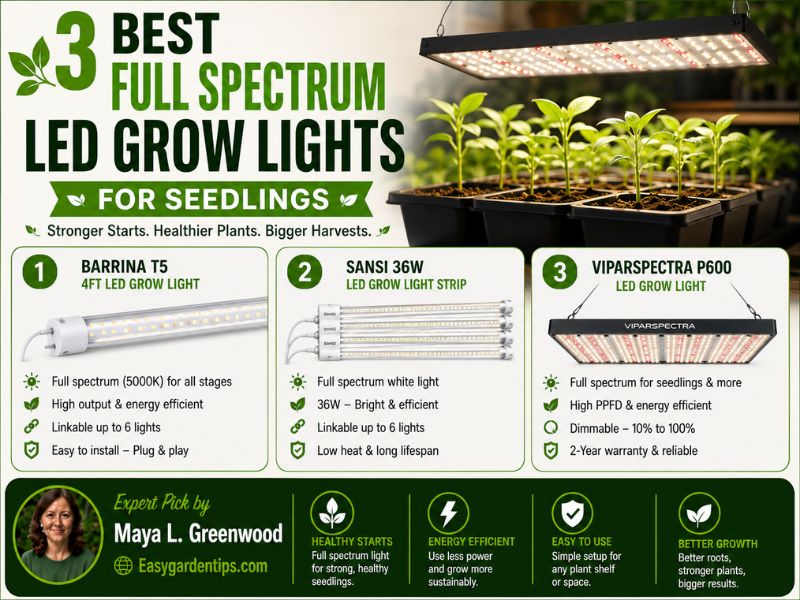
3 Best Full Spectrum LED Grow Lights for Seedlings
Seedlings need a different lighting setup from mature houseplants. A young plant has a small root system, delicate leaves, and limited ability to tolerate heat or water stress. At the same time, insufficient light quickly produces thin stems, stretched growth, and seedlings that struggle after transplanting.
The best full spectrum led grow lights for seedlings should distribute light uniformly across the tray and allow the fixture to move upward as plants grow. Adjustable height, appropriate intensity, timer compatibility, low heat near the canopy, and sufficient edge coverage are more important than exaggerated equivalent-wattage claims.
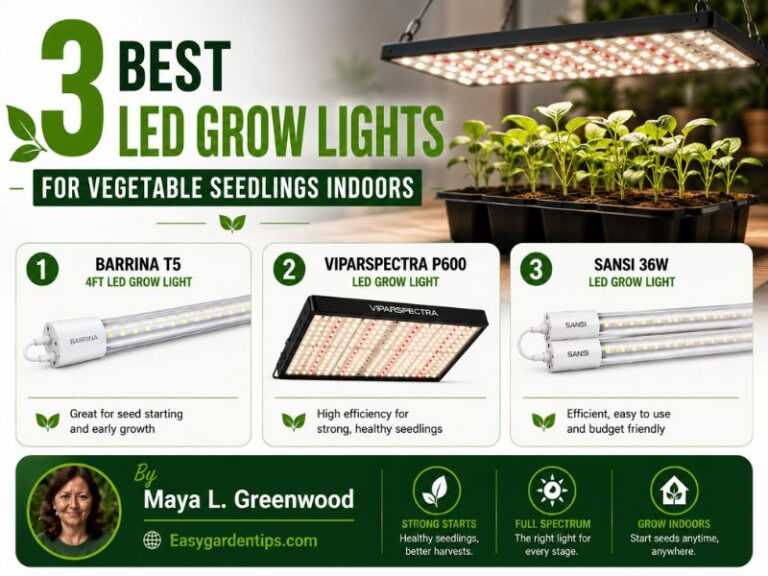
My primary recommendation is the iGrowtek 2-Foot Full Spectrum LED Seedling Grow Light With Adjustable Stand. It combines the frame, overhead light, height adjustment, and timer outlet into one straightforward setup. I would choose it for a beginner starting one standard tray or a compact group of seedlings.
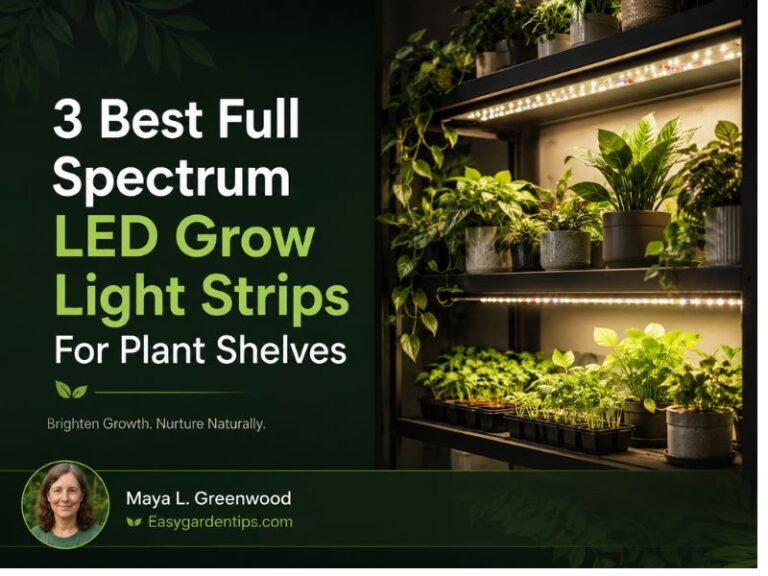
For several trays or a multi-level rack, I would choose the Barrina T5 2-Foot Full Spectrum LED Grow Lights, 8-Pack. Eight 10-watt bars provide 80 watts of combined power and can be distributed across multiple shelves or arranged in parallel over wider trays.
The Mars Hydro TS600 100W Full Spectrum LED Grow Light is the stronger option for a concentrated 2×2-foot seedling area or for keeping plants under the same fixture beyond the early seedling stage. Its output is easier to overapply to newly emerged seedlings, so conservative dimming and hanging height are essential.
The product order reflects broad seed-starting suitability rather than maximum power. The iGrowtek ranks first because it solves the beginner’s complete setup problem. Barrina is more scalable, while Mars Hydro provides greater intensity for a dense or longer-term growing area.
Seed-Starting Setup Selector
| Seed-starting situation | Recommended product | Main reason |
| First-time grower with one tray | iGrowtek | Stand, light, and timer form one system |
| Small apartment or tabletop | iGrowtek | No rack or ceiling mounting required |
| Two to four shelf levels | Barrina T5 | Eight bars can be divided among levels |
| Several rectangular trays | Barrina T5 | Linear fixtures provide even tray coverage |
| Dense 2×2-foot seedling area | Mars Hydro TS600 | Strong overhead panel-style output |
| Plants kept indoors after seedling stage | Mars Hydro TS600 | Greater intensity for continued vegetative growth |
| Very small propagation cells | iGrowtek or dimmed Barrina | Easier to manage close-range intensity |
| Mature fruiting plants | Mars Hydro or larger fixture | Seedling stand may not provide enough long-term output |
One product does not automatically fit every seedling stage. A gentle setup that works immediately after germination may need to be raised, expanded, or replaced once leaves overlap and plants begin rapid vegetative growth.
Best Full Spectrum LED Grow Lights for Seedlings Reviewed
| Image | Product Name | Check Price |
|---|---|---|
Best Choice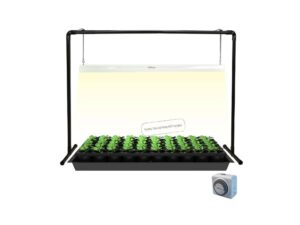 | iGrowtek 2-Foot Full Spectrum LED Seedling Grow Light With Adjustable Stand | Check Price |
Second Best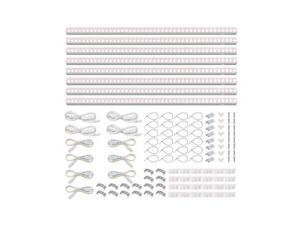 | Barrina T5 2-Foot Full Spectrum LED Grow Lights, 8-Pack | Check Price |
Third Choice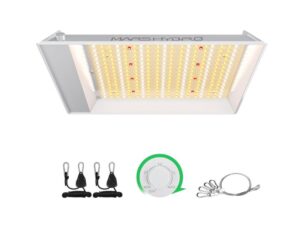 | Mars Hydro TS600 100W Full Spectrum LED Grow Light | Check Price |
1. iGrowtek 2-Foot Full Spectrum LED Seedling Grow Light With Adjustable Stand
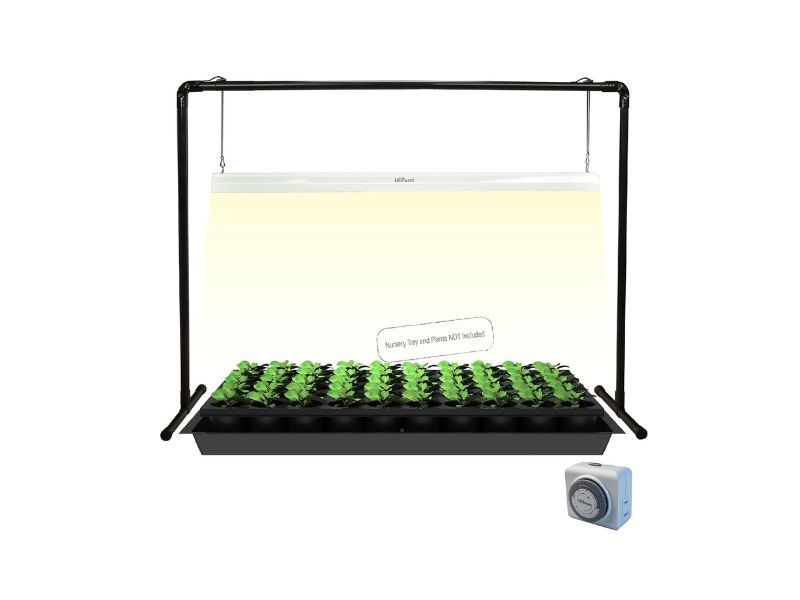
Key Features
- Approximately two-foot light fixture
- Natural-white full-spectrum LEDs
- Adjustable-height iron frame
- Freestanding tabletop design
- Timer outlet included
- Suitable for a compact seedling tray
- No shelf or ceiling installation required
- Easy canopy-height adjustment
- Open frame allows airflow
- Best suited to one primary growing level
The iGrowtek ranks first because it includes the structural equipment that beginning seed starters often forget to plan. A light cannot remain useful if there is no safe way to hold it level above the tray or raise it as seedlings grow.
Its approximately two-foot width suits a compact seed tray or several small propagation containers. The freestanding frame can sit on a table, bench, or counter without drilling into a shelf.
Height adjustment is the most important feature. Newly emerged seedlings can begin relatively close to a moderate-output light, and the fixture can be raised as stems and leaves develop. The light should remain level so plants at one end do not stretch toward a higher or off-center source.
The included timer outlet creates a repeatable photoperiod. Consistency is important because manually operated lights are easily forgotten or left running far longer than intended.
The open frame promotes airflow and makes watering access easier than a closed cabinet. Its principal limitation is capacity: the stand provides only one illuminated level and is not intended for a large multi-tray operation.
My verdict: iGrowtek is the most practical first seed-starting light for a single tray. It offers less expansion potential than Barrina and less output than Mars Hydro, but it provides the easiest complete setup for a beginner.
2. Barrina T5 2-Foot Full Spectrum LED Grow Lights, 8-Pack
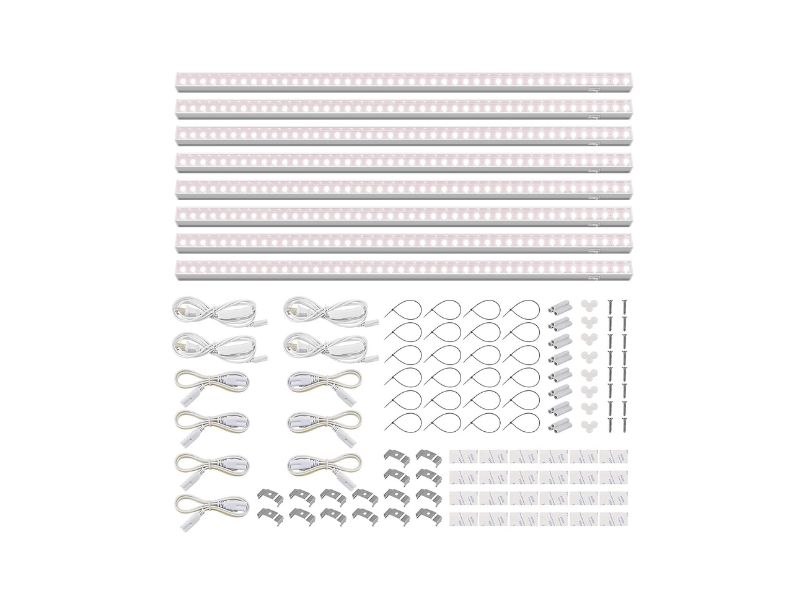
Key Features
- Eight two-foot T5-style LED bars
- 10 watts per bar
- 80 watts combined
- Pinkish-white full-spectrum output
- Linkable fixtures
- Plug-and-play installation
- Low-profile housings
- Individual fixture arrangement
- Suitable for multi-level seedling racks
- External timer required
Barrina’s modular system is the best option for growers starting more than one tray. Eight bars can be divided among several shelf levels or mounted together for greater coverage across a large propagation area.
Two bars per shelf create a practical four-level arrangement. A deeper shelf may need three or four parallel fixtures so seedlings at the front and rear receive similar light.
The pinkish-white spectrum includes plant-useful wavelengths while remaining easier for human vision than a strongly purple fixture. Seedling color, leaf spots, pests, and surface mold remain reasonably visible.
The bars are linkable, which reduces cable clutter. Users must stay within the connection limit and ensure the timer supports the combined electrical load.
No central dimmer is included in this version. Output is managed by altering bar count, spacing, hanging distance, or daily duration. That approach provides flexibility but requires more setup judgment than the iGrowtek stand.
My verdict: Barrina is the strongest scalable choice for several trays or shelves. It ranks second because a rack, timer, and adjustable mounting method must be provided separately.
3. Mars Hydro TS600 100W Full Spectrum LED Grow Light
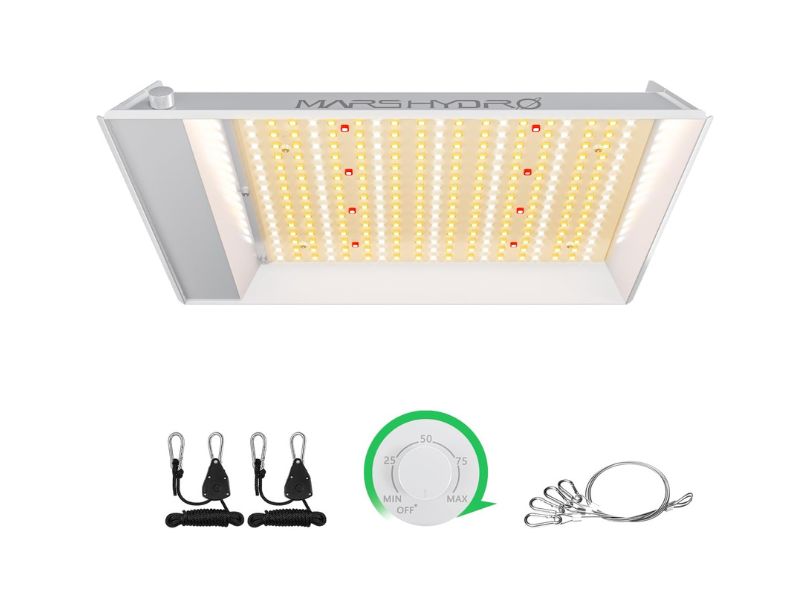
Key Features
- Approximately 100-watt actual power
- Full-spectrum panel-style output
- Updated diode layout
- Reflective hood
- Dimmable current version
- Approximately 2×2-foot core growing area
- Passive fanless cooling
- Hanging hardware
- Suitable beyond the seedling stage
- External timer required
Mars Hydro TS600 is the highest-output fixture in this comparison. It is suited to a dense 2×2-foot seedling area and can continue supporting plants after transplanting into larger containers.
The reflective hood directs light toward the canopy and reduces some sideways spill. The updated dimmable design is particularly useful for young seedlings because full output at close range may be excessive.
The panel distributes light across a square area rather than along a narrow row. It fits closely arranged trays or a compact growing enclosure better than an unusually long shelf.
At 100 watts, it adds more heat to the growing area than the smaller options. Passive cooling eliminates fan noise, but room airflow and safe clearance around the driver remain necessary.
This fixture requires secure overhead suspension. Its ratchet hangers should attach to a stable structure, and the panel must remain level.
My verdict: TS600 is the better choice when seedlings will remain indoors into vegetative growth or when a concentrated tray area needs stronger output. It ranks third for beginners because safe hanging, dimming, and heat management demand more planning.
Seedling-Light Comparison
| Product | Format | Power class | Coverage shape | Height adjustment | Timer | Dimming | Best use |
| iGrowtek | Two-foot light with stand | Moderate | One rectangular tray | Built into stand | Included outlet timer | Mainly by height | First-time seed starting |
| Barrina T5 | Eight linear bars | 80W total | Shelves and long trays | Depends on mounting | External | By bar count and height | Multi-tier seedling rack |
| Mars Hydro TS600 | Compact overhead panel | About 100W | Approximately 2×2 ft | Hanging system | External | Yes, current version | Dense trays and continued growth |
The iGrowtek provides the simplest setup. Barrina offers the greatest layout flexibility. Mars Hydro supplies the most concentrated output.
Total wattage should be interpreted according to the growing area. Eight Barrina bars distributed across four shelves do not deliver 80 watts to each shelf; each level receives approximately 20 watts when two bars are installed.
What Seedlings Need From a Grow Light
Uniformity Across the Tray
Uniform coverage is more important than an extreme center reading. If center seedlings remain compact while edge seedlings lean and stretch, the fixture is too small, too high, or incorrectly positioned.
Check all four corners and rotate trays only as a temporary correction. A permanent leaning pattern means coverage should be improved.
Appropriate Intensity
Young seedlings need enough intensity to prevent stretching, but tender cotyledons can be damaged by an intense panel placed too close.
Intensity should increase gradually as plants produce true leaves and develop stronger roots.
Height Adjustment
Seedlings can grow several inches in a short period. A fixed light may become too close before the grower notices.
The ability to raise the fixture is essential. Adjustable chains, ratchet hangers, movable shelves, or a dedicated frame all solve this problem.
Consistent Photoperiod
Seedlings respond more predictably to a stable schedule than irregular manual operation. A timer also prevents lights from remaining on continuously.
Manageable Heat
LEDs are efficient but still add heat. Heat can dry small cells rapidly, warm enclosed humidity domes, and increase water stress.
Measure temperature at leaf height rather than relying only on the room thermostat.
Does Light Help Seeds Germinate?
Light requirements during germination vary by species.
Some seeds germinate well when surface-sown and exposed to light. Others germinate better when covered and kept dark. Many common vegetable seeds rely primarily on moisture and temperature until emergence.
Check the sowing instructions for the exact species.
Even when light is not needed for germination, the fixture should be ready before seedlings emerge. A newly emerged seedling can stretch rapidly if it spends its first day in weak room light.
Cotyledons Versus True Leaves
The first leaf-like structures visible after germination are often cotyledons, or seed leaves. They support early development using stored energy and photosynthesis.
True leaves appear afterward and resemble the mature plant’s normal foliage.
A practical lighting approach is:
- Begin moderate light as soon as shoots emerge.
- Keep the fixture level and evenly centered.
- Watch cotyledons for bleaching.
- Increase intensity gradually after true leaves appear.
- Raise the fixture as the canopy grows.
- Separate unusually tall seedlings from short seedlings when necessary.
Full Spectrum Explained for Seedlings
White-Light Foundation
Full-spectrum white fixtures use phosphor-converted LEDs to produce a broad visible spectrum. They allow seedlings to be inspected without the color distortion caused by purple light.
Blue Wavelengths
Blue light contributes to compact form, leaf development, and normal photomorphogenesis. Cool or natural-white LEDs generally provide a meaningful blue component.
Red Wavelengths
Red light is used efficiently in photosynthesis. A balanced seedling fixture includes red wavelengths without relying entirely on red output.
Green Wavelengths
Green light penetrates leaves and dense canopies differently from red and blue. It also improves human visual comfort and color accuracy.
Full Spectrum Is Not an Output Rating
A full-spectrum light can still be too weak. Spectrum describes wavelength distribution, while PPFD describes the photons reaching the canopy.
PPF, PPFD, and DLI
PPF
Photosynthetic photon flux measures the total PAR photons emitted per second in µmol/s.
It describes fixture output but not tray-level uniformity.
PPFD
Photosynthetic photon flux density measures the photons reaching one square meter per second in µmol/m²/s.
PPFD changes with:
- Hanging height
- Position across the tray
- Fixture optics
- Bar spacing
- Dimmer level
- Reflective walls
- Plant height
Measure at seedling-leaf height rather than on an empty floor.
DLI
Daily light integral describes the total plant-usable light received during the daily photoperiod.
Use:
DLI = PPFD × operating seconds ÷ 1,000,000
For example, a seedling canopy receiving 150 µmol/m²/s for 16 hours accumulates:
150 × 57,600 ÷ 1,000,000 = 8.64 mol/m²/day
This calculation shows why intensity and time must be considered together.
Practical Light Levels
Exact targets vary by species, but a general progression can be useful.
Newly Emerged Seedlings
Begin with moderate intensity and observe cotyledons. Tender seedlings do not need maximum panel output immediately.
Established Seedlings
After true leaves develop, many vegetables and flowers benefit from stronger light that supports compact stems and root development.
Transplant-Size Plants
Larger plants form overlapping canopies and may need more total output. Raise the fixture to improve spread or move plants beneath a larger light.
High-Light Seedlings
Tomatoes, peppers, brassicas, and many sun-loving flowers generally need stronger illumination than shade-adapted ornamentals.
Positioning Lights Over a Tray
Center the Fixture
The light should follow the tray’s shape. A narrow linear fixture works well over a long row, while a panel suits a square arrangement.
Level the Canopy
Seedlings germinate at different times and grow at different rates. Use risers beneath short containers or move unusually tall plants to a separate group.
Check the Corners
Tray corners are common weak points. If corner seedlings lean inward, lower the fixture within safe limits, add another bar, or use a wider light.
Avoid Obstructions
Humidity domes, labels, shelf edges, and hanging cords can cast shadows. Once most seeds have emerged, remove a humidity dome when appropriate for the species and propagation method.
Height and Dimming Strategy
iGrowtek
Use the stand’s height adjustment to keep the fixture near enough for compact growth without heating or bleaching the leaves. Raise it in small increments as seedlings grow.
Barrina
Adjust both bar count and mounting distance. Two bars mounted evenly may work better than one bar placed extremely close.
Mars Hydro
Start at a conservative dimmer setting and appropriate height. Increase output gradually after seedlings establish.
Do not change height and dimmer setting dramatically at the same time. One change at a time makes plant response easier to interpret.
Recommended Daily Duration
A practical starting period for many seedlings is 14–16 hours daily, followed by 8–10 hours of darkness.
Some species may perform well with 12–14 hours, especially when natural daylight contributes. More hours do not automatically produce better seedlings if intensity is already excessive.
Use the timer consistently. Check electronic timers after power interruptions because schedules may reset.
Recognizing Insufficient Light
Leggy Growth
Long, thin stems are the most recognizable symptom. Seedlings stretch toward the light in an attempt to increase exposure.
Leaning
If the whole tray leans in one direction, the light is off-center or another source is stronger.
Pale True Leaves
Pale growth can result from insufficient light, nutrient issues, saturated media, root problems, or incorrect temperature. Evaluate the complete environment.
Large Internode Spacing
Long spaces between leaves indicate insufficient intensity or an unsuitable spectral environment.
Weak Transplants
Stretched seedlings bend easily and may struggle in wind after moving outdoors.
Recognizing Excessive Light
- Bleached cotyledons
- Dry patches on upper leaves
- Upward curling
- Warm leaf surfaces
- Very compact but stressed growth
- Rapidly drying cells
- Damage concentrated beneath the center of a panel
Raise or dim the fixture and evaluate newly formed leaves. Damaged cotyledons will not return to their previous appearance.
Light Is Only Part of Strong Seedling Growth
Temperature
Warmth speeds germination, but many seedlings prefer cooler air after emergence. Excessive post-germination heat encourages stretching.
A heat mat may be useful during germination and unnecessary afterward. Follow species-specific guidance.
Air Movement
Gentle airflow helps strengthen stems and reduces stagnant humidity. Do not direct a strong fan continuously at delicate seedlings.
Watering
Small cells dry quickly but are also vulnerable to saturation. Bottom watering can help keep foliage dry and distribute moisture more evenly.
Nutrition
Seed-starting media may contain little fertilizer. Begin a suitable dilute feeding schedule only after the plant reaches the appropriate stage.
Excess fertilizer cannot compensate for weak light and can damage young roots.
Spacing
Crowded seedlings shade one another and restrict airflow. Thin or transplant them when necessary.
Preventing Damping-Off
Damping-off describes seedling collapse caused by several soilborne or water-mold pathogens. Excess moisture, poor airflow, contaminated materials, and dense planting increase risk.
Reduce risk by:
- Using clean containers
- Using suitable fresh propagation media
- Avoiding saturated conditions
- Providing airflow
- Removing humidity domes at the correct stage
- Not crowding seedlings
- Cleaning tools
- Keeping foliage reasonably dry
A grow light does not cure damping-off. However, adequate light can help seedlings use water more effectively and maintain stronger growth.
Tray and Shelf Sizing
Standard Trays
A common propagation tray is roughly 10×20 inches. A two-foot light can cover the tray’s length, but one narrow bar may not cover its width evenly.
Multiple Trays
Two trays side by side create an area around 20×20 inches. A square panel such as the Mars Hydro is often easier to position over this arrangement.
Multi-Level Racks
Barrina’s eight bars can serve several levels. Allow clearance for:
- Fixture thickness
- Mounting hardware
- Seedling height
- Containers
- Watering access
- Air circulation
Energy Consumption
Use:
Monthly kWh = watts ÷ 1,000 × daily hours × 30
Barrina T5
All eight bars at 80 watts for 16 hours:
0.080 × 16 × 30 = 38.4 kWh per month
Two 10-watt bars on one shelf consume:
0.020 × 16 × 30 = 9.6 kWh per month
Mars Hydro TS600
At 100 watts for 16 hours:
0.100 × 16 × 30 = 48 kWh per month
iGrowtek
Use the fixture’s actual listed wattage from the purchased version in the same formula. Do not calculate with an equivalent-wattage claim.
Electrical and Water Safety
Keep Power Above Drainage Areas
Mount timers and power strips away from the floor and away from tray drainage.
Form Drip Loops
Allow cords to dip below electrical connections so water cannot run directly into an outlet.
Secure Hanging Hardware
Panels and bars should use properly rated clips, chains, screws, or hangers. Do not rely solely on weak adhesive above wet trays.
Unplug Before Rearranging Wet Equipment
Disconnect power before moving lights, trays, or water containers when accidental splashing is possible.
Inspect for Heat
Stop using equipment that develops:
- Scorched connectors
- Melting plastic
- Strong electrical odor
- Visible arcing
- Unusual flicker
- Excessive driver temperature
Hardening Seedlings Before Transplanting
Indoor-grown seedlings are not prepared for immediate exposure to outdoor sun, wind, and temperature changes.
A strong LED fixture does not eliminate the need for hardening off.
A gradual process generally involves:
- Begin with a short period in sheltered outdoor conditions.
- Avoid intense midday sun initially.
- Increase exposure over several days.
- Protect seedlings from strong wind.
- Monitor soil moisture closely.
- Bring plants inside during unsuitable cold.
- Extend sun and outdoor time gradually.
Outdoor sunlight can be far more intense than an indoor fixture. Sudden full-sun exposure may bleach or scorch leaves.
Common Seedling-Light Mistakes
- Waiting until seedlings stretch before turning on the light
- Placing lights several feet above the tray
- Lowering a powerful panel too close
- Checking only the tray center
- Using one narrow bar over a wide tray
- Leaving a humidity dome on too long
- Running lights 24 hours per day
- Keeping a heat mat on after emergence without need
- Watering on a fixed schedule
- Crowding seedlings
- Forgetting to raise the fixture
- Using weak window light as the only source in winter
- Trusting equivalent wattage
- Ignoring canopy temperature
- Moving indoor seedlings directly into full outdoor sun
- Placing electrical connections beneath drainage trays
- Changing brightness, height, and duration simultaneously
Frequently Asked Questions
What are the best full spectrum LED grow lights for seedlings?
The iGrowtek two-foot stand offers the easiest complete setup for one tray. Barrina is better for multiple shelves, while Mars Hydro TS600 provides stronger output for a concentrated area and continued vegetative growth.
Do seeds need grow lights before germination?
It depends on the species because some seeds need light and others prefer darkness. Check the seed packet or propagation instructions. Prepare the grow light before emergence so new shoots do not stretch.
When should grow lights be turned on?
Turn them on as soon as seedlings emerge unless the species requires an earlier light treatment. Newly emerged shoots can stretch quickly in weak room lighting. Use moderate intensity and consistent timing.
How long should seedling grow lights run?
Fourteen to sixteen hours daily is a practical starting range for many seedlings. Include natural daylight when relevant and provide 8–10 hours of darkness. Species and intensity can justify adjustments.
How close should LED lights be to seedlings?
Distance depends on fixture output, optics, and dimmer setting. Follow the exact product guidance and watch for stretching or bleaching. Moderate bars may sit closer than a 100-watt panel.
Are full-spectrum lights better than purple lights?
White full-spectrum lights are easier for people to work under and inspect seedlings. Both can support growth when output is appropriate. White light reveals natural leaf color and health problems more clearly.
Can seedlings receive too much LED light?
Yes, excessive intensity can bleach cotyledons, warm leaves, and increase water stress. Raise or dim the fixture when damage appears, then evaluate new growth rather than already injured tissue.
Why are my seedlings tall and thin?
Insufficient light, excessive warmth, crowding, or delayed lighting commonly causes stretching. Move the fixture closer within safe limits, increase output, reduce unnecessary heat, and thin crowded plants.
Is a south-facing window enough for seedlings?
Sometimes, but window light is often uneven and seasonally unreliable. Seedlings may lean, receive weak morning or afternoon exposure, or stretch during cloudy weather. Supplemental overhead lighting produces more consistent form.
Is 5000K suitable for seedlings?
Yes, 5000K white light is appropriate for seedling and vegetative growth. Color temperature does not measure intensity, so fixture output and distance still need to be adequate.
How many Barrina bars should be used per tray?
Two evenly spaced bars are a sensible starting point for many standard trays. High-light seedlings or deeper shelves may need more, while low-light propagation may need fewer. Check the corners for leaning.
Is the Mars Hydro TS600 too powerful for seedlings?
It can be excessive at full power or close range. Start dimmed and appropriately elevated, then increase output gradually as true leaves develop. Use the current product’s distance chart.
Do seedlings need a heat mat and grow light?
Many seeds benefit from warmth during germination, while emerged seedlings need appropriate light. Some species prefer cooler conditions after sprouting. Remove or reduce bottom heat when the propagation instructions recommend it.
Should seedlings receive darkness?
Yes, a regular dark period supports normal plant physiology. Continuous 24-hour lighting is unnecessary for most seedlings and increases energy use. A 16-hour day leaves eight hours of darkness.
Can LED lights prevent damping-off?
No, lighting alone cannot prevent or cure damping-off. Clean materials, proper moisture, airflow, spacing, and temperature management are essential. Adequate light helps seedlings grow vigorously but does not eliminate pathogens.
When should the grow light be raised?
Raise it when leaves approach the fixture or show excessive-intensity symptoms. Also raise it to maintain wider coverage as the canopy expands. Check clearance daily during rapid growth.
Can seedlings stay under the same light after transplanting?
Yes, if the fixture provides sufficient coverage and intensity for larger plants. Mars Hydro offers the most continued-growth capacity among these products. The iGrowtek stand may become restrictive as plants increase in size.
Do seedlings still need hardening off?
Yes, indoor-grown seedlings must acclimate gradually to outdoor sun, wind, and temperature. Even strong grow lights are usually less intense than direct outdoor sunlight. Increase exposure over several days.
Conclusion
The best full spectrum led grow lights for seedlings must provide even tray coverage and a practical way to adjust height or output. A powerful fixture with weak corners or poor positioning can produce less consistent seedlings than a moderate light installed correctly.
The iGrowtek 2-Foot Full Spectrum LED Seedling Grow Light remains my primary recommendation for a beginner or one-tray setup. Its freestanding adjustable frame and timer outlet remove the need to build a rack or ceiling-mounted suspension system.
Barrina T5 is the more scalable choice. Eight linkable bars can illuminate several shelves or be grouped in parallel over standard propagation trays. The user must supply the rack, timer, and height-adjustable mounting arrangement.
Mars Hydro TS600 is appropriate for a dense 2×2-foot seedling area or plants that will remain indoors beyond the early stage. Its greater output requires careful dimming, hanging height, airflow, and canopy monitoring.
Turn the lights on promptly after emergence, provide a consistent 14–16-hour starting schedule, and check the tray corners for leaning. Raise the fixture as plants grow and harden seedlings gradually before moving them outdoors.
For the simplest reliable start with one tray, I would choose the iGrowtek adjustable stand.

I’m Maya L. Greenwood, a lifelong plant lover who believes anyone can grow something beautiful with the right guidance. After years of testing soil mixes, pruning methods, irrigation tricks, and pest-safe solutions, I started EasyGardenTips.com to turn hard-won lessons into step-by-step advice. From seed starting and container gardens to composting and seasonal checklists, my goal is to make gardening simple, sustainable, and fun.