3 Best LED Grow Lights for Home Use: Practical Indoor Options
Indoor plants often receive less usable light than their location suggests. A room may look bright to human eyes while providing insufficient photosynthetically active radiation for sustained plant growth. This becomes particularly noticeable during winter, in north-facing rooms, and when plants sit several feet from a window.
The best LED grow lights for home use solve this problem without making an ordinary living space unnecessarily complicated. They should provide an appropriate spectrum, cover the intended plants evenly, fit the available installation space, and remain manageable as part of a daily routine.
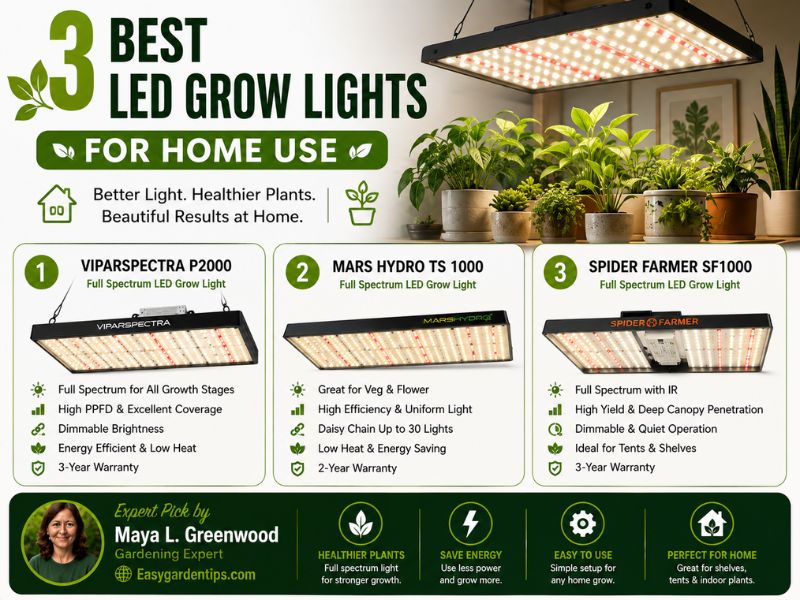
My primary recommendation is the Spider Farmer SF1000 Full-Spectrum Dimmable LED Grow Light because its dimmable 100-watt panel provides the strongest balance of intensity, coverage, and adjustability for a dedicated indoor growing area. It is particularly suitable for plant shelves, seedling stations, and groups containing plants with different light requirements.
I would choose the Barrina T10 Pro 42W Vertical Grow Light when floor-standing convenience and side illumination matter more than maximum overhead intensity. Its vertical design makes it easier to illuminate tall decorative plants without suspending a panel from the ceiling.
The SANSI BR30 36W LED Grow Light Bulb is the most practical option for one large plant or a compact group. It fits a standard US E26 socket, although it requires a sturdy, open fixture that can safely support its size and weight.
Best LED Grow Lights for Home Use Reviewed
| Image | Product Name | Check Price |
|---|---|---|
Best Choice | Spider Farmer SF1000 Full-Spectrum Dimmable LED Grow Light | Check Price |
Second Best | Barrina T10 Pro 42W Vertical Grow Light | Check Price |
Third Choice | SANSI BR30 36W LED Grow Light Bulb | Check Price |
These three lights address distinctly different household arrangements. The Spider Farmer is a hanging panel for a concentrated growing zone, the Barrina is a freestanding vertical lamp for tall plants, and the SANSI is a directional bulb that integrates into a suitable household fixture.
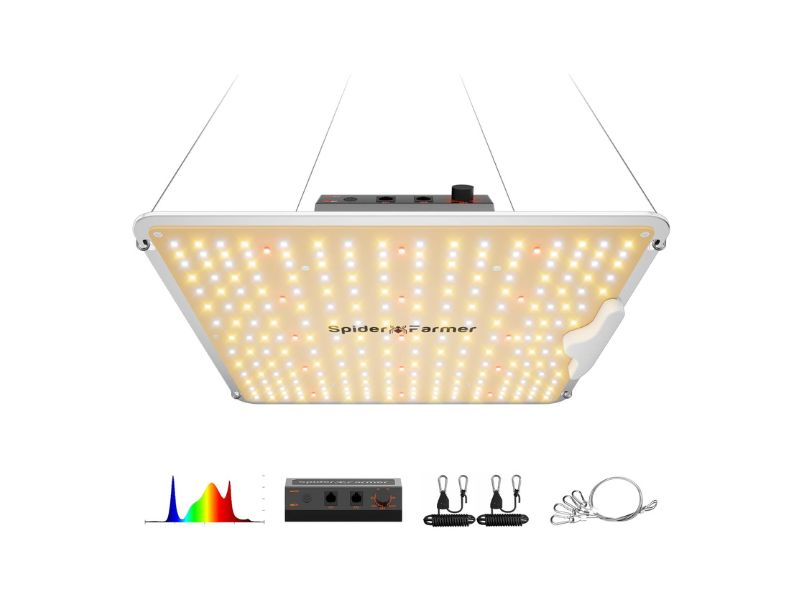
1. Spider Farmer SF1000 Full-Spectrum Dimmable LED Grow Light
Key Features
- Approximately 100 watts of actual power
- Full-spectrum output for vegetative and flowering growth
- Adjustable intensity through an onboard dimmer
- Passive, fanless cooling
- Panel-style overhead coverage
- Hanging hardware included
- Suitable for a dedicated indoor plant zone
The Spider Farmer SF1000 is the most capable all-purpose option in this comparison. Unlike a small bulb or decorative floor light, it is designed to deliver concentrated overhead illumination across a defined growing footprint. That makes it a sensible choice for a plant shelf, utility-room growing corner, seed-starting table, or compact enclosed setup.
Its full-spectrum diode array produces white light supplemented by wavelengths intended to support multiple stages of growth. This is more pleasant to work around than the intense purple appearance associated with older red-and-blue fixtures. Plant colors remain easier to inspect, and the light is less visually disruptive when used in a spare room or dedicated plant area.
The dimmer is an especially useful feature at home. Seedlings, shade-tolerant foliage plants, succulents, and fruiting plants do not require the same intensity. Instead of controlling exposure only by raising the fixture, the user can reduce output and then increase it as plants acclimate. Dimming also helps when the panel is mounted in a room where full output would be unnecessarily bright.
A fanless design eliminates fan noise and removes one moving component that could collect dust or fail. Heat still needs somewhere to go, however. The fixture should remain in open air with clearance around its upper surface rather than being pressed against a shelf or enclosed in cabinetry.
The SF1000 makes the most sense when plants can be grouped under one light. Its intensity is less useful if plants are scattered across separate rooms. It also requires an overhead mounting point and enough height to maintain a suitable distance from the canopy. Renters or anyone unwilling to hang hardware may find a floor-standing lamp easier to accommodate.
Coverage claims must be interpreted cautiously. A panel can illuminate a larger area for low-light foliage than it can adequately support for flowering or fruiting plants. The edges of the footprint receive less intensity than its center, so high-light plants should occupy the central zone while tolerant plants can sit nearer the perimeter.
For home growers who want meaningful control rather than a decorative supplement, this is the strongest of the three products. It offers enough output to build a productive growing station, yet its dimmer prevents that power from becoming an all-or-nothing commitment.
The Spider Farmer SF1000 is my primary recommendation for a grouped collection, propagation station, or compact indoor garden. Choose it when performance and adjustability matter more than blending the fixture into a living-room design.
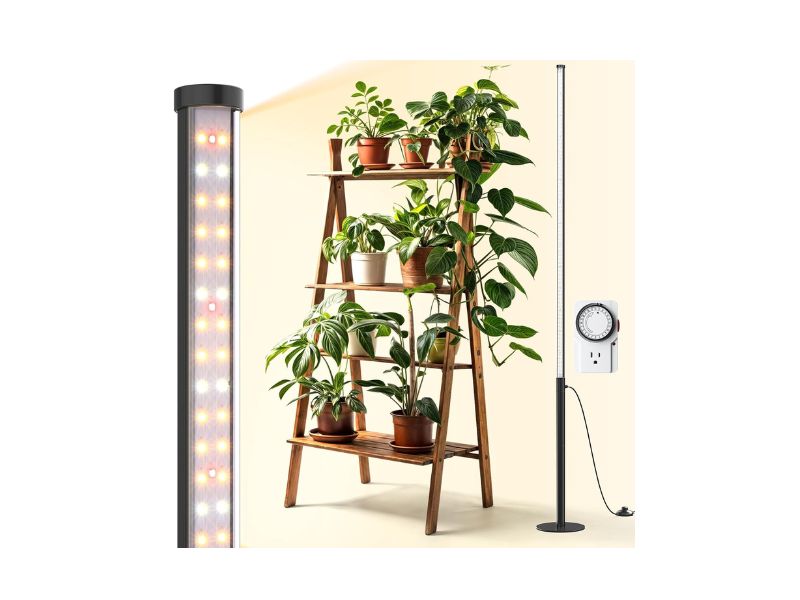
2. Barrina T10 Pro 42W Vertical Grow Light
Key Features
- 42-watt vertical LED light
- Adjustable overall height from approximately 4 to 5.6 feet
- Full-spectrum configuration with supplemental red wavelengths
- Built-in mechanical timer
- Freestanding base
- Foot switch for accessible operation
- Designed for side lighting tall plants
The Barrina T10 Pro approaches indoor plant lighting differently. Rather than shining downward from a suspended panel, its long illuminated section stands beside the plant. This orientation can be useful for monstera, bird of paradise, fiddle-leaf fig, palm, climbing philodendron, and other plants whose foliage extends vertically.
Side lighting does not automatically replace strong overhead light. Leaves naturally orient toward the brightest source, so a stationary light placed on only one side may encourage the plant to lean or turn. Rotating the pot regularly—or placing the light to complement a window—can produce more balanced growth.
The freestanding format is its main advantage in an ordinary home. No ceiling hook or shelf mounting system is required, and the height can be adjusted to suit a developing plant. This reduces setup work and makes the light easier to relocate when furniture or plant arrangements change.
Its output is spread along a vertical bar rather than concentrated into a small point. Consequently, several leaves at different heights can receive useful supplemental illumination. This is often more practical for a tall specimen than pointing a conventional bulb toward the upper canopy and leaving lower foliage comparatively shaded.
The built-in mechanical timer simplifies daily scheduling. Consistent timing matters more than occasional bursts of very long exposure. A repeatable light period allows plants to receive a predictable photoperiod while preserving a dark period for normal physiological processes.
The floor base still requires planning. It must stand on a stable, dry surface where it will not be knocked over by children, pets, a vacuum, or normal foot traffic. Its cord should be routed without creating a trip hazard. Because plant watering introduces moisture, the base and electrical connections should remain outside the splash zone.
At 42 watts, the T10 Pro should be viewed as a focused household light rather than a replacement for a high-output horticultural panel. It is well matched to foliage plants and decorative arrangements, but it is not the product I would select for a dense tray of sun-loving seedlings or a demanding fruiting crop.
The visible fixture also becomes part of the room. Some users will appreciate its clean vertical appearance, while others may prefer a bulb concealed in a familiar lamp. Placement therefore involves both horticultural coverage and interior design.
I would choose the Barrina T10 Pro for one tall floor plant or a vertical cluster that needs convenient side illumination. It is easier to integrate into a furnished room than the Spider Farmer, although it offers less concentrated intensity for demanding plants.
3. SANSI BR30 36W LED Grow Light Bulb
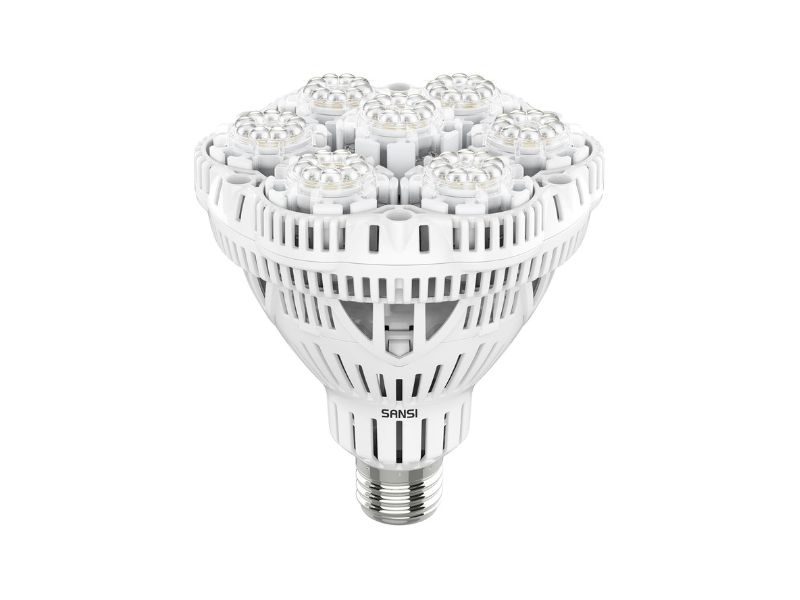
Key Features
- 36-watt BR30-style grow bulb
- Standard US E26 screw base
- Approximately 4000K white full-spectrum output
- Manufacturer-specified PPF of 65.6 µmol/s
- Optical lens for directional light distribution
- Ceramic heat-dissipation construction
- ETL-listed configuration
- Intended for open, adequately ventilated fixtures
The SANSI BR30 is a straightforward solution for illuminating a limited area without installing a dedicated panel. It screws into a compatible E26 socket and directs light toward one plant or a tightly grouped collection. A clamp lamp, pendant socket, or adjustable floor lamp can turn it into a flexible home setup.
Compatibility involves more than matching the screw base. This is a large, relatively heavy 36-watt bulb, so a weak desk lamp or a socket with a loose neck may sag under its weight. The shade must also be wide enough not to touch or trap heat around the bulb. SANSI advises against tightly enclosed fixtures because airflow is necessary for thermal management.
The 4000K appearance is relatively neutral and allows foliage colors to look natural. Its broad visible spectrum can support common houseplants through ongoing vegetative growth. The focused optical design is useful for getting more light onto the intended plant, but it also produces a more limited footprint than a panel or long bar.
Distance has a substantial effect on performance. A bulb placed too far away may illuminate the room while providing little useful plant-level intensity. Set too close, it can create a bright central hotspot, bleach sensitive foliage, or produce excessive leaf temperature. Starting conservatively and watching the newest growth is safer than immediately placing the bulb close to the canopy.
The bulb has no integrated dimmer or scheduling control. Intensity is adjusted by changing its distance, and automatic operation requires a compatible external outlet timer or smart plug. Any external controller should be rated for the electrical load and used according to its instructions.
This design is best for a single medium-to-large plant, a group on a side table, or a focused display under a pendant. It is less efficient as a whole-shelf solution because one bulb creates a circular beam with diminishing intensity toward the edge. Several widely separated plants may need multiple sockets.
The ceramic construction helps transfer heat away from the LED components, but the bulb can still become warm during operation. It should be allowed to cool before handling, and it should never be covered by fabric, foliage, or decorative material.
The SANSI 36W bulb is the most adaptable choice for a small, focused arrangement. I would select it when a compatible fixture is already available and the goal is to support one important plant rather than construct a dedicated growing station.
LED Grow Light Comparison
| Product | Format | Actual Power | Spectrum Appearance | Intensity Control | Timer | Installation | Most Suitable Use | Main Limitation |
| Spider Farmer SF1000 | Hanging panel | About 100W | Full-spectrum white | Built-in dimmer | External timer needed | Suspended overhead | Plant shelves and grouped collections | Requires mounting space |
| Barrina T10 Pro | Vertical floor light | 42W | White full spectrum with red wavelengths | Distance and placement | Built-in mechanical timer | Freestanding | Tall decorative plants | Side lighting may cause leaning |
| SANSI BR30 36W | Directional bulb | 36W | 4000K full-spectrum white | Distance only | External timer needed | Compatible E26 fixture | One plant or compact cluster | Small, concentrated footprint |
The most important difference is not simply wattage. Each light distributes its output in a different shape. The Spider Farmer concentrates light downward across a rectangular growing zone, the Barrina spreads it vertically beside tall foliage, and the SANSI creates a directional cone from a conventional socket.
For multiple plants beneath one overhead point, the Spider Farmer is the more capable system. For a tall plant in a furnished room, the Barrina avoids ceiling installation. For one focused specimen, the SANSI offers the simplest modular arrangement if a suitable fixture is available.
How to Choose a Home LED Grow Light
Start With the Plant Arrangement
Before comparing specifications, identify where the plants actually live. Grow-light format should follow the arrangement rather than forcing plants into an unsuitable beam.
A shelf or rectangular table usually benefits from a panel or linear light suspended overhead. A tall floor plant may receive better coverage from a vertical fixture or an adjustable spotlight. A small group on a desk can often be supported by a focused bulb.
Measure the complete growing zone, including its width, depth, and maximum plant height. Allow space for the fixture, mounting hardware, ventilation, and future growth. A light that fits today may become difficult to position when a plant adds another foot of height.
Understand PPFD, PPF, and DLI
Grow-light terminology becomes much easier once three measurements are separated.
PPF, or photosynthetic photon flux, describes the total quantity of photosynthetically useful photons a fixture produces each second. It is measured in micromoles per second. PPF describes the fixture’s output, but it does not reveal how evenly that light reaches a particular plant.
PPFD, or photosynthetic photon flux density, describes how many of those photons reach a square meter each second. It is measured in µmol/m²/s. PPFD changes with hanging height, beam angle, position, and reflective surroundings.
DLI, or daily light integral, estimates the total photosynthetic light delivered over an entire day. It combines PPFD with operating time:
DLI = PPFD × lighting hours × 3,600 ÷ 1,000,000
For example, an average PPFD of 150 µmol/m²/s maintained for 12 hours produces a DLI of approximately 6.5 mol/m²/day. The same intensity for 16 hours provides roughly 8.6 mol/m²/day.
These figures are useful, but inexpensive handheld lux meters do not directly measure PPFD. Manufacturer maps can provide a starting point, though measurements taken under different test conditions are not always directly comparable.
Match Intensity to Plant Type
Low-light plants such as snake plants and ZZ plants tolerate modest conditions, but “low light” does not mean darkness. They still need enough energy to maintain foliage and produce occasional new growth.
Pothos, heartleaf philodendron, peace lily, many peperomias, and numerous tropical foliage plants commonly fall into a moderate-light category. They may survive in a dim corner but usually grow more compactly and retain better coloration with consistent supplemental light.
Succulents, cacti, herbs, seedlings, and many flowering or fruiting plants require substantially more intensity. A decorative lamp that prevents a pothos from declining may still be inadequate for compact succulent growth or productive herbs.
Plant response provides useful feedback. Long internodes, small pale leaves, loss of variegation, and leaning toward the source can indicate inadequate light. Bleached patches, curled upper leaves, or foliage that feels unusually hot can indicate excessive intensity or insufficient distance.
Do Not Use Wattage as the Only Performance Measure
Actual power consumption helps estimate electricity use and heat, but it does not tell the full performance story. Diode efficiency, driver performance, optical design, spectrum, mounting height, and beam distribution all influence how much usable light reaches the leaves.
A focused 36-watt bulb may create greater intensity at the center of a small area than a 42-watt vertical light spread along several feet. Conversely, a 100-watt panel may cover numerous plants more evenly even when none sits directly beneath a narrow beam.
Ignore large “equivalent wattage” numbers when comparing products. These figures often refer to older lighting technologies and do not provide a reliable horticultural comparison. Actual wattage, PPF, PPFD maps, and coverage at a stated hanging height are more meaningful.
Choose a Comfortable Spectrum for Living Areas
Most modern household grow lights use a white full spectrum that includes visible wavelengths plants can use. The exact spectral distribution varies, even when two products share the “full spectrum” description.
Color temperature affects how the light appears. Warmer light contains relatively more red and looks yellowish, while cooler light contains relatively more blue and appears crisp or bluish. A neutral 3500K–5000K appearance often integrates comfortably into a home and allows natural-looking plant inspection.
Red wavelengths can support photosynthesis and reproductive growth, while blue wavelengths influence compact vegetative development and leaf form. Ordinary houseplants do not generally require separate user-selectable color modes when a balanced full-spectrum fixture provides adequate intensity.
Consider Light Distribution
A fixture’s shape determines which leaves receive useful illumination.
Panels are effective over rectangular areas when mounted parallel to the plant canopy. Their center is normally more intense than their edges. Placing demanding plants centrally and tolerant species around the perimeter makes better use of this distribution.
Bulbs create a cone-shaped beam. Moving the bulb closer reduces the illuminated area while increasing central intensity. Raising it expands the footprint but reduces plant-level strength.
Vertical bars illuminate leaves from the side. This can reach the lower and middle portions of a tall plant, but plants may orient toward the fixture. Regular rotation helps maintain a balanced silhouette.
Select Dimming and Timer Features Carefully
A built-in dimmer is valuable when plant types change, seedlings mature, or the fixture cannot easily be raised. It permits gradual acclimation and reduces unnecessary output.
A timer automates the daily schedule. Built-in timers are convenient, but their behavior following a power interruption varies by design. An external mechanical timer is simple and repeatable, while a compatible smart plug may add scheduling flexibility.
Whatever controller is used, verify that it is rated for the fixture and suitable for the location. Do not overload an outlet strip or daisy-chain household extension cords to reach a distant plant.
Plan for Heat and Ventilation
LEDs are efficient, but they are not heat-free. Drivers, diodes, heat sinks, and bulb bodies release heat during operation. High temperatures can shorten component life and increase plant stress.
Leave the manufacturer-recommended clearance around the fixture. Do not place clothing, paper, curtains, or leaves against a light. Large bulbs should remain in open fixtures unless the manufacturer explicitly approves enclosed use.
A small amount of air movement can help equalize temperature around a dense growing area. However, household fans should not blow so strongly that tender leaves dry out or seedlings bend continuously.
Evaluate Household Practicality
A horticulturally capable light still needs to work within the home.
Consider visible brightness, mounting hardware, cord routing, noise, fixture appearance, and whether the light will shine directly into seated eye level. A panel that works well in a spare room may be uncomfortable above a living-room sofa.
Children and pets add further considerations. Hanging cords should remain inaccessible, floor lamps need stable placement, and hot or fragile components should not be within easy reach. Some pets chew foliage as well as electrical cords, so physical barriers may be necessary.
Setting Up a Grow Light at Home
Establish a Conservative Starting Height
Manufacturer hanging recommendations provide a starting range, not a universal rule. Different plants tolerate different intensities, and the same fixture behaves differently at full and reduced output.
Place sensitive foliage farther from the light initially. If the fixture is dimmable, begin below full power and increase output gradually over several days. Watch the upper leaves and new growth rather than relying only on how bright the room appears.
For a panel, keep the fixture parallel to the canopy. For a bulb, aim the center of the beam at the most light-demanding plant. For a vertical light, position it far enough away that it covers the plant’s height without creating an intense strip on the nearest leaves.
Create a Consistent Schedule
Most houseplants benefit from a regular daily light period and a period of darkness. A common starting schedule is approximately 10–14 hours, adjusted for plant type, light intensity, and natural window exposure.
A longer photoperiod cannot always compensate for extremely weak intensity. Similarly, leaving a powerful fixture on continuously may stress plants and wastes electricity. Use DLI as a conceptual guide: daily light depends on both strength and duration.
If plants receive morning sun, supplemental lighting may only be needed later in the day. In a windowless room, the grow light becomes the primary source and may require a longer, carefully managed schedule.
Acclimate Plants to Stronger Light
Plants adapted to a dim room can suffer when suddenly placed under an intense panel. Increase exposure gradually by raising the light, dimming it, or beginning with a shorter operating period.
Over one to two weeks, move toward the intended height and schedule while monitoring the foliage. New growth is often a better long-term indicator than old leaves, which developed under different conditions.
Arrange Plants by Light Requirement
Do not give every plant the same position merely because the pots fit together. Place high-light plants closer to the beam center and low-light plants near the edge or farther below.
Use stands or inverted sturdy pots to raise short plants so their canopies align with taller neighbors. Ensure any riser is stable and water-resistant. An even canopy helps a panel distribute light more consistently.
Combine Grow Lights With Window Light
A grow light does not have to operate in isolation. Window exposure and artificial lighting can complement each other.
Positioning a vertical light opposite a window can reduce one-sided growth. An overhead panel can extend short winter days. A directional bulb can brighten a plant that sits beside, rather than directly in front of, a window.
Remember that glass, screens, distance, exterior shade, and seasonal sun angle all affect usable window light. A south-facing window in winter does not behave exactly like the same window in summer.
Electricity Use and Operating Cost
Electricity consumption can be estimated from actual wattage:
Monthly energy use = watts ÷ 1,000 × operating hours per day × 30
At 12 hours per day, a 100-watt fixture consumes approximately 36 kWh per month. A 42-watt light consumes roughly 15.1 kWh, and a 36-watt bulb uses about 13 kWh.
Multiply the result by the electricity rate shown on the utility bill. At $0.17 per kWh, the examples would cost approximately $6.12, $2.57, and $2.20 per month, respectively. Actual cost varies by local rate, dimmer setting, schedule, and the fixture’s real power draw.
Dimming can reduce energy use, although the reduction may not track the control percentage perfectly. A plug-in energy meter can show actual consumption more accurately.
Grow-Light Maintenance and Safety
Unplug the fixture before cleaning, adjusting hardware, or changing a bulb. Allow warm components to cool before touching them.
Dust reduces light output and traps heat. Wipe accessible surfaces periodically using a dry or lightly dampened soft cloth according to the manufacturer’s instructions. Never spray cleaner or water directly onto electrical components.
Inspect hanging cables, sockets, cords, plugs, and floor stands for damage. Stop using a fixture if its cord is frayed, the socket is loose, the light flickers abnormally, or the housing shows heat damage.
Keep electrical connections above floor level and away from drainage trays. Water plants carefully so runoff cannot reach plugs, power strips, timers, or drivers. Indoor grow lights should not be assumed waterproof unless an appropriate ingress-protection rating is explicitly provided.
Check mounting points occasionally. Plant shelves can shift, hooks can loosen, and adjustable hangers can be disturbed during watering. A secondary safety cable may be appropriate where a heavy panel hangs above valuable plants.
Common Mistakes When Buying a Home Grow Light
Buying by Advertised Equivalent Wattage
A dramatic equivalent-wattage number does not reveal actual consumption or plant-level output. Compare actual watts, verified photon measurements, beam shape, and the intended coverage area.
Trying to Cover Too Many Plants With One Bulb
A bulb may be bright at its center but weak at the edge. Spreading plants beyond the effective beam produces uneven growth. Use multiple bulbs or a panel when the collection occupies a broad shelf.
Hanging the Light Too Far Away
Light intensity decreases rapidly as distance increases. A fixture mounted near the ceiling may illuminate the room beautifully while delivering inadequate energy to plants several feet below.
Ignoring Heat Around the Fixture
Enclosing a high-output bulb or pressing a panel against a shelf restricts cooling. Adequate clearance protects the light, surrounding materials, and foliage.
Choosing Convenience Over Plant Requirements
Small clip lights and decorative rings may be convenient, but their output may not support sun-loving plants. Match the light to the plant first, then select the most convenient format capable of meeting that need.
Leaving Plants Under Light Continuously
Plants generally benefit from a consistent dark period. Continuous operation consumes more energy and can disrupt normal growth responses without providing a proportional benefit.
Forgetting About Future Growth
A light that barely clears a young plant will become difficult to position as stems and leaves expand. Include adjustment range and mature plant size in the initial plan.
Frequently Asked Questions
What type of LED grow light is best for home use?
A dimmable full-spectrum light matched to the plant arrangement is usually best. Panels suit grouped collections, directional bulbs work well for one plant, and vertical lights can cover tall foliage. The appropriate format depends on canopy size, mounting options, plant requirements, and how visibly the fixture will occupy the room. No single shape provides ideal coverage for every home arrangement.
How many hours should a grow light run each day?
Most houseplants can start with approximately 10–14 hours of daily supplemental light. The correct duration depends on intensity, plant type, and natural daylight. Weak light may require a longer schedule, while a powerful panel may meet the plant’s needs sooner. Preserve a consistent dark period and use a timer instead of operating the light continuously.
How far should an LED grow light be from houseplants?
Use the manufacturer’s range, then adjust it according to plant response. Powerful panels generally need more separation than modest bulbs, while dimmers allow additional control. Start farther away for shade-adapted plants and move closer gradually. Stretching can indicate inadequate intensity, whereas bleaching, curling, or unusually warm leaves can indicate that the fixture is too close.
Can a regular LED bulb grow houseplants?
A regular LED bulb may help tolerant plants but is rarely optimized for demanding growth. It must provide enough actual output, suitable spectrum, and effective plant-level intensity. General household bulbs are designed primarily for human illumination, so their light distribution may be inefficient for plants. A purpose-built grow bulb is easier to position and evaluate for one focused specimen.
Is full-spectrum light necessary for indoor plants?
Full spectrum is practical, but adequate intensity and coverage remain equally important. White full-spectrum fixtures support photosynthesis while allowing leaves and pest problems to be viewed naturally. Plants can grow under narrower spectra, but purple red-and-blue lighting is often less comfortable in living areas. The phrase “full spectrum” alone does not guarantee sufficient performance.
Can LED grow lights burn plant leaves?
Yes, excessive intensity or close placement can damage sensitive foliage. LEDs emit less radiant heat than some older technologies, but a strong fixture can still cause light stress and raise leaf temperature. Acclimate plants gradually, maintain ventilation, and watch the upper canopy. Bleached areas and curling near the light are warning signs that placement or output needs adjustment.
Do LED grow lights increase the electric bill significantly?
The increase depends on actual wattage, daily runtime, and the local electricity rate. A 100-watt light operated for 12 hours daily uses approximately 36 kWh per month. Multiply monthly kWh by the utility rate to estimate cost. Lower-wattage bulbs cost less to operate but may require multiple units to cover the same area.
Should grow lights be placed above or beside plants?
Overhead placement is generally preferable, but side lighting can help tall plants. Most plants naturally orient leaves toward light from above. A vertical side light can illuminate lower foliage that an overhead source misses, especially on tall specimens. When lighting from one side, rotate the pot periodically or combine the fixture with window light to reduce leaning.
Can I use a smart plug with an LED grow light?
Yes, if the plug is properly rated and the fixture restarts automatically. Some electronically controlled lights do not return to their previous setting after power is restored. Test the combination before relying on it. Keep the plug dry, follow its load rating, and avoid connecting several high-power fixtures through an underrated outlet adapter.
Are grow lights safe around pets and children?
They can be safe when cords, heat, moisture, and stability are managed carefully. Secure hanging panels, place floor lamps outside traffic paths, and prevent access to cords or warm components. Electrical connections must remain away from water. Also verify whether the plants themselves are toxic, since stronger growth may make tempting foliage easier for pets to reach.
Will a grow light maintain variegation?
Adequate light can help, but genetics ultimately determine a plant’s variegation. Variegated leaves contain less chlorophyll and often need brighter conditions than fully green leaves of the same species. Insufficient light may lead to smaller growth or more green tissue. Increase intensity gradually, because pale sections can also be more susceptible to damage.
Do seedlings need a different grow light than mature houseplants?
Seedlings need even coverage and careful intensity control near their short canopy. A dimmable panel or linear fixture usually covers trays more uniformly than a single bulb. Weak light causes stretching, while excessive intensity can stress young tissue. Keep the fixture level, adjust it as seedlings grow, and provide gentle airflow once plants are established.
Conclusion
Choosing among the best LED grow lights for home use begins with the shape of the growing area. A powerful fixture is not automatically the correct choice if it cannot be mounted safely or distribute light across the intended foliage.
The Spider Farmer SF1000 remains my primary recommendation for most serious home growing stations. Its 100-watt panel, dimmable output, and useful overhead footprint make it the strongest option for a plant shelf, propagation area, or grouped collection. It does require secure suspension and sufficient clearance for cooling.
The Barrina T10 Pro is more appropriate for a tall houseplant in a furnished room. Its freestanding vertical format provides side illumination without ceiling hardware, though the plant may need regular rotation for balanced growth.
The SANSI BR30 36W bulb is the practical choice for a single specimen or compact group. Confirm that the fixture has an E26 socket, enough physical clearance, adequate ventilation, and sufficient strength to support the bulb.
Whichever product fits the space, establish a timer-controlled schedule, begin with conservative intensity, and monitor new growth. Keep electrical connections away from water, provide ventilation around the fixture, and adjust placement as plants become taller. For the broadest combination of controllable performance and useful coverage, I would choose the Spider Farmer SF1000.

I’m Maya L. Greenwood, a lifelong plant lover who believes anyone can grow something beautiful with the right guidance. After years of testing soil mixes, pruning methods, irrigation tricks, and pest-safe solutions, I started EasyGardenTips.com to turn hard-won lessons into step-by-step advice. From seed starting and container gardens to composting and seasonal checklists, my goal is to make gardening simple, sustainable, and fun.