10 Best Led Grow Lights for Herbs: Compared With Buying Guide
Choosing indoor lighting for basil, mint, parsley, and other kitchen herbs is harder than it looks. The best led grow lights for herbs must provide useful intensity without excessive heat, fit the available shelf or counter space, and offer enough control for different plants and growth stages.
My first choice is MARS HYDRO TS1000 150W Full-Spectrum LED Grow Light. It stands at the top of this 10-product list because it offers the strongest overall fit for the buying priorities covered below.
My second choice is Spider Farmer SF1000 100W Full-Spectrum LED Grow Light. It is the option I would compare next when a buyer has slightly different priorities from my first pick.
My third choice is LEOTER 80-LED Full-Spectrum Gooseneck Grow Light. It rounds out my top three with a useful alternative for buyers whose priorities differ from the first two choices.
MARS HYDRO 150W TS1000 LED Grow Light is my first choice because it combines strong full-spectrum output, broad coverage, dimming, and quiet fanless cooling in one capable fixture. Its 150-watt draw suits a dedicated growing area, while the reflective hood and dense diode layout are intended to improve light distribution across the canopy.
.amz-product-card:hover{transform:translateY(-3px)!important;box-shadow:0 10px 26px rgba(20,70,110,.12)!important;border-color:#bdd7ea!important;}
Best Led Grow Lights for Herbs
I selected these products for their relevance to indoor herbs, useful control features, spectrum information, coverage guidance, installation style, and customer-feedback evidence when available. The list also includes several brands and formats so a beginner can compare dedicated panels with flexible lamps rather than assuming one fixture fits every growing space.
| # | Image | Product | Price on Amazon |
|---|---|---|---|
| 1 |  |
MARS HYDRO TS1000 150W Full-Spectrum LED Grow Light | Check Price |
| 2 |  |
Spider Farmer SF1000 100W Full-Spectrum LED Grow Light | Check Price |
| 3 |  |
LEOTER 80-LED Full-Spectrum Gooseneck Grow Light | Check Price |
| 4 |  |
VIPARSPECTRA 70W Dimmable Full-Spectrum Plant Grow Light | Check Price |
| 5 |  |
VIVOSUN Lumalight 100W Full-Spectrum LED Plant Light | Check Price |
| 6 |  |
GHodec 5500K Free-Standing Gooseneck LED Grow Lamp | Check Price |
| 7 |  |
EWPJDK 84-LED 6500K Clip-on Grow Light | Check Price |
| 8 | 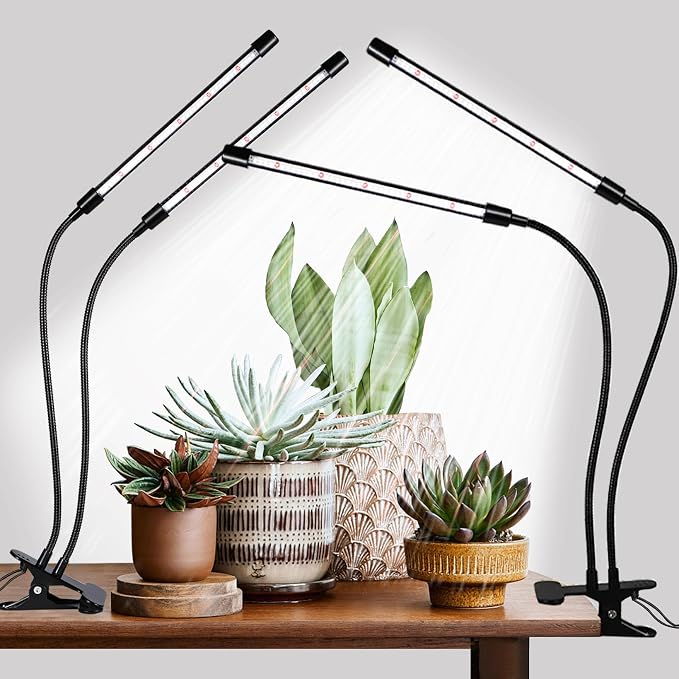 |
Hywyimlait 168-LED Two-Head Clip-on Grow Light | Check Price |
| 9 |  |
RWNTAO 84-LED Two-Head Clip-on Grow Light | Check Price |
| 10 |  |
Sonamindary 5700K Single-Head Clip-on LED Grow Light | Check Price |
MARS HYDRO TS1000 150W Full-Spectrum LED Grow Light
The MARS HYDRO TS1000 is the strongest all-around option in this group for someone growing more than a few herb pots. It uses 354 LEDs and draws 150 watts, with the listed coverage aimed at a 2.5-by-2.5-foot area and maximum coverage up to 3-by-3 feet. That makes it better suited to a shelf, tent, or defined growing zone than a single countertop planter.
Its full-spectrum output covers the familiar white-light range along with red and infrared elements. In practical terms, that means one fixture can support seedlings, leafy growth, and herbs that eventually flower without requiring a separate lamp. The independent dimmer is especially useful when young seedlings need gentler light or when the fixture hangs close to the canopy.
The upgraded reflective hood and diode arrangement are intended to improve uniformity between the center and edges. That matters when several pots share the same area, since plants at the edge are less likely to receive dramatically different illumination. Fanless aluminum cooling also keeps operation quiet, though a large 150-watt fixture can still add some warmth to a small enclosed space.
Pros
- Strong 150-watt output for a larger herb-growing area.
- Full spectrum and adjustable brightness for multiple growth stages.
- Fanless, quiet design with a reflective hood.
- Can be daisy-chained with a separately purchased RJ12 connector.
Cons
- More power and physical coverage than a single herb pot needs.
- Daisy-chain operation requires an additional connector.
- Proper hanging height is important to avoid overwhelming small seedlings.
My Opinion
This is the best fit for a serious indoor herb shelf or small tent where uniform coverage and expandability matter more than the smallest footprint. For one or two pots, it is likely unnecessary, but its dimmer gives a beginner room to start gently and increase output as plants grow.
Spider Farmer SF1000 100W Full-Spectrum LED Grow Light
Spider Farmer’s SF1000 is a sensible middle ground between compact plant lamps and larger grow panels. The 100-watt fixture is listed for 2-by-2 and 3-by-3-foot grow-tent use, giving it enough reach for a small collection of herbs while remaining less demanding than a 150-watt panel.
The spectrum combines 3000K and 5000K white light with 660nm red and 760nm infrared elements. For herbs, the blue-leaning portion is useful during leafy vegetative growth, while the red component becomes more relevant if plants are allowed to mature toward flowering. A dial lets the grower adjust intensity instead of forcing young plants to receive the panel’s maximum output.
Spider Farmer also emphasizes an updated edge-focused diode layout intended to make PPFD more uniform. In everyday use, that should help reduce the common problem of a very bright center and weaker corners when multiple containers share a square growing area. The fanless construction is quiet, and the thick aluminum heat sink helps manage heat without adding fan noise.
A five-year after-service promise through local maintenance centers in several regions is a meaningful ownership advantage, provided the buyer purchases an authentic unit and confirms applicable regional support. The main limitation is that this remains a hanging panel, so it needs overhead space, suitable suspension, and thoughtful distance from the leaves.
Pros
- Useful 100-watt size for small tents and grouped herb pots.
- Full spectrum with blue, red, and infrared components.
- Quiet fanless construction and adjustable dimming.
- Five-year after-service support is listed for multiple regions.
Cons
- Requires a place to hang the panel above the plants.
- May be more output than a single countertop herb needs.
- Authenticity matters for access to brand support.
My Opinion
The SF1000 is a strong alternative when the growing area is larger than a windowsill but smaller than a full room. It offers enough control for beginners while leaving room for a few herbs to grow together, making it one of the more balanced choices here.
LEOTER 80-LED Full-Spectrum Gooseneck Grow Light
LEOTER takes a different approach from the hanging panels above. Its four-head lamp uses 80 LEDs divided among red, blue, yellow, and white diodes, and the heads can be aimed independently with flexible goosenecks. That format is convenient when herb pots sit at different heights or when a shelf cannot support overhead mounting hardware.
Three spectrum modes let the user choose full-spectrum light, a red-and-blue combination, or another targeted setting. For everyday culinary herbs, the full-spectrum mode is the simplest starting point. The red and blue options give more control for seedlings or flowering plants, but beginners should avoid changing modes constantly without a clear reason.
The built-in cycle timer offers three-, nine-, or twelve-hour settings and is intended to repeat the schedule daily. The timer must be reset after a power interruption or when the lamp is disconnected, so it is convenient but not entirely maintenance-free. Ten dimming levels make it easier to begin with lower intensity and increase brightness as plants develop.
A USB connector and included adapter provide flexible power options, while the metal clamp allows placement on a desk, shelf, or plant stand. Because the lamp is close-range and directional, it works best for a small group of pots rather than a broad herb garden. The included heat-dissipation design helps manage warmth, but the lamp still benefits from airflow around its heads.
Pros
- Four adjustable heads cover several small pots from different angles.
- Ten brightness levels and three spectrum modes offer useful control.
- Repeating timer supports regular daily lighting.
- USB power and a clamp suit desks, shelves, and small plant stations.
Cons
- Timer needs resetting after the lamp is disconnected.
- Not intended to replace a high-output panel for a large growing area.
- Multiple goosenecks require occasional repositioning as plants grow.
My Opinion
LEOTER is a practical choice for renters, apartment growers, and anyone keeping several herb pots in a compact location. Its flexibility is more valuable than raw output here, but buyers with dense or mature plants should choose a panel instead.
VIPARSPECTRA 70W Dimmable Full-Spectrum Plant Grow Light
The VIPARSPECTRA 70-watt lamp is aimed at a compact 2-by-2-foot vegetative area. That makes it a reasonable fit for herbs that need consistent overhead lighting but do not justify a larger 100- or 150-watt fixture. The product information describes its output as comparable to a 150-watt HPS/MH light while using 70 watts, so its appeal is mainly efficient supplemental or dedicated lighting.
Its spectrum combines 660nm red with 3000K and 5000K white light. The balanced mix is useful for leafy herbs and can also support plants as they move through different stages. Four dimming levels allow a grower to reduce intensity for young seedlings or adjust the light when the fixture must be positioned closer to the leaves.
Large aluminum heat sinks and a fanless design are intended to remove heat without mechanical noise. That is helpful in kitchens, offices, and bedrooms where a fan would be distracting. Even so, the fixture should not be pressed against a wall or enclosed tightly, because passive cooling depends on open space around the heat sink.
The chief trade-off is its relatively limited adjustment range compared with lamps offering ten levels or a continuously variable dial. Four steps are still useful, but the settings may not provide the exact middle intensity a particular herb needs. It also needs overhead mounting rather than a simple clamp, so the installation is less casual than a desk lamp.
Pros
- 70-watt output fits a compact 2-by-2-foot growing area.
- Balanced white and red spectrum for seedlings and vegetative plants.
- Quiet fanless design with aluminum heat sinks.
- Four-level dimming helps control light intensity.
Cons
- Less coverage than the larger panels in this comparison.
- Four dimming steps offer less precision than ten-level systems.
- Requires a suitable overhead mounting arrangement.
My Opinion
This is a good value-oriented panel for a modest herb station, especially when quiet operation matters. I would choose it over a larger fixture for a small dedicated area, but not for a wide shelf packed with plants that need even edge coverage.
VIVOSUN Lumalight 100W Full-Spectrum LED Plant Light
VIVOSUN’s LumaLight offers 100 watts of full-spectrum output with white, blue, red, and far-red LEDs. Its listed spectrum is intended to carry plants from seedling through harvest, which gives herb growers a single-fixture solution instead of changing lamps as plants mature. The 3000K and 5000K white diodes provide different color balances, while 660nm and 730nm elements add red and far-red support.
Four brightness positions range from 25% to 100%, making it straightforward to reduce intensity for newly sprouted herbs and increase it as the canopy fills in. The product is also compatible with the Vivosun GrowHub and mobile app, sold separately. That option may appeal to growers who want automated scheduling or remote monitoring, but it adds another purchase and is not necessary for basic operation.
Uniform diode placement is intended to keep intensity balanced from the center toward the edges. This matters when basil or leafy greens occupy several containers under the same light. The listed Q90 flux maintenance rate of up to 36,000 hours suggests attention to long-term output consistency, although actual service life will still depend on operating conditions and care.
An IP65 waterproof and dustproof rating gives this lamp an advantage in humid growing areas and around occasional splashes. It does not mean the light should be submerged or sprayed carelessly, so normal electrical safety still applies. Heat management is designed to reduce plant stress, but allow clearance around the fixture and driver.
Pros
- 100-watt full spectrum supports a broad range of growth stages.
- Four settings provide simple 25% to 100% dimming.
- Optional GrowHub and app compatibility add automation potential.
- IP65 protection is useful in humid, splash-prone areas.
Cons
- Smart control requires the separately sold GrowHub.
- A 100-watt panel still needs overhead mounting and clearance.
- Its features may be unnecessary for one small herb pot.
My Opinion
LumaLight is especially appealing to growers who value durability and the option to add connected controls later. It is a capable choice for a small indoor garden, with more environmental protection than many basic panels.
GHodec 5500K Free-Standing Gooseneck LED Grow Lamp
GHodec is built for people who want a floor-standing lamp rather than a hanging panel or clamp. Its adjustable tripod extends from 15 to 48 inches, allowing the light to sit beside a plant stand, indoor greenhouse, or group of pots. That flexibility can be valuable when furniture cannot support a clamp or when the plants need to move around the room.
Each LED strip combines 16 white and four red LEDs. The 5500K daylight-oriented output is intended to resemble natural daylight, while the red elements support flowering, fruiting, and germination. For leafy kitchen herbs, the white-heavy appearance may be comfortable in a living space, although the lamp is better viewed as supplemental or close-range lighting than as a powerful tent panel.
Three timer choices—four, eight, or twelve hours—allow a daily cycle without manual switching. Five brightness levels provide basic adjustment for different plant sizes and ambient light conditions. The controls are less granular than the ten-level systems elsewhere in this list, but the simpler setup may be preferable for a first-time grower.
The stand uses steel and aluminum and is described as strong while also helping dissipate heat. Because the lamp occupies floor space, it needs a stable, level location where pets, children, or foot traffic will not knock it over. Its USB connection and included adapter make power placement easier, but cable reach should still be checked before final positioning.
Pros
- Freestanding design avoids clamps and ceiling mounts.
- Height adjusts from 15 to 48 inches.
- Automatic four-, eight-, or twelve-hour timer.
- Five brightness levels and daylight-style output suit living spaces.
Cons
- Uses floor space and may be less stable in busy areas.
- Five brightness levels offer moderate rather than precise control.
- Less suitable for a dense, broad herb canopy.
My Opinion
GHodec makes the most sense when installation convenience is the priority. It is a friendly option for a few pots near a plant stand, but growers needing high intensity across a full shelf should select a panel with wider, stronger coverage.
EWPJDK 84-LED 6500K Clip-on Grow Light
The EWPJDK lamp is a compact clip-on option using 74 white LEDs and 10 red LEDs. Its 6500K daylight-style output is intended for indoor plants, flowers, and herbs, and the soft, flicker-free presentation may be more comfortable in a home office or kitchen than an aggressively colored red-blue lamp.
Three lighting modes white red and white plus red let the user tailor the lamp to the plant s stage or surrounding conditions Ten brightness levels provide more adjustment than the five-level lamps on this list which is helpful when the light must sit close to leaves A low-power design using about 10 watts also makes it a practical supplemental lamp for one small growing area rather than a major electricity.
The flexible thickened goosenecks can be angled toward the canopy, and the clamp includes a non-slip pad to help keep the fixture secure. That setup is quick to move between shelves, desks, and plant stands. As with any clamp lamp, the mounting surface must be sturdy enough to resist twisting, and the heads should be positioned so they do not shade one another.
The timer repeats three-, nine-, or twelve-hour cycles as long as power remains connected. This is convenient during workdays or short trips, but the light will not maintain a schedule if it is unplugged or loses power. Its modest output is the central limitation: it is well suited to herbs receiving some window light or to a small pot group, not a tall, crowded indoor garden.
Pros
- Low-power, compact design for a single shelf or small herb group.
- 6500K daylight-style white output with red-light mode.
- Ten brightness levels and three lighting modes.
- Non-slip clamp and flexible goosenecks simplify positioning.
Cons
- About 10 watts is not intended for a broad or dense canopy.
- Timer depends on continuous power.
- Clamp placement limits where it can be installed.
My Opinion
EWPJDK is a sensible starter lamp for one or two compact herb pots, particularly when a bright window provides part of the daily light. Its low energy use and flexible mounting are attractive, but expectations should remain realistic about coverage.
Hywyimlait 168-LED Two-Head Clip-on Grow Light
Hywyimlait provides two heads with a total of 168 LEDs, making it more expansive than many single compact clip lamps. Each bar combines 37 sunlight-white LEDs with five red LEDs, producing a 6000K full-spectrum presentation intended to support different stages of indoor plant growth. The two-head arrangement can spread light across neighboring herb pots or approach one wider planter from separate angles.
Its timer offers four-, eight-, twelve-, or eighteen-hour cycles and repeats automatically at the same time each day when continuously powered. The longer eighteen-hour option may be useful for plants in especially dim rooms, but beginners should start with a moderate schedule and watch for signs of stress rather than assuming more hours are always better.
Each LED strip can be controlled separately, and ten dimming levels make it possible to use one head for a smaller plant or both for a broader group. The four-headed flexible gooseneck description and sturdy clips provide considerable positioning freedom, although multiple adjustable sections can take a little more time to arrange neatly on a shelf.
Because this is a clip-on lamp rather than a hanging panel, installation is simple and it does not consume much tabletop space beyond the clamp. The trade-off is reach: it remains best for close-range supplemental lighting. Large herbs, crowded foliage, or plants spread across a deep shelf may still have shaded areas that need repositioning.
Pros
- Two-head, 168-LED format spreads light across more than one small pot.
- Separate head control and ten brightness levels add flexibility.
- Timer offers four-, eight-, twelve-, and eighteen-hour options.
- Strong clips and flexible goosenecks help target the canopy.
Cons
- Close-range format is not a substitute for a large overhead panel.
- Multiple goosenecks may need frequent adjustment.
- Longer timer settings can be excessive for some indoor herbs.
My Opinion
This is a versatile choice for a small shelf containing several herbs with different light needs. I would favor it over a single-head lamp when coverage flexibility matters, while keeping it away from expectations of tent-level intensity.
RWNTAO 84-LED Two-Head Clip-on Grow Light
RWNTAO offers a smaller two-head arrangement with 84 LEDs total, using the same general mix of sunlight-white and red diodes across its bars. The 6000K output is intended to resemble bright daylight, while the red component supports flowering, fruiting, and overall plant development. For culinary herbs, the full-spectrum white-plus-red setting is the natural everyday choice.
Three modes—white, red, and combined light—give the user a straightforward way to change the lamp’s appearance and emphasis. Ten brightness settings are more useful than a simple on/off control, especially when the lamp is close to tender seedlings. A grower can start low, observe new growth, and move upward without immediately exposing the leaves to the highest setting.
The repeating three-, nine-, or twelve-hour timer suits basic indoor routines. It turns on at the same time the next day when left connected, which can reduce daily chores during work or travel. The lamp uses flexible goosenecks and sturdy clips, so each head can be directed toward a different pot or angled around taller leaves.
The main distinction from larger clip-on systems is scale. With 84 LEDs, this lamp is best for a couple of small pots or as supplemental light near a window. It will not illuminate a deep shelf evenly from a distant position, and the clamp must be attached to a solid edge that can support the lamp without sliding.
Pros
- Two adjustable heads provide better spread than a single head.
- Three spectrum modes and ten brightness levels.
- Repeating three-, nine-, or twelve-hour timer.
- Compact clamp format fits shelves, desks, and plant stands.
Cons
- 84 LEDs provide limited reach for larger herb collections.
- Requires continuous power for the automatic cycle.
- Clamp mounting is less suitable for thick or rounded furniture.
My Opinion
RWNTAO is a good match for beginners who want more coverage than a single-head lamp without moving to a hanging panel. It is particularly practical beside a sunny window, where it can fill in weak light rather than carry the entire growing burden alone.
Sonamindary 5700K Single-Head Clip-on LED Grow Light
Sonamindary is the simplest and most focused option in the group. Its single lamp head uses 60 LEDs—48 white, eight red, and four blue—to provide supplemental light for herbs, seedlings, succulents, foliage plants, and flowering plants. The 5700K output is relatively natural-looking, and a CRI of 85 or higher is intended to keep plant colors appearing clear.
Five brightness levels range from 20% to 100%, giving enough adjustment for a single pot or a few small containers. The compact clamp attaches to desks, shelves, tables, and plant stands without taking up the surface area required by a floor base. A flexible metal arm with a silicone sleeve is intended to hold its selected angle with less sagging than a very soft gooseneck.
The automatic timer provides four-, eight-, or twelve-hour daily durations. Once selected, it repeats the cycle every 24 hours, which is useful for a work desk or a plant that sits in a room with inconsistent daylight. The focused single-head design is also easier to position precisely than a multi-head lamp, though it naturally covers less area.
That limited coverage is the important ownership consideration. Sonamindary is not the right choice for a wide herb shelf or several mature plants competing for one beam. It is better for one basil pot, a small seedling tray, or a plant that needs a dependable boost beside a window. Keep the clamp fully tightened and avoid placing the lamp where water can reach the electrical connection.
Pros
- Compact single-head design for one plant or a few small pots.
- 60 LEDs with white, red, and blue components.
- Five brightness levels from 20% to 100%.
- Repeating four-, eight-, or twelve-hour timer.
Cons
- Limited coverage compared with two-head lamps and panels.
- Single clamp restricts placement options.
- Not suitable as the sole light for a broad herb collection.
My Opinion
This is the cleanest choice for a single herb plant on a desk or shelf. Its controls and compact arm are beginner-friendly, but buyers should choose a two-head lamp or panel if they expect the collection to expand.
How I Selected These Best Led Grow Lights for Herbs
The selection balances useful light output, coverage, mounting style, spectrum information, control options, and practical fit. Dedicated panels rank higher for growers who need consistent light over several containers, while clip-on and freestanding lamps earn their place for small spaces, flexible placement, and supplemental use. I also considered the available ratings and number of customer responses as evidence of buyer interest and accumulated feedback, without treating those figures as a substitute for product specifications.
Most important selection takeaway: wattage alone does not decide whether a lamp fits an herb shelf. Coverage, mounting distance, dimming, and the number of plants sharing the light are just as important.
The list includes both high-output panels and low-power household lamps because herb growers have very different setups. Basil under a dim window may need a targeted clip lamp, while a shelf of mature herbs may need a panel with broad, even output. Brand diversity also makes it easier to compare support, controls, protection features, and installation styles.
Use the listed coverage as a starting point rather than a guarantee for every room. Wall color, hanging height, plant density, ambient daylight, and the distance between the lamp and leaves all change the result.
How to Choose the Best Led Grow Lights for Herbs
Start with the growing area and the number of pots, then choose the smallest fixture that can provide useful, even light without forcing the plants against a hot lamp. A compact adjustable lamp is convenient for one or two herbs, while a panel becomes more practical as the canopy expands.
- Match coverage to the shelf: Do not buy a high-output panel for one pot unless you expect to expand.
- Prioritize dimming: Adjustable brightness makes the same lamp more useful for seedlings and mature plants.
- Choose the mounting style first: Hanging panels need overhead support; clips and floor stands need stable furniture or floor space.
- Look for a usable timer: A repeating schedule is easier than manually switching the lamp every day.
- Plan for heat and airflow: Fanless does not mean heat-free, especially in a small enclosed growing area.
Coverage and plant spacing
Think in terms of the illuminated canopy rather than the lamp’s total size. A single basil plant can use a focused beam, but several pots need light spread from the center toward the edges. If stems stretch toward the fixture or outer leaves become noticeably weaker, the area may be too large for the lamp or the plants may be too far away.
Spectrum and controls
For most culinary herbs, full-spectrum white light is the easiest everyday setting because it resembles daylight and makes plant color easier to observe. Red and blue modes can be useful for targeted growth stages, but they should not distract from the basics: enough intensity, consistent timing, and suitable distance. Dimming is often more useful than having many specialized modes.
Power, cooling, and support
Higher-wattage fixtures can illuminate more plants but may add more heat and require stronger mounting hardware. Fanless models are quieter, which is valuable in living areas, but their heat sinks still need open air. Where a brand lists warranty or after-service information, save the purchase documentation and confirm that the seller and region qualify.
How to Set Up a Herb Grow Light
Begin by placing the lamp above or beside the plants so the leaves receive light evenly rather than only the tallest stem. Keep the fixture stable, route cords away from water, and start at a lower brightness or shorter schedule when the plants are young.
First-time setup steps
- Group herbs with similar height and light needs where possible.
- Install the clamp, tripod, or hanging hardware on a stable support.
- Center the beam over the canopy and angle flexible heads toward shaded areas.
- Start with a moderate brightness setting and observe the plants for several days.
- Set the timer at a consistent daily time and leave the power connected.
- Increase brightness or adjust height gradually as the plants produce new growth.
Keep enough distance for air to move around the fixture and leaves. If the plant canopy feels hot, the light is too close, the room needs more ventilation, or the brightness should be reduced. A lamp should supplement a healthy growing environment, not compensate for waterlogged soil, poor drainage, or an unsuitable container.
How Long to Run an Indoor Herb Lamp
There is no single schedule that fits every home because natural daylight, lamp intensity, plant size, and species all vary. A practical starting point is a consistent moderate daily cycle, followed by adjustment based on plant response. Use the timer whenever possible so the plants receive a predictable pattern instead of irregular bursts.
Leafy herbs generally benefit from dependable light during active growth, but leaving a lamp on continuously is not a shortcut to better plants. Plants also need a dark period. If the leaves begin to look stressed, pale, curled, or unusually dry, reduce intensity or duration and check heat, watering, and lamp distance before adding more light.
Maintenance, Safety, and Compatibility
Keep LED surfaces, reflectors, and heat sinks free from dust so heat can escape and light is not blocked. Unplug a lamp before cleaning it, use a dry or lightly damp cloth as appropriate for the product, and keep liquids away from drivers, connectors, and outlets. Even a water-resistant model should not be treated as submersible.
Check compatibility before adding accessories. The MARS HYDRO daisy-chain function requires a separately purchased RJ12 connector, while VIVOSUN’s app-based controls require a separately sold GrowHub. USB-powered lamps can work with suitable USB or AC adapters, but the included adapter and the lamp’s intended power requirements should take priority over improvised alternatives.
Inspect clamps, goosenecks, tripod joints, and hanging hardware periodically. A slowly sagging head can move close enough to stress leaves, while a loose clamp can fall into a watering area. Replace or repair damaged cords rather than continuing to use them near plants and moisture.
Common Mistakes to Avoid
Most disappointing results come from mismatching the lamp to the space, not from choosing the wrong color temperature. A small clip light cannot evenly illuminate a large shelf, and a powerful panel can overwhelm seedlings when placed too close.
- Do not judge a lamp by wattage alone; compare coverage and placement.
- Do not keep a high-output panel at seedling distance without using its dimmer.
- Do not place a clamp on an unstable, thin, or wet surface.
- Do not assume a timer will retain its schedule after unplugging or a power interruption.
- Do not block passive heat sinks with walls, fabric, or plant foliage.
- Do not use red-blue modes constantly if a comfortable full-spectrum setting is better for daily observation.
- Do not let leaves touch a warm fixture or allow water to reach electrical connections.
Best Led Grow Lights for Herbs FAQ
Which type of lamp is best for a single herb pot?
A compact single-head or two-head clip-on lamp is usually the easiest fit. Sonamindary is focused on one plant or a few small pots, while EWPJDK and RWNTAO provide more directional flexibility when a second plant is nearby.
What is better for several herb pots on one shelf?
A panel such as the MARS HYDRO TS1000, Spider Farmer SF1000, VIPARSPECTRA 70W, or VIVOSUN LumaLight can provide broader overhead coverage. Choose according to shelf size, hanging space, and whether the plants will continue expanding.
Do indoor herbs need a full-spectrum LED?
Full-spectrum light is a convenient general-purpose choice because it supports different growth stages and produces a more natural-looking light. A dedicated red or blue mode can be useful, but consistent coverage and scheduling matter more than having many color settings.
Are clip-on lamps powerful enough for basil and mint?
They can be suitable for one or two small plants, especially when used as supplemental light near a bright window. As the plants become larger or more crowded, a higher-output panel may provide more even coverage.
Should an herb grow lamp be dimmable?
Dimming is helpful because seedlings, established plants, and plants at different distances from the fixture do not always need the same intensity. It also gives beginners a safer way to adjust light without immediately moving the lamp.
How important is a timer for indoor herbs?
A timer makes the daily routine more consistent and prevents accidental overuse. Check whether the timer repeats after a power interruption, since several compact lamps require continuous power or a reset after being unplugged.
Final Thoughts
The best led grow lights for herbs depend on the size of the growing area and the level of installation flexibility you need. MARS HYDRO TS1000 is my top pick for broad, controllable output; Spider Farmer SF1000 is the balanced alternative for a small tent or grouped pots; and LEOTER is the practical third choice for compact shelves and individually aimed herb containers.

I’m Maya L. Greenwood, a lifelong plant lover who believes anyone can grow something beautiful with the right guidance. After years of testing soil mixes, pruning methods, irrigation tricks, and pest-safe solutions, I started EasyGardenTips.com to turn hard-won lessons into step-by-step advice. From seed starting and container gardens to composting and seasonal checklists, my goal is to make gardening simple, sustainable, and fun.