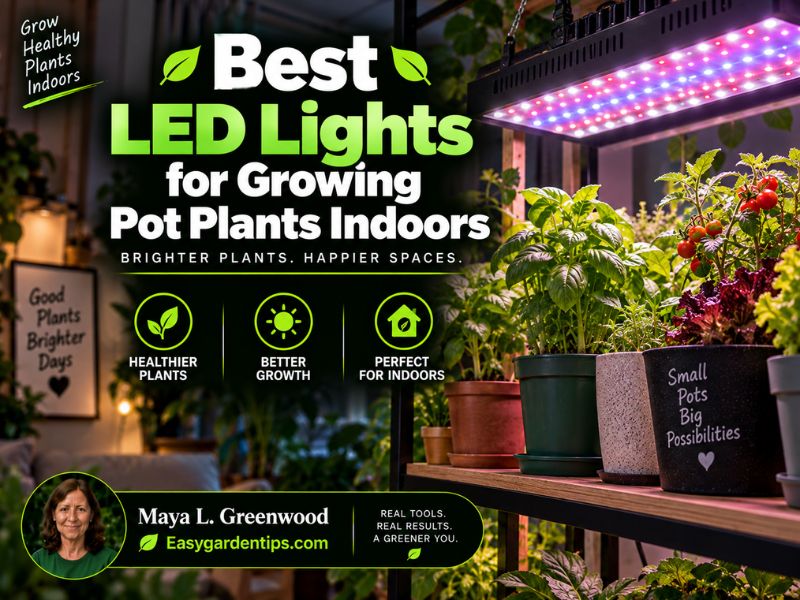
3 Best LED Lights for Growing Pot Plants Indoors
The best LED lights for growing pot plants should concentrate usable light over the actual container canopy without wasting electricity on an oversized room. For one to several substantial potted plants, a dimmable 100–150W fixture often offers a much better balance than either a weak decorative lamp or a huge commercial grow-room light.
For container growing, I would prioritize actual power, system PPE, PPFD distribution, dimming, canopy size, heat management, and hanging flexibility. The pot itself does not determine how much light you need—the mature leaf canopy does.
My primary recommendation is the MARS HYDRO TS1000 150W LED Grow Light. Its current U.S. listing specifies 150W actual input, full-spectrum output, dimming, a 120-degree reflective hood, fanless operation, daisy-chain support, and 2×2/3×3-oriented coverage.
I would choose the Spider Farmer SF1000 100W LED Grow Light when lower electrical demand and strong system efficiency matter more. The current model uses 100W actual input, 2.5 µmol/J system PPE, an upgraded high-density diode layout, full-spectrum output, and dimming.
For a straightforward 100W alternative with broad spectrum and moisture-conscious construction, I would choose the VIVOSUN VS1000E LED Grow Light. Its current listing specifies 100W consumption, 2.5 µmol/J efficiency, 238 diodes, 3000K/5000K/660nm/750nm spectrum, an isolated ETL-certified driver, aluminum heat sink, and IP65-rated fixture construction.
3 Best LED Lights for Growing Pot Plants
1. MARS HYDRO TS1000 150W LED Grow Light
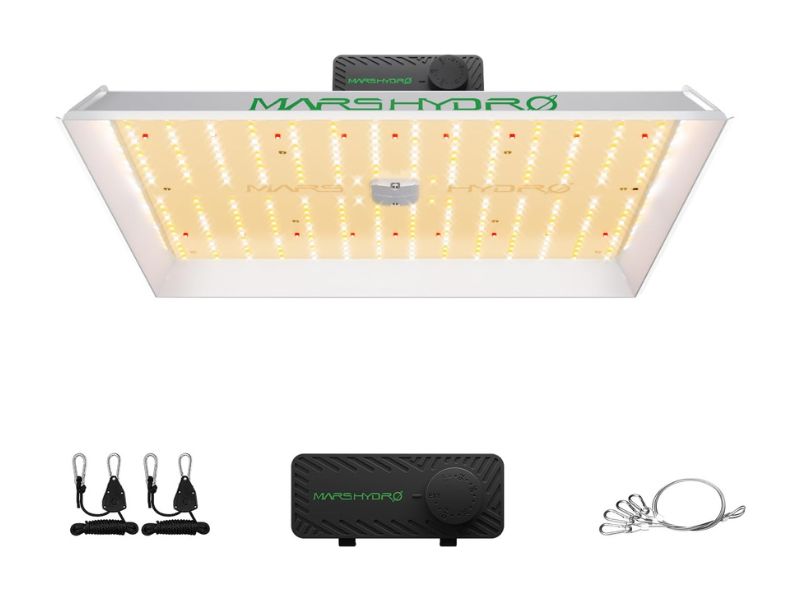
Key Features
- 150W actual input
- Full-spectrum LED output
- Dimmable
- Patented reflective hood
- 120-degree reflector angle
- Fanless construction
- Daisy-chain capable
- Compact 2×2/3×3-oriented footprint
- Updated diode distribution
The MARS HYDRO TS1000 is my primary recommendation because 150W gives a container grower useful output headroom without immediately moving into a large 300–700W fixture.
Its current Amazon configuration is a 150W dimmable full-spectrum grow light with a reflective hood and updated diode arrangement designed to make light distribution more uniform between the center and sides. MARS HYDRO states that the reflector uses a 120-degree refraction angle and is intended to improve light utilization.
That makes it a practical choice for:
- One large potted plant
- Two or three medium containers
- Compact vegetable plants
- Herbs
- Indoor fruiting plants
- Container-grown seedlings that will mature under the same fixture
The biggest advantage over tiny clip lamps is usable canopy area.
A small pot can hold a surprisingly large mature plant.
Once leaves spread two feet or more across, a 10W pot clip may illuminate only the center.
A proper overhead fixture such as TS1000 can distribute light across the whole canopy.
The dimmer is especially valuable.
A young plant may intercept only a small fraction of the available light.
Running the fixture at full output immediately can waste electricity and produce unnecessary heat.
A better approach is to increase intensity gradually as the plant expands.
Think of the light as adjustable capacity:
small canopy → lower output
expanding canopy → moderate output
mature high-light canopy → increase as required
That is much more efficient than buying separate lights for every growth stage.
The full-spectrum design also means you do not need one fixture for foliage growth and a completely different fixture later.
Broad white horticultural light can support a wide variety of potted plants when intensity and photoperiod are managed appropriately.
I also like the fanless design.
A small indoor growing area may already contain a circulation fan or ventilation system.
Removing a fixture fan reduces noise and eliminates one additional moving component.
However, fanless does not mean heatless.
A 150W fixture still introduces significant energy into a small enclosed area.
The room or tent may need:
- Air circulation
- Exhaust ventilation
- Temperature monitoring
depending on ambient conditions.
The reflector is helpful in compact growing spaces because photons that would otherwise spread beyond the plant area can be redirected toward the canopy.
That does not mean every photon reaches a leaf.
Fixture height and plant placement still matter.
I would center the light directly over the canopy rather than over the pot itself if the plant grows asymmetrically.
The pot is only the root container.
The leaf area is what needs illumination.
What I Like
- Strong 150W output class
- Dimmable
- Reflector-assisted light distribution
- Broad full-spectrum output
- Fanless operation
- Useful for one large or several medium potted plants
- More growth headroom than 100W alternatives
What I Do Not Like
- Higher electrical demand than the two 100W models
- More heat to manage
- Overkill for one tiny houseplant
- Compact board format is less distributed than a multi-bar fixture
The TS1000 is my preferred choice when a container garden needs more output headroom than a basic 100W light while remaining compact enough for a small indoor growing area.
2. Spider Farmer SF1000 100W LED Grow Light
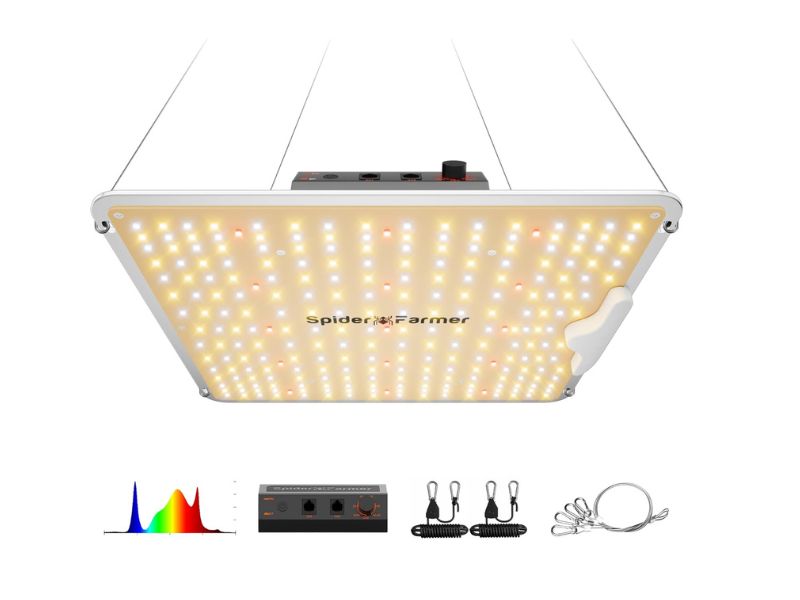
Key Features
- 100W actual input
- 2.5 µmol/J system PPE
- New-generation high-efficiency diodes
- Increased diode count
- Full-spectrum output
- Dimmable
- Fanless operation
- Compact 2×2/3×3-class use
The Spider Farmer SF1000 is my choice when efficiency and lower power consumption are priorities.
Its current listing specifies 100W actual draw and 2.5 µmol/J system PPE from an upgraded diode platform with increased diode count.
PPE is important because watts alone measure electricity—not plant-useful photon output.
If two fixtures both consume 100W, the one converting electricity into photosynthetic photons more efficiently can potentially deliver more useful horticultural output from the same electrical load.
That makes the SF1000 attractive for a grow that operates many hours per day.
I would consider it especially well matched to:
- One medium-to-large potted plant
- Two compact plants
- Potted peppers
- Herbs
- Dwarf vegetables
- Small hydroponic or container gardens
The 100W class also makes heat easier to manage than 150W.
The difference is only 50W, but over a full lighting day it adds up.
At 16 hours daily:
100W fixture: 1.6 kWh/day
150W fixture: 2.4 kWh/day
That is a difference of:
0.8 kWh/day
or about:
24 kWh over 30 days.
The lower wattage can also reduce the amount of heat the room must remove.
Dimming is still essential.
A 100W efficient grow light can be much stronger than a young potted plant needs when mounted close.
I would adjust output according to:
- Plant size
- Distance
- Available window light
- Species
- Leaf response
rather than running maximum power automatically.
One of the most common mistakes with container growing is buying a strong light and assuming 100% brightness must be the correct setting.
The dimmer exists because plant needs change.
The upgraded diode layout also matters for canopy consistency.
Spider Farmer describes the current model as using more diodes while maintaining approximately 2.5 µmol/J system PPE.
A greater number of emitters can help distribute output more evenly than concentrating the same power into fewer highly driven LEDs.
The fanless architecture is another benefit for bedrooms, offices, or apartments.
There is no built-in fan noise.
As with TS1000, passive cooling does not eliminate room heat, so leave the fixture unobstructed and provide ventilation where needed.
What I Like
- Strong 2.5 µmol/J system PPE
- Only 100W actual input
- Dimmable
- Full-spectrum output
- Upgraded diode arrangement
- Lower heat and power burden than 150W
- Good balance for one substantial potted plant
What I Do Not Like
- Less total output headroom than TS1000
- Requires overhead mounting
- Can still be excessive for low-light houseplants
- Mature wide canopies can outgrow one compact board
The SF1000 is the light I would choose when 100W is enough for the canopy and electrical efficiency matters more than maximizing raw fixture power.
3. VIVOSUN VS1000E 100W LED Grow Light
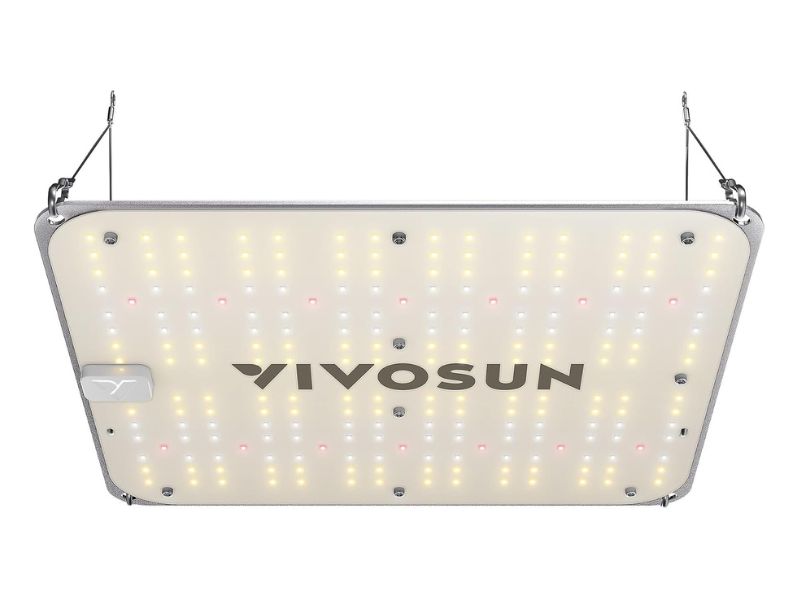
Key Features
- 100W actual input
- 2.5 µmol/J efficiency
- 238 diodes
- Full-spectrum output
- 3000K white
- 5000K white
- 660nm red
- 750nm far red
- ETL-certified isolated driver
- Aluminum heat sink
- IP65-rated fixture construction
- 2×2-class positioning
The VIVOSUN VS1000E is the straightforward 100W alternative.
Its current Amazon listing specifies 238 diodes, 2.5 µmol/J efficiency, and 100W power consumption. The spectrum includes 3000K, 5000K, 660nm, and 750nm wavelengths, covering warm white, cool white, deep red, and far-red components.
For ordinary container growing, I would not buy it because of one specific wavelength.
The more important strengths are:
- Efficient output
- Reasonable power
- Broad spectrum
- Compact footprint
- Passive thermal design
VIVOSUN also specifies an ETL-certified isolated low-voltage driver.
That is useful context for indoor plant setups where watering and electrical equipment exist in the same general space.
It does not make the fixture immune to unsafe water exposure.
Electrical connections, plugs, and power strips should still be kept away from irrigation runoff and standing water.
The listing also describes the light as IP65.
IP65 indicates protection against dust and water jets under specified test conditions.
It does not mean the fixture is submersible.
That distinction is particularly important around potted plants because watering spills are common.
The aluminum heat sink helps dissipate heat without requiring a fixture fan.
That keeps operation quiet.
At 100W, the total room heat burden remains manageable compared with much larger grow lights, though it is still significant in a tiny sealed enclosure.
The VS1000E is best suited to a compact canopy.
VIVOSUN positions the fixture for approximately 2×2-foot grow applications, so I would not expect one unit to provide uniform high-intensity illumination over a large room.
That scale makes sense for one substantial container or a few closely grouped pots.
What I Like
- 100W actual input
- 2.5 µmol/J listed efficiency
- Broad white/red/far-red spectrum
- Quiet passive cooling
- Isolated ETL-certified driver
- IP65-rated fixture construction
- Good fit for compact container gardens
What I Do Not Like
- Less output capacity than TS1000
- Compact footprint limits large-canopy use
- IP65 should not be mistaken for waterproof/submersible protection
- Simpler control package than some smart fixtures
The VS1000E is a practical alternative when you want a compact 100W full-spectrum fixture with simple passive cooling and moisture-conscious construction.
LED Lights for Growing Pot Plants Comparison
| Product | Actual Power | Published Efficiency | Dimming | Coverage Class | Best Use |
| MARS HYDRO TS1000 | 150W | High-efficiency LED platform | Yes | 2×2/3×3-oriented | Larger container canopy |
| Spider Farmer SF1000 | 100W | 2.5 µmol/J system PPE | Yes | 2×2/3×3-oriented | Efficient compact grow |
| VIVOSUN VS1000E | 100W | 2.5 µmol/J listed | Fixture dependent | 2×2-oriented | Simple container setup |
TS1000 provides the most power headroom, SF1000 is particularly attractive for efficiency and dimming, and VS1000E combines a modest electrical load with broad spectrum and an isolated driver.
How to Choose the Best LED Lights for Growing Pot Plants
Size the Light to the Canopy, Not the Pot
A five-gallon container does not tell you how much light the plant needs.
One plant in that container might have a 12-inch canopy.
Another might spread across several feet.
Measure the mature foliage footprint.
That determines the lighting area.
Actual Wattage Matters
All three fixtures in this guide use real electrical inputs in the 100–150W range.
TS1000: 150W
SF1000: 100W
VS1000E: 100W
Use these actual numbers for electricity and heat planning.
Do not rely on model names alone.
What Is PPE?
PPE, or photosynthetic photon efficacy, describes how many photosynthetic photons a fixture produces per joule of electricity.
Spider Farmer currently publishes 2.5 µmol/J system PPE for SF1000, while VIVOSUN lists 2.5 µmol/J for VS1000E.
When comparing efficiency, make sure the numbers represent comparable complete-system measurements.
PPFD Matters at the Leaves
PPFD describes the density of photosynthetic photons reaching a given section of canopy.
This changes with:
- Hanging height
- Dimmer setting
- Fixture shape
- Position beneath the light
That is why one powerful fixture can still perform poorly if the canopy extends far beyond its useful footprint.
Uniformity Is More Useful Than One Huge Center Reading
Do not judge a grow light from one peak PPFD value.
A single potted plant can develop a wide canopy.
If the center receives intense light but outer leaves receive much less, growth can become uneven.
Pay attention to the entire PPFD map.
Best LED Light for One Large Pot
I would choose MARS HYDRO TS1000.
Its 150W power gives more headroom as a substantial container plant develops a wider mature canopy.
Best LED Light for One Medium Pot
I would choose Spider Farmer SF1000.
Its 100W input and 2.5 µmol/J system PPE provide a strong balance between useful output and manageable electrical demand.
Best LED Light for a Compact Container Setup
VIVOSUN VS1000E is another solid 100W-class choice.
Its passive cooling and compact 2×2 positioning work well where simplicity matters.
Dimming Makes One Fixture More Versatile
A dimmer allows the light to adapt as the plant develops.
Young plants usually intercept fewer photons.
A mature canopy intercepts more.
Instead of moving immediately from a small lamp to a much larger fixture, dimming lets one appropriately sized light cover multiple stages.
Full Spectrum Is the Practical Baseline
All three lights use broad horticultural spectra rather than narrow single-color output.
VIVOSUN explicitly lists 3000K, 5000K, 660nm, and 750nm components.
For most indoor potted plants, usable intensity and coverage matter more than chasing one particular wavelength.
Do You Need Far Red?
Not necessarily.
Far red can influence plant morphology and photoperiod responses, but it is an advanced spectral variable.
For most home growers, I would prioritize:
coverage → PPFD → photoperiod → temperature → spectrum refinements.
How Far Should the Light Be From the Plant?
There is no universal distance.
TS1000 at 150W and VS1000E at 100W do not deliver identical intensity.
Use the exact fixture’s manufacturer guidance as a starting point and monitor plant response.
Possible signs of inadequate light include:
- Stretching
- Long internodes
- Leaning
- Pale new growth
Possible signs of excessive light include:
- Bleaching
- Curling
- Pale upper foliage
- Localized canopy stress
Adjust gradually.
Center the Light Over the Canopy
Do not automatically center the fixture over the container.
If the canopy spreads more heavily to one side, center the fixture over the foliage.
Leaves are the primary light-intercepting surface.
Keep the Canopy Even
A flatter canopy makes overhead LEDs easier to use efficiently.
If one branch or section grows far above the rest, it receives substantially greater PPFD because it sits closer to the fixture.
Supporting, rotating, or otherwise managing ordinary potted plants for even exposure can improve lighting uniformity.
Natural Window Light Still Counts
A grow light can supplement sunlight rather than replace it.
A plant beside a bright window may need less artificial output than the same species in a windowless basement.
Adjust the dimmer and runtime accordingly.
Do Not Run Lights 24 Hours by Default
A longer photoperiod does not automatically compensate for weak intensity.
Most ordinary indoor plants benefit from a regular dark period.
Use a consistent schedule appropriate to the species rather than continuous lighting.
Heat Management
The three fixtures range from 100W to 150W.
Even efficient LEDs eventually contribute energy to the room.
A compact tent or closet may need:
- Gentle circulation
- Exhaust
- Temperature monitoring
Keep passive heat sinks unobstructed.
Electricity Use: 100W Light
At 16 hours per day:
0.1 kW × 16 = 1.6 kWh/day
Over 30 days:
48 kWh/month
This applies approximately to SF1000 and VS1000E at full nominal input.
Electricity Use: 150W Light
At 16 hours:
0.15 × 16 = 2.4 kWh/day
Over 30 days:
72 kWh/month
That is the approximate full-power electrical consumption of TS1000 based on its listed 150W input.
Keep Electricity Away From Water
Container gardens involve frequent watering.
Keep:
- Plugs
- Timers
- Extension connections
- Power strips
away from runoff and standing water.
An IP-rated fixture does not make the entire electrical installation waterproof.
Common Pot-Grow-Light Mistakes
Buying by Pot Size
Canopy size matters more.
Using a Tiny Clip Light Over a Large Plant
Outer leaves may receive inadequate intensity.
Using an Oversized Commercial Fixture
Match power to the actual canopy.
Running Maximum Output Immediately
Use dimming when available.
Hanging the Light Too Far Away
PPFD decreases as the fixture moves away.
Ignoring Heat
Even 100–150W adds noticeable energy to a small enclosure.
Assuming Full Spectrum Guarantees Strong Light
Spectrum and intensity are different.
Ignoring Water Around Electrical Equipment
Keep all connections dry and protected.
Frequently Asked Questions
What are the best LED lights for growing pot plants?
TS1000, SF1000, and VS1000E are my three compact container-growing choices.
They span 100–150W actual input and are designed for relatively small indoor growing footprints.
What is my primary recommendation?
MARS HYDRO TS1000 is my primary choice when a larger container canopy needs extra headroom.
Its current version provides 150W actual input, dimming, full-spectrum output, and reflector-assisted distribution.
Which light is most efficient here?
Spider Farmer SF1000 publishes 2.5 µmol/J complete-system PPE.
VIVOSUN also lists 2.5 µmol/J efficiency for VS1000E.
Is 100W enough for one potted plant?
Yes, for many medium-size indoor plants when the canopy fits the fixture’s useful footprint.
Plant species, natural light, distance, and maturity still affect the required intensity.
Is 150W enough for one large plant?
It can provide substantial capacity for one larger container-grown canopy.
TS1000 is a 150W-class fixture aimed at compact grow areas rather than large commercial rooms.
Is 150W better than 100W?
Not automatically; 150W gives more headroom but also consumes more electricity and produces more heat.
Choose based on mature canopy demand rather than assuming larger numbers are always better.
Is SF1000 good for a single plant?
Yes, its 100W dimmable platform is particularly well suited to one substantial compact canopy.
The current model publishes 2.5 µmol/J system PPE.
Is TS1000 good for container plants?
Yes, especially when one or several containers form a roughly 2×2-class canopy.
Its reflective hood and dimming provide useful flexibility.
Is VIVOSUN VS1000E good for potted plants?
Yes, particularly for a compact 2×2-style container garden.
Its listing specifies 100W input, broad spectrum, 2.5 µmol/J efficiency, and passive cooling.
What does 2.5 µmol/J mean?
It describes how many photosynthetic photons the fixture produces for each joule of electricity.
It is a useful system-efficiency metric when comparing grow lights.
What is PPFD?
PPFD measures photosynthetic photon density reaching a specific part of the plant canopy.
It changes with hanging height, dimming, and position.
What is PPF?
PPF measures the total photosynthetically active photons emitted by a fixture each second.
It describes total output rather than intensity at one point.
Does pot size determine grow-light wattage?
No, mature canopy area is much more important than container volume.
A small pot can support a wide plant, while a large container may still hold a compact plant.
Should I use a full-spectrum grow light?
Broad full-spectrum LEDs are a practical choice for most indoor container plants.
They allow one fixture to remain useful across different stages.
Do I need red LEDs?
Red wavelengths are useful parts of a broad spectrum, but they should not drive the purchase alone.
Coverage and intensity are more fundamental.
Do I need far-red light?
Not for ordinary successful indoor container growing.
Far red is an advanced spectral feature rather than a basic requirement.
How close should a 100W grow light be?
Use the exact manufacturer’s guidance because fixture optics and efficiency vary.
Adjust gradually according to canopy response rather than copying one universal distance.
Should grow lights run 24 hours?
No, continuous lighting is not the default I would use for ordinary potted plants.
Provide an appropriate light schedule plus a regular dark period.
Why is my plant stretching?
Insufficient usable light is one common reason for elongated, weak growth.
Check intensity, distance, and whether the entire canopy sits inside the useful light footprint.
Can LED grow lights burn plants?
Yes, excessive canopy-level intensity can bleach or stress upper foliage.
Reduce output or increase distance gradually if light-stress symptoms appear.
Which light should I choose?
Choose TS1000 for more headroom, SF1000 for efficiency, or VS1000E for a simple 100W setup.
The right choice ultimately depends on mature canopy dimensions and how much heat and electricity you want to manage.
Conclusion
The best LED lights for growing pot plants should be selected around the mature canopy rather than the container itself. For compact indoor growing, I would prioritize actual input watts, PPE, PPFD distribution, dimming, fixture height, thermal management, and realistic coverage instead of choosing the largest possible light.
The MARS HYDRO TS1000 remains my primary recommendation. Its 150W actual input, dimming, full-spectrum output, reflective hood, fanless operation, and compact coverage give it more headroom for a substantial container-grown canopy.
The Spider Farmer SF1000 is my preferred 100W alternative. Its published 2.5 µmol/J system PPE, upgraded diode design, dimming, and lower electrical load make it especially attractive when efficiency matters.
The VIVOSUN VS1000E is the straightforward third option. Its 100W input, broad 3000K/5000K/660nm/750nm spectrum, 2.5 µmol/J listed efficiency, isolated driver, and passive cooling fit a compact indoor container garden well.
For a larger pot-grown canopy, I would choose MARS HYDRO TS1000. For an efficient 100W setup, I would choose Spider Farmer SF1000. For a simple compact alternative, I would choose VIVOSUN VS1000E.

I’m Maya L. Greenwood, a lifelong plant lover who believes anyone can grow something beautiful with the right guidance. After years of testing soil mixes, pruning methods, irrigation tricks, and pest-safe solutions, I started EasyGardenTips.com to turn hard-won lessons into step-by-step advice. From seed starting and container gardens to composting and seasonal checklists, my goal is to make gardening simple, sustainable, and fun.