3 Best LED Grow Lights for Vegetables for Strong Indoor Growth
The best LED grow lights for vegetables need enough usable intensity to keep seedlings compact, leafy greens productive, and fruiting crops strong as their canopy expands. For most home growers, the most useful features are full-spectrum output, even coverage, dimming, realistic actual wattage, and a footprint that matches the vegetables being grown.
Vegetable lighting requirements vary significantly. Seedlings and lettuce can thrive under relatively moderate, evenly distributed light, while mature peppers and tomatoes generally need substantially more intensity. University of Minnesota currently recommends white or balanced light for most stages, with seedlings commonly receiving 16–18 hours per day and hydroponic lettuce and herbs around 12–14 hours per day.
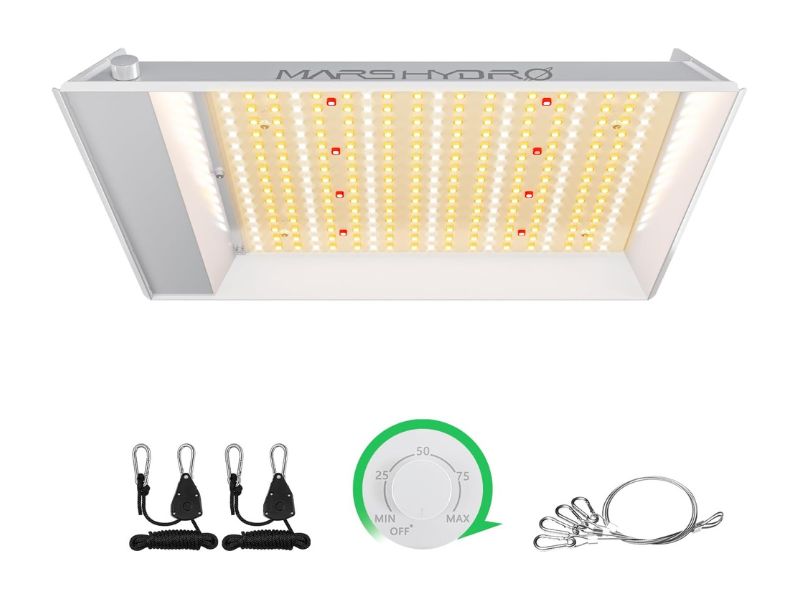
My primary recommendation is the MARS HYDRO TS600. The current 2026 version is a 100W dimmable full-spectrum fixture with 312 LEDs, a reflective hood, and a 2×2-class growing footprint, making it a practical all-purpose option for vegetables from seedlings through compact mature plants.
I would choose the Spider Farmer SF1000 when system efficiency matters more. Its current configuration uses 100W actual input, 2.5 µmol/J system PPE, upgraded high-efficiency diodes, full-spectrum output, and dimming, which makes it especially attractive for compact peppers, herbs, leafy vegetables, and hydroponic gardens.
For long shelves, seedling trays, lettuce, herbs, and row-style vegetable production, I would choose the Barrina T5 4FT 5000K 8-Pack. It provides eight 4-foot bars at 20W each for 160W total, with 5000K full-spectrum output, separate switching, linkability, and three mounting options.
3 Best LED Grow Lights for Vegetables
1. MARS HYDRO TS600 100W LED Grow Light
Key Features
- 100W actual input
- 2026 upgraded dimmable configuration
- 312 LEDs
- Full-spectrum output
- Reflective hood
- Updated diode layout
- Fanless operation
- Approximate 2×2 vegetable-stage coverage
- Suitable for seedlings through compact mature crops
The MARS HYDRO TS600 is my primary recommendation because its 100W power class is a practical middle ground for home vegetable growing.
The current listing identifies the TS600 as a 100W dimmable grow light with 312 LEDs and updated diode distribution. The fixture is designed for compact indoor growing spaces and uses a reflective hood to direct more of its output toward the plant canopy.
I would consider it for:
- Lettuce
- Spinach
- Kale
- Basil
- Parsley
- Cilantro
- Pepper seedlings
- Compact mature peppers
- Dwarf tomatoes
- Vegetable transplants
- Small hydroponic systems
Dimming is one of the most useful features for vegetables.
Young seedlings do not need the same intensity as mature plants carrying flowers or fruit.
A better progression is:
Seedlings → lower output
Established plants → moderate output
Mature high-light vegetables → increase as required
This approach also helps control electricity consumption and heat.
The current TS600 listing specifically notes the newly added dimming function for adjusting intensity from seedling through later growth stages.
The full-spectrum configuration is useful for a mixed vegetable garden.
University of Minnesota notes that blue or mixed light works well for seedlings and leafy greens, while white or mixed/balanced lighting is suitable for most plants across growth stages.
That means you do not need separate lamps for lettuce, peppers, and seedlings simply because the crops are at different stages.
The reflector-assisted design is another advantage in compact spaces.
Vegetables use photons intercepted by their leaves.
Light spilling onto:
- Walls
- Floors
- Empty shelf space
does not contribute directly to crop growth.
A reflector helps keep more of the fixture’s output within the intended growing area.
The current product page positions the TS600 around a 2×2 vegetative footprint, with a smaller high-intensity area as crops progress.
That makes it appropriate for a compact vegetable canopy, but not a large room full of mature tomatoes.
Tomato and pepper plants can expand quickly.
Once the canopy extends well beyond the useful light footprint, adding more wattage at the center does not fix weak edge coverage.
At that point, you need either:
- A larger fixture
- A second light
- A more distributed lighting layout
The TS600 is also fanless.
That keeps fixture noise low, which is useful in apartments, spare rooms, or indoor hydroponic areas.
However, fanless does not mean heat-free.
A 100W fixture still adds heat to an enclosed growing area.
Gentle circulation and ventilation remain important.
What I Like
- Practical 100W power class
- Dimmable
- Full-spectrum output
- Reflector-assisted coverage
- Works from seedlings through compact mature vegetables
- Fanless
- Easy fit for small indoor gardens
What I Do Not Like
- Too small for broad mature tomato canopies
- Requires overhead mounting
- One fixture is not ideal for long shelves
- Stronger crops may eventually outgrow its footprint
The TS600 is my choice for a compact mixed vegetable garden where one fixture needs to handle seedlings, leafy greens, herbs, and smaller fruiting plants without excessive wattage.
2. Spider Farmer SF1000 100W LED Grow Light
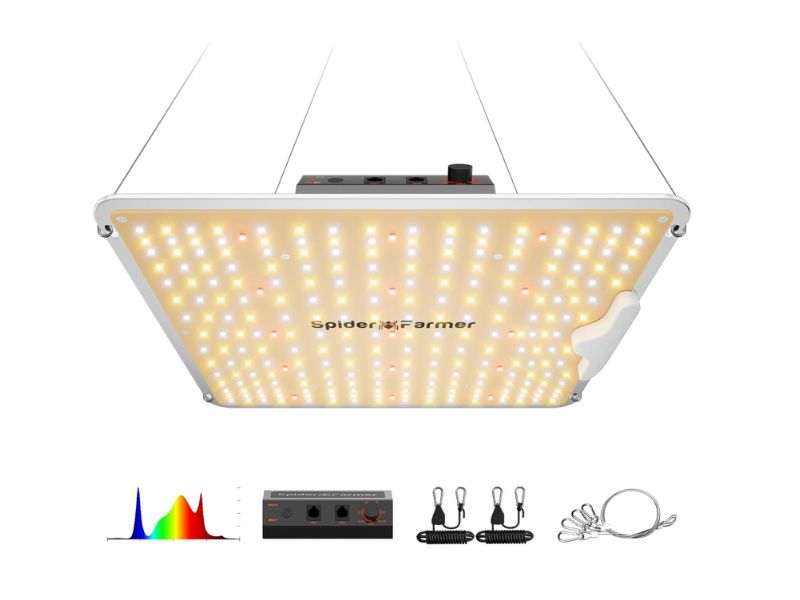
Key Features
- 100W actual power
- 2.5 µmol/J system PPE
- Updated high-efficiency diode layout
- Full-spectrum output
- Dimmable
- Fanless
- Compact 2×2/3×3-oriented design
- Suitable for vegetables and seed starting
The Spider Farmer SF1000 is the option I would choose when efficiency is a higher priority.
Its current listing specifies 100W actual input and 2.5 µmol/J complete-system PPE, along with a revised diode arrangement and dimming.
PPE matters because wattage measures electrical consumption—not plant-light output.
A more efficient fixture can generate more photosynthetically active photons from the same electrical input.
For a light operating 12–18 hours on many days, that becomes increasingly relevant.
The SF1000 is well suited to:
- Peppers
- Dwarf tomatoes
- Herbs
- Lettuce
- Kale
- Chard
- Seedlings
- Compact hydroponic vegetables
The dimmer helps adapt the fixture to these very different crops.
Leafy vegetables generally do not need the same canopy intensity as mature fruiting crops.
You can therefore reduce output over:
- Seedlings
- Young lettuce
- Small herbs
and increase it when the canopy contains:
- Mature peppers
- Flowering vegetables
- Dense high-light herbs
That flexibility is one of the main reasons I would choose a purpose-built dimmable fixture over a basic household bulb.
The 2.5 µmol/J system PPE also gives the SF1000 a strong efficiency advantage on paper for a 100W fixture.
For indoor vegetable growers, that translates into a better balance between:
- Photon output
- Electricity use
- Room heat
than simply purchasing a higher-wattage fixture without examining efficiency.
Coverage still matters.
A 100W LED works best when the canopy stays inside the intended growing area.
A single SF1000 may work well above:
- Two or three pepper plants
- A compact herb garden
- A square hydroponic container
- Several lettuce plants
but it is less naturally suited to a long four-foot shelf.
That is where Barrina’s linear design becomes more useful.
The full-spectrum output also lets one fixture remain in place through multiple stages.
You do not need to replace it when seedlings mature.
Adjusting intensity and photoperiod is usually more useful than changing lamps.
What I Like
- Strong 2.5 µmol/J system PPE
- Only 100W actual input
- Dimmable
- Full-spectrum output
- Good for compact fruiting vegetables
- Suitable for hydroponics
- Quiet fanless operation
What I Do Not Like
- Less suitable for long rows
- Requires overhead hanging
- One fixture can be overwhelmed by large mature tomatoes
- More power than a tiny herb shelf needs
The SF1000 is my preferred option when efficiency, dimming, and enough intensity for compact peppers or other higher-light vegetables are the priorities.
3. Barrina T5 4FT 5000K Grow Lights 8-Pack
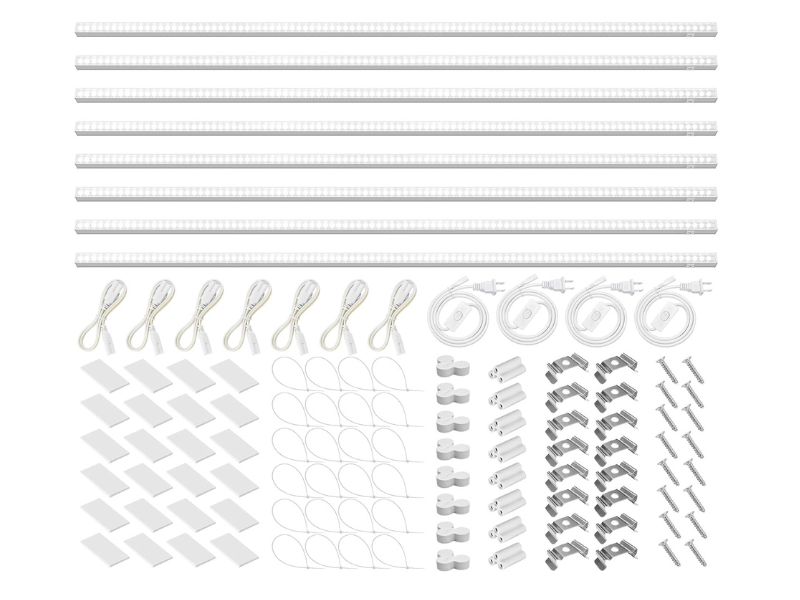
Key Features
- Eight 4-foot T5 LED bars
- 20W per fixture
- 160W total available power
- 5000K full-spectrum white light
- Separate switching
- Linkable
- Three mounting options
- Plug-and-play design
- Excellent for shelves and rows
The Barrina T5 4FT system is the option I would choose for vegetables grown on racks rather than under one square canopy.
The current configuration includes eight four-foot fixtures at 20W each, producing 160W of total available installed lighting. It also provides 5000K full-spectrum output, separate switches, linkability, and three mounting methods.
Its biggest advantage is geometry.
Many vegetables are naturally grown in long rectangular layouts:
- Lettuce rows
- Herb shelves
- Microgreen trays
- Seedling flats
- NFT channels
- Propagation racks
A long linear light follows that shape more naturally than a compact square panel.
Consider a four-foot shelf.
A small panel in the middle may produce:
strong center → weaker sides → weak ends.
A four-foot bar distributes LEDs along most of the shelf length.
Using two or more bars from front to back can improve both:
- End-to-end coverage
- Front-to-back coverage
The eight-bar package also provides considerable flexibility.
You could use:
Two bars × four shelves
or:
Four bars × two shelves
depending on crop intensity requirements.
That makes the system especially useful if your vegetable garden changes during the year.
One month the rack may contain seedlings.
Later it may contain:
- Lettuce
- Basil
- Kale
- Herbs
You can activate only the fixtures currently needed.
University of Minnesota’s 2026 seed-starting guidance recommends 5000K LED or fluorescent lights and keeping lights close enough to seedlings to prevent stretching.
That makes the selected 5000K Barrina configuration a particularly logical match for propagation.
White light also makes it easier to inspect vegetable seedlings.
Under normal white illumination, you can more easily see:
- Yellow leaves
- Pale new growth
- Nutrient symptoms
- Pest damage
- Leaf burn
than under strongly purple grow lighting.
The main disadvantage is intensity control.
Barrina does not offer continuous electronic dimming here.
Instead, you control usable light through:
- Number of active bars
- Fixture height
- Bar spacing
- Photoperiod
For a permanent vegetable rack, that works well.
For a rapidly changing single-plant setup, a dimmable panel is easier.
What I Like
- Excellent four-foot shelf coverage
- 5000K full-spectrum white output
- Eight modular bars
- 160W total available capacity
- Separate switches
- Linkable construction
- Excellent for seedlings and leafy vegetables
What I Do Not Like
- No continuous dimmer
- Requires more mounting work
- Multiple cords need organization
- Less convenient for one large tomato or pepper plant
The Barrina T5 system is my preferred choice for lettuce, herbs, seedlings, microgreens, and vegetables grown across long shelves or hydroponic rows.
LED Grow Lights for Vegetables Comparison
| Product | Actual Power | Fixture Style | Dimming | Coverage Style | Best Use |
| MARS HYDRO TS600 | 100W | Reflector panel | Yes | Compact square | Mixed vegetable garden |
| Spider Farmer SF1000 | 100W | Compact panel | Yes | Compact square | Peppers, herbs, hydroponics |
| Barrina T5 4FT 8-Pack | 160W total | Linear bars | Bar-based control | Long/rectangular | Lettuce, seedlings, racks |
For a general-purpose vegetable garden, TS600 offers the most balanced setup. SF1000 emphasizes efficiency, while Barrina provides the most useful geometry for long vegetable shelves.
How to Choose the Best LED Grow Lights for Vegetables
Start With the Type of Vegetable
Vegetables have very different lighting demands.
Leafy crops include:
- Lettuce
- Spinach
- Kale
- Chard
Fruiting vegetables include:
- Tomatoes
- Peppers
- Cucumbers
Fruiting crops generally need more useful light as they mature.
Do not assume a fixture that handles seedlings automatically has enough coverage for a mature tomato.
Best LED Grow Light for Seedlings
For multiple trays, I would choose Barrina T5 5000K.
Its long linear form makes it easier to provide even light over trays.
University of Minnesota recommends roughly 16–18 hours of daily light for seedlings and specifically recommends 5000K LED or fluorescent lighting in its 2026 seed-starting guidance.
TS600 or SF1000 also work if dimmed appropriately.
Best LED Grow Light for Lettuce
Barrina is my preferred choice for lettuce grown along shelves or hydroponic channels.
University of Minnesota suggests roughly 12–14 hours per day for hydroponic lettuce and herbs as a general indoor-lighting guideline.
Lettuce generally benefits from even moderate illumination more than one extreme hotspot.
Best LED Grow Light for Herbs
For a long herb shelf, Barrina makes the most sense.
For several pots clustered together, TS600 or SF1000 gives you more intensity control.
High-light herbs such as basil may benefit from stronger output than very low-light foliage plants.
Best LED Grow Light for Peppers
I would choose Spider Farmer SF1000.
Its 100W input, dimming, and 2.5 µmol/J system PPE give it enough headroom for a compact mature pepper canopy while remaining manageable for a home grow.
Best LED Grow Light for Tomatoes
For dwarf or compact tomatoes, either TS600 or SF1000 can work within a small canopy.
Large indeterminate tomatoes can quickly become wider and taller than either fixture’s ideal footprint.
When the canopy becomes too large, increase illuminated area rather than simply moving a small fixture closer.
Best LED Grow Light for Hydroponic Vegetables
SF1000 works particularly well over a compact square hydroponic system.
Barrina is better for:
- NFT channels
- Long lettuce rows
- Multi-level systems
Hydroponics changes root management, not the plant’s basic need for light.
What Is PPFD?
PPFD measures the density of photosynthetically active photons reaching a point on the plant canopy.
It is more useful than simply judging how bright a lamp looks.
PPFD changes with:
- Distance
- Dimmer setting
- Fixture shape
- Canopy position
A strong center reading does not tell you whether edge plants receive enough light.
What Is PPF?
PPF measures the total photosynthetically active photons produced by a fixture each second.
It is useful for comparing total output.
However, PPF does not tell you where those photons land.
Fixture layout and hanging height still determine canopy uniformity.
What Is PPE?
PPE measures photon output per joule of electricity.
SF1000 currently publishes 2.5 µmol/J system PPE.
This makes PPE a more meaningful efficiency metric than vague equivalent-watt claims.
White Light Is Good for Vegetables
University of Minnesota currently states that white or balanced light is suitable for most plants at any growth stage, while blue or mixed light is useful for seedlings and leafy greens.
That is why broad white/full-spectrum fixtures are versatile for mixed vegetable gardens.
Is 5000K Good for Vegetables?
Yes.
5000K provides a daylight-like white spectrum and is particularly practical for seedlings and leafy growth.
University of Minnesota’s current seed-starting guidance specifically recommends 5000K LED or fluorescent lights.
Kelvin rating alone does not determine plant performance, though.
Intensity and coverage matter more.
How Many Hours Should Vegetable Grow Lights Stay On?
A useful general range depends on crop type.
University of Minnesota currently suggests:
- Seedlings: 16–18 hours
- Hydroponic lettuce and herbs: 12–14 hours
These are starting points, not universal formulas.
Fixture intensity and natural daylight both affect the appropriate schedule.
Do Not Run Grow Lights 24 Hours by Default
Longer light periods do not automatically compensate for weak intensity.
Vegetables generally benefit from a consistent day/night cycle.
If seedlings stretch, first examine:
- Fixture distance
- Light output
- Coverage
rather than leaving the lamp on continuously.
Signs Vegetable Seedlings Need More Light
Possible symptoms include:
- Long thin stems
- Leaning
- Pale foliage
- Wide internode spacing
- Weak stems
University of Minnesota specifically advises keeping grow lights close to seedlings to prevent stretching.
Signs the Light May Be Too Strong
Watch for:
- Bleaching
- Pale upper leaves
- Curling
- Dry stressed areas
Reduce intensity or increase fixture distance gradually.
Do not make abrupt changes if plants were previously grown under weak light.
Overhead Placement Is Usually Best
Vegetables generally grow more evenly when light comes from above.
Strong side lighting can encourage stems and leaves to lean toward the source.
This is especially noticeable with seedlings.
Keep Canopy Height Even
If one pepper is much taller than the lettuce beside it, the pepper receives significantly more light because its leaves sit closer to the fixture.
Group plants by:
- Height
- Light requirements
- Growth stage
when possible.
Airflow Still Matters
Good lighting increases growth potential, but plants still need an appropriate environment.
Gentle airflow helps reduce stagnant humidity and strengthens young stems.
UMN’s current seed-starting guidance includes a small fan among useful seed-starting equipment and recommends steady growing conditions rather than overly wet seedlings.
More Light Can Increase Water Demand
As photosynthesis and transpiration increase, vegetables may use water faster.
That does not mean watering on a fixed schedule more often.
Monitor:
- Soil moisture
- Plant condition
- Hydroponic reservoir level
and adjust according to actual demand.
Electricity Use of TS600 and SF1000
Both fixtures use approximately 100W at full nominal output.
At 16 hours per day:
0.1 kW × 16 = 1.6 kWh/day
Over 30 days:
48 kWh/month
Actual consumption can be lower when dimmed.
Electricity Use of Barrina T5 8-Pack
The complete package is:
8 × 20W = 160W.
At 16 hours:
0.16 × 16 = 2.56 kWh/day
Over 30 days:
76.8 kWh/month
Using only four bars would roughly halve the lighting load.
Common Vegetable Grow-Light Mistakes
Choosing Only by Wattage
Compare coverage, efficiency, and canopy-level light.
Using a Small Light Over Too Many Plants
Match the fixture to mature canopy area.
Hanging Seedling Lights Too High
Weak light encourages stretching.
Running Maximum Output From Day One
Use dimming when available.
Treating Lettuce Like Tomatoes
Different crops have different intensity needs.
Ignoring Shelf Shape
Long vegetable rows often work better under linear lights.
Ignoring the Dark Period
Do not automatically use 24-hour lighting.
Forgetting Heat and Airflow
Even efficient LEDs warm small enclosed spaces.
Frequently Asked Questions
What are the best LED grow lights for vegetables?
MARS HYDRO TS600, Spider Farmer SF1000, and Barrina T5 4FT are my three choices.
They cover mixed compact vegetable gardens, efficiency-focused setups, and long shelf-grown crops.
What is the best LED grow light for vegetables overall?
MARS HYDRO TS600 is my primary recommendation for compact mixed vegetable growing.
Its current 100W configuration combines dimming, full-spectrum output, updated diodes, and reflector-assisted coverage.
What is the best LED grow light for vegetable seedlings?
Barrina T5 5000K is especially practical for multiple seedling trays.
Its long bars provide even shelf coverage, while 5000K is specifically recommended in current UMN seed-starting guidance.
What grow light is best for lettuce?
Barrina T5 is my preferred option for lettuce rows and shelf systems.
Its four-foot bars can be distributed across rectangular growing areas rather than concentrating output in the center.
What grow light is best for peppers?
Spider Farmer SF1000 is my preferred compact pepper light.
It combines 100W input, dimming, full-spectrum output, and 2.5 µmol/J system PPE.
Can a 100W LED grow vegetables?
Yes, an efficient 100W fixture can support a compact vegetable canopy.
Both TS600 and SF1000 are genuine 100W-class fixtures intended for compact indoor growing.
Is 100W enough for tomatoes?
It can be enough for compact or dwarf tomatoes within a small canopy.
Large indeterminate tomatoes usually need a larger illuminated footprint as they mature.
Is 100W enough for peppers?
Yes, 100W can work well for a compact pepper canopy with proper placement.
Dimming also lets the same fixture serve younger plants.
Is 5000K good for vegetables?
Yes, 5000K is particularly practical for seedlings and vegetative growth.
UMN’s current seed-starting guidance specifically recommends 5000K LED or fluorescent lighting.
Is full-spectrum light good for vegetables?
Yes, balanced white or mixed light works across many vegetable growth stages.
UMN states that white or mixed/balanced lighting is suitable for most plants throughout growth.
How long should vegetable seedlings be under LEDs?
About 16–18 hours per day is a useful general starting point.
That is the current University of Minnesota recommendation for seedlings.
How long should lettuce grow lights stay on?
About 12–14 hours daily is a useful starting point for hydroponic lettuce.
Intensity still matters, so photoperiod should not be considered separately from usable canopy light.
Can vegetable grow lights stay on 24 hours?
I would not use 24-hour lighting as the normal approach.
Use an appropriate daily photoperiod and provide a regular dark period.
What does 2.5 µmol/J mean?
It measures photosynthetic photon output produced for each joule of electricity consumed.
Spider Farmer currently publishes 2.5 µmol/J system PPE for the SF1000.
What is PPFD?
PPFD measures photosynthetic photon density reaching a specific point on the canopy.
It helps evaluate whether vegetables receive enough light where their leaves actually grow.
What is PPF?
PPF measures total photosynthetically active photons produced by a fixture each second.
It describes overall output rather than intensity at one specific location.
Are Barrina lights good for vegetables?
Yes, especially for seedlings, lettuce, herbs, and other row-grown vegetables.
The selected system provides eight 20W four-foot full-spectrum bars.
Is Spider Farmer SF1000 good for vegetables?
Yes, particularly for compact peppers, herbs, leafy greens, and hydroponic systems.
Its 100W platform includes dimming and 2.5 µmol/J system PPE.
Is MARS HYDRO TS600 good for vegetables?
Yes, it is a practical all-purpose fixture for a compact mixed vegetable garden.
The current version is 100W, dimmable, and designed for seedling, vegetative, and later growth stages.
Which LED grow light should I buy for vegetables?
Choose TS600 for mixed crops, SF1000 for efficiency, or Barrina for shelves.
The best choice depends mainly on mature canopy shape and crop light demand.
Conclusion
The best LED grow lights for vegetables should provide useful canopy-level intensity while matching the shape and size of the plants being grown. I would prioritize PPFD distribution, system efficiency, dimming, fixture geometry, photoperiod, and mature canopy size rather than choosing only by wattage.
The MARS HYDRO TS600 remains my primary recommendation for a compact mixed vegetable garden. Its 100W actual input, 2026 dimming upgrade, full-spectrum output, reflective hood, and updated diode layout make it useful from seedling trays through leafy greens, herbs, peppers, and smaller mature crops.
The Spider Farmer SF1000 is my preferred efficiency-focused alternative. Its 100W input and 2.5 µmol/J system PPE make it particularly attractive for peppers, herbs, compact hydroponics, and growers who operate lights for long daily periods.
The Barrina T5 4FT 5000K 8-Pack is the better solution for shelves and rows. Eight linear 20W bars provide 160W of total available lighting and match lettuce, herbs, seedlings, microgreens, and long hydroponic channels particularly well.
For a mixed compact vegetable garden, I would choose MARS HYDRO TS600. For efficiency and compact fruiting crops, I would choose Spider Farmer SF1000. For seedlings, leafy vegetables, and shelf growing, I would choose Barrina T5 5000K.

I’m Maya L. Greenwood, a lifelong plant lover who believes anyone can grow something beautiful with the right guidance. After years of testing soil mixes, pruning methods, irrigation tricks, and pest-safe solutions, I started EasyGardenTips.com to turn hard-won lessons into step-by-step advice. From seed starting and container gardens to composting and seasonal checklists, my goal is to make gardening simple, sustainable, and fun.