3 Best LED Light for African Violets for Reliable Blooms
African violets need bright but controlled light to maintain attractive rosettes and flower consistently. The best LED light for African violets should provide enough intensity for blooming without forcing these compact plants under the extreme output intended for tomatoes, cactus collections, or large grow tents.
Light duration matters too, but there is no single hour setting that works with every LED. Virginia Tech notes that African violets can grow and flower entirely under artificial light and cites roughly 8–12 hours at about 1,000 foot-candles, while University of Minnesota guidance uses a longer 14–16 hours of light with 8–10 hours of darkness. The practical lesson is to balance intensity and duration rather than copying one timer setting blindly.
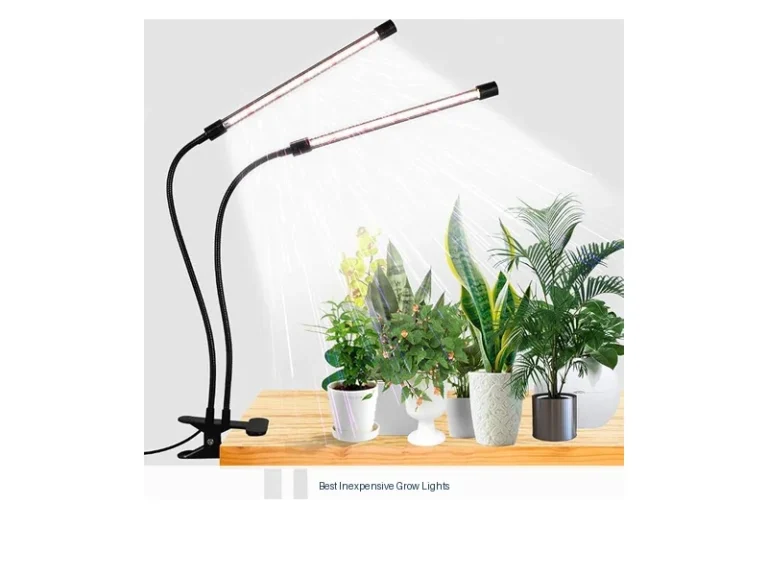
My primary recommendation is the GooingTop 6000K Full Spectrum LED Grow Light. I would choose it for one to several African violets because its current Amazon listing combines 6000K white/red output, five brightness levels, flexible gooseneck positioning, clamp mounting, and 4/8/12-hour automatic timing.
I would choose the Barrina T5 4FT Grow Lights 8-Pack for a larger African violet collection or multi-level shelf. Eight 4-foot, 20W bars provide 160W total available power, and the modular linear format lets you distribute moderate light across several rows instead of concentrating it over one plant.
For one mature violet that needs a stronger, focused overhead source, I would choose the GE PAR38 Balanced Spectrum Grow Bulb. GE’s current Amazon listing specifies 50 µmol/s PPF, balanced white-spectrum output, and a rated 25,000-hour lifespan.
3 Best LED Lights for African Violets Reviewed
| Image | Product Name | Check Price |
|---|---|---|
Best Choice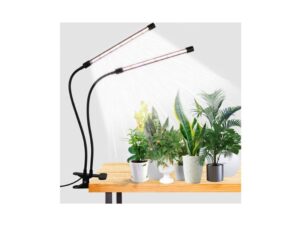 | GooingTop 6000K Full Spectrum LED Grow Light | Check Price |
Second Best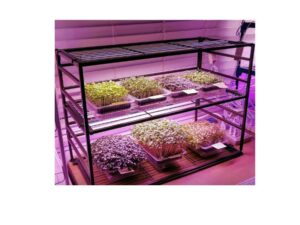 | Barrina T5 4FT Grow Lights 8-Pack | Check Price |
Third Choice | GE PAR38 Balanced Spectrum Grow Bulb | Check Price |
1. GooingTop 6000K Full Spectrum LED Grow Light
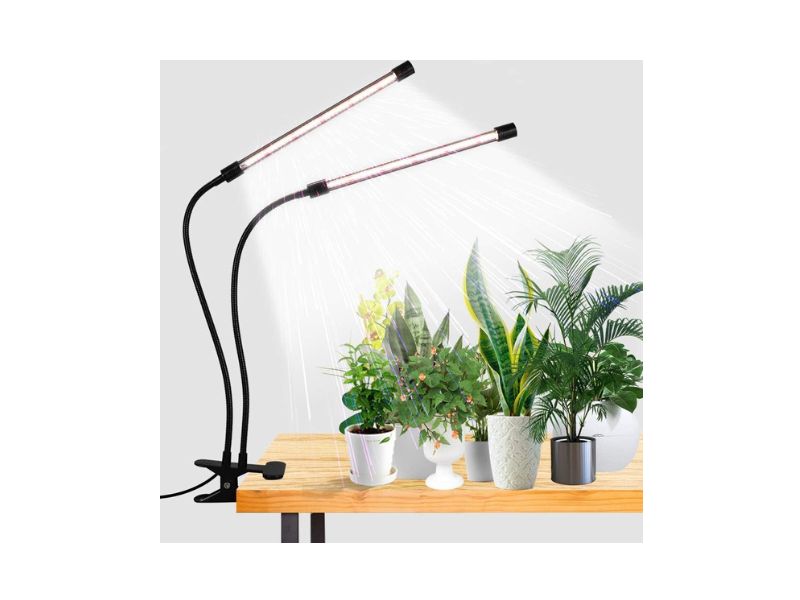
Key Features
- 6000K white/red spectrum
- Five brightness levels
- 4/8/12-hour timer
- Flexible gooseneck
- Clamp mounting
- Compact footprint
- Good for one to several violets
- White-looking light for natural leaf-color inspection
The GooingTop is my primary recommendation because African violets usually benefit more from controllable moderate light than from an oversized high-output fixture.
Its current Amazon listing shows a 6000K full-spectrum-style plant lamp with white and red LEDs, five brightness settings, flexible positioning, and repeating 4-, 8-, and 12-hour timer cycles.
That combination works particularly well for African violets because their small rosette shape makes precise placement easy.
The clamp can attach to a:
- Desk
- Shelf
- Plant stand
- Side table
Then the flexible neck can position the light directly above the foliage.
Overhead positioning is preferable to strong lighting from one side because it encourages a more symmetrical rosette.
A one-sided light source can encourage leaves to orient toward the brighter direction.
The five-level dimmer is especially valuable.
African violets can be sensitive to excessive light.
University of Florida notes that too little light can result in poor flowering, while African violet authorities consistently emphasize bright but controlled light rather than intense direct sun.
With GooingTop, you have two variables available:
brightness
and
distance.
That lets you tune the fixture gradually instead of moving a plant directly from weak window light to maximum LED intensity.
I would start conservatively if the plant has been growing in a dim location.
Then increase brightness or bring the lamp closer while watching new growth.
A healthy African violet should maintain a relatively balanced rosette.
Potential signs of inadequate light can include:
- Leaves stretching upward
- Long petioles
- Sparse flowering
- Leaves reaching toward the lamp
Too much light may produce:
- Pale or yellowish foliage
- Tight, crowded centers
- Shortened petioles
- Bleached-looking areas
Plant response is more useful than assuming one brightness setting is universally correct.
The 6000K spectrum is somewhat cooler than the combinations commonly discussed by African violet specialists, but that does not make it unsuitable.
The African Violet Society of America discusses both 5000K and mixed 5000K/4000K lighting as workable choices, while also emphasizing that spectral response differs by cultivar and foliage type.
The GooingTop also includes red LEDs alongside its cool-white output, so it is not simply a narrow blue-only source.
The built-in timer is convenient but needs some context.
AVSA material notes that newer efficient lights may require shorter exposure than older fluorescent setups, and one AVSA guide describes starting some setups around eight hours before gradually increasing toward twelve.
Other university guidance uses longer daily schedules.
That variation exists because light intensity and time work together.
A stronger LED for fewer hours can deliver a similar daily light total to a weaker fixture running longer.
This is why I would not automatically select the 12-hour timer and assume the job is finished.
Watch whether the plant:
- Produces flowers
- Maintains normal leaf color
- Keeps a balanced rosette
- Shows excessive stretching or compression
and adjust accordingly.
Another advantage is appearance.
The white-looking output is much easier to live with than an intensely purple grow lamp in a bedroom, office, or living room.
It also makes it easier to inspect the leaves for:
- Mites
- Thrips
- Water spotting
- Yellowing
- Crown problems
without turning on another room light.
Coverage is the principal limitation.
The GooingTop is best over one plant or a compact cluster.
Trying to illuminate a long shelf of many African violets with one small lamp will create uneven intensity.
For a collection, Barrina’s linear format is much better.
What I Like
- Five useful brightness levels
- Built-in timer
- Excellent positional flexibility
- Compact footprint
- Easy overhead placement
- White-looking output
- Strong Amazon marketplace history
What I Do Not Like
- Limited coverage
- Built-in timer tops out at 12 hours
- 6000K is cooler than some violet growers prefer
- Not the cleanest solution for a large collection
The GooingTop is the model I would choose for one to several African violets where precise positioning and easy intensity control matter most. It gives you enough adjustment to find a comfortable lighting level without turning a small houseplant setup into a dedicated grow rack.
2. Barrina T5 4FT Grow Lights 8-Pack
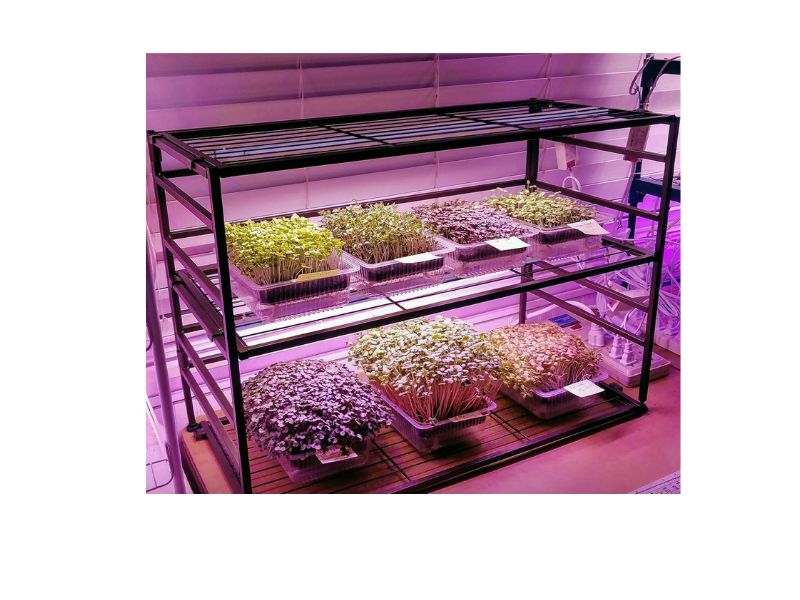
Key Features
- Eight 4-foot LED bars
- 20W per bar
- 160W total available power
- Full-spectrum plant output
- Linear shelf-friendly design
- Separate switching
- Plug-and-play installation
- Flexible mounting
The Barrina T5 system is the option I would choose for an African violet collection.
Its current Amazon listing specifies eight 4-foot grow-light bars at 20W each, for 160W total package power, with separate switching and flexible mounting.
The important feature is not really 160W.
It is the ability to divide that output across several shelves.
For example, you might use:
two bars per shelf across four levels
rather than putting all eight bars over one growing surface.
That approach is particularly well suited to African violets because collectors often grow many relatively small plants on long shelves.
Linear fixtures match that geometry.
A central spotlight over a four-foot shelf tends to create:
bright center → weaker sides → weakest ends.
Four-foot bars spread emitters along nearly the entire row.
That makes it easier to keep plants at both ends of the shelf growing similarly to plants in the middle.
Consistency matters with African violets because lighting affects both:
- Rosette shape
- Flower production
If one violet receives much more light than the next, they can develop very differently even when watering and fertilization are identical.
AVSA specifically recognizes LED and fluorescent shelf lighting as normal artificial-light approaches for African violets. Its lighting guidance also discusses 5000K and 5000K/4000K combinations, illustrating how well linear overhead systems fit traditional violet culture.
The selected Barrina version is marketed as a full-spectrum plant light rather than a plain utility fixture.
Its relatively low 20W per individual bar can actually be useful.
African violets do not require the extreme intensity demanded by many fruiting crops.
Several moderately powered bars spaced properly can provide a more forgiving light field than one high-output panel.
The main goal is uniformity.
On a deep shelf, I would normally use more than one bar from front to back.
For example, two parallel bars can produce better coverage across a shelf than one bar exactly over the center.
The correct number depends on:
- Shelf depth
- Fixture height
- Violet size
- Natural room light
- Cultivar response
The separate on/off controls are practical too.
Suppose only two of four shelves currently contain plants.
You do not need to operate unused fixtures.
That can reduce electricity and unnecessary room heat.
The system does not provide sophisticated electronic dimming, so light intensity is controlled more traditionally through:
- Number of bars
- Bar spacing
- Fixture height
- Photoperiod
That is not necessarily a disadvantage.
African violet growers have successfully used fixed-output fluorescent and LED shelf systems for years.
A reliable external timer can automate the entire rack.
The biggest challenge is determining the daily schedule.
Different authoritative sources give different ranges.
Smithsonian guidance gives a general rule of approximately 10–12 hours of strong light per day, while University of Minnesota recommends 14–16 hours of light and 8–10 hours of darkness for flowering.
Instead of treating this as a contradiction, I would interpret it as evidence that fixture intensity matters.
Your best schedule is the one that produces:
- Flat, balanced foliage
- Healthy green color
- Consistent flowering
- No bleaching or crowding
The Barrina system is particularly useful because a collection can be managed consistently once you determine the right shelf height and timer schedule.
What I Like
- Excellent for African violet collections
- Eight modular fixtures
- Long shelf-friendly format
- 160W total available power
- Separate switching
- Good end-to-end coverage
- Easy to divide among several shelves
What I Do Not Like
- More installation work
- Requires cable management
- External timer recommended
- Intensity control relies on placement rather than a dimmer
The Barrina T5 system is my preferred solution when you have a substantial African violet collection or a dedicated plant rack. Long linear bars provide the kind of even overhead lighting that compact rosette plants benefit from.
3. GE PAR38 Balanced Spectrum Grow Bulb
Key Features
- 50 µmol/s PPF
- Balanced white spectrum
- PAR38 directional beam
- Standard bulb-style format
- Rated 25,000-hour lifespan
- Focused overhead lighting
- Useful for one mature violet or small display
The GE PAR38 is the strongest focused option among these three.
Its current Amazon listing specifies 50 µmol/s PPF, balanced-spectrum white output, and up to 25,000 hours of rated life.
PPF stands for Photosynthetic Photon Flux.
It measures the total photosynthetically active photons emitted each second.
That is more useful for evaluating plant lighting than relying only on lumens because lumens are weighted around human vision.
The GE bulb has substantially more focused output than a small pot-mounted or decorative clip lamp.
That can be useful for:
- One mature African violet
- A small group of violets
- A display plant away from a window
- A dedicated tabletop growing area
However, its extra output needs to be respected.
African violets are not high-intensity desert plants.
Virginia Tech notes that they perform best at roughly 1,000 foot-candles for about 8–12 hours daily in one artificial-light framework.
That makes distance particularly important with a PAR38.
I would not automatically place a powerful directional bulb extremely close to the foliage.
Begin farther away, evaluate leaf posture and flowering, and adjust gradually.
The PAR38 beam is concentrated.
That means moving the lamp only a few inches can meaningfully change the intensity reaching the rosette.
Unlike GooingTop, this GE model is not the option I would choose when constant fine adjustment is a priority.
Its role is simpler:
provide a stronger, focused pool of white grow light.
The balanced white appearance is excellent for indoor displays.
GE describes the bulb as providing balanced blue and red plant-light output while appearing white to human eyes.
That matters with African violets because their foliage and flowers are decorative.
A purple lamp may support plant growth, but it makes:
- Blue flowers
- Pink flowers
- Variegated foliage
- Leaf color
look unnatural.
A white-spectrum bulb lets the plant remain visually attractive while illuminated.
The standard bulb format is another advantage.
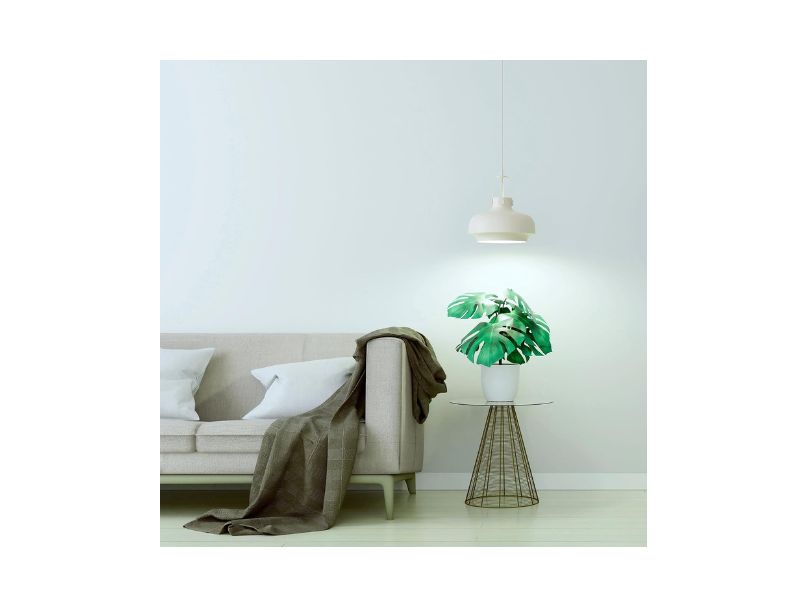
You can use it in an appropriate sturdy lamp instead of installing a purpose-built grow-light frame.
That may work particularly well above:
- A side table
- Plant pedestal
- Display shelf
where a clamp lamp would look awkward.
The downside is control.
There is no integrated timer here.
I would use a suitably rated external timer.
Intensity is also adjusted primarily through:
- Distance
- Fixture angle
- Daily operating time
rather than a multi-level electronic dimmer.
For one plant, that can be perfectly adequate.
For a whole shelf, Barrina is easier to distribute evenly.
What I Like
- Published 50 µmol/s PPF
- Strong directional output
- Natural-looking balanced spectrum
- Long rated lifespan
- Good for a mature individual violet
- Works with conventional lamp-style fixtures
What I Do Not Like
- Easier to provide excessive intensity if positioned too close
- No built-in timer
- Less convenient than a dimmable clip lamp
- Narrower useful area than linear shelf lights
The GE PAR38 is the light I would choose when one mature African violet needs a stronger dedicated overhead source and I have enough room to manage fixture distance carefully.
LED Lights for African Violets Comparison
| Product | Fixture Style | Intensity Control | Timer | Coverage | Best Use |
| GooingTop 6000K | Clamp/gooseneck | 5 levels | 4/8/12 hr | Small | One to several violets |
| Barrina T5 4FT | Linear bars | Bar count/distance | External | Large/linear | Violet collections |
| GE PAR38 | Directional bulb | Distance-based | External | Focused | One mature violet |
GooingTop provides the most flexible everyday control, Barrina gives a collection the most consistent shelf-wide coverage, and GE PAR38 offers the strongest focused single-bulb output.
How to Choose the Best LED Light for African Violets
African Violets Need Bright, Controlled Light
African violets can tolerate relatively modest indoor light, but insufficient light often reduces flowering.
Virginia Tech notes that the plants can flower completely under artificial light, while University of Florida emphasizes that inadequate light can result in poor or absent flowering.
That means the goal is not merely keeping foliage alive.
The goal is enough light to support repeated flowering without stressing the leaves.
Best Light for One African Violet
For one average-size violet, I would start with GooingTop.
The dimmer lets you adjust intensity without changing the entire setup.
For a larger mature plant in a darker room, GE PAR38 can provide more focused output.
Best Light for Several African Violets
GooingTop can handle a small group when the pots sit close together.
Make sure the lamp is centered above the combined canopy.
If the outer plants begin leaning inward, the group has become too wide for one small source.
Best Light for an African Violet Shelf
I would choose Barrina T5.
Shelf-grown African violets benefit from a long overhead light source because the plants are often arranged in rows.
Linear lighting makes edge-to-edge intensity easier to manage.
Best Light for a Large African Violet Collection
Barrina is also the clear choice of these three for a larger rack.
Eight bars can be distributed across several shelves rather than forcing every plant beneath one central fixture.
4000K vs 5000K vs 6000K for African Violets
There is no single mandatory Kelvin rating.
AVSA’s lighting information notes that some light-green and variegated African violets can perform under a single 5000K lamp or a 5000K/4000K combination.
This is useful guidance because it shows that neutral-to-daylight white LED spectra are appropriate.
GooingTop’s 6000K spectrum is cooler but still within the broad white-light approach.
I would prioritize:
- Proper intensity
- Coverage
- Photoperiod
- Cultivar response
over obsessing about a few hundred Kelvin.
Is Full Spectrum Good for African Violets?
Yes.
Broad-spectrum LED lighting is a practical choice for both foliage growth and flowering.
It also keeps foliage and flower colors much easier to evaluate than strongly colored red/blue lighting.
The African Violet Society explicitly discusses modern LED options in its artificial-light guidance.
How Many Hours of LED Light Do African Violets Need?
There is no single universally correct number because fixture intensity varies.
Authoritative guidance ranges considerably:
- Virginia Tech: around 8–12 hours under its specified light level.
- Smithsonian: roughly 10–12 hours of strong light.
- University of Minnesota: 14–16 hours light with 8–10 hours darkness for flowering.
- Iowa State: artificial lights can run around 12–16 hours daily.
The practical approach is to adjust intensity and hours together.
African Violets Need Darkness Too
Continuous 24-hour lighting is unnecessary.
University of Minnesota recommends maintaining 8–10 hours of darkness, while RHS similarly stresses a daily dark period for sustained flowering.
I would use a timer rather than leaving lights on around the clock.
Why Dimming Is Valuable
A dimmer is useful because many home setups have fixed shelf heights.
If the fixture cannot move upward easily, lowering output gives you another way to reduce intensity.
That is one reason GooingTop works particularly well for beginners.
How Far Should LEDs Be From African Violets?
There is no universal distance for all LEDs.
Iowa State gives an example of suspending artificial fixtures roughly 8–10 inches above African violets in one traditional lighting setup, but a modern PAR38 bulb and a low-power LED bar can produce very different photon densities at the same distance.
Use product guidance and plant response rather than applying one distance to every fixture.
Signs an African Violet Needs More Light
Possible signs include:
- Weak flowering
- Long leaf stalks
- Leaves reaching upward
- Open, stretched rosette
University of Florida and Iowa State both identify inadequate light as a major reason African violets flower poorly.
Signs an African Violet May Have Too Much Light
Possible signs include:
- Pale foliage
- Yellow-green leaves
- Tight center growth
- Short petioles
- Bleached-looking areas
Reduce intensity gradually rather than making extreme changes.
Rotate Window-Grown Plants
If artificial light supplements a window, rotating the pot periodically can help preserve symmetry.
A plant receiving strong natural light from one side may orient its leaves toward the window even when an overhead grow lamp is present.
Use Overhead Light for Better Rosettes
African violets are valued partly for their symmetrical leaf arrangement.
Overhead lighting is therefore preferable for display plants.
Try to center the crown beneath the light source.
Do Not Use an Oversized Grow-Tent Fixture
A 100W, 300W, or 700W horticultural panel is usually unnecessary for a handful of African violets.
These plants are compact and do not require the intensity used for mature fruiting crops.
A smaller fixture allows much finer control.
African Violet Variegation and Light
Variegated cultivars can respond differently from dark-green varieties.
AVSA specifically notes that light-green and variegated foliage may work well with 5000K alone or mixed 5000K/4000K lighting.
This is another reason to avoid assuming one fixed light recipe fits every cultivar.
Lighting for Blooming
Adequate light is one of the biggest requirements for consistent African violet flowering.
AVSA’s blooming guidance says good light is fundamental, while University of Florida notes that insufficient light commonly leads to poor flowering.
If an otherwise healthy plant refuses to bloom, light is one of the first variables I would examine.
Do Not Fix Every Blooming Problem With More Light
Flowering also depends on overall culture.
African violets need appropriate:
- Temperature
- Moisture
- Nutrition
- Root health
- Humidity
So if the foliage already looks pale and compressed, adding even more light may make the problem worse.
Timer vs Manual Switching
I strongly prefer a timer.
African violets respond better to a consistent routine than to lights being turned on for five hours one day and sixteen hours the next.
GooingTop builds timing into the fixture.
Barrina and GE can be paired with an external timer.
Electricity Use
The SANSI-scale and GooingTop-scale lamps are modest electrical loads compared with commercial grow fixtures.
For a 20W shelf bar operating 12 hours:
0.02 kW × 12 = 0.24 kWh/day
Over 30 days:
7.2 kWh/month
Two 20W bars would roughly double that consumption.
Use your local electricity rate to estimate cost.
Common African Violet Grow-Light Mistakes
Using a Very Weak Lamp Too Far Away
The plant may survive but flower poorly.
Using a Powerful Light Too Close
African violets do not need desert-level intensity.
Lighting From One Side Only
This can encourage an uneven rosette.
Leaving Lights On 24 Hours
Maintain a regular dark period.
Treating Every Cultivar Identically
Variegated, light-green, and dark foliage can respond differently.
Assuming Kelvin Is Everything
Intensity and duration matter more than choosing exactly 4000K versus 5000K.
Using One Small Light for a Long Shelf
Match fixture geometry to the plant layout.
Frequently Asked Questions
What is the best LED light for African violets?
GooingTop 6000K is my primary recommendation for one to several African violets.
Its five brightness levels, flexible positioning, and built-in timer make light intensity easier to adjust than with a fixed-output fixture.
Which LED light is best for an African violet collection?
Barrina T5 is my preferred option for a dedicated multi-plant shelf or rack.
Its eight four-foot bars can be divided among multiple shelves for more uniform overhead coverage.
Which LED light is best for one mature African violet?
GE PAR38 is useful when one plant needs a stronger focused overhead source.
Its current listing publishes 50 µmol/s PPF, so I would manage distance carefully.
Are LED lights good for African violets?
Yes, African violets can grow and flower successfully under artificial LED lighting.
Multiple university extensions and the African Violet Society recognize artificial lighting as a viable way to grow them.
What color LED is best for African violets?
Broad white light around neutral-to-daylight color temperatures is a practical choice.
AVSA discusses 5000K alone and 5000K/4000K combinations as useful options for some African violet types.
Is 4000K good for African violets?
Yes, 4000K can work well as part of a broad white-light setup.
AVSA specifically discusses using 4000K together with 5000K for African violet lighting.
Is 5000K good for African violets?
Yes, 5000K is directly discussed by African violet specialists as a useful artificial-light option.
Some light-green and variegated varieties can be grown under 5000K alone.
Is 6000K good for African violets?
Yes, provided intensity and duration are controlled appropriately.
GooingTop uses a 6000K white/red configuration, while African violet guidance generally supports broad white artificial light rather than requiring one exact Kelvin value.
How many hours should African violet grow lights stay on?
Roughly 10–16 hours is seen across reputable guidance, depending heavily on intensity.
Virginia Tech, Smithsonian, Iowa State, and Minnesota publish different schedules, which is why fixture strength and plant response should guide the final setting.
Can African violet lights stay on 24 hours?
No, provide a regular dark period instead of continuous lighting.
University of Minnesota recommends 8–10 hours of darkness for flowering plants.
How far should LED lights be from African violets?
The correct distance depends on fixture output, beam spread, and dimmer setting.
Iowa State gives an 8–10-inch example for one artificial-light arrangement, but modern LEDs vary enough that product-specific guidance should take priority.
Why is my African violet not blooming?
Insufficient light is one common reason otherwise healthy African violets fail to flower.
Both University of Florida and Iowa State identify inadequate lighting as an important cause of poor blooming.
Can too much LED light hurt African violets?
Yes, excessive intensity can stress foliage and produce pale or compressed growth.
Use dimming or greater distance if the plant shows signs that the light is too strong.
Do African violets need red light for flowers?
Red wavelengths can contribute, but good overall light intensity and spectrum matter more.
A balanced broad-spectrum LED is generally more practical than selecting a lamp solely because it advertises one red wavelength.
Are purple grow lights necessary?
No, African violets can grow successfully under white-spectrum LED lighting.
White light is also easier on the eyes and makes flower and foliage color easier to inspect.
Can I use a grow light instead of a window?
Yes, African violets can be grown successfully entirely under artificial light.
Virginia Tech specifically notes that they can grow and flower without natural window light when artificial lighting is properly managed.
Are Barrina lights good for African violets?
Their linear format is particularly useful for collections arranged across long plant shelves.
The selected T5 package provides eight 20W bars, allowing light to be distributed rather than concentrated in one central hotspot.
Is GooingTop good for African violets?
Yes, especially for a small setup where dimming and flexible positioning are important.
Its current listing provides five brightness levels and automatic 4/8/12-hour timing.
Is GE PAR38 too strong for African violets?
It can be if placed too close, so distance and daily duration need careful adjustment.
Its 50 µmol/s PPF is significantly more focused than many small decorative plant lights.
Should the grow light be directly above an African violet?
Overhead placement is usually the best starting point for maintaining an even rosette.
Center the crown below the fixture and adjust height or intensity according to plant response.
Conclusion
The best LED light for African violets should provide enough usable light to support flowering without overwhelming these relatively compact, moderate-light plants. I would prioritize intensity control, even overhead coverage, appropriate daily duration, broad white spectrum, and a regular dark period before buying the strongest fixture available.
The GooingTop 6000K remains my primary recommendation for one to several plants. Its flexible gooseneck, five brightness settings, white/red spectrum, and built-in timer give you more control over the two variables that matter most in a small setup: intensity and duration.
The Barrina T5 4FT 8-Pack is my preferred option for a collection. Eight 20W linear fixtures can be distributed across shelves, making it much easier to maintain reasonably even light from one end of an African violet rack to the other.
The GE PAR38 Balanced Spectrum is the stronger focused option. Its published 50 µmol/s PPF makes it useful for one mature plant or small display, provided the fixture is positioned far enough away to avoid excessive intensity.
For most individual African violet growers, I would choose GooingTop. For a dedicated violet shelf or collection, I would choose Barrina T5. For one plant that needs stronger focused illumination, I would choose GE PAR38.

I’m Maya L. Greenwood, a lifelong plant lover who believes anyone can grow something beautiful with the right guidance. After years of testing soil mixes, pruning methods, irrigation tricks, and pest-safe solutions, I started EasyGardenTips.com to turn hard-won lessons into step-by-step advice. From seed starting and container gardens to composting and seasonal checklists, my goal is to make gardening simple, sustainable, and fun.