5 Best Battery Garden Sprayer: Easy Cordless Picks
Are you searching for the best battery garden sprayer for lawn treatments, weeds, fertilizer, or general garden care?
My top pick is the PetraTools HD4000 4-Gallon Battery Powered Backpack Sprayer, which combines a large tank, adjustable 40–90 PSI pressure, extended battery runtime, multiple nozzles, and padded backpack support for demanding residential and professional use.
For a smaller garden where carrying four gallons is unnecessary, the Scotts 190567 2-Gallon Lithium-Ion Battery Powered Sprayer is my preferred compact option. Its rechargeable lithium-ion system, stable 2-gallon tank, Viton seals, 3-in-1 nozzle, and ability to spray up to 12 tanks per charge make it particularly convenient for routine garden applications.
For a more traditional 4-gallon lithium-ion backpack design, I recommend the Chapin 63924 4-Gallon 24V Battery Backpack Sprayer. It offers 40–60 PSI operating pressure, up to two hours of continuous spraying, three useful nozzle patterns, chemical-resistant seals, and a three-stage filtration system that helps reduce clogging.
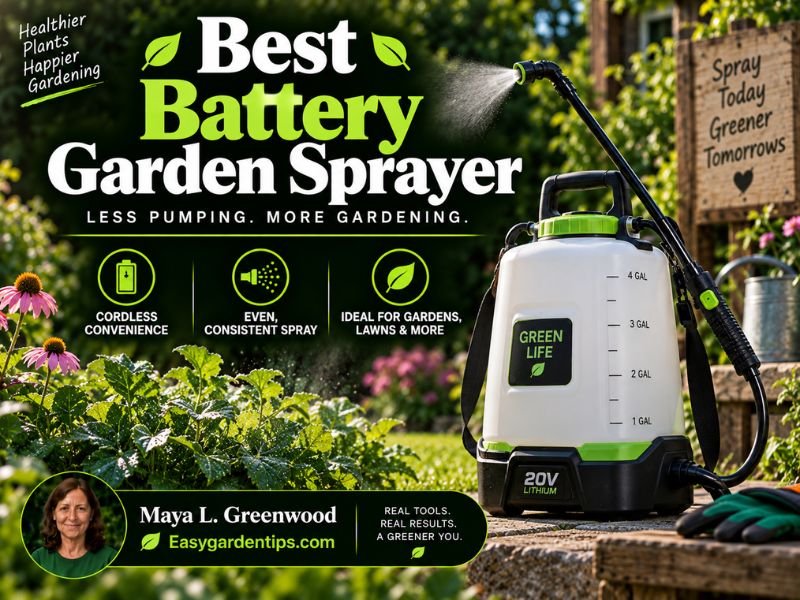
A battery sprayer eliminates the repetitive manual pumping required by conventional garden sprayers. That can make a significant difference when applying liquid fertilizer, herbicide, fungicide, insecticide, plant treatments, or plain water across a lawn or large garden.
Best Battery Garden Sprayers
| Image | Product Name | Check Price |
|---|---|---|
Best Choice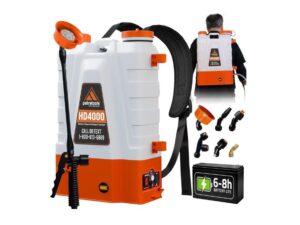 | PetraTools HD4000 4-Gallon Battery Powered Backpack Sprayer | Check Price |
Second Best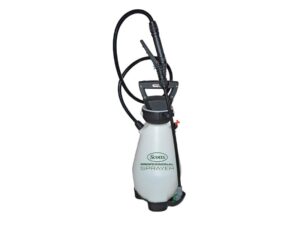 | Scotts 190567 2-Gallon Lithium-Ion Battery Powered Sprayer | Check Price |
Third Choice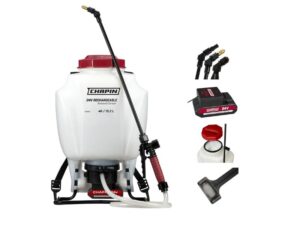 | Chapin 63924 4-Gallon 24V Battery Backpack Sprayer | Check Price |
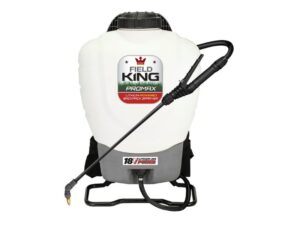 | Field King 190515 4-Gallon Lithium-Ion Backpack Sprayer | Check Price |
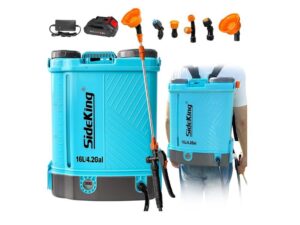 | SideKing 4-Gallon Battery Powered Backpack Sprayer | Check Price |
PetraTools HD4000 4-Gallon Battery Powered Backpack Sprayer- Best Overall
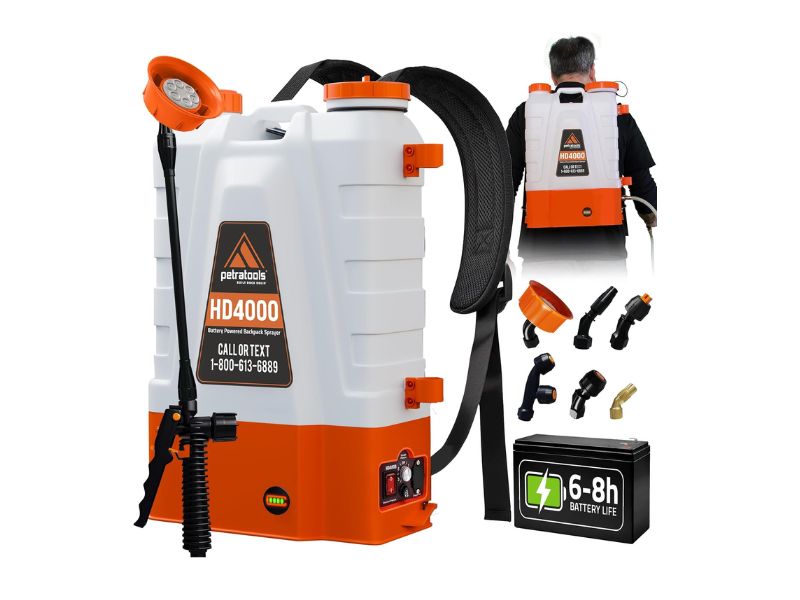
The PetraTools HD4000 is my first choice for gardeners who need enough capacity and pressure for more than occasional spot spraying.
Its 4-gallon tank is large enough to cover substantial lawn and garden areas without frequent refilling, while the powered pump eliminates manual pressurization.
The standout feature is adjustable pressure.
Depending on the current configuration, the HD4000 provides roughly 40 to 90 PSI, allowing you to reduce output for controlled plant spraying or increase it when additional range and coverage are needed. PetraTools also rates current HD4000 systems for up to approximately 6–8 hours of battery operation.
That flexibility makes it useful for several common applications:
lawn treatments, weed control, foliar feeding, pest management, garden spraying, and larger landscape areas.
The translucent tank includes volume markings so you can monitor remaining liquid, while the wide opening simplifies filling and cleaning.
Multiple interchangeable nozzles are another advantage.
Different spray patterns let you switch between targeted treatment and broad coverage without trying to make one nozzle perform every task.
Current Pro configurations also include heavy-duty wand options, metal hose fittings, a battery meter, and well-padded backpack straps.
Those straps matter once the tank is full.
Water weighs about 8.3 pounds per gallon, so four gallons of liquid alone can weigh more than 33 pounds before adding the sprayer itself.
A well-designed backpack harness helps distribute that load across your shoulders and back rather than concentrating it in your arms.
The main disadvantage is size.
For someone maintaining only a few raised beds, a 4-gallon professional-style sprayer is more capacity than necessary.
But for lawns, orchards, larger gardens, and repeated seasonal treatments, the HD4000 offers the strongest combination of pressure adjustment, capacity, battery endurance, accessory selection, and carrying comfort.
Scotts 190567 2-Gallon Lithium-Ion Battery Powered Sprayer- Best for Small Gardens
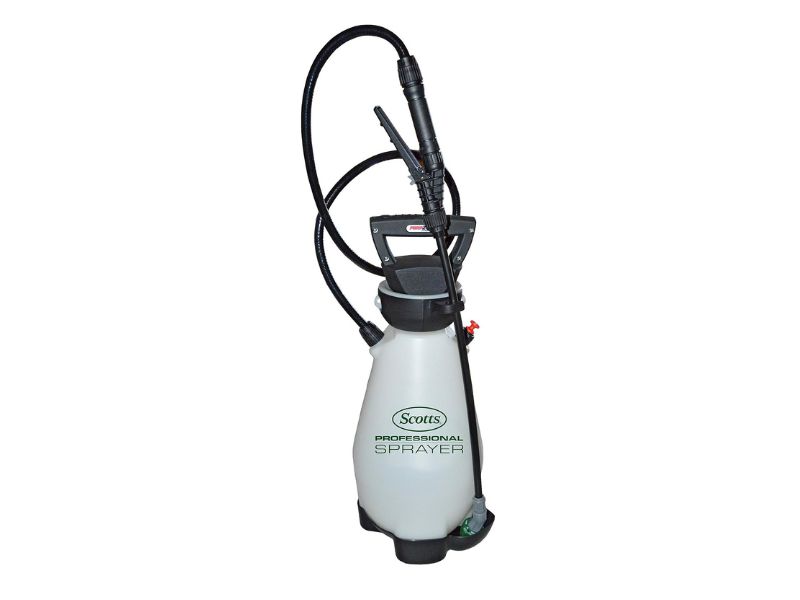
The Scotts 190567 is almost the opposite of the PetraTools.
Instead of maximizing capacity and pressure, it prioritizes portability and simple operation.
Its 2-gallon tank is far easier to carry than a fully loaded 4-gallon backpack system.
The empty sprayer weighs approximately 4.7 pounds, and its teardrop-shaped tank creates a stable base when you place it on the ground.
The rechargeable lithium-ion system uses Pump Zero technology, eliminating repeated hand pumping.
Scotts rates the battery to spray up to 12 full tanks per charge, providing substantially more endurance than most homeowners will need for a small garden during one session.
Operating pressure is approximately 14–21 PSI.
That is much lower than a high-pressure backpack sprayer, but it is appropriate for controlled garden spraying where extreme range is unnecessary.
The integrated 3-in-1 nozzle switches among fan, cone, and stream patterns.
The fan setting works well when you need broad, even coverage.
The cone pattern is useful for plant applications.
The stream provides additional reach when a more concentrated spray is appropriate.
Scotts also equips the system with a 21-inch poly wand, lock-on shut-off, inline filter, pressure-release valve, reinforced hose, and Viton seals for better resistance to common lawn and garden chemicals.
Its main limitation is capacity.
Two gallons disappears quickly when treating a large lawn.
For raised beds, patio plants, shrubs, flower gardens, and spot treatment, however, smaller capacity can actually be an advantage because you carry less weight and are less likely to mix much more solution than you need.
Choose the Scotts when easy carrying, simple operation, and compact storage matter more than maximum PSI or tank volume.
Chapin 63924 4-Gallon 24V Battery Backpack Sprayer- Best Lithium-Ion Backpack Sprayer
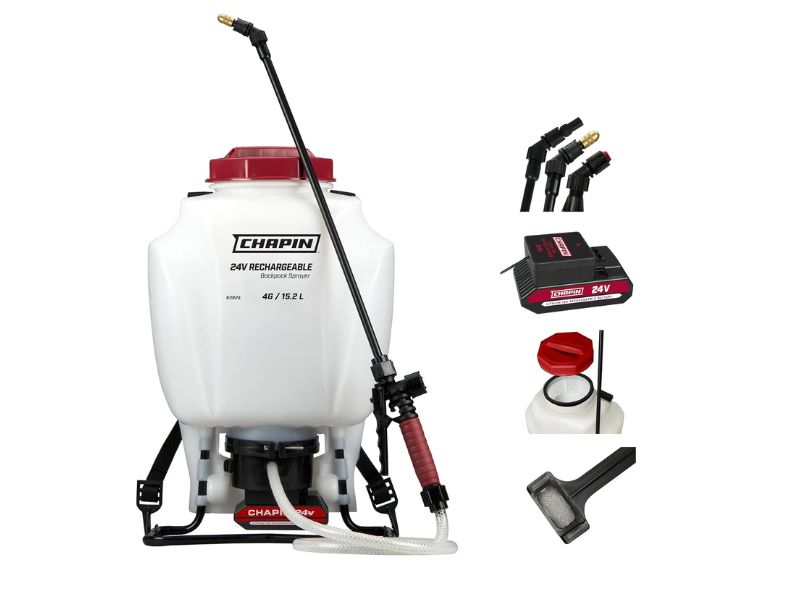
The Chapin 63924 is a strong choice for buyers who want a conventional 4-gallon backpack sprayer built around a rechargeable 24V lithium-ion battery.
Chapin rates the system for up to approximately two hours of continuous spraying or about 58 gallons per charge, depending on operating conditions and nozzle selection.
Its operating pressure sits around 40–60 PSI, with a typical application rate of approximately 0.4–0.5 gallons per minute.
That is plenty for most lawn and garden treatment jobs without pushing into unnecessarily extreme pressure.
The tank has a 6-inch opening, making it easier to fill, mix when permitted by the product label, inspect, and rinse afterward.
Chapin includes three nozzle options:
adjustable brass, adjustable poly cone, and poly fan.
This covers most common garden applications without requiring an immediate accessory purchase.
Another feature I particularly like is the three-stage filtration system.
There is filtration at the tank opening, inside the tank, and around the shut-off system. All three filters are removable for cleaning.
Sprayer clogging is frustrating because even small particles can disrupt nozzle flow and produce an uneven application pattern.
Good filtration is particularly helpful when using compatible wettable products or working in environments where debris can enter the tank during filling.
Comfort features include padded shoulder straps, a cushioned shut-off grip, a 20-inch extension wand, and a 48-inch reinforced hose.
The battery charger is included, and Chapin specifies roughly 3.5–4 hours for recharging.
The Chapin does not offer the very high maximum pressure of the PetraTools or SideKing.
But for gardeners who prioritize consistent moderate pressure, lithium-ion power, proven filtration, chemical-resistant seals, and established sprayer design, that can be an excellent trade-off.
Field King 190515 4-Gallon Lithium-Ion Backpack Sprayer- Best for Long Spray Sessions
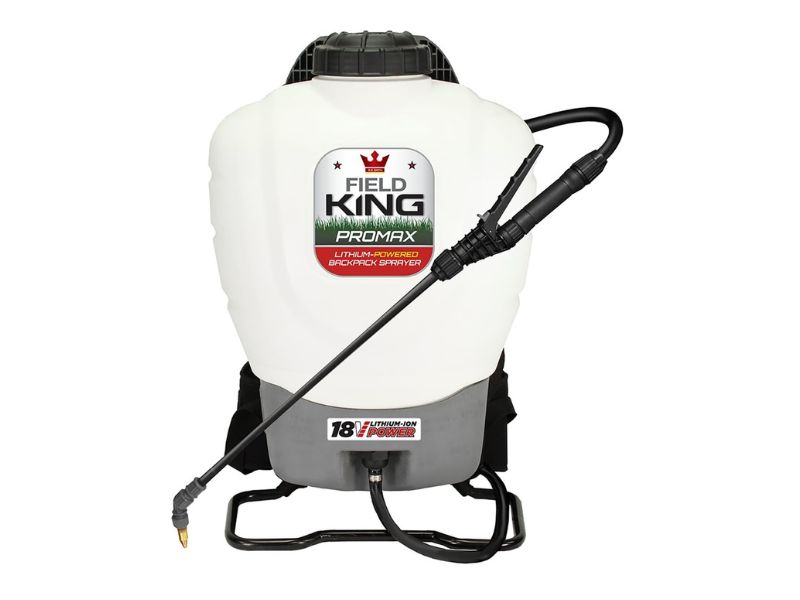
The Field King 190515 stands out because of its battery endurance.
It uses an 18V 2.1Ah lithium-ion battery and is rated for up to approximately four hours of spraying or 50 gallons of liquid per charge when used with the specified 8002 nozzle.
For gardeners who repeatedly refill a 4-gallon tank during the same work session, that capacity is useful.
The sprayer operates at a preset pressure of approximately 40 PSI and flow rate around 0.3 gallons per minute with the referenced nozzle.
Unlike variable-pressure systems, the Field King focuses on delivering predictable output.
That can be advantageous when consistency matters more than maximum range.
The biggest accessory advantage is the nozzle selection.
Field King includes six nozzles, covering adjustable spray, several flat-fan volumes, jet stream, and foaming/spot-treatment patterns.
That gives the sprayer considerable flexibility across lawn and garden jobs.
The poly wand and powder-coated steel frame balance chemical resistance with structural support, while the padded shoulder harness helps manage the load of a filled tank.
Empty weight is approximately 11 pounds, so this is not the lightest product in the roundup.
Once four gallons of liquid are added, total carrying weight becomes substantial.
I therefore like the Field King best for users who specifically need a full backpack system and long battery endurance, rather than buyers looking for the easiest sprayer to carry around a small garden.
The battery recharges in approximately 3.5 hours.
For long lawn-care sessions where you may run several tankfuls through one sprayer, its combination of four-hour runtime, six nozzles, 40 PSI output, and padded harness makes it highly practical.
SideKing SK4000B 4-Gallon Battery Powered Backpack Sprayer- Best Budget High-Pressure Pick
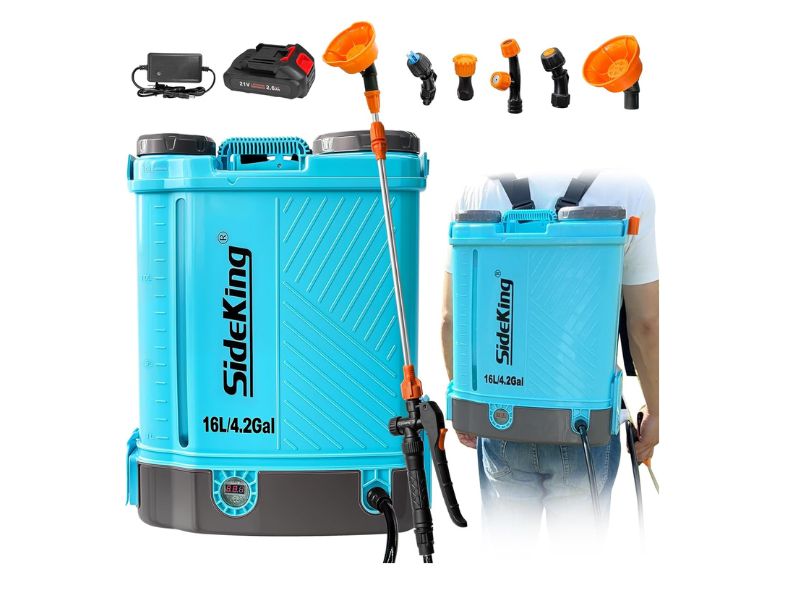
The SideKing SK4000B provides impressive specifications for buyers trying to keep purchase cost reasonable.
Its strongest feature is adjustable pressure up to 100 PSI.
That gives you much more control over output than a fixed-pressure garden sprayer.
Low pressure can be used for close plant work, while additional pressure provides greater spray reach when appropriate.
The system uses a roughly 4-gallon tank and a removable 2.6Ah lithium battery.
Current specifications rate the battery for up to approximately two hours of continuous spraying, with charging taking around three hours.
SideKing includes a telescopic stainless-steel wand and five nozzle patterns in the current SK4000B package.
A trigger lock helps during longer applications because you do not need to continuously squeeze the handle.
The sprayer also includes a digital voltage display so you can monitor remaining battery condition while working.
Empty weight is roughly 8.9 pounds, putting it below the Field King before either tank is filled.
The trade-off is brand history and refinement.
PetraTools, Chapin, Field King, and Scotts have more established positions in the lawn-and-garden sprayer market.
SideKing competes primarily by providing high pressure, multiple nozzles, a removable battery, and a complete backpack package at an aggressive value.
For a homeowner who does not need professional all-day runtime but wants more pressure than a basic handheld sprayer, it offers an appealing middle ground.
Battery Garden Sprayer Comparison Table
| Product | Tank Capacity | Battery System | Pressure | Approx. Runtime/Capacity | Best For |
| PetraTools HD4000 | 4 gal | Rechargeable battery system | 40–90 PSI | Up to 6–8 hr | Best overall |
| Scotts 190567 | 2 gal | Lithium-ion | 14–21 PSI | Up to 12 tanks | Small gardens |
| Chapin 63924 | 4 gal | 24V lithium-ion | 40–60 PSI | Up to 2 hr / 58 gal | Balanced backpack use |
| Field King 190515 | 4 gal | 18V 2.1Ah lithium-ion | 40 PSI | Up to 4 hr / 50 gal | Long spray sessions |
| SideKing SK4000B | ~4 gal | 2.6Ah lithium battery | Up to 100 PSI | Up to ~2 hr | Budget high-pressure use |
Why Choose a Battery Garden Sprayer?
The major advantage is obvious: no manual pumping.
A conventional compression sprayer gradually loses pressure as you work. You stop, pump the handle, build pressure again, and resume spraying.
A battery-powered pump maintains spray pressure automatically.
This can provide:
more consistent coverage, less arm fatigue, faster application, and easier large-area spraying.
It is especially useful when treating a lawn or orchard where you may spray several gallons in one session.
Backpack vs Handheld Battery Sprayer
Tank size largely determines which style makes sense.
A 2-gallon handheld or shoulder sprayer is easier to move around a small garden.
Two gallons of water weighs about 16.7 pounds, plus the sprayer itself.
A 4-gallon backpack sprayer carries more than 33 pounds of liquid when full.
The backpack distributes that weight across your shoulders, making the extra capacity practical.
For a few raised beds, I would choose the smaller Scotts.
For a large lawn, orchard, long fence line, or substantial landscape, a 4-gallon model reduces the number of refill trips.
How Much PSI Does a Garden Sprayer Need?
Higher pressure is not automatically better.
For many garden applications, 20–60 PSI provides more than enough output.
Higher-pressure models become useful when you need greater spray distance, specialized nozzles, or more demanding applications.
The PetraTools reaches up to about 90 PSI.
SideKing reaches up to 100 PSI.
The Chapin works around 40–60 PSI.
The Scotts operates at a much gentler 14–21 PSI.
The correct pressure depends on the product label, nozzle, desired droplet size, target area, and application method.
For chemical treatments, always follow the label rather than choosing maximum pressure by default.
Why Adjustable Pressure Is Useful
A variable-pressure controller lets one sprayer handle several different tasks.
For delicate plants, lower pressure can reduce unnecessary drift and splash.
For a wider fan pattern or longer reach, more pressure may be useful.
Adjustable pressure is particularly helpful if one sprayer will be used for:
lawn treatments, shrubs, trees, garden beds, spot spraying, and general property maintenance.
PetraTools and SideKing provide the widest adjustment ranges among these recommendations.
Battery Runtime vs Tank Capacity
Battery runtime needs to be considered alongside tank capacity.
A sprayer that can run for four hours sounds impressive, but most homeowners will not continuously spray for four hours.
A better question is:
How many tankfuls can I spray before charging?
For a 2-gallon unit, even 10 tanks represents 20 gallons.
For a 4-gallon backpack, 10 tanks means 40 gallons.
That is why all five products here provide enough battery capacity for typical residential garden work.
Professional users who repeatedly refill throughout the day benefit most from extended-runtime systems.
Lithium-Ion vs Lead-Acid Battery Sprayers
Many modern sprayers use lithium-ion batteries.
Lithium-ion packs generally offer good energy density, relatively low weight, and predictable charging.
Chapin, Field King, Scotts, and SideKing use lithium-based configurations in the products reviewed here.
Some high-capacity backpack sprayers use sealed lead-acid batteries because they can provide excellent capacity at a relatively modest cost.
Battery chemistry is only one factor.
Also compare:
runtime, replacement-battery availability, total sprayer weight, recharge time, pressure performance, and warranty support.
How Many Gallons Should You Buy?
1–2 Gallons
Best for:
raised beds, patio plants, shrubs, spot weed treatments, small gardens, and occasional use.
These are easier to carry and clean.
3–4 Gallons
Best for:
medium and large lawns, orchards, extensive landscaping, larger vegetable gardens, and repeated applications.
A backpack harness becomes particularly useful at this capacity.
More Than 4 Gallons
Once tank capacity becomes substantially larger, wheeled or cart-style equipment may be more practical than carrying the full liquid weight on your back.
Nozzle Types Explained
Different nozzles can completely change how a sprayer behaves.
A flat-fan nozzle spreads liquid across a wide strip and is commonly useful for uniform ground applications.
An adjustable cone nozzle can provide broader or more concentrated patterns.
A stream or jet nozzle increases reach.
A foaming nozzle can make spot applications easier to see.
Do not choose a nozzle solely based on visual spray pattern.
When applying pesticides or other regulated products, the label may specify appropriate application equipment, spray volume, droplet considerations, or coverage requirements.
Wand Material
Garden sprayer wands are commonly made from:
plastic, stainless steel, or brass.
Plastic is light and resists corrosion from many compatible liquids.
Stainless steel offers excellent stiffness and durability.
Brass nozzles and fittings are common because they provide precise adjustment and long wear.
No material is compatible with every chemical.
Always verify that the sprayer seals, hose, tank, wand, and nozzle are appropriate for the exact liquid you plan to use.
Why Seal Material Matters
Seals are easy to overlook until a sprayer starts leaking.
Better lawn and garden sprayers use chemical-resistant gasket materials such as Viton in key areas.
Scotts specifically uses Viton seals in its shut-off assembly.
Chapin also specifies chemical-resistant seals for professional lawn and garden products.
A leaking sprayer is more than an inconvenience when the tank contains a product that should not contact skin or desirable plants.
Inspect seals and fittings routinely.
How to Use a Battery Sprayer Safely
Before filling the tank, read both the sprayer manual and the product label for the solution you plan to apply.
Use the protective equipment specified on that label.
Depending on the product, this may include:
chemical-resistant gloves, eye protection, long sleeves, long pants, closed footwear, or additional PPE.
Mix only according to label directions.
More concentrated is not automatically more effective and may damage plants, contaminate the environment, or create unnecessary exposure.
Avoid spraying during strong wind when drift could move product onto neighboring plants, people, pets, water, or property.
Keep Separate Sprayers for Certain Products
If practical, I prefer dedicating different sprayers to different classes of lawn-care products.
For example, a sprayer used repeatedly for non-selective herbicide should not casually be switched to foliar fertilizer for valued vegetable or ornamental plants.
Even after rinsing, small residues can remain in hoses, valves, filters, or nozzles.
Clearly label each dedicated sprayer.
This reduces the risk of accidental cross-contamination.
How to Clean a Battery Garden Sprayer
Do not let spray solution sit inside the tank longer than recommended.
After use, dispose of remaining material according to its label.
Rinse the tank using the cleaning method required by the product manufacturer.
Run appropriate clean rinse liquid through the pump, hose, wand, and nozzle so residue does not remain trapped inside those components.
Remove and inspect filters periodically.
Clogged filters reduce flow and force the system to work harder.
Before long-term storage, allow appropriate components to dry and maintain the battery according to the sprayer manufacturer’s instructions.
Common Battery Sprayer Mistakes
The first mistake is filling a backpack tank completely when you only need one gallon.
Extra liquid means extra weight.
Only mix the amount you expect to use.
Another mistake is treating maximum PSI as the normal operating setting.
Excessive pressure can create finer droplets and more drift.
Use only enough pressure to achieve the required application pattern.
Also avoid storing the sprayer with chemical solution inside.
Long-term exposure can damage seals, hoses, pumps, valves, and nozzles.
Finally, never assume that because a tank is made from plastic it can safely contain every chemical.
Compatibility matters.
Frequently Asked Questions
What is the best battery garden sprayer?
The PetraTools HD4000 is my best overall choice for larger gardens and lawns.
Its 4-gallon capacity, adjustable 40–90 PSI output, extended battery runtime, multiple nozzle options, battery indicator, padded straps, and heavy-duty wand system provide excellent versatility.
Is a battery sprayer better than a pump sprayer?
Yes, when convenience and consistent pressure are priorities.
Battery sprayers eliminate repeated manual pumping and maintain pressure automatically. Manual sprayers remain cheaper and are perfectly adequate for very small jobs.
What size battery sprayer is best for a garden?
A 2-gallon sprayer suits small gardens, while 4 gallons is better for large areas.
Remember that four gallons of liquid alone weighs more than 33 pounds, so backpack comfort becomes important with larger tanks.
How many PSI should a battery garden sprayer have?
About 20–60 PSI covers many common lawn and garden applications.
Higher-pressure 90–100 PSI systems provide greater flexibility and range but should not automatically be operated at maximum output.
Is 100 PSI too much for garden spraying?
It can be excessive for delicate plants and many routine treatments.
A 100 PSI-capable sprayer is useful primarily because pressure can be adjusted. Select the pressure required for the nozzle and application rather than always using maximum output.
How long does a battery garden sprayer last per charge?
Depending on the model, runtime can range from several tankfuls to many hours.
The Chapin is rated for up to two hours, Field King up to four hours, and current PetraTools HD4000 systems for substantially longer operation under appropriate conditions.
Is a 4-gallon backpack sprayer too heavy?
A full 4-gallon tank is heavy but manageable with a good harness for many users.
The liquid itself weighs more than 33 pounds. If that sounds uncomfortable, choose a smaller tank and refill more frequently.
Can I use liquid fertilizer in a battery sprayer?
Yes, when both the fertilizer label and sprayer manufacturer permit it.
Filter the solution appropriately, use the recommended nozzle, and clean the complete spray system thoroughly afterward.
Can I use weed killer in a battery sprayer?
Yes, provided the sprayer materials are compatible and you follow the product label.
For non-selective herbicides, consider dedicating one sprayer to that use to reduce the risk of contaminating future plant treatments.
Can I use the same sprayer for fertilizer and herbicide?
It is possible after proper cleaning, but separate dedicated sprayers are safer when practical.
Small residues of certain herbicides may damage desirable plants during a later foliar application.
What is the best battery sprayer for a small garden?
The Scotts 190567 is my favorite compact option.
Its 2-gallon tank is easier to carry than a full backpack sprayer, while its lithium-ion battery can power multiple tanks without manual pumping.
What is the best battery backpack sprayer for long runtime?
The Field King 190515 is especially strong for extended spray sessions.
It is rated for up to four hours or approximately 50 gallons of spraying per charge with the specified nozzle setup.
Are lithium-ion battery sprayers better?
Lithium-ion batteries generally provide an excellent balance of weight, runtime, and recharge convenience.
However, overall sprayer quality also depends on the pump, seals, pressure control, wand, hose, nozzles, harness, and availability of replacement parts.
Should I empty my garden sprayer after every use?
Yes, unless the chemical and sprayer manufacturers explicitly state otherwise.
Leaving product inside can damage components, clog nozzles, create contamination problems, and shorten sprayer life.
Final Verdict
The best battery garden sprayer should eliminate manual pumping while providing reliable pressure, enough capacity for your property, comfortable handling, and nozzles that match the applications you perform most often.
The PetraTools HD4000 is my best overall choice. Its 4-gallon tank, adjustable 40–90 PSI pressure, extended battery endurance, multiple nozzle options, padded harness, and professional-style accessories make it suitable for everything from backyard gardens to demanding lawn-care work.
The Scotts 190567 is the better choice for a small garden because its 2-gallon tank significantly reduces carrying weight while still providing convenient rechargeable operation.
The Chapin 63924 offers a well-balanced 24V lithium-ion backpack setup with consistent 40–60 PSI pressure, strong filtration, chemical-resistant seals, and three useful nozzles.
Choose the Field King 190515 when extended battery operation and nozzle versatility matter most. Its four-hour rated runtime makes it particularly attractive for repeated tankfuls.
Finally, the SideKing SK4000B offers an affordable route to adjustable high-pressure spraying with a rechargeable battery and full-size backpack tank.
For most homeowners, I would choose 2 gallons for targeted garden work and 4 gallons for lawns or large landscapes. Prioritize comfortable straps, adjustable or appropriate pressure, replaceable nozzles, chemical-resistant components, and easy cleaning rather than simply buying the sprayer with the highest advertised PSI.

I’m Maya L. Greenwood, a lifelong plant lover who believes anyone can grow something beautiful with the right guidance. After years of testing soil mixes, pruning methods, irrigation tricks, and pest-safe solutions, I started EasyGardenTips.com to turn hard-won lessons into step-by-step advice. From seed starting and container gardens to composting and seasonal checklists, my goal is to make gardening simple, sustainable, and fun.