3 Best LED Grow Lights for Lettuce for Crisp Indoor Growth
Lettuce does not need the extreme light intensity demanded by many fruiting crops, but weak or uneven lighting can still produce pale, stretched, loose growth. The best LED grow lights for lettuce should deliver moderate, uniform illumination across the entire leafy canopy while offering sensible power consumption and convenient height or intensity control.
For most indoor lettuce growers, I would prioritize even PPFD, broad coverage, white/full-spectrum output, appropriate hanging distance, and a consistent photoperiod before maximum wattage. University of Minnesota Extension currently recommends roughly 12–14 total hours of light per day for hydroponic lettuce and herbs, while seedlings generally receive longer lighting periods.
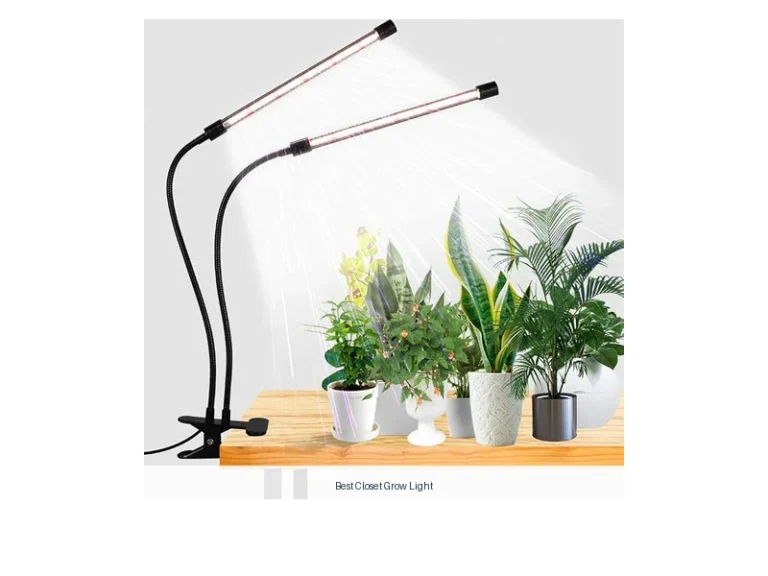
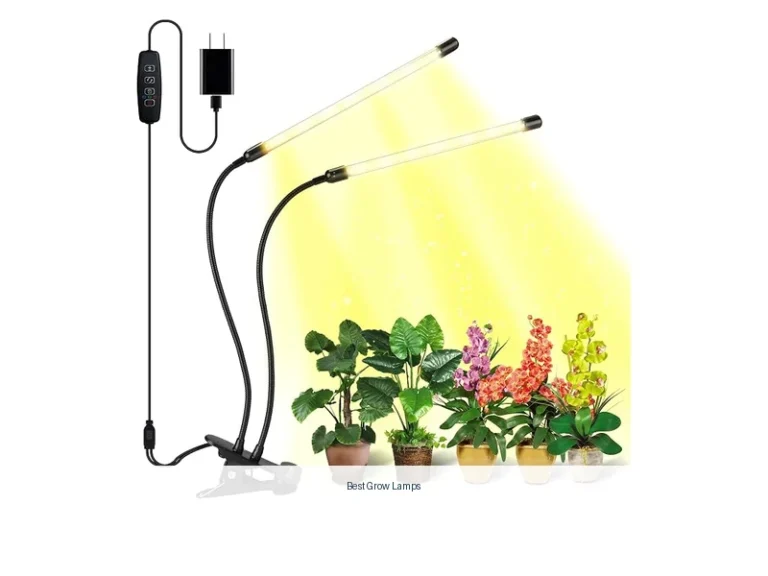
My primary recommendation is the GooingTop 6000K Full Spectrum LED Grow Light for a few lettuce plants or a very compact countertop setup. Its flexible clamp design, cool-white spectrum, five brightness settings, and built-in timer make it especially convenient when the growing area is small.
I would choose the Spider Farmer SF1000 100W LED Grow Light for a larger tray, compact hydroponic system, or multiple lettuce heads. The current U.S. Amazon listing specifies 100W actual power, 2.5 µmol/J system PPE, dimming, full-spectrum output, and 2×2/3×3-oriented coverage, giving it substantially more output headroom than a small clip lamp.
For long shelves or multiple trays, I would choose the Barrina T5 4FT 8-Pack Grow Lights. Eight long linear fixtures totaling 160W available system power make it much easier to spread light evenly across rows of lettuce rather than concentrating intensity under one central panel.
3 Best LED Grow Lights for Lettuce Reviewed
| Image | Product Name | Check Price |
|---|---|---|
Best Choice | GooingTop 6000K Full Spectrum LED Grow Light | Check Price |
Second Best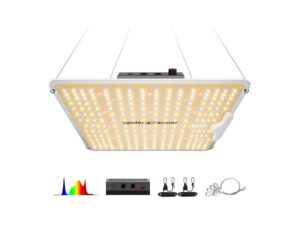 | Spider Farmer SF1000 100W LED Grow Light | Check Price |
Third Choice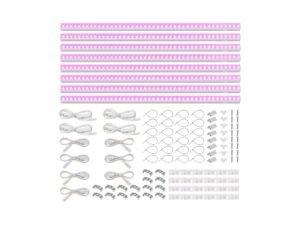 | Barrina T5 4FT 160W 8-Pack Grow Lights | Check Price |
1. GooingTop 6000K Full Spectrum LED Grow Light
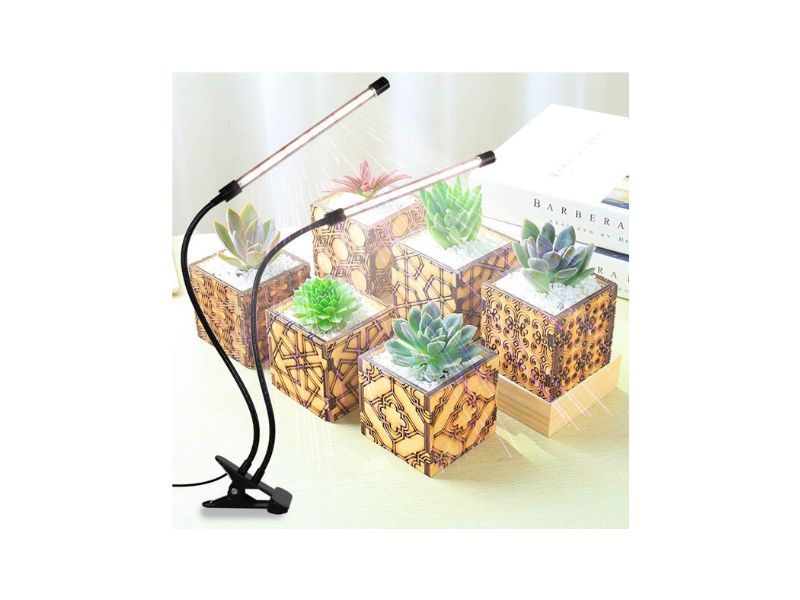
Key Features
- 6000K cool-white/full-spectrum-style output
- White plus red LEDs
- Five brightness levels
- 4/8/12-hour automatic timer
- Flexible gooseneck
- Clamp mounting
- Compact footprint
- Best for a few lettuce plants
The GooingTop is my primary recommendation for small-scale indoor lettuce growing because lettuce usually does not require a massive fixture when only a few plants occupy the growing area.
A flexible lamp can be positioned directly over:
- One lettuce pot
- Several small heads
- A countertop hydroponic unit
- A small nursery tray
That close positioning allows a modest lamp to deliver useful light without consuming the electricity or physical space of a large tent fixture.
The 6000K white-heavy spectrum is also a practical fit for leafy growth.
For lettuce, I care more about producing dense, healthy leaves than supporting flowering.
Cool-white output provides plenty of blue-rich visible light while still maintaining a broad spectrum.
It also makes plant inspection much easier than intensely purple red/blue lighting.
You can clearly see whether leaves are:
- Pale
- Yellowing
- Developing brown margins
- Showing tipburn
- Developing pest damage
The five brightness settings provide useful flexibility.
Young lettuce seedlings should not necessarily begin at the same intensity as mature heads.
You can start more conservatively and increase output as leaves expand.
That becomes especially useful if the fixture cannot be moved much higher.
The built-in timer provides 4-, 8-, and 12-hour settings.
For hydroponic lettuce, University of Minnesota Extension currently recommends approximately 12–14 hours of total daily light, so the 12-hour timer can work well for some setups, especially when natural daylight contributes additional illumination.
If the GooingTop is the only meaningful light source, however, an external timer may give you more precise control over the complete daily schedule.
The biggest weakness is coverage.
Lettuce spreads sideways as it develops.
A clip lamp that works well over four tiny seedlings can become too narrow once several mature heads form a broad canopy.
If plants near the outside begin leaning inward, pale growth develops, or center plants become much denser than edge plants, the fixture is covering too much area.
That is when I would move up to the SF1000 or Barrina.
What I Like
- Excellent for very small lettuce setups
- Easy clamp installation
- Five brightness levels
- Built-in timer
- White-looking output
- Minimal power and space requirements
What I Do Not Like
- Limited mature-canopy coverage
- Built-in timer stops at 12 hours
- Not appropriate for full trays or long shelves
The GooingTop is the light I would choose for a few lettuce plants, countertop greens, or a compact hydroponic setup where simplicity and positioning matter more than raw output.
2. Spider Farmer SF1000 100W LED Grow Light
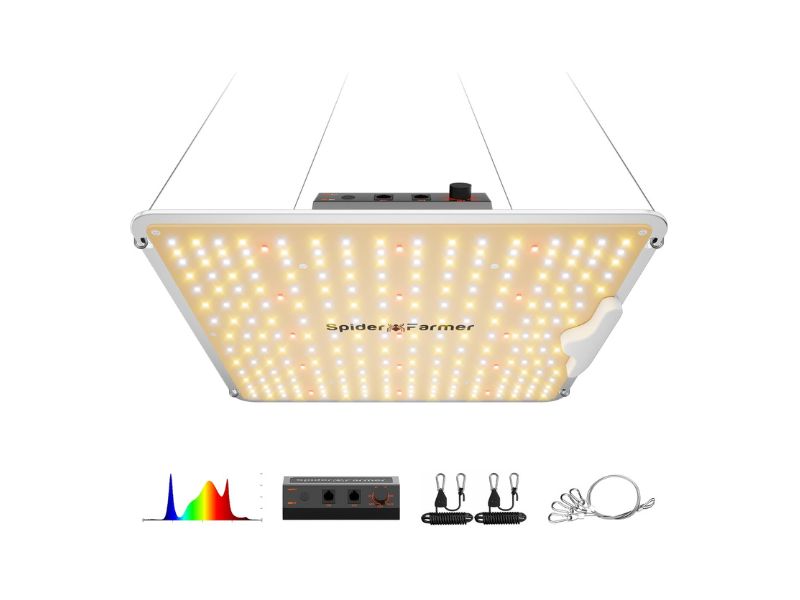
Key Features
- 100W actual input
- 2.5 µmol/J system PPE
- New-generation upgraded LEDs
- Increased diode count
- Full-spectrum output
- Dimmable
- Fanless operation
- Designed for approximately 2×2/3×3 grow spaces
- Strong option for lettuce trays and hydroponics
The Spider Farmer SF1000 is the light I would choose when lettuce growing moves beyond a few countertop plants.
Its current Amazon listing specifies 100W actual input, new-generation upgraded LEDs, 2.5 µmol/J system PPE, full-spectrum output, and dimming. The exact listing currently carries 12,391 ratings.
For lettuce, the most important feature here may actually be the dimmer.
One hundred watts from an efficient modern fixture provides much more light than a few young lettuce seedlings require at close range.
Instead of hanging the fixture unnecessarily high, you can reduce output and keep the light positioned to provide broad coverage.
As the canopy grows, intensity can increase.
That makes one fixture useful from:
seedling → juvenile lettuce → mature leafy canopy.
The SF1000 is particularly attractive for:
- A 1020-style seedling tray
- Multiple lettuce pots
- Compact DWC
- Kratky lettuce
- Small NFT systems
- Ebb-and-flow trays
- Herbs grown alongside lettuce
The 2.5 µmol/J system PPE specification is also meaningful.
PPE tells you how efficiently electrical input becomes photosynthetically active photon output.
For lettuce, I do not need the enormous photon output of a 700–800W fixture.
What I want is enough efficient light to provide an even moderate canopy intensity.
The full-spectrum output allows the same fixture to be used for other vegetables and seedlings when lettuce is not occupying the space.
That versatility is valuable if your indoor garden changes throughout the year.
Another advantage is fixture geometry.
Compared with GooingTop, SF1000 illuminates a much broader overhead footprint.
That matters because lettuce grows horizontally.
Even illumination helps prevent plants in the middle from developing much faster than those around the perimeter.
The key is not to overpower the crop.
Utah State University research illustrates an important point: lettuce productivity can increase under higher photon flux in highly controlled environments, but high light can also increase risks such as tipburn and photobleaching, particularly when environmental conditions do not support the faster growth.
For a normal home grow, there is little reason to chase extreme PPFD.
Lettuce generally benefits from:
- Moderate intensity
- Even coverage
- Consistent airflow
- Appropriate temperature
- Stable water and nutrients
rather than maximum light output.
The SF1000’s dimmer makes that easier.
The fanless design also helps in quiet indoor spaces.
There is no small fixture fan adding noise above the hydroponic system.
However, 100W still contributes heat to the room.
That amount is modest compared with large commercial fixtures but meaningful inside a small enclosed tent.
What I Like
- 100W provides good lettuce-growing headroom
- Published 2.5 µmol/J system PPE
- Dimmable
- Broad coverage compared with clip lamps
- Good for trays and hydroponic systems
- Full spectrum
- Fanless
- Very strong Amazon rating history
What I Do Not Like
- More fixture than a few countertop plants need
- Needs overhead mounting
- Can provide excessive intensity if used carelessly at close distance
The SF1000 is my preferred choice when you need one proper overhead fixture for a compact lettuce garden rather than individual lights for individual plants.
3. Barrina T5 4FT 160W 8-Pack Grow Lights
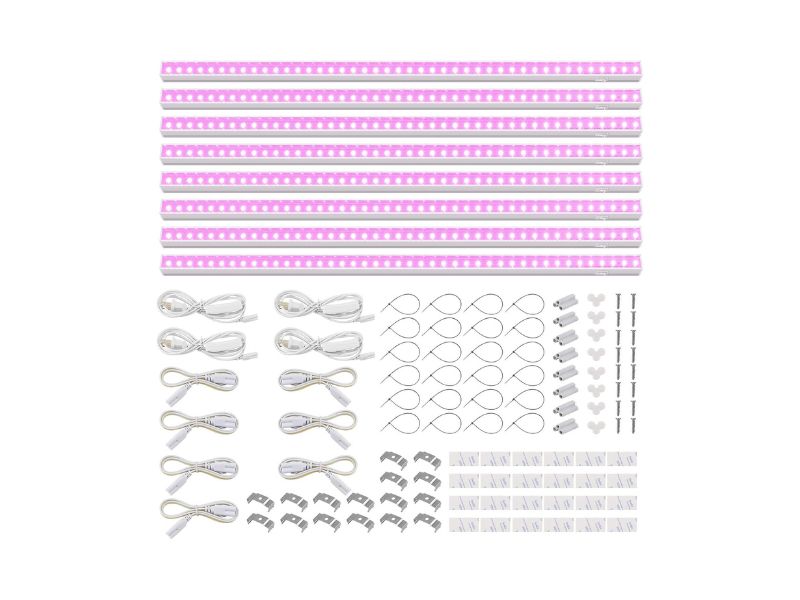
Key Features
- Eight 4-foot LED bars
- 20W per bar
- 160W total available power
- Full-spectrum-style output
- Long linear coverage
- Individual fixture control
- Linkable installation
- Excellent for shelves
- Strong fit for lettuce and leafy-green rows
The Barrina T5 system is my preferred choice for growers who organize lettuce on shelving.
Its biggest advantage is not maximum output.
It is fixture shape.
Lettuce is commonly grown in:
- Long trays
- NFT channels
- Rows of hydroponic sites
- Multi-level racks
- Nursery shelves
A four-foot linear grow light matches those layouts far better than a small round spotlight.
The selected Barrina package includes eight four-foot fixtures with approximately 20W per bar, providing up to 160W across the full package.
You do not need to put all eight bars over one shelf.
That flexibility is what makes the system useful.
A grower might use:
- Two bars over each of four shelves
- Four bars over each of two shelves
- Different bar counts for seedlings and mature lettuce
This lets you change electrical density without changing fixture types.
Linear lighting also improves uniformity.
Imagine ten lettuce plants sitting in a four-foot row.
A compact central panel can produce:
strong center → weaker middle edges → weak outer plants.
Long bars distribute emitters along the full length of the row.
That can reduce the tendency for plants at the ends to lean toward the center.
The relatively low wattage per bar also works well with lettuce because leafy greens usually do not need extremely concentrated intensity.
Instead of blasting one region with a high-output fixture, you can distribute moderate light across a larger area.
That is often a better match for:
- Butterhead lettuce
- Loose-leaf lettuce
- Romaine seedlings
- Baby greens
- Mixed salad greens
- Herbs
The system is particularly useful for multi-level growing.
Large LED panels are often awkward in shelf racks because they require more vertical clearance.
Slim T5-style bars leave more room between the fixture and plants.
That can help increase the number of growing levels in a fixed-height room.
The primary limitation is control.
These bars are more modular than sophisticated.
For a predictable daily photoperiod, I would connect them to a suitably rated external timer.
University of Minnesota’s current guidance lists approximately 12–14 hours of daily lighting for hydroponic lettuce and herbs, which provides a sensible starting point for a home lettuce shelf.
Air movement also deserves attention.
Fast-growing lettuce can develop tipburn under conditions where leaf growth outpaces calcium movement to developing tissue. Research from Utah State demonstrated that airflow directly around growing tissue can materially affect tipburn at very high growth rates.
That does not mean every lettuce shelf needs laboratory-style airflow.
It means lighting should not be optimized while ignoring air circulation.
What I Like
- Excellent long-shelf coverage
- Eight modular light bars
- 160W total available power
- Easy to divide across multiple shelves
- Good fit for hydroponic rows
- Better end-to-end distribution than one central lamp
- Slim profile
What I Do Not Like
- Requires more installation
- More cable management
- External timer recommended
- Excessive package size for one or two plants
The Barrina T5 system is the option I would choose for a dedicated lettuce rack, long hydroponic row, or multi-level leafy-green shelf where uniform coverage matters more than concentrated intensity.
LED Grow Lights for Lettuce Comparison
| Product | Format | Power Class | Dimming | Timer | Coverage | Best Use |
| GooingTop 6000K | Clip/gooseneck | Compact | 5 levels | 4/8/12 hr | Small | Few lettuce plants |
| Spider Farmer SF1000 | Overhead panel | 100W | Yes | External | Medium | Trays/hydroponics |
| Barrina T5 8-Pack | Eight 4-ft bars | 160W total | By bar arrangement | External | Large/linear | Shelves/NFT rows |
GooingTop is the simplest option for a few plants, SF1000 gives a compact lettuce garden more intensity and control, and Barrina is best suited to long or multi-level growing areas.
How to Choose the Best LED Grow Lights for Lettuce
Lettuce Does Not Need Extreme Light
One of the easiest mistakes is treating lettuce like a high-light fruiting crop.
A large tomato canopy and a lettuce tray have very different lighting requirements.
With lettuce, I would prioritize:
uniform moderate light over extreme peak intensity.
Very high light can accelerate growth under optimized conditions, but it can also increase physiological stress and tipburn risk when temperature, airflow, nutrient transport, and other conditions are not equally well controlled.
Best Grow Light for One or Two Lettuce Plants
I would choose GooingTop.
It is easy to place directly above a few containers and requires almost no dedicated growing infrastructure.
The dimmer is particularly useful when plants are small.
Best Grow Light for a Lettuce Tray
I would choose Spider Farmer SF1000.
A tray needs broader overhead coverage than a small clip lamp can provide.
The SF1000 also gives you enough output to raise or dim the fixture as plant size changes.
Best Grow Light for a Lettuce Shelf
I would choose Barrina T5.
Long linear fixtures naturally follow the shelf’s geometry.
This improves end-to-end coverage and makes it easier to illuminate several rows consistently.
Best Grow Light for Hydroponic Lettuce
For a compact hydroponic system, I prefer SF1000.
For longer NFT channels or multi-level hydroponic shelves, Barrina’s linear format is more practical.
University of Minnesota recommends about 12–14 hours/day of total light for hydroponic lettuce and herbs as general indoor guidance.
Best Grow Light for Kratky Lettuce
A few Kratky jars can work very well under GooingTop.
For six or more containers grouped into a larger rectangular canopy, SF1000 or linear bars usually make more sense.
The light should cover the entire leaf area as plants mature.
Best Grow Light for NFT Lettuce
NFT systems are usually long.
That makes linear fixtures particularly attractive.
Barrina bars can run parallel with NFT channels, allowing the light-emitting area to follow the plant row.
Best Grow Light for DWC Lettuce
For a small DWC tote, SF1000 is my preferred choice.
Its overhead footprint is a better match for several lettuce sites arranged across a rectangular reservoir.
Dimming helps reduce intensity when seedlings are transplanted into the system.
5000K or 6000K Is Practical for Lettuce
Cool-white LEDs are a natural fit for leafy greens.
University of Minnesota recommends 5000K LED or fluorescent lighting for seed starting, while white or balanced grow lights are broadly suitable for plants through different growth stages.
You do not need a highly specialized purple spectrum to grow lettuce.
Full Spectrum vs Blue-Heavy Light
Blue light contributes to compact vegetative growth, but lettuce still benefits from a broad spectrum.
Modern white LEDs provide a mix of wavelengths rather than only one narrow blue band.
For home growers, white/full-spectrum fixtures also make it easier to evaluate leaf color accurately.
How Long Should Grow Lights Stay On for Lettuce?
A reasonable starting point for hydroponic lettuce is around 12–14 hours per day, according to current University of Minnesota Extension guidance.
Seedlings can be managed differently and may receive longer daily light periods.
Do not assume longer is automatically better.
The correct photoperiod depends on how much light reaches the canopy during each hour.
Why Daily Light Integral Matters
DLI, or Daily Light Integral, represents the total quantity of photosynthetic photons received during the entire day.
This means both of these matter:
- PPFD
- Number of lighting hours
A relatively bright fixture can reach a useful daily total in fewer hours than a weak fixture.
That is why photoperiod should never be considered separately from intensity.
PPFD Matters More Than Wattage
PPFD measures the density of photosynthetically active photons reaching the lettuce canopy.
Watts measure electricity.
A more efficient fixture can produce more usable plant light from the same electrical input.
SF1000’s current listing, for example, publishes 2.5 µmol/J system PPE, which gives more useful efficiency context than simply knowing it draws 100W.
Do Not Use Peak PPFD Alone
A lettuce tray needs even illumination.
A fixture that produces a very high reading in the middle but poor light at the edges can create inconsistent growth.
Look for uniformity across:
- Center
- Sides
- Corners
rather than chasing the largest number on a marketing graphic.
Keep the Canopy Relatively Even
Lettuce naturally forms a relatively flat canopy.
That makes it well suited to overhead LED lighting.
Keep plants spaced so one oversized head does not shade several smaller ones.
Even plant height helps produce more consistent PPFD across the crop.
How Close Should LED Grow Lights Be to Lettuce?
There is no universal distance because fixture intensity varies dramatically.
A GooingTop clip lamp needs a very different placement from SF1000.
University of Minnesota currently gives general hydroponic lettuce/herb grow-light distance guidance in roughly the 6–12 inch range, but specific fixture recommendations should take precedence because modern LED outputs vary considerably.
Start with the manufacturer’s instructions and plant response.
Signs Lettuce Needs More Light
Possible indicators include:
- Pale leaves
- Long weak stems
- Loose growth
- Leaning
- Slow development
University of Minnesota notes that inadequate light can lead to pale coloration and leggy growth.
Signs Light May Be Too Intense
Watch for:
- Bleaching
- Scorched-looking tissue
- Excessive stress near the top of the canopy
Too much light can cause scorched or bleached foliage.
Reduce intensity or increase fixture distance gradually.
Tipburn Is Not Just a Lighting Problem
Tipburn is a common quality problem in rapidly growing lettuce.
It is associated with calcium supply to developing tissues and can become worse when rapid growth exceeds the plant’s ability to move calcium where it is needed.
Utah State research found that air movement around developing lettuce tissue could dramatically reduce tipburn under very high-growth conditions.
So do not respond to tipburn by changing only the light.
Also examine:
- Airflow
- Temperature
- Humidity
- Growth rate
- Nutrient conditions
Lettuce Prefers a Cooler Environment
Lettuce is generally a cool-season crop.
Extremely bright lights that raise canopy temperature can create additional stress.
High-efficiency LEDs help, but fixture wattage still eventually contributes heat to the room.
This is another reason not to oversize your grow light.
Airflow Helps Leafy Greens
Gentle airflow can:
- Reduce stagnant humidity
- Strengthen seedlings
- Improve leaf-level air exchange
- Help maintain more uniform conditions
You do not need powerful wind.
A small circulation fan moving air gently across the growing area is usually more appropriate.
Grow-Light Electricity Use
A 100W SF1000 operating 14 hours per day consumes:
0.1 kW × 14 = 1.4 kWh/day
Over 30 days:
42 kWh/month
A full 160W Barrina package operating 14 hours uses:
0.16 × 14 = 2.24 kWh/day
Over 30 days:
67.2 kWh/month
Actual Barrina consumption can be lower if only some bars are operating.
Multiply your electricity use by your local utility rate to estimate operating cost.
Common Lettuce Grow-Light Mistakes
Buying a Huge High-Power Fixture
Lettuce usually benefits more from even moderate light.
Hanging the Light Too High
Weak canopy intensity can produce pale or stretched plants.
Hanging a Strong Light Too Close
Excess intensity can bleach or stress leaves.
Ignoring Edge Coverage
Outer lettuce heads need adequate light too.
Using One Small Clip Light Over a Full Tray
Match fixture geometry to canopy size.
Running Lights 24 Hours
Use a consistent day/night cycle instead.
Ignoring Temperature
Strong lights can raise the growing area’s temperature.
Ignoring Airflow
Fast-growing lettuce can develop quality problems even under excellent lighting if the environment is poorly managed.
Frequently Asked Questions
What are the best LED grow lights for lettuce?
GooingTop, Spider Farmer SF1000, and Barrina T5 cover three useful lettuce-growing scales.
GooingTop works for a few plants, SF1000 suits trays and compact hydroponics, and Barrina is ideal for long shelves.
What is my primary recommendation for lettuce?
GooingTop is my primary choice for a small home lettuce setup.
Its flexible positioning, five brightness settings, and timer make it easy to manage several compact plants without installing a full grow fixture.
What is the best grow light for a lettuce tray?
Spider Farmer SF1000 is my preferred option for a full compact tray.
Its 100W power class, dimming, and 2.5 µmol/J system PPE give you much more coverage headroom than a clip lamp.
What is the best grow light for a lettuce shelf?
Barrina T5 is the best fit here because long LED bars match shelf geometry.
Multiple bars can be distributed across one or several growing levels.
What is the best LED grow light for hydroponic lettuce?
SF1000 works well for compact systems; Barrina is better for longer hydroponic rows.
Choose according to the mature canopy shape rather than the reservoir alone.
How many hours of LED light does lettuce need?
About 12–14 daily hours is a useful starting point for hydroponic lettuce indoors.
That is the current University of Minnesota Extension guidance for hydroponic lettuce and herbs.
Should lettuce grow lights stay on 24 hours?
No, a regular dark period is a better default than continuous lighting.
Increase useful daytime intensity when necessary rather than compensating for a weak fixture with nonstop operation.
Is 100W enough for lettuce?
Yes, 100W from an efficient modern fixture is substantial for a compact lettuce canopy.
The Spider Farmer SF1000 is a dimmable 100W fixture, so full power may not always be necessary.
Is 6000K good for lettuce?
Yes, cool-white 6000K lighting is well suited to leafy vegetative growth.
Adequate intensity and uniformity are more important than selecting one exact color temperature.
Is 5000K good for lettuce?
Yes, 5000K white LEDs are a practical choice for lettuce and seedlings.
University of Minnesota Extension specifically recommends 5000K LED or fluorescent lights for seed starting.
Does lettuce need full-spectrum light?
Broad white full-spectrum lighting is convenient and effective for indoor lettuce growing.
You do not need a purple red/blue-only fixture to grow healthy leaves.
What PPFD is best for lettuce?
Lettuce generally favors moderate, evenly distributed PPFD rather than extreme intensity.
Exact targets depend on cultivar, temperature, CO₂, photoperiod, and production goals, so avoid treating one number as universal.
Does higher PPFD make lettuce grow faster?
It can increase productivity when other environmental factors can support the faster growth.
Research has also associated very high-light rapid growth with greater risks such as tipburn and photobleaching under some conditions.
Why is my lettuce growing tall and thin?
Insufficient usable light is one common cause of stretched or leggy growth.
Move the light closer if appropriate, increase output gradually, or improve coverage.
Why is my lettuce pale under LEDs?
Pale growth can indicate insufficient light, though nutrition and root problems can cause similar symptoms.
Evaluate lighting alongside nutrient conditions rather than assuming the fixture is always responsible.
Can LED lights burn lettuce?
Yes, excessive intensity can bleach or scorch leaves.
Strong fixtures should be dimmed or repositioned when plants show excessive-light symptoms.
Which fixture is best for Kratky lettuce?
GooingTop suits a few jars, while SF1000 better matches a larger group.
Choose according to the total mature leaf canopy.
Which fixture is best for NFT lettuce?
Barrina T5 is particularly useful because linear bars can follow long NFT channels.
That geometry helps maintain more consistent lighting from one end of the channel to the other.
Do lettuce grow lights need a dimmer?
Dimming is highly useful because lettuce intensity needs change as plants grow.
It also prevents wasting electricity when small seedlings occupy only part of the available canopy.
Does lettuce need airflow under grow lights?
Gentle airflow is useful, particularly as the canopy becomes dense and growth accelerates.
Research under intensive lettuce production has shown that airflow around developing tissue can significantly affect tipburn.
Which of these lights uses the least electricity?
GooingTop is the lowest-power solution because it is designed for only a few plants.
SF1000 and Barrina provide more total coverage, so comparing electrical draw without considering growing area would be misleading.
Conclusion
The best LED grow lights for lettuce are not necessarily the largest or most powerful fixtures. Lettuce generally benefits from moderate, evenly distributed PPFD, appropriate photoperiod, good airflow, cool growing conditions, and enough coverage for the entire leafy canopy.
The GooingTop 6000K remains my primary recommendation for a small home setup. Its clamp mounting, flexible gooseneck, five brightness levels, and built-in timer make it particularly convenient for a few lettuce plants or a countertop hydroponic garden.
The Spider Farmer SF1000 is my preferred upgrade for trays and compact hydroponic systems. Its 100W input, dimming, full-spectrum output, and 2.5 µmol/J system PPE provide considerably more growth and coverage headroom without stepping into unnecessary commercial wattage.
The Barrina T5 4FT 8-Pack is the strongest choice for shelves and long hydroponic rows. Its eight linear bars can distribute up to 160W across a much broader area and are especially useful when multiple lettuce heads need similar light from one end of a rack to the other.
For a few lettuce plants, I would choose GooingTop. For a dedicated tray or compact hydroponic system, I would choose Spider Farmer SF1000. For long shelves or NFT-style rows, I would choose Barrina T5.

I’m Maya L. Greenwood, a lifelong plant lover who believes anyone can grow something beautiful with the right guidance. After years of testing soil mixes, pruning methods, irrigation tricks, and pest-safe solutions, I started EasyGardenTips.com to turn hard-won lessons into step-by-step advice. From seed starting and container gardens to composting and seasonal checklists, my goal is to make gardening simple, sustainable, and fun.