How to Water Raised Garden Beds: Amount, Timing, and Methods
To water raised garden beds properly, check the soil about 2 inches below the surface, then apply water slowly around the base of the plants until the root zone is thoroughly moist. Most established vegetable gardens need approximately 1–1½ inches of water per week from rainfall and irrigation combined, although the actual amount varies with weather, soil, and plant growth.
Raised beds often dry faster than traditional in-ground gardens because their loose soil drains readily and their sides are exposed to the surrounding air. This makes regular moisture monitoring particularly important during hot summer weather.
However, watering too frequently can be just as problematic as allowing the soil to become excessively dry. Constantly saturated soil can restrict oxygen around roots, while repeated shallow watering may encourage roots to remain near the surface.
A successful watering routine should balance adequate moisture with proper drainage.
In this article, I explain how to water raised garden beds step by step, including how much water to apply, when to water, and how to check soil moisture. I also cover hand watering, drip irrigation, soaker hoses, watering schedules for different seasons and vegetables, water-saving techniques, and ways to recognize and correct overwatering or underwatering.
How to Water Raised Garden Beds Step by Step
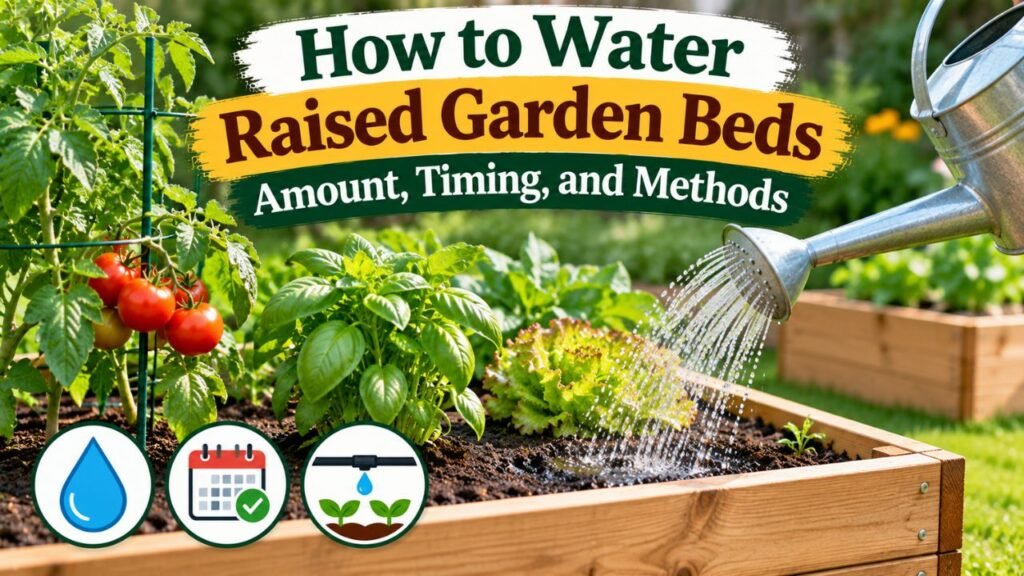
Watering a raised bed is relatively simple once you understand how quickly its soil dries and how much moisture the plants need.
The goal is to keep the active root zone consistently moist without leaving the soil waterlogged.
Step 1: Check the Soil Moisture
Before watering, insert your finger approximately 2 inches into the soil near a plant.
Feel whether the soil is dry, slightly moist, or wet.
- Dry soil: Watering may be necessary.
- Slightly moist soil: The plants may not need additional water yet.
- Very wet or saturated soil: Wait and allow excess water to drain.
Check more than one location, especially if the bed contains several types of vegetables.
Soil near the edges may dry faster than soil in the center.
According to Oregon State University Extension’s watering guidance, checking moisture approximately 2 inches below the surface is a practical way to determine when watering is needed.
Step 2: Choose the Best Time to Water
Early morning is generally the best time to water raised garden beds.
Watering before the hottest part of the day allows moisture to soak into the soil while evaporation is relatively low.
Morning watering also gives accidentally wetted leaves time to dry.
However, if plants are severely water-stressed in the afternoon, don’t withhold needed water until the next morning.
Water the soil promptly.
Step 3: Direct Water Toward the Plant Roots
Apply water to the soil around the base of each plant.
Avoid spraying water unnecessarily across the foliage.
You can use a watering can, garden hose with a gentle nozzle, soaker hose, or drip irrigation system.
Watering at soil level helps reduce splashing and keeps more moisture near the roots.
This is especially useful for tomatoes, peppers, cucumbers, and other vegetables susceptible to certain leaf diseases.
Step 4: Water Slowly
Apply water gently enough that it can soak into the soil.
A strong stream may:
- Displace seeds.
- Expose plant roots.
- Wash away mulch.
- Create channels in loose soil.
- Splash potentially contaminated soil onto leaves.
If water begins pooling or flowing away, reduce the flow.
Allow it to soak in before continuing.
Step 5: Moisten the Root Zone
Established vegetables generally benefit from deeper watering rather than repeated light sprinkling.
For many common vegetables, aim to moisten at least the upper 6–8 inches of the active root zone when the bed is deep enough.
Larger, established crops may use moisture deeper in the soil.
The appropriate depth depends on the vegetable and how its roots have developed.
Seeds and small seedlings are different: their shallow root zones need more frequent, gentle watering.
Step 6: Check the Soil After Watering
Wait for water to infiltrate.
Then use a finger, narrow trowel, or soil probe to examine the soil below the surface.
If only the top inch is wet while the deeper soil remains dry, additional watering may be necessary.
If the soil is thoroughly moist, stop.
Avoid continuing until the bed becomes saturated.
Step 7: Monitor the Bed Over the Next Few Days
Check soil moisture regularly.
Pay attention to how quickly the bed dries after watering.
A shallow bed in direct summer sunlight may need water much sooner than a deeper bed with mulch and moisture-retentive soil.
Use these observations to develop a practical routine.
Key Takeaway: Check before watering, apply moisture slowly around the roots, and confirm that water reaches below the surface. Soil conditions matter more than following a rigid daily schedule.
How Often Should You Water Raised Garden Beds?
There is no single watering frequency that works for every raised bed.
Some established vegetable beds may need irrigation two or three times a week during moderate weather.
Others may require more frequent watering during hot, dry, or windy conditions.
Shallow elevated beds may dry quickly enough to require daily attention.
The deciding factor should be soil moisture.
Typical Watering Frequency by Growing Conditions
| Growing Conditions | Starting Point for Checking and Watering |
| Cool spring weather | Check every 1–2 days; water as needed |
| Mild summer weather | Check daily; established beds may need watering every few days |
| Hot, dry summer weather | Check daily, sometimes twice daily in shallow beds |
| After substantial rainfall | Check moisture before adding water |
| Newly planted seeds | Check frequently; keep the seed zone moist |
| Newly transplanted vegetables | Check daily during establishment |
| Cool fall weather | Water less frequently as soil drying slows |
These aren’t fixed schedules.
For example, a mulched 18-inch-deep raised bed may retain moisture longer than a 6-inch-deep elevated planter.
A bed filled with a fast-draining soilless mix can also behave differently from a bed containing mineral soil and compost.
Should You Water Raised Beds Every Day?
Not automatically.
Daily watering may be appropriate for newly planted seeds, young seedlings, or shallow beds during extreme heat.
However, established plants in deeper beds often benefit from watering that thoroughly moistens the root zone, followed by a period that allows the upper soil to dry slightly.
Watering an already wet bed every day can create excessive moisture.
How Often Should You Water During Summer?
Summer watering depends on temperature, wind, rainfall, mulch, and bed depth.
During prolonged hot weather, check the soil daily.
You may need to water more often as plants become larger and begin producing fruit.
However, don’t assume that every hot day requires additional irrigation.
If the soil remains moist below the surface, watering may not be necessary.
How Often Should You Water in Spring and Fall?
Cooler temperatures generally reduce evaporation and plant water demand.
Rainfall may also provide some or all the necessary moisture.
Check the soil regularly and adjust accordingly.
Key Takeaway: Raised beds often need more frequent monitoring than in-ground gardens, but watering frequency should depend on actual moisture conditions.
How Much Water Do Raised Garden Beds Need?
Most established vegetable gardens require approximately 1–1½ inches of water per week as a general starting point.
This includes both rainfall and supplemental irrigation.
During periods of high temperatures, strong winds, or heavy crop growth, some vegetables may need more.
According to Penn State Extension’s vegetable irrigation guidance, vegetable crops commonly need 1–1½ inches of water weekly, with higher demand as plants grow and during unusually hot or windy conditions.
However, this is a planning estimate rather than an instruction to apply the same amount every week regardless of rainfall.
How Many Gallons Is 1 Inch of Water?
One inch of water distributed across one square foot equals approximately 0.623 gallons.
You can use this conversion to estimate water requirements.
Formula:
Gallons of water = Bed length (ft) × Bed width (ft) × Water depth (in) × 0.623
For example, consider a raised bed measuring 4 feet wide and 8 feet long.
Its surface area is:
4 × 8 = 32 square feet
For 1 inch of water:
32 × 1 × 0.623 = 19.94 gallons
For 1½ inches:
32 × 1.5 × 0.623 = 29.90 gallons
Therefore, approximately 20–30 gallons represents the weekly water volume corresponding to 1–1½ inches across a 4×8 bed.
This is a water-depth equivalent, not a guarantee that every gallon applied through a hose will remain in the root zone.
Runoff, evaporation, drainage, and irrigation efficiency affect actual water delivery.
Weekly Water Estimates for Common Raised Bed Sizes
<escape></escape>
| Raised Bed Size | 1 Inch of Water | 1½ Inches of Water |
| 2×4 ft | 5 gallons | 7.5 gallons |
| 3×3 ft | 5.6 gallons | 8.4 gallons |
| 3×6 ft | 11.2 gallons | 16.8 gallons |
| 4×4 ft | 10 gallons | 15 gallons |
| 4×8 ft | 19.9 gallons | 29.9 gallons |
| 4×10 ft | 24.9 gallons | 37.4 gallons |
| 4×12 ft | 29.9 gallons | 44.9 gallons |
These estimates assume water is applied evenly over the entire bed.
They don’t account for rainfall, soil texture, irrigation losses, or plant-specific demand.
Should You Subtract Rainfall?
Yes.
If your target is approximately 1 inch per week and the bed receives ½ inch of effective rainfall, you may need to supply only the remaining ½ inch.
For a 4×8 bed, that represents approximately 10 additional gallons before accounting for application losses.
However, actual moisture should still be checked.
A short rainfall event may not soak deeply into dry soil, while heavy rainfall may produce runoff instead of uniform infiltration.
Use a rain gauge and soil-moisture observations together.
How Deep Should You Water a Raised Garden Bed?
The appropriate watering depth depends on the plants and available rooting volume.
For established vegetables, watering should reach the active root zone rather than wetting only the surface.
For Established Vegetables
Moistening approximately 6–8 inches of soil is a useful initial check for many common vegetables.
However, crops such as mature tomatoes may develop roots substantially deeper.
When the bed is open to the ground, roots may extend into the soil beneath the raised section.
In these cases, evaluate moisture deeper than the top few inches when necessary.
For Shallow Raised Beds
A raised bed that is only 6 inches deep cannot hold the same amount of root-zone water as a much deeper, soil-filled planter.
However, if it is open-bottomed and placed on suitable garden soil, roots can grow below the frame.
That makes its effective rooting depth greater than the height of the raised bed walls.
For Raised Beds on Concrete
A raised bed positioned over concrete or another impermeable surface has a limited rooting volume.
Its plants depend on the water stored inside the bed.
These installations may need more frequent irrigation and careful drainage design.
The University of Maryland Extension’s raised-bed gardening guide notes that beds placed over hard surfaces dry more quickly because roots cannot access moisture in the soil beneath them.
How to Check Watering Depth
After watering, allow the moisture to infiltrate.
Use a garden trowel to inspect the soil at several depths without damaging major roots.
A narrow soil probe may also be useful.
Check whether the soil is moist throughout the portion occupied by the roots.
If only the upper inch is wet, increase the watering duration or adjust the delivery method.
What Is the Best Time of Day to Water Raised Garden Beds?
Early morning is generally best.
A practical watering window is approximately 5–9 a.m., although the exact clock time is less important than temperature, sunlight, and wind.
Why Morning Watering Works Well
Morning watering has several advantages.
- Temperatures are often cooler.
- Wind is frequently lighter.
- Less water is lost to evaporation.
- Plants can access moisture before afternoon heat.
- Wet foliage has time to dry.
If you use a timer-controlled drip system, morning irrigation can be convenient.
Can You Water Raised Beds in the Afternoon?
Yes.
If the soil is dry and plants need water, afternoon irrigation is appropriate.
Water at soil level to reduce evaporation.
Avoid wasting water through excessive spraying.
Don’t allow plants to remain severely dehydrated solely because it isn’t morning.
Can You Water Raised Beds at Night?
Watering at night isn’t automatically harmful.
However, overhead watering late in the evening may leave foliage wet for an extended period.
Prolonged leaf wetness can encourage certain plant diseases.
Drip irrigation or soaker hoses reduce that concern because they deliver moisture primarily to the soil.
Morning remains the preferred routine when possible.
Best Ways to Water Raised Garden Beds
Several methods work well.
The best option depends on the number of beds, available water supply, budget, and amount of time you want to spend watering.
1. Watering Can
A watering can is practical for small raised beds and newly planted seedlings.
It allows controlled application directly around plants.
Use a fine rose attachment for seeds and delicate seedlings.
For larger plants, apply water gently around their bases.
Advantages:
- Inexpensive.
- Easy to control.
- Suitable for small beds.
- Convenient for seedlings.
Limitations:
- Requires repeated refilling.
- Can be time-consuming for larger gardens.
- Makes consistent water distribution more difficult across many beds.
2. Garden Hose With a Gentle Nozzle
A hose works well for medium or large raised beds.
Choose a gentle shower or watering setting rather than a concentrated high-pressure jet.
Move the nozzle around the root zones.
Avoid directing water forcefully toward stems.
A hose is convenient when beds are close to an outdoor faucet.
However, hand watering requires attention to ensure the entire bed receives sufficient moisture.
3. Soaker Hose
A soaker hose releases water slowly through porous tubing.
It can be arranged along rows or around plants inside the raised bed.
Water gradually seeps into the surrounding soil.
Soaker hoses are especially useful for gardeners who want simple root-zone watering without assembling a detailed drip-emitter system.
However, pressure and flow can vary along the hose.
Very long runs may produce uneven watering.
4. Drip Irrigation
Drip irrigation delivers water through tubing and small emitters.
Emitters release controlled amounts of water near plant roots.
This method is often convenient for multiple beds or gardeners who prefer scheduled irrigation.
Drip systems can provide precise water placement when properly designed.
However, they still require maintenance and moisture monitoring.
5. Buried Clay Watering Pots
Unglazed clay pots, sometimes called ollas, slowly release water into the surrounding soil.
They can work well in certain raised beds.
The pot is buried with its opening accessible above the surface.
Water moves through the porous clay into the soil.
However, seedlings with shallow roots may need supplemental watering until their roots reach the moist area.
Ollas aren’t necessarily suitable for every soil type or planting layout.
Watering Method Comparison
| Method | Best For | Main Advantage |
| Watering can | Small beds and seedlings | Simple, precise control |
| Garden hose | Occasional hand watering | Quick and flexible |
| Soaker hose | Rows of vegetables | Slow root-zone watering |
| Drip irrigation | Multiple or frequently watered beds | Controlled delivery and automation |
| Buried clay pot | Small plant groups | Gradual localized moisture delivery |
Key Takeaway: Drip irrigation and soaker hoses are particularly useful for regular watering because they deliver moisture near the roots and reduce unnecessary wetting of leaves.
How to Set Up Drip Irrigation for Raised Garden Beds
Drip irrigation can save time and make watering more consistent.
A basic raised-bed system generally uses a water source, pressure-regulating components, tubing, and emitters.
Step 1: Locate the Water Source
Identify the nearest outdoor faucet or approved irrigation connection.
Make sure the hose or tubing can reach the raised beds without obstructing walking paths.
Step 2: Install Appropriate Supply Components
A typical drip system may require:
- Backflow prevention.
- Filter.
- Pressure regulator.
- Main supply tubing.
- Drip tubing or individual emitters.
- End caps or flush valves.
- Optional irrigation timer.
Use components compatible with your water source and the drip manufacturer’s specifications.
Backflow prevention is particularly important to protect drinking-water supplies and may be required by local plumbing regulations.
Step 3: Arrange Tubing Across the Bed
For a 4-foot-wide raised bed, multiple parallel drip lines may be useful.
The number and spacing depend on soil texture, emitter output, and plant arrangement.
Sandy soils tend to move water differently from finer-textured soils.
Don’t assume one drip line along the center will adequately moisten the full width of every bed.
Step 4: Position Emitters Near the Root Zones
Place emitters or drip tubing where moisture can reach the intended roots.
For closely spaced crops, continuous drip tubing can be useful.
For widely spaced vegetables such as tomatoes or peppers, individual emitters may be appropriate.
Avoid positioning all the emitters directly against plant stems.
Step 5: Test the System
Turn on the water and inspect the tubing.
Check for:
- Leaks.
- Blocked emitters.
- Uneven flow.
- Excessive pressure.
- Water escaping outside the bed.
Allow the system to operate long enough to moisten the soil.
Then check how the water spreads below the surface.
Step 6: Determine the Correct Run Time
Drip irrigation timing depends on emitter flow, spacing, pressure, soil, and plant demand.
An emitter rated at 1 gallon per hour delivers approximately 1 gallon in an hour under its specified operating conditions.
However, knowing the flow rate of a single emitter doesn’t establish the correct watering duration for the entire bed.
You also need to know how many emitters are operating and how effectively the water spreads through the root zone.
Drip Irrigation Calculation Example
Suppose a raised bed contains eight emitters, each rated at 1 gallon per hour.
Total theoretical flow:
8 × 1 = 8 gallons per hour
If your watering target is 12 gallons:
12 ÷ 8 = 1.5 hours
That equals approximately 90 minutes.
This is only a flow-volume example, not a recommended runtime for every raised bed.
Actual delivery and soil wetting can differ.
Always verify moisture distribution before setting a permanent schedule.
Step 7: Adjust the Timer for Weather
An irrigation timer can make watering convenient.
However, automatic schedules still need adjustment.
Reduce or suspend irrigation after sufficient rainfall.
Increase monitoring during heat waves.
If the soil remains saturated, reduce watering frequency or duration.
Key Takeaway: Don’t set drip irrigation to run for the same number of minutes every day without testing. Calibrate the system and adjust according to soil moisture and weather.
How to Water Raised Garden Beds With a Soaker Hose
A soaker hose is a relatively simple alternative to a drip system.
It is particularly suitable for gardeners who want slow watering without individual emitters.
Step 1: Position the Hose
Lay the soaker hose around the plants or between rows.
Try to distribute it evenly across the bed.
Avoid sharp bends that restrict flow.
Step 2: Connect to the Water Source
Use the pressure and fittings recommended by the hose manufacturer.
Some soaker hoses operate best at relatively low pressure.
Excessive pressure can produce uneven flow or damage the hose.
Step 3: Turn on the Water Slowly
Allow water to seep from the hose.
The goal is gentle infiltration rather than visible spraying.
If the soil begins pooling, reduce the flow.
Step 4: Check the Moisture Depth
After an initial watering session, inspect the soil near and between the hose runs.
Determine whether moisture is reaching the plants’ root zones.
Adjust hose placement or watering duration as needed.
Step 5: Add Mulch
A suitable layer of organic mulch over the hose can help reduce evaporation.
Don’t bury the hose so deeply that it becomes difficult to inspect or maintain.
Follow the manufacturer’s instructions.
How to Water Newly Planted Raised Garden Beds
New raised beds need careful watering because the growing medium may initially be dry or unevenly moist.
Before Planting
Moisten the soil before sowing seeds or installing transplants.
If the soil is very dry, water slowly in several passes.
Allow time for moisture to move into the mix.
Avoid creating a muddy or saturated bed.
After Sowing Seeds
Seeds generally require consistent moisture for germination.
Water gently with a fine spray or watering can.
Avoid strong water streams that may wash seeds away.
Check the upper soil frequently.
Unlike mature plants, germinating seeds may need light, frequent watering because the seed zone is shallow.
After Transplanting Seedlings
Water immediately after planting to settle soil around the roots.
Then check moisture daily during establishment.
New transplants have limited access to water outside their original root balls.
As roots grow into the surrounding soil, you can gradually shift toward deeper watering.
After Plants Become Established
Once vegetables develop larger root systems, reduce unnecessary shallow watering.
Apply water deeply enough to moisten the root zone.
Use soil checks rather than a fixed transition date.
How to Water Different Vegetables in Raised Beds
Different crops have different rooting patterns and moisture requirements.
For example, lettuce has a relatively shallow root system, while established tomatoes can use moisture deeper in the soil.
Raised Bed Vegetable Watering Guide
| Vegetable | Watering Priority | Practical Guidance |
| Tomatoes | Consistent moisture during flowering and fruiting | Water deeply and avoid large wet-dry swings |
| Peppers | Steady root-zone moisture | Monitor carefully during fruit development |
| Cucumbers | Consistent moisture during rapid growth | Check frequently in hot weather |
| Lettuce | Moist upper soil | Water more frequently when the shallow root zone dries |
| Spinach | Consistent cool-season moisture | Avoid severe drying during active growth |
| Carrots | Even moisture during germination and root development | Prevent surface crusting and prolonged drought |
| Beans | Adequate moisture during flowering and pod filling | Avoid both drought and waterlogging |
| Radishes | Consistent moisture during rapid root development | Prevent severe dry periods |
These are general care principles.
The exact amount of water depends on variety, soil conditions, plant size, and weather.
Watering Tomatoes in Raised Beds
Tomatoes generally benefit from deep, consistent watering.
Large fluctuations in soil moisture can contribute to fruit cracking and blossom-end rot.
Blossom-end rot is associated with calcium movement into developing fruit and may be aggravated by uneven moisture.
Mulch and well-managed irrigation can help reduce these fluctuations.
Watering Lettuce in Raised Beds
Lettuce has a relatively shallow root system.
The upper soil should remain adequately moist during active growth.
In hot weather, it may need more frequent watering than deeply rooted crops.
However, avoid continuously saturated soil.
Watering Cucumbers in Raised Beds
Cucumbers grow quickly and can develop substantial foliage.
Their water demand may increase during flowering and fruiting.
Monitor moisture closely during hot, dry periods.
Apply water around the root zone rather than repeatedly wetting the foliage.
Watering Carrots in Raised Beds
Carrot seeds need consistent moisture for germination.
Once established, roots extend deeper into the soil.
Uneven moisture may affect growth and root quality.
Avoid allowing the soil to become extremely dry and then applying excessive water suddenly.
Key Takeaway: Seedlings and shallow-rooted vegetables need special attention near the surface, while established fruiting crops benefit from consistent moisture throughout a deeper root zone.
How to Water Raised Garden Beds in Summer
Summer heat can increase evaporation and plant water demand.
Raised beds may be particularly vulnerable because the sides of the bed are exposed to warm air.
Check the Soil More Often
During a heat wave, check soil moisture at least daily.
Very shallow elevated beds may need more frequent checks.
However, checking frequently doesn’t necessarily mean watering every time.
Water Early in the Morning
Morning watering provides moisture before afternoon heat.
This is particularly useful for tomatoes, peppers, cucumbers, and other actively growing vegetables.
Add Organic Mulch
A 2–3-inch layer of suitable organic mulch can help reduce moisture loss.
Options include clean straw, shredded leaves, or other appropriate garden mulch.
Keep mulch slightly away from plant stems to avoid trapping excessive moisture directly against them.
Watch for Wind
Hot, dry winds can increase water loss from both plants and soil.
A windy day may increase watering demand even if temperatures aren’t extreme.
Consider Temporary Shade
During intense heat, temporary shade cloth may reduce plant stress for some crops.
However, use an appropriate shade level and avoid depriving sun-loving vegetables of too much light.
Shade is a supplement to proper irrigation, not a replacement.
How to Water Raised Garden Beds During Rainy Weather
Rain can supply some or all of the water needed by garden plants.
However, a rainy week doesn’t always guarantee that the root zone is adequately moist.
Measure Rainfall
Use a rain gauge to estimate how much rain the garden receives.
Compare the total with your crop’s approximate weekly needs.
Check Soil Below the Surface
Light rainfall may wet only the topsoil.
Heavy rainfall may create runoff or drain quickly through sandy soil.
Inspect moisture below the surface before deciding whether supplemental watering is needed.
Turn Off Automatic Irrigation
If rainfall has provided sufficient moisture, skip scheduled irrigation.
A rain sensor or moisture-based controller may help automate this process.
However, occasional manual checks remain useful.
Watch for Waterlogging
After repeated heavy rain, check whether the bed drains properly.
If soil remains saturated for an extended period, investigate drainage problems.
Don’t add irrigation until the soil has dried sufficiently.
How to Water Raised Beds With Different Soil Mixes
The soil mix affects how quickly water infiltrates, drains, and remains available to plants.
Compost-Rich Soil
Compost can improve soil structure and water-holding capacity.
However, the amount and properties of the compost matter.
A compost-rich mix isn’t automatically immune to drying.
Monitor moisture rather than relying only on the ingredients.
Sandy Soil
Sandy soil generally drains quickly and holds less water than finer-textured soil.
It may require smaller, more frequent irrigations.
Avoid applying water so rapidly that it moves beyond the active root zone.
Loamy Soil
Loamy soil often provides a useful balance between drainage and moisture retention.
However, its watering frequency still depends on weather and plant demand.
Soilless Raised Bed Mixes
Some elevated beds use lightweight mixes containing peat, coir, compost, perlite, or similar materials.
These can drain quickly.
Certain dry growing media can also become difficult to rewet evenly.
If water runs through the mix without thoroughly moistening it, apply water slowly in several passes.
Clay-Heavy Soil
Clay-rich soil can retain moisture longer but may absorb water more slowly.
Apply water gently to reduce surface runoff.
Avoid working or compacting the soil while it is saturated.
How to Keep Raised Garden Beds Moist Longer
Reducing unnecessary evaporation can make raised beds easier to maintain.
Add Organic Mulch
A 2–3-inch layer of clean straw, shredded leaves, or suitable organic mulch can help reduce moisture loss.
Mulch also moderates soil temperature and helps suppress weeds.
The University of Minnesota Extension’s water-conservation guidance recommends organic mulch to help conserve soil moisture.
Improve Soil Structure
Use suitable organic matter to improve soil structure.
However, avoid repeatedly adding large amounts of compost without considering soil test results.
Excessive compost can contribute to nutrient imbalances and soluble salt buildup.
Reduce Bare Soil Exposure
Healthy plant growth and appropriate mulch can reduce the amount of exposed soil.
However, avoid overcrowding plants because competition for water may increase.
Follow recommended spacing for each crop.
Use Drip Irrigation
Drip irrigation places moisture near the roots.
It can reduce unnecessary watering of pathways and nonplanted areas.
Maintain Suitable Bed Depth
Deeper beds generally provide a larger volume of soil that can store plant-available water.
However, deeper beds still require proper drainage.
A deeper bed shouldn’t be treated as a substitute for regular moisture monitoring.
How to Tell if Raised Garden Beds Need Water
The soil provides more dependable information than plant appearance alone.
Signs of Underwatering
Possible signs include:
- Dry soil below the surface.
- Leaves that remain wilted during cooler periods.
- Slow growth.
- Dry or curled leaf edges.
- Soil shrinking away from bed sides.
- Reduced fruit production.
However, these signs can also occur for other reasons.
Signs of Overwatering
Possible signs include:
- Soil that remains saturated.
- Yellowing leaves.
- Stunted growth.
- Persistent wilting despite wet soil.
- Root decay.
- A sour or unpleasant smell from poorly drained soil.
Overwatering can limit oxygen around roots.
As a result, plants may wilt even when the soil is wet.
What if Plants Wilt in the Afternoon?
Some plants temporarily wilt during intense afternoon heat.
If they recover as temperatures cool and the soil remains moist, additional water may not be necessary.
Check the soil before irrigating.
If the root zone is dry and plants remain stressed, water appropriately.
Should You Use a Soil Moisture Meter?
A moisture meter can be useful, especially for gardeners managing multiple beds.
However, inexpensive meters may provide inconsistent readings in certain soil mixes.
Use the meter as an additional indicator rather than relying on it exclusively.
Check the actual soil occasionally.
Common Mistakes When Watering Raised Garden Beds
Watering on a Fixed Schedule Without Checking Soil
A schedule can be convenient, but it shouldn’t override actual moisture conditions.
Rainfall, heat, wind, and plant size change water demand.
Watering Only the Surface
A quick splash may wet the upper inch while leaving deeper roots dry.
Apply water slowly and confirm adequate penetration.
Overwatering Every Day
Daily watering of already wet soil can reduce root oxygen and contribute to disease.
Allow appropriate drainage and check moisture before adding more.
Using Too Much Water Pressure
Strong jets can displace soil, seeds, and mulch.
Use a gentle stream or low-pressure irrigation method.
Ignoring Rainfall
Continuing automatic irrigation after substantial rainfall can waste water and oversaturate the bed.
Monitor rainfall and adjust irrigation.
Watering Leaves Late in the Evening
Wet foliage remaining overnight may encourage certain fungal diseases.
Water at soil level when possible.
Forgetting About Raised Bed Drainage
Beds placed on hard surfaces need a functional drainage arrangement.
Water shouldn’t remain trapped at the bottom.
Letting Seedlings Dry Out
New seeds and small seedlings have limited root systems.
They may need more frequent attention than established vegetables.
Assuming All Crops Need the Same Amount
Lettuce, tomatoes, carrots, and cucumbers have different moisture needs.
Adjust watering based on growth stage and crop characteristics.
Ignoring Mulch
Bare soil may lose moisture quickly during hot weather.
Appropriate organic mulch can reduce evaporation.
A Simple Raised Garden Bed Watering Schedule for Beginners
Use the following routine as a starting point rather than a rigid requirement.
Morning Routine
Check moisture approximately 2 inches below the surface.
If the soil is dry, apply water slowly around the plant roots.
If it is still moist, wait and check again later.
For seedlings, pay attention to the shallow seed or root zone.
After Watering
Check whether moisture has penetrated beyond the surface.
Avoid leaving the bed saturated.
Inspect irrigation tubing and emitters for leaks or blockages.
Every Few Days
Examine moisture in different parts of the bed.
Check whether edges are drying faster than the center.
Adjust watering to account for crop growth.
Weekly Routine
Review rainfall totals and approximate irrigation amounts.
Check mulch depth and replace displaced material when necessary.
Inspect plant growth and signs of moisture stress.
During Heat Waves
Increase the frequency of soil checks.
Water when the root zone needs moisture, even if that means adjusting the usual routine.
After Heavy Rain
Pause irrigation.
Check the soil after drainage has occurred.
Resume watering only when moisture conditions justify it.
Conclusion
Learning how to water raised garden beds begins with understanding the soil rather than relying on a fixed calendar.
Most established vegetable gardens need approximately 1–1½ inches of combined rainfall and irrigation per week as a general starting point. However, raised beds may dry faster than in-ground gardens, especially during hot weather or when they contain shallow, fast-draining soil.
For the best results, check moisture about 2 inches below the surface, water slowly around the base of the plants, and make sure moisture reaches the active root zone.
Drip irrigation and soaker hoses are useful for consistent water delivery, while watering cans and gentle hose nozzles work well for smaller beds.
I recommend watering in the morning when possible, adding suitable organic mulch, and checking soil moisture more frequently during summer. Newly planted seeds need consistent surface moisture, while mature vegetables benefit from deeper watering that supports healthy root development.
The goal is straightforward: keep the root zone consistently moist, not constantly saturated. With regular soil checks and a flexible watering routine, raised beds can support healthy vegetables throughout the growing season.
FAQs About How to Water Raised Garden Beds
How Often Should I Water My Raised Garden Bed?
Watering frequency depends on the weather, soil mix, bed depth, and plants.
Established raised beds may need watering every few days during moderate weather, but shallow beds and seedlings can require more frequent attention.
Check soil moisture approximately 2 inches below the surface before watering.
Should Raised Garden Beds Be Watered Every Day?
Not necessarily.
Daily watering may be appropriate for germinating seeds, young seedlings, or shallow beds during extreme heat.
However, established vegetables in deeper beds may need less frequent, deeper watering.
Avoid watering when the soil is already saturated.
How Much Water Does a 4×8 Raised Bed Need?
One inch of water over a 4×8-foot raised bed equals approximately 20 gallons.
A weekly target of 1–1½ inches represents about 20–30 gallons before accounting for rainfall and irrigation losses.
Actual needs vary with soil, weather, and crops.
Is It Better to Water Raised Beds in the Morning or Evening?
Morning is generally better because temperatures are often cooler and wetted leaves can dry during the day.
However, if plants need water in the afternoon or evening, water them.
Direct moisture toward the soil rather than unnecessarily wetting foliage.
Should I Use a Soaker Hose or Drip Irrigation for Raised Beds?
Both methods are useful.
Soaker hoses are relatively simple to install and work well for rows of vegetables.
Drip irrigation provides more control over individual emitters and is convenient for automation.
Choose based on bed layout, soil, available water pressure, and maintenance preferences.
How Deep Should Water Penetrate a Raised Garden Bed?
For many established vegetables, aim to moisten at least the upper 6–8 inches of the root zone when the bed is deep enough.
Larger mature crops may need moisture deeper in the soil.
Newly planted seeds require moisture near the surface.
Can You Overwater a Raised Garden Bed?
Yes.
Although raised beds often drain well, excessive irrigation can keep the root zone saturated.
This limits oxygen around roots and may contribute to root diseases.
Check moisture before watering and ensure adequate drainage.
How Do I Keep My Raised Bed Soil From Drying Out?
Apply approximately 2–3 inches of suitable organic mulch, maintain healthy soil structure, and use drip irrigation or soaker hoses when practical.
Check soil moisture regularly during hot weather.
Avoid leaving large areas of bare soil exposed unnecessarily.
How Long Should I Run Drip Irrigation in Raised Beds?
There is no universal runtime.
It depends on emitter flow rate, spacing, bed size, soil type, and crop water demand.
Calculate the system’s approximate output, run a test, and check how deeply moisture penetrates.
Adjust the timer according to rainfall and growing conditions.
Should I Water Raised Beds After Rain?
Only if the root zone still needs moisture.
Check rainfall with a gauge and inspect the soil below the surface.
If the soil is thoroughly moist, additional irrigation may be unnecessary.
If rain only dampened the surface and deeper soil remains dry, supplemental watering may be appropriate.

I’m Maya L. Greenwood, a lifelong plant lover who believes anyone can grow something beautiful with the right guidance. After years of testing soil mixes, pruning methods, irrigation tricks, and pest-safe solutions, I started EasyGardenTips.com to turn hard-won lessons into step-by-step advice. From seed starting and container gardens to composting and seasonal checklists, my goal is to make gardening simple, sustainable, and fun.