How Often to Water Raised Beds: A Practical Watering Schedule
Most established raised garden beds need watering approximately 1–3 times per week during mild weather, but they may need water daily or every other day during hot, dry summer conditions. The best schedule depends on soil moisture, temperature, rainfall, plant growth, and how quickly the raised bed drains. Check the soil about 2 inches below the surface, and water when it feels dry at that depth.
Raised beds often dry faster than traditional in-ground gardens because their soil is well-drained and more exposed to heat and wind. Young seedlings may need light, frequent watering, while established vegetables generally benefit from deeper watering that reaches their root systems.
As a starting point, many vegetable gardens need approximately 1 inch of water per week from rainfall and irrigation combined. Requirements can increase during unusually hot or windy weather.
However, watering too frequently can leave roots in saturated soil and reduce healthy growth.
In this article, I explain how often to water raised beds in spring, summer, fall, and winter, including specific considerations for tomatoes, lettuce, herbs, and newly planted seeds. I also cover how much water different bed sizes need, soil moisture testing, drip irrigation, mulching, and how to recognize overwatering or underwatering.
How Often to Water Raised Beds in Different Conditions
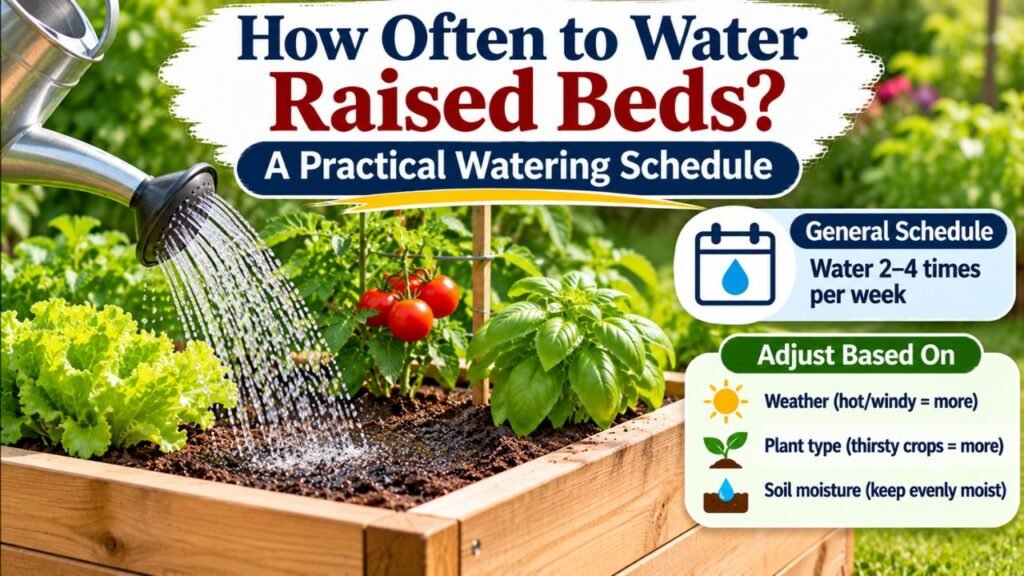
The frequency of watering depends primarily on how quickly plants use water and how much moisture the soil retains.
Raised beds with loose, fast-draining soil generally require more attention than gardens with moisture-retentive soil.
For a typical raised vegetable bed in full sun, the following schedule is a reasonable starting point.
| Weather Conditions | Starting Watering Frequency | What to Monitor |
| Cool, mild weather | About 1–2 times weekly if needed | Soil moisture and rainfall |
| Warm spring weather | About 2–3 times weekly | Drying soil and plant growth |
| Hot summer weather | Every 1–2 days if soil dries quickly | Root-zone moisture and heat |
| Extreme heat above 90°F | Check daily, sometimes twice daily | Rapid drying and plant stress |
| Rainy weather | Water only when needed | Moisture below the surface |
| Cool fall weather | Often 1–2 times weekly or less | Rainfall and slower plant growth |
| Newly seeded beds | Check daily and moisten as needed | Surface moisture during germination |
These are flexible examples, not fixed watering requirements. A bed with mulch and moisture-retentive soil may need substantially less frequent irrigation than an exposed bed filled with a lightweight potting mixture.
According to the University of Minnesota Extension’s hot-weather gardening guidance, vegetables may need watering daily or every other day during extremely hot weather, particularly when daytime temperatures exceed 90°F and nighttime temperatures remain above 70°F.
The most reliable approach is to check moisture before watering.
How Often Should You Water Raised Beds in Mild Weather?
During mild weather, established vegetables may need watering approximately once to three times per week.
For example, if temperatures remain around 60–75°F and the bed receives limited rainfall, checking soil moisture every couple of days is a practical starting point.
If the soil remains moist several inches below the surface, additional water may not be necessary.
However, seedlings and recently transplanted vegetables may require more frequent attention.
How Often Should You Water Raised Beds in Hot Weather?
During hot weather, raised beds may need watering every day or every other day.
Temperatures above 85–90°F, low humidity, strong sunlight, and wind can increase moisture loss.
Watering needs may be especially high when vegetables are flowering or producing fruit.
Check the soil each morning.
If it is dry below the surface, water thoroughly.
If the soil remains moist in the root zone, do not automatically add more water just because the day is hot.
Should Raised Beds Be Watered Every Day?
Not necessarily.
Daily watering may be appropriate during extreme heat, for very fast-draining raised beds, or when seeds and small seedlings need consistent surface moisture.
However, established vegetables usually benefit from watering that reaches deeper roots rather than frequent light sprinkling that only wets the topsoil.
If a raised bed remains moist several inches below the surface, daily irrigation may cause overwatering.
Key Takeaway: Check soil moisture daily during hot weather, but water only when the plants and soil actually need it. Consistent moisture is more important than following a rigid schedule.
How Much Water Do Raised Garden Beds Need Each Week?
Many vegetable gardens need approximately 1 inch of water per week during ordinary growing conditions.
Some need closer to 1.5–2 inches during extended hot, dry periods, depending on the crop and soil.
The total includes both natural rainfall and irrigation.
For example, if a raised bed receives sufficient rain, you may not need to add much water.
The University of Illinois Extension’s vegetable garden watering guidance identifies approximately 1 inch of water per week as a useful general target for vegetable gardens.
How Many Gallons Equal 1 Inch of Water?
One inch of water applied evenly over 1 square foot equals approximately 0.623 U.S. gallons.
You can estimate weekly water needs using this formula:
Gallons of water = Bed length (ft) × Bed width (ft) × Water depth (in.) × 0.623
For example, a 4 × 8-foot raised bed has a surface area of:
4 × 8 = 32 square feet
To apply 1 inch of water:
32 × 0.623 = 19.94 gallons
Therefore, a 4 × 8 raised bed requires approximately 20 gallons of water to receive the equivalent of 1 inch of irrigation.
This is a starting estimate, not a requirement to add 20 gallons regardless of rainfall or soil moisture.
Weekly Water Needs by Raised Bed Size
| Raised Bed Size | 1 Inch of Water | 2 Inches of Water |
| 3 × 3 ft | 5.6 gallons | 11.2 gallons |
| 3 × 6 ft | 11.2 gallons | 22.4 gallons |
| 4 × 4 ft | 10 gallons | 20 gallons |
| 4 × 8 ft | 20 gallons | 40 gallons |
| 4 × 10 ft | 24.9 gallons | 49.8 gallons |
| 8 × 8 ft | 39.9 gallons | 79.8 gallons |
These quantities represent the water depth spread evenly across the bed’s surface.
Actual irrigation requirements depend on rainfall, evaporation, root depth, and how effectively water reaches the soil.
Does Raised Bed Depth Affect Water Requirements?
Yes, although surface area and rooting conditions affect water demand differently.
The length and width determine how many gallons equal an inch of water over the bed.
The depth influences how much soil and potentially available moisture the bed can hold.
However, greater depth does not automatically mean the bed needs more gallons every time it is watered.
The bed’s drainage, exposure, soil mix, and plant roots also matter.
Should You Apply All the Water at Once?
Not always.
Deep watering is generally beneficial for established vegetables, but the total weekly amount may need to be divided into multiple applications.
For example, if your 4 × 8 raised bed needs approximately 20 gallons during a week with no rainfall, you might distribute that amount across two or three watering sessions.
During a heatwave, smaller and more frequent applications may be necessary to maintain consistent root-zone moisture.
Check the soil rather than assuming the same schedule works every week.
How to Check if a Raised Bed Needs Water
Checking soil moisture is the simplest way to decide whether irrigation is necessary.
The surface can look dry even when the soil around the roots remains moist.
Similarly, a recently watered surface may hide dry soil deeper down.
Use the Two-Inch Finger Test
The finger test is useful for everyday moisture checks.
Follow these steps:
- Move aside any mulch covering the soil.
- Insert your finger approximately 2 inches into the soil.
- Feel the moisture level near your fingertip.
- If the soil is dry at that depth, consider watering.
- If the soil is moist, check again later.
- Repeat the test in multiple places if the bed is large.
According to Oregon State University Extension’s Watering Basics, pushing a finger about 2 inches into the soil is a practical method for deciding when plants need water.
The same guidance recommends slow watering that reaches below the soil surface.
Check Deeper Moisture for Established Vegetables
For established plants, the top 2 inches may not provide the complete picture.
Use a narrow garden trowel or soil probe to examine the soil approximately 4–6 inches below the surface.
For deeper-rooted crops in sufficiently deep beds, check farther into the active root zone when necessary.
If the soil is dry throughout the root zone, the plants may need a thorough watering.
If it remains moist deeper down, additional water may not be necessary.
How Should Moist Soil Feel?
Moist garden soil generally feels cool and holds together lightly when squeezed.
However, the exact texture depends on the soil mixture.
Sandy soil may fall apart even when moist.
Soil containing significant compost or organic material may have a different texture.
A soil moisture meter can help, but inexpensive meters vary in accuracy.
Use the reading alongside a physical soil check.
Check More Than One Location
Raised beds do not always dry evenly.
Soil near exposed edges may become dry before soil near the center.
A tall tomato plant may use more water than a small herb growing nearby.
Check representative areas rather than relying on one spot.
Key Takeaway: The two-inch finger test is a useful starting method, but established vegetables also benefit from deeper moisture checks. Avoid watering solely because the soil surface looks dry.
How Often to Water Raised Beds in Summer
Summer is often the most demanding season for raised-bed irrigation.
Long days, intense sunlight, warm soil, and wind increase water loss.
Watering During Normal Summer Weather
During warm but not extreme weather, many established raised-bed vegetables may need watering every two or three days.
However, this varies substantially with soil composition and mulch.
A bed containing a moisture-retentive loam mixture may remain adequately moist longer than one filled with a lightweight, fast-draining material.
Check moisture before every scheduled watering.
Watering During a Heatwave
During prolonged heat above 90°F, inspect the soil daily.
Watering every day or every other day may be appropriate when the soil dries rapidly.
For exceptionally exposed beds or newly planted seedlings, more frequent checks may be necessary.
Avoid assuming that plants need additional water whenever their leaves wilt in the afternoon.
Temporary midday wilting can occur during intense heat even when the soil has adequate moisture.
Check the root-zone soil before adding more water.
Watering Raised Beds During Drought
During drought conditions, use water efficiently.
Prioritize vegetables that are actively flowering or fruiting and plants showing genuine moisture stress.
Useful strategies include:
- Watering early in the morning
- Using drip irrigation
- Applying organic mulch
- Removing competing weeds
- Checking soil moisture before irrigating
- Repairing leaking hoses or irrigation fittings
Follow local watering restrictions when they apply.
A consistent, well-managed irrigation schedule is more useful than repeatedly flooding the bed.
How Often to Water Raised Beds in Spring
Spring watering depends on rainfall, soil temperature, and planting stage.
In many regions, spring soil remains moist longer than summer soil.
However, newly planted seeds require close attention.
Newly Prepared Raised Beds
A newly filled raised bed may contain dry soil or unevenly moistened material.
Before planting, water the soil slowly and thoroughly.
This helps settle the mixture and distribute moisture.
Avoid flooding the bed so aggressively that the soil washes out.
After the initial watering, check moisture at several depths.
Newly Planted Seeds
Seeds require consistent moisture for germination.
The upper seed zone should remain moist but not waterlogged.
Depending on weather, light watering may be necessary once or more per day.
However, there is no benefit to watering again when the seed zone is already sufficiently moist.
Use a fine watering rose or gentle spray to prevent washing seeds out of position.
Young Seedlings
Young seedlings have relatively small root systems.
They cannot access deep moisture as effectively as established plants.
Inspect the seedling area daily, especially when temperatures rise or wind increases evaporation.
Apply water gently when the root zone begins drying.
As the plants establish deeper roots, transition toward less frequent but more thorough watering.
Established Spring Vegetables
Established vegetables may need watering once or twice weekly during cool, moist conditions.
However, warm weather and little rainfall can increase their needs.
Check the soil and adjust.
Do not continue daily seedling-style watering after the plants become well established unless conditions require it.
How Often to Water Raised Beds in Fall and Winter
Cooler temperatures and shorter days often reduce plant water use.
However, raised beds can still dry out when weather remains dry and windy.
Fall Vegetable Gardens
Fall crops such as lettuce, kale, spinach, carrots, and other cool-season vegetables need adequate moisture for growth.
In mild fall weather, watering once or twice weekly may be sufficient.
Rainfall can reduce or eliminate the need for irrigation.
Check the soil rather than following a fixed calendar.
Winter Raised Beds With Growing Vegetables
In mild-winter climates, vegetables may continue growing throughout the season.
These crops still need water when the soil becomes dry.
However, they often use water more slowly than during hot summer weather.
Water only as needed.
Avoid saturating cold soil for extended periods.
Raised Beds With No Winter Crops
An empty raised bed generally does not require the same irrigation schedule as a planted vegetable bed.
Natural precipitation may be sufficient.
However, overwintering perennials, cover crops, or newly planted shrubs may still need moisture during dry periods.
Adjust according to the plants and local climate.
Should You Water Raised Beds When the Soil Is Frozen?
Avoid trying to irrigate frozen soil.
Water may not infiltrate properly and can collect on the surface.
For overwintering plants, provide appropriate moisture during unfrozen periods when needed.
In regions with freezing weather, disconnect and protect irrigation equipment according to its manufacturer’s winterization instructions.
How Often to Water Raised Beds for Different Vegetables
Vegetables do not all have identical water requirements.
Plant age, root depth, weather, and growth stage influence how frequently each crop needs water.
Raised Bed Watering by Crop
| Vegetable | Watering Priority | Practical Guidance |
| Tomatoes | Consistent moisture | Water deeply and avoid large wet-dry fluctuations |
| Peppers | Moderate, even moisture | Check more frequently during flowering and fruiting |
| Cucumbers | Relatively high water demand | Maintain consistent moisture during fruit production |
| Lettuce | Consistent moisture near roots | Monitor closely during warm weather |
| Spinach | Even soil moisture | Avoid extended drying during active growth |
| Carrots | Moist seed zone during germination | Transition to deeper watering as roots develop |
| Radishes | Consistent moisture | Avoid severe drying during rapid growth |
| Beans | Adequate moisture during flowering | Avoid prolonged stress during pod development |
| Squash | Moisture during vigorous growth | Water thoroughly around the root zone |
| Basil | Even moisture | Water when the active root zone begins drying |
| Rosemary | Generally prefers drier conditions | Allow appropriate drying between watering |
These are crop-specific considerations, not fixed watering intervals.
Plants growing together in a raised bed should have reasonably compatible water requirements.
How Often to Water Raised Bed Tomatoes
Tomatoes benefit from consistent soil moisture.
During mild conditions, established plants may need watering approximately two or three times weekly in a well-drained raised bed.
Hot weather may require more frequent irrigation.
However, the correct schedule depends on soil moisture rather than the number of days.
Irregular watering can contribute to problems such as fruit cracking and blossom-end rot.
The University of Minnesota Extension’s tomato-growing guidance emphasizes consistent soil moisture and thorough watering.
Apply water close to the base of the plants.
Avoid repeatedly soaking the leaves when possible.
How Often to Water Raised Bed Lettuce
Lettuce has a relatively shallow root system and benefits from consistent moisture.
It can suffer quality problems during prolonged hot, dry conditions.
Check the upper root zone frequently.
During warm weather, watering every day or two may be necessary in fast-draining beds.
However, do not keep the soil waterlogged.
Mulch and appropriate afternoon shade can help reduce moisture stress in hot climates.
How Often to Water Cucumbers in Raised Beds
Cucumbers use substantial water during vigorous growth and fruiting.
In hot weather, check their soil daily.
Water when the root zone begins drying.
Deep, consistent watering is particularly important during fruit production.
Do not assume that large cucumber leaves always indicate a need for water when they temporarily wilt under intense afternoon heat.
Examine the soil before irrigating.
How Often to Water Peppers in Raised Beds
Peppers generally benefit from steady moisture without prolonged saturation.
During moderate weather, watering every few days may be sufficient.
During hot weather, inspect the soil more frequently.
Avoid dramatic cycles of severe drying followed by excessive irrigation.
How Often to Water Raised Bed Herbs
Herbs have different moisture preferences.
Basil often performs well with relatively consistent moisture.
Rosemary, thyme, and several Mediterranean herbs generally prefer well-drained soil and less frequent watering after establishment.
Avoid placing very drought-tolerant herbs beside moisture-demanding vegetables without considering their different needs.
For mixed beds, group plants with similar watering requirements.
How Raised Bed Height and Soil Type Affect Watering Frequency
Two raised beds of identical length and width may have different irrigation requirements.
The construction and soil mixture influence drainage and moisture retention.
Shallow Raised Beds
Shallow raised beds have limited soil depth.
A bed only 6 inches deep may dry quickly when filled with a fast-draining mixture.
The roots also have less room to access deeper moisture when the bed sits on an impermeable surface.
Monitor shallow beds closely, especially during hot weather.
However, a shallow open-bottom bed over healthy garden soil may allow roots to grow into the ground below.
Tall Raised Beds
Tall raised beds can experience significant moisture loss because their sides and soil are more exposed.
The University of Minnesota Extension notes that raised beds dry more quickly than in-ground gardens and that taller beds may require more frequent watering.
This is especially important for elevated or container-style beds that are exposed on multiple sides.
Monitor tall beds carefully rather than assuming their greater soil volume always provides longer intervals between watering.
Sandy Raised Bed Soil
Sandy mixtures allow water to drain rapidly.
They generally retain less water than loamy or clay-rich soils.
If a bed contains a large proportion of sand, it may require more frequent irrigation.
However, excessive watering can also wash nutrients below the active root zone.
Compost-Rich Raised Bed Soil
Mature compost can improve soil structure and moisture retention when used appropriately.
However, a bed filled almost entirely with compost may behave differently from a balanced raised-bed soil mixture.
As organic material decomposes, the soil level may settle.
Use a suitable soil blend rather than assuming more compost always creates better moisture retention.
Raised Beds on Concrete
Raised beds placed over concrete or other hard surfaces behave more like large containers.
Drainage depends on their construction.
If water cannot escape effectively, the soil may remain excessively wet.
Make sure the bed has a functional drainage arrangement appropriate for its location.
Do not respond to every apparent plant problem by adding more water.
What Is the Best Time of Day to Water Raised Beds?
Early morning is generally the best time to water raised garden beds.
Temperatures are usually cooler, wind may be calmer, and less water is lost to evaporation than during the hottest part of the day.
Morning Watering
Watering in the morning allows moisture to move into the root zone before intense afternoon heat.
It also gives wet leaves time to dry if overhead watering is used.
This can reduce the period during which foliage remains wet.
Afternoon Watering
Afternoon irrigation may be necessary when soil becomes severely dry.
Do not delay water needed by stressed plants solely because it is not morning.
However, hot, windy weather can increase evaporation losses.
Apply water close to the soil surface.
Evening Watering
Evening watering can work when necessary, particularly with drip irrigation that keeps foliage dry.
However, overhead watering late in the day may leave leaves wet overnight.
Prolonged leaf wetness can favor certain plant diseases.
When possible, prioritize morning irrigation.
Best Ways to Water Raised Garden Beds
Several irrigation methods work well for raised beds.
The best option depends on bed size, plant arrangement, budget, and the amount of time available for watering.
Watering Can
A watering can is useful for small raised beds and seedlings.
Choose a gentle rose attachment to distribute water evenly.
Apply water slowly near the plants.
Avoid washing soil away from roots or seeds.
The main limitation is that larger beds may require repeated refilling.
Garden Hose With a Gentle Nozzle
A garden hose works well for medium and large raised beds.
Use a gentle setting rather than a forceful jet.
Direct the water toward the soil around the plant roots.
Move slowly enough to allow infiltration.
If water begins running off the soil, reduce the flow or pause briefly.
Soaker Hose
A soaker hose releases water gradually along its length.
It is useful for growing vegetables in rows.
The hose can be placed along planting areas and covered lightly with mulch when permitted by its instructions.
However, flow rates vary depending on hose design, pressure, and length.
Check whether moisture reaches all parts of the root zone.
Drip Irrigation
Drip irrigation delivers water through emitters or drip tubing near plant roots.
It can provide controlled irrigation while minimizing unnecessary wetting of walkways and leaves.
Advantages include:
- Targeted watering
- Reduced surface runoff when properly adjusted
- Less wetting of foliage
- Compatibility with timers
- Practical use in multiple raised beds
A filter and pressure regulator may be necessary, depending on the irrigation components.
Choose emitters and tubing suitable for the bed.
Automatic Irrigation Timer
A timer can reduce the need for manual watering.
However, the timer should not replace checking soil moisture.
Adjust the schedule when rainfall, temperature, or plant growth changes.
A rain sensor or compatible moisture-control system may help prevent unnecessary watering.
How Long Should Drip Irrigation Run in Raised Beds?
There is no universal number of minutes that works for every raised bed.
Drip irrigation duration depends on:
- Number of emitters
- Emitter flow rate
- Soil drainage
- Bed dimensions
- Root depth
- Recent rainfall
- Weather conditions
Calculate Drip Irrigation Runtime
A simple estimate is:
Runtime (hours) = Desired gallons ÷ Total emitter flow rate (gallons per hour)
For example, suppose your drip system has:
- 16 emitters
- Each emitter delivers 1 gallon per hour
- Total flow is 16 gallons per hour
If your goal is to apply approximately 20 gallons:
20 ÷ 16 = 1.25 hours
That equals approximately 75 minutes.
However, the calculation assumes the emitters are functioning as rated.
It does not guarantee that water will be distributed evenly or reach the required root depth.
Test the Soil After Irrigation
Run the system for an initial period.
Then use a trowel to inspect how deeply the water has penetrated.
Check near and between emitters.
If only the top layer is wet, adjust the duration or emitter arrangement.
If the soil remains saturated for long periods, reduce irrigation.
Record the results and refine the schedule.
Can You Run Drip Irrigation Every Day?
Yes, when conditions justify it.
In very hot weather, shorter daily irrigation cycles may help maintain consistent moisture.
However, in cooler weather or moisture-retentive soil, less frequent irrigation may be appropriate.
Do not operate drip irrigation daily simply because the timer allows it.
How to Keep Raised Beds Moist Without Overwatering
Good soil management can reduce water loss and help maintain more consistent growing conditions.
Add Organic Mulch
Mulch reduces evaporation from the soil surface.
Suitable options include:
- Clean straw
- Shredded leaves
- Suitable untreated plant-based mulch
- Other appropriate organic materials
A layer approximately 2–3 inches thick is a common starting point for established plants.
Keep mulch from being piled tightly against stems.
For tiny seedlings, avoid burying them beneath a thick layer.
Improve Soil Structure
A suitable blend of mineral soil and mature organic matter can improve water retention and drainage.
Avoid using only a very lightweight potting mixture in a large raised bed if it dries too quickly for your conditions.
Also avoid compacting the soil excessively.
Healthy soil structure supports both water movement and root aeration.
Reduce Weed Competition
Weeds compete with vegetables for water.
Remove them regularly while they are small.
Mulch can also suppress some weed growth.
Group Plants by Water Needs
Planting crops with similar moisture requirements together makes irrigation easier.
For example, grouping lettuce and other moisture-loving greens can simplify watering.
Drought-tolerant herbs may be better suited to a separate bed or a section with different irrigation.
Use Shade Strategically
During extreme heat, temporary shade cloth may reduce heat stress for certain vegetables.
However, excessive shade can limit sunlight and growth.
Choose shade levels appropriate for the crop.
Shade does not replace watering when soil moisture is insufficient.
Signs You Are Underwatering Raised Beds
Underwatering occurs when plants cannot access sufficient moisture for normal growth.
The symptoms depend on the crop and environmental conditions.
Common Signs of Underwatering
- Dry soil several inches below the surface
- Persistent leaf wilting
- Slow or stunted growth
- Dry, brittle leaf edges
- Premature flower drop
- Reduced fruit development
- Rapid drying around plant roots
However, some symptoms can also result from disease, poor roots, excessive heat, or nutrient problems.
Confirm the soil is dry before assuming underwatering is responsible.
How to Correct Underwatering
Apply water slowly.
Allow it to infiltrate rather than run off.
Check that moisture reaches the active root zone.
If the soil has become extremely dry and repels water, several gentle applications may be more effective than one fast, heavy watering.
Add suitable mulch to reduce future evaporation.
Monitor the bed more frequently until conditions stabilize.
Signs You Are Overwatering Raised Beds
Overwatering can be as harmful as underwatering.
Roots need oxygen as well as water.
When soil remains saturated, air spaces become filled with water, limiting oxygen availability.
Common Signs of Overwatering
- Soil staying soggy for long periods
- Yellowing leaves
- Wilting despite wet soil
- Slow plant growth
- Poor drainage
- Algae on persistently wet surfaces
- Unpleasant, stagnant odors
- Root deterioration
These signs are not unique to overwatering, so inspect the soil and roots before making a diagnosis.
How to Correct Overwatering
Stop watering until the soil has an opportunity to drain appropriately.
Check whether excess water can leave the raised bed.
If the bed has an impermeable bottom, inspect the drainage arrangement.
Avoid adding more water just because plants appear wilted.
If root damage has occurred, improving drainage and moisture management is essential.
Common Raised Bed Watering Mistakes
Even experienced gardeners can create problems by following a watering schedule too rigidly.
Watering Only the Soil Surface
A small amount of water may dampen the top inch without reaching established roots.
This can encourage shallow rooting.
For established vegetables, water thoroughly enough to wet the active root zone.
Ignoring Recent Rainfall
A raised bed may not require irrigation after adequate rain.
Check the soil before watering.
Use a rain gauge when possible.
Remember that a brief shower may wet only the surface, while a longer rainfall may penetrate more deeply.
Watering Every Bed the Same Way
Different beds may contain different soil mixtures, crops, and amounts of shade.
A sunny tomato bed may dry faster than a partially shaded bed of established greens.
Evaluate each bed separately.
Forgetting Newly Planted Seeds
Seeds need consistent moisture near the surface.
Deep watering once a week may not maintain adequate moisture in the seed zone during hot weather.
Use gentle watering as needed until the seeds germinate and seedlings establish.
Overwatering in Cool Weather
Plants generally use less water during cool, cloudy conditions.
Reduce irrigation when the soil remains moist.
Avoid watering simply because a timer is set for the same schedule used during summer.
Using High-Pressure Water
Strong water pressure can wash soil away from seeds and roots.
Use a gentle nozzle or slow-flowing irrigation method.
Neglecting Mulch
Bare soil can lose moisture rapidly during hot weather.
A suitable layer of mulch helps moderate surface temperature and reduce evaporation.
However, mulch is not a substitute for checking root-zone moisture.
A Simple Weekly Raised Bed Watering Routine
A flexible routine can help you maintain consistent moisture without overwatering.
Monday: Check Moisture and Water if Necessary
Inspect the soil approximately 2 inches below the surface.
For established vegetables, check deeper areas when appropriate.
Water if the root zone is becoming dry.
Tuesday: Check Seedlings and Exposed Areas
Inspect newly planted seeds, seedlings, and exposed bed edges.
These areas may dry faster.
Provide gentle water when needed.
Established plants may not require additional irrigation.
Wednesday: Recheck Root-Zone Moisture
Check soil moisture again.
If the bed has become dry, apply a slow, thorough watering.
If the soil remains moist, wait.
Thursday and Friday: Adjust for Weather
Monitor temperature, wind, and rainfall.
During hot weather, check the bed daily.
During cool or rainy periods, irrigation may be unnecessary.
Weekend: Review the Entire Bed
Inspect plant condition, soil moisture, mulch coverage, and irrigation equipment.
Check whether the previous watering reached the desired depth.
Adjust the following week’s plan based on observed conditions.
This routine is a soil-checking schedule, not a requirement to water on specific days. During a heatwave, some beds need daily irrigation. During rainy periods, they may need none.
Conclusion
Determining how often to water raised beds depends on the season, soil mixture, plant type, rainfall, and how quickly the root zone dries.
During mild weather, established raised-bed vegetables may need watering approximately 1–3 times weekly. During hot summer conditions, watering every day or every other day may be necessary.
Many vegetable gardens need around 1 inch of water per week from rainfall and irrigation combined, with greater requirements possible during prolonged heat or drought.
However, the amount and timing should be adjusted based on actual soil moisture.
For a 4 × 8-foot raised bed, 1 inch of water equals approximately 20 gallons. That provides a useful starting point for estimating irrigation needs, but it does not mean 20 gallons must be added every week regardless of weather.
I recommend checking soil moisture about 2 inches below the surface, watering deeply enough to reach established roots, and using mulch or drip irrigation to reduce unnecessary water loss.
The best raised-bed watering schedule is one that keeps the root zone consistently moist without leaving the soil saturated.
FAQs About How Often to Water Raised Beds
Should I Water My Raised Garden Bed Every Day?
Not always. Established vegetables may need daily watering during extreme heat, especially in fast-draining raised beds. However, during mild or rainy weather, watering every day may be excessive. Check soil moisture before irrigating.
How Often Should You Water Raised Beds in Summer?
During ordinary summer weather, raised beds may need watering every two or three days. During heatwaves above 90°F, some beds require water daily or every other day. Soil composition, plant size, mulch, and rainfall determine the actual frequency.
How Many Gallons of Water Does a 4 × 8 Raised Bed Need?
A 4 × 8-foot raised bed requires approximately 20 gallons of water to receive the equivalent of 1 inch of rainfall or irrigation. If conditions call for 2 inches, the equivalent is about 40 gallons. Subtract effective rainfall and adjust for soil moisture and plant needs.
How Do I Know if My Raised Bed Needs Water?
Insert your finger approximately 2 inches into the soil. If it feels dry at that depth, watering may be necessary. For established vegetables, also check moisture deeper in the root zone. If the soil remains adequately moist, wait before watering again.
Is It Better to Water Raised Beds in the Morning or Evening?
Early morning is generally best. Cooler conditions help reduce evaporation, and foliage has time to dry if it becomes wet. Evening watering can be used when necessary, especially with drip irrigation, but avoid leaving leaves unnecessarily wet overnight.
Can You Overwater a Raised Garden Bed?
Yes. Even well-drained raised beds can become excessively wet if irrigation is too frequent or drainage is inadequate. Signs may include persistently soggy soil, yellowing leaves, and wilting despite wet conditions. Allow the soil to drain and adjust watering based on moisture checks.
How Often Should Newly Planted Raised Beds Be Watered?
Newly planted seeds and seedlings often need daily moisture checks because their roots are shallow. Water gently whenever the seed or root zone begins drying. As plants establish deeper roots, transition toward less frequent, more thorough watering when conditions allow.

I’m Maya L. Greenwood, a lifelong plant lover who believes anyone can grow something beautiful with the right guidance. After years of testing soil mixes, pruning methods, irrigation tricks, and pest-safe solutions, I started EasyGardenTips.com to turn hard-won lessons into step-by-step advice. From seed starting and container gardens to composting and seasonal checklists, my goal is to make gardening simple, sustainable, and fun.