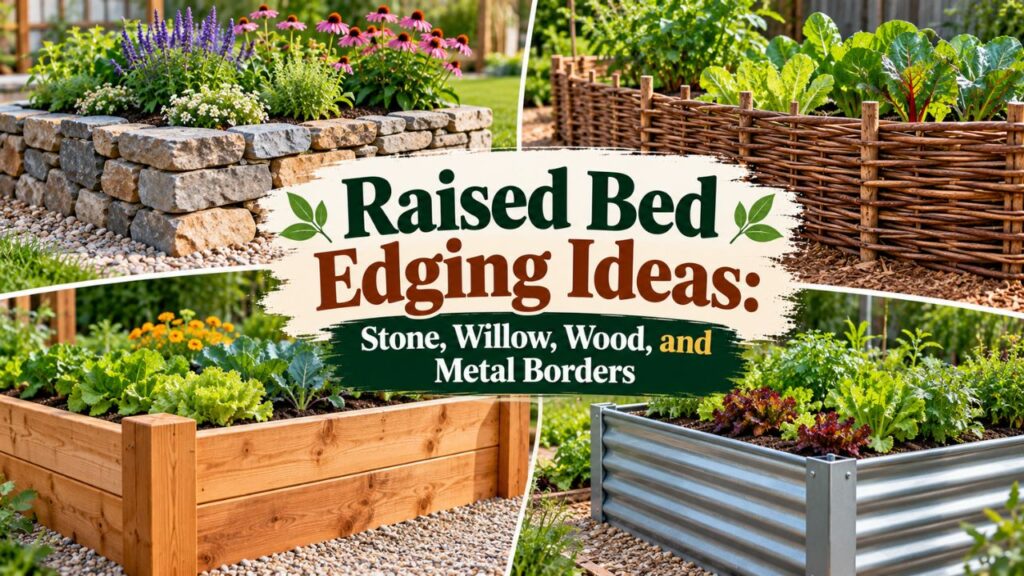
Raised Bed Edging Ideas: Stone, Willow, Wood, and Metal Borders
Raised bed edging is a border that defines a garden bed, helps contain soil, and creates a neat separation between planting areas and surrounding paths or lawns. Stone, woven willow, wood, brick, and metal are all useful edging materials, but the best choice depends on the bed’s height, shape, appearance, and how much soil the border must support.
A low decorative border around a slightly raised flower bed doesn’t need the same strength as a 12-inch-tall vegetable bed filled with soil. Stone and masonry can create durable borders, while willow offers a natural, woven appearance that works especially well in cottage gardens.
Wood is relatively easy to customize, and metal can create narrow, clean lines around straight or curved planting areas. Each material also has practical differences in installation, weather resistance, maintenance, and cost.
Choosing the wrong edging may lead to shifting stones, rotting materials, soil escaping through gaps, or borders that cannot safely support the planting area.
Understanding the available designs and how they function will help you select raised bed edging that looks attractive while providing the stability your garden needs.
Choosing Raised Bed Edging for Soil Retention and Garden Style
Raised bed edging serves two related purposes: defining the shape of the garden and containing the raised soil.
Some edging products are designed only to separate grass from mulch or planting soil. Others form structural walls capable of supporting a deeper growing area.
This distinction matters when choosing materials.
Decorative Edging vs. Structural Raised Bed Borders
Decorative edging creates a visible boundary around a garden bed.
It may extend only a few inches above the surrounding ground and is suitable for shallow mounded beds, flower borders, or separating mulch from paths.
Examples include:
- Thin metal landscape edging.
- Single rows of bricks.
- Small natural stones.
- Low willow hurdles.
- Short wooden border sections.
Structural raised bed edging must resist the outward pressure of the soil inside the bed.
It generally requires stronger materials, stable connections, and a suitable foundation.
Examples include reinforced wooden frames, engineered stone walls, properly constructed masonry, and manufactured metal raised bed panels.
A lightweight landscape edging strip should not be used as the primary wall of a deep, soil-filled garden bed unless the product is specifically designed for that purpose.
Raised Bed Edging Material Comparison
| Edging Material | Appearance | Durability | Best Application |
| Natural stone | Rustic or traditional | Long-lasting when installed correctly | Permanent garden borders |
| Concrete pavers | Clean and structured | Long-lasting | Straight or curved raised beds |
| Willow wattle | Natural and woven | Requires periodic replacement | Cottage gardens and low beds |
| Cedar or other suitable wood | Warm and traditional | Depends on species and conditions | Vegetable beds and DIY frames |
| Metal edging | Modern and minimal | Depends on coating and thickness | Clean lines and curved borders |
| Brick edging | Classic and formal | Long-lasting with a stable base | Decorative and masonry beds |
| Recycled composite boards | Uniform and contemporary | Product-dependent | Low-maintenance garden frames |
The strongest material isn’t necessarily the best for every project.
For example, natural stone may be an excellent choice for a permanent flower bed but unnecessary for a small seasonal herb garden.
Likewise, willow edging may be attractive around vegetables but unsuitable for retaining several feet of soil.
Stone Edging for Raised Beds
Stone edging is a durable option for raised garden beds and works particularly well in traditional, rustic, and naturalistic landscapes.
Natural stone can define straight or curved planting areas and complement patios, gravel pathways, and surrounding garden features.
The main consideration is choosing stones that can remain stable under the weight and pressure of the raised soil.
Natural Fieldstone Raised Bed Edging
Fieldstone creates an informal garden border with irregular shapes and natural colors.
Stones can be arranged along the perimeter of a shallow raised bed or carefully stacked into a low retaining wall.
This style works well for:
- Cottage-style vegetable gardens.
- Curved flower beds.
- Herb gardens.
- Rustic backyard landscapes.
- Planting areas beside gravel paths.
Choose pieces with relatively stable contact surfaces when building a retaining edge.
Large, flat-bottomed stones are generally easier to position securely than rounded rocks.
Avoid relying on loose, rounded stones to hold back a tall bed.
Dry-Stacked Stone Raised Bed Borders
A dry-stacked stone border uses carefully arranged stones without mortar.
The stones depend on their shape, weight, placement, and the wall’s construction for stability.
This approach creates a natural appearance and may allow water to pass through some joints.
For a low border, carefully fitted flat stones can work well.
For taller retaining walls, construction becomes more demanding.
Important considerations include:
- A firm, level foundation.
- Stable stones in the bottom course.
- Joints staggered between courses.
- Suitable wall width and support.
- Appropriate management of water behind the wall.
The Royal Horticultural Society’s guide to building raised beds explains that stone and masonry construction often requires suitable footings, with stronger structural construction needed as wall height increases.
Its guidance also emphasizes drainage when building raised beds on hard surfaces.
A tall stone wall or a raised bed retaining soil on a slope may require professional design and construction.
Stone Paver Edging for Raised Beds
Manufactured stone or concrete pavers provide a more uniform alternative to irregular fieldstone.
Their consistent dimensions can make layout and installation easier.
Pavers are particularly suitable for:
- Rectangular raised beds.
- Formal kitchen gardens.
- Borders adjoining paved paths.
- Geometric flower beds.
- Gardens requiring a consistent finish.
Some pavers are designed to interlock or be used in retaining walls.
However, ordinary paving blocks aren’t automatically suitable for every raised bed wall height.
Choose products designed for the intended soil-retaining application.
River Rock Edging Around Raised Beds
River rocks create a softer, rounded appearance.
They work best as decorative edging around the outside of an existing raised bed or as a boundary between pathways and planting areas.
For example, smooth river stones can create a border around a wooden raised bed without supporting the soil inside it.
Because rounded rocks can shift or roll, they aren’t usually the best choice for constructing a freestanding retaining wall.
They are better used in shallow decorative arrangements where movement won’t create a safety concern.
How to Install Stone Edging for a Raised Bed
The installation method depends on whether you’re creating a low decorative stone border or a structural wall.
The following steps are suitable for a simple, low stone edging project on reasonably level ground.
Step 1: Mark the Raised Bed Perimeter
Decide the size and shape of the planting area.
For a rectangular bed, use stakes and string to mark straight lines.
For a curved design, use a garden hose or flexible rope to establish the outline.
Check that the edging won’t interfere with nearby paths, irrigation lines, or garden access.
Step 2: Prepare the Ground
Remove grass, weeds, roots, and loose debris from the edging line.
Excavate a shallow trench appropriate for the selected stones.
The required depth depends on their size, the manufacturer’s installation instructions, and ground conditions.
Work toward a firm, level base rather than placing stones directly on loose turf.
Step 3: Create a Stable Base
For suitable low landscape edging, a compacted granular base may help improve stability.
Use the base material and installation method recommended for the selected stone or paver product.
Check the level as you work.
In regions with significant freeze-thaw conditions, foundation design becomes more important because ground movement can shift poorly supported stonework.
Larger masonry walls may require concrete footings or another engineered foundation.
Step 4: Position the Stones
Place the largest or most stable stones first.
Adjust each piece so it rests securely without rocking.
For low stacked borders, stagger vertical joints wherever possible.
Avoid balancing heavy stones on narrow contact points.
If the design requires retaining a considerable amount of soil, follow a suitable retaining-wall construction method rather than simply stacking decorative stones.
Step 5: Fill and Check the Raised Bed
After the edging is secure, add the growing soil.
Fill gradually and inspect the border for movement.
If stones shift, stop filling and correct the instability before continuing.
The finished border should hold the intended soil level without leaning outward or creating loose stones near paths.
Willow Edging for Raised Beds
Willow edging creates a natural, handwoven garden border using flexible branches woven around upright stakes.
The technique is commonly known as wattle fencing.
It gives raised beds a traditional cottage-garden appearance and works especially well alongside herbs, leafy vegetables, flowers, and natural pathways.
Unlike stone or metal, willow is an organic material that gradually weathers and decomposes.
What Is Woven Willow Raised Bed Edging?
Woven willow edging consists of two main components:
- Vertical stakes that support the structure.
- Flexible willow rods, sometimes called withies, woven horizontally between the stakes.
The branches are threaded alternately around the supports, creating a continuous panel.
As the woven rows build up, they form a decorative boundary that can help contain shallow garden soil.
The appearance is informal, textured, and well suited to traditional kitchen gardens.
Willow can also be woven into removable hurdle panels that are installed around existing beds.
Why Willow Works Well for Cottage Gardens
Willow has a softer appearance than metal or masonry.
Its natural colors blend easily with vegetation, mulch, wood, and gravel.
It also allows gardeners to create gentle curves and irregular shapes without cutting rigid building materials.
Other advantages include:
- A distinctive handcrafted appearance.
- The ability to use suitable locally harvested branches.
- Minimal specialized construction equipment.
- Easy replacement of individual woven sections.
- Compatibility with natural garden designs.
However, willow isn’t as durable as permanent stone or metal edging.
It also requires enough structural support to prevent the woven border from bulging under soil pressure.
How Long Does Willow Edging Last?
The lifespan of willow edging varies with the material’s condition, climate, soil moisture, construction, and contact with the ground.
Untreated natural branches gradually decompose.
Constant contact with damp soil can accelerate deterioration, especially around the bases of the stakes.
A woven willow border should therefore be considered a repairable garden feature rather than a permanent retaining wall.
Some sections may need replacement before others.
Using durable support stakes and keeping unnecessary soil contact to a minimum can help extend its useful life.
How to Make Willow Edging for Raised Beds
A low woven willow border can be built using flexible branches and sturdy vertical stakes.
The process is straightforward, but the structure needs enough support to remain secure.
Step 1: Collect Suitable Willow Branches
Choose long, flexible willow stems that can bend without breaking.
Freshly harvested dormant stems are often easier to weave than older, brittle branches.
The University of Maine Cooperative Extension’s guidance on wattle fencing identifies willow as a traditional weaving material and recommends harvesting suitable branches in late winter or spring before leaves emerge.
Its guidance also explains that woven rods should be long enough to pass around at least three upright supports.
This helps create a more continuous and stable weave.
Step 2: Prepare the Support Stakes
Select sturdy wooden stakes capable of supporting the woven branches.
Naturally decay-resistant wood, such as suitable cedar, may provide better long-term support than untreated softwood.
Mark the raised bed perimeter.
Drive the stakes securely into the ground at intervals appropriate for the length and flexibility of your weaving material.
Place additional stakes at corners and other areas needing reinforcement.
The supports must be firm enough to resist the pulling forces created during weaving.
Step 3: Weave the Willow Branches
Begin near the bottom of the stakes.
Pass one willow rod in front of the first stake, behind the next, and continue alternating along the border.
Use another rod to continue the pattern.
For a closely woven finish, stagger the starting and ending positions of individual rods.
Press each completed row gently downward to reduce large gaps.
Continue until the edging reaches the intended height.
Avoid applying excessive force that could bend or dislodge the support stakes.
Step 4: Secure the Ends
Tuck the branch ends into the woven structure where possible.
Trim protruding pieces that could catch clothing or scratch someone working beside the bed.
Check that the upper rows remain stable.
If a section moves easily, add appropriate support rather than relying on the soil to hold it upright.
Step 5: Prevent Soil From Escaping Through the Weave
Woven willow edging contains natural gaps.
For a low raised bed, a suitable permeable liner can help prevent fine soil from washing through those openings.
Position the liner along the inner face of the woven border without sealing the bed’s drainage path.
A barrier can reduce direct soil contact with the willow, but it won’t prevent eventual weathering or decay.
For taller beds, a stronger soil-retaining frame may be needed behind the decorative willow.
Important: Wattle edging is generally better suited to low raised beds and decorative borders than tall, heavily filled planters.
Step 6: Inspect Willow Edging Seasonally
Check the stakes and woven branches after heavy rainfall, winter weather, or periods of prolonged moisture.
Replace broken or decayed rods.
Reinforce loose supports before the soil pushes the edging outward.
Regular inspection helps maintain both the appearance and stability of the border.
Living Willow vs. Dead Willow Edging
Willow edging can be constructed using either living material intended to grow or cut branches intended mainly for weaving.
These approaches are different.
Living Willow Edging
Living willow uses fresh, viable stems planted into the ground.
Under suitable conditions, some stems can develop roots and new shoots.
These structures need ongoing pruning and training.
Living willow may be appropriate for decorative garden fencing or larger landscape features.
However, its vigorous growth and root development can make it less practical beside compact vegetable beds.
Traditional Woven Willow Edging
Traditional wattle edging is intended primarily as a woven structure rather than a living hedge.
Dried or otherwise non-rooting materials are often preferred when ongoing willow growth is unwanted.
Fresh willow stakes or cuttings may sometimes root if they remain viable and conditions are favorable.
If you don’t want living willow around the bed, choose prepared weaving materials and inspect the structure for unwanted shoots.
Other Raised Bed Edging Ideas for Different Garden Styles
Stone and willow aren’t the only options.
Wood, metal, brick, and composite materials can create attractive borders with different maintenance requirements.
Cedar Wood Edging for Raised Beds
Cedar is a popular choice for wooden raised beds because of its natural resistance to decay.
Boards can be cut and assembled into rectangular, square, or custom-shaped frames.
Wooden edging works especially well for vegetable gardens where simple construction and easy access are priorities.
Use suitable outdoor fasteners and strong corner connections.
Long sides may need additional support to resist outward soil pressure.
Avoid wood contaminated with unknown chemicals, creosote, or old industrial treatments.
Metal Raised Bed Edging
Metal creates a clean, modern appearance.
Thin steel or aluminum landscape edging can define shallow beds and curved planting areas.
However, thin edging strips are different from structural metal raised bed panels.
A deep raised bed requires panels designed to support the contained soil.
Check the material thickness, protective coating, connections, and manufacturer specifications.
Exposed metal edges should be finished or covered appropriately to reduce the risk of cuts.
Brick Edging for Raised Beds
Brick provides a classic appearance that pairs well with patios, walkways, and traditional homes.
A single row of suitable bricks can create a decorative border around a shallow planting area.
For taller beds, brickwork needs appropriate structural support and foundation construction.
Use materials rated for outdoor exposure, particularly in climates with freezing temperatures.
Poorly supported brick edging may shift as the ground settles or freezes.
Recycled Composite Edging
Composite and recycled plastic boards can provide a uniform alternative to natural wood.
Some products resist rot and insect damage, making them attractive for low-maintenance gardens.
However, not all landscape boards are designed to retain deep soil.
Check the manufacturer’s intended application, maximum unsupported span, and requirements for stakes or braces.
Thermal expansion and connection strength may also matter.
Log and Timber Edging
Natural logs and landscape timbers can create rustic raised bed borders.
Choose sound, suitable wood and secure it to prevent rolling or movement.
Logs work particularly well around informal flower beds and woodland-style gardens.
Their lifespan depends on the wood species, moisture exposure, and construction.
Avoid salvaged railroad ties treated with creosote, especially around edible crops.
Raised Bed Edging Ideas for Different Garden Layouts
The edging design should complement the shape, location, and purpose of the bed.
Straight Edging for Rectangular Vegetable Beds
Straight boards, metal panels, and uniformly shaped pavers work well for rectangular beds.
They help create organized rows of planting areas and pathways.
This layout is useful for kitchen gardens where access, irrigation, and efficient space planning are important.
Curved Stone Edging for Flower Beds
Curved stone borders create a softer transition between lawns and planting areas.
They work particularly well around ornamental beds, shrubs, and perennial flowers.
Choose stones or pavers that fit the desired curve without leaving unstable gaps.
Broad, gradual curves are generally easier to install and maintain than very tight bends.
Willow Edging for Informal Herb Gardens
Low woven willow borders complement herbs such as thyme, parsley, sage, and chives.
A series of small willow-edged beds can create a traditional cottage-garden layout.
Keep the beds shallow enough for the edging to remain structurally appropriate.
If more soil depth is necessary, use a stronger hidden frame with willow as the decorative outer finish.
Stone Edging Along Gravel Pathways
A stone border can create a distinct transition between a raised bed and a gravel pathway.
Choose stones that remain stable under occasional contact from garden tools or wheelbarrows.
Prevent loose gravel from accumulating inside the planting area.
Consider the comfort of walking and kneeling beside the border.
Mixed-Material Raised Bed Edging
Combining materials can provide both structural support and a decorative finish.
For example:
- A sturdy wooden frame with a low stone border outside it.
- A structural raised bed with decorative willow panels.
- Metal raised bed panels surrounded by gravel paths.
- Brick edging beside a cedar vegetable bed.
The structural frame should carry the soil load.
Decorative materials should not be expected to provide support unless they are specifically designed and installed for that purpose.
How Much Raised Bed Edging Material Do You Need?
The amount depends on the length and width of the bed, its shape, and the edging material.
For a rectangular raised bed, calculate the perimeter.
Perimeter = 2 × (Length + Width)
For a 4-foot by 8-foot raised bed:
2 × (4 + 8) = 24 linear feet
This means the bed has a perimeter of 24 feet.
If you’re installing a continuous border, use this measurement as the starting point.
However, the purchasing quantity may be greater because of cuts, overlaps, corner connections, and installation waste.
Calculating Stone Edging
For a single row of uniformly sized stones, divide the perimeter by the length each stone covers along the border.
If each stone covers exactly 12 inches and no joints or cuts are required:
24 feet ÷ 1 foot = 24 stones
This is only a basic quantity estimate.
Actual requirements depend on the stone dimensions, joint spacing, corners, curves, and installation pattern.
Stacked stone walls also require additional material for every course.
Calculating Willow Edging
Willow edging requires both upright stakes and flexible weaving rods.
The number of stakes depends on their spacing and the perimeter.
The number of willow rods depends on their length, thickness, flexibility, and the desired height of the woven border.
Allow additional material for overlaps, breakage, and finishing the ends.
A small test section can help establish realistic material quantities before harvesting or purchasing enough willow for the entire bed.
Calculating Wood or Metal Edging
For wooden boards or metal strips, start with the total perimeter and check the available material lengths.
Account for corner joints and any required supporting stakes.
For tall beds, additional braces or structural members may be necessary.
Follow the structural requirements of the selected material rather than calculating solely from linear footage.
How to Choose Raised Bed Edging That Lasts
Durability depends on more than the material itself.
The installation method, weather conditions, drainage, and expected soil load all affect performance.
Consider Moisture and Ground Contact
Materials that remain in direct contact with damp soil can deteriorate more quickly.
Untreated willow and some softwoods are particularly affected by prolonged moisture exposure.
Stone and suitable masonry materials generally offer better resistance to biological decay.
Metal may resist rust when appropriately coated, although corrosion resistance depends on the specific product and environment.
Consider Freeze-Thaw Conditions
In colder regions, repeated freezing and thawing can cause ground movement.
Poorly supported stones, bricks, and pavers may shift or become uneven.
A properly prepared base and foundation design help reduce these problems.
Permanent masonry walls may require deeper or more substantial foundations depending on local soil and climate conditions.
Match the Edging to Soil Height
A shallow decorative border experiences much less soil pressure than a tall raised bed wall.
As soil height increases, retaining requirements become more demanding.
Don’t use a flexible edging strip, loose willow hurdles, or casually stacked stones to retain a deep bed without suitable structural support.
For substantial walls, sloped sites, or uncertain ground conditions, seek qualified construction guidance and check local requirements.
Plan for Easy Garden Maintenance
Consider how you’ll access the plants and maintain the surrounding paths.
Edging shouldn’t create sharp hazards, unstable stepping surfaces, or unnecessary obstacles.
If you regularly use a mower near the bed, choose a border design that allows safe trimming without striking the wall.
For gardens where sitting on the edge is important, use a suitably designed structural wall or seating cap.
Decorative edging should not be treated as a seat unless it is designed to support that load.
Common Raised Bed Edging Mistakes to Avoid
Using Decorative Edging as a Retaining Wall
Thin metal strips and lightweight willow borders may be attractive, but they aren’t suitable for every raised bed height.
Use a structural frame or wall when the soil needs significant support.
Placing Stone Directly on Unstable Ground
Stone edging installed over loose soil or vegetation may shift over time.
Prepare a stable base suited to the edging design and local ground conditions.
Using Willow Without Strong Support Stakes
Flexible willow branches need firm vertical supports.
Weak or shallow stakes can lean outward as the border is woven or filled with soil.
Choose suitable stakes and secure them properly before weaving.
Blocking Drainage With Solid Liners
A liner can help prevent soil from escaping through willow or wooden borders.
However, a waterproof barrier placed across the bottom of an open raised bed may interfere with drainage and root growth.
Use liners according to the bed’s construction and drainage requirements.
Ignoring Material Maintenance
Natural wood and willow gradually weather.
Metal coatings may become damaged, and stone borders may need occasional adjustment.
Inspect the edging periodically instead of assuming the original installation will remain unchanged indefinitely.
Conclusion
The best raised bed edging combines an attractive appearance with enough stability to support the intended garden design.
Stone edging is a strong option for permanent borders, especially when installed on a suitable foundation. Willow edging creates a natural, woven appearance that works well in low cottage-style raised beds but requires more maintenance.
Wood offers simple construction and flexibility, while metal and brick provide alternatives for modern or traditional layouts.
For shallow decorative beds, edging can be relatively simple. For deeper raised beds, structural strength, stable connections, and suitable foundations become more important.
Choose the material according to the soil height, local conditions, maintenance requirements, and surrounding landscape. A properly selected and installed border can keep the garden organized while complementing the plants inside it.
FAQs About Raised Bed Edging
What Is the Best Material for Raised Bed Edging?
The best material depends on the bed’s height and the desired appearance.
Stone is suitable for durable permanent borders, willow works well for natural decorative edging, and wood is convenient for simple DIY raised beds.
Metal and brick are also useful when their construction matches the required soil support.
Can You Use Stone Edging Without Mortar?
Yes. Low dry-stacked stone borders can be constructed without mortar when the stones are stable and the wall is appropriately designed.
Taller walls may need stronger construction, suitable foundations, and professional guidance.
Is Willow Edging Strong Enough for Raised Beds?
Willow edging can work for low raised beds when supported by sturdy stakes and constructed carefully.
It isn’t generally suitable as the sole retaining structure for a tall, heavily filled raised bed.
A stronger frame can be used behind willow when additional soil support is necessary.
Can Raised Bed Edging Stop Grass From Growing Into the Bed?
Edging can help define the boundary between grass and planting soil, but it doesn’t automatically stop every type of grass.
Species with spreading underground stems or rhizomes may grow beneath shallow borders.
Where invasive lawn grasses are present, an appropriately designed root barrier and regular maintenance may be necessary.
Does Stone Edging Affect Raised Bed Soil Temperature?
Stone absorbs and releases heat, so its exposed surfaces may influence nearby soil temperatures.
The effect depends on the stone’s color, size, sunlight exposure, climate, and the bed’s construction.
Stone edging shouldn’t be considered a substitute for proper frost protection.
Can You Add Willow Edging Around an Existing Raised Bed?
Yes. Decorative willow panels can be installed around an existing raised bed.
If the original bed already has a strong frame, the willow can serve as an outer decorative finish.
Avoid disturbing the structural supports or damaging established plant roots during installation.
Can You Mix Stone and Willow Edging in the Same Garden?
Yes. Stone and willow can complement each other when used for different purposes.
For example, stone may form permanent borders around larger beds, while willow creates softer decorative edges around herb gardens.
Use each material according to its structural capabilities and maintenance needs.

I’m Maya L. Greenwood, a lifelong plant lover who believes anyone can grow something beautiful with the right guidance. After years of testing soil mixes, pruning methods, irrigation tricks, and pest-safe solutions, I started EasyGardenTips.com to turn hard-won lessons into step-by-step advice. From seed starting and container gardens to composting and seasonal checklists, my goal is to make gardening simple, sustainable, and fun.