Raised Garden Bed Drainage: Holes, Soil Mix, and Simple Fixes
Raised garden bed drainage works best when excess water can move through loose, well-structured soil and escape through an open bottom or properly positioned drainage holes. Most raised beds placed directly on garden ground do not need drainage holes in their walls. However, elevated raised beds with solid bottoms need adequate outlets to prevent water from collecting around plant roots.
Poor drainage can leave vegetables growing in saturated soil, where roots struggle to obtain enough oxygen. Tomatoes, peppers, herbs, and many other garden plants may develop weak growth or root diseases when the growing medium stays excessively wet.
The solution depends on the bed’s construction and location. A wooden or metal raised bed installed over compacted clay requires different drainage improvements from an elevated planter standing on legs or a raised bed placed over concrete.
Soil composition matters, too. Adding gravel to the bottom is not a reliable solution, and drilling extra holes will not correct every drainage problem.
This guide explains drainage holes, elevated bed construction, suitable soil mixtures, and practical methods to improve drainage in raised beds that remain too wet.
How Raised Garden Bed Drainage Works
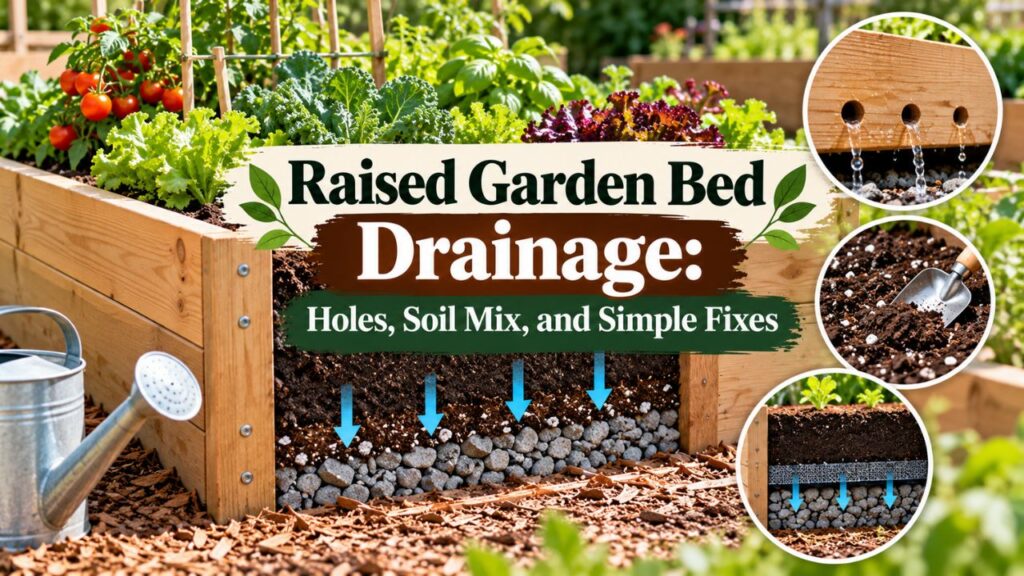
Raised garden beds drain when gravity pulls excess water downward through the growing medium and an available outlet allows it to leave.
Healthy soil contains spaces between particles. Some hold water for plant roots, while others contain air.
When soil becomes saturated, water fills most of those air spaces. Prolonged saturation limits the oxygen available to roots and can encourage certain root diseases.
Good drainage allows excess water to move away while retaining enough moisture for healthy plant growth.
Open-Bottom Raised Garden Bed Drainage
Most traditional raised garden beds have four surrounding walls but no solid bottom.
They sit directly on natural ground, allowing water to move through the raised soil and into the earth underneath.
This design generally works well when:
- The underlying soil is reasonably well-drained.
- The growing mixture contains suitable mineral soil and organic matter.
- The bed is not installed in a persistently flooded area.
- The soil underneath is not severely compacted.
An open bottom also allows plant roots to extend into the underlying ground.
However, an open-bottom bed can still develop drainage problems if the native soil becomes saturated or prevents water from moving downward.
Drainage in Raised Beds With Solid Bottoms
A raised bed with a solid bottom behaves more like a large gardening container.
Water cannot move into the ground beneath it, so the structure needs drainage holes, slots, or another outlet.
Without adequate drainage, water may accumulate at the bottom.
This is particularly important for elevated raised beds, raised planter boxes, and gardening containers placed on patios.
Key Takeaway: An open-bottom raised bed usually drains through the ground. A solid-bottom bed needs a separate outlet for excess water.
Do Raised Garden Beds Need Drainage Holes?
Not every raised garden bed requires drilled drainage holes. The need depends mainly on whether the bottom is open, enclosed, or covered by a water-resistant material.
Raised Garden Bed Drainage Hole Requirements
| Raised-bed type | Drainage holes needed? | Main consideration |
| Wooden bed directly on soil | Usually no | Open bottom allows drainage |
| Metal bed directly on soil | Usually no | Water exits into native soil |
| Elevated wooden planter | Yes, if bottom is solid | Holes must remain unobstructed |
| Elevated metal planter | Yes, if bottom is solid | Provide bottom drainage outlets |
| Fabric raised planter | Usually no additional holes | Fabric must be water-permeable |
| Bed with a waterproof liner | Yes, if liner covers bottom | Liner must allow drainage |
| Open-bottom bed on concrete | Needs an outlet for runoff | Water must escape at the base |
An open-bottom bed installed over compacted ground may need soil and site improvements rather than holes drilled through the side panels.
Where Should Raised Garden Bed Drainage Holes Go?
For a raised bed with a solid bottom, drainage holes should generally be located at the lowest practical points of the base.
Spread the openings across the bottom so water does not have to travel across the entire structure to reach a single outlet.
The location should account for how the bottom is supported and whether the planter sits level.
If drainage holes are placed only partway up the side walls, water can remain trapped below their level.
For elevated beds, make sure the openings are not blocked by support beams, trays, or the surface underneath.
How Many Drainage Holes Does a Raised Garden Bed Need?
There is no universal hole count that works for every raised bed.
The required drainage opening area depends on:
- The size and depth of the planter.
- The growing medium’s ability to transmit water.
- The diameter and distribution of the holes.
- The material and construction of the bottom.
- Whether the outlets remain clear.
- The amount of water entering the bed.
A large elevated planter generally needs multiple distributed openings rather than one small hole.
The goal is to allow excess water to escape without weakening the structure or losing substantial amounts of growing medium.
For a manufactured raised bed, follow its drainage design and assembly instructions.
How to Add Drainage Holes to a Raised Bed
If your elevated raised bed has a solid bottom without drainage outlets, use this general process:
- Empty or expose the base. Remove enough soil to inspect the bottom safely.
- Check the structure. Identify support beams, fasteners, and load-bearing components before drilling.
- Mark several drainage locations. Distribute them across areas where water can collect.
- Choose the correct drill bit. Use equipment suitable for wood, plastic, or metal.
- Create the openings. Wear eye protection and avoid damaging structural supports.
- Remove sharp edges. Smooth drilled metal openings and protect exposed edges where appropriate.
- Protect large openings if necessary. Use water-permeable mesh to limit soil loss.
- Test the drainage. Add water and confirm that it exits freely.
Some materials may crack or lose strength when drilled. Check the manufacturer’s recommendations before modifying a purchased planter.
Important: Adding holes is useful only when water has somewhere to go. A drainage opening pressed tightly against an impermeable surface may not function properly.
Drainage for Elevated Raised Beds
Elevated raised beds are supported above the ground by legs, stands, or frames. They are popular for patios, decks, and gardeners who prefer working without bending as far.
Unlike ordinary open-bottom beds, many elevated designs contain their own growing medium inside an enclosed base.
This makes drainage particularly important.
How Elevated Raised Beds Should Drain
A properly designed elevated raised bed should have:
- Drainage holes or slots distributed across the bottom.
- A growing medium suitable for container-style gardening.
- A sturdy bottom that supports the weight of moist soil.
- A clear path for discharged water.
- Enough clearance below the outlets to prevent blockage.
Some elevated planters have slatted bottoms with a permeable liner. Others contain a solid tray with manufactured drainage openings.
Both arrangements can work when water exits freely.
For elevated planters with solid bottoms, avoid placing a continuous waterproof plastic sheet across the base unless it is part of a properly designed drainage system.
Should Elevated Raised Beds Have a Liner?
A liner can help contain growing medium and reduce direct soil contact with certain framing materials.
However, the liner must not prevent excess water from draining.
For a slatted wooden base, a durable water-permeable fabric may retain soil while allowing water to pass through.
For a solid-bottom planter, drainage openings in the liner must align with effective outlets below.
A waterproof liner can protect the walls of a wooden raised planter, but extending it across the entire bottom without drainage can create a water collection area.
How to Improve Drainage in Elevated Raised Beds
If an elevated planter stays wet longer than expected:
- Inspect the underside for blocked holes or slots.
- Remove soil or debris clogging the outlets.
- Confirm that the liner allows water to pass through.
- Check whether a tray underneath is collecting water.
- Replace dense or compacted growing medium if necessary.
- Adjust irrigation frequency based on actual soil moisture.
If the bed includes a drainage collection tray, empty it as needed unless the planter has a designed water reservoir.
Water should not remain in accidental contact with the root zone simply because the tray is full.
For beds on decks or balconies, consider where the drainage water will flow. Prevent runoff from damaging nearby surfaces or dripping onto areas below.
Raised Garden Bed Drainage on Concrete or Pavers
A raised bed placed on concrete requires a different drainage arrangement from one sitting on natural soil.
Concrete prevents water from soaking directly into the ground underneath the bed.
Even if the raised-bed frame has no bottom, water still needs a path to escape from the base.
How to Drain an Open-Bottom Bed on Concrete
For a raised bed resting on a hard surface, the bottom must allow water to move outward.
Possible designs include:
- A slightly elevated frame with adequate clearance for runoff.
- Purpose-designed drainage gaps along the lower edges.
- A stable base that allows water to move toward an appropriate outlet.
- A drainage system that directs water away from vulnerable surfaces.
The correct design depends on the surrounding surface and where discharged water can safely go.
Simply placing a completely sealed frame on concrete may trap water inside.
Avoid allowing runoff to collect against a house foundation or other moisture-sensitive structure.
Should You Raise the Bed Above the Concrete?
A small clearance underneath a suitable raised planter can help prevent drainage openings from becoming blocked.
However, the structure must remain stable and adequately supported.
A large raised bed filled with wet soil can be extremely heavy.
Do not raise a substantial planter on a few loose bricks or unstable supports without considering the load.
For decks, rooftops, and balconies, the supporting structure must also be capable of carrying the saturated planter’s weight.
What Is the Best Soil Mix for Raised Garden Bed Drainage?
A suitable soil mixture balances drainage, moisture retention, and root aeration.
Soil that holds water for too long can deprive roots of oxygen. Soil that drains excessively fast may require frequent watering and allow nutrients to move beyond the root zone.
The best mixture depends on whether the bed is open to natural ground or functions as a large container.
Soil Mix for Open-Bottom Raised Beds
For a traditional raised bed installed over suitable garden ground, a practical starting mixture is:
- Approximately 67% quality topsoil
- Approximately 33% finished compost
This is a two-to-one topsoil-to-compost ratio.
The topsoil should have a reasonably loose, crumbly texture rather than being dominated by dense clay.
Finished compost contributes organic matter and helps improve soil structure.
According to the University of Maryland Extension’s raised-bed soil and site preparation guidance, a compost-to-topsoil ratio of 1:2 or 1:1 can be used when preparing raised beds over poor or compacted ground. The guidance also recommends loosening compacted underlying soil to improve drainage and aeration.
The right mixture ultimately depends on the quality of the starting materials.
Too much compost can cause moisture-management problems, particularly when it dries excessively or contains large amounts of incompletely decomposed material.
Soil Mix for Elevated Raised Beds
Elevated raised beds with enclosed bottoms often perform better with a growing medium designed for container conditions.
A suitable blend may contain:
- Coconut coir or peat-based growing medium.
- Finished compost.
- Aged bark or other stable organic components.
- Perlite or other materials that help maintain air spaces.
For raised beds on hard surfaces, the University of Maryland Extension guidance referenced above describes a 1:1 mixture of compost and soilless growing medium.
The composition should be adjusted according to the ingredients already present in a commercial mix.
Avoid filling enclosed elevated planters with heavy, compacted garden clay.
Also avoid assuming that adding large quantities of perlite will fix every drainage problem. The entire mixture and the available outlets determine how water moves.
Why Heavy Clay Can Cause Poor Drainage
Clay particles are much smaller than sand particles.
Clay-rich soil can retain substantial moisture, and densely compacted clay may transmit water slowly.
In a raised bed, this can cause water to remain near the roots after irrigation or heavy rainfall.
Adding a small amount of sand to dense clay is not a dependable way to improve drainage.
A better approach is to use suitable loamy topsoil, maintain appropriate organic matter, and improve the physical condition of the existing soil.
If the underlying ground has a compacted layer, that layer may also need attention.
How to Check Raised Garden Bed Drainage
Before changing the soil or drilling additional holes, identify whether excess water is actually the problem.
Moist soil is normal and necessary for vegetable growth. Drainage becomes a concern when excess water remains long enough to restrict root aeration.
Signs of Poor Raised-Bed Drainage
Look for several of these conditions together:
- Water remains pooled on the surface long after ordinary watering or rainfall.
- The root zone stays saturated despite a pause in irrigation.
- Plants wilt even though the soil is already very wet.
- Lower leaves turn yellow while overall growth slows.
- The growing medium develops an unpleasant, stagnant odor.
- The soil feels dense, sticky, or severely compacted.
- Water does not appear to leave the outlets of a solid-bottom planter when excess water is applied.
These signs do not prove that drainage is the only problem.
Yellow leaves and wilting can also result from pests, nutrient issues, temperature stress, and plant diseases.
A Simple Raised-Bed Drainage Check
Use the following method to investigate:
- Check soil moisture several inches below the surface.
- Identify whether the bed has an open or enclosed bottom.
- Inspect visible drainage openings for blockage.
- If the soil is not already saturated, water a small test area slowly.
- Observe how the water enters the soil.
- Check whether excess water exits the available outlets.
- Recheck the root zone after the excess water has had time to drain.
Water that remains pooled or a root zone that stays saturated well after an ordinary watering event suggests a problem worth investigating.
Recent heavy rainfall, naturally wet soil, and very low temperatures can affect drainage behavior, so avoid judging the entire system from one observation.
For an open-bottom bed, inspect the underlying ground as well. A loose upper soil layer can sit above a poorly draining surface.
How to Improve Drainage in Raised Beds That Stay Wet
Poor drainage usually has an identifiable cause. Correcting that cause is more effective than adding random materials to the bottom.
Step 1: Check for Excessive Watering
Before changing the raised bed, review how much water it receives.
Automatic irrigation systems may deliver more water than the soil can absorb or plants can use.
Rainfall can also keep an already wet bed saturated.
Check moisture below the surface before irrigating.
If the soil remains wet, reduce unnecessary watering and allow the excess moisture to drain.
Avoid trying to fix saturated soil by adding fertilizer.
Step 2: Clear Blocked Drainage Holes
For elevated raised beds, inspect all visible drainage openings.
Growing medium, roots, and debris may obstruct the outlets.
Remove blockages carefully without damaging the base.
Check whether a liner has shifted across the openings.
If water exits into a tray, make sure the collected water is not blocking drainage.
When the existing outlets are insufficient, consider modifications appropriate for the planter’s construction.
Step 3: Loosen Compacted Raised-Bed Soil
Compacted soil contains fewer large air spaces, which can slow drainage.
For an empty or unplanted bed, gently loosen the growing medium with a garden fork.
Avoid turning wet soil aggressively because working saturated soil can create additional compaction.
For an open-bottom bed with severely compacted native soil underneath, remove or move the upper growing medium as necessary and gently loosen the underlying ground.
Insert a garden fork and rock it backward and forward rather than repeatedly pulverizing the soil.
Do not disturb established roots unnecessarily.
Step 4: Improve the Soil Mixture
If the growing medium contains excessive dense clay or has become physically unsuitable, improve its composition.
For open-bottom beds, consider incorporating suitable loamy topsoil and finished compost.
For elevated container-style beds, use a well-structured soilless growing medium appropriate for the crop.
Avoid creating sharply separated layers of dense soil and lightweight potting mix.
Mix compatible materials into a reasonably uniform growing zone.
Do not add large quantities of compost automatically. Existing nutrient levels and organic matter should guide substantial amendments.
Step 5: Improve Drainage Beneath the Raised Bed
If the growing medium itself drains well but the underlying ground remains saturated, the site may be the limiting factor.
Possible solutions include:
- Loosening compacted native soil.
- Moving the raised bed to a better-drained location.
- Increasing the raised growing depth where appropriate.
- Redirecting surface runoff away from the garden.
- Correcting surrounding grading problems.
A raised bed should not be located where roof runoff or surrounding surface water continually collects.
For persistent waterlogging across a larger garden area, an appropriately designed drainage system may be necessary.
Such systems need a suitable discharge location. Drainage piping without an effective outlet will not solve the problem.
Step 6: Protect the Soil From Future Compaction
Raised beds are intended to be maintained from surrounding walkways.
Avoid stepping inside the planting area.
Keep the bed narrow enough to reach plants and soil without walking on it.
Use suitable organic mulch to protect the surface from erosion and crust formation.
These practices help preserve soil structure and reduce future drainage problems.
Should You Put Rocks or Gravel at the Bottom of a Raised Bed?
A layer of rocks or gravel beneath the soil is generally not recommended as a drainage fix for raised beds.
In a planter with a solid bottom, gravel does not replace drainage openings.
Water moving from fine-textured growing medium into a coarse layer may remain held in the soil above until sufficient moisture accumulates.
This behavior is associated with a perched water zone, where water remains in the finer growing medium above the coarse material.
The University of Illinois Extension’s container drainage guidance explains that gravel beneath potting medium does not improve drainage in containers. Instead, water can accumulate in the soil immediately above the gravel layer.
The gravel also takes up space that could otherwise support plant roots.
What Should Go at the Bottom Instead?
For an open-bottom raised bed on garden ground, suitable native soil is generally the preferred foundation.
Remove unwanted debris and assess whether the underlying soil needs loosening.
For an elevated raised bed, use an appropriate structural base with effective drainage outlets.
A permeable liner or mesh can help keep the growing medium in place without creating a waterproof barrier.
For beds built over concrete, design a path for excess water to escape safely.
A specially engineered drainage layer or subsurface drainage system may be appropriate in certain difficult installations, but it requires proper design and an outlet. It is not the same as adding loose gravel inside the bottom of a planter.
Does Cardboard Improve Raised-Bed Drainage?
Cardboard is sometimes placed beneath new raised beds to suppress existing grass or weeds.
However, cardboard is not a drainage material.
A temporary cardboard layer may slow water movement until it becomes wet and starts decomposing.
If the bed is installed over clean, well-drained ground, cardboard is usually unnecessary.
Avoid thick, overlapping layers of water-resistant packaging material.
Remove plastic coatings and tape before using plain cardboard beneath garden soil.
How to Keep Raised Beds Draining Well Without Drying Out Too Fast
Improving drainage does not mean removing moisture as quickly as possible.
Plants need enough water in the root zone between irrigation events.
A raised bed that drains very rapidly may require frequent watering, especially in hot weather.
Maintain Balanced Organic Matter
Finished compost can improve the structure of many mineral soils and help maintain an appropriate balance of water and air.
However, the amount should reflect the existing growing medium.
Excessive compost and other organic materials can change moisture behavior and lead to settling as they decompose.
For an established bed, soil testing can help determine whether substantial amendments are necessary.
Use Mulch to Reduce Surface Moisture Loss
An appropriate layer of organic mulch can reduce evaporation and protect the growing medium from direct rainfall impact.
Suitable options may include clean straw, shredded leaves, and other plant-based mulches.
Keep mulch away from small emerging seedlings where it could block growth.
Avoid piling wet mulch against plant stems.
Mulch helps manage surface moisture, but it does not correct a blocked outlet or waterlogged underlying ground.
Adjust Irrigation to the Soil and Weather
Watering frequency should reflect the actual moisture condition of the root zone.
During hot weather, raised beds may dry more quickly than nearby ground-level gardens.
During extended rainfall, additional irrigation may be unnecessary.
Check the growing medium before watering and apply moisture slowly enough for it to penetrate.
Drip irrigation can help deliver water near plant roots without repeatedly wetting the entire surface.
Inspect Drainage Before Each Growing Season
Before planting, inspect the soil texture, raised-bed structure, and available drainage paths.
For elevated beds, confirm that bottom openings remain clear.
For open-bottom beds, watch for persistent standing water or surrounding runoff.
Correct small drainage problems before establishing new plants, when the soil is easier to access.
Raised Garden Bed Drainage Problems and Their Solutions
The table below helps identify the most likely corrective action based on what you observe.
| Drainage problem | Possible cause | Practical solution |
| Water pools on the surface | Compacted or dense growing medium | Check soil structure and loosen when appropriate |
| Elevated bed remains saturated | Blocked or insufficient outlets | Clear or improve bottom drainage openings |
| Soil stays wet after rainfall | Saturated or poorly drained underlying ground | Address site drainage and runoff |
| Bed on concrete holds water | Water cannot escape beneath the frame | Provide a safe outlet at the base |
| Water drains too quickly | Very coarse or unsuitable growing medium | Adjust soil mix and moisture management |
| Drainage holes release soil | Large openings without retention material | Install suitable permeable mesh |
| Soil stays wet above gravel | Coarse drainage layer under finer soil | Remove unnecessary gravel when rebuilding |
| Wooden bed base deteriorates | Persistent moisture against framing | Improve drainage and inspect damaged wood |
The most reliable improvement is the one that addresses the actual restriction in water movement.
If a bed drains properly but plants still struggle, investigate other growing conditions before making extensive changes.
Conclusion
Effective raised garden bed drainage depends on three main factors: a suitable growing medium, an appropriate bottom design, and a clear path for excess water to escape.
Traditional open-bottom raised beds placed directly on well-drained garden soil generally do not need extra drainage holes. Elevated raised beds with solid bottoms require properly positioned outlets, while beds installed on concrete need a way for water to move away from the base.
For beds that stay excessively wet, begin by checking watering habits, drainage openings, soil compaction, and the underlying ground.
Avoid relying on gravel layers to improve drainage. Correcting soil structure and providing an effective outlet are more dependable approaches.
The best raised bed retains enough moisture for plant roots while allowing excess water to drain away. Maintaining that balance supports healthy growth without creating unnecessary waterlogging or drying problems.
FAQs About Raised Garden Bed Drainage
Do Raised Garden Beds Need Drainage Holes in the Bottom?
Raised beds with solid bottoms generally need drainage holes or another effective outlet for excess water.
However, traditional raised beds with open bottoms installed directly on suitable garden soil usually do not need additional holes.
The drainage requirements depend on the bed’s construction and location.
How Big Should Raised Garden Bed Drainage Holes Be?
There is no single hole diameter suitable for every raised bed.
The openings must provide enough drainage capacity without allowing excessive growing medium to escape or weakening the structure.
Follow the manufacturer’s specifications when available, distribute outlets across the bottom, and test whether excess water can leave freely.
Should I Drill Drainage Holes in a Metal Raised Garden Bed?
If your metal raised garden bed is open at the bottom and installed directly on well-drained ground, additional drainage holes are generally unnecessary.
If it has a solid base, adequate bottom outlets are needed.
Use appropriate drilling equipment only when modifications are supported by the manufacturer’s design.
Can a Raised Garden Bed Have Too Much Drainage?
Yes. A raised bed containing an excessively coarse or fast-draining growing medium may lose moisture too quickly for plants to use.
This is different from having sufficient drainage holes.
The objective is to provide a growing medium that retains useful moisture while releasing excess water.
Why Is My Raised Bed Soil Still Wet After Several Days?
Persistent wetness can result from prolonged rainfall, overwatering, compacted soil, poor drainage beneath the bed, or blocked outlets.
First check whether the soil is saturated throughout the root zone.
Then inspect the bed’s bottom and the surrounding site.
If the ground beneath the bed is waterlogged, improving only the upper soil mixture may not solve the problem.
Do Elevated Raised Beds Need Gravel at the Bottom?
No. Elevated raised beds with solid bottoms generally benefit more from effective drainage openings and a suitable container-style growing medium than from a gravel layer.
Gravel can reduce usable rooting depth and may leave water held in the finer growing medium above.
Use a permeable liner or mesh where necessary to retain soil without blocking drainage.
How Can I Improve Drainage in a Raised Bed With Clay Soil?
Start by checking whether the clay-rich soil is compacted and whether water can escape into the ground below.
For an empty open-bottom bed, gently loosen compacted underlying soil and use a suitable loamy topsoil-and-compost mixture for the growing layer.
Avoid trying to correct dense clay by adding a small amount of sand or placing gravel underneath it.
If the entire site remains waterlogged, address the underlying drainage problem or relocate the bed.

I’m Maya L. Greenwood, a lifelong plant lover who believes anyone can grow something beautiful with the right guidance. After years of testing soil mixes, pruning methods, irrigation tricks, and pest-safe solutions, I started EasyGardenTips.com to turn hard-won lessons into step-by-step advice. From seed starting and container gardens to composting and seasonal checklists, my goal is to make gardening simple, sustainable, and fun.