What Is Raised Bed Soil? Types, Ingredients, and How to Use It
Raised bed soil is a loose, nutrient-supporting growing mixture designed for garden beds built above the surrounding ground. It usually combines quality topsoil with finished compost, although some commercial blends contain peat moss, coconut coir, wood-based materials, or other ingredients instead of mineral soil.
Unlike ordinary dirt taken from a yard, a properly prepared raised bed mix should provide enough air around plant roots, hold moisture between watering sessions, and allow excess water to drain. These qualities help vegetables, herbs, flowers, and other garden plants establish healthy root systems.
The ingredients matter because not every product labeled as garden soil, potting mix, or raised bed soil performs the same way. A mixture that works in an open-bottom wooden bed may not be suitable for a shallow elevated planter.
Choosing the wrong material can lead to poor drainage, rapid drying, excessive settling, or unnecessary fertilizer problems.
Understanding what raised bed soil is made of, the different types available, and how to use them makes it easier to prepare a productive planting area without wasting money on unnecessary materials.
What Is Raised Bed Soil and How Does It Work?
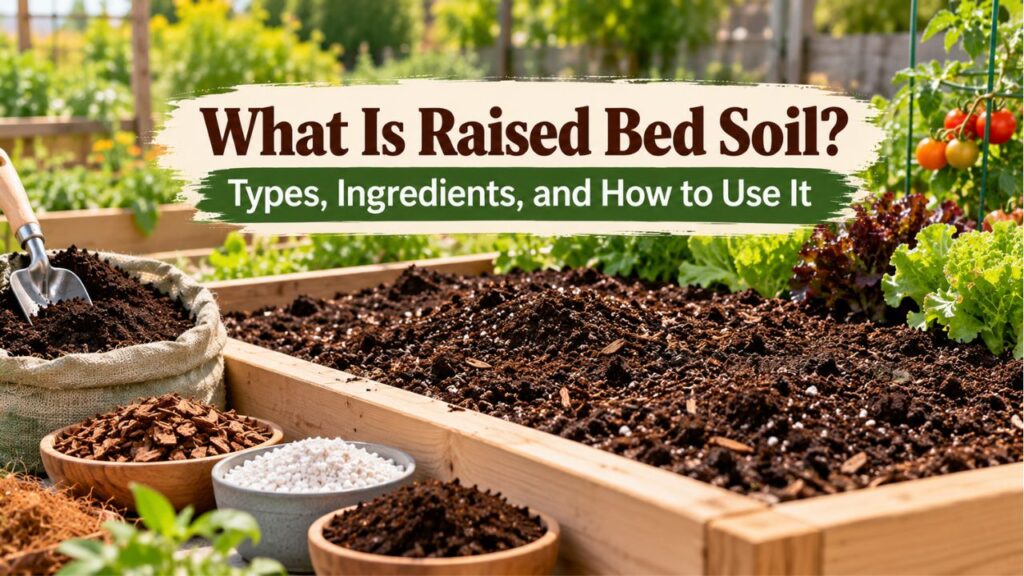
Raised bed soil is the growing medium used inside an elevated garden bed. Its purpose is to provide plants with a suitable environment for root development, water absorption, nutrient uptake, and biological activity.
Most soil-based raised bed mixtures contain mineral soil and decomposed organic material. Their proportions can vary depending on the garden’s location, the existing ground conditions, and the plants being grown.
A good raised bed mixture performs three important functions:
- Supports plant roots: Mineral particles and organic matter form a structure that allows roots to spread and anchor plants.
- Manages moisture: Small spaces within the mixture retain some water while larger spaces allow excess water to drain.
- Supplies and holds nutrients: Mineral soil and compost contribute nutrients and help retain them for plant use.
Raised beds also provide an opportunity to improve poor growing conditions without replacing all the soil in an existing yard.
For example, a gardener with compacted clay soil can create a growing area containing a looser soil-and-compost mixture. When the bed has an open bottom and the underlying soil is suitable, plant roots can eventually extend into the ground below.
Raised bed soil is not necessarily a manufactured product. It can be mixed at home, purchased in bags, delivered in bulk, or prepared by improving existing garden soil.
The important feature is how the mixture performs, not simply the name printed on its packaging.
What Is Raised Bed Soil Made Of?
Most traditional raised bed soil is made from a combination of topsoil and finished compost. Some mixtures also contain additional organic materials or mineral amendments to adjust water retention, aeration, and growing conditions.
The exact ingredients depend on whether the mixture is intended for an open-bottom garden bed or a self-contained planter.
Topsoil: The Main Mineral Component
Topsoil is the mineral soil component of many raised bed mixtures. It contains particles of sand, silt, and clay, along with varying amounts of organic matter.
These mineral particles influence soil texture, drainage, moisture retention, and nutrient-holding capacity.
Quality loam or sandy loam is generally desirable for raised vegetable beds because it offers a useful balance between drainage and moisture retention.
Different soil textures behave differently:
- Sandy soil: Usually drains quickly but may need more frequent watering.
- Clay-heavy soil: Holds considerable moisture and nutrients but can become dense when compacted.
- Loamy soil: Contains a balanced combination of particle sizes and is often easier to manage for vegetable gardening.
The goal is not to eliminate clay or sand completely. Both have useful properties when present in suitable proportions.
Poor-quality fill dirt, construction debris, and topsoil containing excessive clay or unknown contaminants should not be used simply because they are inexpensive.
Compost: The Organic Matter Component
Compost is decomposed organic material produced from plant residues and other suitable compostable materials.
Finished compost improves the physical condition of soil and contributes nutrients as its remaining organic materials continue to break down.
In raised beds, compost can help:
- Improve the structure of mineral soil
- Support beneficial soil organisms
- Increase moisture retention in sandy soil
- Improve the workability of some heavier soils
- Supply nutrients through gradual decomposition
The compost should be mature, stable, and suitable for food gardening when vegetables are being grown.
Unfinished compost can continue decomposing rapidly after being added to a bed, potentially interfering with plant growth.
Excessive compost is not automatically beneficial either. Too much may contribute to nutrient imbalances, high soluble salt levels, or changes in moisture behavior.
The University of Minnesota Extension’s raised bed gardening recommendations describe a suitable mixture as roughly one-half to two-thirds topsoil combined with one-third to one-half plant-based compost.
These proportions provide a useful starting point, although the final mixture should account for the quality of each ingredient.
Additional Ingredients Found in Raised Bed Soil
Not every raised bed mix contains only topsoil and compost.
Manufacturers sometimes include other materials to modify the physical characteristics of the growing medium.
| Ingredient | Main Purpose |
| Coconut coir | Holds moisture and contributes lightweight organic material |
| Peat moss | Retains moisture and adds organic material |
| Perlite | Creates air spaces in lightweight growing mixes |
| Pumice | Provides durable mineral particles that support aeration |
| Vermiculite | Helps retain water in some growing media |
| Composted bark | Adds organic material and changes texture |
| Fertilizer | Supplies nutrients when the mixture requires supplementation |
These ingredients do not all need to be present.
For ordinary open-bottom vegetable beds, a quality topsoil-and-compost blend may be sufficient without adding perlite, vermiculite, or peat moss.
Lightweight ingredients are often more useful in elevated containers and specialty growing media.
Important: A bag containing peat moss, coir, compost, and bark is not necessarily mineral soil, even if the product name includes the word “soil.”
Types of Raised Bed Soil for Different Garden Setups
Raised bed soil is available in several forms, and the most suitable type depends on the bed’s construction, location, and intended crops.
The main distinction is between soil-based mixtures and growing media made primarily from organic or lightweight materials.
1. Topsoil and Compost Raised Bed Mix
A mixture of loamy topsoil and finished compost is a common choice for outdoor vegetable beds.
The mineral soil provides structure, while compost improves the growing environment through organic matter.
This type works particularly well in raised beds that sit directly on suitable ground.
Roots can move through the amended soil and into the underlying earth when there are no restrictive barriers.
A topsoil-and-compost mixture is appropriate for many common crops, including tomatoes, peppers, beans, lettuce, carrots, and herbs.
The proportions should be adjusted according to the existing soil and the quality of the purchased ingredients.
2. Commercial Bagged Raised Bed Soil
Commercial raised bed soil is a packaged growing mixture sold specifically for filling garden beds.
Some products contain mineral soil, compost, and additional amendments.
Others consist largely of composted bark, wood fiber, peat moss, coir, or similar materials.
Because formulations vary, the words “raised bed mix” do not guarantee a particular composition.
Before purchasing bagged soil, check:
- Whether the product contains mineral topsoil
- The types of organic materials included
- Whether fertilizer has already been added
- Whether the product is intended for direct planting
- Whether the manufacturer recommends mixing it with existing garden soil
Bagged raised bed soil can be convenient for smaller beds because it is easy to transport and measure.
For large garden projects, bulk soil-and-compost blends may be more economical.
3. Soilless Raised Bed Growing Mix
A soilless growing mix contains little or no mineral topsoil.
Instead, it may use ingredients such as coir, peat moss, composted bark, perlite, and other components.
These mixtures are typically lighter than mineral soil blends and are often designed to maintain air spaces around roots.
They can be useful in elevated planters with enclosed bottoms, provided the mix has suitable water-holding capacity, drainage, and nutrients.
However, a lightweight potting mixture does not automatically perform well in a large open-bottom raised bed.
Some soilless mixes dry faster than soil-based blends and may require more frequent watering or fertilization.
The intended use should guide the choice rather than assuming that lightweight material is always better.
4. Improved Native Garden Soil
Existing garden soil can also become suitable raised bed soil when its structure, drainage, and nutrient conditions are appropriate.
For example, healthy loamy garden soil may only need an application of finished compost before planting.
This approach can reduce the cost of purchasing large amounts of new material.
However, native soil should be evaluated before use, particularly where there may be contamination, severe compaction, or drainage problems.
Raised Bed Soil vs. Garden Soil vs. Potting Soil
Raised bed soil, garden soil, and potting soil are related products, but they are not interchangeable in every situation.
Understanding their differences helps prevent choosing a mixture that performs poorly in the intended growing area.
| Soil Type | Typical Composition | Most Suitable Use |
| Raised bed soil | Topsoil and compost or a formulated growing blend | Raised garden beds |
| Garden soil | Mineral soil, sometimes with added organic matter | Ground-level gardening and soil improvement |
| Potting soil or potting mix | Often peat, coir, bark, perlite, and other lightweight components | Pots and enclosed planters |
| Topsoil | Mostly mineral soil with varying organic matter | Soil-based mixtures and landscaping |
| Compost | Decomposed organic material | Improving soil and adding organic matter |
Can Garden Soil Be Used in Raised Beds?
Yes, good-quality garden soil can be used in raised beds.
However, it may need compost or other appropriate amendments to improve its physical condition.
Soil taken from an existing garden should be checked for excessive compaction, poor drainage, and possible contamination.
Heavy clay soil may not perform well when transferred into a deep container without suitable preparation.
Can Potting Soil Be Used in Raised Beds?
Potting mix can be used in certain raised beds, especially elevated planters that function like large containers.
However, filling a large open-bottom raised bed entirely with lightweight potting mix is often unnecessary.
Mineral soil and compost can provide a more suitable and economical foundation for many conventional outdoor beds.
Potting mixes vary considerably, so their suitability depends on their ingredients and intended application.
Is Compost the Same as Raised Bed Soil?
No. Compost is an ingredient commonly added to raised bed soil, not a direct substitute for every type of growing mixture.
A bed filled entirely with compost may experience excessive settling, inconsistent moisture behavior, and nutrient imbalances.
For most traditional raised vegetable beds, combining compost with suitable mineral soil provides a more balanced growing medium.
How to Make Raised Bed Soil at Home
Making raised bed soil allows you to control the ingredients and avoid paying for unnecessary materials.
A simple mineral-soil-based mixture is usually a sensible starting point for an open-bottom vegetable bed.
A Practical Homemade Raised Bed Soil Recipe
A useful starting recipe is:
- 2 parts quality loamy topsoil
- 1 part mature plant-based compost
Measure these ingredients by volume rather than weight.
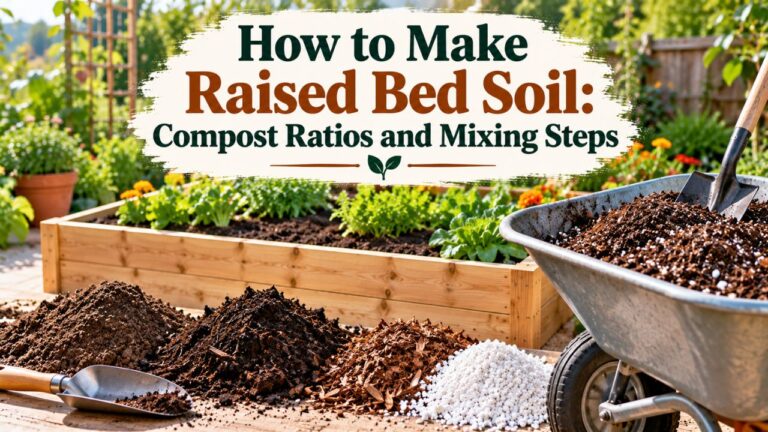
For example, to prepare 12 cubic feet of mixture, combine approximately 8 cubic feet of topsoil with 4 cubic feet of finished compost.
This produces a blend containing about two-thirds topsoil and one-third compost.
It is a general starting mixture, not a universal formula for every garden.
If the purchased topsoil already contains substantial compost, adding the full amount may create an unnecessarily high organic matter concentration.
If existing garden soil is already fertile, well-drained, and structurally sound, less additional material may be needed.
Step 1: Choose Quality Topsoil
Select loose, crumbly loam or sandy loam from a reputable supplier.
Avoid material containing large amounts of construction debris, trash, roots of invasive weeds, or unfamiliar residues.
For bulk purchases, ask about the soil’s origin and whether test results are available.
Step 2: Select Mature Compost
Use fully decomposed compost suitable for gardening.
Finished compost generally has an earthy smell and a relatively uniform texture.
Avoid material with a strong ammonia odor or obvious signs of incomplete decomposition.
If using composted manure, account for its nutrient and salt content rather than assuming it can replace unlimited amounts of plant-based compost.
Step 3: Measure the Ingredients
Use buckets, containers, or another consistent volume measurement.
For the two-to-one recipe, add two equal containers of topsoil for every one container of compost.
Measuring by volume keeps the proportions consistent even when the ingredients have different moisture contents and densities.
Step 4: Blend the Materials Thoroughly
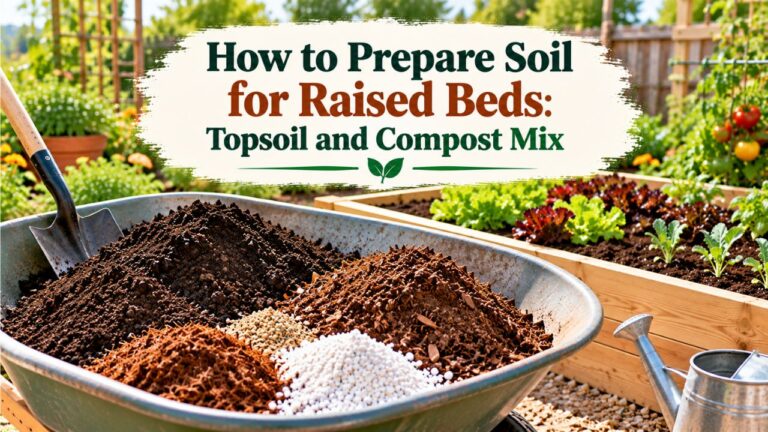
Combine the topsoil and compost on a clean surface, in a wheelbarrow, or directly inside the raised bed.
Mix until the compost is reasonably distributed throughout the mineral soil.
Break apart large clumps without crushing the entire mixture into a fine powder.
The finished material should be workable, reasonably loose, and free of large compacted masses.
Step 5: Check Soil Nutrients and pH
Before adding fertilizer or lime, consider testing the soil mixture.
A laboratory soil test can identify nutrient levels, pH, and potential amendment requirements.
Most common vegetables perform well in slightly acidic to near-neutral soil, but individual crops have different preferences.
Apply fertilizers, lime, or sulfur according to soil test recommendations instead of adding them automatically.
How to Use Raised Bed Soil Correctly
Using raised bed soil involves more than pouring bags into a wooden or metal frame.
The preparation method depends on whether the bed sits on natural ground, pavement, or an elevated support structure.
Step 1: Prepare the Area Beneath the Raised Bed
For an open-bottom raised bed, choose a location with suitable sunlight and drainage.
Remove unwanted vegetation or manage it through an appropriate smothering method.
If the native soil is safe for gardening but heavily compacted, loosen the surface carefully to encourage root growth and water movement between soil layers.
The University of Maryland Extension’s vegetable raised bed guidance explains how soil preparation and amendments should change depending on the condition of the existing ground.
Do not mix potentially contaminated soil into a new raised bed. Sites with a history of industrial use, older painted structures, or other contamination concerns may need soil testing and a separately managed growing system.
Step 2: Calculate the Amount of Raised Bed Soil Needed
Measure the inside length, width, and intended soil depth.
For a rectangular bed, use:
Soil Volume = Length × Width × Soil Depth
All measurements must use the same units.
For example, a raised bed measuring 4 feet long, 2 feet wide, and 1 foot deep requires:
4 × 2 × 1 = 8 cubic feet of soil
This is approximately 0.30 cubic yards or 227 liters.
If the bed has tall sides but will not be filled completely, calculate using the intended growing soil depth rather than the full frame height.
Step 3: Fill the Raised Bed With the Prepared Mixture
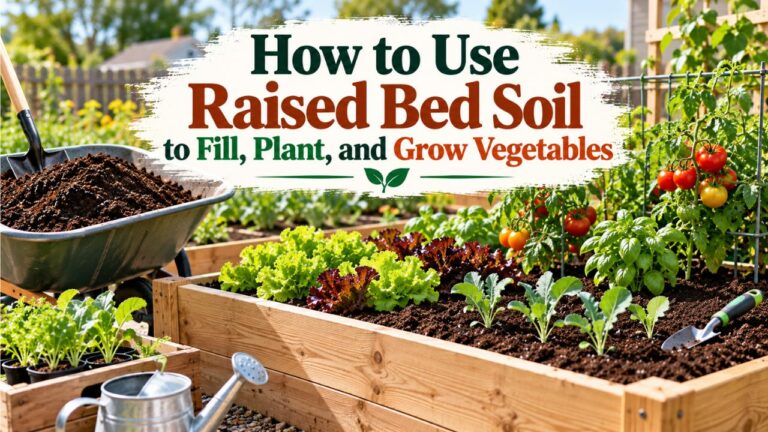
Add the growing mixture evenly across the bed.
For an open-bottom bed over suitable soil, gently incorporating some of the new material into the loosened native surface can reduce an abrupt boundary between different soil textures.
Do not use this approach where the underlying soil needs to remain isolated because of contamination.
Avoid stepping into the raised bed while filling it.
Walking on the growing surface can compress the soil and reduce the air spaces needed for healthy roots.
Step 4: Water the Soil to Help It Settle
After filling the bed, water the mixture evenly.
This helps distribute moisture and allows loose material to settle naturally.
Check whether the soil level drops noticeably after watering.
Add more growing medium if necessary, but avoid repeatedly pressing the mixture down to force additional material into the frame.
Leave enough space below the bed rim to accommodate mulch and routine watering.
Step 5: Plant Seeds or Transplants
Once the soil is moist and ready, follow the planting depth and spacing requirements for the selected crops.
Seeds generally need a prepared surface that allows good contact with moist soil.
Transplants should be installed at the appropriate depth for the species.
Avoid adding large amounts of fertilizer directly into planting holes unless a tested soil deficiency or crop-specific recommendation justifies it.
Step 6: Apply Mulch After Planting
A suitable layer of organic mulch can help reduce evaporation and limit weed growth.
Straw, shredded leaves, or another appropriate garden mulch may be used depending on the crop.
Keep thick mulch away from delicate young seedlings until they are established, and avoid piling it tightly against plant stems.
How Much Raised Bed Soil Do You Need?
The amount of raised bed soil needed depends on the bed’s interior dimensions and desired fill depth.
A larger growing area or deeper soil layer requires more material.
The following examples assume rectangular beds filled to the stated soil depth.
| Raised Bed Dimensions | Soil Volume | Approximate Cubic Yards |
| 2 × 4 feet, 12 inches deep | 8 cubic feet | 0.30 |
| 3 × 4 feet, 12 inches deep | 12 cubic feet | 0.44 |
| 3 × 6 feet, 12 inches deep | 18 cubic feet | 0.67 |
| 4 × 8 feet, 12 inches deep | 32 cubic feet | 1.19 |
| 4 × 8 feet, 18 inches deep | 48 cubic feet | 1.78 |
These are geometric volume calculations, not guaranteed purchasing amounts.
The actual quantity needed can vary because of soil settling, the space left below the rim, and any suitable existing soil already inside the bed.
For deep open-bottom beds, soil roots may extend beyond the frame into the native ground, reducing the need for excessively deep imported growing media.
For enclosed planters, the mixture must provide enough growing volume for the selected crops because roots cannot extend into the surrounding ground.
How to Choose Raised Bed Soil for Different Plants
Most common vegetables can grow in a well-prepared soil-and-compost mixture, but their root systems and moisture needs differ.
The growing medium does not need a completely different recipe for every crop.
Instead, the bed should provide appropriate root space, drainage, and nutrient management.
Raised Bed Soil for Vegetables
Tomatoes, peppers, beans, and squash generally benefit from a loose but moisture-retentive growing medium.
A mineral-soil-and-compost mixture is suitable for many of these crops in open-bottom beds.
Large fruiting plants can require substantial water and nutrients throughout the growing season, so monitor soil moisture and use soil test information to guide fertilization.
Raised Bed Soil for Leafy Greens
Lettuce, spinach, kale, and similar leafy vegetables grow well in fertile soil with consistent moisture.
Their relatively shallow root systems can make them sensitive to drying near the surface.
A suitable amount of compost and appropriate mulch can help manage moisture fluctuations.
Avoid overfertilizing leafy vegetables simply to encourage faster growth.
Raised Bed Soil for Root Vegetables
Carrots, radishes, beets, and other root crops benefit from soil that allows roots to develop without excessive obstruction.
A loose, stone-free growing zone is especially helpful for producing straight, well-shaped carrots.
Remove large clods and debris before planting.
Fresh or excessive manure-based amendments are not ideal for root crop beds and may contribute to nutrient problems or irregular root growth.
Raised Bed Soil for Herbs
Many common culinary herbs grow well in ordinary raised bed soil.
However, their moisture preferences are not identical.
Basil and parsley generally appreciate reasonably consistent moisture, while rosemary and thyme prefer conditions that drain well and do not remain constantly wet.
Planting herbs with compatible watering requirements in the same bed can make maintenance easier.
How to Maintain Raised Bed Soil After Planting
Raised bed soil changes over time as plants remove nutrients, organic matter decomposes, and watering alters the soil structure.
Routine maintenance keeps the growing medium productive without requiring complete replacement every season.
Add Compost When Needed
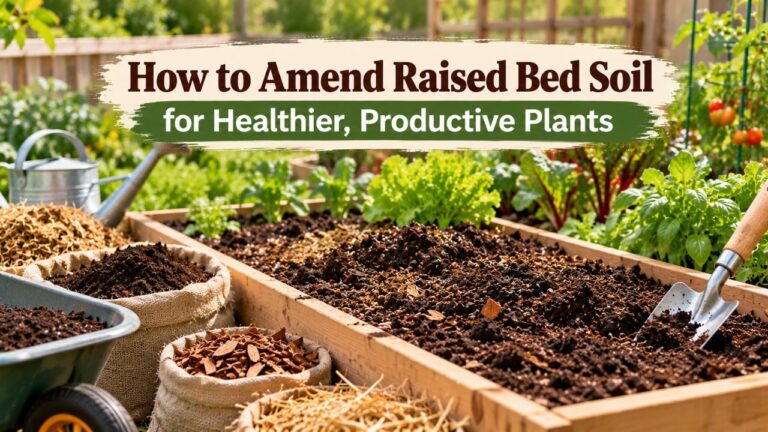
A modest top-dressing of finished compost can replenish organic matter as the growing season ends or before the next planting.
Spread the compost evenly rather than concentrating large amounts around individual plant stems.
The appropriate quantity depends on the existing soil condition and its nutrient content.
If a soil test indicates excessive phosphorus or other nutrients, adding more compost may not be advisable.
Monitor Soil Moisture
Raised beds can lose moisture faster than surrounding ground-level soil, particularly during hot or windy weather.
Check moisture beneath the surface instead of watering only according to a fixed daily schedule.
If the upper surface is dry but the root zone is still adequately moist, additional watering may not be necessary.
Drip irrigation or a soaker hose can deliver water close to plant roots with less wetting of surrounding walkways.
Avoid Compacting the Growing Medium
Do not walk or repeatedly stand inside the raised bed.
Keep garden paths outside the planting area so roots can grow through a relatively loose soil structure.
Use hand tools carefully to remove weeds or incorporate small amounts of amendments without unnecessarily disturbing established roots.
Check Soil Fertility Periodically
Soil nutrient levels can change after several growing seasons.
A laboratory test provides better information than guessing whether plants need additional fertilizer.
Testing also helps prevent unnecessary applications of lime, composted manure, or phosphorus-rich fertilizers.
Refill Soil That Has Settled
Raised bed soil may gradually lose volume as organic materials decompose and loose particles settle.
Add compatible growing material when the soil level falls below the desired planting depth.
A small annual top-up may be enough for an established bed.
Complete soil replacement is usually unnecessary unless there is a specific problem such as serious contamination or unsuitable growing material.
Raised Bed Soil Problems and How to Fix Them
Even a properly prepared soil mixture can develop problems depending on watering, weather, drainage, and the quality of its ingredients.
Identifying the cause helps determine whether the solution requires a soil amendment or a change in garden maintenance.
Raised Bed Soil Dries Out Too Quickly
Fast drying can result from hot weather, shallow growing depth, exposed soil, or a mixture containing a high proportion of coarse or lightweight materials.
Check the moisture level below the surface before making adjustments.
Organic mulch, appropriate watering, and a growing mixture with suitable mineral soil content may improve moisture management.
For elevated planters, smaller soil volumes may require more frequent monitoring.
Raised Bed Soil Holds Too Much Water
Persistent waterlogging may indicate compacted material, poor drainage, a blocked outlet, or an impermeable base.
Check whether excess water has somewhere to drain.
Beds with enclosed bottoms require functioning drainage openings.
Avoid assuming that adding a layer of gravel beneath the soil will solve drainage problems. Proper drainage depends on the growing medium and the ability of water to leave the planter.
Raised Bed Soil Becomes Hard or Compacted
Soil can become dense when repeatedly stepped on, worked while very wet, or filled with poorly structured material.
Prevent further compaction by keeping foot traffic out of the growing area.
Allow overly wet soil to drain before working it.
Appropriate organic matter management and protection of the soil surface can gradually improve its condition.
Raised Bed Soil Settles Rapidly
Significant settling often occurs when the original mixture contains a large amount of loosely packed or rapidly decomposing organic material.
The growing surface may drop noticeably during the first season.
Allow the soil to settle naturally, then add suitable growing material as needed.
Avoid depending on bulky, unfinished organic materials immediately beneath shallow-rooted crops when consistent growing depth is important.
Plants Grow Poorly Despite Good-Looking Soil
Dark color and loose texture do not guarantee balanced soil fertility.
Poor plant growth can result from nutrient deficiencies, excessive nutrients, incorrect pH, overwatering, or root problems.
Inspect the plants and growing conditions before adding fertilizer.
A soil test can help determine whether nutrient or pH adjustments are necessary.
Conclusion
Understanding what is raised bed soil begins with recognizing that it is a growing mixture designed to provide suitable conditions for roots, moisture movement, and nutrient availability.
Traditional raised bed soil commonly combines loamy topsoil with finished compost. Some commercial mixtures also include coir, peat moss, perlite, bark, or other amendments, while certain elevated planters use soilless growing media.
For an ordinary open-bottom vegetable bed, a mixture of approximately two parts quality topsoil and one part mature compost is a practical starting point.
The most appropriate blend ultimately depends on the existing ground, the bed’s design, and the plants being grown.
Choose ingredients carefully, prepare the bed correctly, and maintain its moisture and fertility over time. A well-managed raised bed can remain productive for multiple growing seasons without routinely replacing all its soil.
FAQs About What Is Raised Bed Soil
Can I plant directly into raised bed soil?
Yes. Raised bed soil can be planted directly when it is suitable for the intended crops and does not require additional preparation. Check moisture, drainage, and fertilizer content before planting seeds or transplants.
Does raised bed soil need fertilizer?
Not always. Some raised bed mixtures contain sufficient nutrients for initial plant growth, while others need supplementation. Soil testing and crop requirements provide a better basis for fertilizer decisions than automatically adding nutrients.
Can I use raised bed soil in regular flowerpots?
It depends on the mixture. A lightweight raised bed product designed for enclosed planters may work in pots, but mineral-soil-heavy blends can become too dense or heavy for ordinary containers. A suitable potting mix is generally the safer choice for small pots.
How long does raised bed soil last?
Raised bed soil can remain useful for many years when properly maintained. Compost decomposes, nutrients change, and the soil may settle, but complete replacement is not normally required after each growing season.
Can I mix new raised bed soil with old soil?
Yes, provided the existing soil is suitable and free of known contamination. Mixing compatible materials can improve the growing environment, but the correct amount of new soil or compost depends on the original mixture’s texture and fertility.
Is organic raised bed soil better than regular raised bed soil?
Not automatically. Products described as organic may contain different ingredients and vary in their drainage, nutrient content, and physical quality. A suitable growing mixture should be judged by its composition, performance, and the needs of the plants, not simply by its marketing label.

I’m Maya L. Greenwood, a lifelong plant lover who believes anyone can grow something beautiful with the right guidance. After years of testing soil mixes, pruning methods, irrigation tricks, and pest-safe solutions, I started EasyGardenTips.com to turn hard-won lessons into step-by-step advice. From seed starting and container gardens to composting and seasonal checklists, my goal is to make gardening simple, sustainable, and fun.