Best Outdoor Grow Tent: 3 Weather-Ready Picks for Your Garden
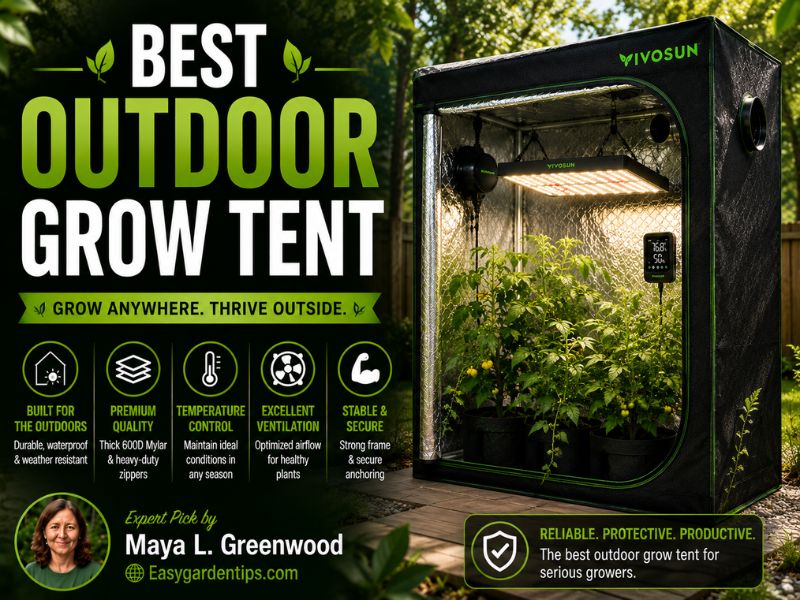
Choosing the best outdoor grow tent requires a different approach from buying the reflective Mylar tents normally used with LED grow lights indoors.
Most conventional grow tents are designed to sit inside a bedroom, basement, garage, or dedicated grow room. Their fabric walls may control light extremely well, but that does not automatically make them suitable for rain, UV exposure, wind, or changing outdoor temperatures.
For a backyard, patio, or garden, a portable greenhouse-style grow tent is generally the more appropriate design. These enclosures use translucent polyethylene or similar covers that allow sunlight to reach plants while providing some protection from rain, cool weather, birds, and environmental exposure. They also include doors or mesh windows that can be opened because ventilation becomes particularly important when sunlight heats an enclosed outdoor structure.
My first recommendation is the Ohuhu 3-Tier 12-Shelf Walk-In Greenhouse. Its current Amazon listing combines a walk-in enclosure with 12 wire shelves, a roll-up zippered door, two screened windows, rust-resistant framing, and an outdoor-oriented cover. The combination of large customer-feedback history and practical growing space earns it the first position.
The EAGLE PEAK 6×4 Pop-Up Greenhouse is the better alternative when you want more open floor space rather than built-in shelving. Its pop-up frame uses EAGLE PEAK’s center-lock system, adjustable steel legs, roll-up ventilation windows, a zippered entrance, stakes, and guy ropes.
For gardeners needing a larger walk-in footprint, the CROWN SHADES 8×6 Pop-Up Greenhouse provides 48 square feet of floor space, tool-free center-lock setup, adjustable height, a roll-up door, and mesh windows for ventilation.
These are portable outdoor plant shelters, not permanent engineered greenhouses. Correct anchoring, ventilation, site selection, and weather awareness are therefore just as important as the enclosure you buy.
3 Outdoor Grow Tents for Backyard Plants
| Image | Product Name | Check Price |
|---|---|---|
Best Choice | Ohuhu 3-Tier 12-Shelf Walk-In Greenhouse | Check Price |
Second Best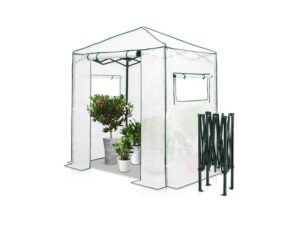 | EAGLE PEAK 6×4 Pop-Up Greenhouse | Check Price |
Third Choice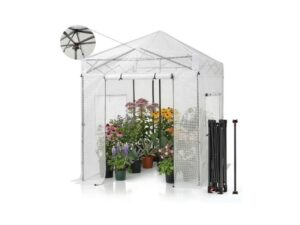 | CROWN SHADES 8×6 Pop-Up Greenhouse | Check Price |
I ranked these three products using current Amazon rating and review confidence first, then considered the characteristics that matter most outside:
- Outdoor-oriented cover material
- Frame stability
- Ground anchoring
- Ventilation
- Walk-in access
- Plant capacity
- Shelving versus open floor
- Ease of seasonal setup
- Available headroom
- Ability to manage heat from direct sun
None should be treated like a permanent building intended to handle every storm or snow event without attention.
1. Ohuhu 3-Tier 12-Shelf Walk-In Greenhouse
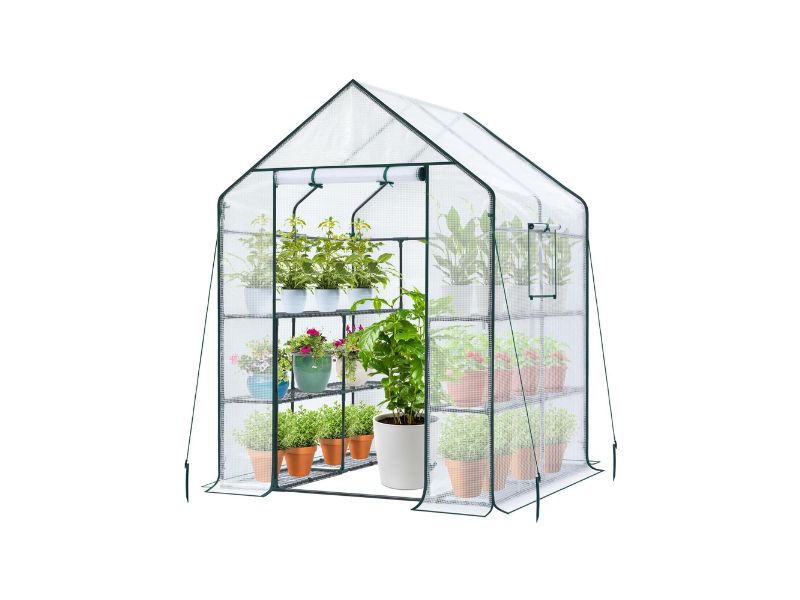
Key Features
- Walk-in greenhouse format
- 12 wire shelves
- Roll-up zippered entrance
- Two screened ventilation windows
- Rust-resistant metal tubing
- Reinforced outdoor cover
- Space for seedlings, flowers, herbs, and compact vegetables
The Ohuhu takes first place because it turns a relatively compact outdoor footprint into a large amount of usable plant space.
Its biggest advantage is the 12-shelf layout. Instead of placing every seed tray, herb container, or small pot on the ground, you can spread plants vertically along both sides while preserving a center walkway.
The current Amazon listing specifies a roll-up zippered door plus two screened side windows that allow airflow to be adjusted. That matters because a translucent enclosure can become considerably warmer than the surrounding outdoor air when direct sunlight is strong.
The rust-resistant tubular frame is another practical feature. It is still a lightweight portable greenhouse rather than a permanent aluminum or steel greenhouse, but the structure is appropriate for seasonal backyard use when properly positioned and secured.
I like this style particularly for seed starting, herbs, flowers, young vegetable plants, and multiple smaller containers. The shelves make much less sense if you intend to grow a few very large floor-standing plants, because those plants need uninterrupted vertical and horizontal room.
What I Like
- Excellent use of vertical space
- Twelve shelves reduce floor clutter
- Screen windows provide controllable ventilation
- Walk-in layout keeps plants accessible
What I Do Not Like
- Shelves reduce flexibility for very large plants
- Lightweight portable construction still requires careful outdoor anchoring
Choose the Ohuhu when plant quantity and shelf organization matter more than having one completely open growing floor.
2. EAGLE PEAK 6×4 Pop-Up Greenhouse
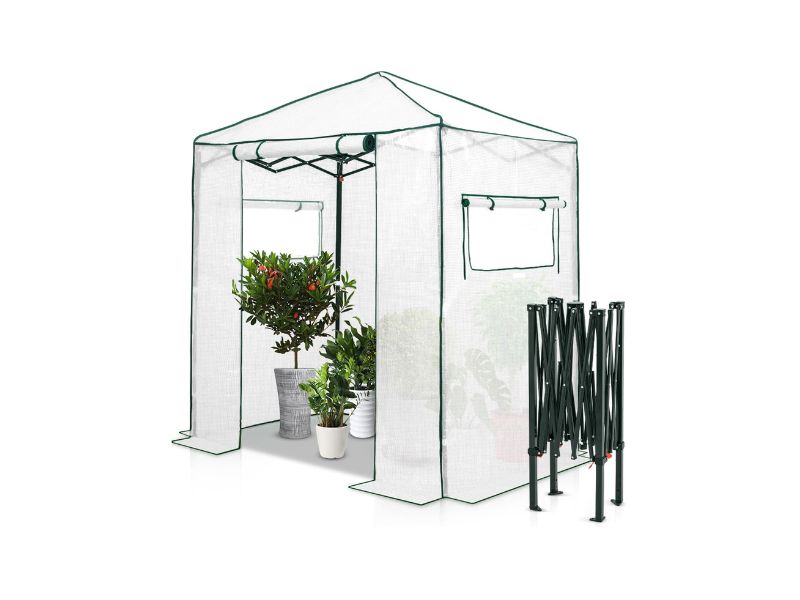
Key Features
- 6×4-foot open floor
- Pop-up center-lock frame
- Tool-free setup
- Adjustable steel legs
- Roll-up zippered entry
- Two roll-up windows
- Stakes and guy ropes included
- Approximately 88.8-inch peak height
EAGLE PEAK takes second position because it offers a completely different style from the shelving-focused Ohuhu.
The 6×4 footprint provides 24 square feet of open floor, letting you choose the container arrangement instead of building around fixed shelves.
That is useful for:
- Tomatoes
- Peppers
- Larger containers
- Raised planters
- Tropical plants
- Overwintering patio plants
EAGLE PEAK uses its Peak Push center-lock design so the frame can open from the center without assembling dozens of separate poles every season. The manufacturer also specifies adjustable steel legs, roll-up windows, a zippered entry, ten stakes, and four guy ropes.
The peak reaches roughly 88.8 inches, which gives substantially more headroom than many compact shelving greenhouses. That height makes the enclosure much easier to use with taller plants and allows hot air more room to accumulate above the canopy before ventilation openings release it.
The included anchoring hardware is valuable, but it should not create a false sense of security. A large plastic-covered enclosure can act like a sail when wind catches it. Secure placement remains essential.
What I Like
- Open floor accommodates larger plants
- Very fast seasonal setup
- Good standing height
- Adjustable legs
- Included stakes and guy ropes
What I Do Not Like
- No built-in shelves
- Portable construction still needs extra attention when strong winds are expected
The EAGLE PEAK is my preferred option when you want a flexible outdoor growing area instead of a tall plant rack enclosed in plastic.
3. CROWN SHADES 8×6 Pop-Up Greenhouse
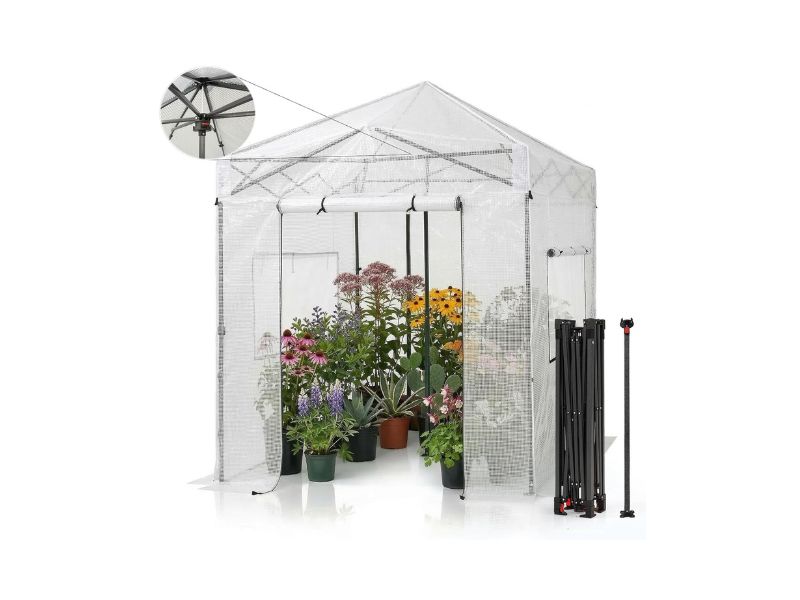
Key Features
- 8×6-foot walk-in footprint
- 48 square feet of floor area
- One-push center-lock system
- Tool-free pop-up setup
- Adjustable height
- Roll-up zippered door
- Mesh ventilation windows
- Reinforced support design
CROWN SHADES takes third position because its larger 8×6 footprint works well for gardeners who need more interior freedom.
With 48 square feet available, you can create rows of containers, install freestanding shelving, or leave a center path for watering and maintenance.
The current Amazon listing uses a one-push center-lock frame designed for quick tool-free setup. It also incorporates a reinforced center area and extra support, while the roll-up door and mesh windows provide natural ventilation.
CROWN SHADES specifically describes the portable structure as appropriate for ordinary use in mild weather. That is a useful reminder of what this product category actually is: a seasonal portable greenhouse rather than a structure you can ignore through every severe weather event.
The 8×6 footprint is the biggest advantage and the biggest consideration. You gain space, but there is also more surface area for wind to act on and more enclosed air to manage during hot sunny weather.
What I Like
- Spacious 8×6 growing area
- Quick pop-up assembly
- Good access for larger container layouts
- Multiple ventilation openings
What I Do Not Like
- Larger footprint requires more available yard space
- Needs particularly careful anchoring because of its size
Choose the CROWN SHADES when your main priority is a roomy seasonal outdoor plant enclosure with minimal assembly.
Outdoor Grow Tent Comparison
| Product | Approx. Footprint | Interior Layout | Ventilation | Main Strength | Main Limitation |
| Ohuhu 12-Shelf Walk-In | Compact walk-in | 12 shelves | Door + 2 screened windows | Maximum organized plant capacity | Less room for large floor plants |
| EAGLE PEAK 6×4 | 24 sq. ft. | Open floor | Door + roll-up windows | Flexible layout and quick setup | No included shelving |
| CROWN SHADES 8×6 | 48 sq. ft. | Open floor | Door + mesh windows | Largest growing footprint | Requires more space and anchoring |
The most important distinction is shelf greenhouse versus open-floor greenhouse.
Choose shelving for many small plants.
Choose an open floor for fewer, larger plants or customized container arrangements.
Outdoor Grow Tent vs Indoor Grow Tent
These products should not be confused with conventional reflective grow tents.
Indoor Grow Tent
An indoor grow tent commonly uses:
- Opaque fabric
- Reflective Mylar interior
- Duct ports
- Cable openings
- Artificial lighting
- Powered ventilation
The goal is to create an enclosed controlled environment inside another building.
Outdoor Grow Tent
What most gardeners actually need outside is closer to a portable greenhouse.
It uses:
- Translucent or clear cover material
- Sunlight
- Natural or assisted ventilation
- Ground anchoring
- Outdoor-oriented framing
The goal is not to block sunlight.
It is to let sunlight reach plants while modifying the immediate growing environment.
Can You Put a Normal Mylar Grow Tent Outdoors?
I generally would not.
A product designed for indoor use may lack:
- UV-resistant outer material
- Rainproof construction
- Outdoor anchoring
- Wind-rated framing
- Drainage planning
Even if the fabric itself sheds some water, the zippers, seams, frame, electrical ports, and roof shape may never have been designed for extended outdoor exposure.
Putting an ordinary indoor grow tent in the yard can also create a difficult heat problem because the dark exterior may absorb considerable sunlight.
For direct outdoor placement, choose an enclosure actually marketed and designed for outdoor gardening.
Why Portable Greenhouses Work Better Outdoors
The cover serves a different function.
Rather than reflecting artificial light inward, a greenhouse-style cover allows solar radiation to reach the plants while helping create a protected microclimate.
Penn State notes that greenhouse structures allow growers to manage factors such as water, temperature, and ventilation, and that ventilation becomes particularly important during warmer periods to prevent damaging temperature buildup.
A portable version provides less environmental control than a permanent commercial greenhouse, but the same basic principle applies.
Outdoor Grow Tent Size Guide
The correct footprint depends on both plant quantity and the way you want to use the enclosure.
Around 4×4
A compact square enclosure works well when you want:
- Seed-starting trays
- Herbs
- Small containers
- Shelving
This is where the Ohuhu approach makes sense.
The shelving multiplies usable growing area without requiring a large yard footprint.
6×4
A 6×4 provides 24 square feet.
This is an excellent middle ground for:
- Several container vegetables
- Patio plants
- Taller individual plants
- A narrow center walkway
The EAGLE PEAK is particularly flexible because the floor remains open rather than being dominated by fixed shelving.
8×6
An 8×6 provides 48 square feet.
This allows substantially more customization.
Possible arrangements include:
- Two rows of containers
- Shelving on one wall
- Large pots around the perimeter
- Center maintenance path
The tradeoff is that a larger greenhouse requires more yard space and more attention to ventilation and anchoring.
Think About Canopy Size, Not Pot Count
A common mistake is deciding that a greenhouse fits eight plants simply because eight containers fit on the floor.
Plants expand.
A ten-inch container may eventually support a canopy two or three feet across.
Plan space for:
- Mature branches
- Watering
- Pruning
- Airflow
- Walking
- Harvesting
A crowded greenhouse is harder to ventilate and much harder to inspect.
Shelves or Open Floor?
This is one of the biggest decisions in this article.
Shelves Work Best For
- Seed trays
- Herbs
- Flowers
- Small pots
- Propagation
- Young transplants
The Ohuhu’s 12-shelf configuration is ideal for this style.
Open Floor Works Best For
- Large containers
- Tomatoes
- Peppers
- Tall tropical plants
- Overwintering patio plants
- Custom shelving
Both the EAGLE PEAK and CROWN SHADES provide more freedom for this kind of setup.
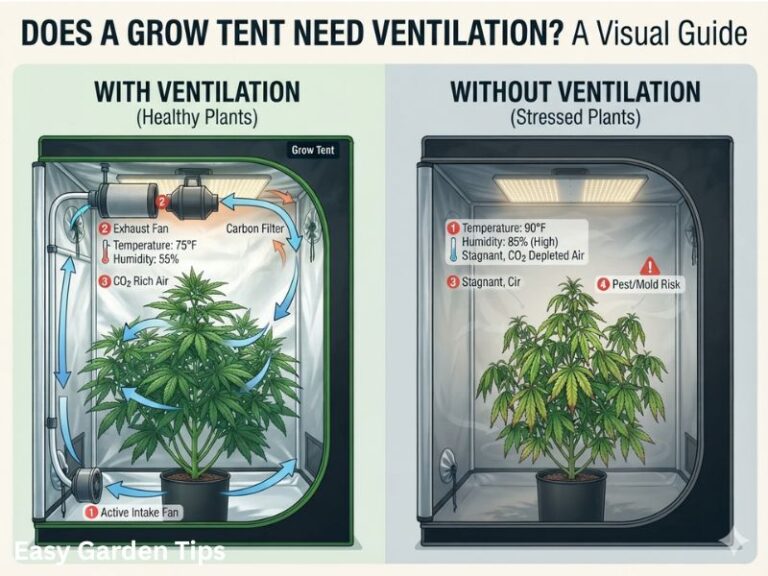
Outdoor Greenhouse Ventilation Is Critical
One of the biggest misconceptions about outdoor grow tents is that plants are outside, so ventilation somehow takes care of itself.
It does not.
Sunlight passing through a translucent greenhouse cover can raise interior temperatures well above ambient outdoor conditions.
University of Minnesota Extension identifies insufficient ventilation as a major high-tunnel design problem and emphasizes the importance of providing paths for hot air to escape while cooler air enters.
That is why all three recommended products include opening doors, windows, or mesh ventilation.
Use the Door as a Vent
On warm days, the main zippered door can provide a large exhaust opening.
Opening it partially or fully can dramatically increase air exchange.
This is particularly useful when:
- Afternoon sun hits the enclosure directly
- Plants are densely packed
- Outdoor temperatures are already warm
- Humidity is elevated
Do not leave the greenhouse tightly sealed because you want to “hold heat” when daytime conditions are already hot.
Mesh Windows Help With Airflow
Mesh windows serve two useful functions.
They allow air exchange while also limiting direct entry by some larger insects and debris.
The Ohuhu includes two screened side windows, EAGLE PEAK uses roll-up side windows, and CROWN SHADES incorporates mesh ventilation openings.
However, window mesh itself creates some airflow resistance.
In hot weather, opening both windows and the door may be necessary.
Do You Need a Fan Outdoors?
Not always.
A small portable greenhouse may achieve enough air exchange through open doors and windows when outdoor wind conditions are favorable.
However, natural ventilation is weather-dependent.
During still, hot weather, an enclosed structure may remain warmer than you want even with available openings.
A weather-appropriate circulation or exhaust solution can sometimes help, but any electrical equipment used outside needs to be suitable for the environment and connected safely.
Do not move an indoor-only grow-tent fan and ordinary power strip into a wet backyard greenhouse without checking their environmental ratings.
Shade Cloth Can Help in Summer
A greenhouse designed to preserve warmth can become too warm during peak summer.
University of Minnesota Extension notes that shade cloth is a useful high-tunnel temperature-management tool and reports meaningful temperature reductions from properly selected shade material.
For a small backyard greenhouse, shade cloth can make sense when:
- The enclosure receives intense afternoon sun
- Ventilation is already fully open
- Heat-sensitive plants are inside
Do not automatically use the darkest shade material.
Too much shading also reduces the sunlight plants receive.
Where Should You Put an Outdoor Grow Tent?
Site selection affects performance almost as much as the greenhouse itself.
Look for an area that has:
- Useful sunlight
- Good drainage
- Reasonably level ground
- Access to water
- Protection from extreme wind
- Enough clearance around doors and windows
Avoid low spots where rainwater collects.
Also avoid placing a lightweight greenhouse directly below large damaged branches that could fall during storms.
Wind Exposure Matters
Wind is one of the biggest practical challenges for a portable greenhouse.
A translucent plastic enclosure presents a large surface area.
When wind hits it, the frame and anchors experience considerable force.
EAGLE PEAK includes stakes and guy ropes specifically to improve stability, while portable greenhouse manufacturers consistently emphasize ground securing.
Do not assume the enclosure is secure just because it feels heavy when filled with plants.
Anchor the Greenhouse Properly
Use all supplied anchoring hardware.
Depending on the installation and manufacturer guidance, stabilization may include:
- Stakes
- Guy lines
- Ground anchors
- Weight bags
- Heavy perimeter objects
The correct solution depends on your surface.
Ground stakes that work well in soil obviously cannot be used the same way on a concrete patio.
The greenhouse itself should not be used as the only indication that the site is sufficiently secure.
Do Not Rely on Plants as Ballast
Heavy containers can add weight to the floor, but they do not necessarily secure the greenhouse frame.
A strong gust can still lift or distort the cover independently of the containers.
Anchor the structure, not just the objects inside it.
What About Severe Weather?
Portable greenhouses are seasonal garden shelters.
They should not be treated like permanent engineered structures.
CROWN SHADES describes its current pop-up greenhouse as suited to ordinary mild-weather use, and EAGLE PEAK includes dedicated ground securing hardware with its portable design.
If forecasts call for conditions beyond what the manufacturer specifies, follow the manufacturer’s weather guidance and consider taking down or otherwise protecting a portable enclosure rather than hoping the frame survives.
Can an Outdoor Grow Tent Handle Snow?
Do not assume it can.
Snow creates significant roof loading, particularly when it is wet and heavy.
A permanent polycarbonate greenhouse and a lightweight PE-covered pop-up greenhouse are very different structures.
Penn State notes that hard-panel greenhouse designs can be built specifically to handle winter snow loads, highlighting the structural difference between substantial permanent greenhouses and lighter plastic-covered structures.
Unless the exact portable greenhouse has a documented snow-load rating, I would not treat it as a leave-it-alone winter structure under heavy accumulation.
Rain Protection
A greenhouse cover can help shield plants from direct rainfall.
That can be useful when you want greater control over watering.
It can also reduce the amount of moisture sitting directly on foliage after storms.
But rain protection introduces another responsibility:
you now need to water the plants yourself.
Do not forget container irrigation simply because it has rained outside.
Outdoor Grow Tent and Irrigation
Containers inside a covered greenhouse can dry differently from identical pots sitting outdoors.
Factors include:
- Higher daytime temperature
- Reduced direct rainfall
- Increased transpiration
- Wind reduction
- Container size
Check actual soil moisture rather than watering on the same schedule as uncovered garden pots.
Raised Beds Inside an Outdoor Grow Tent
You can use a greenhouse over raised beds if the dimensions allow it.
Measure:
- Bed width
- Bed length
- Greenhouse interior width
- Door opening
- Walkway
A tunnel-style greenhouse often makes more sense for permanent raised beds than a shelving greenhouse.
For freestanding containers, the EAGLE PEAK or CROWN SHADES layouts are easier to adapt.
Can You Grow Vegetables in an Outdoor Grow Tent?
Yes.
Portable greenhouses are commonly used for:
- Tomatoes
- Peppers
- Herbs
- Leafy greens
- Seedlings
- Flowers
- Tender vegetables
Crop choice should still reflect season and local climate.
A plastic greenhouse does not make outdoor weather disappear.
It modifies conditions inside the enclosure.
Seed Starting Outdoors
The Ohuhu is particularly useful for seed-starting trays because its shelves provide substantial organized surface area.
However, seedlings can be much more sensitive to:
- Sudden heat
- Cold nights
- Drying
- Direct intense sunlight
Check temperatures regularly rather than assuming the greenhouse keeps them within a safe range automatically.
Overwintering Container Plants
A portable greenhouse can provide useful protection for some plants during mild cold periods.
But its translucent plastic walls offer nowhere near the insulation of a heated building.
University of Minnesota’s deep-winter greenhouse work demonstrates how much design, thermal storage, orientation, and structural engineering are involved when greenhouses are intended for reliable cold-climate winter production.
A simple portable enclosure should therefore be viewed as season extension and weather moderation, not automatic freeze protection in severe climates.
Should You Add a Heater?
Only with considerable attention to safety and equipment suitability.
Portable plastic-covered greenhouses can contain flammable or heat-sensitive materials.
Never assume an ordinary household heater is suitable simply because there is enough floor space.
If supplemental heat is necessary, use equipment explicitly appropriate for the environment and follow all clearance, electrical, moisture, and manufacturer requirements.
Outdoor Grow Tent Flooring
These portable greenhouses often sit directly on:
- Soil
- Grass
- Gravel
- Patio surfaces
Each has tradeoffs.
Soil or Grass
Easy to stake.
Potential issues:
- Mud
- Weeds
- Uneven ground
Gravel
Provides good drainage.
May require different anchors.
Concrete or Patio
Clean and level.
But ordinary soil stakes cannot secure the greenhouse.
Use an anchoring solution appropriate for the surface and manufacturer instructions.
Keep the Ground Drained
Standing water around a greenhouse is undesirable.
It can:
- Make the floor muddy
- Increase humidity
- Complicate access
- Undermine stakes
- Create slippery conditions
Choose a site where rainfall naturally drains away.
Outdoor Grow Tent Height
Height affects more than whether you can stand inside.
It also determines:
- Plant headroom
- Shelf clearance
- Hot-air volume above plants
- Ease of maintenance
The EAGLE PEAK reaches roughly 88.8 inches at the peak, providing generous standing room for a portable 6×4 enclosure.
For tall tomatoes or overwintered patio plants, extra height can be more useful than extra shelving.
Common Mistakes When Buying an Outdoor Grow Tent
Buying an Indoor Mylar Tent for the Backyard
Indoor lightproof material does not automatically equal outdoor weather resistance.
Ignoring Wind
Portable greenhouses need anchoring.
Choosing by Plant Count Alone
Plan around mature canopy size.
Buying Shelves for Large Plants
Built-in shelving can become an obstacle when plants need the full height.
Buying Open Floor for Hundreds of Seedlings
Shelves may use the same footprint much more efficiently.
Leaving Every Vent Closed
Direct sunlight can create excessive heat quickly.
Assuming the Greenhouse Is a Permanent Building
Portable PE structures have different structural limits.
Ignoring Drainage
Do not place the enclosure where rainwater pools.
Forgetting Watering Because It Rained
Covered plants may receive little or no direct rainfall.
Leaving Plants Packed Against the Walls
Preserve airflow and maintenance access.
Ignoring the Entrance Size
Large containers must actually fit through the door.
Buying the Largest Greenhouse Possible
More enclosed volume means more space to anchor, ventilate, and maintain.
Frequently Asked Questions
1. What is the best outdoor grow tent?
The Ohuhu 3-Tier 12-Shelf Walk-In Greenhouse is my first recommendation for gardeners who want a compact outdoor enclosure with high plant capacity.
Its 12 shelves, screened windows, zippered door, and rust-resistant frame make especially good use of limited backyard space.
2. Can a normal grow tent be used outdoors?
I would generally choose an enclosure specifically intended for outdoor use instead.
Conventional reflective grow tents are usually designed around indoor artificial lighting rather than prolonged exposure to sunlight, rain, and wind.
3. Is a portable greenhouse basically an outdoor grow tent?
For most buyers searching for an outdoor grow tent, a portable greenhouse is the more appropriate product category.
It allows natural sunlight through while offering a sheltered environment and controllable ventilation.
4. Is the Ohuhu greenhouse good outdoors?
Yes, it is specifically sold as an outdoor greenhouse and includes ventilation windows, a zippered entrance, shelving, and a rust-resistant frame.
Its strongest use case is organizing many smaller pots, herbs, flowers, and seedlings.
5. Is EAGLE PEAK good for outdoor growing?
Yes. Its 6×4 pop-up greenhouse is specifically designed for indoor/outdoor gardening and includes stakes and guy ropes for securing the portable frame.
Its open floor works particularly well for larger containers.
6. Is CROWN SHADES good for an outdoor grow tent?
Yes, particularly if you want a larger 8×6 walk-in footprint and fast seasonal setup.
The current model uses a one-push center lock, adjustable height, a roll-up door, and mesh windows.
7. What size outdoor grow tent should I buy?
Choose according to mature plant size and maintenance access rather than simply counting pots.
Compact shelf greenhouses suit seedlings and small containers, while 6×4 and 8×6 open-floor designs are more flexible for larger plants.
8. Is a 6×4 greenhouse big enough?
Yes for many container gardens.
A 6×4 provides 24 square feet and can comfortably hold several substantial pots while still preserving some access space.
9. Is an 8×6 greenhouse too large for a backyard?
Not if you have the site and need the space, but measure carefully before buying.
An 8×6 occupies 48 square feet before you account for room needed to open the door and walk around the exterior.
10. Do outdoor grow tents need ventilation?
Yes. Ventilation is critical because sunlight can drive enclosed greenhouse temperatures well above the outdoor temperature.
University of Minnesota Extension emphasizes adequate ventilation as one of the most important considerations for avoiding excessive high-tunnel heat.
11. Should I leave greenhouse windows open?
Open them as needed according to temperature, sunlight, wind, and plant conditions.
In hot weather, both windows and the main door may need to be opened to increase natural air exchange.
12. Do I need a fan in a portable greenhouse?
Not necessarily, especially if natural ventilation keeps conditions acceptable.
Fans can be helpful in still hot weather, but any electrical equipment used outside needs to be properly rated and installed for the environment.
13. Does an outdoor greenhouse need to be anchored?
Yes. A portable greenhouse should be secured using the manufacturer’s anchoring system.
EAGLE PEAK, for example, includes ground stakes and guy ropes specifically for additional stability.
14. Can I leave a portable greenhouse up during high winds?
Follow the manufacturer’s weather limits rather than assuming a portable frame can withstand severe wind.
These products are seasonal shelters, and the CROWN SHADES listing specifically frames its stability around normal mild-weather use.
15. Can an outdoor grow tent stay up all winter?
That depends heavily on local weather and the exact structure.
A lightweight portable greenhouse without a documented snow-load rating should not be treated like a permanent winter greenhouse designed for significant snow accumulation.
16. Do I need shelves inside an outdoor grow tent?
Shelves are excellent for seedlings and small containers but can restrict large mature plants.
Choose the Ohuhu-style shelf layout when vertical organization is the priority; choose an open-floor design when flexibility matters more.
17. Does shade cloth help an outdoor greenhouse?
Yes, it can help reduce excessive summer heat when ventilation alone is not enough.
University of Minnesota Extension identifies shade cloth as a useful high-tunnel heat-management tool.
18. Where should an outdoor grow tent be placed?
Use a reasonably level, well-drained location with useful sunlight and as much protection from severe wind exposure as practical.
Leave enough room around the greenhouse to operate its door, ventilation openings, anchors, and guy lines.
Conclusion
Choosing the best outdoor grow tent means buying for actual outdoor conditions rather than moving a reflective indoor grow tent into the backyard and hoping it handles the weather.
For gardeners who want to maximize the number of smaller plants in a compact footprint, the Ohuhu 3-Tier 12-Shelf Walk-In Greenhouse is my first recommendation. Its 12 wire shelves, screened ventilation windows, zippered entry, and rust-resistant frame make it especially practical for seedlings, herbs, flowers, and smaller container plants.
The EAGLE PEAK 6×4 is the stronger choice for larger individual plants. Its 24-square-foot open floor, approximately 88.8-inch peak height, pop-up center-lock frame, adjustable steel legs, ventilation windows, stakes, and guy ropes give you far more freedom to arrange large pots.
CROWN SHADES 8×6 is the option for gardeners who need still more room. Its 48-square-foot footprint, tool-free center-lock setup, roll-up door, mesh ventilation, and adjustable height create a spacious seasonal backyard growing area.
Whichever enclosure you choose, remember that an outdoor greenhouse is an active environment. Anchor it properly, open the vents before temperatures climb, monitor watering because the roof blocks rainfall, and respond to severe-weather forecasts rather than treating a portable cover as a permanent structure.
For most backyard gardeners, getting those basics right will matter more than buying the largest greenhouse available.

I’m Maya L. Greenwood, a lifelong plant lover who believes anyone can grow something beautiful with the right guidance. After years of testing soil mixes, pruning methods, irrigation tricks, and pest-safe solutions, I started EasyGardenTips.com to turn hard-won lessons into step-by-step advice. From seed starting and container gardens to composting and seasonal checklists, my goal is to make gardening simple, sustainable, and fun.