Best 8×8 Grow Tent: 5 Large Indoor Growing Rooms Compared
Meta Description: Compare the best 8×8 grow tent options for canvas strength, frame capacity, access, ventilation, light control, and value.
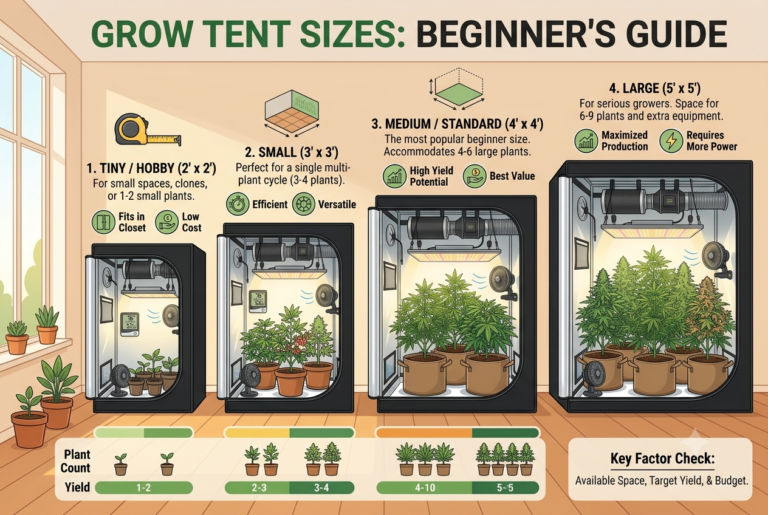
An 8×8 grow tent is not simply a larger version of a personal 2×4 or 4×4 enclosure. With 64 square feet of floor space, it functions more like a portable indoor grow room. Lighting normally needs to be divided into several zones, the ventilation system must move a substantial volume of air, and every plant needs to remain accessible after the canopy becomes dense.
The best 8×8 grow tent should therefore provide more than reflective walls. It needs a strong frame for multiple lights and filters, several doors for reaching the center and rear plants, large duct ports, dependable zippers, a removable floor tray, and enough structural resistance to handle negative pressure from a high-capacity exhaust system.
My primary recommendation is the VIVOSUN S888 8×8 Grow Tent. It combines a widely established design, a full 96-by-96-inch footprint, multiple access points, a reflective interior, observation windows, and practical ventilation openings.
The AC Infinity CLOUDLAB 899 is the stronger option when heavy canvas, thicker poles, controller mounting, and high equipment capacity are priorities.
The VIVOSUN P888 PRO provides a reinforced premium alternative, while the Mars Hydro 8×8 Grow Tent balances 1680D construction with a multi-door layout.
The TopoLite 8×8 Grow Tent is a simpler option for buyers who do not need the heaviest frame.
Before choosing any large tent, measure the room rather than relying only on the nominal 8×8 dimensions. You also need clearance for assembly, opened doors, ducting, exhaust equipment, power connections, and access around at least part of the exterior.

5 Best 8×8 Grow Tents
| Image | Product Name | Check Price |
|---|---|---|
Best Choice | VIVOSUN S888 8×8 Grow Tent | Check Price |
Second Best | AC Infinity CLOUDLAB 899 Advance 8×8 Grow Tent | Check Price |
Third Choice | VIVOSUN P888 PRO 8×8 Grow Tent | Check Price |
 | Mars Hydro 8×8 Grow Tent | Check Price |
 | TopoLite 96x96x80 Grow Tent | Check Price |
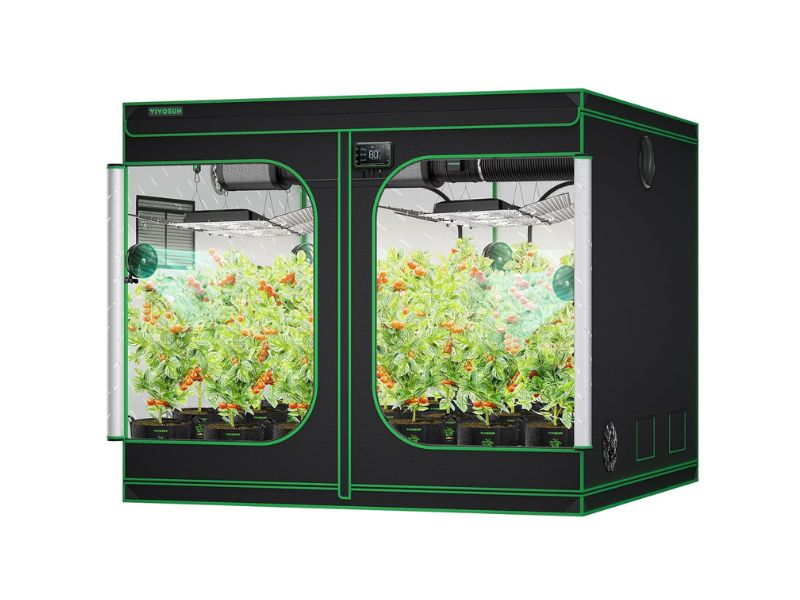
1. VIVOSUN S888 8×8 Grow Tent
Key Features
- 96 × 96 × 80-inch dimensions
- Sixty-four-square-foot growing area
- Reflective Mylar interior
- 600D Oxford-fabric exterior
- Reinforced metal frame
- Multiple large access doors
- Observation windows
- Mesh intake openings
- Several duct and cable ports
- Removable waterproof floor tray
- Internal tool organizer
- Tool-free frame assembly
The VIVOSUN S888 is a well-established large-format grow tent designed around a full 8×8-foot floor. Its main advantage is practicality: it provides the access points, ventilation openings, reflective surfaces, and floor protection required for a multi-light indoor setup without relying on specialized smart-system hardware.
The 80-inch height provides approximately 6 feet 8 inches of vertical space. That sounds generous until overhead equipment is installed. Multiple grow lights, ratchet hangers, carbon filters, exhaust fans, support bars, and a safe canopy gap can remove a significant portion of the usable height.
Plant containers and hydroponic equipment also raise the starting point of the canopy. A 12-inch container combined with an 18-inch light gap can leave much less vertical growing space than expected.
The reflective Mylar interior helps redirect light toward the canopy. This is especially important in an 8×8 enclosure because light from central fixtures can otherwise lose useful intensity before reaching the walls and corners.
Reflection cannot compensate for an undersized lighting system. Most complete 8×8 canopies require multiple fixtures positioned in separate zones rather than one extremely powerful light in the center.
The S888 includes multiple access doors. This is one of its most important features. A grower cannot comfortably reach the center or rear of an eight-foot-deep canopy from one front opening. Side or rear access reduces the need to lean over containers, irrigation lines, and plants.
Observation windows allow quick inspections without opening a full door. They are convenient for checking whether the lights and circulation fans are operating, but they should remain securely covered when maintaining a dark cycle is important.
The 600D canvas is lighter than the 1680D and 2000D materials used by several premium competitors. It remains practical for normal use, but it may show more inward movement when a powerful exhaust fan creates strong negative pressure.
High-CFM support bars can help prevent the walls from pulling inward and reducing the usable canopy area. Fan speed should also be adjusted to create controlled negative pressure rather than collapsing the tent sides.
The removable floor tray provides useful protection from runoff and small spills. An 8×8 setup can contain many gallons of irrigation water, so the tray should not be treated as complete flood containment. Secondary liners, drain tables, and water alarms remain worthwhile.
What I Like
- Established large-tent design
- Full 8×8 growing footprint
- Multiple access points
- Useful observation windows
- Several ventilation and cable openings
- Reflective interior
- Removable floor tray
- Practical tool storage
- Straightforward component layout
What I Do Not Like
- 600D canvas is lighter than premium alternatives
- Large cover is difficult to install alone
- Strong exhaust pressure may pull the walls inward
- Eighty-inch height becomes limited after equipment installation
- Heavy overhead equipment requires careful load distribution
The S888 is the strongest general-purpose option for growers who need a proven 8×8 enclosure without moving into the highest construction tier. It offers the essential access and environmental-management features required for a large indoor canopy.
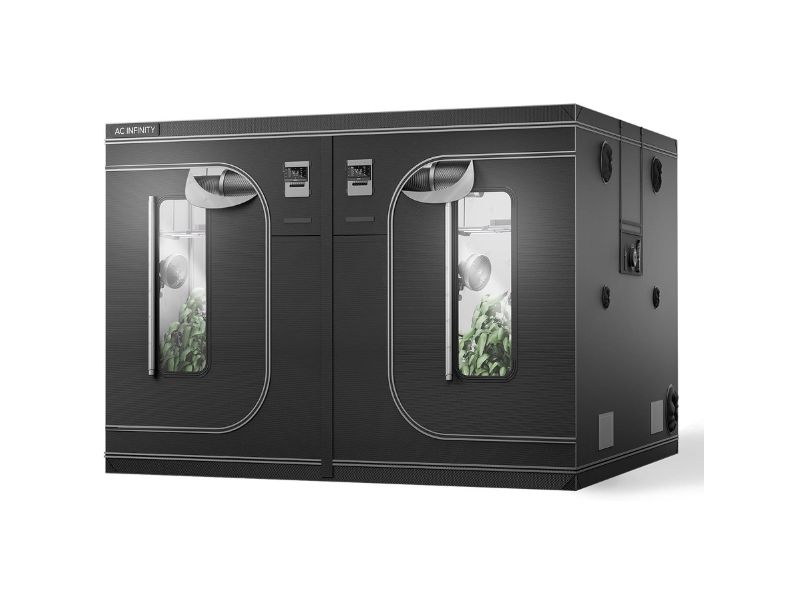
2. AC Infinity CLOUDLAB 899 Advance 8×8 Grow Tent
Key Features
- 96 × 96 × 80-inch size class
- Heavy 2000D Oxford canvas
- Thick one-inch steel poles
- Reinforced frame corners
- High-reflectivity Mylar interior
- Multiple primary and secondary access doors
- Large observation windows
- Controller mounting plate
- Light-resistant cable passthrough
- Extra hanging support bars
- Heavy-duty catch tray
- Multiple four- and eight-inch duct ports
The AC Infinity CLOUDLAB 899 is designed for growers who expect the tent frame to support a large amount of equipment. Its thicker poles, dense canvas, reinforced corners, extra hanging bars, and controller-ready exterior distinguish it from lighter entry-level enclosures.
In an 8×8 tent, frame strength matters because a complete setup may include four large LED fixtures, one or more carbon filters, inline fans, circulation equipment, sensors, supplemental bars, and irrigation lines.
The total weight should never be concentrated on one roof bar. Lights and filters should be distributed across multiple support points, and the published capacity of a beam should not be interpreted as permission to load the entire roof unevenly.
The 2000D canvas provides greater material density than common 600D covers. This generally improves resistance to tearing, pinholes, and excessive inward movement under negative pressure.
Heavier canvas also makes assembly more demanding. The frame should be positioned correctly before the cover is pulled into place. Trying to rotate or move the tent after the heavy shell is installed can stress the poles and corner joints.
The controller mounting plate is a practical feature for automated growing systems. A fan or environmental controller can remain outside the humid tent while probes and cables pass through a more organized light-resistant opening.
This reduces cable clutter and makes the display easier to read. It also helps keep sensitive electronics away from irrigation runoff.
The CLOUDLAB 899 provides multiple duct openings for exhaust, intake, humidification, heating, or air-conditioning connections. The final port layout should be planned before lights and plants are installed because reaching unused rear openings later can be difficult.
The observation window is larger than the small viewing panels found on many tents. This improves visibility but adds another large seam that must remain closed and covered during dark periods.
Its internal catch tray is designed for cleanup and spill containment. For automated irrigation, hydroponics, or several large reservoirs, a separate drainage plan remains necessary.
What I Like
- Very thick 2000D canvas
- Strong one-inch poles
- Extra hanging bars
- Controller-ready design
- Organized cable passthrough
- Multiple duct options
- Large viewing area
- Heavy-duty floor protection
- Better resistance to negative pressure
What I Do Not Like
- Heavier and more difficult to assemble
- Requires substantial room around the frame during setup
- Premium construction increases total system cost
- Large doors and windows create more zipper length to maintain
- Heavy equipment can still overload poorly distributed support bars
The CLOUDLAB 899 is the better option for growers installing multiple heavy lights, filters, controllers, and environmental devices. Its construction is particularly valuable in a permanent setup where the tent will remain assembled for repeated cycles.
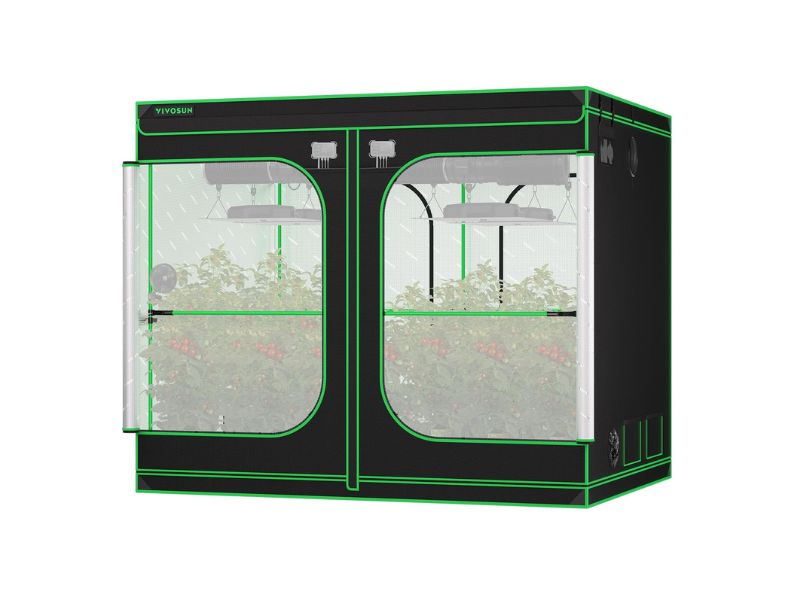
3. VIVOSUN P888 PRO 8×8 Grow Tent
Key Features
- 96 × 96 × 80-inch dimensions
- Heavy 2000D Oxford fabric
- Thick one-inch steel poles
- Reinforced reflective Mylar interior
- Extra hanging bars
- High-CFM support kit
- Multiple access doors
- Observation windows
- Removable floor tray
- Large duct openings
- Reinforced frame structure
- Designed for multi-light installations
The VIVOSUN P888 PRO is a reinforced alternative to the standard S888. It retains the same basic 8×8 footprint while upgrading the frame, canvas, and airflow-support structure.
The one-inch poles provide a more substantial foundation for several lighting fixtures and filtration components. This is important because a full 8×8 lighting layout is usually divided into four 4×4 zones or another multi-fixture arrangement.
The 2000D fabric improves durability and light containment. It also gives the tent more structural resistance when an exhaust fan creates negative pressure.
The included high-CFM support components help hold the walls outward. Without support bars, inward wall movement can reduce the effective floor area and press the fabric against plants near the perimeter.
The extra hanging bars improve equipment placement. Rather than forcing every light and filter onto a small number of fixed roof positions, the bars can create more attachment points and distribute the load.
The additional bars should be secured according to the instructions. Roof equipment must not be allowed to shift when the tent is opened, bumped, or placed under uneven tension.
The reflective interior supports a multi-fixture lighting layout, while the observation windows allow basic inspections. Large access doors make the central section easier to reach than it would be through one front opening.
Compared with the standard S888, the P888 PRO is more appropriate for a high-output permanent installation. The trade-off is weight. The denser canvas and thicker frame make initial assembly more difficult and reduce portability.
What I Like
- Heavy 2000D fabric
- Thick one-inch poles
- High-CFM wall support
- Extra hanging bars
- Strong fit for multiple LED fixtures
- Good access around a large canopy
- Removable floor tray
- Better structural support than basic tents
What I Do Not Like
- Heavy cover requires multiple people during setup
- Higher construction tier may be unnecessary for light equipment
- Requires accurate room measurements
- Extra frame components add assembly steps
- Still limited to an 80-inch standard height
The P888 PRO is best for growers who like the VIVOSUN layout but need a stronger structure than the standard S888 provides. It is particularly relevant for multi-light systems and higher-capacity exhaust fans.
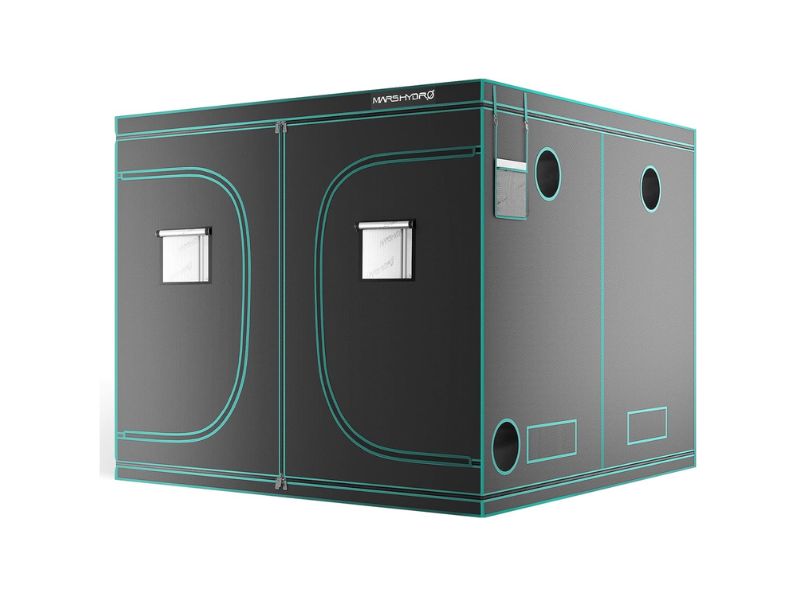
4. Mars Hydro 8×8 Grow Tent
Key Features
- 96 × 96 × 80-inch dimensions
- Heavy 1680D Oxford canvas
- Reflective Mylar interior
- Reinforced metal poles
- Multiple front and rear doors
- Several large duct ports
- Mesh intake vents
- Observation windows
- Removable floor tray
- Double-stitched seams
- Light-blocking zipper flaps
- Designed for several grow lights
The Mars Hydro 8×8 tent occupies a middle position between basic 600D enclosures and premium 2000D models. Its 1680D canvas provides substantial material density while keeping the overall design relatively conventional.
The access layout is one of its main strengths. Multiple front and rear doors help growers reach plants from more than one direction.
An 8×8 canopy should never be designed with the assumption that every plant can be serviced from the front. After branches and irrigation equipment fill the interior, even a four-foot reach can become difficult.
The reflective interior supports several lighting zones. A common approach is to divide the tent into four 4×4 sections, each with an appropriately sized fixture. This provides more uniform output and allows separate dimming or height adjustment.
The large duct openings support high-capacity ventilation equipment. An 8-inch exhaust system is a common starting point for an enclosure of this size, but the required airflow depends on lighting power, duct resistance, filter size, ambient temperature, and humidity.
Several smaller exhaust or circulation zones may work better than one poorly positioned fan. The correct arrangement must prevent warm, humid pockets from forming in distant corners.
The canvas and zipper flaps help contain light. Every port that remains unused should be closed securely, and active duct openings should be cinched around the ducting to reduce leakage.
The removable tray helps protect the floor, but irrigation spills can spread across a large area before they are noticed. A water sensor near the lowest point adds useful protection.
What I Like
- Strong 1680D canvas
- Multiple front and rear access doors
- Practical ventilation layout
- Reflective interior
- Good balance between weight and durability
- Removable floor tray
- Light-blocking zipper details
- Suitable for multiple lighting zones
What I Do Not Like
- Large shell is difficult to install without assistance
- Standard-height design limits tall equipment stacks
- Multiple doors create extensive zipper maintenance
- Strong exhaust may still require support bars
- Large lighting systems need separate load planning
The Mars Hydro tent is a balanced option for growers who want heavier-than-basic fabric and broad access without moving to the thickest available structure. Its multi-door layout is particularly useful for maintaining a full canopy.
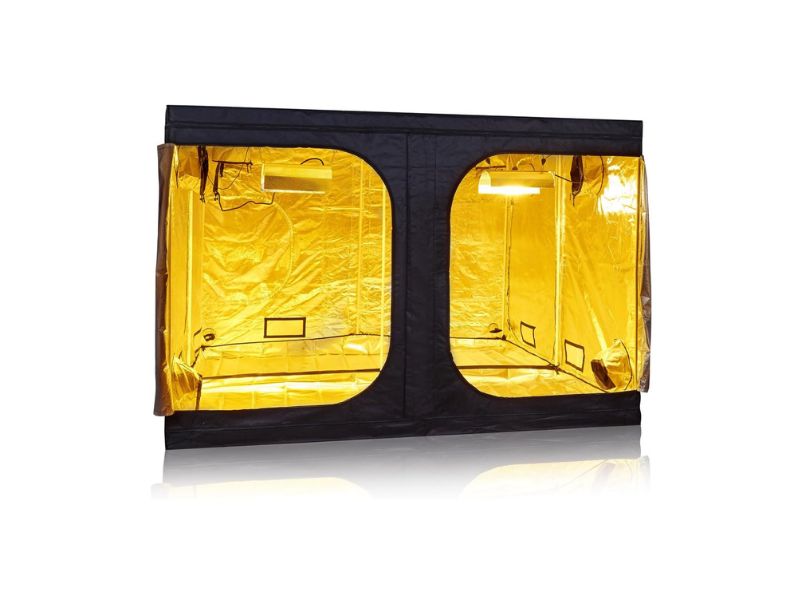
5. TopoLite 96x96x80 Grow Tent
Key Features
- 96 × 96 × 80-inch dimensions
- 600D light-resistant Oxford fabric
- Reflective diamond Mylar interior
- Metal frame
- Large zippered access
- Observation window
- Multiple ventilation openings
- Mesh intake panels
- Removable floor tray
- Tool-free frame design
- Suitable for soil and hydroponic setups
- Lower-complexity construction
The TopoLite 8×8 tent is a simpler alternative for growers who need the full floor area but do not plan to hang an unusually heavy equipment package from the roof.
Its 600D fabric is comparable to other standard large tents. It provides a reflective, light-controlled enclosure but does not offer the same density as 1680D or 2000D alternatives.
This makes the tent lighter and potentially easier to handle, though an 8×8 cover remains difficult for one person to install. At least two people should normally assemble any tent of this size.
The diamond-pattern Mylar lining helps scatter reflected light across the enclosure. Its benefit is greatest when the lighting system already provides direct coverage across the full footprint.
The frame includes metal poles and connectors, but equipment loading should remain conservative. Heavy filters and multiple fixtures should be distributed carefully or supported independently when possible.
Multiple vents allow exhaust and intake equipment to be installed, while mesh panels provide passive-air options. Passive vents should be positioned so incoming air reaches the entire canopy rather than short-circuiting directly toward the exhaust.
The floor tray is useful for runoff and cleaning. As with every large enclosure, it cannot replace a complete drainage or spill-control system.
What I Like
- Full 8×8 dimensions
- Straightforward construction
- Reflective interior
- Several ventilation openings
- Observation access
- Removable floor tray
- Suitable for lighter equipment packages
- Simpler than premium reinforced systems
What I Do Not Like
- Lighter 600D fabric
- Lower confidence for very heavy roof loads
- Less specialized controller integration
- May show more wall movement under strong negative pressure
- Basic frame requires conservative load distribution
The TopoLite tent is most suitable for buyers who need an affordable large enclosure and plan to use a moderate equipment load. It offers the required footprint and basic environmental-control features without the heavier structure of the premium models.
8×8 Grow Tent Comparison Table
| Product | Canvas | Pole Design | High-CFM Support | Controller Mounting | Access | Main Strength | Main Limitation |
| VIVOSUN S888 | 600D | Standard metal frame | Optional or separate | Basic accessory mounting | Multiple doors and windows | Established practical design | Lighter canvas |
| AC Infinity CLOUDLAB 899 | 2000D | One-inch steel poles | Strong structural resistance | Dedicated mounting plate | Large multi-side access | Heavy equipment support | High weight and complexity |
| VIVOSUN P888 PRO | 2000D | One-inch poles | Included support system | External accessory compatibility | Multiple access points | Reinforced multi-light setup | More assembly work |
| Mars Hydro 8×8 | 1680D | Reinforced metal frame | May require added bars | Basic external mounting | Front and rear access | Balanced construction | Standard 80-inch height |
| TopoLite 8×8 | 600D | Standard metal poles | Limited | No specialized plate | Basic large access | Full area at lower complexity | Less suitable for heavy loads |
Is an 8×8 Grow Tent the Right Size?
An 8×8 tent provides:
8 feet × 8 feet = 64 square feet
This is a substantial indoor growing area. Before purchasing, consider whether the room can support the tent and its equipment.
A complete installation may require:
- Eight-foot-square floor area
- Exterior clearance for assembly
- Room for opened doors
- Space for ducting
- Exhaust discharge path
- Electrical circuits
- Irrigation reservoir
- Drainage access
- Dehumidification
- Air conditioning
- Safe walking space
A tent that technically fits between four walls may still be unusable if its rear doors cannot open or the exhaust duct has nowhere to go.
An 8×8 tent is most appropriate for growers who need multiple lighting zones, a substantial plant canopy, or room for hydroponic equipment and service paths.
Measure the Room Before Ordering
Measure:
- Wall-to-wall width
- Baseboards
- Ceiling height
- Door width
- Hallway turns
- Electrical outlet locations
- Windows
- HVAC vents
- Floor slope
- Available exterior walking space
The packed tent may also be heavy and long. Confirm that the package can pass through stairs, doorways, and hallways.
Allow room for assembly. The frame is easier to build when the poles can be laid out around the final location.
If the room is only slightly larger than eight feet in each direction, pulling the canvas over the frame may become extremely difficult.
Lighting an 8×8 Tent
A full 8×8 canopy normally requires multiple grow lights.
A common layout divides the area into four 4×4 zones:
[ Zone 1 ][ Zone 2 ]
[ Zone 3 ][ Zone 4 ]
Each zone can use one fixture designed for approximately 4×4 flowering coverage.
Advantages include:
- Better canopy uniformity
- Independent height adjustment
- Separate dimming
- Reduced center hotspots
- Easier maintenance
- Partial operation during early growth
- Redundancy if one fixture requires service
The lighting system should be centered across all four zones rather than concentrated along the middle.
Check the total equipment weight before hanging several lights. Drivers may be relocated outside the tent when the fixture supports remote mounting.
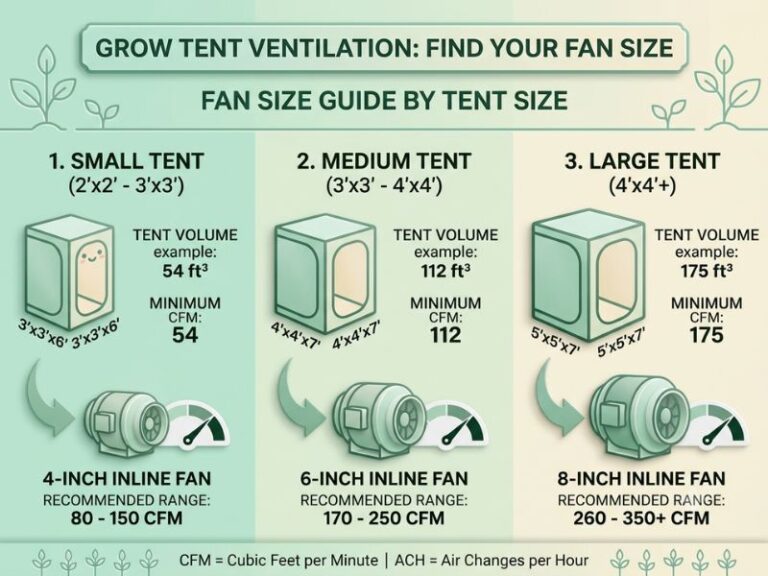
Ventilation Capacity
Tent volume is:
8 × 8 × 6.67 feet = approximately 427 cubic feet
This is the empty geometric volume. Plants, lights, filters, and equipment reduce the open-air volume but add heat and airflow resistance.
A basic fan calculation starts with the desired air-exchange frequency:
Required CFM = Tent volume ÷ desired minutes per exchange
For one exchange per minute:
427 ÷ 1 = 427 CFM
The actual fan normally needs more capacity because airflow is reduced by:
- Carbon filter resistance
- Long ducting
- Sharp bends
- Silencers
- Intake restrictions
- Dirty prefilters
- Hot lighting equipment
- High room temperature
A nominal fan rating should not be treated as the final installed airflow.
One Large Exhaust Fan or Two Smaller Fans?
One large fan
Advantages:
- Simpler controls
- One filter
- Less wiring
- One exhaust route
Limitations:
- Can create uneven airflow
- Strong suction may collapse the tent walls
- One failure affects the complete tent
- Distant corners may remain stagnant
Two smaller systems
Advantages:
- Better zoning
- More even exhaust locations
- Redundancy
- Flexible installation
- Lower speed per fan
Limitations:
- Two filters and duct paths
- More controllers
- Higher equipment count
- More roof weight
The best arrangement depends on room shape, lighting heat, duct routing, and odor-control requirements.
Managing Negative Pressure
Negative pressure helps prevent unfiltered air from escaping through small openings.
Too much negative pressure can:
- Pull walls inward
- Reduce canopy space
- Press fabric against plants
- Restrict passive intake
- Increase zipper stress
- Distort the frame
- Reduce exhaust efficiency
Use high-CFM support bars when necessary and provide enough intake area.
Passive intake openings should have substantially more total area than the exhaust duct. An active intake fan may be useful when ducting and filters create major restrictions.
Planning Interior Access
Do not fill all 64 square feet with immovable containers.
Create service paths or layouts that allow access to:
- Every plant
- Irrigation emitters
- Runoff trays
- Sensors
- Fans
- Reservoir fittings
- Rear duct ports
- Electrical connections
Possible layouts include:
Central aisle
Two canopy zones sit on each side of a central walkway.
This reduces productive floor area but makes maintenance much easier.
Perimeter access
Plants fill the central area while doors on several sides provide access.
This requires open exterior space around the tent.
Rolling or movable trays
Platforms can be moved to create temporary access.
The floor must remain level, and irrigation lines need enough flexibility.
Modular quadrants
The tent is divided into four 4×4 sections.
Each zone can have independent lights, pots, and irrigation.
Frame and Hanging-Load Planning
The roof may need to support:
- Four LED grow lights
- Several LED drivers
- One or two carbon filters
- Inline fans
- Ducting
- Circulation fans
- Sensors
- Plant-support netting
Estimate the complete weight before installation.
Use multiple bars to distribute the load. Do not suspend all fixtures and filters from one central crossbar.
Heavy equipment should use rated hangers, straps, and secure attachment points.
Water reservoirs should remain on the floor or on structures designed for their filled weight. Never hang a nutrient reservoir from the tent frame.
Floor and Water Protection
An 8×8 tent can contain a large irrigation volume.
Use several layers of protection:
- Included floor tray
- Waterproof secondary liner
- Individual saucers
- Raised drainage tables
- Drain-to-waste tubing
- Leak sensors
- Elevated power connections
- Wet vacuum access
- Reservoir shutoff valves
A small disconnected hose can release many gallons before the problem is noticed.
Automatic watering systems should be tested through several complete cycles before being left unattended.
Electrical Planning
A multi-light 8×8 system may place a substantial load on the room’s electrical circuits.
Calculate:
- Grow-light wattage
- Inline fans
- Circulation fans
- Dehumidifier
- Humidifier
- Heater
- Air conditioner
- Pumps
- Controllers
- Supplemental lighting
Do not place the complete setup on one power strip.
Use grounded outlets, correctly rated timers, dry connections, and drip loops.
High-power lighting and climate-control equipment may require separate circuits. Electrical work should follow local requirements and be completed by a qualified person when necessary.
Temperature and Humidity Control
A large tent changes more slowly than a small tent, but it also produces more total heat and moisture.
Plants release water through transpiration. A full 8×8 canopy can add substantial humidity, particularly after irrigation and during the dark period.
Environmental control may require:
- High-capacity exhaust
- Room air conditioning
- Dehumidification
- Internal circulation
- Remote LED drivers
- Temperature and humidity sensors in several zones
One sensor at the tent entrance may not represent the conditions in a distant rear corner.
Place monitors at canopy height in multiple zones when the tent is densely filled.
Assembly Tips
An 8×8 tent should normally be assembled by at least two people.
A practical sequence is:
- Clear and clean the complete room.
- Lay out the fabric in the correct orientation.
- Assemble the lower frame.
- Add vertical poles.
- Install the upper frame.
- Attach roof support bars.
- Pull the cover into position gradually.
- Avoid forcing the zippers.
- Install the floor tray.
- Level and square the frame.
- Test every door and port.
- Add equipment only after the shell is stable.
Do not hang heavy equipment until every pole and connector is fully seated.
Common 8×8 Grow-Tent Mistakes
Buying without exterior clearance
The tent fits, but doors and ducting cannot be used properly.
Installing one central light
The center becomes intense while corners remain weak.
Blocking rear access
Plants and equipment become impossible to service.
Overloading one roof bar
Lights and filters should be distributed across the frame.
Using excessive exhaust speed
The walls collapse inward and usable area shrinks.
Ignoring room-level heat
The tent exhausts heat into the same room, warming the intake air.
Depending only on the floor tray
A large reservoir leak can exceed the tray’s capacity.
Using one environmental sensor
Conditions may vary significantly between lighting zones.
Placing every container directly on the floor
Drainage and runoff become difficult to manage.
Assembling the tent alone
The large canvas can damage poles, seams, and zippers when handled incorrectly.
Maintenance
Weekly
- Inspect zippers
- Check wall suction
- Clean intake screens
- Review environmental data
- Inspect irrigation lines
- Empty runoff
- Check hanging hardware
- Confirm circulation fans operate
Monthly
- Clean carbon-filter prefilters
- Inspect duct clamps
- Remove dust from lights
- Check support bars
- Clean observation windows
- Inspect seams and corners
- Test leak alarms
Between growing cycles
- Remove all plants and equipment
- Vacuum loose debris
- Wash the floor tray
- Wipe reflective walls
- Inspect for pinholes
- Clean fans and filters
- Check every connector
- Test the complete empty environment
Frequently Asked Questions
What is the best 8×8 grow tent?
The VIVOSUN S888 is my primary recommendation because it combines an established design, full 8×8 dimensions, multiple access doors, reflective walls, and practical ventilation openings.
The AC Infinity CLOUDLAB 899 is better when heavy-duty poles, 2000D canvas, and controller integration matter more.
How many plants fit in an 8×8 grow tent?
The number depends on plant size, container capacity, training method, irrigation layout, and required access.
A full tent may hold many small plants or a much smaller number of large canopies. Maintenance paths should be planned before plant count.
How many grow lights does an 8×8 tent need?
Four fixtures designed for approximately 4×4 flowering coverage create a practical four-zone layout.
Different combinations can also work when the final PPFD map remains uniform across all 64 square feet.
What size exhaust fan is needed?
A basic calculation starts around 427 CFM for one theoretical air exchange per minute.
Filter resistance, ducting, bends, lighting heat, and room conditions normally require additional capacity.
Is one 8-inch inline fan enough?
It may be enough when the installed airflow, filter, ducting, and room temperature are appropriate.
Some setups benefit from two exhaust zones or supplemental room cooling.
How tall is an 8×8 grow tent?
Most models are approximately 80 inches tall.
Usable plant height is lower after subtracting containers, lights, hangers, filters, and the canopy gap.
Can an 8×8 tent fit in a normal bedroom?
It may fit in a large room, but exterior access, ducting, opened doors, and assembly clearance must also be considered.
Measure the complete room before ordering.
Is 600D canvas thick enough?
A well-constructed 600D tent can work for normal setups.
A 1680D or 2000D tent provides greater material density and may resist negative pressure and repeated handling more effectively.
Does an 8×8 tent need support bars?
High-CFM support bars are useful when exhaust suction pulls the walls inward.
They help preserve canopy area but do not replace correct intake sizing.
Can I assemble an 8×8 tent alone?
It is possible in a very large room, but it is not recommended.
The frame and heavy cover are easier and safer to handle with at least two people.
How much floor protection is needed?
Use the included tray plus secondary leak protection when operating large reservoirs or automatic irrigation.
Elevate electrical connections and install a water alarm.
Should the carbon filter be inside or outside?
Either arrangement can work.
External mounting preserves overhead space, while internal mounting can simplify filtered exhaust routing. Frame capacity and room layout determine the better option.
How do I reach plants in the middle?
Use multiple doors, service aisles, modular trays, or movable platforms.
Do not create an eight-foot-deep fixed canopy that can only be accessed from one side.
Can an 8×8 tent use passive intake?
Yes, when the intake openings provide enough area for the exhaust airflow.
Strong negative pressure or restricted ports may require active intake assistance.
How many environmental sensors are needed?
At least two sensors are useful in a large tent.
Additional sensors may be needed when lights, intake air, or plant density create separate temperature and humidity zones.
Conclusion
Selecting the best 8×8 grow tent requires more planning than comparing canvas ratings. A large enclosure must support several lighting zones, high-capacity ventilation, extensive irrigation, and safe access to every part of the canopy.
The VIVOSUN S888 is the strongest general-purpose option because of its established layout, useful access points, and straightforward environmental features.
The AC Infinity CLOUDLAB 899 is the better heavy-duty choice for substantial equipment loads and controller-based systems. The VIVOSUN P888 PRO provides a reinforced alternative with high-CFM support and extra hanging bars.
The Mars Hydro 8×8 tent balances thick fabric with multiple front and rear doors, while the TopoLite 8×8 provides a simpler full-size enclosure for moderate equipment loads.
Before purchasing, measure the room, plan the lighting zones, calculate ventilation losses, confirm electrical capacity, and decide how the center plants will be reached. A well-organized 8×8 tent can function as a complete indoor grow room, but only when the equipment and access layout are designed before the canopy fills the space.

I’m Maya L. Greenwood, a lifelong plant lover who believes anyone can grow something beautiful with the right guidance. After years of testing soil mixes, pruning methods, irrigation tricks, and pest-safe solutions, I started EasyGardenTips.com to turn hard-won lessons into step-by-step advice. From seed starting and container gardens to composting and seasonal checklists, my goal is to make gardening simple, sustainable, and fun.