Where to Place Raised Garden Beds for Sun, Drainage, and Access
The best place for raised garden beds is a level, well-drained area that receives at least 6–8 hours of direct sunlight daily, has convenient access to water, and provides enough space for walking around the beds. For most vegetable gardens in the United States, an open, sunny section of the backyard away from large trees and buildings is a practical choice.
However, the ideal location also depends on what you plan to grow. Tomatoes, peppers, and squash need more direct sunlight than many leafy greens, while gardeners in extremely hot climates may benefit from some afternoon shade for certain crops.
Choosing the wrong location can create problems that are difficult to correct after the beds are filled. Insufficient sunlight may reduce vegetable production, poor drainage can damage roots, and narrow pathways can make routine maintenance frustrating.
Before building, evaluate how sunlight moves across your yard, where rainwater collects, and how easily you can reach the planting area.
This guide explains where to position raised beds, how to arrange them, which locations to avoid, and how to select a site that supports healthy plants and convenient gardening.
Where to Place Raised Garden Beds for Best Results
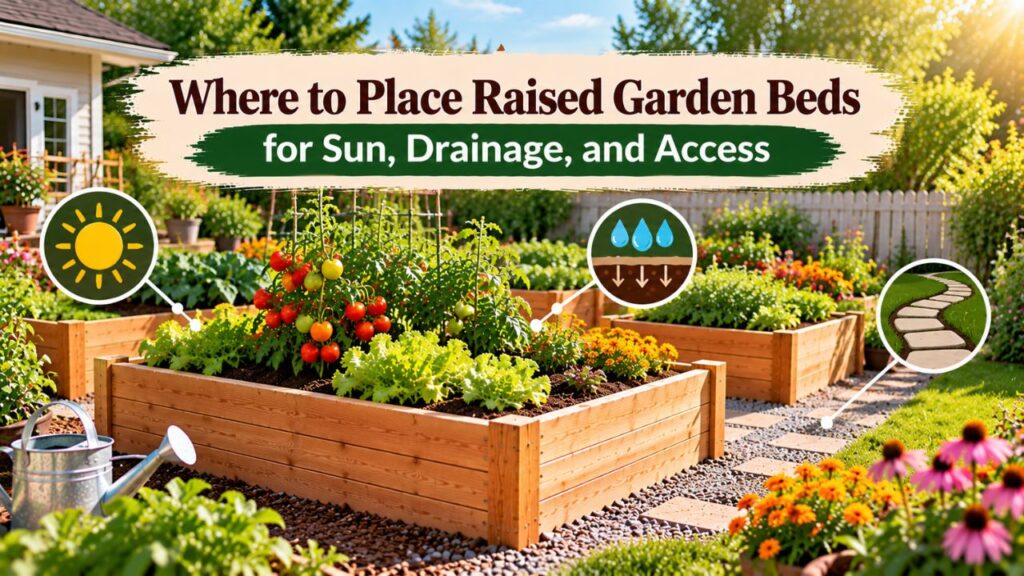
A good raised-bed location should provide suitable growing conditions while making daily gardening tasks manageable.
The most important factors are sunlight, drainage, access to water, surrounding vegetation, and available walking space.
Best Raised Garden Bed Location Checklist
| Location Factor | Recommended Conditions | Locations to Avoid |
| Sunlight | 6–8 hours of direct sun for most fruiting vegetables | Deep shade from buildings or trees |
| Ground | Level or properly terraced | Steep, unstable slopes |
| Drainage | Well-drained ground | Areas with prolonged standing water |
| Water supply | Within convenient hose reach | Areas requiring difficult water transport |
| Nearby trees | Away from major root competition | Directly beneath large trees |
| Accessibility | Clear paths around planting areas | Narrow, obstructed spaces |
| Air circulation | Open area with reasonable airflow | Enclosed, stagnant corners |
| Soil safety | Suitable ground for food gardening | Known or suspected contaminated soil |
Not every yard has a location that satisfies all these conditions.
If your options are limited, prioritize the requirements of the crops you intend to grow.
For example, a slightly uneven location with excellent sunlight may be easier to improve than a perfectly level area that receives very little direct sun.
How Much Sunlight Do Raised Garden Beds Need?
Sunlight is one of the first factors to evaluate because it directly affects photosynthesis, plant growth, and vegetable production.
Most fruiting vegetables need substantial direct sunlight to grow and produce well.
Choose a Sunny Location for Vegetables
According to the University of Minnesota Extension’s raised-bed gardening guidance, vegetables such as tomatoes, peppers, and eggplants should receive at least 6–8 hours of direct sunlight daily.
A location with 8 hours or more of direct sunlight is often desirable for sun-loving vegetables, provided their watering and temperature needs are met.
Common full-sun crops include:
- Tomatoes.
- Peppers.
- Eggplants.
- Cucumbers.
- Squash.
- Melons.
- Many beans.
These crops generally perform best when nearby buildings, fences, or trees do not shade the growing area for much of the day.
Can Raised Garden Beds Go in Partial Shade?
Yes. Raised garden beds can be placed in partial shade when growing crops that tolerate reduced sunlight.
Some leafy greens and herbs can grow with fewer hours of direct sun than tomatoes or peppers.
Suitable crops may include:
- Lettuce.
- Spinach.
- Kale.
- Swiss chard.
- Scallions.
- Parsley.
- Certain radish varieties.
A location receiving around 4–6 hours of direct sunlight may support some of these crops, although growth and harvests depend on the season and actual light intensity.
In hot summer climates, afternoon shade can sometimes help cool-season leafy vegetables by reducing heat stress.
However, deep shade is generally unsuitable for a productive vegetable garden.
Observe Sunlight Before Installing Raised Beds
A yard may appear sunny during the morning but receive substantial shade later in the day.
Before selecting a location, observe the area at several times:
- Check which sections receive direct sunlight in the morning.
- Observe shadows around midday.
- Identify areas shaded by buildings or trees during the afternoon.
- Estimate the total hours of unobstructed direct sunlight.
- Consider how the sun’s position and tree foliage change during the growing season.
You can also use a sun-tracking app or sunlight meter to help compare different locations.
Important: A location that receives full sun in early spring may become shaded after nearby deciduous trees develop their leaves.
Evaluate the site under conditions representative of the crops’ main growing season.
Choose a Raised Garden Bed Location With Good Drainage
Raised beds generally provide better upper-soil drainage than poorly prepared ground-level gardens, but their location still affects how water moves through the growing area.
Waterlogged conditions can reduce oxygen availability around plant roots and increase the risk of root problems.
Look for Naturally Well-Drained Ground
Choose an area where rainwater can move away without collecting around the bed.
Suitable locations include level ground or a gently graded area that does not receive concentrated runoff.
Inspect the yard after a significant rainfall.
If water remains standing for long periods, the location may have compacted soil, poor subsurface drainage, or a low elevation relative to the surrounding ground.
A raised bed can improve the upper rooting environment, but it does not automatically correct severe drainage problems beneath the structure.
Avoid Low Spots That Collect Rainwater
Low-lying sections of a yard may collect runoff from nearby slopes, patios, or other surfaces.
Placing a raised bed directly in such an area can create recurring drainage problems.
Excessive water may accumulate around the bed or saturate the underlying soil.
If the area frequently floods, consider improving site drainage or selecting another location.
Do not rely on adding a thick gravel layer beneath the bed as the primary solution.
The growing medium needs a suitable drainage pathway, not simply an elevated frame.
Keep Raised Beds Away From Concentrated Roof Runoff
Avoid positioning raised beds directly beneath roof downspouts or locations where gutters discharge large amounts of water.
Concentrated runoff can cause:
- Soil erosion.
- Nutrient loss.
- Uneven moisture conditions.
- Saturated planting areas.
- Damage to surrounding pathways.
Redirect roof runoff through an appropriate drainage system before placing a garden bed nearby.
Also avoid altering drainage in ways that direct water toward a building’s foundation or neighboring property.
Place Raised Garden Beds Near a Convenient Water Source
Raised beds need regular watering, particularly during hot and dry weather.
Locating them near a reliable water source can make garden maintenance significantly easier.
Keep the Beds Within Hose Reach
Choose a position accessible from an outdoor faucet, irrigation line, or other suitable water supply.
Consider the actual path the hose must follow, not just the straight-line distance to the faucet.
A hose may need to pass around buildings, fences, landscaping, or walking paths.
A location that requires dragging a long hose through narrow spaces can become inconvenient during the growing season.
The University of Maryland Extension’s vegetable garden planning recommendations emphasize choosing a location with convenient water access, adequate sunlight, and enough room for garden maintenance.
Plan Irrigation Before Filling the Beds
If you intend to install drip irrigation or soaker hoses, plan the water supply before constructing the entire garden.
Consider where the main supply line will enter the garden and how individual beds will connect to it.
Drip irrigation can deliver water near plant roots while reducing unnecessary wetting of surrounding pathways.
However, irrigation frequency still depends on the soil, weather, and crops.
Avoid placing hoses where they create tripping hazards along frequently used paths.
Keep the Garden Easy to Visit
A raised garden bed that is easy to reach is generally easier to inspect and maintain.
Regular visits help gardeners notice:
- Wilting plants.
- Dry soil.
- Pest damage.
- Weeds.
- Vegetables ready for harvest.
- Problems with irrigation equipment.
A suitable sunny location near the house can therefore be more practical than a distant corner of the yard with similar growing conditions.
How Far Should Raised Garden Beds Be From Trees and Shrubs?
Large trees and established shrubs can interfere with raised-bed gardening in several ways.
Their branches create shade, while their root systems compete with vegetables for water and nutrients.
Avoid Placing Raised Beds Directly Under Trees
Large trees may produce extensive root systems that spread well beyond the visible canopy.
An open-bottom raised bed constructed near a tree can eventually contain invading tree roots.
These roots may use moisture and nutrients intended for vegetable crops.
Trees can also drop leaves, branches, and other debris into the bed.
If possible, choose an open section of the yard outside the tree’s main root-influenced growing area.
There is no universal minimum distance suitable for every tree. Root spread varies with species, soil conditions, tree size, and available moisture.
Consider the Mature Size of Nearby Shrubs
Small shrubs may seem harmless when the raised bed is installed.
However, some grow considerably wider and taller over time.
A shrub that currently provides little shade may eventually block several hours of sunlight.
When selecting the bed’s location, consider the mature height and spread of nearby plants.
Also leave sufficient space for pruning and maintaining existing landscaping without stepping into the garden bed.
Avoid Damaging Established Tree Roots
Building a raised garden bed should not require cutting major roots from valuable established trees.
Excavating near tree roots can damage the tree and create long-term stability or health problems.
Adding a deep soil layer over an extensive root zone can also change the conditions around existing roots.
If a large tree dominates the available space, choose another location or use appropriately sized containers outside its sensitive root zone.
Where Should Raised Beds Go Near Fences and Buildings?
Raised beds can be placed near fences, walls, and buildings, but the position should account for shade, drainage, airflow, and maintenance access.
Raised Beds Along a Fence
A fence can provide a convenient boundary for a garden.
However, its height and orientation affect how much sunlight reaches nearby plants.
In much of the United States, a tall fence located south of a raised bed can cast shade toward the bed when the sun is in the southern sky.
A northern fence may interfere less with midday sunlight, although its effects vary by season and location.
Before installing the bed, check the fence’s shadow at different times of day.
Leave enough clearance to maintain both the garden and the fence.
Raised Beds Next to a House
A raised bed can work near a house if the location receives sufficient sunlight and does not interfere with drainage or building maintenance.
South-facing areas can receive substantial sunlight in the Northern Hemisphere when they are unobstructed.
However, walls can also affect the growing environment.
Possible concerns include:
- Excessive heat reflected from exterior surfaces.
- Limited air circulation.
- Roof runoff.
- Restricted access to siding or foundation areas.
- Shade from roof overhangs.
Avoid placing the bed where it prevents inspection or maintenance of the building.
Keep soil and mulch from accumulating against exterior siding or other moisture-sensitive construction materials.
Raised Beds Near Driveways and Walkways
A sunny section beside a driveway or walkway may be suitable for a garden if the site is safe and well-drained.
However, consider whether runoff from vehicles, road salt, deicing chemicals, or other contaminants could reach the planting area.
Avoid locations where cars regularly overhang the bed or where garden work would interfere with vehicle movement.
For food gardens, assess possible contamination before using soil from an area with a history of vehicle-related or industrial activity.
Which Direction Should Raised Garden Beds Face?
Raised garden beds can be arranged north-to-south or east-to-west.
Neither orientation is automatically best for every yard.
The ideal arrangement depends on sunlight, nearby obstacles, and the height of the crops.
North-to-South Raised Bed Orientation
A bed with its long axis running north-to-south can provide useful sunlight distribution across the planting area.
This arrangement is often convenient for beds containing relatively low-growing vegetables.
However, plant spacing and nearby shadows still influence how evenly sunlight reaches the crops.
A north-to-south orientation cannot compensate for a bed positioned directly beneath a large shade tree.
East-to-West Raised Bed Orientation
An east-to-west bed may also work well, especially when taller plants are arranged to reduce shading of shorter crops.
In the Northern Hemisphere, the sun is generally toward the southern part of the sky around solar noon.
Placing taller plants toward the northern side of the garden can help reduce shade on shorter plants to the south.
For example:
- Place a tall tomato trellis along the northern side.
- Grow medium-height crops toward the center.
- Position low-growing lettuce or herbs toward the sunnier southern side.
This arrangement is a useful planning principle rather than an absolute rule.
Actual shadows depend on season, latitude, and plant height.
Does Bed Orientation Matter More Than Sunlight?
No. The amount of direct sunlight reaching the plants is usually more important than the direction of the raised bed.
If the sunniest available location requires an east-to-west layout, there is generally no reason to choose a heavily shaded north-to-south location instead.
Prioritize direct sunlight, drainage, and accessibility.
Use bed orientation to improve an already suitable location.
Where to Place Raised Beds on Grass, Concrete, or Sloping Ground
Raised beds can be installed on different surfaces, but the underlying ground affects drainage, rooting depth, and construction requirements.
Placing Raised Garden Beds on Grass
A grassy backyard is a common location for traditional open-bottom raised beds.
Before installation, remove or suppress existing grass and persistent weeds.
You can remove the sod or use an appropriate temporary weed-suppression method, depending on the site.
A single layer of plain, uncoated cardboard may help suppress existing grass while it decomposes.
Avoid creating a thick, impermeable barrier beneath an open-bottom vegetable bed.
The growing medium should provide enough depth for the intended crops, and roots should be able to enter suitable ground below when needed.
Placing Raised Garden Beds on Concrete
Raised beds can be placed on concrete or paved surfaces, but they require different planning.
Because plant roots cannot grow into the ground beneath the bed, the structure must provide adequate growing-medium depth.
Consider:
- Reliable drainage.
- Sufficient root space.
- Appropriate growing-medium composition.
- Excess heat from pavement.
- Water runoff around the structure.
- The total weight of the filled bed.
An enclosed raised planter with designed drainage may be more suitable than a traditional bottomless frame.
For a raised bed on an elevated concrete deck or rooftop, verify structural capacity before installation.
Placing Raised Garden Beds on a Slope
A gentle slope can sometimes accommodate a raised garden bed with appropriate site preparation.
However, placing a rigid rectangular frame directly on uneven ground can create instability or uneven soil depth.
For sloped locations, consider leveling a suitable area or creating a properly supported terrace.
Avoid unsupported fill that may erode or shift during heavy rainfall.
The bed should be stable and capable of supporting the weight of saturated soil.
For steep slopes or structures that retain substantial amounts of soil, professional design or local construction guidance may be appropriate.
How Much Space Should You Leave Around Raised Garden Beds?
A good raised-bed location includes sufficient space for moving, watering, weeding, and harvesting.
The surrounding paths should be planned before the beds are filled.
Leave Enough Room Between Raised Beds
For many home gardens, approximately 24–36 inches of pathway width is a practical starting range.
A wider path may be necessary for wheelbarrows, garden carts, mobility equipment, or frequent two-person access.
Narrow paths can become difficult to use once plants grow beyond the edges of the beds.
Measure the actual gardening equipment you intend to use before finalizing path widths.
Keep Raised Beds Narrow Enough to Reach
Many rectangular raised beds are built approximately 3–4 feet wide when both sides are accessible.
This allows gardeners to reach the center without stepping onto the growing surface.
For beds accessible from only one side, a width of approximately 2 feet may be more practical.
The ideal dimensions depend on the gardener’s reach and mobility.
Avoid choosing a very wide bed simply because the available space allows it.
Example Layout for Two 4×8 Raised Beds
Consider a small backyard garden containing two raised beds measuring 4 feet wide and 8 feet long.
If the beds sit side by side with a 3-foot path between them:
4 feet + 3 feet + 4 feet = 11 feet of total width
The beds require at least 8 feet of length, plus any clearance needed at their ends.
Additional perimeter paths may increase the overall garden footprint.
This arrangement allows both beds to be maintained from the central walkway, although access to their outside edges should also be considered.
Plan the garden’s total footprint rather than measuring only the planting beds.
Raised Garden Bed Locations to Avoid
Some locations create recurring problems that are difficult to resolve after construction.
| Poor Location | Potential Problem | Better Approach |
| Directly beneath large trees | Shade and root competition | Choose an open sunny area |
| Low-lying ground that floods | Prolonged saturation | Improve drainage or relocate |
| Beneath a roof downspout | Heavy runoff and erosion | Redirect runoff |
| Against a shaded wall | Insufficient direct sunlight | Check daily shadow patterns |
| Steep, unstable slope | Shifting soil and erosion | Build a suitable terrace |
| Narrow gap between structures | Poor access and limited light | Leave adequate clearance |
| Known contaminated ground | Potential exposure to harmful substances | Test and use appropriate controls |
| Over buried utilities or septic components | Damage and restricted maintenance access | Choose a safe location |
Avoid Known Contaminated Areas
A raised bed with clean imported soil can help manage some site contamination concerns, but it does not automatically isolate plants from contaminated ground.
Open-bottom beds may allow roots to reach the underlying soil.
If contamination is suspected, arrange appropriate testing and follow local extension or environmental guidance.
Do not assume that ordinary landscaping fabric or cardboard forms a reliable barrier against chemical contamination.
Avoid Septic Drain Fields and Utility Access Areas
Do not place permanent raised beds over septic drain fields, septic access points, or buried infrastructure that requires future maintenance.
Construction, added soil loads, digging, and plant roots may interfere with underground systems.
Before excavating or installing substantial ground anchors, check for underground utilities using the appropriate utility-location service.
In the United States, 811 is commonly used to arrange marking of participating underground utilities before digging.
Privately installed lines, such as some irrigation or electrical systems, may need separate identification.
Avoid Strongly Exposed Wind Corridors
A location exposed to persistent strong winds can increase moisture loss and damage tall vegetable plants.
Buildings and fences may create wind tunnels, while completely enclosed areas may have poor airflow.
Choose a position with reasonable air movement and protection from damaging winds.
If necessary, use a suitable windbreak that doesn’t shade the raised bed excessively.
How to Choose the Best Raised Bed Location Before Building
Selecting a raised-bed site is easier when you compare potential locations before purchasing soil and framing materials.
Use the following process.
Step 1: Identify Possible Garden Locations
Walk around the property and identify two or three areas that could accommodate the intended raised beds.
Consider open lawn areas, sunny backyard sections, and available spaces near existing gardens.
Exclude obviously unsuitable locations, such as permanently shaded corners or places that regularly flood.
Step 2: Compare Daily Sunlight
Observe each location during the morning, midday, and afternoon.
Estimate the direct sunlight available during the main growing season.
For most fruiting vegetables, prioritize locations receiving at least 6–8 hours of direct sun.
If only partial shade is available, select crops that can tolerate those conditions.
Step 3: Check Drainage and Ground Conditions
Inspect the proposed locations after rainfall.
Look for standing water, runoff channels, compacted surfaces, and erosion.
Choose a stable area with adequate drainage.
If the site is sloped, determine whether leveling or terracing will be required.
Step 4: Measure the Beds and Walking Paths
Use a tape measure, stakes, and string to outline the proposed layout.
Mark the exact position of each raised bed.
Include paths and clearance for hoses, wheelbarrows, and harvesting.
Walk through the marked layout before construction to confirm that it feels practical.
Step 5: Check Water Access and Nearby Obstacles
Confirm that an outdoor faucet or planned irrigation system can reach the beds.
Look for obstacles such as tree roots, fence gates, drainage lines, underground utilities, and building maintenance areas.
Make adjustments before the frames are installed.
Step 6: Evaluate Soil Safety and Prepare the Site
If the raised beds will sit directly on the ground, assess the underlying soil.
A standard soil test can help identify pH and nutrient conditions.
Where contamination is possible, request testing appropriate to the suspected contaminants.
Remove unwanted vegetation, correct significant site problems, and prepare a stable area for construction.
Step 7: Install the Beds in the Final Position
After selecting the location, assemble or position the raised-bed frames.
Confirm that they are stable and appropriately level.
Prepare the ground beneath open-bottom beds as needed, and fill the structures with suitable growing medium.
Install irrigation and apply mulch where appropriate.
Once the beds are filled, their weight makes relocation considerably more difficult.
Conclusion
Understanding where to place raised garden beds starts with finding a location that supports healthy plants and makes everyday gardening convenient.
For most vegetable gardens, the best choice is a sunny, level, well-drained section of the yard that receives 6–8 hours of direct sunlight, has reliable water access, and provides enough space for walking around the beds.
Avoid heavy shade, persistent standing water, major tree-root competition, and areas where the beds could interfere with buildings or underground systems.
If the yard has several possible locations, observe sunlight and drainage before choosing one.
A carefully selected location reduces future maintenance problems and allows the raised beds to support productive growing conditions for many seasons.
FAQs About Where to Place Raised Garden Beds
Can I Put a Raised Garden Bed in My Front Yard?
Yes. A front yard can be a suitable location when it receives adequate sunlight, has good drainage, and provides convenient access.
However, check applicable homeowners’ association rules, local ordinances, and property restrictions before constructing the bed.
Avoid blocking sidewalks, utility access, or required visibility near driveways and intersections.
Is Morning Sun Enough for a Raised Garden Bed?
Morning sunlight can support certain leafy greens and herbs, especially when the site receives several hours of direct light.
However, tomatoes, peppers, squash, and other sun-loving vegetables generally need more total direct sunlight.
If the location receives only morning sun, choose plants according to the actual number of hours available.
Can I Put Raised Garden Beds Under a Tree?
It is generally better to avoid placing vegetable raised beds directly beneath large trees.
Tree branches can reduce sunlight, while roots may compete with vegetables for water and nutrients.
If the area is partially shaded, consider a container garden or shade-tolerant plants positioned where tree-root disturbance can be minimized.
Should Raised Garden Beds Face North or South?
There is no universal requirement that raised beds must face north or south.
North-to-south and east-to-west layouts can both work.
For gardens in the Northern Hemisphere, placing taller crops toward the northern side can help prevent them from shading shorter plants.
Available sunlight and site access are more important than following a fixed orientation.
Can Raised Garden Beds Be Placed Next to a Driveway?
Yes, if the location receives adequate sunlight, drains properly, and does not interfere with vehicle movement.
However, avoid areas exposed to vehicle runoff, deicing salts, or possible contamination.
Check that the bed will not obstruct access or create visibility problems.
Can I Move a Raised Garden Bed After Filling It?
It is possible, but moving a filled raised bed can be difficult because moist soil is heavy.
Most framed raised beds need to be emptied or substantially dismantled before relocation.
This is why it is better to test sunlight, drainage, and accessibility before installing the bed permanently.

I’m Maya L. Greenwood, a lifelong plant lover who believes anyone can grow something beautiful with the right guidance. After years of testing soil mixes, pruning methods, irrigation tricks, and pest-safe solutions, I started EasyGardenTips.com to turn hard-won lessons into step-by-step advice. From seed starting and container gardens to composting and seasonal checklists, my goal is to make gardening simple, sustainable, and fun.