What Are the Different Types of Topsoil? Soil Types Explained
The main types of topsoil are sandy, silty, clay-rich, and loamy topsoil, each with different drainage, moisture retention, and nutrient-holding characteristics. When purchasing topsoil, you’ll also encounter screened, unscreened, compost-blended, and manufactured varieties. These commercial descriptions refer to how the soil is processed or prepared rather than its natural texture.
Topsoil forms the upper portion of the soil profile, where mineral particles, decomposed organic materials, roots, and soil organisms interact. Its composition varies significantly by location, which means two products labeled topsoil can behave very differently in a garden.
For example, sandy topsoil drains quickly but may need frequent watering, while clay-rich topsoil can retain substantial moisture yet become difficult to work when wet. Loamy topsoil generally provides a more useful balance for many lawns, flower beds, and vegetable gardens.
In this article, I explain the different types of topsoil, how their textures affect plant growth, and the differences between natural and commercially prepared products. I also cover the best choices for lawns, vegetable gardens, raised beds, and landscaping, along with simple ways to identify soil texture, evaluate quality, and avoid purchasing unsuitable topsoil.
What Are the Different Types of Topsoil?
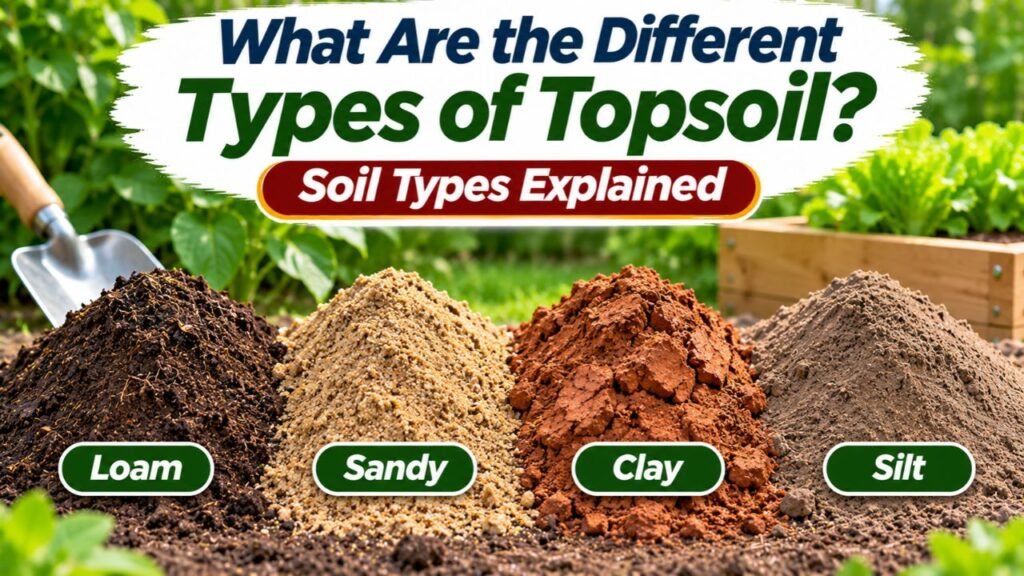
Topsoil can be classified in two main ways: by its natural soil texture and by how it is processed or sold.
These classifications answer different questions.
Soil texture describes the relative proportions of sand, silt, and clay particles.
Commercial topsoil type describes characteristics such as screening, blending, grading, or the material’s intended use.
Main Types of Topsoil by Texture
| Topsoil Type | Texture | Drainage | Water Retention | Common Uses |
| Sandy topsoil | Gritty and loose | Usually fast | Low | Improving drainage in appropriate soil systems |
| Silty topsoil | Smooth and flour-like | Moderate to slow | Moderate to high | Gardens and lawns when structure is good |
| Clay-rich topsoil | Fine, sticky when wet | Often slow | High | Landscapes and crops suited to heavier soils |
| Loamy topsoil | Balanced mixture of particles | Generally moderate | Moderate | Vegetable gardens, lawns, and flower beds |
| Sandy loam topsoil | Loamy soil with substantial sand | Relatively fast | Moderate | Lawns, vegetables, and general landscaping |
| Silt loam topsoil | Loamy soil with substantial silt | Moderate | Moderate to high | Gardens with good structure and drainage |
| Clay loam topsoil | Loamy soil with more clay | Moderate to slow | Relatively high | Gardens where moisture retention is valuable |
These are broad tendencies rather than guaranteed properties.
Soil structure, compaction, organic matter, and the existing ground beneath a topsoil layer also affect drainage and plant growth.
The University of Connecticut Extension’s guide to purchasing topsoil explains that topsoil and loam are not interchangeable terms. Topsoil describes the soil’s position in the ground, while loam is a specific textural classification.
Key Takeaway: Topsoil refers to a surface soil layer, not a single soil texture. Good-quality topsoil can be sandy loam, loam, silt loam, or another suitable texture.
1. Sandy Topsoil
Sandy topsoil contains a relatively high proportion of large mineral particles.
It usually feels gritty and loose when rubbed between your fingers.
Water tends to move through sandy soil quickly because of the relatively large spaces between particles.
Characteristics of Sandy Topsoil
Typical characteristics include:
- Fast water infiltration.
- Relatively low water-holding capacity.
- Good aeration under suitable conditions.
- Low resistance to root penetration.
- Greater potential for nutrient leaching.
- Less tendency to become sticky when wet.
However, extremely sandy soil may dry out too quickly for certain vegetables and landscape plants.
Advantages of Sandy Topsoil
Sandy topsoil can be useful in situations where excessive water retention is a concern.
It also tends to warm relatively quickly in spring.
Its loose texture makes it easier to work than heavily compacted clay.
However, these benefits depend on how the soil is managed.
Limitations of Sandy Topsoil
The main drawback is limited water and nutrient retention.
Plants growing in very sandy topsoil may need more frequent irrigation.
Some nutrients can also move below the root zone when excessive water passes through the soil.
The University of Maryland Extension’s soil basics guide explains that coarse-textured soils typically drain quickly but have lower water- and nutrient-holding capacity.
Best Uses for Sandy Topsoil
Sandy topsoil may be appropriate for:
- Plants that prefer well-drained conditions.
- Certain landscape applications.
- Sites requiring relatively coarse-textured surface soil.
- Soil blends where drainage and aeration need to be balanced.
However, pure sand or extremely sandy soil is not usually the best general-purpose topsoil for vegetable gardens.
Best choice: Sandy loam is often more practical than very sandy topsoil because it retains more moisture while allowing good drainage.
2. Silty Topsoil
Silty topsoil contains a substantial proportion of medium-sized mineral particles.
Silt particles are smaller than sand but larger than clay.
When dry, silty soil often feels smooth or powdery.
When moist, it can feel silky rather than gritty.
Characteristics of Silty Topsoil
Silty soil commonly has:
- Moderate to high moisture retention.
- A smooth, fine texture.
- Greater nutrient-holding capacity than very sandy soil.
- A tendency to compact when poorly managed.
- Vulnerability to erosion when exposed.
- Potential for surface crusting.
Its actual performance depends on soil structure and organic matter.
Advantages of Silty Topsoil
Silt-rich soil can provide a favorable environment for many plants when it has good structure.
It generally holds more moisture than sandy soil.
This can reduce watering requirements under suitable conditions.
Silt loam is often considered a productive garden soil texture.
Limitations of Silty Topsoil
High-silt soil can be susceptible to compaction and erosion.
When soil particles are poorly aggregated, the surface may form a crust after heavy rain.
This can interfere with seedling emergence and water infiltration.
Best Uses for Silty Topsoil
Silty topsoil can be suitable for:
- Vegetable gardens.
- Flower beds.
- Lawns.
- General landscape planting.
- Crops that benefit from consistent soil moisture.
However, well-structured silt loam is generally preferable to nearly pure silt.
Best choice: Silt loam can be productive when drainage and soil structure are properly managed.
3. Clay-Rich Topsoil
Clay-rich topsoil contains a relatively high proportion of very fine mineral particles.
Clay particles have a large surface area relative to their size.
This contributes to their ability to hold water and certain plant nutrients.
However, clay-rich soils can be difficult to manage when compacted or poorly structured.
Characteristics of Clay-Rich Topsoil
Typical characteristics include:
- High moisture-holding capacity.
- Relatively high nutrient-retention potential.
- Sticky or plastic consistency when wet.
- Hard clods when dry.
- Slow infiltration in poorly structured soils.
- Greater susceptibility to compaction.
Clay-rich topsoil isn’t automatically poor-quality soil.
Many productive agricultural soils contain substantial clay.
The challenge is maintaining suitable structure and aeration.
Advantages of Clay-Rich Topsoil
Clay can retain water and certain nutrients more effectively than sand.
This may help plants during periods without rainfall.
Well-structured clay loam can support productive gardens.
Clay-containing soils can also form stable aggregates when organic matter and biological activity are sufficient.
Limitations of Clay-Rich Topsoil
Excessive compaction can reduce pore space.
This limits oxygen movement and slows drainage.
Working clay-rich soil while it is too wet can further damage its structure.
In very dry conditions, some clay soils become hard and difficult to cultivate.
Best Uses for Clay-Rich Topsoil
Clay loam may be suitable for:
- Vegetable gardens with proper drainage.
- Lawns.
- Flower beds.
- Moisture-retentive planting areas.
- Landscapes with plants adapted to heavier soil.
However, very heavy clay is often a poor choice for filling an elevated garden bed or a planter that needs consistent drainage.
Should You Add Sand to Clay Topsoil?
Adding a small amount of sand to heavy clay is generally not an effective shortcut to creating loam.
Large amounts of correctly graded material may be required to change soil texture meaningfully.
For typical home gardens, improving structure with appropriate organic matter and avoiding compaction is often more practical.
Best choice: Clay loam can be useful when well-structured, but extremely clay-heavy topsoil should be evaluated carefully before purchase.
4. Loamy Topsoil
Loamy topsoil is commonly preferred for general gardening because it combines sand, silt, and clay in proportions that provide a useful balance of physical properties.
However, loam does not mean that each particle type makes up exactly one-third of the soil.
The USDA uses specific percentage boundaries to classify loam.
Characteristics of Loamy Topsoil
Good-quality loamy soil commonly has:
- Moderate drainage.
- Useful water-holding capacity.
- Adequate aeration.
- A crumbly structure when well-managed.
- Relatively easy cultivation.
- Suitable conditions for many plant roots.
Its actual fertility depends on nutrient levels, organic matter, pH, and other properties.
Why Is Loamy Topsoil Popular?
Loamy topsoil tends to avoid the extremes associated with very sandy or heavily clay-rich soils.
It can retain moisture while still allowing excess water to drain.
This makes it suitable for many garden and landscape applications.
What Does Loamy Topsoil Look Like?
Loamy topsoil often appears dark brown and crumbly.
When moist, it may form a weak ball that breaks apart with moderate pressure.
However, appearance alone cannot establish its exact texture or quality.
A laboratory soil test provides more reliable information.
Best Uses for Loamy Topsoil
Loamy topsoil is a practical option for:
- Vegetable gardens.
- Flower beds.
- New lawns.
- Landscape planting.
- Improving suitable existing garden areas.
- Ground-connected raised beds.
The University of New Hampshire Extension’s purchasing topsoil guide recommends loam or sandy loam for many landscape uses.
Best choice: Good-quality loamy topsoil is a versatile general-purpose option, particularly when it has suitable organic matter and drainage.
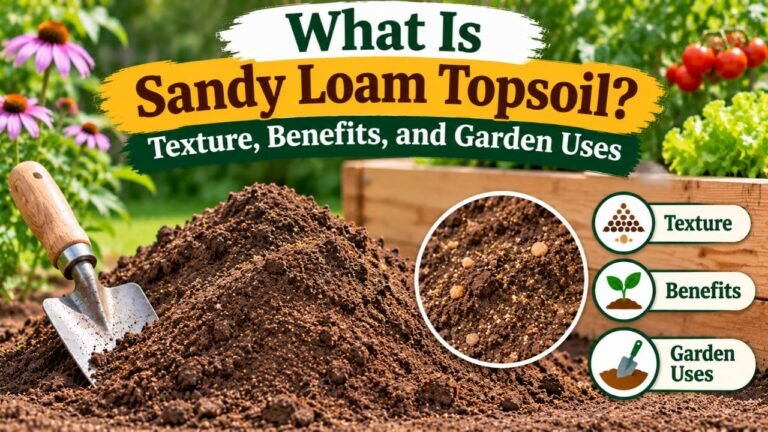
5. Sandy Loam Topsoil
Sandy loam contains a substantial amount of sand along with enough silt and clay to improve moisture and nutrient retention compared with very sandy soil.
It is often one of the most practical topsoil textures for garden and landscape use.
How Sandy Loam Differs From Sand
Very sandy soil generally drains rapidly and has limited water retention.
Sandy loam retains more moisture because its finer particles contribute additional water-holding capacity.
However, it still tends to provide relatively good aeration.
Why Sandy Loam Is Useful
Sandy loam offers several advantages:
- Relatively easy root penetration.
- Good drainage under suitable conditions.
- Less stickiness than clay-heavy soil.
- Better moisture retention than pure sand.
- Convenient cultivation.
However, sandy loam can still dry quickly in hot weather.
Best Uses for Sandy Loam
Sandy loam is often suitable for:
- Vegetable gardens.
- Establishing lawns.
- Flower beds.
- Landscape planting.
- Ground-connected raised beds.
University of Connecticut Extension identifies sandy loam and fine sandy loam as especially desirable topsoil textures because they balance drainage, aeration, and moisture retention.
Key Takeaway: For many residential landscaping projects, sandy loam provides a useful combination of drainage and water retention.
6. Silt Loam Topsoil
Silt loam has a relatively high silt content but also contains sand and clay.
It generally feels smoother than sandy loam.
This soil can be productive because it often retains moisture and supports nutrient availability.
Benefits of Silt Loam
Silt loam can provide:
- Useful moisture retention.
- A favorable environment for many vegetables.
- Moderate drainage when well-structured.
- Good root growth in uncompacted soil.
Main Challenges
Silt loam can compact under repeated foot traffic or heavy equipment.
It may also develop surface crusting.
For best results, avoid walking on planting beds and keep soil covered with appropriate mulch or vegetation.
Best Uses
Silt loam can be suitable for:
- Established garden beds.
- Lawns.
- Flower borders.
- General landscape soil.
However, it should have good structure and appropriate drainage.
7. Clay Loam Topsoil
Clay loam combines the characteristics of loam with a relatively higher clay content.
It typically holds more water than sandy loam but may drain more slowly.
Benefits of Clay Loam
Clay loam can provide good moisture and nutrient retention.
When it has stable aggregates and sufficient pore space, it can support productive plant growth.
Main Challenges
It may become compacted when worked wet.
Some clay loams dry into hard clods.
Drainage can also be a concern where the soil is compacted or the site remains waterlogged.
Best Uses
Clay loam can work for:
- General garden beds.
- Lawns with appropriate drainage.
- Moisture-retentive landscapes.
- Established planting areas.
However, for a new raised bed where drainage is the priority, sandy loam may be easier to manage.
Are There More Than Four Types of Topsoil?
Yes.
Sandy, silty, clay-rich, and loamy are broad descriptions.
The USDA recognizes 12 basic mineral soil texture classes, based on the percentages of sand, silt, and clay.
These classes include:
| USDA Soil Texture Class | Broad Description |
| Sand | Very coarse-textured |
| Loamy sand | Predominantly sand with some finer particles |
| Sandy loam | Moderately coarse-textured |
| Loam | Balanced medium texture |
| Silt loam | Medium-textured, silt-rich |
| Silt | Dominated by silt-sized particles |
| Sandy clay loam | Moderately fine, with substantial sand and clay |
| Clay loam | Moderately fine-textured |
| Silty clay loam | Moderately fine, with substantial silt and clay |
| Sandy clay | Fine-textured, with substantial sand and clay |
| Silty clay | Fine-textured, with substantial silt and clay |
| Clay | Fine-textured, clay-rich |
The Minnesota Pollution Control Agency’s soil classification reference identifies these 12 USDA texture classes.
A soil texture triangle is used to determine the class from measured sand, silt, and clay percentages.
However, these classifications apply to mineral soil texture generally, not exclusively to topsoil.
The same texture class can occur in topsoil or deeper soil horizons.
What About Peaty and Chalky Topsoil?
Gardeners sometimes see additional descriptions such as peaty or chalky soil.
These terms emphasize different properties.
Peaty soil contains substantial organic material and may hold considerable moisture.
Chalky soil contains calcium carbonate and is often alkaline.
Neither term replaces the USDA’s 12 basic mineral-texture classifications.
A soil can be sandy or loamy in texture while also having a high calcium carbonate content.
Likewise, organic-rich soil should not automatically be considered good-quality topsoil for every plant.
What Are the Different Types of Topsoil Sold by Suppliers?
Topsoil sold at garden centers and landscape suppliers is often categorized by processing, texture, or intended application.
These labels aren’t always used consistently.
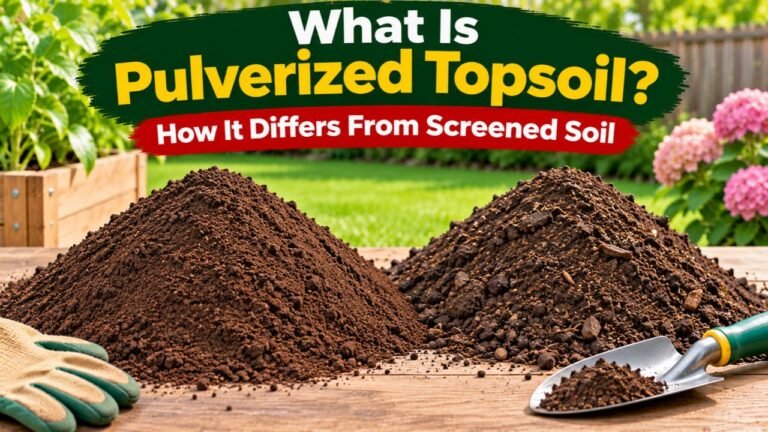
1. Screened Topsoil
Screened topsoil has passed through screening equipment to remove larger stones, roots, and debris.
The mesh size varies by supplier.
Screening can make the soil easier to spread and level.
However, it doesn’t automatically improve fertility or eliminate fine contaminants.
Best uses: New lawns, garden beds, flower borders, and landscaping where relatively uniform texture is useful.
2. Unscreened Topsoil
Unscreened topsoil is typically sold without mechanical separation of larger materials.
It may contain stones, roots, clods, and other naturally occurring debris.
Its quality depends heavily on the source.
Unscreened soil is sometimes less expensive, but it may require additional preparation.
Best uses: Certain rough landscaping projects or larger soil-filling applications where the material has been inspected and is suitable.
It is less convenient for seedbeds and fine lawn preparation.
3. Compost-Blended Topsoil
Compost-blended topsoil combines mineral soil with finished compost.
The compost contributes organic matter and may improve soil structure and water retention.
However, the result depends on the proportions and quality of the ingredients.
Too much compost can create excessive nutrient levels or soluble salt concerns.
Best uses: Vegetable gardens, flower beds, and raised beds when the blend has suitable texture and test results.
4. Manufactured or Engineered Topsoil
Manufactured topsoil is created by blending selected mineral materials and organic amendments.
It may be designed to meet a particular texture or landscaping specification.
However, the term manufactured doesn’t guarantee good quality.
The ingredient proportions and laboratory results matter.
Best uses: Landscape construction, planting areas, and projects requiring consistent soil specifications.
5. Premium Topsoil
Premium topsoil is generally marketed as a higher-quality product.
It may be screened, blended, or selected for a particular texture.
However, the term premium isn’t a universally standardized quality grade in the United States.
Ask for actual test results.
6. General-Purpose Topsoil
General-purpose topsoil is marketed for common landscaping and gardening activities.
It may be suitable for lawns, beds, and borders.
However, the name doesn’t establish its drainage properties or fertility.
7. Economy Topsoil
Economy topsoil is usually marketed as a lower-cost option.
It may be less processed or supplied with more variable texture.
Inspect it carefully before buying.
Commercial Topsoil Comparison
| Product Type | Main Difference | What to Check |
| Screened | Larger debris removed | Screening size, texture, contamination |
| Unscreened | Minimal processing | Stones, roots, weeds, debris |
| Compost-blended | Added organic amendment | Compost percentage, salts, nutrients |
| Manufactured | Deliberately mixed ingredients | Recipe and laboratory analysis |
| Premium | Seller’s quality designation | Actual test results |
| General-purpose | Broad intended use | Texture and pH |
| Economy | Lower-cost category | Source and consistency |
The Royal Horticultural Society’s topsoil buying guide distinguishes premium, general-purpose, and economy grades in its UK guidance.
However, British standards and seller-defined grading systems should not be assumed to apply universally to U.S. topsoil products.
Which Type of Topsoil Is Best for a Vegetable Garden?
For many vegetable gardens, good-quality sandy loam or loam with appropriate organic matter is a practical choice.
These textures can provide a useful balance between drainage, moisture retention, and aeration.
What Vegetables Need From Topsoil
Vegetable roots need:
- Adequate moisture.
- Sufficient oxygen.
- Appropriate nutrients.
- Suitable pH.
- Enough rooting space.
- Soil free from harmful contamination.
A topsoil product may look dark and fertile but still have unsuitable pH or excessive salt levels.
Is Compost-Blended Topsoil Good for Vegetables?
Yes, when the blend contains suitable mineral soil and properly finished compost.
University of Maryland Extension notes that topsoil-compost blends can provide an excellent growing medium for raised beds.
However, ask about the compost percentage and product testing.
A blend dominated by compost isn’t necessarily preferable.
Should You Use Pure Topsoil for Vegetables?
Pure mineral topsoil may support vegetables if its structure, drainage, and nutrient levels are appropriate.
However, many gardens benefit from suitable organic matter.
Use a soil test to decide whether additional compost or fertilizer is needed.
Which Type of Topsoil Is Best for Raised Garden Beds?
For open-bottom raised garden beds, good-quality sandy loam or loam is often suitable.
A compost-blended topsoil can also work well if the proportions are appropriate.
However, the correct product depends on the raised-bed design.
Open-Bottom Raised Beds
These beds connect directly to the existing ground.
Roots can extend into suitable soil below.
A mineral topsoil or topsoil-compost blend may provide an effective growing medium.
Choose soil with good structure and adequate drainage.
Raised Beds Over Concrete
A raised bed placed over concrete has a restricted rooting volume.
It needs sufficient soil depth and a functional drainage system.
A dense clay-heavy topsoil may be inappropriate.
Use a growing medium suitable for the enclosed or partly enclosed design.
Elevated Planters
Elevated planters with bottoms behave more like large containers.
Ordinary field topsoil can become heavy and may compact or drain poorly in containers.
A suitable raised-planter or container growing mix may be a better choice.
Should You Fill a Raised Bed With 100% Compost?
Usually not.
Pure compost can contain excessive nutrients or soluble salts depending on its source.
It may also settle substantially.
For ground-connected raised beds, an appropriate mineral-soil and finished-compost blend is often more balanced.
Key Takeaway: The best raised-bed soil depends on whether the roots can grow into the ground below. Ground-connected beds and enclosed planters don’t necessarily need the same material.
Which Type of Topsoil Is Best for Lawns?
For establishing a lawn, sandy loam or good-quality loam is generally a useful choice.
The soil should provide drainage while retaining enough moisture for grass growth.
Topsoil for New Lawns
When preparing a new lawn, you may need to add topsoil to create a suitable rooting layer.
Choose a uniform, reasonably fine-textured material.
Avoid soil containing large stones, construction debris, or excessive clay.
Topsoil for Lawn Leveling
For lawn leveling, the material should be compatible with the existing soil and appropriate for the grass.
Very different soil textures can create undesirable layering.
Apply thin amounts rather than covering living grass with a thick layer of soil.
Topsoil for Lawn Topdressing
Screened topsoil may be useful for certain lawn topdressing applications.
However, a lawn topdressing blend should be chosen based on the existing soil and purpose.
Adding an incompatible material can affect water movement.
How Much Topsoil Does a New Lawn Need?
The Royal Horticultural Society recommends at least approximately 4 inches of topsoil for laying a new lawn where adequate topsoil is absent.
However, actual site preparation depends on the existing soil profile, drainage, and intended turf use.
A lawn over healthy existing topsoil may not need a completely new 4-inch layer.
Which Type of Topsoil Is Best for Flower Beds?
Loam, sandy loam, and suitable silt loam can all work well for flower beds.
However, plant requirements matter.
General Flower Gardens
Many common flowering plants grow well in fertile, well-drained loam.
Compost can improve soil structure where needed.
Drought-Tolerant Flowers
Certain drought-tolerant species prefer relatively well-drained soil.
Sandy loam may be suitable.
However, avoid assuming that every drought-tolerant flower needs extremely sandy soil.
Moisture-Loving Flowers
Some plants prefer soil that retains more moisture.
A suitable loam or silt loam may work well.
However, moisture retention should not be confused with permanent saturation.
Acid-Loving Flowers
Plants such as azaleas and rhododendrons have particular soil pH requirements.
Topsoil texture alone doesn’t determine whether the soil is suitable.
Check pH before making amendments.
How Can You Identify Different Types of Topsoil?
You can estimate soil texture using simple observations.
However, laboratory testing is more reliable when purchasing a large quantity of topsoil.
The Hand-Feel Test
Take a small soil sample.
Remove stones and large organic debris.
Add a little water until the soil is moist but not muddy.
Rub it between your fingers.
- Sandy soil: Feels noticeably gritty.
- Silty soil: Feels smooth or flour-like.
- Clay-rich soil: Feels sticky and forms a ribbon when pressed.
- Loamy soil: Has a mixture of characteristics without one extreme dominating.
This is an approximate field test.
It doesn’t provide exact sand, silt, and clay percentages.
The Ribbon Test
Moisten the soil and squeeze it between your thumb and forefinger.
Try to form a narrow ribbon.
Sandy soil generally breaks apart quickly.
Clay-rich soil can form a longer ribbon.
Loamy soils usually produce intermediate results.
The University of Georgia’s soil texture guide describes how grittiness, smoothness, and ribbon length can help distinguish major soil texture classes.
The Jar Test
A settling jar can provide a rough visual estimate of soil particle fractions.
To try it:
- Collect a representative soil sample.
- Remove large stones, roots, and debris.
- Place soil in a transparent jar.
- Add water and a suitable dispersing agent if using an established test procedure.
- Shake thoroughly.
- Allow the particles to settle.
- Compare the visible sediment layers.
Larger particles generally settle faster than smaller particles.
However, organic matter, aggregation, and incomplete dispersion can make jar-test results inaccurate.
Don’t rely on a simple jar test alone to assign an exact USDA texture class.
Laboratory Soil Testing
A laboratory can provide more dependable information.
Depending on the test package, results may include:
- Soil pH.
- Organic matter.
- Nutrient levels.
- Soluble salts.
- Soil texture.
- Certain contaminants.
Not every standard fertility test includes texture or contamination screening.
Ask the laboratory which analyses are included.
Key Takeaway: Hand-feel testing is useful for identifying obvious differences, but laboratory testing is preferable when buying bulk topsoil for a major garden project.
How to Choose Good-Quality Topsoil
The label alone doesn’t reveal whether a topsoil product is suitable.
Evaluate the actual material.
1. Check the Texture
For many garden and landscape projects, loam or sandy loam is a practical choice.
Avoid products dominated by pure sand or very heavy clay unless the project specifically requires those properties.
2. Examine the Structure
Good garden topsoil often forms small, crumbly aggregates.
Avoid severely compacted clods that are difficult to break apart.
However, soil texture and moisture affect its appearance.
A dry clay loam may look harder than it behaves after proper management.
3. Check the Organic Matter
Organic matter contributes to soil aggregation, moisture retention, and nutrient storage.
University of Connecticut Extension suggests that purchased topsoil should generally contain approximately 2%–10% organic matter.
However, the optimal amount varies with soil texture, intended use, and source material.
More organic matter isn’t automatically better.
4. Ask About Soil pH
Many landscape and garden plants grow well within a moderately acidic to near-neutral pH range.
However, specific crops have different requirements.
University of New Hampshire Extension identifies approximately pH 5.5–7.5 as an acceptable range for many purchased topsoil applications.
Check the needs of the plants you intend to grow.
5. Look for Debris
Inspect the soil for:
- Glass.
- Plastic.
- Bricks.
- Construction waste.
- Large stones.
- Persistent weed roots.
- Unusual foreign materials.
A reputable supplier should be able to explain the source and processing of the soil.
6. Ask for Soil Test Results
Request recent analytical results where available.
Useful information includes soil texture, pH, organic matter, and nutrient status.
For some projects, soluble salt and contaminant testing may be important.
The University of Maine Cooperative Extension’s soil purchasing guide recommends asking vendors about the soil’s source and testing information before purchasing.
7. Consider Contamination Risks
For vegetable gardens, investigate the origin of purchased topsoil.
Soil from industrial or historically contaminated locations may require special attention.
If contamination is suspected, ask about appropriate testing for substances such as lead.
A standard nutrient test doesn’t necessarily check for heavy metals or petroleum contamination.
8. Don’t Rely on Dark Color Alone
Dark soil may contain substantial organic matter.
However, color doesn’t establish:
- Nutrient balance.
- Texture.
- pH.
- Salt concentration.
- Drainage properties.
- Contamination status.
A very dark product may still be inappropriate for your project.
Key Takeaway: Good topsoil should be evaluated through texture, structure, source, and testing—not color or marketing terms alone.
What Is the Difference Between Topsoil, Garden Soil, and Potting Soil?
These products are often sold near each other, but they aren’t necessarily interchangeable.
| Product | What It Typically Contains | Intended Use |
| Topsoil | Mineral soil containing sand, silt, and clay, with varying organic matter | Lawns, landscaping, garden beds |
| Garden soil | Often soil blended with organic amendments | In-ground garden beds |
| Raised-bed mix | Formulated mixture that may contain mineral soil, compost, and other ingredients | Raised beds, depending on design |
| Potting mix | Usually lightweight materials such as bark, coir, peat, perlite, or compost | Pots and containers |
| Compost | Decomposed organic material | Soil amendment |
Product formulas vary by manufacturer.
A bag labeled garden soil may contain different ingredients from another brand’s product.
Can You Use Topsoil in Containers?
Ordinary field topsoil is usually not the best choice for small plant containers.
It can be heavy and may compact or drain poorly when used by itself.
A quality potting mix is generally more suitable.
Can You Use Potting Soil Instead of Topsoil?
Potting mix can support plants in containers, but it may not be the most economical or appropriate material for building large landscape soil layers.
It also behaves differently from mineral topsoil.
Is Compost the Same as Topsoil?
No.
Compost is an organic amendment.
Topsoil is a soil layer containing mineral particles and varying amounts of organic matter.
Compost can improve certain soil properties, but it isn’t necessarily a complete replacement for mineral soil.
Is Screened Topsoil Better Than Unscreened Topsoil?
Screened topsoil is generally more convenient for projects requiring a uniform material.
However, screening alone doesn’t establish quality.
Benefits of Screened Topsoil
Screened topsoil typically contains fewer large stones and roots.
This makes it easier to:
- Spread over prepared ground.
- Rake into planting beds.
- Level certain landscape areas.
- Prepare fine seedbeds.
- Work into garden projects.
Limitations of Screened Topsoil
Screening doesn’t necessarily remove:
- Weed seeds.
- Chemical contaminants.
- Excess fertilizer salts.
- Unsuitable mineral composition.
- Soil-borne plant pathogens.
A screened product may still have too much sand or clay for your intended application.
When Unscreened Topsoil May Be Suitable
Unscreened material may be acceptable for certain large-scale landscape applications when the material has been inspected.
However, for vegetable gardens and new lawns, the additional work required to remove stones and debris may outweigh the initial savings.
Key Takeaway: Screened topsoil is easier to handle, but screening isn’t a substitute for verifying soil quality.
How Much Topsoil Do You Need?
Once you’ve selected a suitable type, calculate the volume required for your project.
For a rectangular area, use:
Topsoil volume (cubic feet) = Length (ft) × Width (ft) × Depth (ft)
Convert cubic feet to cubic yards by dividing by 27.
Example: 4×8 Raised Garden Bed
A bed measuring 4 feet wide and 8 feet long has an area of 32 square feet.
If you want 12 inches of topsoil:
4 × 8 × 1 = 32 cubic feet
32 ÷ 27 = 1.19 cubic yards
That is the geometric volume before allowing for settling or any additional materials.
Topsoil Volume Table
| Area | Soil Depth | Approximate Volume |
| 4×4 ft | 6 inches | 0.30 cubic yards |
| 4×8 ft | 6 inches | 0.59 cubic yards |
| 4×8 ft | 12 inches | 1.19 cubic yards |
| 10×10 ft | 4 inches | 1.23 cubic yards |
| 10×20 ft | 4 inches | 2.47 cubic yards |
| 20×20 ft | 4 inches | 4.94 cubic yards |
These calculations assume level, rectangular areas.
Actual requirements may differ because of uneven ground, compaction, or settling.
When ordering bulk topsoil, discuss delivery quantities and expected settling with the supplier.
Common Mistakes When Choosing Types of Topsoil
Assuming All Topsoil Is Loam
Topsoil can have many textures.
Some products are sandy, while others contain substantial clay or silt.
Ask for the actual texture classification.
Buying Based Only on Color
Dark color may suggest organic matter, but it doesn’t guarantee fertility or drainage.
Request testing information when possible.
Assuming Screened Means Contaminant-Free
Screening removes larger physical debris.
It doesn’t reliably remove dissolved contaminants or weed seeds.
Using Pure Sand as General Garden Topsoil
Very sandy materials may drain too quickly and retain insufficient moisture for many plants.
Consider sandy loam or another suitable blended soil.
Adding Large Amounts of Sand to Clay Soil
Small additions of sand usually don’t transform heavy clay into loam.
Improving soil structure and managing organic matter is often more practical.
Filling Containers With Ordinary Topsoil
Field topsoil may compact or drain poorly in pots.
Use a growing mix designed for the container.
Adding Too Much Compost
Excessive compost can contribute to nutrient or soluble salt problems.
Choose appropriate blends and follow soil-test results.
Ignoring the Existing Soil
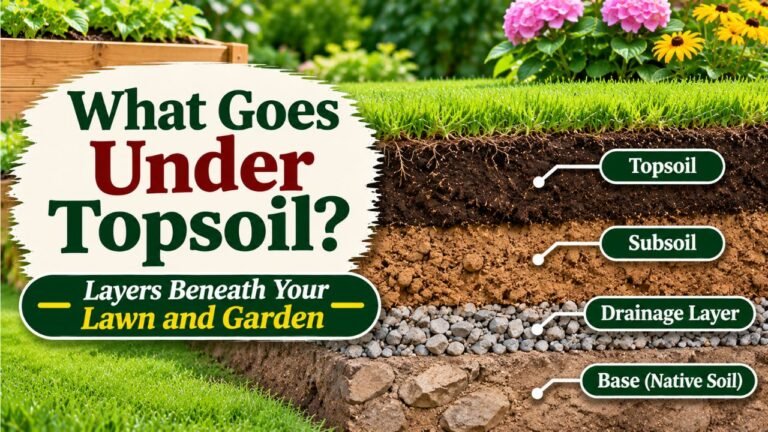
Adding a new layer of topsoil doesn’t automatically fix compacted or poorly drained ground underneath.
Evaluate the full root zone.
Purchasing Bulk Soil Without Inspection
Large deliveries are difficult to return or correct once spread.
Inspect a sample and ask about its source before ordering.
Ignoring Plant-Specific Requirements
No single topsoil texture or pH works equally well for every crop.
Choose soil based on the intended plants and growing conditions.
Which Type of Topsoil Should You Choose?
For most residential projects, the choice can be simplified by matching soil texture and preparation to the intended use.
| Project | Practical Topsoil Choice | Why |
| Vegetable garden | Sandy loam or loam with suitable organic matter | Balanced drainage and water retention |
| Open-bottom raised bed | Quality loam or suitable topsoil-compost blend | Provides a mineral growing layer |
| New lawn | Good-quality sandy loam or loam | Supports rooting and drainage |
| Flower garden | Loam or suitable silt loam | Useful moisture and nutrient balance |
| Lawn topdressing | Fine, screened, compatible material | Easier distribution in thin layers |
| Landscape grading | Suitable tested topsoil chosen for the site | Helps establish vegetation |
| Enclosed raised planter | Appropriate planter or container mix | Better suited to restricted drainage |
| Drought-tolerant planting | Suitable well-drained soil, often sandy loam | Reduces prolonged saturation |
The best topsoil is the one that performs well in your actual growing conditions.
For general-purpose gardening, I would usually begin by comparing good-quality loam and sandy loam.
However, if your existing soil is already healthy and productive, improving it with appropriate management may be better than purchasing a large quantity of replacement topsoil.
Conclusion
The answer to what are the different types of topsoil depends on whether you’re describing natural soil texture or commercially prepared products.
The four broad texture groups are sandy, silty, clay-rich, and loamy topsoil. More specific classifications include sandy loam, silt loam, and clay loam, while the USDA recognizes 12 basic mineral soil texture classes.
Commercial suppliers also offer screened, unscreened, compost-blended, and manufactured topsoil, along with product descriptions such as premium and general-purpose.
For most vegetable gardens, flower beds, and lawns, good-quality loam or sandy loam offers a useful balance of drainage, moisture retention, and aeration. However, no single soil is ideal for every plant or growing environment.
I recommend choosing topsoil based on texture, organic matter, drainage, pH, and verified source information rather than appearance or marketing labels. If you’re buying a large quantity, inspect a sample and request soil test results before delivery.
Understanding these differences helps you select soil that supports healthy roots, efficient watering, and productive plant growth.
FAQs About Different Types of Topsoil
What Are the Four Main Types of Topsoil?
The four broad categories are sandy, silty, clay-rich, and loamy topsoil.
They differ mainly in the proportions of sand, silt, and clay particles.
However, the USDA recognizes 12 more specific mineral soil texture classes.
What Is the Best Type of Topsoil for Gardening?
Good-quality loam or sandy loam is often suitable for general gardening.
These textures usually provide a practical balance between drainage and water retention.
However, soil pH, organic matter, fertility, and plant requirements are also important.
Is Sandy Loam Better Than Regular Topsoil?
Sandy loam is a specific soil texture, while topsoil refers to a surface soil layer.
Therefore, the terms aren’t directly comparable.
Sandy loam topsoil is often useful for gardens and lawns because it generally drains well while retaining more moisture than pure sand.
What Is the Difference Between Screened and Unscreened Topsoil?
Screened topsoil has been processed to remove larger stones, roots, and debris.
Unscreened topsoil is sold with less processing and may contain more coarse material.
However, screening doesn’t guarantee that the soil has appropriate nutrients, pH, or freedom from contaminants.
What Type of Topsoil Is Best for a Lawn?
Sandy loam or good-quality loam is generally a practical choice for establishing a new lawn.
The soil should support drainage and root development.
For topdressing established grass, choose a material compatible with the existing soil and apply it appropriately.
What Is Premium Topsoil?
Premium topsoil is a commercial quality description.
It may refer to screened, blended, or specially selected soil.
However, the term isn’t a universal U.S. quality standard.
Ask about texture, pH, organic matter, and laboratory test results before buying.
Is Black Topsoil Better Than Brown Topsoil?
Not necessarily.
Dark soil may contain more organic matter, but color alone doesn’t establish quality.
Brown topsoil can be productive, while black material may have unsuitable texture, excessive salts, or other problems.
Use soil testing and physical inspection rather than color alone.
Can You Use Topsoil in Raised Garden Beds?
Yes.
Good-quality mineral topsoil or a suitable topsoil-compost blend can work in open-bottom raised beds.
For raised planters with solid bottoms, a growing medium designed for containers may be more appropriate.
Is Compost-Blended Topsoil Better Than Pure Topsoil?
It depends on the original soil and the quality of the compost.
A suitable blend can improve soil structure and water retention.
However, excessive compost may increase nutrient or salt levels.
The best mixture depends on the intended plants and soil test results.
How Can You Tell if Topsoil Is Good Quality?
Inspect its texture, structure, smell, and visible debris.
Ask the supplier about the soil’s origin and processing.
For a reliable assessment, request laboratory results covering relevant properties such as texture, pH, organic matter, and nutrients.
For food gardens, investigate contamination risks when the soil source is uncertain.
Does Topsoil Always Contain Organic Matter?
Natural topsoil generally contains organic matter mixed with mineral particles, although the amount varies.
However, a product sold as topsoil may contain relatively little organic matter depending on its source and processing.
Its actual composition should be verified.
Can I Mix Different Types of Topsoil?
Yes, but blending different soils doesn’t automatically produce ideal loam.
The result depends on the proportions, texture, structure, and organic matter of the ingredients.
For major landscaping or gardening projects, it’s better to choose a tested growing medium with suitable properties than to combine unsuitable materials at random.

I’m Maya L. Greenwood, a lifelong plant lover who believes anyone can grow something beautiful with the right guidance. After years of testing soil mixes, pruning methods, irrigation tricks, and pest-safe solutions, I started EasyGardenTips.com to turn hard-won lessons into step-by-step advice. From seed starting and container gardens to composting and seasonal checklists, my goal is to make gardening simple, sustainable, and fun.