What Is Pulverized Topsoil? How It Differs From Screened Soil
Pulverized topsoil is natural topsoil that has been mechanically broken into smaller, looser clumps, making it easier to shovel, rake, level, and spread. It is commonly used for lawn preparation, landscaping, filling low spots, and improving planting areas. Some suppliers also screen pulverized soil to remove larger stones, roots, and debris.
Unlike ordinary unscreened topsoil, pulverized topsoil usually has a finer, more uniform appearance. This makes it convenient for projects where smooth grading and easy handling are important.
However, pulverized does not automatically mean nutrient-rich, weed-free, or suitable for every garden. The processing improves workability, but it does not necessarily change the soil’s natural sand, silt, and clay proportions.
Very finely processed soil can also become compacted or develop a hard surface crust under certain conditions.
In this article, I explain what pulverized topsoil is, how manufacturers process it, and how it compares with screened and regular topsoil. I also cover its benefits, limitations, common landscaping uses, suitability for raised garden beds, and what to inspect before buying.
What Is Pulverized Topsoil and How Is It Made?
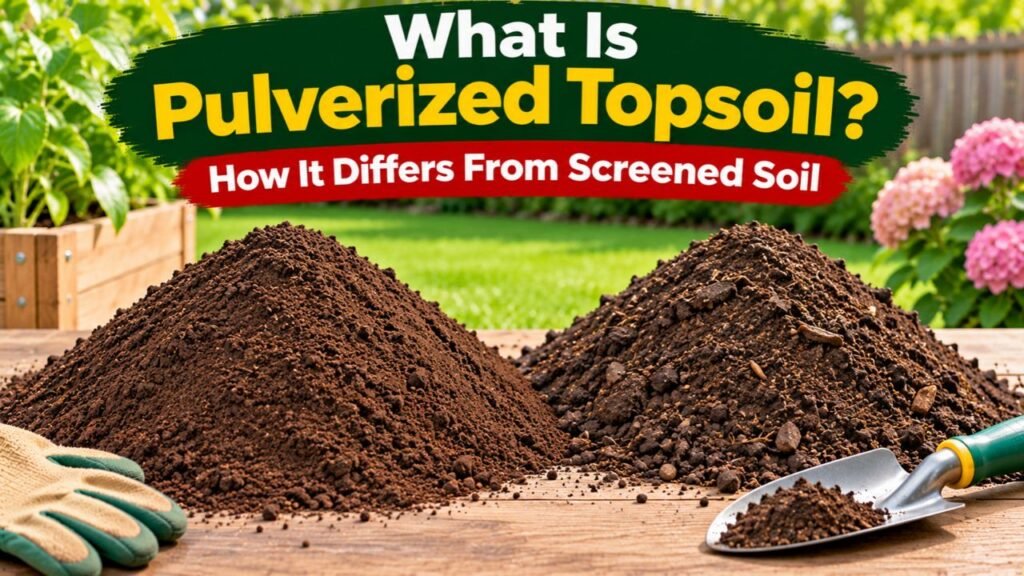
Pulverized topsoil is a processed form of topsoil in which large soil clumps are mechanically broken apart.
The main objective is to create a loose, relatively uniform material that is easier to handle and distribute.
What Does Pulverized Mean?
The word pulverized refers to material that has been crushed, broken, or reduced into smaller pieces.
In landscaping, it usually describes topsoil that has passed through equipment designed to break apart clods.
The process does not necessarily grind every mineral particle into powder.
Instead, it mainly breaks up larger clumps of soil.
For example, a hard lump of clay-rich topsoil may be broken into numerous smaller pieces.
This makes the material easier to spread.
However, the clay particles remain part of the soil, so the material may still behave like clay-rich soil after wetting.
How Is Pulverized Topsoil Processed?
Production methods vary between suppliers.
A typical process may involve several stages.
Step 1: Collecting Natural Topsoil
Soil is collected from an approved source, such as an agricultural field or landscaping excavation.
Its original composition depends on where it was obtained.
Some topsoil is naturally sandy, while other deposits contain more silt or clay.
Step 2: Breaking Large Clumps
The collected soil passes through mechanical processing equipment.
Depending on the supplier, the machine may use rotating hammers, shredders, or other mechanisms to break apart compacted clumps.
Step 3: Screening, When Included
Some producers also pass the soil through a screen.
This separates larger stones, roots, and debris from the finer material.
However, screening is not automatically part of every pulverizing process.
Step 4: Collecting the Processed Soil
The resulting material is collected into stockpiles or loaded for delivery.
It generally has a more consistent texture than freshly excavated, unprocessed soil.
Step 5: Optional Blending
Some suppliers mix the processed soil with compost or other materials.
This creates a blended garden soil product.
However, a product labeled only as pulverized topsoil should not be assumed to contain compost or fertilizer.
According to Roberts Topsoil’s soil terminology guide, pulverizing uses mechanical force to break apart soil clumps, while screening removes larger materials through a mesh.
The distinction matters because a soil can be pulverized without being screened, screened without extensive pulverization, or both.
What Does Pulverized Topsoil Look Like?
Pulverized topsoil usually looks finer and more uniform than unprocessed topsoil.
It often appears loose and crumbly when dry enough to handle.
Common Physical Characteristics
Depending on the source, it may have:
- A relatively fine, uniform appearance.
- Smaller soil clumps.
- Fewer large aggregates.
- A loose texture immediately after processing.
- Dark brown, medium brown, or another natural soil color.
- Small mineral particles.
- Some organic material.
- Small stones or other debris if screening was limited.
Color alone does not determine quality.
Dark topsoil may contain useful organic matter, but a dark color does not prove that its nutrient levels are ideal.
Likewise, lighter topsoil is not automatically unsuitable.
Is Pulverized Topsoil Soft?
It often feels soft and loose immediately after processing.
This is one reason landscapers find it convenient to shovel and rake.
However, the initial fluffiness may not last.
Rain, irrigation, foot traffic, and settling can cause the soil to become denser.
Clay-rich pulverized soil may form hard clods again after repeated wetting and drying.
Is Pulverized Topsoil the Same as Fine Soil?
Not exactly.
Pulverizing reduces the size of soil clumps, but it does not necessarily change the underlying soil texture.
Soil texture refers to the relative proportions of sand, silt, and clay.
Soil structure describes how those particles form aggregates and pore spaces.
A pulverized clay soil remains clay-rich even though it temporarily looks finer and looser.
This distinction is important when assessing drainage and long-term growing conditions.
Pulverized Topsoil vs. Screened Topsoil: What’s the Difference?
Pulverizing and screening are two different soil-processing methods.
They are sometimes used together, which explains why landscaping suppliers may use the terms interchangeably.
Pulverized Topsoil
Pulverized topsoil is mechanically broken apart to reduce larger clumps.
The primary purpose is to improve workability.
The process may leave stones, roots, or debris unless the material is also screened.
Screened Topsoil
Screened topsoil passes through a mesh screen.
The screen separates materials larger than its openings.
This may remove:
- Large rocks.
- Roots.
- Sticks.
- Construction debris.
- Oversized soil clumps.
Screening improves material uniformity, but it does not guarantee that every remaining soil clump has been pulverized.
Comparison Table
| Feature | Pulverized Topsoil | Screened Topsoil |
| Main process | Mechanical breaking of clumps | Passing soil through a screen |
| Primary purpose | Improve soil workability | Remove oversized material |
| Clump size | Usually smaller | Limited by screen size and processing |
| Rocks and debris | May remain | Larger pieces are removed |
| Texture | Often loose and fine-looking | Depends on original soil |
| Nutrient content | Depends on source and amendments | Depends on source and amendments |
| Suitable for lawns | Often useful | Often useful |
| Suitable for gardens | Depends on actual soil quality | Depends on actual soil quality |
Is Screened and Pulverized Topsoil the Same Product?
Sometimes.
For example, Wright Landscape Supply’s description of pulverized topsoil explains that its product is both screened and pulverized.
Other suppliers distinguish between these operations.
Therefore, ask what processing the soil actually receives rather than relying on its product name alone.
Which Is Better?
Neither is universally better.
If your main concern is avoiding rocks and roots, screened soil may be more appropriate.
If you need to spread and level soil easily, pulverized soil may offer a handling advantage.
For lawns and gardens, the most important qualities are still appropriate texture, drainage, organic matter, and freedom from contamination.
Pulverized Topsoil vs. Regular Topsoil
Regular topsoil is the natural upper soil layer or a commercially sold material intended to represent it.
When sold without processing, it may contain large clumps, stones, roots, and other materials.
Pulverized topsoil has undergone additional mechanical processing.
Main Differences
| Feature | Regular Unprocessed Topsoil | Pulverized Topsoil |
| Appearance | May contain uneven clumps | Usually more uniform |
| Shoveling | Can be difficult when clumpy | Often easier |
| Raking | May require breaking clods | Generally easier |
| Large stones | May be present | Depends on screening |
| Soil fertility | Depends on original soil | Depends on original soil |
| Drainage | Depends on soil composition and structure | Depends on soil composition and structure |
| Cost | Often lower | May cost more due to processing |
| Best applications | Bulk grading and general landscaping | Fine grading and planting preparation |
Is Pulverized Topsoil More Fertile?
Not necessarily.
Pulverizing does not automatically add nutrients.
If the original soil has low organic matter or inadequate nutrient levels, the processed soil may have the same limitations.
A supplier might blend compost into the material, but that is a separate operation.
Does Pulverizing Improve Drainage?
Not automatically.
Breaking clumps temporarily loosens the material, but the underlying sand, silt, and clay composition still influences water movement.
Fine clay-rich soil may become dense after settling.
Soil with stable aggregates and connected pore spaces generally provides a better long-term environment for water movement and root development.
The Penn State Extension guide to soil quality explains how soil structure and pore spaces influence the movement of air, water, roots, and soil organisms.
Key Takeaway: Pulverized topsoil is usually easier to spread than unprocessed soil, but processing alone does not guarantee better fertility or drainage.
What Is Pulverized Topsoil Used For?
Pulverized topsoil is commonly used in landscaping projects that benefit from a consistent, easy-to-spread material.
Its fine appearance makes it particularly convenient for surface preparation.
1. Preparing Soil for a New Lawn
Pulverized topsoil can help create a relatively smooth planting surface before grass seeding or sod installation.
It can be spread and raked to improve grading.
The material should be suitable for turfgrass growth, with adequate drainage and nutrient availability.
However, a loose surface layer is not enough if the underlying soil remains severely compacted.
2. Filling Low Spots in a Yard
Pulverized topsoil is commonly used to fill shallow depressions.
Its consistency makes it easier to distribute and level than soil containing large clumps.
After spreading, the soil should be settled appropriately.
Remember that newly delivered loose topsoil may settle after rain and irrigation.
3. Preparing Flower Beds
It can be incorporated into planting areas when additional mineral soil is needed.
If the material has low organic matter, finished compost may improve the growing environment.
Avoid simply placing a thick, poorly draining clay-rich layer over existing soil without assessing drainage.
4. Filling Raised Garden Beds
Pulverized topsoil can serve as a mineral-soil component of a raised-bed mix.
However, it should not automatically be used as the only ingredient.
Its suitability depends on soil texture, drainage, organic matter, and the bed’s construction.
5. Preparing a Vegetable Garden
A suitable pulverized loam can help establish a workable soil surface.
It may be useful when a garden needs additional topsoil.
However, a very finely pulverized product may require careful management to prevent surface crusting.
6. Fine Grading Around Landscaping
Pulverized topsoil can be useful when smoothing the final planting surface.
It is easier to rake than soil containing large clumps.
However, it is not a substitute for properly compacted structural fill beneath buildings, retaining structures, or paved surfaces.
Also maintain appropriate drainage away from foundations.
7. Topdressing Selected Lawn Areas
A small quantity of suitable pulverized topsoil may be useful for correcting minor uneven areas in an established lawn.
However, it should be applied thinly enough that existing grass remains exposed.
Heavy applications can bury or smother turf.
For broad lawn topdressing, choose material compatible with the existing soil and follow local turfgrass guidance.
Is Pulverized Topsoil Good for Grass?
Yes, suitable pulverized topsoil can work well for new grass planting.
Its fine, workable consistency makes it convenient for preparing a smooth seedbed.
However, soil composition and preparation are more important than how finely it has been processed.
Benefits for Lawn Establishment
Potential advantages include:
- Easier grading.
- Fewer large clumps around grass seed.
- Better seed-to-soil contact when properly prepared.
- More consistent surface leveling.
- Convenient spreading before seeding.
- Easier correction of minor depressions.
How to Use Pulverized Topsoil for a New Lawn
- Remove construction debris and unwanted materials from the area.
- Check whether the existing ground has drainage or compaction problems.
- Loosen severely compacted soil as appropriate.
- Spread suitable pulverized topsoil where needed.
- Blend the interface between new and existing soil when appropriate for the project.
- Grade the surface smoothly, maintaining necessary drainage slopes.
- Allow the soil to settle and correct any low spots.
- Sow grass seed according to the species and local planting season.
- Rake or otherwise incorporate seed to the recommended depth.
- Water gently to maintain suitable germination moisture.
Avoid excessive soil pulverization during seedbed preparation.
University of Illinois Extension warns that overly pulverized soil can dry more quickly at the surface and develop crusting.
Can You Spread Pulverized Topsoil Over Existing Grass?
Yes, in limited amounts for suitable topdressing or leveling projects.
However, don’t cover established grass with a thick layer.
Spread small amounts into the turf canopy so the grass blades remain exposed.
For large depressions requiring substantial filling, different renovation methods may be more appropriate.
Key Takeaway: Pulverized topsoil can be useful for lawn preparation and shallow leveling, but excessive pulverization and thick topdressing can create problems.
Is Pulverized Topsoil Good for Raised Garden Beds?
It can be, but its quality needs to be evaluated.
Pulverized topsoil may provide the mineral-soil component of a raised-bed growing mix.
However, a good raised bed also needs adequate organic matter, drainage, aeration, and nutrient availability.
Can You Fill a Raised Bed With Only Pulverized Topsoil?
You can physically fill a bed with it, but using pure pulverized topsoil is not always the best option.
Potential issues include:
- Low organic matter.
- Excessive clay or silt.
- Compaction after settling.
- Surface crusting.
- Poor drainage.
- Inadequate nutrient levels.
- Excessive weight in elevated planters.
The soil may need to be blended with suitable amendments.
What Should You Mix With Pulverized Topsoil?
For raised beds built directly over native soil, finished compost can be useful when the purchased topsoil needs organic matter.
The University of Maryland Extension’s raised-bed growing guide describes compost-to-topsoil mixtures of approximately 1:2 or 1:1 for certain new raised-bed situations with poor existing soil.
These ratios are guidance for particular conditions, not universal recipes for every purchased topsoil.
If the material already contains sufficient organic matter, additional compost may be unnecessary.
Raised Beds Over Concrete
Beds over hard surfaces require particular attention to depth, drainage, and total growing volume.
University of Maryland Extension recommends a compost-and-soilless-medium mixture for these beds, with topsoil added only in limited proportions under suitable conditions.
For beds at least 16 inches deep, its guidance allows topsoil up to approximately 20% by volume.
This is one reason ordinary pulverized topsoil should not automatically replace a purpose-designed growing mix in an enclosed planter.
Can Pulverized Topsoil Become Too Compacted?
Yes.
A soil that feels fluffy immediately after processing can settle and become dense.
Clay-rich or silty products are especially worth evaluating for crusting and drainage problems.
Avoid walking on raised-bed soil.
Use mulch and appropriate organic matter management to help protect soil structure over time.
Key Takeaway: Pulverized topsoil can be a useful part of a raised-bed mixture, but it should be selected for its actual soil properties rather than its fine appearance.
Can You Use Pulverized Topsoil Instead of Potting Soil?
Generally, no.
Pulverized topsoil and potting soil are intended for different growing environments.
Pulverized Topsoil
Pulverized topsoil is primarily mineral soil.
It contains varying proportions of sand, silt, and clay.
Depending on the source, it may also contain organic matter.
It is commonly used in lawns, gardens, and landscaping.
Potting Soil
Commercial potting mixes are usually designed for plants growing in containers.
They often contain ingredients such as:
- Composted bark.
- Coir.
- Peat moss.
- Perlite.
- Other components that support drainage and aeration.
Many potting mixes contain little or no natural mineral topsoil.
Why Potting Soil Is Different
Containers restrict root growth to a limited volume.
They also require a carefully managed balance between moisture retention and air-filled pore space.
Ordinary pulverized topsoil may settle too densely in a container.
This can restrict drainage and root aeration.
For typical flowerpots, vegetable containers, and indoor plants, use an appropriate potting mix rather than relying on pulverized topsoil alone.
What Are the Benefits of Pulverized Topsoil?
Its main benefits concern handling and surface preparation.
Easier to Spread
Breaking up large clumps makes the soil easier to distribute with a shovel or rake.
This is particularly useful when preparing a lawn or leveling planting areas.
Smoother Surface Finish
A more uniform material can help create a relatively even surface.
This is useful for grass seeding and landscape grading.
Easier Seedbed Preparation
Smaller clumps can make it easier to prepare a surface where grass seed contacts the soil.
However, the seedbed should not become excessively fine or compacted.
Reduced Manual Labor
Processed soil may require less time breaking clumps by hand.
This can be helpful when spreading several cubic yards of material.
Useful for Mixing
Loose pulverized topsoil may be easier to blend with compost or other appropriate amendments.
However, blending should be based on actual soil needs.
More Consistent Appearance
Some pulverized products have a relatively uniform texture.
This may make them easier to rake and grade.
Consistency in appearance, however, does not guarantee consistency in nutrient content.
What Are the Disadvantages of Pulverized Topsoil?
Pulverized topsoil also has limitations.
The most important concern is that mechanical processing does not necessarily improve long-term soil quality.
Surface Crusting
Very fine soil can form a dense surface crust after heavy rain or irrigation.
This may interfere with water infiltration and seedling emergence.
Potential Compaction
Pulverized soil may settle after delivery and installation.
If the original material contains substantial clay or silt, it can become dense.
Doesn’t Automatically Add Nutrients
Breaking up soil clumps does not create fertilizer.
Poor-quality topsoil remains poor-quality topsoil even after processing.
May Contain Weed Seeds
Pulverizing is not sterilization.
Weed seeds and some plant pathogens may remain in the product.
Screening doesn’t necessarily remove them either.
May Still Contain Debris
Unless the soil is adequately screened, small stones, roots, and other fragments may remain.
May Dry Quickly at the Surface
Overly fine soil can dry and crust under certain weather conditions.
This can be especially problematic for shallowly planted seeds.
Processing May Increase Cost
Pulverizing requires specialized machinery and additional handling.
Therefore, processed topsoil may cost more than unprocessed material.
Actual pricing depends on the supplier, location, quality, and delivery arrangements.
Benefits and Drawbacks Summary
| Benefits | Limitations |
| Easy to shovel and rake | Can settle or compact |
| Convenient for fine grading | May develop surface crusting |
| Often relatively uniform | Not necessarily nutrient-rich |
| Useful for lawn preparation | May contain weed seeds |
| Can be blended with amendments | Not always screened |
| Requires less manual clod-breaking | May cost more than raw topsoil |
Key Takeaway: Pulverized topsoil offers handling convenience, but soil quality, drainage, and long-term structure matter more than initial fluffiness.
How to Choose Good-Quality Pulverized Topsoil
Before purchasing a large quantity, inspect the product and ask the supplier about its source.
The word pulverized alone tells you little about its suitability for growing plants.
1. Ask Where the Soil Came From
Find out whether the soil originated from agricultural land, a landscaping project, or another source.
This is particularly important if you plan to grow vegetables.
Avoid soil from sites with a suspected history of contamination unless appropriate testing confirms its suitability.
2. Confirm Whether It Was Screened
Ask whether the material is both pulverized and screened.
If screened, ask about the screen opening size.
Smaller openings generally remove more large fragments, but screen size does not determine nutrient content or drainage quality.
3. Inspect the Soil Texture
Take a small sample.
Moisten it slightly and feel how it behaves.
A suitable loamy soil often feels workable and forms a loose clump that breaks apart relatively easily.
Very sandy soil may feel gritty and struggle to hold together.
Clay-rich soil may feel sticky and form a long ribbon when squeezed.
These observations are useful screening checks but are not substitutes for laboratory analysis.
4. Check for Unwanted Debris
Look for:
- Plastic.
- Glass.
- Construction rubble.
- Large stones.
- Excessive roots.
- Other unwanted materials.
A small amount of natural organic residue may be normal.
However, substantial foreign debris is a warning sign.
5. Smell the Soil
Good-quality topsoil often has a natural earthy smell.
Strong chemical, petroleum, sewage-like, or other unusual odors warrant further investigation.
Don’t assume an unusual smell can be fixed simply by adding compost.
6. Ask About Soil Testing
A soil test can provide useful information about:
- pH.
- Organic matter.
- Phosphorus.
- Potassium.
- Other nutrient levels.
- Relevant soluble salts, when included in testing.
For edible gardens, consider whether contaminant testing is appropriate.
The University of Connecticut Extension’s topsoil purchasing guide advises buyers to inspect the product, evaluate its texture, and consider testing for contaminants such as lead when growing vegetables.
7. Request a Sample Before Delivery
If possible, inspect a sample from the actual stockpile being sold.
A small trial quantity can reveal whether the soil compacts, crusts, or drains poorly after wetting.
This is more informative than judging the soil only when it is freshly pulverized and fluffy.
8. Compare the Delivered Price
Ask for the total delivered cost rather than comparing the soil price alone.
Delivery fees, minimum quantities, and unloading arrangements can substantially affect the final expense.
Also confirm whether the quoted volume is measured as loose material before settling.
Key Takeaway: Good pulverized topsoil should be selected by texture, drainage, cleanliness, source, and test results—not simply by color or fine appearance.
How Much Pulverized Topsoil Do You Need?
Bulk topsoil is usually sold by the cubic yard.
To calculate the required amount, measure the area and the intended soil depth.
Topsoil Calculation Formula
Cubic Feet = Length (ft) × Width (ft) × Depth (ft)
Then:
Cubic Yards = Cubic Feet ÷ 27
If the depth is measured in inches, divide it by 12 to convert it to feet.
Example 1: Topsoil for a 10×10-Foot Area
Suppose you want to add 2 inches of pulverized topsoil to a 10×10-foot area.
Length = 10 feet.
Width = 10 feet.
Depth = 2 ÷ 12 = 0.167 feet.
Volume:
10 × 10 × 0.167 = approximately 16.7 cubic feet.
Convert to cubic yards:
16.7 ÷ 27 = approximately 0.62 cubic yard.
This is the theoretical volume before allowing for settling or grading variations.
Example 2: Topsoil for a 4×8 Raised Bed
Suppose you want to fill a 4×8-foot bed to a depth of 8 inches.
Length = 4 feet.
Width = 8 feet.
Depth = 8 ÷ 12 = 0.667 feet.
Volume:
4 × 8 × 0.667 = approximately 21.3 cubic feet.
Convert to cubic yards:
21.3 ÷ 27 = approximately 0.79 cubic yard.
If you’re preparing a mixture of pulverized topsoil and compost, calculate each ingredient based on the chosen proportions.
Do not assume the entire bed should contain pure pulverized topsoil.
Quick Topsoil Volume Reference
| Area | Soil Depth | Approximate Volume |
| 100 sq ft | 1 inch | 0.31 cubic yard |
| 100 sq ft | 2 inches | 0.62 cubic yard |
| 100 sq ft | 4 inches | 1.23 cubic yards |
| 500 sq ft | 2 inches | 3.09 cubic yards |
| 1,000 sq ft | 1 inch | 3.09 cubic yards |
| 1,000 sq ft | 2 inches | 6.17 cubic yards |
| 4×8-ft bed | 8 inches | 0.79 cubic yard |
| 4×8-ft bed | 12 inches | 1.19 cubic yards |
These are calculated volumes.
Actual ordering quantities may differ because of settling, compaction, uneven surfaces, and supplier measurement practices.
How to Spread Pulverized Topsoil Properly
Pulverized topsoil is relatively easy to spread, but proper preparation is still important.
Step 1: Prepare the Area
Remove construction debris, weeds, and other unwanted materials.
Check the existing soil for severe compaction or drainage problems.
Do not simply cover an underlying problem with new soil.
Step 2: Deliver the Soil to a Suitable Location
Arrange delivery to an accessible location near the project.
Avoid placing heavy soil piles where they could damage structures, block drainage, or obstruct access.
Keep the material away from storm drains.
Step 3: Spread the Soil Evenly
Use a shovel, wheelbarrow, and landscape rake.
Move the soil into the planting or grading area.
Spread it in manageable layers rather than creating large uneven piles.
Step 4: Avoid Working the Soil When Excessively Wet
Very wet soil can become compacted or smeared when handled.
Allow it to dry to a workable moisture level before intensive grading.
The soil should not be muddy or sticky enough to form dense, smeared surfaces.
Step 5: Maintain Proper Drainage
Grade the soil so water moves away from vulnerable structures.
Do not pile soil against siding, wood framing, or foundation details in a way that creates moisture problems.
Maintain the drainage slopes and clearances appropriate for the property.
Step 6: Allow for Settling
Loosely placed topsoil may settle after watering or rainfall.
Check the grade after the soil settles.
Add or redistribute soil where necessary.
Step 7: Protect the Surface
After planting, use suitable mulch or establish vegetation to reduce erosion and crusting.
Avoid excessive tilling or repeatedly pulverizing the soil.
Healthy soil structure develops over time through roots, organic matter, and biological activity.
Common Mistakes When Using Pulverized Topsoil
Several mistakes can reduce the value of processed topsoil.
Assuming Pulverized Means Fertilized
Pulverizing changes the physical form of soil clumps.
It does not automatically add plant nutrients.
Check the supplier’s product description and test results.
Assuming Pulverized Means Screened
A product may be pulverized without being screened.
Ask whether rocks and debris were removed.
Buying Soil Without Checking Its Source
Unknown soil may contain unwanted debris or contaminants.
For vegetable gardens, pay particular attention to past land use and the possibility of lead contamination.
Using Pure Topsoil in Small Pots
Mineral soil may compact in containers.
Use an appropriate container-growing mix instead.
Applying a Thick Layer Over Existing Grass
Thick topdressing can bury living turf.
For substantial leveling work, use an appropriate lawn renovation method rather than smothering existing grass.
Overworking the Soil
Repeated pulverization can damage natural aggregates.
Very fine surfaces may crust after rain.
Avoid unnecessary tilling once the soil is prepared.
Ignoring Soil Drainage
A loose surface does not guarantee good drainage below it.
Check the underlying ground and overall soil profile.
Adding Excessive Compost Without Testing
Compost can be beneficial, but too much may cause nutrient imbalances.
Use amendments based on soil conditions and the intended plants.
Ordering Too Little or Too Much
Measure the project area and calculate cubic yards before purchasing.
Account for changes in soil depth and possible settling.
Conclusion
Pulverized topsoil is mechanically processed topsoil with smaller, looser clumps that make it easier to spread, rake, and level. It is commonly used for new lawns, landscape grading, flower beds, and certain garden soil mixtures.
The main difference between pulverized and screened topsoil is the processing method. Pulverization breaks apart soil clumps, while screening separates larger stones, roots, and other materials. Some suppliers use both methods.
Although pulverized topsoil is convenient, a fine appearance does not guarantee high fertility, good drainage, or freedom from contamination.
For raised beds and vegetable gardens, evaluate the soil’s texture, organic matter, and nutrient levels before using it. A suitable blend of topsoil and other growing materials may perform better than pulverized topsoil alone.
Before ordering, inspect a sample, ask about screening and soil testing, and calculate the quantity needed.
Choosing quality soil based on its properties—not just its label—will help create better long-term conditions for lawns and garden plants.
FAQs About Pulverized Topsoil
Is Pulverized Topsoil Better Than Regular Topsoil?
Pulverized topsoil is generally easier to shovel, rake, and spread because large clumps have been broken apart.
However, it is not automatically better for growing plants.
Soil fertility, drainage, texture, organic matter, and structure are more important than processing alone.
Is Pulverized Topsoil the Same as Screened Topsoil?
Not necessarily.
Pulverizing mechanically breaks up clumps, while screening removes oversized material.
Some suppliers process soil using both methods and sell the finished material under either name.
Ask the supplier which processes were used.
Is Pulverized Topsoil Good for Growing Grass?
Yes, if the soil has suitable texture, drainage, and nutrient levels.
It is commonly used for preparing new lawns and leveling planting surfaces.
However, excessively fine soil can form a surface crust, and thick applications over existing grass can cause damage.
Can You Use Pulverized Topsoil in Raised Garden Beds?
Yes, it can be part of a raised-bed growing mix.
However, pure pulverized topsoil may not provide adequate organic matter or drainage.
A suitable mixture with finished compost or other growing materials may be preferable, depending on the bed’s construction and existing soil properties.
Does Pulverized Topsoil Contain Compost?
Not always.
Pulverized topsoil may be natural mineral soil that has only been mechanically processed.
Some suppliers add compost, creating a blended product.
Check the ingredient description before buying.
Does Pulverized Topsoil Have Fertilizer in It?
Not necessarily.
Pulverization does not add fertilizer or increase nutrient content by itself.
The soil may contain naturally occurring nutrients, but a soil test is needed to evaluate fertility.
Will Pulverized Topsoil Become Hard After Rain?
It can.
Very finely processed soil, particularly material containing substantial clay or silt, may settle, compact, or form a crust after wetting and drying.
Good organic matter management, mulch, and avoiding excessive soil disturbance can help maintain better structure.
Is Pulverized Topsoil Good for Leveling a Lawn?
Yes, a suitable finely processed topsoil can be useful for correcting minor low spots.
Apply it carefully and avoid burying established grass under thick layers.
For larger depressions, a more substantial lawn repair or renovation method may be necessary.
Is Pulverized Topsoil Safe for Vegetable Gardens?
It may be, but the label alone does not guarantee safety.
Ask about the soil’s source and whether it has been tested.
If the source has a possible history of industrial activity, old building demolition, or contamination, consider appropriate testing for substances such as lead before using it for edible crops.
Can You Use Pulverized Topsoil Instead of Potting Mix?
Generally, no.
Pulverized topsoil is mineral soil and may become too dense in small containers.
Potting mixes are formulated to provide a suitable balance of drainage, aeration, and moisture retention within a restricted root volume.
Use an appropriate potting mix for most container-grown plants.

I’m Maya L. Greenwood, a lifelong plant lover who believes anyone can grow something beautiful with the right guidance. After years of testing soil mixes, pruning methods, irrigation tricks, and pest-safe solutions, I started EasyGardenTips.com to turn hard-won lessons into step-by-step advice. From seed starting and container gardens to composting and seasonal checklists, my goal is to make gardening simple, sustainable, and fun.