What Goes Under Topsoil? Layers Beneath Your Lawn and Garden
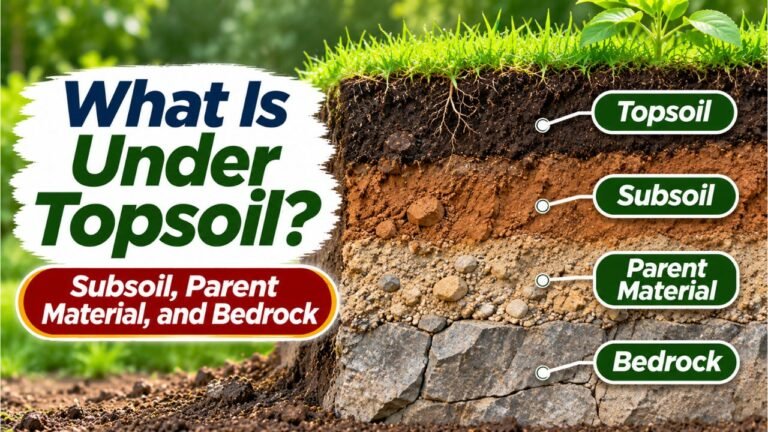
Under natural topsoil, you usually find subsoil—the denser, lower-organic layer known as the B horizon. In some soils, a pale, leached E horizon sits between topsoil and subsoil; deeper down are less-weathered parent material and, eventually, bedrock. The precise sequence varies, and a newly landscaped yard may have construction fill or compacted clay directly beneath imported topsoil instead.
Knowing what’s underneath matters when you’re planting a lawn, building a garden bed, or trying to fix soggy soil. Roots, water, and air must move through the entire soil profile, not just the dark surface layer. A few inches of good topsoil over dense, compacted ground may produce shallow roots and drainage problems.
You generally do not need to put a gravel blanket, plastic sheet, or landscape fabric beneath new topsoil. For most lawns and in-ground gardens, sound, loosened native soil provides a better base, with the transition between layers prepared carefully.
In this article, I explain the natural soil horizons, how to recognize subsoil, and what may lie beneath topsoil in developed yards. I also cover the best underlying materials and preparation for lawns, vegetable gardens, raised beds, and drainage repairs.
What Goes Under Topsoil in a Natural Soil Profile?
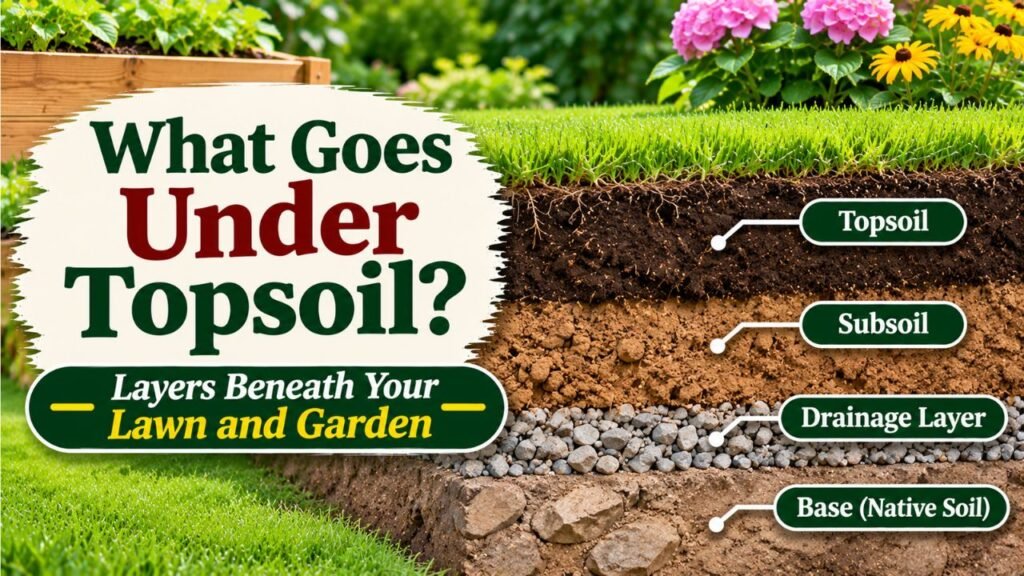
A natural soil profile consists of layers called soil horizons.
These layers develop over time through weathering, biological activity, organic matter accumulation, and the movement of water and minerals.
The number, appearance, and thickness of soil horizons depend on location and soil-forming conditions.
According to the USDA Natural Resources Conservation Service’s explanation of soil profiles, most soils have three major mineral horizons: the A horizon, B horizon, and C horizon. Some soils also have an organic O horizon or a leached E horizon.
The following table shows a generalized soil profile.
| Soil Layer | Scientific Name | Main Characteristics |
| Organic layer | O horizon | Leaves, decomposing plant material, and other organic matter |
| Topsoil | A horizon | Mineral soil with relatively abundant organic matter and biological activity |
| Leached layer | E horizon | Often lighter-colored material with some minerals removed |
| Subsoil | B horizon | Weathered soil, often containing accumulated clay or minerals |
| Parent material | C horizon | Relatively little-altered mineral material or weathered rock |
| Bedrock | R layer | Solid underlying rock |
The sequence is a simplified example.
Not every soil has all these layers, and their thickness can vary substantially.
In many gardens, topsoil sits directly above the B horizon.
In some locations, the A horizon may overlie a C horizon without a distinct B horizon.
O Horizon: Organic Material Above Topsoil
The O horizon is usually at or near the soil surface.
It consists mainly of organic materials such as fallen leaves, needles, twigs, and decomposing vegetation.
It is particularly noticeable in some forests and undisturbed landscapes.
The O horizon may contain materials in different stages of decomposition.
As these materials break down, they contribute organic compounds to the soil system.
However, not every lawn or garden has a recognizable O horizon.
Cultivation, landscaping, and other disturbances may mix or remove this surface material.
A Horizon: Topsoil
The A horizon is commonly called topsoil.
It contains mineral particles such as sand, silt, and clay, along with varying amounts of organic matter.
Topsoil often appears darker than the underlying layers because of accumulated organic material.
It supports substantial biological activity and contains many plant roots.
Topsoil is particularly important for plant establishment because it commonly provides favorable conditions for:
- Root growth
- Water storage
- Air movement
- Nutrient availability
- Soil organisms
However, topsoil quality varies.
Dark color alone does not guarantee suitable fertility, drainage, or freedom from contaminants.
E Horizon: The Leached Layer
Some soils have an E horizon directly beneath the topsoil.
This layer often appears pale gray, whitish, or lighter than the surrounding soil.
It develops when water moving through the soil removes certain materials, including clay, iron compounds, or organic substances.
The E horizon is especially common in some forest soils.
However, many gardens and agricultural soils do not have a distinct E horizon.
Where it occurs, the E horizon may lie between the A horizon and B horizon.
This explains why topsoil does not always rest directly on subsoil as represented in simplified diagrams.
B Horizon: Subsoil
The B horizon is commonly called subsoil.
It usually contains less organic matter than the topsoil above it.
Its color may be brown, yellow, reddish, gray, or another shade depending on mineral composition, drainage, and weathering.
Some B horizons contain accumulations of clay or other materials that have moved downward from upper soil layers.
Subsoil may also have a denser or more developed structure.
However, not all subsoil is heavily compacted or poorly drained.
Healthy subsoil can allow roots, air, and water to move through it.
C Horizon: Parent Material
The C horizon occurs beneath the more developed soil horizons where present.
It consists of relatively little-altered material such as weathered rock, sediment, or other soil parent material.
The material may contain sand, gravel, silt, clay, or partly weathered rock depending on the location.
The C horizon usually contains less biological activity than the surface soil.
However, roots can sometimes penetrate it if conditions are suitable.
R Layer: Bedrock
Bedrock is the solid rock beneath the soil and other unconsolidated materials.
It may consist of granite, sandstone, limestone, shale, or other rock types.
Bedrock can occur close to the ground surface or many feet below it.
Some properties have shallow soil over rock, while others have very deep soil and sediment deposits.
You should not assume bedrock begins at a particular depth beneath your yard.
Key Takeaway: Subsoil is usually the main layer beneath natural topsoil, but some soil profiles include an E horizon between them. Deeper layers may include parent material and bedrock.
What Is Subsoil and How Is It Different From Topsoil?
Topsoil and subsoil are both important parts of the ground, but they commonly differ in organic matter content, structure, color, and biological activity.
Topsoil is generally more favorable for seed germination and early root development.
Subsoil often contains less organic matter and may have different drainage or nutrient characteristics.
Topsoil vs. Subsoil
| Feature | Topsoil | Subsoil |
| Typical position | Near the surface | Beneath topsoil or an E horizon |
| Organic matter | Generally higher | Generally lower |
| Color | Often darker | Frequently lighter, redder, or yellower |
| Biological activity | Usually greater | Often lower |
| Root density | Commonly high | Often lower |
| Structure | Often granular or crumbly | May be blocky, firm, or otherwise structured |
| Nutrient availability | Often favorable | Varies by soil |
| Water movement | Depends on texture and structure | Depends on texture, structure, and compaction |
These are general differences rather than fixed rules.
Some soils have naturally dark subsoil, while others have relatively light-colored topsoil.
A soil’s appearance alone cannot determine all its properties.
Is Subsoil Always Clay?
No.
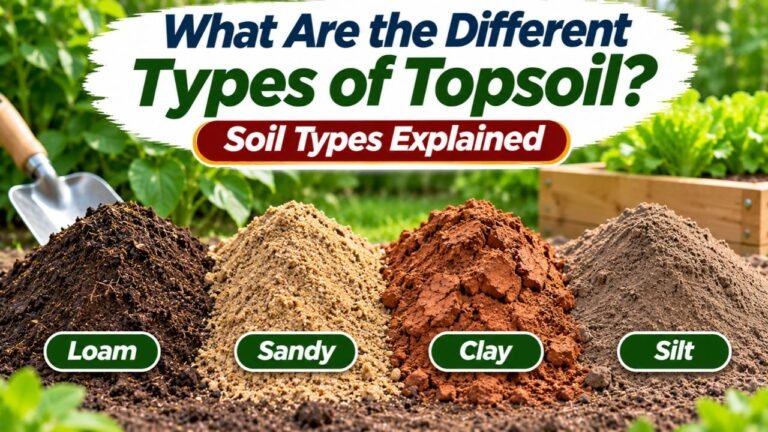
Subsoil can contain sand, silt, clay, or mixtures of these particles.
Some subsoils are clay-rich.
Others are sandy, loamy, or composed of different mineral materials.
Soil texture depends on the local geology and how the soil developed.
A clay-rich subsoil may hold water and nutrients well but drain slowly when its structure is poor.
A sandy subsoil may allow water to move more quickly but retain less moisture.
The actual behavior depends on both soil texture and structure.
Is Subsoil Bad for Plants?
Not necessarily.
Subsoil can provide additional rooting space, moisture, and nutrients.
Many established plants develop roots below the topsoil.
However, problems occur when subsoil is excessively compacted, poorly aerated, or affected by prolonged waterlogging.
In those conditions, roots may remain concentrated in the upper soil.
A thin layer of good topsoil cannot fully compensate for a severely restricted rooting zone underneath.
What Goes Under Topsoil in a Lawn?
In a typical lawn, topsoil rests over existing native soil, which may include natural subsoil or previously disturbed material.
For new lawns, the underlying soil is commonly graded before topsoil is spread.
The goal is to create a stable but root-friendly growing environment.
Typical Lawn Soil Structure
A newly established lawn may have the following arrangement:
| Position | Material |
| Surface | Grass and thatch, where present |
| Upper growing layer | Good-quality topsoil |
| Beneath topsoil | Prepared native soil or subsoil |
| Deeper ground | Natural soil horizons or parent material |
The exact profile depends on the property’s history.
In established lawns, grass roots may extend through the topsoil and into the soil underneath when conditions permit.
How Much Topsoil Does a Lawn Need?
According to Penn State Extension’s lawn establishment guidance, a minimum of approximately 4–6 inches of good-quality topsoil after settling is commonly recommended for establishing a healthy lawn.
The guidance also recommends incorporating some topsoil into the upper portion of the prepared subsoil to create a more gradual transition between layers.
This approach can improve rooting conditions and water movement.
However, the correct soil depth for a particular lawn depends on existing conditions, grass type, and site preparation.
Should You Loosen Subsoil Before Adding Topsoil?
Often, yes—especially when the underlying soil has been compacted by construction equipment or repeated traffic.
Compacted subsoil can restrict:
- Root penetration
- Water movement
- Soil aeration
- Drainage
- Long-term grass development
Loosening the compacted layer may improve the root environment.
However, soil should not be cultivated when it is excessively wet.
Working wet clay soil can worsen compaction and damage its structure.
Also identify buried utilities and other underground obstacles before using deep cultivation equipment.
Should You Mix Topsoil With the Soil Underneath?
Creating a gradual transition between topsoil and native soil is often beneficial during new lawn establishment.
A sharp boundary between two materials with very different textures can affect water movement and root growth.
Penn State Extension describes incorporating approximately 2 inches of topsoil into the upper 2–3 inches of prepared subsoil as one approach.
This does not mean mixing the entire topsoil layer into the ground below.
The goal is to reduce an abrupt interface while retaining enough suitable topsoil for lawn establishment.
What Should Go Under Topsoil for a New Garden?
For an ordinary in-ground garden, prepared native soil is usually the most appropriate material beneath added topsoil.
You generally do not need a separate layer of rocks, sand, plastic, or landscape fabric.
The underlying soil should be reasonably well drained and free from severe compaction.
Start With Existing Native Soil
Before adding topsoil, inspect the existing ground.
Remove weeds and unwanted surface debris.
Check for visible construction material, rubble, or signs of contamination.
If the soil is compacted, improve its structure through an appropriate preparation method.
For many vegetable gardens, roots eventually extend deeper than the surface layer.
The soil underneath therefore matters even when the topsoil looks healthy.
Add Organic Matter Where Needed
Finished compost can improve many garden soils.
It may help with:
- Soil structure
- Moisture retention
- Nutrient supply
- Biological activity
However, compost is usually best incorporated into an appropriate growing zone rather than placed as a thick, isolated layer beneath all the topsoil.
Avoid adding excessive amounts without considering the existing soil’s nutrient and organic matter levels.
A soil test can help determine which amendments are needed.
Avoid Creating Sharp Texture Changes
Adding one type of soil directly over a very different material can sometimes interfere with water movement.
For example, a layer of fine-textured topsoil over coarse material may not drain as expected.
Likewise, a good-quality topsoil layer over heavily compacted clay can leave water accumulating near the interface.
A properly prepared transition and suitable drainage are generally more important than creating multiple distinct material layers.
Do You Need Fertilizer Under Topsoil?
Not automatically.
Fertilizer should be added according to soil fertility and the needs of the plants.
Placing concentrated fertilizer in a separate deep layer can create uneven nutrient distribution or other problems.
Test the soil when possible.
Apply nutrients at suitable rates and depths according to crop recommendations.
What Should Go Under Topsoil in a Raised Garden Bed?
The correct material beneath topsoil in a raised bed depends on whether the bed has an open bottom or a solid base.
An open-bottom raised bed placed over garden soil functions differently from a planter sitting on concrete.
Open-Bottom Raised Beds
For a typical open-bottom raised bed, the best arrangement is often:
- Suitable growing soil inside the raised bed.
- Existing ground soil beneath the bed.
- Natural soil layers farther below.
An open bottom allows roots to extend into the underlying soil where conditions permit.
It also provides a route for excess water to move into the ground.
Before filling the bed, remove persistent weeds and check the existing soil.
A temporary layer of plain, non-glossy cardboard may help suppress existing grass during installation.
However, cardboard decomposes and should not be treated as a permanent weed barrier.
Avoid leaving plastic coatings, tape, or staples in the soil.
Should You Put Landscape Fabric Under a Raised Bed?
For an open-bottom vegetable raised bed, landscape fabric is generally unnecessary.
A durable woven barrier can interfere with roots extending into the ground.
It may also complicate future soil cultivation.
Where burrowing animals are a concern, appropriately sized hardware cloth may be more suitable because its openings can allow root growth and water movement.
The mesh should be secured safely and chosen for the specific pest.
Raised Beds on Concrete
A raised bed built on concrete cannot drain naturally into ground soil.
It needs an appropriate drainage design.
This may include:
- A suitable planter base
- Drainage openings
- A growing medium designed for the container
- A defined route for excess water to escape
- Structural support for the weight of wet soil
Do not assume that placing gravel at the bottom will solve drainage problems.
Water must have somewhere to leave the container.
If the planter is deep or large, consider its weight and the capacity of the supporting surface.
Should You Fill the Bottom With Logs or Branches?
Some raised bed systems use buried woody material, a method related to hügelkultur.
This can be suitable for certain gardening projects.
However, wood breaks down over time, causing the fill level to settle.
It can also temporarily influence nitrogen availability near the decomposing material.
For ordinary shallow raised beds, a consistent growing medium is usually simpler to manage.
Do not use large logs as an automatic substitute for adequate soil depth.
Should You Put Gravel Under Topsoil?
Usually not for ordinary lawns or garden beds.
A common misconception is that adding gravel underneath topsoil automatically improves drainage.
In reality, water movement depends on soil texture, pore size, compaction, and whether water has an outlet.
Why a Gravel Layer May Not Improve Drainage
Water does not always move freely from fine-textured soil into a coarse gravel layer.
At a sharp interface, the upper soil may need to become relatively wet before water enters the large pores below.
This can result in moisture accumulating above the boundary.
The problem is especially relevant when gravel is added to the bottom of a planter without a proper drainage outlet.
When Gravel Is Useful
Gravel can be appropriate in engineered drainage systems.
Examples include:
- Certain French drains
- Subsurface drainage trenches
- Perforated pipe drainage systems
- Engineered structural bases
- Specified landscape construction assemblies
In these applications, gravel has a defined function and works with other components.
It is not simply placed beneath topsoil without considering drainage direction or soil conditions.
What Should You Use Instead?
For ordinary gardening, focus on:
- Suitable soil structure
- Adequate drainage outlets
- Correct grading
- Reduced compaction
- Appropriate soil amendments
- Raised growing areas where needed
If the site has severe drainage problems, identify the actual cause before adding materials.
Can Clay Soil Be Under Topsoil?
Yes.
Clay-rich subsoil is common in many locations.
You may find a dark surface layer of topsoil over reddish, yellowish, or gray clay-rich material.
This is not automatically a problem.
Some clay soils support healthy plant growth when their structure and drainage are suitable.
Why Clay Can Cause Problems
Clay contains very small mineral particles.
Depending on soil structure, clay-rich layers may transmit water slowly.
When heavily compacted, they can restrict air and root movement.
This may cause water to remain near the surface after heavy rainfall.
However, clay itself is not the same as compaction.
A well-structured clay soil may contain cracks, channels, and pores that support root growth and water movement.
Should You Remove Clay Before Adding Topsoil?
Not automatically.
Removing all the clay-rich soil can be expensive and unnecessary.
Instead, evaluate its condition.
If it is severely compacted, appropriate loosening may help.
If it has poor drainage because of a high water table or restrictive subsurface layer, additional drainage planning may be needed.
For garden beds, adding suitable organic matter and maintaining soil structure may improve conditions over time.
Avoid adding small amounts of sand to heavy clay in an attempt to create instant loam.
An unsuitable mixture can remain dense and difficult to manage.
How Much Topsoil Should You Add Over Clay?
The amount depends on the intended use.
For lawns, approximately 4–6 inches of settled quality topsoil is a common planning recommendation.
For vegetable gardens, the rooting environment often needs to extend deeper.
The correct solution may involve improving the underlying soil rather than simply placing more topsoil over a restrictive layer.
A deeper layer of topsoil cannot guarantee drainage if water has nowhere to go.
What Goes Under Topsoil on Construction Sites?
Construction and landscaping can dramatically change the natural soil profile.
A new home may have imported topsoil spread over compacted subsoil or construction fill.
This differs from an undisturbed natural soil.
Compacted Subsoil
Heavy equipment can compress the soil beneath the surface.
Compacted soil has fewer large pores for air, water, and roots.
Even after topsoil is replaced, the compacted layer may remain.
A lawn installed over this condition may develop shallow roots and poor drainage.
Site preparation should address compaction where feasible.
Construction Fill
Construction fill may contain soil, rock, or other material used to change ground elevation.
Properly selected and placed fill can serve legitimate engineering purposes.
However, fill found beneath landscaping may vary in composition.
Some disturbed urban soils contain:
- Broken brick
- Concrete fragments
- Stones
- Mixed soil
- Other construction debris
Do not assume that every buried material is safe for growing edible plants.
If contamination is suspected, obtain appropriate soil testing or professional advice before planting food crops.
Engineered Fill vs. Garden Soil
Engineered structural fill is selected and compacted to support construction loads.
Garden soil is managed to support plant roots, water, and biological activity.
These purposes are different.
A surface layer of topsoil does not necessarily make compacted structural fill suitable for deep root growth.
Landscaping over structural fill may require careful soil preparation without disturbing areas that must remain compacted for engineering reasons.
Should You Dig Into Compacted Fill?
Not without understanding its purpose.
Some compacted layers support foundations, retaining walls, pavement, or other structures.
Disturbing these areas may create stability or drainage problems.
Near buildings, consult the relevant landscape or engineering professional before deep excavation or soil modification.
How to Prepare the Ground Before Spreading New Topsoil
Proper ground preparation helps new topsoil perform as intended.
The exact method depends on whether the area will become a lawn, flower bed, or vegetable garden.
Step 1: Inspect the Existing Surface
Walk across the site and examine the ground.
Look for:
- Standing water
- Deep tire tracks
- Construction debris
- Heavy compaction
- Exposed rock
- Persistent weeds
- Low areas where water collects
Identify any issues that should be corrected before adding topsoil.
Step 2: Check Drainage and Grading
Observe how rainwater moves across the property.
Water should not be directed toward a house foundation or neighboring property.
For a lawn, the ground generally needs suitable surface grading before topsoil is spread.
Avoid creating low spots that trap water.
If the project affects foundation drainage, retaining walls, or significant changes in elevation, obtain appropriate professional guidance.
Step 3: Address Compaction
Where the underlying soil is compacted and can safely be disturbed, loosen it using appropriate equipment.
The required depth depends on the severity and location of the compacted layer.
Avoid working soil when it is excessively wet.
Do not disturb structural fill or buried utilities.
Step 4: Remove Unsuitable Material
Remove large construction debris and other unwanted materials from the intended growing zone.
Do not bury plastics, treated wood debris, or unidentified waste under new topsoil.
If the soil has an unusual chemical smell, visible staining, or a known history of contamination, arrange appropriate testing.
Step 5: Prepare the Transition Layer
For new lawn establishment, blend a portion of quality topsoil into the loosened upper subsoil when appropriate.
This can help reduce a sharp texture boundary.
Avoid creating a dense, smeared layer during cultivation.
If existing soil texture differs greatly from imported soil, seek local advice before mixing large quantities.
Step 6: Spread the Topsoil Evenly
Distribute the topsoil to the required depth.
For lawn establishment, aim for approximately 4–6 inches of suitable topsoil after settling, where this is appropriate for the site.
For planting beds, the required root-zone depth depends on the crops and underlying soil.
Use equipment that minimizes unnecessary compaction.
Do not repeatedly drive heavy machinery over freshly placed garden soil.
Step 7: Settle and Prepare the Surface
After spreading the topsoil, level the area.
Use gentle watering or appropriate light firming to help settle the soil.
Avoid excessive compaction.
For a lawn, prepare a fine, reasonably firm seedbed according to the grass establishment method.
For planting beds, maintain a loose surface suitable for transplanting or sowing seeds.
How to Tell What Is Under Your Topsoil
You can often identify the general layers beneath your yard by examining a small soil profile.
However, visible appearance provides only part of the information.
Examine a Small Soil Sample
In a safe, suitable location away from utilities, dig a small inspection hole.
Observe changes in:
- Color
- Texture
- Root density
- Moisture
- Structure
- Stone content
A dark, crumbly upper layer may transition into lighter or more clay-rich material.
That transition can indicate the boundary between topsoil and subsoil.
However, a color change alone does not prove where one soil horizon ends.
Check Soil Texture
Moisten a small sample and rub it between your fingers.
Sandy soil often feels gritty.
Silty soil commonly feels smooth or floury.
Clay-rich soil tends to feel sticky when wet and can form a ribbon when pressed between the fingers.
This simple field test can help identify broad texture differences.
It does not replace a laboratory particle-size analysis.
Look for Compaction
Dense soil may resist a shovel or soil probe.
Roots may also grow horizontally along the top of a compacted layer.
However, dry soil can feel hard even when it is not severely compacted.
Observe the soil under different moisture conditions before drawing conclusions.
Check for Drainage Problems
If water remains near the surface long after rain, the soil may have restricted drainage.
Possible causes include:
- Compaction
- Clay-rich layers
- Poor surface grading
- High groundwater
- Buried construction material
- A restrictive soil horizon
Do not automatically blame clay without investigating the actual problem.
Does the Material Under Topsoil Affect Drainage?
Yes.
The underlying soil can strongly influence how water moves and how deeply roots develop.
Even good-quality topsoil may perform poorly when placed over a restrictive layer.
Topsoil Over Well-Structured Loam
Loamy soil with stable structure often provides favorable conditions for drainage and root growth.
Water can move through connected pores while some moisture remains available to plants.
However, results depend on compaction and soil depth.
Topsoil Over Sandy Soil
Sandy subsoil often permits relatively rapid water movement.
However, the growing zone may dry quickly.
A sharp difference between a finer-textured topsoil layer and coarse sand beneath it can also influence water movement.
Proper soil transition and irrigation management matter.
Topsoil Over Clay-Rich Soil
Clay-rich soil may hold water for extended periods, particularly when compacted or poorly structured.
However, it can also store useful moisture and nutrients.
The goal is not necessarily to remove clay, but to maintain suitable structure and prevent prolonged saturation.
Topsoil Over Rock or Rubble
Rocky material may limit root penetration and create uneven drainage conditions.
Large stones also reduce the volume of soil available for roots.
If the rocky layer is shallow, plants may experience moisture stress during dry weather.
In a vegetable garden, additional usable soil depth or a different planting location may be needed.
Topsoil Over Impermeable Material
An impermeable surface prevents water from draining downward.
If topsoil is placed directly over concrete, plastic, or another impermeable barrier without a drainage route, water may accumulate.
This can create saturated root conditions.
A solid-bottom growing area needs an appropriate drainage system rather than assuming topsoil alone will provide adequate drainage.
Common Mistakes When Adding Topsoil Over Existing Ground
Several mistakes can cause problems even when the imported topsoil is high quality.
1. Spreading Topsoil Over Compacted Subsoil
A compacted layer may restrict root growth and water movement.
Prepare the underlying soil when appropriate before installing the new topsoil.
2. Adding Gravel Without a Drainage Outlet
Gravel alone does not guarantee better drainage.
In some soil arrangements, it can contribute to water accumulating above the interface.
Use gravel only when it has a defined purpose within an appropriate drainage system.
3. Installing Landscape Fabric Beneath Lawn Topsoil
A permanent landscape fabric layer is usually unnecessary under ordinary lawn topsoil.
It may interfere with roots and future lawn renovation.
Use suitable soil preparation instead.
4. Using Poor-Quality Imported Topsoil
Not all materials sold as topsoil have the same composition.
Some may contain excessive stones, debris, weed seeds, or unsuitable soil textures.
Inspect the material and request testing information when appropriate.
5. Ignoring Soil pH and Nutrients
Topsoil may look dark and healthy but still have unsuitable pH or nutrient levels.
A soil test provides better information than appearance alone.
6. Creating an Abrupt Soil Boundary
Placing a fine-textured soil directly over a very different underlying material can alter drainage.
Where suitable, preparing a gradual transition may help.
7. Adding Excessive Compost in a Separate Layer
A thick layer of compost under topsoil is not always beneficial.
It may settle, produce uneven moisture conditions, or create nutrient-management problems.
Use compost as an appropriate amendment based on soil and plant needs.
8. Burying Tree Roots With Additional Topsoil
Adding substantial soil over established tree roots can reduce oxygen availability and harm the tree.
Avoid burying the root flare or significantly changing soil depth around established trees without professional guidance.
9. Raising the Soil Level Against a Building
Excessive soil buildup near foundations or exterior walls may interfere with drainage and moisture management.
Keep required clearances from siding, vents, and other building components.
Maintain appropriate grading away from structures.
10. Treating Every Soil Profile as Identical
Natural soils vary widely.
Some have distinct A, E, B, and C horizons.
Others have fewer recognizable layers or have been heavily disturbed.
Understand the actual site conditions rather than assuming every property contains the same sequence at the same depths.
Conclusion
So, what goes under topsoil? In most natural soil profiles, the answer is subsoil, commonly called the B horizon. Some soils have an E horizon between the topsoil and subsoil, while deeper layers may include parent material and bedrock.
In residential yards, the material beneath topsoil may be natural subsoil, compacted clay, sandy soil, or construction fill.
For lawns and gardens, the condition of this underlying material matters because roots, water, and air must move through more than the surface layer.
I recommend preparing suitable native soil before adding new topsoil rather than automatically installing gravel, plastic, or landscape fabric underneath it.
For new lawns, approximately 4–6 inches of good-quality settled topsoil is a common recommendation, with appropriate preparation of the underlying soil.
For raised garden beds, an open bottom over suitable ground soil is often the simplest arrangement. Solid-bottom planters require adequate growing depth and a reliable drainage outlet.
Understanding the layers beneath topsoil helps you make better decisions about soil preparation, planting depth, drainage, and long-term plant health.
FAQs About What Goes Under Topsoil
What Is Directly Under Topsoil?
Subsoil, also called the B horizon, is commonly found directly beneath natural topsoil.
However, some soils have an E horizon between the topsoil and subsoil.
In disturbed residential yards, imported topsoil may sit directly over construction fill, compacted clay, or other materials.
Is There Always Clay Under Topsoil?
No. Subsoil may be clay-rich, sandy, silty, loamy, or composed of other mineral materials.
Its texture depends on geology, soil formation, and site history.
Clay is common in many subsoils, but it is not a universal layer beneath topsoil.
Should You Put Gravel Under Topsoil for Drainage?
Usually not for ordinary lawns or garden beds.
A gravel layer without a suitable drainage outlet may not improve water movement and can create an abrupt texture boundary.
For drainage problems, first investigate soil compaction, grading, water movement, and the possibility of a restrictive subsurface layer.
How Much Topsoil Should Go Over Subsoil?
For establishing a lawn, approximately 4–6 inches of good-quality topsoil after settling is a common recommendation.
For gardens, the appropriate depth depends on the plants and whether their roots can extend into the soil underneath.
The underlying soil should be prepared appropriately rather than relying only on a thick surface layer.
Can Plants Grow Into Subsoil?
Yes. Many plants develop roots through topsoil and into suitable subsoil.
Root penetration depends on soil texture, structure, moisture, aeration, and compaction.
Dense or waterlogged subsoil may restrict root growth, but healthy subsoil can provide additional moisture and rooting space.
Should I Put Landscape Fabric Under Topsoil?
Landscape fabric is generally unnecessary beneath ordinary lawn or in-ground garden topsoil.
It may interfere with root growth and future cultivation.
In engineered landscape systems, geotextiles can serve specific functions, but those applications are different from placing fabric under a normal growing area.
What Comes After Subsoil?
Beneath the subsoil, many natural soil profiles contain a C horizon, often called parent material or substratum.
Below that may be bedrock, designated as the R layer.
However, the depth and sequence vary, and some soils do not contain every horizon.

I’m Maya L. Greenwood, a lifelong plant lover who believes anyone can grow something beautiful with the right guidance. After years of testing soil mixes, pruning methods, irrigation tricks, and pest-safe solutions, I started EasyGardenTips.com to turn hard-won lessons into step-by-step advice. From seed starting and container gardens to composting and seasonal checklists, my goal is to make gardening simple, sustainable, and fun.