Top Rated Plastic Seed Starter Trays: Top Picks and Buying Guide
As an Amazon Associate, I earn from qualifying purchases. Learn more
Choosing plastic seed starter trays can be surprisingly difficult because cell size, depth, drainage, and included accessories all affect how easily seedlings get established. A tray that works well for lettuce may be a poor fit for tomatoes, peppers, or plants that need more room before transplanting.
My first choice is RooTrimmer 10 Pack 32 Cell Seed Starter Trays. The 20-by-10-inch format also fits standard 1020 flats, making it a practical option for gardeners who want sturdy, transportable trays for larger seedlings.
My second choice is Amazon.com Mr. Pen- Seed Starter Trays. It is the option I would compare next when a buyer has slightly different priorities from my first pick.
This comparison covers five different approaches, from deep cells and compact six-cell inserts to complete humidity-dome kits. The buying guidance explains how to match cell size, drainage, covers, heat, cleaning, and storage habits to the plants you plan to grow.
5 Best Plastic Seed Starter Trays
I selected these products by comparing relevance to home seed starting, useful construction and sizing details, included accessories, available customer-feedback evidence, and the different growing situations each option serves. Brand variety also mattered when a different design offered a meaningful alternative rather than another nearly identical tray.
| # | Image | Product | Price on Amazon |
|---|---|---|---|
| 1 |  |
RooTrimmer 10 Pack 32 Cell Seed Starter Trays | Check Price |
| 2 | 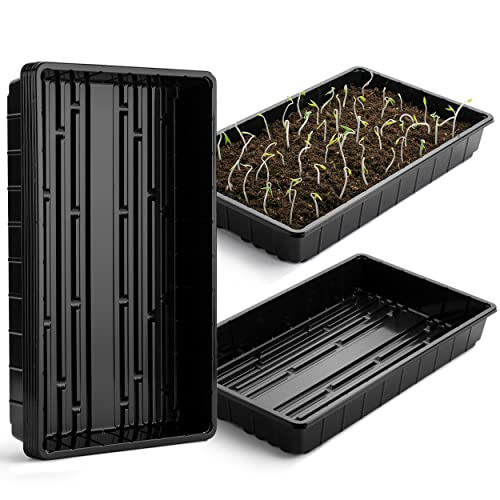 |
Amazon.com Mr. Pen- Seed Starter Trays | Check Price |
| 3 |  |
MIXC 10 Pack Seed Starter Tray | Check Price |
| 4 |  |
Bonviee 5-Pack Seed Starter Trays | Check Price |
| 5 |  |
The Hydroponic City Seed Starter Trays | Check Price |
RooTrimmer 10 Pack 32 Cell Seed Starter Trays
The RooTrimmer trays earn the top position for gardeners who want more growing depth than many compact starter inserts provide. Each of the 32 cells is 4.33 inches deep, with a 2.32-by-2.32-inch side dimension. That extra volume is useful for seedlings with longer roots, taller growth habits, or a longer indoor growing period before transplanting.
The 20-by-10-inch footprint fits standard 1020 flats, so these trays can integrate with a common nursery setup. Large drainage holes help excess water escape, while guide channels at the top direct water toward the cells instead of leaving it pooled across the surface. That combination can make watering more predictable, although gardeners still need to monitor moisture rather than assuming drainage prevents overwatering.
RooTrimmer specifies 1mm-thick plastic and describes the trays as sturdy enough to carry and transport. They are suitable for indoor growing, greenhouse propagation, and nursery use, but the supplied information cautions against leaving them exposed to sun. The 10-pack is also convenient for gardeners starting several varieties at once or replacing older inserts in batches.
Pros
- Extra-deep 4.33-inch cells suit larger or taller seedlings.
- Fits standard 1020 flats and includes 10 trays.
- Large drainage holes and top guide channels support controlled watering.
- Sturdy 1mm plastic is intended for repeated use and transport.
Cons
- Deep cells may use more potting mix than small seedlings need.
- The trays should be protected from prolonged direct sun.
- No humidity domes, labels, or base trays are listed as included.
My Opinion
This is the strongest overall choice when root room and tray durability matter more than having a complete germination kit. Confirm that your shelving, lights, and bottom trays accommodate the deeper 4.33-inch profile before ordering.
Amazon.com Mr. Pen- Seed Starter Trays
Mr. Pen takes a simpler, more open-ended approach. The five trays measure 17 by 10 by 2.4 inches and use a one-piece design with raised edges. That makes them useful not only for starting seeds, but also for holding soil, mixing potting media, growing sprouts or microgreens, and keeping water and fertilizer contained during routine work.
The relatively shallow profile is a benefit when you want easy access to young plants or need trays that store without taking up as much vertical space as deeper inserts. The stackable design also helps gardeners organize multiple trays between growing cycles. Because each tray is a broad container rather than a cell-heavy propagation system, it offers flexibility but less separation between individual seedlings.
Compatibility is one of this option’s biggest advantages. The supplied information says the trays work with heat mats, humidity domes, and hydroponics systems, so they can serve as a base for a setup that grows over time. They are described as lightweight, durable, reusable, and easy to clean, making them a sensible second choice for beginners who want uncomplicated equipment rather than a tray loaded with accessories.
Pros
- Five reusable trays provide a flexible multi-purpose setup.
- Stackable 17-by-10-inch design is convenient for storage.
- Raised edges help contain soil, water, and fertilizer.
- Works with heat mats, humidity domes, and hydroponic systems.
Cons
- Broad trays do not provide individual cells for every seedling.
- At 2.4 inches deep, they offer less root space than RooTrimmer.
- The listed package does not include domes, labels, or separate cell inserts.
My Opinion
Mr. Pen is the better fit for gardeners who value versatility and easy cleanup over maximum root depth. Choose it for microgreens, sprouts, shallow starts, or as a general-purpose tray, but select a cell-based option when transplant separation is a priority.
MIXC 10 Pack Seed Starter Tray

The MIXC kit is aimed at gardeners who want a complete, organized propagation system in one package. It includes 10 trays, 10 watertight base trays, 10 humidity domes, and 10 plant labels. Having the base and cover supplied together reduces the need to assemble accessories separately and gives each tray a defined mini-greenhouse environment.
Adjustable vents let the gardener regulate humidity and temperature rather than leaving the dome fully closed throughout germination. That control is important because a sealed cover can retain moisture well, but seedlings eventually need ventilation as they emerge and grow. The base trays are described as watertight, which can help keep shelves and windowsills cleaner while watering.
Each kit contains 120 cells across the 10 trays, giving gardeners plenty of space for flowers, vegetables, or herbs. The trays are described as lightweight, portable, durable, and reusable for multiple seasons. Customer-feedback evidence is substantial, with 11,286 ratings listed in the supplied product data, although that number alone does not guarantee that every tray will suit every growing method.
The main trade-off is that this is a more enclosed system than a basic open tray. It is a strong choice for seed starting from scratch, but buyers should make sure they have enough room to store 10 domed units and enough light for the number of seedlings they plan to raise.
Pros
- Complete package includes trays, watertight bases, domes, and labels.
- Adjustable vents provide control over humidity and temperature.
- 120 cells support a large variety of seedlings.
- Portable and reusable for repeated growing seasons.
Cons
- A 120-cell setup may be more capacity than a small garden needs.
- Covered trays require ventilation management as seedlings emerge.
- More components mean more pieces to clean and store.
My Opinion
MIXC is the most complete choice for a beginner who wants a coordinated seed-starting station instead of sourcing each accessory separately. It ranks below the first two because its many small cells and larger accessory footprint are less flexible for gardeners raising only a few larger plants.
Bonviee 5-Pack Seed Starter Trays

Bonviee focuses on larger individual cells and controlled germination. Each tray has 12 cells measuring 1.5 inches square, and the package includes five clear cell trays, five black base trays, five humidity domes, five adjustable vents, and 10 plant labels. The larger cell format is specifically suited to seeds such as potatoes, tomatoes, peppers, and eggplants that can benefit from more room than tiny plug cells provide.
The clear plastic lets you observe developing plants without disturbing the roots. That visibility is particularly useful for beginners who are learning to judge emergence and moisture. Adjustable vents provide a way to gradually exchange air and reduce humidity when seedlings are established, while the base trays help contain water beneath the cell inserts.
Six trays are said to equal the size of a standard 1020 flat, which gives buyers a useful planning reference for shelves and propagation benches. The trays are also described as heat-mat compatible and able to withstand high and low temperatures without warping or melting. Even so, heat-mat users should follow the mat manufacturer’s setup guidance and avoid treating compatibility as a substitute for temperature monitoring.
With only 12 cells per tray, Bonviee is better for a curated group of plants than for starting hundreds of small seedlings. Its included domes and labels make it more organized than a bare insert, but the larger cell arrangement means fewer plants per shelf.
Pros
- Large 1.5-inch-square cells suit bigger seeds and seedlings.
- Includes bases, domes, vents, and labels.
- Clear trays make root and moisture observation easier.
- Designed for use with heat mats and standard propagation planning.
Cons
- Only 12 cells per tray limits total seedling capacity.
- Uses more shelf space per plant than a fine-cell kit.
- Additional domes and bases require more cleaning and storage.
My Opinion
Bonviee is a thoughtful option for gardeners raising larger vegetable starts who want humidity control without overcrowding the roots. It is less economical for tiny herbs or mass flower sowing, where MIXC’s greater cell count is likely to be more efficient.
The Hydroponic City Seed Starter Trays

The Hydroponic City package provides 216 cells through 36 separate six-cell trays. Each cell measures 1.5 inches square by 2.25 inches deep, giving seedlings a moderate amount of vertical root space while keeping each unit small and easy to organize. The product is listed as equivalent to three standard 1020 tray inserts, which helps buyers estimate its overall capacity.
Small six-cell modules can be useful when different varieties need different sowing dates or transplant schedules. Instead of disturbing an entire large insert, a gardener can handle a small tray containing only the seedlings ready for the next step. The 36-tray format also offers flexibility for labeling and arranging plants by type, though it creates more separate pieces to keep track of.
Strategically placed drainage slits help excess water leave the cells and support more balanced soil moisture. The trays are described as durable and reusable, and the package includes five THCity plant stakes for labeling. Those stakes add organization, but the supplied information does not list humidity domes or base trays, so buyers may need separate equipment for enclosed germination or spill control.
This product ranks fifth mainly because its small modules are specialized rather than universally convenient. It can be a smart fit for gardeners who want high capacity and flexible grouping, while someone seeking a few larger plants or a complete covered kit may prefer Bonviee or MIXC.
Pros
- 216 cells provide high capacity in manageable six-cell modules.
- 1.5-by-1.5-inch cells are 2.25 inches deep for useful root room.
- Drainage slits help reduce excess moisture.
- Includes plant stakes for organizing varieties and sowing dates.
Cons
- Many separate trays can be easier to misplace.
- Domes and base trays are not listed as included.
- Six-cell modules may be less efficient for one large uniform sowing.
My Opinion
This is the most adaptable choice for gardeners who want to divide seedlings into small batches and keep many varieties separate. It is worth considering when organization matters, but buyers should budget space and accessories for the 36 individual trays.
How I Selected These Plastic Seed Starter Trays
I compared these plastic seed starter trays by looking at how well each product addresses a real propagation need rather than ranking cell count alone. Depth, cell dimensions, drainage, included bases or domes, compatibility with common equipment, reuse potential, and ease of organizing multiple plant varieties all influenced the order.
The ranking also reflects the quality of the supplied product information. RooTrimmer and Mr. Pen stood out for straightforward tray utility and practical size details. MIXC and Bonviee earned attention for complete covered systems, while The Hydroponic City offered a modular approach that can be useful even though it is less convenient for some beginners.
Choose the tray structure around the plant’s next stage of growth, not just the number of seeds you want to sow.
Customer-feedback evidence was considered when available, including the substantial feedback volume listed for MIXC, Bonviee, and The Hydroponic City. Still, feedback counts do not replace checking dimensions, accessory compatibility, and the space available in your own growing area.
How to Choose Plastic Seed Starter Trays
The best plastic seed starter trays match the crop, growing location, and amount of attention you can give seedlings. Before buying, decide whether you need individual cells, extra depth, humidity control, a watertight base, or simply a washable container for shallow starts.
- Match cell size to the crop: Small cells work for many herbs and flowers, while larger cells are more comfortable for tomatoes, peppers, eggplants, and plants held indoors longer.
- Check depth and footprint: Compare tray height with shelving, lights, heat mats, and any outer 1020 flat or catch basin.
- Prioritize drainage: Bottom holes or slits are essential, but drainage works best when the growing medium is airy and the tray is not left standing in water.
- Decide whether you need a dome: Domes can support germination, while adjustable vents make it easier to transition seedlings to less humid conditions.
- Plan for quantity: A 120- or 216-cell package is useful for a large garden but can create unnecessary planting, lighting, cleaning, and storage work for a small one.
Cell count versus cell depth
Cell count describes capacity, not automatically quality. A high-count tray can be efficient for many small seedlings, but a lower-count deep tray may produce easier-to-handle starts for crops that develop roots quickly.
Cell depth also affects how long a seedling can remain in the insert before roots become crowded. If transplanting will be delayed by weather, a deeper cell can provide a useful buffer, provided the light is strong enough to prevent weak, stretched growth.
Open trays, bases, and complete kits
An open insert is often lighter and simpler, but it needs a separate way to catch water. A base tray makes watering and transport neater, while a humidity dome adds a controlled environment during germination.
Complete kits reduce shopping and compatibility questions, but they also bring more parts to wash and store. A gardener who already owns domes, labels, or bottom trays may save space by choosing a basic insert instead.
Setting Up Trays for the First Sowing
Start with a clean, stable surface that can tolerate some moisture and sits close to the intended light source. Place the tray inside its base or catch tray before adding growing medium so you do not need to move a full, fragile setup later.
Fill cells evenly without packing the medium hard. Over-compressed mix can restrict drainage and root growth, while a loose fill may settle dramatically after watering. Moisten the medium according to the seed’s needs, sow at the recommended depth, and label each variety immediately.
For a domed kit, place the cover on after sowing and use the vents according to the humidity and emergence stage. Once seedlings appear, inspect them daily and begin increasing airflow instead of leaving the dome sealed indefinitely.
Watering and Drainage Basics
Drainage holes are useful only when excess water has somewhere to go. Set cell trays over a base tray or other suitable catch surface, then empty standing water when the medium has absorbed what it needs.
Water gently from above when seeds are fragile, or use careful bottom watering when the tray design allows it. The goal is evenly moist media rather than saturated cells. Heavy watering can wash seeds into corners, expose shallowly sown seeds, or leave roots without enough air.
Check moisture by looking at the surface and lifting a tray carefully when practical. A tray that feels consistently heavy and remains wet may need less water, better airflow, or a more suitable growing medium.
Using Heat Mats and Humidity Domes Safely
Heat mats can speed germination for seeds that prefer warm conditions, but the tray must sit securely and the temperature should be monitored with the seed’s requirements in mind. Product information may say a tray is compatible with heat mats, but that does not mean every crop should receive supplemental heat.
Humidity domes are most helpful before or during germination. After emergence, excessive humidity and stagnant air can create an environment where seedlings struggle. Open adjustable vents gradually, remove the dome when seedlings need more airflow, and keep foliage from pressing against the cover.
Place covered trays where they receive adequate light after sprouting. A dome can retain moisture, but it cannot correct insufficient light or poor air circulation.
Transplanting Without Damaging Roots
Transplant when the seedling is developed enough to handle but before roots become badly crowded. Watering lightly beforehand can help the root ball hold together, though the medium should not be dripping wet.
Support the plant by the leaves or root ball rather than pulling on a delicate stem. A dibber, pencil, or similar tool can help loosen the edge of a cell. Deep trays may release longer root systems more cleanly, while shallow or crowded cells may require extra care.
After moving seedlings to pots or the garden, protect them from abrupt changes in light, temperature, wind, and moisture. Gradual hardening off is especially important for indoor-grown plants that have not experienced outdoor conditions.
Cleaning, Disinfecting, and Storage
Reusable trays should be emptied promptly after transplanting so old roots and damp media do not dry into corners. Rinse away loose material, then clean the surfaces with a mild approach suitable for plastic. Pay particular attention to drainage holes, vents, and the seams between inserts and bases.
Allow every component to dry fully before stacking. Storing damp trays can leave an unpleasant residue and makes the next planting cycle less sanitary. Keep domes, labels, plant stakes, and bases together so a complete kit does not become a collection of mismatched parts.
Store trays away from prolonged direct sun when the product information advises it, especially for the RooTrimmer design. Avoid placing heavy items on thin edges or nesting trays while they contain grit that could scratch or deform them.
How to Make Starter Trays Last Longer
Lift trays from underneath instead of carrying them by a single flexible edge, particularly when cells are filled with wet medium. Supporting the base reduces bending and lowers the chance of cracking around drainage openings.
Use tools gently around cell walls and do not force a root-bound plug out with a sharp object. Empty soil completely before stacking, and keep trays protected from unnecessary outdoor exposure when they are not in use.
Different products have different durability limits, so inspect them before each season. Replace a tray when cracks, distorted cells, blocked drainage, or brittle plastic make watering and transplanting unreliable.
Common Mistakes to Avoid with Starter Trays
Most problems come from treating every tray and every seed as though they require the same method. A few small planning errors can lead to poor emergence, crowded roots, messy watering, or a setup that does not fit the available shelf.
- Choosing by cell count alone: More cells are not better if the plants need larger cells or you lack room and light for them.
- Leaving water in the base: A catch tray should collect drainage, not keep the cell bottoms submerged indefinitely.
- Keeping domes sealed too long: Increase ventilation after emergence and watch for overly damp conditions.
- Skipping labels: Similar seedlings are easy to confuse, especially when several varieties germinate together.
- Ignoring the full footprint: Include the base, dome, heat mat, and surrounding clearance when measuring a shelf.
- Moving full trays by the rim: Wet soil adds weight; support the underside during transport.
Good drainage does not mean “water as much as possible,” and a humidity dome does not mean “keep the tray closed until transplanting.”
Practical Capacity Planning for a Home Garden
Estimate your real planting list before choosing a multi-pack. If you need 20 tomato and pepper starts, five 12-cell trays may provide a comfortable amount of room, while a 216-cell package may leave many cells unused.
For a larger vegetable or flower garden, high capacity can be valuable, especially when sowing several varieties over multiple dates. In that situation, smaller modules can help separate early crops from later ones, while a 10-pack of deeper trays can simplify a uniform group of larger plants.
Remember that every planted cell may require light, water, labeling, and transplant space. Capacity is useful only when the rest of the growing system can support it.
Which Tray Style Fits Which Gardener?
Choose RooTrimmer when deep cells, repeated transport, and standard 1020-flat compatibility are central requirements. Its design is especially practical for larger seedlings or gardeners who do not want roots limited by a shallow insert.
Mr. Pen suits a beginner who wants reusable trays for several tasks, including sprouts, microgreens, shallow starts, and soil work. It is the least specialized option, which is an advantage when your growing projects change from season to season.
MIXC is a logical choice for someone who wants domes, bases, and labels included. Bonviee is more targeted toward larger seeds and controlled germination, while The Hydroponic City is attractive for gardeners who prefer many small, separately managed six-cell modules.
FAQS About Plastic Seed Starter Trays
What size cells are best for plastic seed starter trays?
It depends on the crop and how long seedlings will remain indoors. Small cells suit many herbs and flowers, while 1.5-inch-square cells or deeper formats are more comfortable for tomatoes, peppers, eggplants, and other plants that develop larger roots before transplanting.
Do plastic seed starter trays need drainage holes?
Yes, drainage holes or slits help excess water leave the cells and reduce the risk of saturated roots. Use a base or catch tray beneath them, and avoid leaving the cells standing in collected water.
Are plastic seed starter trays reusable?
Several products in this comparison are described as durable and reusable. Clean out old growing medium, wash and dry the components, inspect for cracks or blocked holes, and store them away from damaging exposure between seasons.
Do plastic seed starter trays need humidity domes?
No. A dome can help retain humidity during germination, but it is not required for every seed or growing environment. If you use one, ventilate it as seedlings emerge and remove it when plants need better airflow.
Can plastic seed starter trays be used with heat mats?
Bonviee is specifically described as heat-mat compatible, and Mr. Pen is listed as working with heat mats. Even with compatible trays, use a suitable temperature control method and follow the seed’s preferred germination range.
How do I prevent seedlings from becoming crowded in starter trays?
Choose a cell size that matches the crop, avoid sowing more seeds than the cell can support, and transplant before roots become severely crowded. A deeper or larger-cell tray is often more suitable when outdoor conditions will delay transplanting.
Final Thoughts
For most gardeners, RooTrimmer 10 Pack 32 Cell Seed Starter Trays is the best all-around choice because its deep cells, sturdy construction, drainage, and 1020-flat fit support a wide range of larger seedlings. Mr. Pen Seed Starter Trays 5 Pack is the better alternative for flexible, stackable, easy-to-clean growing trays that can also handle microgreens and other shallow projects. Choose between them based on whether you need root depth or broad everyday versatility from your plastic seed starter trays.
For the final decision, my first two recommendations are RooTrimmer 10 Pack 32 Cell Seed Starter Trays and Amazon.com Mr. Pen- Seed Starter Trays. They are the two options I would compare first based on the ranking and buying factors covered above.

I’m Maya L. Greenwood, a lifelong plant lover who believes anyone can grow something beautiful with the right guidance. After years of testing soil mixes, pruning methods, irrigation tricks, and pest-safe solutions, I started EasyGardenTips.com to turn hard-won lessons into step-by-step advice. From seed starting and container gardens to composting and seasonal checklists, my goal is to make gardening simple, sustainable, and fun.