How Much Compost to Add to Raised Garden Bed? Ratios and Timing
For a new raised garden bed, use approximately 25%–33% finished compost by volume mixed with quality topsoil. For an established raised bed, adding about ¼–1 inch of compost annually is often sufficient, depending on the soil’s condition. You may need less if the soil already contains plenty of organic matter or has received compost regularly.
Compost improves soil structure, supports soil organisms, and contributes nutrients as organic materials decompose. However, adding too much can create problems with moisture management, nutrient balance, and soil settling. This is particularly important in raised beds that already contain compost-rich commercial soil mixes.
The amount also depends on whether you’re filling a new bed, refreshing an existing vegetable garden, or replacing soil that has settled over time. Composting materials and finished compost aren’t interchangeable, and different compost products may contain different nutrient concentrations.
In this article, I cover the right compost ratios for new raised beds, how much to add each growing season, and how to calculate quantities for different bed sizes. I also explain which compost works best, how to apply it correctly, and how to avoid overloading your soil with organic matter.
How Much Compost to Add to Raised Garden Bed: New vs. Established
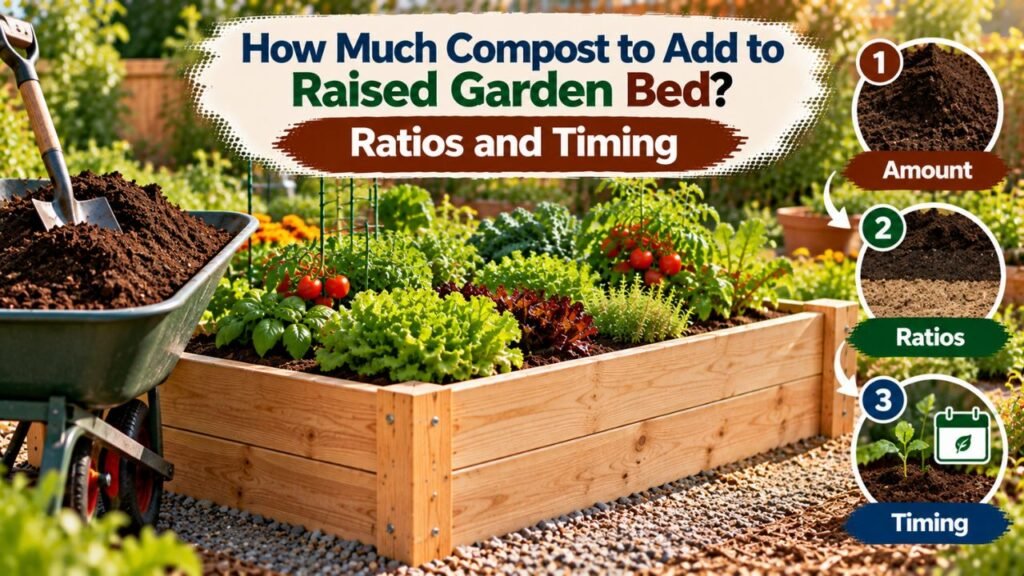
The amount of compost depends primarily on whether you’re creating a growing medium from scratch or maintaining soil that already supports plants.
A newly constructed bed may need a substantial amount of compost mixed with mineral topsoil.
An established bed typically needs much less because the existing soil already contains organic matter from previous amendments, plant roots, and decomposing materials.
| Raised Bed Condition | Suggested Compost Amount | Application Method |
| New raised bed with purchased topsoil | Approximately 25%–33% of soil mix by volume | Blend evenly with topsoil |
| New in-ground garden soil being improved | Around 3–4 inches before incorporation, where appropriate | Mix into the upper 8–12 inches |
| Established vegetable raised bed | Approximately ¼–1 inch annually if needed | Surface apply or gently incorporate |
| Raised bed already rich in compost | Less, or possibly none | Base decision on soil condition and testing |
| Bottomed bed on concrete | Requires a container-appropriate mix | Follow a suitable compost and soilless mix formulation |
These are starting guidelines rather than universal requirements.
The Oregon State University Extension guide to using compost recommends adding up to 25% compost by volume when filling certain soil-based raised beds. For existing vegetable gardens, it describes annual surface applications of approximately ¼–1 inch.
The distinction matters because repeatedly adding the same large compost quantity to an established bed can create nutrient imbalances.
Key Takeaway: Use compost as a substantial ingredient when preparing new soil, but apply smaller maintenance amounts once the raised bed is established.
How Much Compost Should You Mix Into a New Raised Bed?
For a new open-bottom raised garden bed, a practical starting mixture is approximately:
- 67%–75% quality topsoil
- 25%–33% mature compost
This combination provides mineral particles for soil structure while incorporating organic matter to support the growing environment.
The exact proportion should depend on the topsoil’s existing quality and the compost’s composition.
Using a 75% Topsoil and 25% Compost Mixture
A 75/25 mixture is a useful option when you’re working with reasonably good mineral topsoil.
For every four equal containers of growing material, combine:
- Three containers of topsoil.
- One container of finished compost.
This mixture provides a substantial mineral-soil foundation without relying excessively on organic material.
It may be particularly appropriate when the topsoil already contains some organic matter.
However, a soil test can help determine whether further amendments are needed.
Using a 67% Topsoil and 33% Compost Mixture
Another common starting approach is to combine two parts topsoil with one part compost.
For every three equal containers:
- Two containers contain topsoil.
- One container contains mature compost.
This creates a mixture containing approximately one-third compost by volume.
The University of Maryland Extension’s raised bed soil guidance describes compost-to-topsoil mixtures of 1:2 or 1:1 for certain raised bed conditions.
A 1:2 ratio means one part compost and two parts topsoil.
Although some extension guidance allows higher compost proportions for specific situations, it doesn’t mean every raised bed benefits from adding as much compost as possible.
Consider the quality of the topsoil and whether the finished growing mix already contains organic matter.
Should You Mix Compost With the Entire Soil Depth?
For a newly filled soil-based raised bed, mix compost evenly with the topsoil that will form the growing medium.
Avoid placing a thick layer of pure compost beneath a separate layer of topsoil.
A consistent mixture generally provides more uniform root conditions.
If you’re adding compost to existing native soil rather than filling an empty frame, the amendment can be incorporated into the upper growing area.
Deeply turning established soil isn’t always necessary, especially where the soil already has suitable structure.
How Much Compost for a 4×8 Raised Garden Bed?
A 4-foot by 8-foot raised bed is a common size for growing vegetables.
The amount of compost depends on the depth of the bed and the proportion used in the soil mixture.
For a bed filled 12 inches deep:
4 feet × 8 feet × 1 foot = 32 cubic feet of growing medium
Compost for a 25% Soil Mixture
If compost makes up 25% of the total volume:
32 × 0.25 = 8 cubic feet of compost
The remaining 24 cubic feet consists of suitable topsoil.
If you’re buying 2-cubic-foot bags of compost:
8 ÷ 2 = 4 bags
Compost for a 33% Soil Mixture
For a mixture containing approximately one-third compost:
32 ÷ 3 = 10.67 cubic feet of compost
You would also need approximately 21.33 cubic feet of topsoil.
For 2-cubic-foot compost bags:
10.67 ÷ 2 = 5.34
Round up to 6 bags of compost.
Compost Requirements for Common Raised Bed Sizes
The following calculations assume the beds are empty and will be filled 12 inches deep.
| Raised Bed Size | Total Soil Volume | Compost at 25% | Compost at 33% |
| 3×3 feet | 9 cu ft | 2.25 cu ft | 3 cu ft |
| 3×6 feet | 18 cu ft | 4.5 cu ft | 6 cu ft |
| 4×4 feet | 16 cu ft | 4 cu ft | 5.33 cu ft |
| 4×8 feet | 32 cu ft | 8 cu ft | 10.67 cu ft |
These values describe loose-material purchasing quantities.
Actual settled volume may differ because soil and compost can compress or settle after mixing and watering.
Important: If your purchased raised bed soil already contains finished compost, you may not need to add these quantities separately.
How Much Compost to Add to an Existing Raised Bed Each Year
An established raised bed generally needs less compost than a newly constructed one.
For many vegetable beds, a surface layer of approximately ¼–1 inch is a useful maintenance range when additional organic matter is needed.
However, the full amount shouldn’t automatically be applied every year.
Soil that already has high organic matter or elevated nutrient levels may need little or no additional compost.
Adding a Quarter-Inch Layer of Compost
A ¼-inch layer is a relatively light application.
It may be appropriate for a raised bed that has been maintained regularly and doesn’t require a substantial organic matter addition.
Spread the compost evenly across the soil surface.
It can be left as a top-dressing or gently incorporated into the upper soil, depending on your gardening approach.
Adding a Half-Inch Layer of Compost
A ½-inch layer provides more organic material without adding a thick band of compost.
This is a practical option to consider when an established bed needs replenishment but already contains a suitable mineral-soil foundation.
Check the soil’s fertility and previous compost applications before deciding.
Adding a One-Inch Layer of Compost
A 1-inch layer is the upper end of Oregon State University Extension’s general annual recommendation for existing vegetable beds.
It may be appropriate when the soil needs additional organic matter.
However, repeated applications of nutrient-rich compost can accumulate phosphorus and salts.
Avoid assuming that a full inch is necessary every year.
Annual Compost Quantities by Raised Bed Size
The table below shows the amount required to cover the entire surface at different depths.
| Bed Size | ¼-Inch Layer | ½-Inch Layer | 1-Inch Layer |
| 3×3 feet | 0.19 cu ft | 0.38 cu ft | 0.75 cu ft |
| 3×6 feet | 0.38 cu ft | 0.75 cu ft | 1.5 cu ft |
| 4×4 feet | 0.33 cu ft | 0.67 cu ft | 1.33 cu ft |
| 4×8 feet | 0.67 cu ft | 1.33 cu ft | 2.67 cu ft |
These amounts are much smaller than the compost needed to fill a new raised bed.
For example, applying a ½-inch layer to a 4×8 bed requires approximately 1.33 cubic feet, not the 8–11 cubic feet used when preparing a new soil mixture.
Key Takeaway: Don’t confuse initial soil preparation with yearly compost maintenance. They require very different quantities.
How to Calculate Compost for Any Raised Garden Bed
You can calculate compost requirements using the bed’s dimensions and the intended application method.
There are two main calculations: compost as a percentage of a new soil mix and compost as a surface layer.
Formula for Compost in a New Soil Mix
First, calculate the total soil volume.
Total volume (cubic feet) = Length × Width × Depth
All measurements must be in feet.
Then calculate the compost portion:
Compost volume = Total soil volume × Compost percentage
For example, a 4×4 bed filled 12 inches deep requires:
4 × 4 × 1 = 16 cubic feet
For a 25% compost mixture:
16 × 0.25 = 4 cubic feet of compost
The remaining 12 cubic feet would be topsoil.
Formula for Compost Top-Dressing
When applying compost to an existing bed, calculate the surface area and compost layer thickness.
Compost volume (cubic feet) = Length × Width × Layer depth in feet
Convert inches into feet by dividing by 12.
For a 4×8 raised bed with a ½-inch compost layer:
4 × 8 × (0.5 ÷ 12) = 1.33 cubic feet
This is the amount needed to spread a half-inch layer over the bed.
How Many Bags of Compost Should You Buy?
Compost is commonly sold in bags labeled by volume.
For example, if your raised bed requires 2.67 cubic feet of compost:
- 1-cubic-foot bags: 3 bags.
- 1.5-cubic-foot bags: 2 bags.
- 2-cubic-foot bags: 2 bags.
Always round up to the next whole bag.
Check the volume printed on the package rather than assuming a fixed number of pounds equals one cubic foot.
Compost weight varies considerably with moisture and composition.
What Type of Compost Is Best for Raised Garden Beds?
The type of compost matters because different materials contain different amounts of nutrients, soluble salts, and organic matter.
For many vegetable raised beds, mature plant-based compost is a practical starting choice.
Plant-Based Compost
Plant-based compost may contain decomposed leaves, grass clippings, vegetable residues, and other suitable organic materials.
Properly finished compost generally has a crumbly texture and an earthy smell.
It can help improve soil structure and water management.
Choose compost that has completed active decomposition and is suitable for growing edible plants.
Avoid mixing large amounts of raw plant waste into the main root zone as a substitute for mature compost.
Leaf Compost
Decomposed leaves can provide organic matter and help improve soil structure.
Leaf compost often contains fewer concentrated nutrients than some manure-based compost products.
It may be useful for maintaining soil condition without relying heavily on nutrient-rich amendments.
However, the actual composition depends on the leaves and composting process.
Don’t assume every bag of leaf compost has identical properties.
Composted Manure
Composted manure can contribute organic matter and nutrients.
However, it may contain substantial phosphorus and soluble salts, depending on the animal source and composting process.
Repeated heavy applications can create nutrient imbalances.
Use composted manure according to soil test results rather than automatically applying it at the same rate as plant-based compost.
If purchasing manure-based compost, choose a reputable source that can provide information about its ingredients and maturity.
Mushroom Compost
Spent mushroom substrate, often marketed as mushroom compost, can be used as a soil amendment in suitable circumstances.
However, it may contain elevated soluble salts or have an alkaline reaction, depending on its composition.
It shouldn’t automatically replace all other compost ingredients.
Check the product’s characteristics before adding large amounts to raised beds.
For crops sensitive to high soluble salts, extra caution is appropriate.
How to Add Compost to a Raised Garden Bed Step by Step
The application method depends on whether you’re building a new raised bed or maintaining an established one.
The following process is suitable for refreshing an existing soil-based raised bed.
Step 1: Inspect the Existing Soil
Before adding compost, examine the soil’s condition.
Look for:
- Compaction.
- Poor drainage.
- Unusual odors.
- Severe surface crusting.
- Excessive drying.
- Unusual plant growth problems.
Compost may help improve some soil conditions, but it won’t correct every problem.
For example, adding more compost to a poorly draining bed may not solve an underlying drainage obstruction.
Step 2: Check Soil Fertility
If the bed has received compost or fertilizer regularly, consider a laboratory soil test.
A soil test can help identify pH and nutrient conditions.
This is especially useful if plants have grown poorly despite regular feeding.
Follow the laboratory’s sampling instructions.
Avoid adding more phosphorus-rich compost when the soil already contains excessive phosphorus.
Step 3: Choose Mature Compost
Use compost that has completed active decomposition.
It should generally have a relatively uniform, earthy appearance.
Avoid products that are excessively hot, strongly sour-smelling, or full of undecomposed food scraps.
Immature compost may interfere with seedling establishment or temporarily affect nutrient availability.
Step 4: Measure the Compost Quantity
Calculate the bed’s surface area.
Choose a compost depth based on the soil’s needs.
For example, a 4×8 raised bed receiving a ½-inch layer needs approximately 1.33 cubic feet.
Measure the compost before spreading it so the application remains reasonably uniform.
Step 5: Spread the Compost Evenly
Remove large unwanted debris and weeds from the surface.
Distribute the compost across the bed using a shovel or garden rake.
Avoid concentrating the entire quantity in a few planting holes.
For established plants, keep thick accumulations away from stem bases.
Step 6: Leave It on the Surface or Incorporate It Lightly
Finished compost can be used as a surface top-dressing.
This allows gradual incorporation through watering, soil organisms, and routine biological activity.
If the soil needs more direct amendment, gently mix compost into the upper few inches using a garden fork or hand tool.
Avoid unnecessary deep digging in established beds with good soil structure.
Step 7: Water and Maintain the Soil
After applying compost, water gently if conditions are dry.
Avoid saturating the bed.
Apply suitable organic mulch where needed.
Keep monitoring moisture and plant growth throughout the season.
Adding compost doesn’t eliminate the need for appropriate irrigation or crop-specific nutrient management.
When Is the Best Time to Add Compost to Raised Beds?
Compost can be applied at several points during the gardening year.
The best timing depends on crop schedules, soil condition, and whether you’re preparing a new planting area.
Adding Compost in Spring
Spring is a convenient time to amend raised bed soil before planting.
Remove unwanted vegetation and assess the growing medium.
If the soil needs compost, apply the selected amount before sowing seeds or transplanting vegetables.
Use mature compost to avoid exposing young roots to actively decomposing materials.
Don’t work soil while it is excessively wet.
Adding Compost in Fall
Fall can also be a suitable time to add compost.
After removing spent crops, apply the appropriate amount to the soil surface.
Compost can remain in place during winter as part of the bed’s soil management plan.
However, heavy compost applications are unnecessary when nutrient levels are already high.
Avoid leaving exposed soil vulnerable to erosion where heavy rain or wind is common.
Adding Compost During the Growing Season
Mature compost can sometimes be used as a light side-dressing around established plants.
However, it shouldn’t be assumed to provide all the nutrients a rapidly growing vegetable needs at the time it needs them.
Compost releases nutrients at different rates depending on its composition and environmental conditions.
If plants require additional fertilization, use soil test results and crop requirements to guide the choice.
Can You Add Too Much Compost to a Raised Bed?
Yes. Excessive compost can create problems even when the material is fully decomposed.
Compost is useful, but it isn’t a substitute for every component of healthy soil.
Excessive Phosphorus and Soluble Salts
Some compost products contain substantial phosphorus.
Repeated heavy applications may cause phosphorus to accumulate beyond plant requirements.
Compost can also contribute soluble salts.
High salt concentrations may interfere with water uptake and damage sensitive roots.
Manure-based compost often deserves particular attention because its nutrient concentrations may be higher than those of many plant-based composts.
Poor Moisture Management
A growing medium containing excessive organic material may behave differently from a balanced mineral-soil mixture.
Some compost-rich mixes hold substantial moisture under certain conditions.
Others can dry out severely and become difficult to rewet.
A blend containing suitable mineral topsoil generally provides more predictable soil structure in an open-bottom raised bed.
Excessive Settling
Organic matter gradually decomposes and changes in volume.
Beds filled with very large amounts of compost may settle noticeably.
Although topping up the soil is normal maintenance, frequent substantial settling can indicate that the growing mix contains too much decomposable material.
Nutrient Imbalances
Adding compost doesn’t guarantee that plants receive the right balance of nutrients.
A soil may contain excessive phosphorus while still having insufficient plant-available nitrogen during certain growth stages.
This is why compost shouldn’t be treated as a complete replacement for soil testing and targeted fertilization.
Important: Don’t add more compost simply because plant leaves turn yellow. Check watering, drainage, root health, sunlight, and nutrient conditions first.
Should You Add Compost on Top or Mix It Into Raised Bed Soil?
Both methods can work, but they serve different purposes.
Mixing Compost Into New Soil
When preparing a new raised bed, blending compost with topsoil creates a more uniform growing medium.
This is usually preferable to constructing thick, separate bands of compost and mineral soil.
A consistent mixture helps avoid abrupt changes in moisture behavior throughout the root zone.
Top-Dressing an Established Bed
For an established bed with healthy soil structure, compost can be spread over the surface.
It can gradually become incorporated into the upper soil through natural processes.
This approach reduces unnecessary disturbance and may help protect soil structure.
Should Compost Go at the Bottom of a Raised Bed?
For a standard shallow raised bed, a thick layer of compost at the bottom is generally unnecessary.
Blend finished compost into the growing medium instead.
If the bed is unusually tall, some gardeners use clean organic filler below the main planting zone, but raw branches and leaves are not equivalent to finished compost.
Keep sufficient prepared growing soil above any bulky filler.
Do Raised Garden Beds Need Compost Every Year?
Not necessarily.
Some raised beds benefit from small annual compost additions, while others already contain enough organic matter and nutrients.
The need depends on:
- Existing soil composition.
- Previous compost applications.
- Crop requirements.
- Soil fertility.
- Organic matter changes.
- Compost nutrient content.
- Soil test results.
A bed initially filled with a compost-rich mixture may not need additional compost immediately.
Likewise, a bed that has received manure-based compost for several years may already contain excessive phosphorus.
Consider annual compost applications as an option for soil maintenance rather than a fixed requirement.
Can You Use Only Compost to Fill a Raised Bed?
For an ordinary soil-based raised garden bed, filling the entire frame with compost alone isn’t recommended.
Compost doesn’t provide the same mineral structure as suitable topsoil.
An all-compost growing medium may settle substantially and develop moisture or nutrient imbalances.
A balanced soil mixture is generally more dependable for an open-bottom vegetable bed.
For bottomed raised planters and beds on hard surfaces, follow a suitable container-style growing-medium formulation rather than assuming a heavy topsoil blend is appropriate.
Do Tomatoes Need More Compost Than Other Vegetables?
Tomatoes need adequate nutrients, moisture, root space, and drainage.
However, that doesn’t mean they automatically require a higher compost percentage than other vegetables.
Once a raised bed contains a suitable soil mixture, tomato fertility should be managed according to soil conditions and plant requirements.
Adding extra compost without checking nutrient levels may create imbalances.
The same principle applies to peppers, cucumbers, squash, and other heavy-feeding crops.
Common Mistakes When Adding Compost to Raised Beds
Applying New-Bed Compost Quantities Every Year
A new raised bed may contain 25%–33% compost in its initial growing mix.
However, repeating that percentage as an annual amendment is unnecessary.
Established beds generally need much smaller amounts when compost is required.
Using Unfinished Compost
Compost that hasn’t completed decomposition may contain materials that temporarily affect nutrient availability or interfere with seedling growth.
Use mature compost around vegetable roots.
Avoid treating raw kitchen scraps or fresh plant waste as equivalent to finished compost.
Adding Compost Without Checking Soil Conditions
Poor plant growth doesn’t always indicate insufficient organic matter.
Waterlogging, compaction, incorrect pH, pests, and nutrient imbalances can produce similar symptoms.
Identify the likely cause before adding more compost.
Applying Thick Compost Layers Around Plant Stems
Piling compost directly against stems can keep those surfaces continuously damp.
Apply amendments evenly and avoid burying the crowns of established plants.
Choosing Compost From an Unknown Source
Compost quality can vary considerably.
Materials may contain unwanted debris, excess salts, viable weed seeds, or residues from contaminated inputs.
Purchase from a reputable supplier and ask about the materials used.
Be especially cautious with compost made from plant waste or manure that may have been exposed to persistent herbicides.
Confusing Compost With Mulch
Compost is a decomposed organic amendment used to improve soil conditions.
Mulch is a surface covering that may consist of straw, shredded leaves, wood chips, or other materials.
Some compost can function as a surface covering, but adding several inches of compost isn’t the same as applying an ordinary mulch layer.
Use each material according to its intended purpose.
Conclusion
Understanding how much compost to add to raised garden bed soil depends on whether the bed is new or established.
For many new open-bottom beds, approximately 25%–33% mature compost mixed with suitable topsoil is a practical starting range. A 4×8 bed filled 12 inches deep would need approximately 8–10.67 cubic feet of compost at those proportions.
For established raised beds, a smaller surface layer of approximately ¼–1 inch may be appropriate when additional organic matter is needed. However, regular compost use doesn’t mean an annual application is always necessary.
Choose mature, suitable compost and consider existing soil fertility before adding large amounts. If the bed already contains a rich growing mixture, adding more compost may provide little benefit.
The best approach is to build a balanced growing medium initially, monitor its condition, and replenish organic matter according to actual soil needs rather than following the same compost quantity every season.
FAQs About How Much Compost to Add to Raised Garden Bed
How Much Compost Should I Add to a 4×4 Raised Bed?
A 4×4 raised bed filled 12 inches deep requires 16 cubic feet of growing medium.
For an initial mixture containing 25%–33% compost, you’ll need approximately 4–5.33 cubic feet of compost.
For an established bed, a ½-inch surface layer requires only about 0.67 cubic feet.
Is 2 Inches of Compost Too Much for a Raised Bed?
It depends on the situation.
Two inches may be appropriate as part of an initial soil improvement project when the compost is incorporated into a suitable depth of mineral soil.
However, applying 2 inches of compost every year to an established raised bed may be excessive, especially when nutrient levels are already high.
How Many Bags of Compost Do I Need for a 4×8 Raised Bed?
For a new 4×8 bed filled 12 inches deep, a 25% compost mixture requires 8 cubic feet, or four 2-cubic-foot bags.
A one-third compost mixture requires approximately 10.67 cubic feet, or six 2-cubic-foot bags.
For a ½-inch annual top-dressing, approximately 1.33 cubic feet is sufficient.
Can I Plant Directly Into Compost?
Some seedlings may grow in compost-rich material, but pure compost isn’t generally the best choice for filling a soil-based raised vegetable bed.
A balanced topsoil and compost mixture provides more dependable structure and moisture management.
Use mature compost as an amendment rather than assuming it can replace every component of growing soil.
Should I Add Compost Before or After Planting?
For a new raised bed, mix compost into the growing soil before planting.
For established beds, mature compost can be applied before planting or as a light surface top-dressing around existing plants.
Avoid disturbing established roots unnecessarily.
Is Compost Better Than Fertilizer for Raised Beds?
Compost and fertilizer perform different functions.
Compost contributes organic matter and can improve soil structure while supplying some nutrients.
Fertilizer is generally used to supply particular nutrients at more targeted rates.
A raised bed may benefit from compost, fertilizer, both, or neither, depending on its current soil conditions.
Can I Add Compost to Raised Beds in Winter?
Yes. Mature compost can be added to raised beds during winter when the soil isn’t frozen or excessively wet and conditions allow safe access.
However, avoid unnecessary soil disturbance and heavy applications where nutrient runoff or erosion is a concern.
Spring or fall may be more convenient depending on your planting schedule and local climate.

I’m Maya L. Greenwood, a lifelong plant lover who believes anyone can grow something beautiful with the right guidance. After years of testing soil mixes, pruning methods, irrigation tricks, and pest-safe solutions, I started EasyGardenTips.com to turn hard-won lessons into step-by-step advice. From seed starting and container gardens to composting and seasonal checklists, my goal is to make gardening simple, sustainable, and fun.