How Many Bags of Mulch Make a Yard? Simple Math Explained
A cubic yard of mulch usually takes 13.5 bags at 2 cubic feet each, or 9 bags at 3 cubic feet each. The exact count depends on the bag’s volume and the depth you want, because a thicker layer covers less ground.
Are you staring at a stack of mulch bags and wondering if you bought enough for the whole bed? Are you trying to avoid a second store trip or a pile of soggy leftovers?
You’ll learn how to convert cubic yards into bags, choose the right mulch depth, measure a garden bed, and adjust the order for slopes, settling, and awkward corners.
Get the math right, and you’ll spread an even layer, protect plant roots, and avoid paying for mulch you can’t use. Guess too low, and thin spots leave soil exposed; guess too high, and extra bags sit in the driveway like colorful sandbags.
This takes about 9 minutes to read. By the end, you’ll know:
- How many 1.5-, 2-, and 3-cubic-foot bags equal one yard.
- Which mulch depth fits beds, trees, slopes, and playground areas.
- How to calculate bags for a bed of any length and width.
- How much extra mulch to add without going overboard.
How Many Bags of Mulch in A Yard?
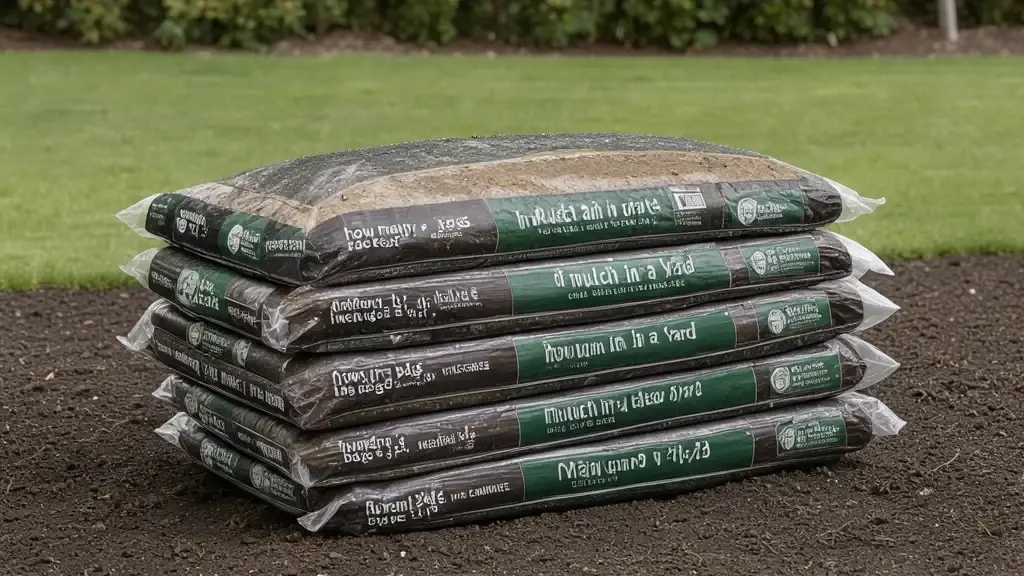
One cubic yard equals 27 cubic feet, so divide 27 by the cubic feet in each bag. A 2-cubic-foot bag covers 13.5 bags per cubic yard, while a 3-cubic-foot bag takes 9 bags, and stores may round those counts up for a complete order.
The word “yard” causes the confusion. In mulch sales, a yard means a cubic yard, which measures volume, not surface area. One cubic yard fills a space 3 feet long, 3 feet wide, and 3 feet high.
A bag marked 2 cubic feet holds less than a bag marked 3 cubic feet. That means you need more 2-cubic-foot bags to reach the same total volume, even though the mulch may look similar once spread.
| Bag Size | Bags Per Cubic Yard | Approximate Coverage at 3 Inches Deep |
|---|---|---|
| 1 cubic foot | 27 bags | About 12 square feet |
| 1.5 cubic feet | 18 bags | About 18 square feet |
| 2 cubic feet | 13.5 bags | About 24 square feet |
| 2.5 cubic feet | 10.8 bags | About 30 square feet |
| 3 cubic feet | 9 bags | About 36 square feet |
Coverage in the table assumes a full 3-inch layer and a true bag volume. Real coverage changes with mulch texture, settling, uneven ground, and how accurately you spread the material.
Use this formula:
- Measure the bed’s length and width in feet.
- Multiply length by width to get square feet.
- Multiply square feet by the desired depth in feet.
- Divide the result by 27 to get cubic yards.
- Multiply cubic yards by 27, then divide by the bag size.
For a 12-foot by 8-foot bed, the area is 96 square feet. At 3 inches deep, convert 3 inches to 0.25 feet, then multiply 96 by 0.25 to get 24 cubic feet, which equals about 0.89 cubic yards.
A 2-cubic-foot bag covers 24 square feet at 3 inches, so that bed needs about 12 bags. The same bed takes 8 bags of 3-cubic-foot mulch, with a small adjustment if the ground is rough or the bags contain loose, fluffy material.
Pro Tip: Write the bag volume on your measuring tape or phone before shopping. Two mulch products can have different bag sizes even when the packages look nearly identical.
The easiest shortcut works for rectangular beds:
Bags needed = length × width × depth in inches ÷ 12 ÷ bag size in cubic feet × 27
A simpler version uses a coverage chart from the bag. If the label says one bag covers 12 square feet at 3 inches, divide your bed’s square footage by 12, then round up.
How Do You Calculate Mulch for A Garden Bed?
Measure each bed separately, convert the desired depth to feet, and calculate volume before dividing by the bag size. Rounded measurements work for simple beds, but irregular beds need smaller sections added together so corners don’t throw off the order.
Start with a quick sketch. Mark the length, width, curves, trees, rocks, and any space that won’t receive mulch, such as a walkway or a patch of exposed concrete.
For a rectangular bed, use length multiplied by width. For a triangular bed, multiply length by width, then divide by two. For a round bed, measure the distance from the center to the edge, called the radius, and use radius multiplied by radius multiplied by 3.14.
Break a kidney-shaped or curved bed into rectangles, triangles, and circles. Add the square footage from each section, then calculate the total depth from that combined area.
Here’s the process in plain numbers:
- Measure a bed that is 15 feet long and 6 feet wide.
- Multiply 15 by 6 for 90 square feet.
- Choose a 3-inch layer, which equals 0.25 feet.
- Multiply 90 by 0.25 for 22.5 cubic feet.
- Divide 22.5 by 2 for 11.25 bags of 2-cubic-foot mulch.
- Round up to 12 bags.
The same bed needs about 8 bags of 3-cubic-foot mulch because 22.5 divided by 3 equals 7.5. Rounding up matters because half a bag won’t cover the final strip neatly.
If you’d rather avoid doing the full math, a [mulch amount calculator guide](mulch amount calculator guide) can help compare bed dimensions, depth, and bag sizes in one place. Use the same measurements either way, because a calculator can’t fix a bad length or width.
What happens if your bed has a tree in the middle? Subtract the tree’s mulch-free area from the total bed area, especially when the trunk takes up several square feet.
Keep mulch a few inches away from tree trunks and woody shrub stems. A thick mound against bark holds moisture, invites decay, and can attract pests that damage the trunk.
I once measured a long flower bed as one rectangle, even though a wide stone path cut through the middle. The first estimate came out too high, and splitting the bed into two smaller rectangles would have saved both mulch and a frustrating return trip.
Important Tip: Measure the widest parts of curves, then divide the shape into smaller sections. A rough sketch usually beats trying to remember five separate measurements in the garden center.
For sloped ground, measure the surface length rather than the straight horizontal distance if you want a closer material estimate. Slopes also tend to lose mulch downhill after heavy rain, so a shallow top layer may need a little extra material later.
Don’t add a huge cushion for every bed. A practical allowance is usually around 5% to 10% for uneven soil, settling, minor measuring errors, and small gaps.
A 10% allowance on 12 bags means 1.2 extra bags, so buy 14 bags if the store sells full bags and the bed has rough ground. On a flat, well-edged bed, rounding up to the next whole bag may be enough.
What Mulch Depth Should You Use?
Most decorative garden beds work well with 2 to 3 inches of mulch, while 3 to 4 inches may suit paths or areas needing stronger weed suppression. Deeper mulch can hold too much moisture and reduce air near plant roots, so more is not automatically better.
A 2-inch layer refreshes an existing bed where some old mulch remains. A 3-inch layer gives bare soil a stronger cover and usually looks fuller after settling.
Keep mulch shallower around shallow-rooted plants, young seedlings, and wet areas. Thick layers can trap moisture, cover low stems, and make the bed look like a giant chocolate cake, which is not the garden style most people want.
| Area | Common Depth | Reason |
|---|---|---|
| Existing mulch refresh | 1 to 2 inches | Adds color without burying plants |
| Flower and shrub beds | 2 to 3 inches | Covers soil and slows weeds |
| Bare soil around shrubs | About 3 inches | Creates a fuller protective layer |
| Garden paths | 3 to 4 inches | Gives better foot coverage |
| Playground or impact areas | Follow local safety guidance | Depth depends on fall protection needs |
Depth changes bag count dramatically. A 2-cubic-foot bag covers about 24 square feet at 3 inches, but it covers about 36 square feet at 2 inches.
A 20-foot by 10-foot bed has 200 square feet. At 2 inches, it needs about 33.3 cubic feet, or 17 bags of 2-cubic-foot mulch after rounding up; at 3 inches, it needs 50 cubic feet, or 25 bags.
That difference is eight bags for one bed. Before ordering, decide if you’re refreshing existing mulch or starting over on bare soil.
Color also affects the visual result. Dark mulch can look thick and rich at 2 inches, while lighter shredded wood may show bare soil sooner as it settles.
I’d choose 2 inches for a tidy refresh and 3 inches for bare soil around shrubs. I wouldn’t pile 4 inches around plant crowns just to avoid pulling weeds for a few extra weeks.
How Bag Type Changes The Math
Bagged mulch may contain shredded wood, nuggets, cedar, pine, rubber, or composted material. The bag volume controls the math, while the material controls weight, texture, color, water movement, and how fast the layer breaks down.
The label may show cubic feet in large print, or it may list coverage at a certain depth. Check both before grabbing a cartful. A bag labeled “covers 12 square feet” might assume 3 inches, 2 inches, or another depth.
If you’re comparing products, the [best bagged mulch choices](best bagged mulch choices) can help sort out texture, color, plant use, and bag value. A cheaper bag isn’t a bargain if the mulch blows away, fades quickly, or contains chunks that make a smooth bed hard to rake.
For a sloped bed, shredded mulch often grips soil better than smooth nuggets. Rubber mulch lasts longer in many settings, but it doesn’t improve soil as it breaks down and may not fit every planting area.
How Bag Volume And Pallets Affect A Large Order
A pallet can save repeated trips, but the count varies by product, bag size, store, and supplier. One pallet may hold a different number of bags than another, so never order by pallet count alone.
If a large project needs several pallets, check [how many bags of mulch are in a pallet](bags in a mulch pallet) for the exact product and store listing. Confirm the bag volume too, since 2-cubic-foot and 3-cubic-foot bags produce different total cubic yards even when the pallet footprint looks similar.
For one or two garden beds, individual bags are easier to adjust. For a long property border, bulk delivery may cost less per cubic yard and create less plastic waste, but you’ll need a dry place to store the pile.
What Does One Bag of Mulch Cover?
A 2-cubic-foot bag covers about 12 square feet at 2 inches deep, 8 square feet at 3 inches, or 6 square feet at 4 inches. A 3-cubic-foot bag covers roughly 18, 12, or 9 square feet at those same depths.
Bag coverage is never a magic number. The label’s estimate depends on how evenly you spread the mulch and whether the ground has dips, roots, rocks, or old material.
| Bag Size | 2-Inch Depth | 3-Inch Depth | 4-Inch Depth |
|---|---|---|---|
| 1.5 cubic feet | About 9 sq. ft. | About 6 sq. ft. | About 4.5 sq. ft. |
| 2 cubic feet | About 12 sq. ft. | About 8 sq. ft. | About 6 sq. ft. |
| 3 cubic feet | About 18 sq. ft. | About 12 sq. ft. | About 9 sq. ft. |
These figures use the basic volume formula and assume an even layer. Loose mulch may settle after rain, while chunky bark can leave more air gaps than fine shredded material.
If you’re unsure how much a package holds, check [how many cubic feet are in a mulch bag](cubic feet in a mulch bag). The printed volume matters more than the bag’s physical size because packaging can look large while holding less material.
A 2-cubic-foot bag is common and easy to calculate. A 3-cubic-foot bag gives more coverage per lift, though it can be heavier and harder to carry across a large yard.
I prefer 2-cubic-foot bags for small beds because they’re easier to move and spread. For a big project with a short path from the driveway, 3-cubic-foot bags can cut down the number of trips.
Common Mulch Buying Mistakes
The most common mulch mistakes are using the wrong bag volume, measuring depth incorrectly, and covering too much of the plant base. A short measuring session and a quick label check prevent most wasted bags and plant problems.
Measuring From The Wrong Place
Measure the bed, not the lawn beside it. If edging curves inward, follow the actual planting space rather than using the widest outside dimension for the entire length.
Don’t count paths, stepping stones, drain covers, or large bare gaps. Those areas need no mulch, and including them can add several unnecessary bags to a medium-size bed.
Mixing Depths Without Adjusting The Order
A bed may need 2 inches near low plants and 3 inches across bare soil. That’s fine, but calculate each zone separately instead of using one average depth that hides the difference.
A 100-square-foot bed at 2 inches uses about 16.7 cubic feet. At 3 inches, the same area uses 25 cubic feet, which is a large jump in bag count.
Ignoring Old Mulch
Old mulch still takes up space. Raking it evenly before adding new material gives a more accurate depth and keeps fresh mulch from becoming too thick.
If old mulch has turned into dark soil, blend it into the top inch of soil only where appropriate, then add fresh mulch above it. Don’t bury plant crowns, low branches, or irrigation emitters.
Creating A Mulch Volcano
Mulch should form a level blanket, not a cone around a tree trunk. Pull mulch away from trunks, stems, fences, and siding so moisture doesn’t stay trapped against surfaces.
Important Tip: Leave a 3- to 6-inch gap around tree trunks when possible. A clear ring makes watering easier and helps you spot bark damage before it becomes a bigger headache.
Buying By Price Instead Of Coverage
A bag that costs less may contain less material. Compare price per cubic foot by dividing the bag price by the listed cubic-foot volume.
If one bag costs $4 and holds 2 cubic feet, the price is $2 per cubic foot. Another bag may cost $5 but hold 3 cubic feet, making its material cost about $1.67 per cubic foot before delivery or special treatment.
Forgetting Settling And Wind
Fresh shredded mulch can settle after rain. Lightweight material can also shift in strong wind, especially along exposed edges.
Add a modest 5% to 10% allowance for uneven beds or exposed slopes. Don’t double the order unless a professional calculation or site condition supports it, because excess mulch creates its own problems.
Skipping Basic Handling Safety
Mulch bags can be awkward, dusty, and heavier than they look. Wear gloves, lift with your legs, keep the load close, and ask for help with oversized bags.
Avoid breathing dusty material while dumping bags, especially in dry weather. Wash your hands after handling mulch, and keep bags away from open flames if the packaging or product label warns about flammable materials.
Key Takeaways:
- Divide 27 cubic feet by the bag’s cubic-foot size to find bags per cubic yard.
- A 2-cubic-foot bag equals about 1/13.5 of a yard, while a 3-cubic-foot bag equals 1/9 of a yard.
- Use 2 inches for many refresh jobs and about 3 inches for bare garden soil.
- Round up to full bags, then add only a modest allowance for uneven ground or settling.
- Keep mulch away from trunks, stems, siding, and plant crowns.
FAQs About How Many Bags of Mulch in a Yard
How many 2-cubic-foot bags of mulch are in a yard?
A cubic yard contains 13.5 bags of 2-cubic-foot mulch, because 27 cubic feet divided by 2 equals 13.5. Since stores sell whole bags, buy 14 bags for a full cubic yard, though coverage still depends on the depth and shape of the bed.
How many 3-cubic-foot bags of mulch equal a yard?
A cubic yard equals 9 bags of 3-cubic-foot mulch, because 27 divided by 3 equals 9. Nine bags provide the full calculated volume, but uneven soil, sloped ground, and settling may justify one additional bag for a real garden bed.
How many bags of mulch do I need for a 100-square-foot bed?
A 100-square-foot bed needs about 17 bags of 2-cubic-foot mulch at 2 inches deep, or about 25 bags at 3 inches deep. The same depths require roughly 12 or 17 bags when using 3-cubic-foot bags, rounded up to whole bags.
Is one cubic yard of mulch enough for a large flower bed?
One cubic yard covers about 324 square feet at 1 inch deep, 162 square feet at 2 inches, or 108 square feet at 3 inches. A large flower bed may need more than one yard if the soil is bare, the bed is uneven, or the target depth exceeds 3 inches.
Should mulch be 2 or 3 inches deep?
Mulch should usually be 2 inches deep for a refresh and about 3 inches over bare soil in shrub or flower beds. Thicker layers can hold excess moisture and cover plant stems, so depth should match the plants, drainage, and purpose of the area.
Can you put new mulch over old mulch?
Yes, new mulch can go over old mulch after the existing layer is raked evenly and checked for excessive depth. Keep the combined layers near the target depth, because adding 3 fresh inches over 3 old inches can bury stems and restrict air near roots.
Buy the Right Mulch Amount the First Time
The reliable answer comes down to three numbers: bed area, mulch depth, and bag volume. Calculate the bed in square feet, convert inches to feet, divide the resulting cubic feet by the bag size, and round up to a whole bag.
For a quick shopping decision, remember that 14 bags of 2-cubic-foot mulch equal about one cubic yard, while 9 bags of 3-cubic-foot mulch equal about one cubic yard. Those numbers get you close, but the label and your chosen depth finish the job.
I’d rather have one spare bag than leave a strip of soil uncovered, but I wouldn’t buy a mountain of extras. Measure carefully, leave breathing room around plants and trunks, and spread the mulch after checking the layer with a ruler. That small bit of math saves money, protects the bed, and keeps the whole job from turning into a muddy guessing game.

I’m Maya L. Greenwood, a lifelong plant lover who believes anyone can grow something beautiful with the right guidance. After years of testing soil mixes, pruning methods, irrigation tricks, and pest-safe solutions, I started EasyGardenTips.com to turn hard-won lessons into step-by-step advice. From seed starting and container gardens to composting and seasonal checklists, my goal is to make gardening simple, sustainable, and fun.