Best Grow Light for 3×3 Tent: 5 Efficient Full-Spectrum LEDs
Choosing the best grow light for 3×3 tent use requires more than finding a fixture labeled for nine square feet. A 3×3 tent has a square canopy, so the light must provide useful intensity not only in the center but also toward all four corners.
Compact fixtures can create a strong central hotspot while the corner plants stretch toward the light. A wide bar-style frame generally distributes photons more evenly, but fixture size, diode spacing, hanging height, dimming range, and reflective-wall distance still affect the result.
My primary recommendation is the Mars Hydro FC-3000 EVO 300W LED Grow Light. Its Samsung LM301H EVO diodes, 300-watt power draw, efficient bar-style construction, and dimmable full-spectrum output provide a strong balance of intensity and canopy uniformity for a complete 3×3 setup.
The Spider Farmer G3000 is a practical alternative for growers who prioritize integrated app controls. The AC Infinity IONFRAME EVO4 offers more advanced scheduling and environmental integration, while the VIPARSPECTRA KS3000 and VIVOSUN LumaLight provide broad physical coverage with different control systems.
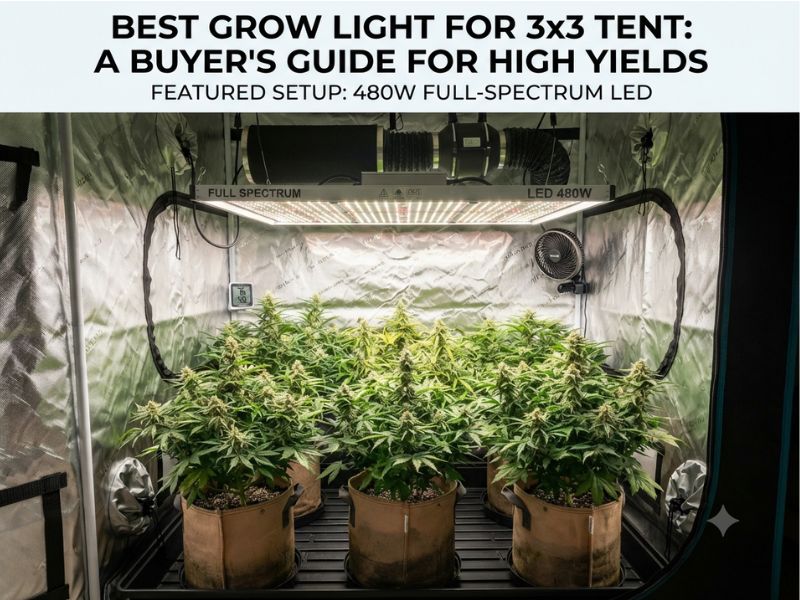
The best LED grow light for 3×3 tent applications should match the canopy layout, environmental capacity, fixture dimensions, and intended growth stage. Maximum wattage matters, but corner PPFD, usable photon output, driver placement, and dimming flexibility often matter more.
5 Best Grow Lights for a 3×3 Tent
| Image | Product Name | Check Price |
|---|---|---|
Best Choice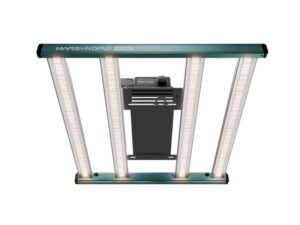 | Mars Hydro FC-3000 EVO 300W LED Grow Light | Check Price |
Second Best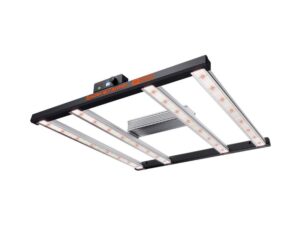 | Spider Farmer G3000 300W LED Grow Light | Check Price |
Third Choice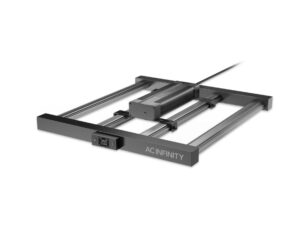 | AC Infinity IONFRAME EVO4 300W LED Grow Light | Check Price |
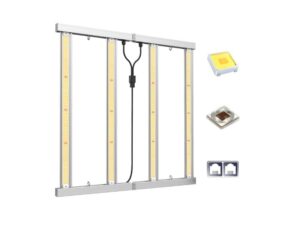 | VIPARSPECTRA KS3000 LED Grow Light | Check Price |
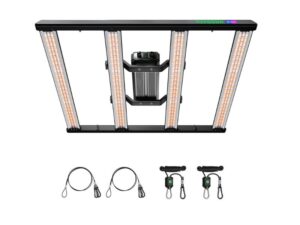 | VIVOSUN LumaLight 320W LED Grow Light | Check Price |
1. Mars Hydro FC-3000 EVO 300W LED Grow Light
Key Features
- 300W actual power draw
- Approximately 855 µmol/s PPF
- Approximately 2.95 µmol/J system efficacy
- Samsung LM301H EVO diodes
- Bar-style aluminum frame
- Full-spectrum white and deep-red output
- Manual intensity control
- Optional Wi-Fi and Bluetooth control
- Approximately 3×3 maximum coverage
- Passive fanless cooling
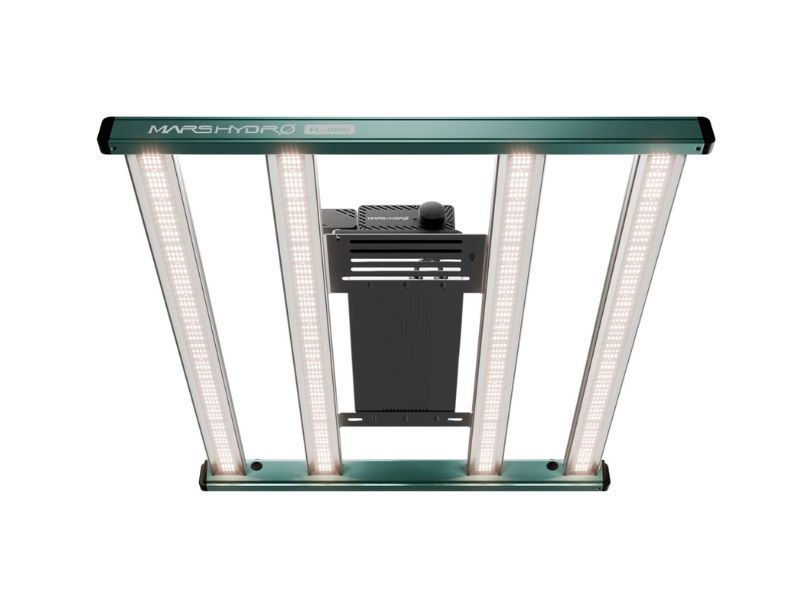
The Mars Hydro FC-3000 EVO is designed around a square multi-bar frame that closely matches the shape of a 3×3 tent. Instead of concentrating most of the diodes on one central board, it spreads them across multiple light bars to improve distribution toward the canopy edges.
Its 300-watt power draw provides approximately 33 watts per square foot across a nine-square-foot tent. Wattage alone does not determine plant-usable output, but this places the fixture in a practical range for full-cycle growing.
The stronger specifications are its photon output and system efficacy. Approximately 855 µmol/s of photosynthetic photon flux indicates substantial total output, while the listed efficacy of approximately 2.95 µmol/J suggests efficient conversion of electrical power into useful photons.
The Samsung LM301H EVO diode platform is another advantage. Efficient diodes can produce more photon output per watt, reducing the need to increase electrical consumption merely to achieve stronger canopy intensity.
The bar arrangement is especially useful in a square tent because it reduces the difference between the center and the corners. It does not eliminate intensity falloff completely. The strongest area may still be smaller than the full advertised footprint, so fixture height and canopy layout remain important.
When hung too low, the center and the areas directly beneath each bar can receive excessive intensity while the corners remain comparatively weaker. Raising the fixture improves blending, but it also reduces overall PPFD. The correct position balances average intensity with corner uniformity.
The full-spectrum output supports seedlings, vegetative development, and flowering. White diodes provide a broad range of visible wavelengths, while deep-red output near 660 nm supports efficient photosynthetic activity and flowering-stage light use.
Manual dimming makes it possible to use one fixture throughout the complete growth cycle. Seedlings can begin under a reduced setting, while mature plants can receive progressively more intensity as their leaf area and environmental demands increase.
Optional smart controls can add remote adjustment, schedules, and gradual transitions. These features are useful when the tent is part of a larger automated setup, but the light remains practical without them.
The aluminum frame uses passive heat dissipation. There are no fixture-mounted cooling fans to add noise or require cleaning, though the light still introduces approximately 300 watts of heat into the tent or surrounding room.
The fixture should be centered carefully, with approximately equal clearance from every sidewall. Keeping the frame level is critical because a small tilt can create uneven plant-to-light distances across a compact canopy.
This light suits growers who plan to use most of the nine-square-foot area and want strong flowering capacity without moving significantly beyond 300 watts.
What I Like
- Strong balance of output and electrical efficiency
- Square bar frame matches a 3×3 canopy
- Premium Samsung diode platform
- Good center-to-edge distribution
- Full-cycle spectrum
- Manual dimming
- Optional smart control
- Passive, quiet cooling
What I Do Not Like
- Complete smart control may require another accessory
- The highest-intensity core can be smaller than the full coverage area
- Large frame requires careful leveling
- Driver heat remains part of the tent’s thermal load
- Full output may be excessive during early plant stages
The FC-3000 EVO is my primary recommendation for a full 3×3 setup. It combines efficient photon production, a canopy-friendly frame, useful dimming, and enough power for a dense mature canopy without requiring an unusually high electrical load.
2. Spider Farmer G3000 300W LED Grow Light
Key Features
- 300W actual power draw
- Approximately 824 µmol/s PPF
- Approximately 2.75 µmol/J photon efficacy
- 896 high-efficiency diodes
- Extended bar-style frame
- Full 3×3 coverage
- Digital brightness display
- App-based controls
- Custom scheduling
- Sunrise and sunset modes
- Daisy-chain support
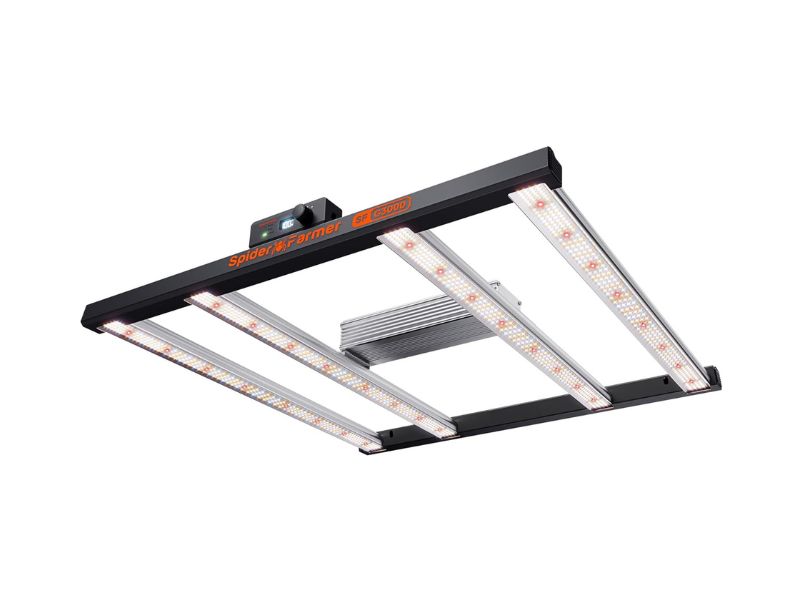
The Spider Farmer G3000 is another 300-watt fixture built specifically around a 3×3 canopy. Its bars extend toward the outer sections of the frame, helping distribute output toward the corners instead of concentrating most of the light directly beneath the fixture’s center.
At approximately 824 µmol/s PPF, the G3000 provides substantial total photon output for a nine-square-foot area. Its listed efficacy is somewhat lower than the FC-3000 EVO, but it remains within the range expected from an efficient modern LED fixture.
The main functional difference is the control system. A digital brightness display allows more repeatable adjustments than an unmarked rotary dimmer. Instead of estimating whether the dial is set near 40% or 60%, the user can record and reproduce a specific output setting.
That can be useful when maintaining a grow log. If a particular intensity works well during a specific plant stage, the setting can be repeated in a later cycle without relying on visual estimates.
App-based controls add remote adjustments, schedules, and gradual sunrise or sunset transitions. These functions may reduce reliance on a separate timer and make it easier to check or change the light schedule without opening the tent.
Smart controls are convenient, but they do not replace physical environmental checks. A programmed schedule cannot correct excessive canopy temperature, poor airflow, overwatering, or incorrect fixture height.
The G3000’s bar-style layout promotes relatively even coverage across a square area. The extended bars help move the diodes closer to the canopy perimeter, which can improve corner intensity when compared with a compact central board.
The frame should not be pushed directly against the reflective walls. Leaving some space allows the output from the outer diodes to spread and reflect instead of striking the wall at an inefficient angle.
Its full-spectrum design supports the complete plant cycle. White light creates a broad visual spectrum, while deep-red wavelengths support efficient photosynthesis during mature growth.
The 300-watt output gives the fixture useful flowering headroom. It can be dimmed substantially for seedlings and early vegetative plants, then increased in measured steps as the canopy expands.
At full power, the G3000 produces a similar heat load to the Mars Hydro light. Adequate exhaust ventilation and internal circulation are required, especially when the tent is in a warm room.
The digital electronics and app functions add useful convenience but also introduce more setup steps. Growers who prefer a basic timer and manual dimmer may not need the connected features.
What I Like
- Designed for a complete 3×3 footprint
- Extended bars support corner coverage
- Digital brightness display
- Integrated app controls
- Scheduling and transition modes
- Strong full-cycle output
- Daisy-chain support
- Fanless operation
What I Do Not Like
- Lower stated efficacy than the first product
- App setup adds complexity
- Digital controls may be unnecessary for basic tents
- Full power can add substantial heat
- Connected features do not replace canopy measurements
The G3000 is a strong choice for growers who want exact 3×3 coverage with integrated digital controls. It is particularly useful when repeatable dimming and remote scheduling matter more than obtaining the highest possible system efficacy.
3. AC Infinity IONFRAME EVO4 300W LED Grow Light
Key Features
- 300W actual power draw
- 896 Samsung LM301H EVO diodes
- 3×3 flowering coverage
- 4×4 vegetative coverage
- Ten brightness levels
- Built-in schedule programming
- Sunrise and sunset dimming
- Removable driver
- Daisy-chain capability
- UIS smart-controller compatibility
- IP65 construction
- ETL-certified design
- Supplemental UV, red, and far-red diodes
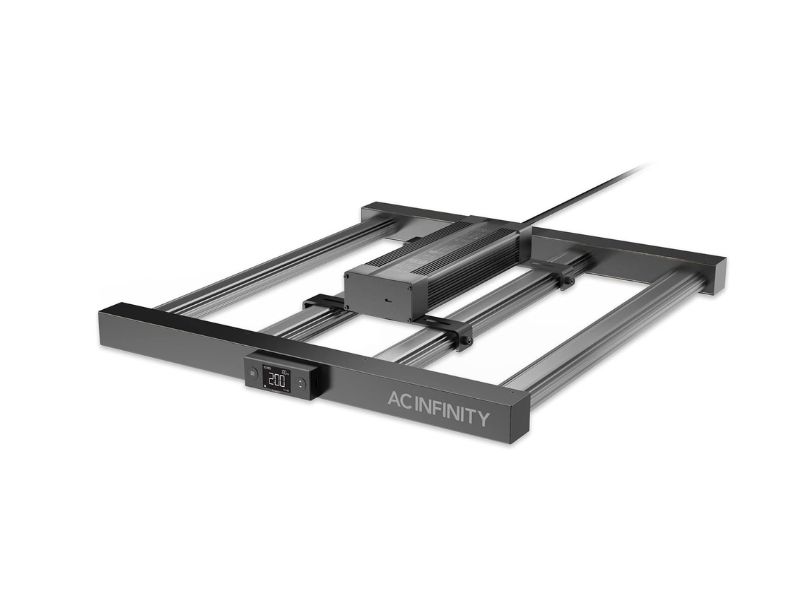
The AC Infinity IONFRAME EVO4 is the most automation-focused fixture in this comparison. Its 300-watt bar frame is designed for 3×3 flowering coverage and uses Samsung LM301H EVO diodes distributed across multiple bars.
The diode positioning is intended to reduce center hotspots and create more consistent output across a square canopy. This is particularly important when four or nine plants occupy fixed positions near the corners and outer edges.
The ten brightness levels provide clear, repeatable intensity adjustment. A numbered level is easier to record and reproduce than a smooth dimmer without marked positions.
Built-in scheduling can reduce dependence on a separate outlet timer. The light can follow recurring on-and-off periods, while sunrise and sunset transitions gradually increase or decrease output.
These transitions are not essential for plant development, but they can create a smoother environmental change and reduce sudden electrical-load shifts when multiple devices activate simultaneously.
The removable driver is one of the EVO4’s most useful practical features. LED drivers generate heat, and placing the driver outside the tent can reduce the internal thermal load.
Remote mounting does not remove the heat produced by the light bars, but it can improve temperature control in compact tents. The driver should remain securely mounted, well ventilated, and protected from moisture.
IP65 construction provides documented protection against dust and water exposure. The light should still be kept away from direct spray, but the sealed design is appropriate for a humid growing environment.
ETL certification adds another layer of electrical-safety documentation. It does not replace proper installation, grounded power, dry connectors, or appropriate circuit planning.
UIS compatibility allows the light to coordinate with compatible exhaust fans, circulation fans, humidifiers, heaters, and environmental controllers. This can create a unified system in which lighting and climate equipment operate through the same platform.
The integrated ecosystem is valuable only when the grower plans to use it. A buyer who needs one light, one timer, and a manual exhaust controller may not benefit enough to justify the added complexity.
Supplemental ultraviolet, red, and far-red diodes broaden the fixture’s spectrum. These wavelengths should be considered secondary features rather than substitutes for strong PAR output and uniform PPFD.
At 300 watts, the EVO4 offers suitable full-cycle capacity. Its strongest advantage is not raw wattage but controlled delivery, repeatable settings, driver relocation, and integration.
What I Like
- Premium Samsung diode platform
- Bar spacing supports square-canopy uniformity
- Ten repeatable brightness levels
- Built-in scheduling
- Removable driver
- IP65 protection
- ETL-certified construction
- Environmental-controller compatibility
- Full-cycle spectrum
What I Do Not Like
- More complex than a basic manual fixture
- Ecosystem expansion can increase total cost
- Many features may remain unused in a simple tent
- Additional hardware may be required for full automation
- Maximum diode efficacy is not the same as complete fixture efficacy
The EVO4 is the strongest option for an automation-centered 3×3 tent. It is most appropriate when scheduling, remote driver placement, environmental integration, and defined moisture protection matter more than minimizing initial complexity.
4. VIPARSPECTRA KS3000 LED Grow Light
Key Features
- Approximately 300–320W power class
- Four-bar square frame
- Samsung LM301H white diodes
- OSRAM 660 nm red diodes
- Full 3×3 physical coverage
- Continuous 0–100% dimming
- Daisy-chain support
- Detachable driver
- Passive fanless cooling
- Broad diode spacing
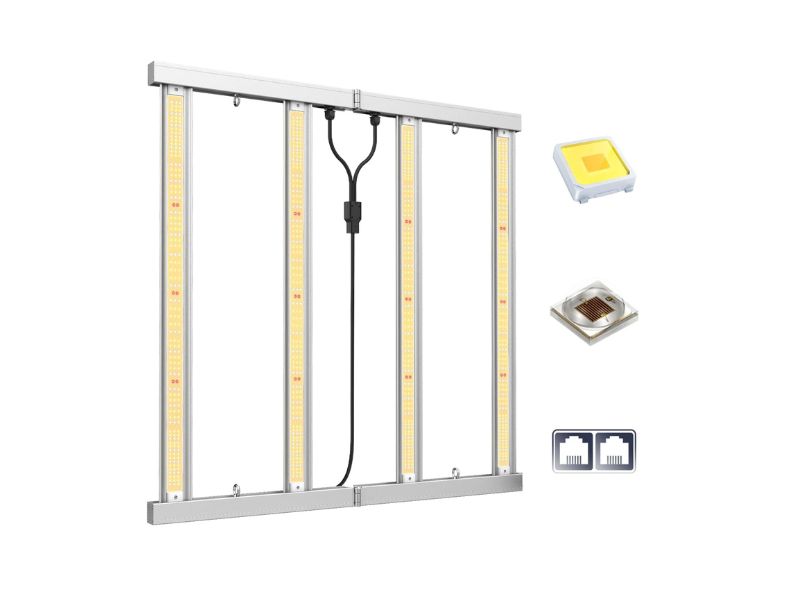
The VIPARSPECTRA KS3000 uses a simple four-bar frame that occupies much of a 3×3 tent’s horizontal area. This physical spread is its main advantage.
Rather than using a compact central board, the fixture positions the diodes across four long bars. The wider layout can improve corner intensity and reduce the difference between the canopy center and perimeter.
Its Samsung white diodes provide efficient broad-spectrum output, while OSRAM 660 nm red diodes supplement the spectrum with deep-red light. This combination supports seedlings, vegetative plants, and flowering growth.
The fixture sits within the approximate 300- to 320-watt category, depending on the exact version and operating conditions. That provides enough power for a fully occupied 3×3 canopy while retaining the ability to dim for less demanding stages.
Continuous dimming offers finer adjustment than fixtures limited to four or ten preset levels. The output can be increased gradually rather than jumping between large steps.
The downside is repeatability. An analog dial can be harder to return to an exact previous setting unless it includes clear markings. A grower may need to record the dial position visually.
The detachable driver provides an opportunity to move some heat outside the tent. This can be particularly useful when the fixture operates near full output during warm months.
The driver should only be relocated using the supported cable arrangement. Improvised wiring extensions or poorly ventilated mounting locations can create reliability and safety problems.
The KS3000 lacks the integrated app schedules and environmental ecosystem of the Spider Farmer and AC Infinity models. For some buyers, this is an advantage. Fewer digital controls can mean faster setup and less dependence on apps, wireless connections, or additional controllers.
The wide frame takes up a substantial portion of the tent ceiling. Before purchasing, confirm there is enough room for the carbon filter, inline fan, ducting, hangers, and driver.
Its passive cooling system operates without fixture-mounted fans. Dust should still be cleaned from the bars and heat-dissipation surfaces to preserve cooling performance.
What I Like
- Wide square frame matches a 3×3 canopy
- Strong physical corner coverage
- Samsung and OSRAM diode combination
- Continuous dimming
- Detachable driver
- Simple operation
- Daisy-chain capability
- Quiet passive cooling
What I Do Not Like
- Limited integrated automation
- Exact wattage may vary by version
- Large frame reduces overhead equipment space
- Analog dimming is less repeatable than numbered levels
- Fixture dimensions require careful planning
The KS3000 is a practical choice for buyers who want broad coverage and uncomplicated control. It provides a strong physical match for a 3×3 tent without requiring a connected environmental platform.
5. VIVOSUN LumaLight 320W LED Grow Light
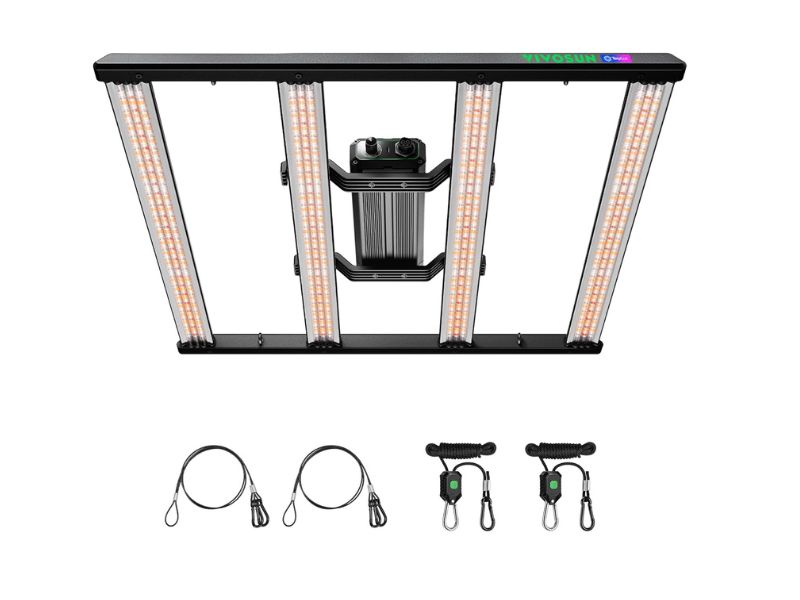
Key Features
- 320W output class
- Approximately 3×3 coverage
- Multi-bar light matrix
- Micro-lens optic system
- Four dimming levels
- Full-spectrum white, blue, red, and far-red output
- 3000K and 5000K white diodes
- 660 nm red light
- 730 nm far-red light
- GrowHub compatibility
- IP65-sealed light bars
- Integrated heat-dissipation fins
The VIVOSUN LumaLight takes a different approach by combining a multi-bar frame with micro-lens optics. The lenses are intended to direct output more deliberately toward the canopy and improve penetration.
Lens-assisted distribution can help shape the beam, but it does not automatically guarantee uniform PPFD. The effectiveness still depends on fixture height, bar spacing, canopy distance, and the shape of the tent.
At approximately 320 watts, the LumaLight is one of the most powerful fixtures in this group. Across nine square feet, that equals roughly 35.6 watts per square foot.
That output provides useful flowering headroom, but it also increases heat and electricity demand. Seedlings and young plants should begin under a reduced setting rather than full output.
The fixture offers four manual dimming levels. This is simpler than continuous dimming and makes it easy to select a repeatable output stage.
The limitation is adjustment precision. A large step between preset levels may require changing hanging height to reach the desired canopy intensity.
GrowHub compatibility adds scheduling and connected control when used with supported equipment. Growers already using compatible fans or environmental devices may find this integration useful.
The spectrum includes warm and cool white, blue, 660 nm red, and 730 nm far red. The broad white spectrum provides most of the full-cycle illumination, while the additional wavelengths modify the spectral balance.
Far-red can affect plant morphology and shade-response signaling, but it should not be treated as inherently beneficial at every intensity or stage. The complete photon distribution remains more important.
IP65-sealed light bars provide documented protection in a humid environment. The driver and electrical connections should still remain dry and away from irrigation spray.
Integrated heat-dissipation fins increase surface area and help the fixture release heat without active cooling fans. Adequate airflow above and around the frame remains necessary.
The square light-bar matrix should be centered with equal sidewall clearance. Lens-equipped surfaces also require careful cleaning because residue or scratches can alter light distribution.
What I Like
- Strong 320-watt capacity
- Square multi-bar layout
- Lens-assisted light distribution
- IP65-sealed bars
- Repeatable dimming levels
- GrowHub compatibility
- Broad full-spectrum output
- Passive heat-dissipation fins
What I Do Not Like
- Only four manual intensity levels
- Less precise adjustment than continuous dimming
- Higher full-power heat load
- Smart controls require compatible equipment
- Lens surfaces require careful maintenance
The LumaLight is a modern option for growers who want strong output, sealed bars, lens-assisted distribution, and optional controller integration. Its four-step dimmer is easy to use but less flexible than continuous or ten-level control.
Grow Light Comparison Table
| Product | Power | Fixture Geometry | Coverage | Diode Platform | Output or Efficiency | Dimming | Smart Control | Main Limitation |
| Mars Hydro FC-3000 EVO | 300W | Square bar frame | Approx. 3×3 | Samsung LM301H EVO | Approx. 855 µmol/s and 2.95 µmol/J | Continuous | Optional controller | Smaller high-intensity core |
| Spider Farmer G3000 | 300W | Extended bar frame | 3×3 | High-efficiency LED array | Approx. 824 µmol/s and 2.75 µmol/J | Digital | Integrated app | Lower stated efficacy |
| AC Infinity EVO4 | 300W | Bar frame | 3×3 flower | Samsung LM301H EVO | High-efficiency diode platform | Ten levels | UIS compatible | Greater system complexity |
| VIPARSPECTRA KS3000 | 300–320W class | Four-bar square frame | 3×3 | Samsung and OSRAM | Version dependent | Continuous | Daisy-chain control | Limited automation |
| VIVOSUN LumaLight | 320W class | Lens-assisted bar matrix | 3×3 | Full-spectrum LED array | Model specific | Four levels | GrowHub compatible | Limited manual adjustment |
The FC-3000 EVO offers the strongest overall efficiency balance. The G3000 emphasizes integrated digital controls. The EVO4 provides the most complete environmental ecosystem, while the KS3000 offers wide physical coverage with simpler operation. The LumaLight combines high output with sealed bars and lens-assisted distribution.
How a 3×3 Canopy Changes the Lighting Decision
A 3×3 tent provides nine square feet of growing area:
3 feet × 3 feet = 9 square feet
Unlike a 2×4 tent, which is long and narrow, a 3×3 tent requires relatively equal coverage in every direction.
The center of the canopy is closer to the fixture than the four corners when a compact central light is used. This can create a pattern in which the center plants receive strong PPFD while the corners receive much less.
A wide square or near-square bar frame reduces this distance difference by positioning diodes closer to the outer canopy.
The ideal fixture should provide:
- Adequate center intensity
- Useful corner PPFD
- Smooth transitions between bars
- Minimal central hotspot
- Enough total output for the selected plant stage
Reflective tent walls can redirect some sideward light toward the plants. However, reflection cannot fully compensate for a fixture that provides weak direct illumination at the corners.
Some photons are absorbed by the tent material, frame, pots, floor, and other equipment. Reflected light also travels a longer path before reaching the leaves.
Fixture size matters as much as fixture power. A physically wide 280- or 300-watt bar light can sometimes provide more useful uniformity than a compact 320-watt board.
The best choice therefore depends on both the photon budget and how effectively those photons are distributed across all nine square feet.
Building a Photon Budget for Nine Square Feet
A photon budget estimates how much useful light a fixture produces and how much of it reaches the canopy.
A 3×3 tent contains approximately 0.84 square meters:
9 square feet × 0.0929 = approximately 0.84 m²
Suppose a fixture produces 840 µmol/s PPF. Dividing total PPF by 0.84 m² gives a theoretical average of approximately 1,000 µmol/m²/s.
That does not mean the canopy will actually receive a perfectly uniform 1,000 PPFD.
The calculation assumes:
- Every emitted photon reaches the canopy
- No light strikes the walls
- No photons escape through openings
- No output is absorbed by equipment
- Distribution is perfectly even
- The fixture operates at the stated output
- Measurement conditions match the final installation
Real-world average PPFD will be lower and unevenly distributed.
A fixture may produce:
- Very high center PPFD
- Moderate side PPFD
- Low corner PPFD
Another light with the same wattage and total PPF may produce a lower center peak but stronger corners, resulting in a more useful canopy average.
This is why one PPFD reading directly beneath the center is insufficient. A proper map includes measurements at multiple points, such as:
- Center
- Four midpoints
- Four corners
The minimum reading is particularly important because the weakest canopy areas often determine how evenly plants develop.
A wide bar frame, suitable hanging height, and reflective walls can improve the percentage of emitted photons that reach useful leaf surfaces.
Canopy density also changes the photon budget. A full canopy intercepts more light than widely separated small plants, while gaps allow photons to reach the floor.
Choosing Between 300W and 320W
A 20-watt difference appears small, but it can affect heat, electricity use, and maximum intensity.
A 300-watt light is usually sufficient for a complete 3×3 canopy when the fixture is efficient and distributes output evenly.
A 320-watt model provides additional headroom. That can be useful when:
- The canopy is dense
- The crop tolerates high intensity
- The fixture is hung higher for better uniformity
- The environment supports faster growth
- Strong corner coverage is required
- The light will often operate below maximum
A 320-watt light can be efficient when dimmed. Running a larger fixture at 80% may provide broad, quiet, and controlled output without using the full rated power.
More wattage is not automatically better. Extra light can become waste when the environment is limited by:
- High temperature
- Low carbon dioxide
- Poor root health
- Inadequate irrigation
- Nutrient imbalance
- Excessive humidity
- Low humidity
- Weak air circulation
A 300-watt fixture with strong uniformity may outperform a 320-watt fixture with a severe center hotspot.
Choose the higher output when the tent, ventilation system, and canopy can use it. Choose based on usable distribution rather than the largest number.
Understanding Corner Uniformity and Center Hotspots
Center PPFD measures intensity near the middle of the canopy.
Corner PPFD measures the weakest outer areas.
Average PPFD combines multiple readings across the full space.
Uniformity describes how closely those readings match one another.
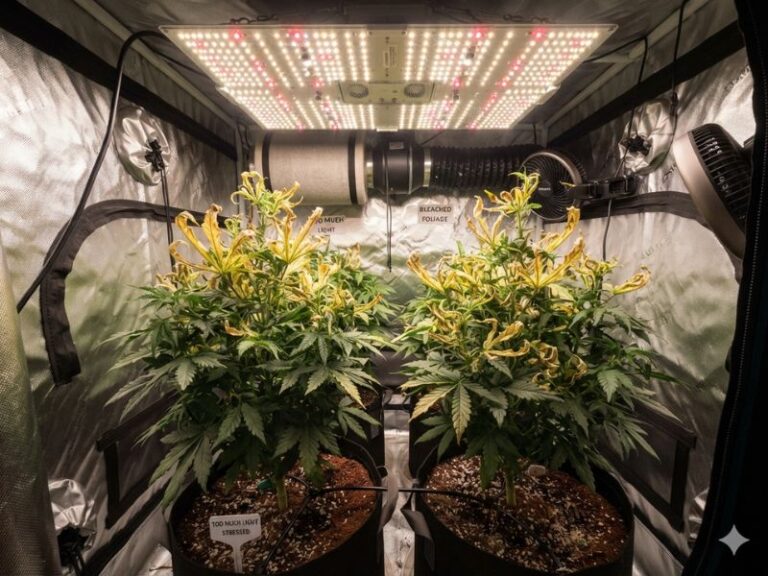
A useful light does not need identical intensity at every point, but the difference should not be so large that center plants bleach while corner plants stretch.
Hotspots can result from:
- Compact diode placement
- Low hanging height
- Strong optical lenses
- Excessive center overlap
- Tilted fixtures
- Uneven canopy height
Weak corners can result from:
- Small fixture footprint
- Excessive distance from outer diodes to walls
- Low hanging height
- Blocked light
- Tall center plants shading shorter corner plants
Raising the light generally improves blending. The beams overlap more before reaching the canopy, reducing sharp intensity differences.
The trade-off is lower overall PPFD. Dimming and hanging height should therefore be adjusted together.
Bar spacing also matters. Bars positioned closer to the perimeter can strengthen edge and corner intensity.
Micro-lens optics may direct more photons downward, but narrow beam angles can also create concentrated zones when the fixture is too close.
Reflective walls help recover sideward light. Keeping them clean and maintaining reasonable fixture-to-wall distance improves their usefulness.
Matching the Light to the Canopy Layout
One large central plant
A single trained plant may occupy most of the tent.
The center begins directly beneath the strongest part of the fixture, while branches are trained outward toward the corners.
A wide bar light helps maintain intensity as the canopy expands. Training should create a relatively level surface so central growth does not move dangerously close to the fixture.
Four medium plants
Four plants can be placed in a two-by-two layout, with one occupying each quadrant.
This arrangement makes corner uniformity particularly important. Each plant may extend toward a tent corner, where weak PPFD can cause uneven growth.
The fixture should be centered precisely, and the pots should remain equally spaced where possible.
Nine small plants
Nine plants can form a three-by-three grid.
This layout requires consistent intensity across every position. The center plant naturally receives strong direct light, while the four corner plants are most vulnerable to reduced PPFD.
A wide square frame is usually preferable to a compact board for this arrangement.
Plant count should follow legal, practical, and horticultural considerations. These layouts are examples of light-distribution patterns, not universal planting recommendations.
Fixture Clearance and Ceiling-Space Planning
A fixture can fit within the tent’s width and still leave insufficient vertical room.
Use this formula:
Usable plant height = tent height − container height − fixture depth − hanging clearance − canopy gap
For example, a 72-inch tent might lose:
- 12 inches to the container
- 4 inches to the fixture
- 6 inches to hangers and overhead equipment
- 18 inches to the desired canopy gap
That leaves:
72 − 12 − 4 − 6 − 18 = 32 inches of usable plant height
This example shows why overhead planning matters.
The tent ceiling may also contain:
- Carbon filter
- Inline exhaust fan
- Flexible ducting
- Driver
- Sensors
- Circulation fan
- Support bars
- Power cables
A wide square fixture can interfere with an internally mounted filter. Moving the exhaust fan or driver outside the tent may preserve growing height.
Ratchet hangers should be kept as short as safely practical. Long hanging cables reduce usable height.
Confirm the exact frame dimensions before purchasing, particularly with bar lights that occupy most of the tent width.
Light Acclimation Without Fixed Dimmer Percentages
Plants should be acclimated to increasing light rather than exposed to the maximum setting immediately.
Begin with conservative intensity after germination, transplanting, or a major fixture change.
Increase output in small steps and observe the plants long enough to identify a response. Changing the dimmer several times per day makes it difficult to determine which setting caused an improvement or problem.
Evaluate new growth rather than relying only on older damaged leaves. Existing bleaching or curling may not reverse after the light is corrected.
Positive responses include:
- Flat, evenly colored leaves
- Controlled vertical growth
- Consistent development across the tent
- Gentle upward leaf orientation
- Stable canopy temperature
Possible excess-light symptoms include:
- Pale upper growth
- Bleached areas
- Upward-curling edges
- Drying near the fixture
- Reduced growth directly beneath the center
- Excessive leaf-surface temperature
Possible low-light symptoms include:
- Stretching
- Thin stems
- Wide internodal spacing
- Slow canopy filling
- Corner plants leaning inward
Increase intensity only when temperature, humidity, airflow, irrigation, and root health remain stable.
Converting Grow-Light Wattage Into Heat Load
Electrical power can be converted into approximate heat using:
BTU per hour = watts × 3.412
For a 300-watt fixture:
300 × 3.412 = approximately 1,024 BTU/h
For a 320-watt fixture:
320 × 3.412 = approximately 1,092 BTU/h
Efficient LEDs produce more usable photons per watt than inefficient lights, but nearly all consumed electrical energy still becomes heat somewhere in the room.
The heat may come from:
- LED bars
- Driver
- Power electronics
- Absorbed light
- Reflected light
Moving a removable driver outside the tent reduces internal heat, but the driver still warms the surrounding room.
The exhaust system must remove heat from the tent, while the room itself may require air conditioning or ventilation.
The 68 BTU/h difference between 300 and 320 watts is modest, but it can matter during summer or in a small room that already contains other equipment.
Canopy temperature should be monitored directly rather than estimated only from room temperature.
Reflective Walls: Useful Support, Not Extra Wattage
Reflective tent walls redirect some escaped light toward the canopy.
They can improve:
- Side illumination
- Corner distribution
- Lower-canopy exposure
- Overall photon use
Reflection does not create additional photons. Every reflection also involves some loss.
Clean, smooth walls usually reflect more effectively than dusty, stained, or heavily wrinkled surfaces.
Do not push the fixture directly against the tent wall. Outer bars need space for light to spread before reaching the reflective surface.
Reflective walls are most useful when the fixture already provides reasonable direct coverage. They should support a good light-distribution pattern rather than compensate for an undersized fixture.
Troubleshooting Uneven Growth in a 3×3 Tent
Center plants are pale or bleached
The center may be receiving excessive PPFD.
Possible corrections include:
- Raising the fixture
- Reducing output
- Leveling the canopy
- Checking leaf-surface temperature
- Moving the tallest branches outward
Corner plants are stretching
Corner PPFD may be too low.
Possible corrections include:
- Raising the fixture slightly to improve blending
- Increasing output carefully
- Confirming the frame is centered
- Moving plants inward temporarily
- Removing objects that block side light
One side grows faster
The fixture may be tilted, the canopy may be uneven, or airflow may differ across the tent.
Check:
- Hanger length
- Fixture level
- Pot height
- Plant training
- Fan direction
- Wall clearance
- Shading from taller plants
Upper leaves curl while lower leaves look normal
The upper canopy may be experiencing excessive light or heat.
Increase the fixture distance, reduce output, and check airflow above the canopy.
Growth is slow everywhere
Insufficient light is only one possibility.
Also evaluate:
- Root health
- Temperature
- Humidity
- Watering
- Nutrition
- Photoperiod
- Air exchange
- Plant genetics
Increasing light will not correct a root-zone or environmental problem.
Electrical Load and Controller Planning
At 120 volts, approximate current draw is:
- 300W ÷ 120V = 2.5 amps
- 320W ÷ 120V = 2.67 amps
The light is only one part of the electrical load.
A complete tent may include:
- Inline fan
- Clip fan
- Humidifier
- Dehumidifier
- Heater
- Pump
- Controller
- Monitoring equipment
Check the timer or smart-controller relay rating before connecting the light. A controller may support low-power fans but not the continuous load of a high-output fixture.
Use grounded outlets and keep connectors away from water. Create drip loops so moisture cannot follow a cable directly into a plug or power strip.
Avoid overloaded adapters and tightly coiled extension cords.
Maintenance for Bar and Lens-Based Fixtures
Disconnect the light from power before maintenance.
For bar fixtures:
- Remove dust from each bar
- Inspect bar alignment
- Check connectors
- Confirm hanging hardware remains tight
- Keep heat-dissipation channels clear
For lens-equipped fixtures:
- Use a soft material
- Avoid abrasive cleaning
- Do not apply chemicals that may cloud or damage the lenses
- Remove residue before it alters beam distribution
Inspect the driver for excessive heat, unusual noise, discoloration, or damaged cables.
Keep the driver’s ventilation area open and dry.
Recheck fixture height as plants grow. A safe gap can become inadequate after rapid vertical development.
Frequently Asked Questions
What is the best grow light for a 3×3 tent?
My primary recommendation is the Mars Hydro FC-3000 EVO because it combines a 300-watt output, efficient Samsung diodes, a wide bar frame, and strong full-cycle coverage.
The Spider Farmer G3000 is better for integrated app control, while the AC Infinity EVO4 offers more extensive environmental automation.
Is 300 watts enough for a 3×3 grow tent?
Yes. An efficient 300-watt LED fixture is generally sufficient for a complete nine-square-foot canopy.
The final result depends on photon efficacy, distribution, hanging height, plant stage, and environmental conditions. A uniform 300-watt light may be more useful than a poorly distributed 320-watt fixture.
Is 320 watts too much for a 3×3 tent?
No, but it may need to be dimmed.
A 320-watt fixture provides useful flowering headroom and can be operated below maximum during early growth. Adequate ventilation and canopy distance are required.
How much PPF does a 3×3 tent need?
There is no single universal total because plant species, growth stage, photoperiod, and environmental conditions differ.
Fixtures around 800–900 µmol/s PPF can provide substantial output for nine square feet when distribution is efficient.
What PPFD should reach the corners of a 3×3 canopy?
Corner PPFD should be high enough to prevent visible stretching or weak development relative to the center.
The exact target depends on the crop and stage. The priority is avoiding a severe center-to-corner difference rather than reaching one universal number.
Why are plants stretching in the tent corners?
The corners may receive lower PPFD than the center.
Check fixture size, hanging height, frame position, canopy shading, and wall clearance. Raising the fixture slightly can improve blending, though it also lowers average intensity.
Is one grow light enough for a 3×3 tent?
Yes. One properly designed 3×3 fixture is generally sufficient.
A wide square bar frame usually provides better coverage than several small lights, though multiple fixtures can offer independent zoning.
Are square bar lights better for a 3×3 tent?
They often provide better uniformity because the diodes are distributed closer to the canopy edges and corners.
Compact board lights are simpler but may produce stronger center intensity.
How close should the fixture be to the tent walls?
Leave enough space for output from the outer diodes to spread and reflect.
The exact clearance depends on the frame size and optics. Avoid pressing bars directly against the tent fabric.
How much vertical clearance does a 3×3 light require?
Calculate tent height after subtracting container height, fixture depth, hanging hardware, and the required canopy gap.
Wide bar fixtures may also compete with filters and ducting for ceiling space.
Should I mount the LED driver outside the tent?
External driver placement can reduce internal heat when the fixture supports it.
The driver must remain dry, ventilated, securely mounted, and connected with approved cables.
Does reflective Mylar increase PPFD?
It can redirect some sideward photons toward the canopy and improve edge distribution.
It does not create additional output, and each reflection involves some loss.
Is app control necessary for a grow light?
No. A reliable timer and manual dimmer are sufficient for many setups.
App control is useful for remote schedules, transitions, and integration with environmental equipment.
What is the difference between diode efficiency and system efficiency?
Diode efficiency describes the LED component under specific conditions.
System efficiency includes the driver, wiring, thermal conditions, and complete fixture. System efficacy is more useful when comparing finished lights.
How much heat does a 300W grow light produce?
A 300-watt fixture contributes approximately 1,024 BTU per hour of heat to the tent or room.
Some heat can be moved outside the tent by relocating the driver, but the room still receives the energy.
How can I tell if the center receives too much light?
Look for center plants that are paler, curled, warmer, or slower-growing than plants near the edges.
Confirm the pattern with multiple PPFD readings when possible, then raise or dim the fixture gradually.
Conclusion
Selecting the best grow light for 3×3 tent use depends on photon output, corner uniformity, control features, heat load, and available ceiling space.
My primary recommendation is the Mars Hydro FC-3000 EVO 300W LED Grow Light. Its efficient Samsung diodes, strong total output, and square bar-style frame provide a balanced system for a complete nine-square-foot canopy.
The Spider Farmer G3000 300W LED Grow Light is a strong alternative for integrated app controls and digital dimming. The AC Infinity IONFRAME EVO4 is better suited to an automated environmental system with removable-driver heat management.
The VIPARSPECTRA KS3000 provides broad physical coverage with straightforward controls, while the VIVOSUN LumaLight 320W combines strong output, sealed bars, and lens-assisted distribution.
Do not judge a 3×3 fixture by center intensity alone. Check corner coverage, frame dimensions, hanging clearance, driver placement, dimming range, and heat load. A well-distributed 300-watt light is generally more useful than a higher-powered fixture that leaves the canopy uneven.

I’m Maya L. Greenwood, a lifelong plant lover who believes anyone can grow something beautiful with the right guidance. After years of testing soil mixes, pruning methods, irrigation tricks, and pest-safe solutions, I started EasyGardenTips.com to turn hard-won lessons into step-by-step advice. From seed starting and container gardens to composting and seasonal checklists, my goal is to make gardening simple, sustainable, and fun.