Best Grow Light for 2×4 Tent: 5 Efficient Full-Spectrum LEDs
Choosing the best grow light for 2×4 tent use requires more than comparing wattage. A 2×4 tent contains eight square feet of canopy space, so the fixture must distribute light across a long rectangular area rather than concentrate most of its output in the center.
A square light designed for a 3×3 space may technically fit inside a 2×4 tent, but it can create excessive intensity in the middle while leaving the ends underlit. A rectangular board or bar-style fixture usually matches the canopy more effectively and makes it easier to maintain consistent PPFD from one end of the tent to the other.
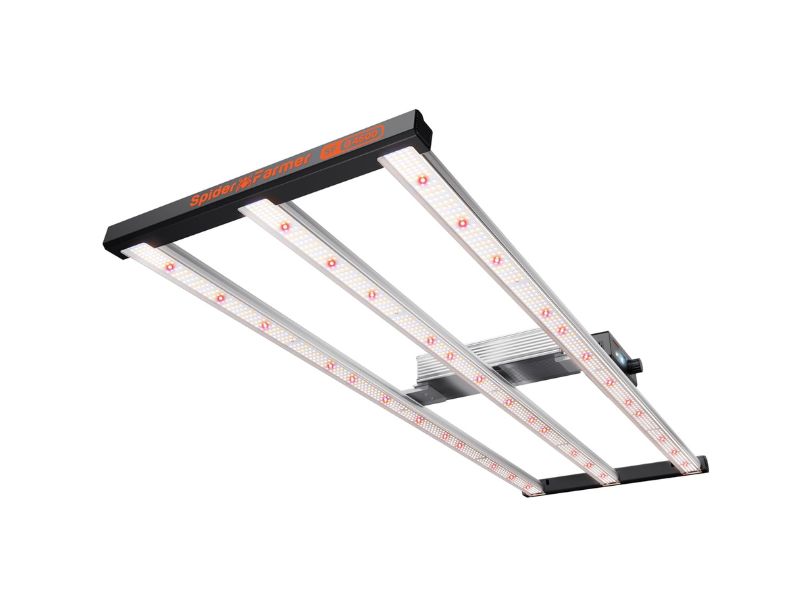
My primary recommendation is the Spider Farmer G4500 320W LED Grow Light. Its elongated bar design, 320-watt output, dimming system, and full 2×4 coverage provide the strongest balance of flowering intensity and canopy uniformity among the five products in this guide.
The Mars Hydro SP3000 is a closely matched 300-watt alternative, while the AC Infinity IONFRAME EVO3 offers more advanced scheduling and environmental-control integration. The lower-powered Spider Farmer SF2000 and VIPARSPECTRA XS2500 are worth considering when electricity consumption, heat, or moderate-intensity growing matters more than maximum output.
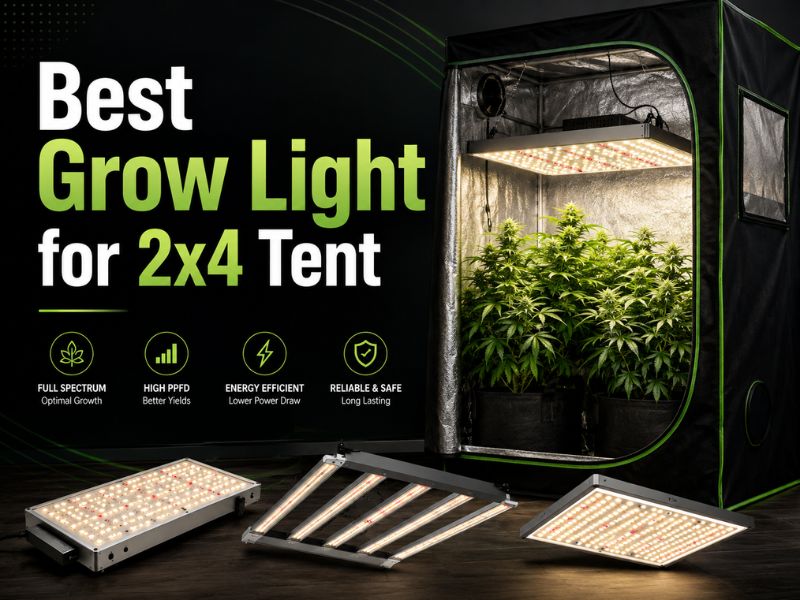
The best LED grow light for 2×4 tent applications should match the plant stage, fixture dimensions, tent height, ventilation capacity, and electrical system. Actual power, photon output, dimming, spectrum, and fixture shape matter more than advertised wattage-equivalent claims.
5 Best Grow Lights for a 2×4 Tent
| Image | Product Name | Check Price |
|---|---|---|
Best Choice | pider Farmer G4500 320W LED Grow Light | Check Price |
Second Best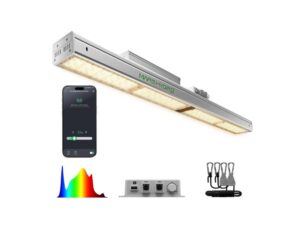 | Mars Hydro SP3000 300W LED Grow Light | Check Price |
Third Choice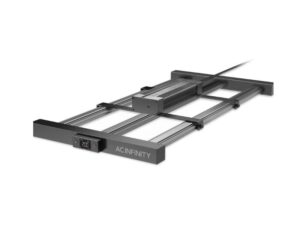 | AC Infinity IONFRAME EVO3 280W LED Grow Light | Check Price |
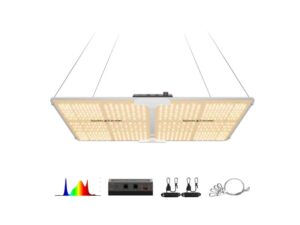 | Spider Farmer SF2000 200W LED Grow Light | Check Price |
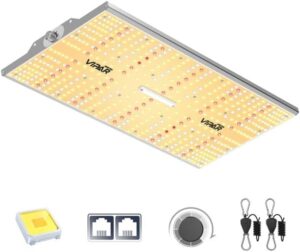 | VIPARSPECTRA XS2500 250W LED Grow Light | Check Price |
1. Spider Farmer G4500 320W LED Grow Light
Key Features
- 320W actual power draw
- Approximately 2.85 µmol/J photon efficacy
- Elongated bar-style construction
- Full 2×4 grow-tent coverage
- High-efficiency Bridgelux diodes
- Dimmable full-spectrum output
- Manual and app-based controls
- Daisy-chain capability
- Passive cooling
- No complex frame assembly required
The Spider Farmer G4500 is designed around the shape of a 2×4 grow tent. Its long, narrow bar arrangement distributes LEDs across most of the four-foot canopy length, reducing the sharp center-to-edge drop that can occur with compact square fixtures.
At 320 watts, the G4500 provides the highest power draw in this comparison. That gives it substantial flowering headroom across a fully occupied eight-square-foot canopy. Dividing 320 watts by eight square feet produces an average of 40 watts per square foot, although actual photon distribution and fixture efficiency are more informative than wattage alone.
Its published efficacy of approximately 2.85 µmol/J indicates efficient conversion of electrical energy into photosynthetically active photons. The wide diode spacing also helps distribute that output across the canopy rather than concentrating most of it directly beneath one board.
This design is particularly useful during flowering, when plants generally need higher intensity than seedlings or vegetative plants. The G4500 has enough output to support a dense canopy, but it should not be operated at full power immediately after germination or transplanting. Starting with a reduced dimmer setting helps prevent bleaching, upward leaf curling, and unnecessary heat.
The full-spectrum output is intended to support the complete growth cycle. Blue wavelengths contribute to compact vegetative development, while red and deep-red wavelengths support photosynthetic efficiency and flowering. Green light also penetrates deeper into the canopy than many growers assume, helping illuminate leaves below the top layer.
Manual dimming provides straightforward local control. The app-based functions add convenience for growers who want remote adjustment, schedules, or connected operation. However, the app is not essential for basic use. The fixture can still function as a conventional dimmable light.
Its bar-style frame supports passive cooling by spreading heat across a larger surface area. There are no internal cooling fans to collect dust or create additional noise. Passive cooling does not eliminate heat, though. A 320-watt fixture eventually transfers most of that energy into the tent or surrounding room.
The light should be centered lengthwise inside the tent, with the long side aligned along the four-foot dimension. Keeping the fixture level is important because even a small tilt changes the distance between the diodes and different parts of the canopy.
The narrow frame leaves useful room around the sides for circulation fans, sensors, irrigation lines, and support equipment. Overhead space still needs to be planned carefully if a carbon filter and inline exhaust fan are mounted inside the tent.
This fixture is most suitable for growers who plan to use most or all of the 2×4 canopy and want strong flowering output from one light. It may be excessive for a lightly planted tent, early propagation, or a setup where heat removal is limited.
What I Like
- Excellent physical match for a rectangular 2×4 canopy
- Strong flowering output
- Efficient photon production
- Wide bar layout supports better edge coverage
- Manual and app-based dimming
- Full-cycle spectrum
- Passive, fanless cooling
- Enough output for a dense canopy
What I Do Not Like
- Higher electricity use than the other fixtures
- Produces more heat at full power
- App features add setup complexity
- Full output may be unnecessary for seedlings and small plants
- Requires adequate exhaust and air circulation
The G4500 is the most complete option for growers who want high-intensity, full-cycle lighting across the entire tent. Its combination of output, rectangular coverage, dimming, and bar-style uniformity makes it my primary recommendation for a serious 2×4 setup.
2. Mars Hydro SP3000 300W LED Grow Light
Key Features
- 300W actual power draw
- Approximately 727.2 µmol/s PPF
- Approximately 2.8 µmol/J photon efficacy
- Elongated 2×4 fixture shape
- 0–100% dimming
- Daisy-chain capability
- Full-spectrum output
- 3000K, 5000K, and 660 nm wavelengths
- Optional Bluetooth and Wi-Fi control
- Timed dimming and sunrise/sunset options with compatible controls
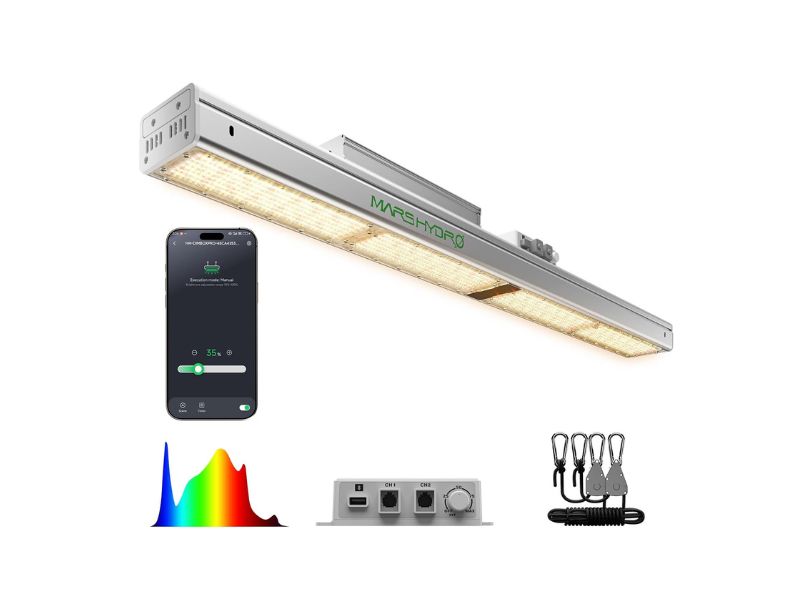
The Mars Hydro SP3000 is another elongated fixture designed specifically for a 2×4 growing area. Its narrow linear design distributes light across the full tent length and makes it more suitable for a rectangular canopy than a compact square board.
The 300-watt power draw places it slightly below the G4500 but above the EVO3, XS2500, and SF2000. Across eight square feet, that equals approximately 37.5 watts per square foot. This is a useful output level for full-cycle growing and provides adequate flowering headroom for many indoor plants.
The listed PPF of approximately 727.2 µmol/s describes the total quantity of photosynthetically active photons produced each second. Its efficacy of approximately 2.8 µmol/J indicates good electrical efficiency.
PPF does not show exactly how evenly those photons reach the canopy. Fixture shape and hanging height determine whether output is spread evenly or concentrated in a few high-intensity areas. The SP3000’s long body helps address this by positioning the LEDs across the tent’s four-foot length.
The spectrum combines warm white, cool white, and 660 nm deep-red light. The white diodes create a broad visible spectrum suitable for seedlings, vegetative development, and flowering. The deep-red component supports photosynthetic efficiency and is particularly relevant during mature growth.
Its 0–100% dimming range makes the SP3000 adaptable. Seedlings can begin under reduced output, while mature plants can receive progressively more intensity as the canopy develops.
Daisy chaining can simplify control when multiple fixtures are used, although one SP3000 is normally sufficient for a 2×4 tent. The feature becomes more useful when several tents or a larger open growing area use matching lights.
Optional smart controls can add remote scheduling, timed dimming, and gradual sunrise or sunset transitions. Those functions may require compatible accessories rather than being fully integrated into the basic fixture. Buyers who only need a manual dimmer and outlet timer may not benefit from the additional control system.
The elongated frame should be centered carefully. The ends of the fixture need enough distance from the tent walls to prevent unnecessary reflection losses and uneven intensity. The light should also remain level, especially when suspended from two separate ratchet hangers.
At 300 watts, heat management remains important. The fixture itself uses passive cooling, but its electrical energy ultimately becomes heat within the tent or room. An appropriate inline exhaust fan and internal circulation fan help move that heat away from the canopy.
The SP3000 suits growers who want high output and rectangular distribution but do not need the maximum 320-watt capacity of the G4500. It provides a useful balance between performance, efficiency, and control.
What I Like
- Exact physical match for a 2×4 tent
- Strong 300-watt flowering output
- Useful published PPF and efficacy
- Wide dimming range
- Full-spectrum and deep-red output
- Daisy-chain capability
- Optional smart automation
- Good end-to-end coverage potential
What I Do Not Like
- Smart functions may require an additional accessory
- Long shape requires careful hanging and alignment
- Driver heat contributes to the tent’s thermal load
- Slightly less output than the G4500
- Advanced controls may be unnecessary for basic setups
The SP3000 is a strong alternative for growers who want full-canopy flowering intensity and a fixture shaped specifically for a 2×4 tent. It provides nearly the output of the G4500 while remaining slightly more moderate in power consumption.
3. AC Infinity IONFRAME EVO3 280W LED Grow Light
Key Features
- 280W actual power draw
- 840 Samsung LM301H EVO diodes
- 2×4 flowering coverage
- 3×5 vegetative coverage
- Bar-style diode arrangement
- Ten brightness levels
- Built-in schedule control
- Sunrise and sunset dimming
- Removable driver
- UIS smart-controller compatibility
- Daisy-chain capability
- IP65 protection
- ETL-certified construction
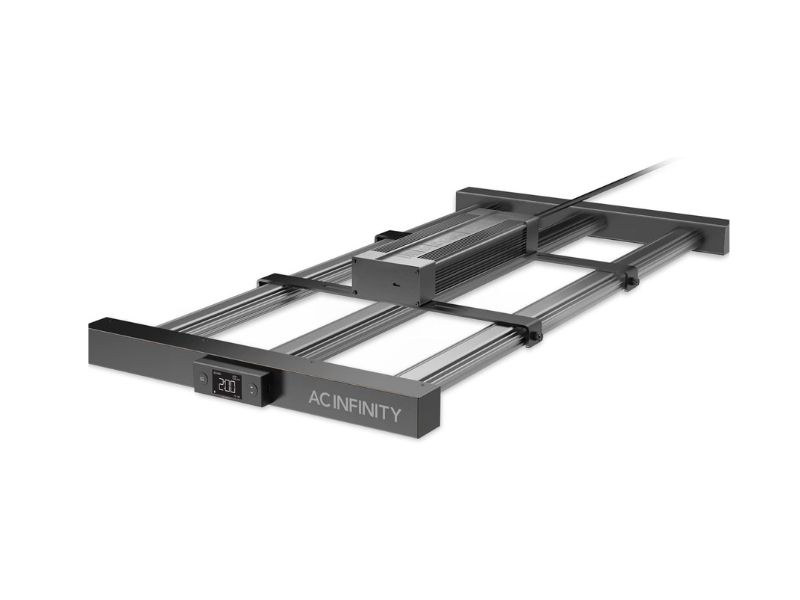
The AC Infinity IONFRAME EVO3 focuses on control, uniformity, and system integration. Its 280-watt bar-style frame is specifically designed for 2×4 flowering coverage, while its broader vegetative coverage reflects the lower light intensity usually required during early growth.
The fixture uses 840 Samsung LM301H EVO diodes distributed across multiple bars. Wider diode spacing helps reduce central hotspots and creates a smoother intensity gradient from the middle of the canopy toward the edges.
At 280 watts, the EVO3 provides approximately 35 watts per square foot across a 2×4 tent. This is sufficient for full-cycle growing in many environments, although it offers less maximum flowering headroom than the 300- and 320-watt fixtures above.
Its lower wattage can also be an advantage. The light consumes less electricity and introduces less heat at full power. Growers working in a warm room, a poorly ventilated space, or a location with high electricity costs may prefer this balance.
The EVO3’s main distinction is its control system. Ten defined brightness levels make intensity adjustments repeatable. Instead of estimating an analog dimmer position, the user can record a numbered setting and reproduce it later.
Built-in scheduling allows the light cycle to be programmed without relying entirely on a separate plug-in timer. Sunrise and sunset transitions gradually increase or decrease brightness instead of switching instantly between full darkness and the selected intensity.
Gradual transitions are not required for successful indoor growing, but they can create a smoother operating routine and reduce abrupt electrical-load changes when several devices start simultaneously.
The removable driver is one of the most practical features. LED drivers produce heat, so mounting the driver outside the tent can reduce the internal thermal load. This is especially useful when the tent operates near the upper end of the desired temperature range.
Remote mounting must still be done safely. The driver needs adequate ventilation, protection from water, and secure cable routing. Extension cables should not be stretched tightly or placed where they can be damaged.
IP65 protection provides documented resistance to dust and water exposure. The fixture should not be sprayed directly, but the rating is reassuring in a humid environment where condensation or occasional splashes are possible.
UIS compatibility allows the EVO3 to integrate with supported fans, humidifiers, heaters, and environmental controllers. This is valuable for growers building a coordinated automation system. It is less important for someone who only wants a basic light and mechanical timer.
The EVO3 is most appropriate for a controlled 2×4 setup where scheduling, environmental integration, and heat management matter more than obtaining the highest available wattage.
What I Like
- Wide bar-style canopy distribution
- Premium Samsung diode platform
- Ten repeatable brightness levels
- Built-in light scheduling
- Sunrise and sunset transitions
- Removable driver
- IP65 protection
- Environmental-controller integration
- Lower heat load than the top two fixtures
What I Do Not Like
- Lower maximum output than the G4500 and SP3000
- More controls than some growers need
- Smart integration can increase total system complexity
- Additional compatible equipment may raise the total cost
- Full ecosystem benefits require using matching controllers and devices
The EVO3 is the strongest option for growers who value automation, repeatable settings, and remote driver placement. Its 280-watt output is slightly more conservative, but the feature set is more advanced than the other lights in this guide.
4. Spider Farmer SF2000 200W LED Grow Light
Key Features
- 200W actual power draw
- Approximately 2.7 µmol/J photon efficacy
- 2×4 flowering coverage
- 3×4 vegetative coverage
- Compact board-style construction
- Dimmable full-spectrum output
- Passive fanless cooling
- Detachable driver
- 3000K, 5000K, 660 nm, and infrared spectrum
- Controller compatibility
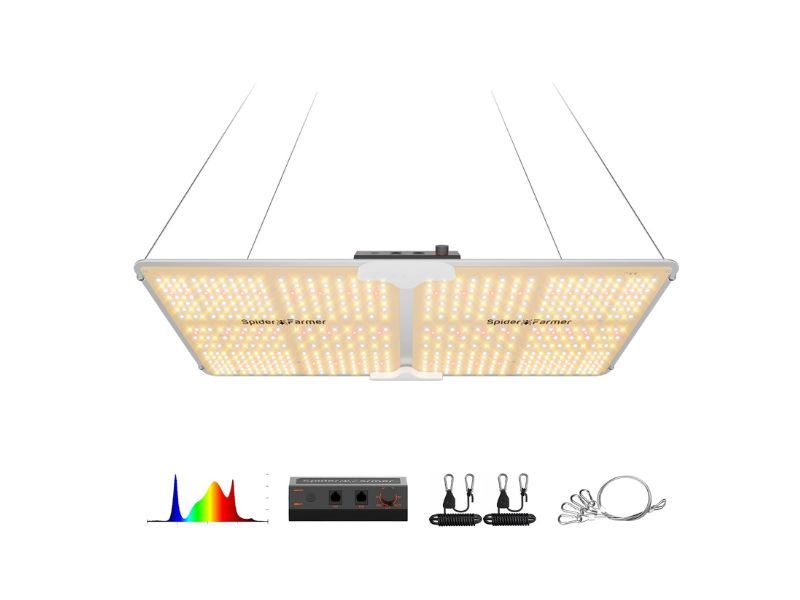
The Spider Farmer SF2000 is the lowest-powered fixture in this comparison. Its 200-watt design is positioned for 2×4 flowering coverage, though it provides less intensity reserve than the 250- to 320-watt alternatives.
Across eight square feet, 200 watts equals approximately 25 watts per square foot. With efficient LEDs, that can be suitable for seedlings, vegetative plants, herbs, leafy greens, and moderate-intensity flowering.
A dense, fully occupied flowering canopy may benefit from more output, especially when the goal is high PPFD from one end of the tent to the other. The SF2000 should therefore be selected with realistic expectations.
Its board-style construction places the LEDs on a compact rectangular surface. This makes the fixture easy to hang and leaves more open space around the tent ceiling. It can be a useful choice when an inline fan, filter, ducting, and circulation equipment already occupy much of the overhead area.
The compact board may produce stronger intensity near the center than at the ends. Hanging the fixture slightly higher can improve spread, but increasing distance also reduces PPFD.
Dimming makes it easy to manage seedlings and young plants. Because the maximum output is lower than the other fixtures, the dimmer may remain closer to full power during mature growth.
The full-spectrum output includes warm white, cool white, deep red, and infrared wavelengths. This combination supports multiple plant stages without requiring separate vegetative and flowering lights.
Its passive cooling system eliminates internal fans. This reduces noise and removes a mechanical component that could eventually wear out. Dust should still be removed from the heat sink and LED surface so cooling and light transmission remain effective.
The detachable driver can help with heat management if remote placement is supported and performed correctly. Moving the driver outside the tent reduces some internal heat, though the LED board itself still generates warmth.
The SF2000 is particularly attractive for growers who prioritize lower electricity use. At full power, it consumes substantially less energy than the G4500 or SP3000.
It can also be a practical choice for a tent that is not always filled from wall to wall. When only part of the canopy is occupied, a 200-watt fixture may provide enough intensity without the cost and heat of a larger model.
What I Like
- Lowest power consumption in the comparison
- Lower heat output
- Simple installation
- Dimmable full-spectrum light
- Fanless operation
- Compact board design
- Suitable for seedlings and vegetative growth
- Established 2×4 fixture format
What I Do Not Like
- Limited flowering headroom
- Less uniform edge coverage than wide bar fixtures
- Lower total photon output
- Basic controls compared with the EVO3
- May require careful canopy management at the tent ends
The SF2000 is a sensible option for lower-intensity growing, vegetative use, or buyers who want to minimize electricity and heat. It is less suitable for growers seeking the strongest possible flowering intensity across a dense 2×4 canopy.
5. VIPARSPECTRA XS2500 250W LED Grow Light
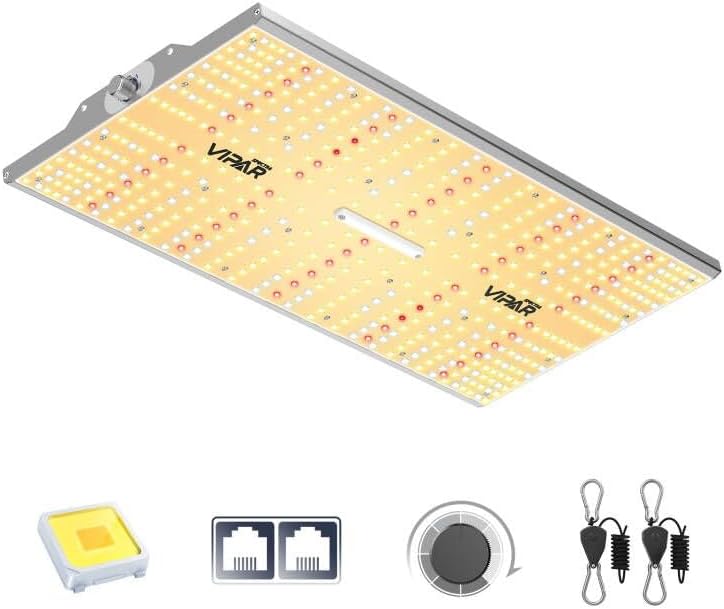
Key Features
- 250W actual power draw
- Samsung LM301H diodes
- 2×4 coverage
- Full-spectrum output
- 3000K and 5000K white light
- 660 nm red light
- 730 nm infrared light
- Dimming control
- Daisy-chain capability
- Fanless passive cooling
- Compact board-style fixture
The VIPARSPECTRA XS2500 occupies the middle ground between the lower-powered SF2000 and the higher-output bar lights. Its 250-watt draw provides approximately 31.25 watts per square foot across a 2×4 canopy.
This output level is suitable for full-cycle growing and provides more flowering reserve than a 200-watt fixture. It remains easier to cool and less expensive to operate than 300- or 320-watt models.
The XS2500 uses Samsung LM301H diodes with a full-spectrum mix of white, deep-red, and infrared wavelengths. The white diodes support the complete growth cycle, while the red and infrared components broaden the spectrum.
Infrared or far-red light should not be treated as a substitute for adequate PAR output. Its effect depends on intensity, timing, cultivar, and the rest of the spectrum. The primary buying factors should remain canopy coverage, usable photon output, dimming, and heat management.
Its board-style layout is compact and straightforward to install. The fixture can be centered over the tent with its long side aligned with the four-foot length.
As with other board lights, center intensity may be stronger than edge intensity. Hanging height needs to balance spread and PPFD. A lower position increases intensity directly beneath the board, while a higher position improves blending across the canopy.
The dimming system supports gradual adjustment through seedlings, vegetative growth, and flowering. Because the fixture provides 250 watts rather than 320 watts, mature plants may eventually use a higher dimmer setting.
Daisy chaining simplifies synchronized control when multiple fixtures are used in a larger room. In a single 2×4 tent, only one XS2500 is normally required.
Passive cooling keeps the fixture quiet. Heat still needs to be removed by the tent’s ventilation system, but the 250-watt load is easier to manage than the top two models.
The XS2500 suits growers who want more flowering capacity than a 200-watt board but do not need the advanced controls or full output of the higher-ranked fixtures.
What I Like
- Balanced 250-watt output
- Samsung diode platform
- Full-spectrum light with red and infrared
- Simple dimming
- Daisy-chain support
- Silent passive cooling
- Compact construction
- Moderate electricity consumption
What I Do Not Like
- Board-style layout may produce weaker edge uniformity
- Fewer smart-control features
- Less output than the 280- to 320-watt fixtures
- Far-red inclusion does not guarantee better results
- Hanging height requires careful adjustment
The XS2500 is a capable middle-ground option. It is suitable for growers who want stronger flowering performance than a 200-watt fixture without moving to the heat, power consumption, or complexity of a 300-watt smart system.
Grow Light Comparison Table
| Product | Power | Fixture Style | Coverage | Diode Platform | Efficacy | Controls | Main Strength | Main Limitation |
| Spider Farmer G4500 | 320W | Bar style | 2×4 | Bridgelux | Approx. 2.85 µmol/J | Manual and app control | High output and uniformity | Higher heat and electricity use |
| Mars Hydro SP3000 | 300W | Elongated strip | 2×4 | High-efficiency LED array | Approx. 2.8 µmol/J | Dimmer and optional smart control | Balanced flowering output | Smart features may require accessories |
| AC Infinity EVO3 | 280W | Bar style | 2×4 flower | Samsung LM301H EVO | High-efficiency diode platform | Ten levels and scheduling | Automation and removable driver | More complex control system |
| Spider Farmer SF2000 | 200W | Board style | 2×4 flower | Full-spectrum LED array | Approx. 2.7 µmol/J | Dimmer and controller support | Low heat and power use | Limited flowering headroom |
| VIPARSPECTRA XS2500 | 250W | Board style | 2×4 | Samsung LM301H | Model-specific system efficacy | Dimmer and daisy chain | Balanced output and simplicity | Less uniform than wide bar lights |
The G4500 provides the strongest output and wide bar coverage. The SP3000 offers a similar rectangular design with slightly lower wattage. The EVO3 emphasizes smart control and heat management. The SF2000 is the most economical to operate, while the XS2500 provides a moderate 250-watt balance.
How Much Light Does a 2×4 Grow Tent Need?
A 2×4 tent provides:
2 feet × 4 feet = 8 square feet
Efficient LED fixtures for this space commonly range from approximately 200 to 320 actual watts.
Lower-intensity and vegetative setups
A range of roughly 160 to 220 watts can be sufficient for:
- Seedlings
- Clones
- Leafy greens
- Herbs
- Vegetative plants
- Lightly occupied canopies
- Heat-sensitive environments
The Spider Farmer SF2000 fits within this category.
Moderate full-cycle setups
A range of roughly 240 to 280 watts provides more flowering capacity while keeping heat manageable.
The VIPARSPECTRA XS2500 and AC Infinity EVO3 fit within this range.
Higher-intensity flowering setups
A 300- to 320-watt fixture provides stronger PPFD and more headroom for a dense canopy.
The Mars Hydro SP3000 and Spider Farmer G4500 fall into this group.
Wattage is only a rough guide. Two lights with the same power draw can produce different photon outputs depending on diode efficiency, driver efficiency, spectrum, and thermal design.
Canopy distribution also matters. A 300-watt square fixture may be less effective in a 2×4 tent than a 280-watt bar fixture designed for the rectangular footprint.
Ignore advertised “equivalent wattage” comparisons. Use actual wall draw, PPF, PPE, PPFD maps, and flowering coverage.
Understanding Grow-Light Specifications
PAR
Photosynthetically active radiation, or PAR, refers to wavelengths from approximately 400 to 700 nanometers that plants commonly use for photosynthesis.
PAR describes a wavelength range, not a quantity of light.
PPF
Photosynthetic photon flux, or PPF, measures the total PAR photons emitted each second.
It is expressed in:
µmol/s
A higher PPF means the fixture produces more total photosynthetically active light.
PPFD
Photosynthetic photon flux density, or PPFD, measures how many PAR photons reach one square meter of canopy each second.
It is expressed in:
µmol/m²/s
PPFD is more useful for understanding actual canopy intensity. A fixture may have high total PPF but poor edge PPFD if most output remains concentrated near the center.
PPE
Photosynthetic photon efficacy, or PPE, measures the number of PAR photons produced for each joule of electrical energy.
It is expressed in:
µmol/J
Higher efficacy generally means better electrical efficiency, but it does not automatically mean better canopy coverage.
DLI
Daily light integral, or DLI, measures the total PAR received over an entire day.
DLI combines:
- PPFD
- Photoperiod
- Time
A plant receiving moderate PPFD for 18 hours may receive a similar DLI to a plant receiving higher PPFD for 12 hours.
Vegetative coverage vs. flowering coverage
Vegetative coverage is often larger because plants require less intensity during early growth.
Flowering coverage is the more conservative and useful specification for planning a full-cycle setup.
A light advertised for 3×5 vegetative coverage may still be rated for only 2×4 flowering coverage.
Bar-Style vs. Board-Style Grow Lights
Bar-style fixtures
The G4500 and EVO3 use multi-bar layouts, while the SP3000 uses an elongated rectangular form.
Advantages include:
- Wider diode distribution
- Better end-to-end uniformity
- Reduced center hotspots
- More open passive cooling
- Better physical match for a rectangular tent
Potential disadvantages include:
- Larger fixture footprint
- More hanging points
- Greater overhead-space requirements
- More complex cable routing
Board-style fixtures
The SF2000 and XS2500 use compact board-style construction.
Advantages include:
- Easy installation
- Compact dimensions
- Strong center intensity
- More open ceiling space
- Fewer frame components
Potential disadvantages include:
- Greater center-to-edge variation
- More sensitivity to hanging height
- Less physical diode spread
For a fully occupied 2×4 flowering canopy, bar-style fixtures generally offer better uniformity. Board lights remain useful when simplicity, cost, and compactness matter more.
Full-Spectrum Lighting for Each Growth Stage
Seedlings
Seedlings need relatively low intensity. Start with the light higher above the canopy or at a reduced dimmer setting.
Too much light may cause:
- Bleaching
- Curling
- Stunted growth
- Dry media
- Excessive leaf temperature
Vegetative growth
Increase intensity gradually as plants develop more leaf area.
Blue wavelengths support compact growth, while green light penetrates through the upper canopy and contributes to lower-leaf photosynthesis.
Flowering
Mature plants can use higher intensity when temperature, irrigation, nutrition, root health, and carbon dioxide are adequate.
Deep-red light near 660 nm is commonly included because plants use it efficiently in photosynthesis.
Infrared and far-red light can influence plant responses, but more far-red does not automatically mean better flowering. The complete spectrum and intensity matter more than one wavelength.
Hanging Height and Dimming Guide
No single hanging height works for every fixture or plant.
Seedlings
Start higher or dimmer than the flowering recommendation.
The leaves should remain flat and evenly colored. If they curl upward, bleach, or stop expanding, reduce intensity.
Vegetative growth
Lower the light gradually or increase the dimmer in small steps.
Avoid making major intensity changes in one day.
Early flowering
Increase output as the canopy fills the tent. Check the tallest plants first because they receive the strongest intensity.
Full flowering
Full power may be useful with a 200- or 250-watt fixture. A 300- or 320-watt light may not need to run at maximum output in every environment.
Watch for:
- Bleached upper leaves
- Upward curling
- Excessive canopy heat
- Rapid drying
- Stalled growth
- Pale areas directly beneath the fixture
Possible signs of insufficient light include:
- Stretching
- Large internodal spacing
- Weak stems
- Slow growth
- Poor lower-canopy development
A PAR meter provides the most reliable information. Manufacturer hanging charts are useful starting points, but the final position should reflect actual canopy response.
Heat, Ventilation, and Electrical Planning
Every watt consumed by the lighting system eventually becomes heat in the tent or surrounding room.
The five fixtures draw:
- SF2000: 200W
- XS2500: 250W
- EVO3: 280W
- SP3000: 300W
- G4500: 320W
The difference between 200 and 320 watts is significant in a compact tent. A higher-output fixture may require more exhaust airflow, especially during warm weather.
Ventilation
A complete setup should include:
- Inline exhaust fan
- Passive or active intake
- Internal circulation fan
- Temperature and humidity monitoring
- Adequate room ventilation
The exhaust system removes warm tent air, while the circulation fan moves heat away from the leaves and prevents stagnant pockets.
Driver heat
A removable driver can be mounted outside the tent when the manufacturer supports remote placement.
This reduces some internal heat but does not eliminate the thermal output from the LED fixture.
Electrical safety
Use:
- Grounded outlets
- Properly rated timers
- Suitable controllers
- Dry, elevated power strips
- Drip loops
- Secure cables
- Correct circuit capacity
Do not place electrical connectors beneath irrigation lines or reservoirs.
Electricity-Cost Calculation
Use:
Monthly cost = Kilowatts × hours per day × 30 × electricity rate
Assume a 12-hour schedule and an electricity rate of $0.16 per kilowatt-hour.
| Fixture Power | Monthly Energy Use | Estimated Monthly Cost |
| 200W | 72 kWh | $11.52 |
| 250W | 90 kWh | $14.40 |
| 280W | 100.8 kWh | $16.13 |
| 300W | 108 kWh | $17.28 |
| 320W | 115.2 kWh | $18.43 |
These calculations assume full-power operation. Dimming reduces actual consumption.
Ventilation, heating, cooling, pumps, and humidity-control equipment add to the total operating cost.
How to Position a Grow Light in a 2×4 Tent
Center the fixture over the eight-square-foot canopy.
Align the long side of the light with the four-foot tent length.
The layout should resemble:
[———– Grow Light ———–]
[——— 2×4 Canopy Area ——–]
Maintain equal distance from both end walls. Keep the fixture level and verify that the center is not dramatically brighter than the edges.
Leave enough overhead room for:
- Carbon filter
- Exhaust fan
- Ducting
- Driver
- Sensors
- Hanging hardware
Use ratchet hangers that allow easy height adjustment. Secure power cables so they do not rest on hot components or hang into the canopy.
Common 2×4 Grow-Light Mistakes
Choosing a square fixture
A square 3×3 light may not distribute photons effectively across a narrow rectangular tent.
Buying by wattage alone
Actual photon output and coverage matter more than wattage-equivalent claims.
Confusing vegetative and flowering coverage
Use flowering coverage when planning a complete grow cycle.
Running full power on seedlings
Young plants rarely need the maximum output of a 250- to 320-watt fixture.
Hanging the light too close
Lower placement increases PPFD but can create hotspots and bleaching.
Ignoring canopy edges
A strong center reading does not guarantee consistent end-to-end coverage.
Ignoring heat
Efficient LEDs still add heat to the tent.
Using an oversized fixture
Confirm the physical dimensions before purchase. Leave room for ventilation equipment and hangers.
Relying only on smart controls
Automation cannot correct poor placement, excessive heat, inadequate airflow, or incorrect watering.
Overloading timers and circuits
Check the total electrical load of the complete system.
Maintenance and Long-Term Use
Disconnect power before cleaning or adjusting the fixture.
Regularly inspect:
- LED surfaces
- Heat sinks
- Bars or boards
- Drivers
- Power cables
- Connectors
- Dimmers
- Controllers
- Ratchet hangers
- Tent support bars
Dust can reduce cooling efficiency and light transmission. Clean the fixture with a soft, dry material or follow the manufacturer’s maintenance instructions.
Do not spray liquid directly onto the LEDs, driver, dimmer, or connectors.
Keep air space around heat sinks and drivers. Recheck hanging height as the canopy grows.
Replace damaged cables or connectors rather than covering them with tape and continuing to operate the fixture.
Frequently Asked Questions
What is the best grow light for a 2×4 tent?
My primary recommendation is the Spider Farmer G4500 because its 320-watt output and elongated bar layout provide strong flowering intensity and uniform 2×4 coverage.
The Mars Hydro SP3000 is a closely matched alternative, while the AC Infinity EVO3 offers more advanced controls.
How many watts do I need for a 2×4 grow tent?
Most efficient LED setups use approximately 200 to 320 actual watts.
A 200-watt fixture may suit seedlings, vegetative growth, or moderate flowering. A 280- to 320-watt light provides more full-canopy flowering headroom.
Is 200W enough for a 2×4 tent?
Yes, 200 watts can be enough for lower-intensity plants, vegetative growth, and moderate flowering.
A dense flowering canopy may benefit from more output, especially when strong PPFD is required at both ends of the tent.
Is 300W too much for a 2×4 tent?
No, but it may need to be dimmed.
A 300-watt light is appropriate for high-intensity flowering when hanging height, temperature, irrigation, and ventilation are properly managed.
Can one grow light cover a 2×4 tent?
Yes. Each product in this guide is intended to cover a 2×4 or 4×2 area with one fixture.
The light should be centered and aligned with the four-foot tent length.
Are bar-style lights better for a 2×4 tent?
They generally provide better edge-to-edge uniformity.
Board lights are more compact and simpler, but bar fixtures physically distribute the LEDs across a wider section of the canopy.
What PPFD should seedlings receive?
Seedlings need low to moderate intensity compared with mature plants.
Begin with the light dimmed or positioned higher, then increase output gradually while monitoring leaf color, posture, and growth.
What PPFD is suitable for flowering?
The appropriate flowering PPFD depends on the plant, environment, carbon dioxide level, nutrition, and temperature.
Higher intensity should only be used when the complete environment can support increased photosynthesis.
How high should a grow light hang in a 2×4 tent?
Start with the manufacturer’s recommended range.
Adjust according to dimmer setting, canopy response, and measured PPFD. Higher placement improves spread but reduces intensity.
Should I run my grow light at full power?
Not during every growth stage.
Seedlings and young plants usually need less light. Mature plants may use full output when temperature and other environmental factors remain controlled.
Do I need a dimmable grow light?
Dimming is highly useful.
It allows one fixture to support seedlings, vegetative plants, and flowering without repeatedly changing hanging height or replacing the light.
How much electricity does a 2×4 grow light use?
A 200- to 320-watt fixture uses approximately 72 to 115.2 kilowatt-hours per month on a 12-hour daily schedule at full power.
Actual cost depends on the local electricity rate and dimmer setting.
Do LED grow lights require ventilation?
Yes. Efficient LEDs still generate heat.
Use an exhaust fan and internal circulation fan to control canopy temperature and prevent stagnant air.
Are smart grow-light controls worth it?
They are useful for scheduling, repeatable dimming, remote adjustments, and environmental integration.
A basic dimmer and timer are sufficient for growers who prefer simple manual control.
What is the difference between flowering and vegetative coverage?
Vegetative coverage is usually larger because plants need less intensity during early growth.
Flowering coverage represents the smaller area where the fixture can provide stronger light for mature plants.
Conclusion
Selecting the best grow light for 2×4 tent use depends on the desired flowering intensity, canopy uniformity, control system, heat load, and electricity consumption.
My primary recommendation is the Spider Farmer G4500 320W LED Grow Light. Its elongated bar design, strong output, and dimming controls make it the most complete option for a fully occupied 2×4 canopy.
The Mars Hydro SP3000 300W LED Grow Light provides a balanced alternative with strong full-cycle output and optional smart control.
The AC Infinity IONFRAME EVO3 280W LED Grow Light is better suited to growers who prioritize scheduling, removable-driver heat management, and environmental-system integration.
For lower power consumption, the Spider Farmer SF2000 200W LED Grow Light is a practical option. The VIPARSPECTRA XS2500 250W LED Grow Light provides a useful middle ground between efficiency and flowering capacity.
Whichever fixture you choose, verify its physical dimensions, flowering coverage, hanging requirements, ventilation needs, and electrical load. Correct placement and gradual intensity adjustment are more important than simply selecting the highest wattage.

I’m Maya L. Greenwood, a lifelong plant lover who believes anyone can grow something beautiful with the right guidance. After years of testing soil mixes, pruning methods, irrigation tricks, and pest-safe solutions, I started EasyGardenTips.com to turn hard-won lessons into step-by-step advice. From seed starting and container gardens to composting and seasonal checklists, my goal is to make gardening simple, sustainable, and fun.