
Light is one of the most important factors for healthy indoor plants, but more light isn’t always better. Many new growers assume that turning the grow light to full power or placing it as close as possible will speed up growth and increase yields. In reality, too much light can have the opposite effect. Excessive light intensity can stress plants, reduce photosynthesis efficiency, bleach leaves, and even slow overall development.
Modern LED grow lights are far more powerful than older lighting systems, making light stress more common than many growers realize. Research has shown that once plants reach their light saturation point, additional light provides little benefit and may begin causing damage instead. That’s why experienced indoor gardeners focus on managing PPFD (Photosynthetic Photon Flux Density) and Daily Light Integral (DLI) rather than simply using the brightest setting available.
In this guide, I’ll explain whether you can have too much light in a grow tent, the warning signs of excessive light exposure, what causes light stress, and how to fix it before it affects your plants. You’ll also learn the ideal light intensity for different growth stages and practical tips to maximize healthy growth without risking light burn.
Can You Have Too Much Light in a Grow Tent?
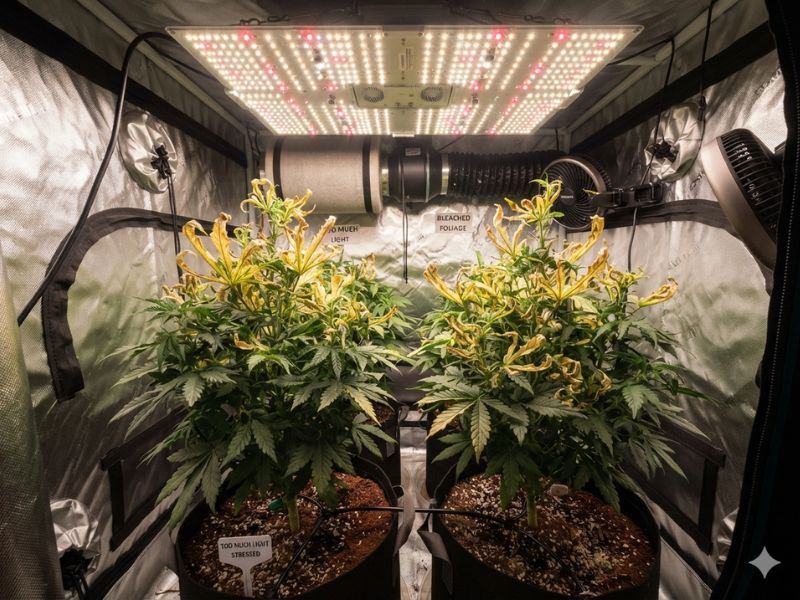
Yes, you absolutely can have too much light in a grow tent. While plants need light to produce energy through photosynthesis, there is a limit to how much they can use. Once that limit is reached, increasing light intensity doesn’t make plants grow faster. Instead, it puts them under stress and can reduce their overall health and productivity.
Think of light as fuel for your plants. Too little fuel limits growth, but too much can overwhelm the plant’s natural processes. Excessive light can damage leaf tissue, increase water loss, and force the plant to spend more energy protecting itself instead of growing.
This issue is especially common with modern full-spectrum LED grow lights. Many high-quality LEDs produce enough light to exceed a plant’s needs, particularly in smaller grow tents. If the fixture is mounted too close or operated at full brightness throughout the entire growing cycle, plants may begin showing signs of light stress within days.
The good news is that light stress is often reversible when caught early. Adjusting the light intensity, raising the fixture, or shortening the daily lighting period usually allows plants to recover before permanent damage occurs.
How Too Much Light Affects Plants
Plants rely on light to convert carbon dioxide and water into sugars through photosynthesis. However, this process has a natural limit. When light levels exceed what the plant can efficiently use, excess energy creates stress instead of promoting growth.
Photosynthesis Reaches a Limit
Every plant has a light saturation point, where photosynthesis is operating near its maximum rate. Beyond this point, additional light provides little or no increase in energy production.
Rather than producing more sugars, the plant begins dissipating excess energy to protect its cells. This means you’re using more electricity without gaining faster growth or higher yields.
Increased Plant Stress
Too much light forces plants to work harder to prevent cellular damage. This can lead to a condition known as photoinhibition, where the photosynthetic machinery becomes less efficient due to excessive light exposure.
As stress increases, plants may:
- Curl their leaves upward.
- Close their stomata to reduce water loss.
- Lose moisture more quickly.
- Divert energy from growth to self-protection.
These responses help the plant survive but often slow development.
Lower Yield and Poor Plant Quality
Prolonged exposure to excessive light can reduce both plant size and harvest quality. Instead of producing vigorous foliage or dense flowers, stressed plants often develop smaller leaves, weaker stems, and reduced biomass.
During flowering, excessive light may also contribute to issues such as bleaching, poor bud development, or lower overall yields. Rather than maximizing production, too much light can ultimately reduce the results you’re trying to achieve.
Understanding these effects is the first step toward providing the right balance of light intensity, duration, and distance for healthy, productive plants.
Common Signs Your Grow Tent Has Too Much Light
Plants usually give clear warning signs before excessive light causes serious damage. Learning to recognize these symptoms early allows you to adjust your lighting setup before growth and yields are affected.
Bleached or White Leaves
One of the most recognizable signs of excessive light is leaf bleaching. The leaves closest to the grow light may lose their rich green color and turn pale yellow or almost white. This happens because intense light damages chlorophyll faster than the plant can replace it.
Unlike nutrient deficiencies, bleaching typically starts on the topmost leaves that receive the strongest light.
Leaf Curling or “Tacoing”
Leaves may curl upward along the edges, creating a shape that resembles a taco. This is the plant’s natural defense mechanism to reduce the surface area exposed to intense light.
If you notice taco-shaped leaves near the canopy while lower leaves remain healthy, your light intensity may be too high.
Burnt Leaf Tips
Excessive light can cause leaf tips and edges to appear dry, brown, or crispy. Although this symptom is sometimes mistaken for nutrient burn, light burn usually affects the leaves closest to the fixture first.
Checking both your nutrient levels and light distance can help identify the true cause.
Yellowing Upper Leaves
When only the top canopy begins turning yellow while the rest of the plant stays green, excessive light is often responsible. High-intensity light can interfere with normal chlorophyll production, causing discoloration in the leaves receiving the most direct exposure.
Dry, Crispy Foliage
Too much light increases transpiration, causing plants to lose water more quickly. If roots cannot replace that moisture fast enough, leaves may become dry, brittle, and crispy even when the growing medium contains enough water.
Slow Growth Despite Good Care
Many growers are surprised to see plants stop growing even though nutrients, watering, and temperature seem ideal. Excessive light can force plants into survival mode, reducing new growth until the stress is relieved.
Poor Flower Development
During the flowering stage, excessive light may lead to lighter-colored flowers, foxtailing in some species, or reduced density. Instead of improving harvest quality, excessive intensity often lowers it.
If several of these symptoms appear together, checking your light distance and measuring PPFD should be one of your first troubleshooting steps.
Light Burn vs. Heat Stress
Light burn and heat stress are often confused because they produce similar symptoms. However, they have different causes, and fixing the wrong problem may not help your plants recover.
| Light Burn | Heat Stress |
| Caused by excessive light intensity | Caused by high air or leaf temperature |
| Most noticeable on leaves closest to the light | Can affect the entire plant if temperatures are high |
| Often causes bleaching or whitening | More commonly causes wilting and drooping |
| Can occur even when temperatures are within the ideal range | Usually accompanied by temperatures above the recommended range |
Although they are different problems, they often occur together. For example, a powerful LED fixture mounted too close to the canopy can expose plants to both excessive light intensity and elevated leaf temperatures.
To determine which issue you’re facing:
- Measure the temperature at canopy level.
- Check the distance between the light and the plants.
- Observe whether leaves are bleaching (light stress) or simply wilting from heat.
- Use a PPFD meter or PAR meter if available to verify light intensity.
Correct diagnosis is important because lowering the room temperature alone won’t solve light burn, just as raising the grow light won’t fully correct excessive heat if ventilation is inadequate. Many indoor growers find that adjusting both lighting and airflow provides the quickest recovery.
What Causes Too Much Light in a Grow Tent?
In most cases, excessive light isn’t caused by the grow light itself—it’s caused by how the light is used. A powerful fixture can produce excellent results when it’s properly positioned and adjusted, but the same light can stress plants if the intensity is too high.
Grow Light Hung Too Close
One of the most common mistakes is placing the grow light too close to the plant canopy. Light intensity increases dramatically as the distance between the fixture and the plants decreases.
Even if the manufacturer recommends a certain hanging height, factors like plant species, growth stage, and light output can require additional adjustments. Regularly measuring the distance between the light and the canopy helps prevent accidental light burn.
Light Intensity Set Too High
Many modern LED grow lights include a dimmer, but some growers run them at 100% power throughout the entire growing cycle.
Seedlings and young plants rarely need maximum brightness. Starting with lower intensity and gradually increasing it as plants mature allows them to adapt without unnecessary stress.
Excessive Daily Light Hours
Light intensity isn’t the only factor that matters. Plants also respond to the total amount of light they receive each day, known as the Daily Light Integral (DLI).
Even if the light isn’t extremely bright, running it for too many hours can expose plants to more light than they can effectively use. Matching both light intensity and photoperiod to the plant’s growth stage produces better results than simply extending the lighting schedule.
High PPFD Without Added CO₂
Higher light intensity increases a plant’s demand for carbon dioxide. In a standard grow tent without supplemental CO₂, there is a limit to how much light plants can use efficiently.
If PPFD levels are pushed beyond that limit, plants may become stressed instead of growing faster. For most home growers, maintaining moderate PPFD levels without CO₂ supplementation is the most effective approach.
Highly Reflective Tent Walls
Grow tents are designed with reflective interiors to maximize light efficiency. While this is generally beneficial, highly reflective walls can also increase the amount of light reaching the canopy.
Combined with a powerful fixture and a small tent, reflected light can contribute to excessive intensity, especially near the top of the plants.
Ideal PPFD and DLI for Indoor Plants
Instead of guessing whether your plants are receiving enough light, experienced growers use PPFD (Photosynthetic Photon Flux Density) and DLI (Daily Light Integral) as reliable measurements.
- PPFD measures the amount of usable light reaching the plant every second (µmol/m²/s).
- DLI measures the total amount of usable light the plant receives over an entire day (mol/m²/day).
The ideal values depend on the plant’s growth stage.
| Growth Stage | Recommended PPFD | Typical Light Schedule | Target DLI |
| Seedlings | 100–300 µmol/m²/s | 16–18 hours | 8–20 mol/m²/day |
| Vegetative Growth | 300–600 µmol/m²/s | 18 hours | 20–40 mol/m²/day |
| Flowering/Fruiting | 600–900 µmol/m²/s* | 12 hours | 25–40 mol/m²/day |
*Plants grown with supplemental CO₂ can often tolerate PPFD levels above 900 µmol/m²/s, but most home growers achieve excellent results without exceeding this range.
Rather than chasing the highest PPFD possible, aim to provide consistent light levels that match your plants’ needs. A balanced combination of PPFD, DLI, proper watering, nutrients, and airflow will almost always outperform excessive light intensity.
How Far Should Grow Lights Be From Plants?
The correct distance between your grow light and plant canopy depends on the type of light, its power, and the plant’s growth stage. Hanging a light too close increases the risk of light burn, while placing it too far away can reduce growth due to insufficient light.
Although every grow light is different, these general recommendations provide a good starting point.
| Grow Light Type | Seedlings | Vegetative Stage | Flowering Stage |
| LED Grow Lights | 24–36 inches | 18–24 inches | 12–18 inches* |
| HPS Grow Lights | 30–36 inches | 24–30 inches | 18–24 inches |
| Fluorescent (T5/CFL) | 2–6 inches | 4–8 inches | 6–12 inches |
*Always follow the manufacturer’s recommendations for high-powered LED fixtures, as some commercial models require greater hanging distances.
Rather than relying only on distance, observe how your plants respond over the next few days after making any adjustment. Healthy plants typically show:
- Upright leaves with a rich green color.
- Steady, compact growth.
- No bleaching or burnt leaf edges.
- Even development across the canopy.
If the top leaves begin curling upward, turning pale, or developing dry patches, the light may be too close. Raising the fixture by a few inches or lowering the brightness is often enough to solve the problem.
For the most accurate setup, use a PPFD meter or a PAR meter instead of estimating light levels by distance alone.
How to Fix Too Much Light in a Grow Tent
If you notice signs of light stress, don’t panic. In many cases, plants recover quickly once the lighting conditions are corrected. The key is to reduce stress before permanent damage occurs.
Raise the Grow Light
Increasing the distance between the fixture and the canopy is usually the fastest solution. Raising the light by just a few inches can significantly reduce the amount of light reaching the leaves.
After adjusting the height, monitor the plants for several days to see if new growth appears healthy.
Dim the Fixture
If your LED grow light has a dimmer, reduce the intensity instead of immediately raising the fixture. This maintains good light coverage while lowering PPFD to a safer level.
Young plants often perform better at 40–60% power before gradually increasing intensity as they mature.
Reduce Daily Light Hours
If your plants are receiving an unusually long photoperiod, shortening the lighting schedule may reduce their total daily light exposure.
For example:
- Seedlings: 16–18 hours
- Vegetative plants: 18 hours
- Flowering plants: 12 hours
Matching the lighting schedule to the plant’s growth stage helps prevent excessive DLI.
Improve Airflow
Strong air circulation helps plants manage heat and transpiration more effectively. Oscillating fans and proper exhaust ventilation won’t reduce excessive PPFD, but they can minimize additional stress caused by high leaf temperatures.
Measure Instead of Guessing
Using a PPFD meter, PAR meter, or a reliable smartphone app with a compatible light sensor provides a much better estimate of light intensity than judging by eye.
Regular measurements make it easier to keep lighting within the recommended range throughout the growing cycle.
Give Plants Time to Recover
Damaged leaves rarely return to their original appearance, but healthy new growth is a good sign that conditions have improved.
Avoid making multiple major changes at once. Adjust one factor—such as light height or intensity—and observe the plant’s response for several days before making additional changes. Patience often leads to better results than frequent adjustments.
How to Prevent Light Stress in a Grow Tent
Preventing light stress is much easier than fixing it after your plants have been damaged. A few simple practices can help you maintain healthy growth throughout the entire growing cycle.
Start With Lower Light Intensity
Young plants don’t need maximum light output. Seedlings and clones have limited photosynthetic capacity, so exposing them to intense light too early can slow growth instead of accelerating it.
Begin with a lower brightness setting and gradually increase the intensity as your plants become larger and more established.
Increase Light Gradually
Avoid making sudden changes to your lighting setup. If you upgrade to a more powerful fixture or increase brightness, do it in small increments over several days.
This gives plants time to adapt without experiencing unnecessary stress.
Monitor PPFD and DLI
The best way to avoid excessive light is to measure it rather than guess.
Whenever possible:
- Check PPFD at canopy level.
- Ensure your Daily Light Integral (DLI) matches the plant’s growth stage.
- Recheck measurements as plants grow taller.
Even a perfectly positioned light can become too intense if the canopy moves closer to the fixture over time.
Maintain Proper Environmental Conditions
Plants tolerate higher light levels when other environmental factors are properly controlled.
Pay attention to:
- Temperature
- Relative humidity
- Air circulation
- Water availability
- Nutrient balance
A healthy growing environment helps plants use available light more efficiently and reduces the risk of stress.
Inspect Plants Every Day
Plants often show early warning signs before serious damage occurs. Spending a few minutes checking your grow tent each day allows you to catch problems quickly.
Look for:
- Pale or bleached upper leaves
- Upward leaf curling
- Dry leaf edges
- Uneven canopy growth
- Wilting during the light cycle
Early adjustments are usually enough to prevent long-term damage.
Frequently Asked Questions
Can LED grow lights burn plants?
Yes. Although LED grow lights produce less radiant heat than traditional HID lights, they can still cause light burn if they’re too powerful or placed too close to the canopy. High light intensity—not just heat—is often the primary cause.
Can seedlings receive too much light?
Absolutely. Seedlings require much lower PPFD than mature plants. Excessive light can stunt growth, bleach leaves, and slow root development. Keeping lights higher or dimmed during the early stages helps young plants establish healthy growth.
Is 24 hours of light too much?
For most plants, yes. While some species tolerate continuous lighting for short periods, many benefit from a daily dark period that supports normal metabolic processes. Most indoor growers use 16–18 hours of light for vegetative growth and 12 hours for flowering plants.
Can too much light cause yellow leaves?
Yes. When the upper leaves receive more light than they can process, chlorophyll may break down, causing yellowing or bleaching. If the discoloration is concentrated near the top of the plant, excessive light is a likely cause.
Does adding CO₂ allow plants to use more light?
Yes. Supplemental CO₂ can increase a plant’s ability to utilize higher PPFD levels. However, most home grow tents operate without CO₂ enrichment, so extremely high light intensity usually provides little benefit and may increase the risk of light stress.
Can too much light reduce yield?
Yes. Instead of improving growth, excessive light can reduce photosynthetic efficiency, damage leaves, and divert energy toward stress responses. Over time, this can lead to smaller harvests and lower-quality flowers, fruits, or foliage.
You have not enough Humanizer words left. Upgrade your Surfer plan.
Common Grower Mistakes to Avoid
Even experienced indoor gardeners occasionally struggle with light management. Avoiding these common mistakes can help keep your plants healthy and productive from seedling to harvest.
Assuming More Light Always Means Faster Growth
One of the biggest misconceptions is that increasing light intensity automatically leads to larger plants and higher yields. In reality, every plant has a limit to how much light it can effectively use. Once that limit is reached, additional light offers little benefit and may even slow growth.
Hanging the Grow Light Too Close
As plants grow taller, the distance between the canopy and the light decreases. If you don’t regularly adjust the fixture, the top leaves can receive far more light than intended.
Check the hanging height every few days, especially during periods of rapid growth.
Running the Light at 100% From Day One
Many LED fixtures are designed to support plants through every growth stage, but that doesn’t mean maximum brightness is always appropriate.
Seedlings and young plants typically perform better under lower light intensity. Gradually increasing brightness as plants mature helps prevent unnecessary stress.
Ignoring PPFD and DLI
Judging light by brightness alone is unreliable. Two fixtures with similar wattage can produce very different PPFD levels.
Whenever possible, base your lighting decisions on measurable values like PPFD and DLI rather than estimates or assumptions.
Confusing Light Stress With Nutrient Problems
Yellow leaves, burnt tips, and slow growth are often blamed on nutrient deficiencies or fertilizer burn. While those issues can produce similar symptoms, excessive light may be the real cause—especially if the damage is concentrated on the upper canopy.
Before changing your feeding schedule, always check your light intensity and fixture height.
Final Thoughts
Yes, you can have too much light in a grow tent. While light is essential for photosynthesis, there comes a point where increasing intensity no longer improves growth. Instead, excessive light can cause bleaching, curled leaves, slower development, and lower yields.
The best approach is to provide your plants with the right amount of light for their current growth stage rather than the maximum amount your fixture can produce. Monitoring PPFD, maintaining the correct hanging distance, and adjusting light intensity as plants mature will help create a healthier growing environment.
Remember that lighting works together with temperature, humidity, airflow, watering, and nutrition. When all of these factors are balanced, your plants can use light efficiently and produce vigorous growth without suffering from unnecessary stress.
By observing your plants regularly and making small adjustments when needed, you’ll be able to prevent light burn, maintain healthy development, and get the most out of your grow tent setup.

I’m Maya L. Greenwood, a lifelong plant lover who believes anyone can grow something beautiful with the right guidance. After years of testing soil mixes, pruning methods, irrigation tricks, and pest-safe solutions, I started EasyGardenTips.com to turn hard-won lessons into step-by-step advice. From seed starting and container gardens to composting and seasonal checklists, my goal is to make gardening simple, sustainable, and fun.