5 Best Aerator Spreader Combo: Top Product Picks and Buying Guide
Choosing the best aerator spreader combo is mainly about matching the attachment style, lawn size, soil condition, and material capacity to the work ahead. A good combination can save a separate pass for spreading seed, fertilizer, or lime, but the wrong setup may be difficult to tow, incompatible with your grass, or too small for your property.
My first choice is Brinly Tow Behind Combination Aerator Spreader. Its 40-inch working width, 100-pound hopper, 75-pound weight tray, and 132 tine tips make it a practical fit for many homeowners who want to aerate and distribute lawn products in the same pass.
My second choice is Mantis Aerator/Dethatcher Combo. Its 60 spring-steel picks clear a 15-inch swath, although its grass compatibility limitations matter before buying.
My third choice is Agri-Fab 45-0299 48-Inch Tow Plug Aerator. The aerator pulls plugs up to 3 inches deep, while the drop spreader can hold up to 175 pounds and cover about 40,000 square feet.
This guide compares the five ranked options, explains the difference between spike and plug aeration, and covers capacity, towing, grass compatibility, setup, maintenance, storage, and common mistakes. The goal is to help you choose a practical match instead of simply selecting the attachment with the biggest number.
Best Aerator Spreader Combo
I selected these products for their direct relevance to combined lawn aeration and material spreading, the usefulness of their supplied specifications, and the amount of customer-feedback evidence available. I also considered different equipment formats, including integrated combinations, attachment kits, and paired tow-behind tools, so the list serves more than one type of lawn owner.
| # | Image | Product | Price on Amazon |
|---|---|---|---|
| 1 |  |
Brinly Tow Behind Combination Aerator Spreader | Check Price |
| 2 | 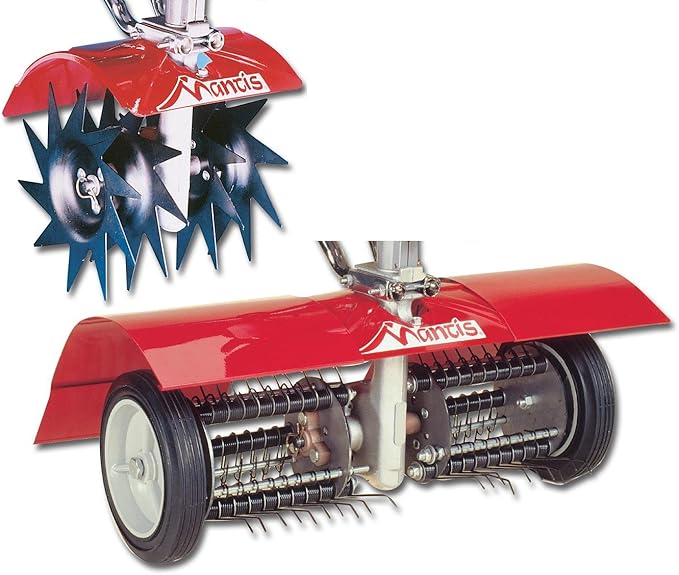 |
Mantis Aerator/Dethatcher Combo | Check Price |
| 3 |  |
Agri-Fab 45-0299 48-Inch Tow Plug Aerator | Check Price |
| 4 |  |
Brinly SAT2-40BH-P Tow Behind Spike Aerator | Check Price |
| 5 |  |
CRAFTSMAN 40-Inch Tow Plug Aerator + Craftsman 110-Lb Tow Broadcast Spreader | Check Price |
Brinly Tow Behind Combination Aerator Spreader
The Brinly combination unit is the most complete all-in-one option in this group. Its 40-inch width gives it a useful balance between covering ground efficiently and remaining manageable behind a residential lawn tractor. Because the hopper and aerating mechanism work together, seed, fertilizer, or lime can be released while the tine stars open the soil.
A 100-pound steel hopper offers substantial capacity for larger lawn-care jobs, and the rigid weight tray accepts up to 75 pounds of additional weight. That extra load can help the 8-inch steel stars reach their stated depth of up to 2 inches, particularly where the ground is compacted. The trade-off is that adding weight also increases the demand on the towing vehicle and can make turns more difficult.
Brinly’s galvanized 3-D tines are intended to resist bending and rust, while the 132 tine tips provide repeated soil contact across the working width. An adjustable stop on the flow control helps reduce wasted material, but the correct setting still depends on the product being spread and the travel speed. The 10-inch pneumatic transport wheels and single-lever transport mode are helpful when crossing sidewalks or driveways.
Pros
- Combines aeration and spreading in one 40-inch tow-behind unit.
- 100-pound steel hopper and 75-pound weight tray support larger jobs.
- Galvanized 3-D tines resist bending and rust.
- Transport wheels simplify movement between lawn areas.
Cons
- Added weight may require a capable lawn tractor.
- Proper flow calibration is still necessary for different materials.
- A combined unit may be less specialized than separate aeration and spreading tools.
My Opinion
This is my top pick for a homeowner who wants one machine to handle routine aeration and material distribution. Confirm the towing vehicle can safely manage the hopper and optional tray weight, then calibrate the flow before treating the entire lawn.
Mantis Aerator/Dethatcher Combo
The Mantis Aerator/Dethatcher Combo takes a different approach from the tow-behind machines. It is an attachment pack for Mantis 7000 Series tillers and cultivators, so it makes the most sense for someone who already owns the correct power unit. A separate tiller is required, and the attachment is not compatible with the Mantis XP, 3550, or 3558 models.
Its aerator is intended for compact or clay soil, where opening the surface can improve access for air, water, and nutrients. The dethatching attachment adds another useful seasonal task by removing accumulated thatch quickly. Sixty spring-steel picks clear a 15-inch path in one pass, making the narrower working width better suited to smaller lawns, garden edges, or owners who value maneuverability more than maximum coverage.
The most important limitation is grass type. Mantis states that these lawn-care attachments are not recommended for surface-rooted grasses such as Bermuda, Zoysia, Centipede, and St. Augustine because the action may damage their root systems. That restriction is more significant than the attractive 4.4 rating from 182 customer ratings, since a compatible tiller and suitable turf are both essential.
Pros
- Combines aeration and dethatching functions in one attachment pack.
- Useful for compact and clay soil.
- Sixty spring-steel picks clear a 15-inch swath.
- Compact format can suit smaller or tighter lawn areas.
Cons
- Requires a separately purchased compatible Mantis tiller.
- Does not fit Mantis XP, 3550, or 3558 models.
- Not recommended for several common surface-rooted grasses.
- It does not provide a spreader function.
My Opinion
This is a sensible second choice only for the right Mantis owner. It is appealing when dethatching is as important as aerating, but buyers should identify their tiller model and grass type before considering the convenience of the attachment pair.
Agri-Fab 45-0299 48-Inch Tow Plug Aerator
This Agri-Fab pairing suits buyers who want the deeper action of a plug aerator and the controlled placement of a drop spreader. The 48-inch aerator uses 32 galvanized knives to pull soil plugs up to 3 inches deep. Plug removal can be especially useful when the lawn needs more than shallow surface penetration, though the deeper action also makes soil moisture and towing conditions more important.
Flat-free tires support smooth transport without the possibility of pneumatic tires losing air. A cantilever transport handle raises and lowers the aerator, making it easier to move across hard surfaces without dragging the knives. The separate 175-pound drop spreader has a 17-gallon dry hopper and can cover roughly 40,000 square feet, or about one acre, according to the supplied product information.
The rustproof poly hopper is a practical advantage for a spreader that may be exposed to fertilizer or lime residue. Since the two tools are separate rather than integrated, switching between them takes more time and storage space than using a combination unit. On the other hand, separate tools let the owner aerate deeply without forcing a spreading operation during every pass.
Pros
- Plug aerator pulls cores up to 3 inches deep.
- 48-inch width can cover substantial lawn area.
- 175-pound drop spreader offers high material capacity.
- Flat-free aerator tires and a cantilever transport handle aid movement.
- Rustproof poly hopper helps resist material-related wear.
Cons
- Separate tools require more storage and switching time.
- Deep plug aeration may be excessive for some lawns.
- Only four customer ratings are supplied, so the rating evidence is limited.
My Opinion
This pair is strongest for a larger property where deep plug removal and high-capacity spreading are more valuable than an all-in-one design. Choose it when you are comfortable managing two attachments and want each tool to focus on its own job.
Brinly SAT2-40BH-P Tow Behind Spike Aerator
This combination pairs a Brinly 40-inch spike aerator with an Agri-Fab broadcast spreader rather than placing both functions in one frame. The Brinly aerator uses 11 eight-inch tine stars with 12 spike tips each, reaching up to 2 inches into the soil. Its steel construction, solid 5/8-inch axle, nylon spacers, and double tow bar point toward a sturdy setup for repeated residential use.
The weight tray accepts up to 150 pounds, which is more than the tray on the integrated Brinly unit in this list. That can be useful on compacted ground, but it also makes towing demands more significant. The aerator’s transport wheels help keep the spikes off hard surfaces while moving between lawn sections.
The Agri-Fab broadcast spreader holds up to 130 pounds and covers about 25,000 square feet, or one-half acre. Its 10- to 12-foot spread width and 13-by-4-inch pneumatic tires allow broad coverage, but broadcast spreading requires attention to overlap and boundary control. Because this is a spike aerator rather than a plug aerator, it punctures the soil without removing cores.
Pros
- Strong all-steel aerator with a double tow bar.
- Weight tray holds up to 150 pounds.
- Broadcast spreader covers up to one-half acre per load.
- 10- to 12-foot spread width reduces passes.
- Transport wheels simplify movement between work areas.
Cons
- Separate aerator and spreader need additional storage.
- Broadcast distribution can be less precise near beds and walkways.
- Heavy tray loads increase towing and turning demands.
- Only two customer ratings are supplied.
My Opinion
This is a good middle ground for buyers who want a robust spike aerator and a fast broadcast spreader without paying for a single integrated frame. It fits lawns where shallow-to-moderate penetration is adequate and broad material coverage matters.
CRAFTSMAN 40-Inch Tow Plug Aerator + Craftsman 110-Lb Tow Broadcast Spreader
The Craftsman pairing combines a 40-inch tow plug aerator with a 110-pound broadcast spreader. The aerator uses 24 galvanized steel coring points to pull plugs up to 3 inches deep, giving it a more aggressive soil-opening action than a basic spike tool. It is positioned for spring or fall planting preparation, when loosening the lawn can support access to the root zone.
The spreader provides up to a 10-foot broadcast width, which can reduce the number of passes on open lawn areas. Its capacity is lower than the 130- and 175-pound spreaders in this comparison, so it may require more refills on a large property. That smaller load can also be easier to manage for owners using a modest lawn tractor.
Large 10-inch pneumatic tires are intended to provide smooth transport, an important consideration because the plug aerator must be moved across driveways, paths, or storage areas without dragging its coring points. The supplied information does not provide a customer-rating count, so buyers have less feedback evidence to weigh than with several other options here.
Pros
- Plug aerator removes cores up to 3 inches deep.
- Galvanized coring points resist corrosion.
- 40-inch aerating width suits many residential lawns.
- Broadcast spreader reaches up to a 10-foot width.
- Large pneumatic tires support smoother transport.
Cons
- 110-pound spreader capacity is not the largest in this group.
- Separate tools need more storage and handling.
- Broadcast spreading needs careful overlap and boundary control.
- No customer-rating count is supplied.
My Opinion
This is a practical choice for a Craftsman-oriented buyer who wants genuine plug aeration without moving up to the largest spreader capacity. It is best for medium residential lawns where a 10-foot spread pattern and 40-inch aerator provide a reasonable balance.
How I Selected These Aerator and Spreader Options
The ranking weighs functional fit first: whether the equipment can aerate soil, distribute lawn material, or support both jobs in a useful ownership setup. I also considered penetration style, working width, hopper capacity, transport features, weight options, and compatibility warnings. A product that looks powerful on paper can still be a poor match if it damages the grass, does not fit the owner’s tiller, or exceeds the towing vehicle’s practical ability.
Customer feedback was used as supporting evidence rather than as the only deciding factor. The Mantis has a 4.4 rating from 182 ratings, while the integrated Brinly shows 3.9 from 575 ratings. The Agri-Fab pair shows a 5.0 rating from only four ratings, and the Brinly-Agri-Fab pairing shows 4.4 from two, so those very high scores should be interpreted cautiously because the sample sizes are small.
Selection takeaway: The top-ranked Brinly is the most balanced single-unit choice, but separate plug aerator and spreader pairs may be better when deep core removal or greater spreading capacity matters more than convenience.
Brand diversity also matters because lawn owners do not all begin with the same equipment. Mantis serves buyers who already use a compatible tiller, while Brinly, Agri-Fab, and Craftsman provide tow-behind formats. This makes the comparison more useful than ranking five nearly identical machines.
Compatibility takeaway: Check the power unit, grass type, towing ability, and available storage before comparing widths or capacities. Those details can eliminate an otherwise attractive choice immediately.
How to Choose the Best Aerator Spreader Combo for Your Lawn
Start with the job your lawn actually needs. A spike aerator makes holes, a plug aerator removes soil cores, and a dethatcher pulls loose thatch from the surface. Then decide whether spreading must happen during the same pass or whether separate tools provide better control and deeper aeration.
- Choose an integrated unit for convenience and fewer equipment changes.
- Choose separate tools when deep plugs, high capacity, or specialized spreading matters more.
- Match the working width and hopper size to lawn area and towing ability.
- Confirm compatibility with the tractor, tiller, cultivator, and grass type.
- Plan for calibration, cleaning, transport, and storage before buying.
Spike Versus Plug Aeration
Spike aerators push pointed tines into the ground without removing cores. They can relieve surface compaction and are usually straightforward to operate, but they do not create the same open channels as core removal. Plug aerators pull soil cylinders from the lawn, with the products here reaching up to 3 inches deep. That deeper action can be valuable on compacted ground, but it generally requires more attention to soil moisture, towing force, and cleanup.
For a lawn that only needs periodic surface opening, the Brinly spike option may be sufficient. For thicker or heavily compacted soil, the Agri-Fab or Craftsman plug systems may offer a better match. Avoid choosing solely by maximum depth; the best result depends on lawn condition and whether the towing vehicle can handle the implement.
Integrated Unit or Separate Attachments?
An integrated aerator spreader saves storage space and can place material while the tines work. That is the simplest route for a buyer who wants one pass and one primary machine. Separate attachments provide more flexibility: you can aerate when the soil is ready and spread fertilizer or seed at a different time, using the tool best suited to each task.
Separate equipment also makes replacement and troubleshooting more focused, but it increases purchase, storage, and setup complexity. The Agri-Fab and Craftsman pairs are sensible when those trade-offs are acceptable.
Capacity, Width, and Towing Ability
A wider implement covers more lawn per pass, but it may be harder to maneuver around trees, beds, and narrow gates. Hopper capacity affects refill frequency, while added weight can improve penetration and increase the load on the tow vehicle. The Brinly combination carries 100 pounds in its hopper and accepts 75 pounds on the tray; the Brinly spike aerator tray accepts up to 150 pounds. Those numbers are useful only if the tractor and hitch setup can manage them safely.
For smaller lawns, a narrower attachment or lower-capacity spreader may be easier to control. For open properties, the 48-inch Agri-Fab aerator and its 175-pound spreader can reduce interruptions, provided storage and towing capacity are adequate.
Check Compatibility Before You Buy
Compatibility is not limited to the hitch. The Mantis attachment requires a Mantis 7000 Series tiller or cultivator and does not fit the XP, 3550, or 3558 models. Its grass warning is equally important: surface-rooted Bermuda, Zoysia, Centipede, and St. Augustine may be damaged by the attachment action.
For tow-behind products, confirm the lawn tractor has the appropriate hitch arrangement and enough ability for the implement, material, and optional tray weight. A machine that can pull an empty aerator may behave differently when the hopper is loaded or the tray is carrying additional weight.
How to Set Up and Calibrate the Spreader
Assemble and inspect the frame before loading any material. Check that the hitch is secure, the wheels rotate freely, and the aerator mechanism raises fully for transport. For a spreader, begin with the flow control closed or at a conservative setting, then use a small test area to observe the pattern and output.
Walk or drive at a steady pace during calibration. Mark the starting and ending points of the test area, compare the amount used with the intended coverage, and adjust gradually. The Brinly combination includes an adjustable stop to help repeat a setting, but different seed, fertilizer, and lime products can flow differently.
Broadcast spreaders usually need overlap to avoid untreated strips, while drop spreaders place material more directly beneath the hopper. Keep the spreader away from ponds, drainage areas, flower beds, and paved surfaces unless the material label specifically supports that use.
Best Conditions for Aerating
Soil that is too dry can resist tine penetration, while soil that is saturated may smear, compact, or produce poor plugs. Aim for ground that is moist enough to open cleanly but not wet enough to hold water on the surface. If using a plug aerator, inspect the removed cores; clean, consistent plugs generally indicate better operating conditions than crushed or barely formed pieces.
Make a plan for slopes, turns, and narrow areas before beginning. Straight passes usually produce more even coverage than repeated sharp turns. Raise the aerator before crossing pavement, and use the transport mode or transport handle where supplied.
Using Weight Without Overloading the Equipment
Additional weight can help spikes or coring points enter compacted soil, but more weight is not automatically better. It increases hitch stress, braking demands, tire load, and turning effort. Begin with a modest load and observe whether the aerator penetrates consistently before adding more.
Never assume the weight tray rating means every lawn tractor can safely tow that amount. Consider the loaded hopper, operator, slope, ground condition, and stopping distance together. On sloped lawns, a lighter load may provide better control than maximum penetration.
Cleaning, Maintenance, and Storage
Remove leftover fertilizer, lime, and seed after each use. Residue can attract moisture and accelerate corrosion, especially around moving parts, openings, and fasteners. Rinse appropriate surfaces, avoid leaving water trapped inside the hopper, and allow the equipment to dry fully before storage.
Inspect tines, knives, coring points, axles, spacers, tires, and hitch hardware periodically. Galvanized and rust-resistant parts can still wear or bend under hard use. Replace or repair damaged components before the next operation rather than compensating with additional weight.
Store the equipment under cover where possible. Keep the aerator raised or supported according to its design so the working points are not resting against a damaging surface. Pneumatic tires should be checked before use, while flat-free tires still deserve inspection for cuts and embedded debris.
Common Mistakes to Avoid
Most disappointing results come from a mismatch between conditions and equipment rather than from a missing feature. A homeowner may use the wrong attachment on the wrong grass, spread at an inconsistent speed, or overload the tray in an attempt to force deeper penetration.
- Do not use the Mantis attachment on a listed incompatible tiller model.
- Do not use the Mantis lawn-care attachments on the listed surface-rooted grass types.
- Do not spread an entire lawn before calibrating the flow.
- Do not load the maximum tray weight without considering the towing vehicle and slope.
- Do not pull spikes or coring knives across pavement when they can be raised.
- Do not leave fertilizer or lime residue in the hopper after use.
- Do not treat a small customer-rating sample as conclusive proof of long-term performance.
Ownership Tips for Better Results
Keep a simple note of the material used, flow setting, travel speed, and lawn area covered. That information makes the next application more consistent and reduces waste. It is especially helpful when switching between seed, fertilizer, and lime, since each material may flow differently.
Divide a complicated property into sections and plan the direction of travel before loading the hopper. This reduces unnecessary turns and makes it easier to identify missed strips. For separate aerator and spreader pairs, complete the aeration pattern first, then decide whether the spreading pattern should follow the same route or use a crosswise pass for more even distribution.
FAQS About Best Aerator Spreader Combo
What is the best option for combining aeration and spreading in one pass?
The Brinly Tow Behind Combination Aerator Spreader is the strongest single-unit choice in this comparison. It combines a 40-inch aerator, 100-pound steel hopper, adjustable flow control, and a 75-pound weight tray.
Is a spike aerator or plug aerator better?
A spike aerator is suitable when the lawn needs holes without removing soil. A plug aerator is better when deeper core removal is the priority. Soil condition, grass type, moisture, and towing ability should guide the decision.
Which option is best for a large lawn?
The Agri-Fab pairing offers a 48-inch plug aerator and a 175-pound spreader rated for roughly 40,000 square feet of coverage. The Brinly and Craftsman options may also suit larger lawns, but their capacities and formats differ.
Can the Mantis Aerator/Dethatcher Combo work without a Mantis tiller?
No. The attachment requires a compatible Mantis 7000 Series tiller or cultivator, which is sold separately. It is also not compatible with the Mantis XP, 3550, or 3558 models.
How much weight should be added to a tow-behind aerator?
Use only enough weight to achieve consistent penetration while maintaining safe control. The maximum tray ratings vary, and the safe working load also depends on the tractor, slope, hitch, ground condition, and loaded hopper.
Do tow-behind spreaders need calibration?
Yes. Flow varies by material, speed, and spreader design. Test a small area first, maintain a steady pace, and adjust the control before treating the full lawn.
Final Thoughts
The best aerator spreader combo for most buyers is the Brinly Tow Behind Combination Aerator Spreader because it balances integrated operation, useful capacity, adjustable flow, and optional added weight. The Mantis Aerator/Dethatcher Combo is my second recommendation for owners of the correct Mantis tiller and compatible turf, while the Agri-Fab 48-inch plug aerator and 175-pound spreader pair is the better third choice for deeper aeration and larger material loads. Choose according to your soil, grass, towing equipment, and storage space rather than capacity alone.

I’m Maya L. Greenwood, a lifelong plant lover who believes anyone can grow something beautiful with the right guidance. After years of testing soil mixes, pruning methods, irrigation tricks, and pest-safe solutions, I started EasyGardenTips.com to turn hard-won lessons into step-by-step advice. From seed starting and container gardens to composting and seasonal checklists, my goal is to make gardening simple, sustainable, and fun.