5 Best Plant Propagation Station: Compared With Buying Guide
Choosing the best plant propagation station can be surprisingly difficult when the options range from compact desktop displays to large wall-mounted holders. The right choice depends on how many cuttings you want to grow, how much space you have, and whether your priority is easy maintenance, decoration, or maximum capacity.
My first choice is Renmxj Plant Propagation Station. The compact wooden stand fits a desk or windowsill, while the open C-shaped holders let you lift out one vase without disturbing the others.
My second choice is Mkono Plant Propagation Station. Fifteen removable test tubes make it a strong fit for serious propagation in a small footprint, although the tall hanging design requires careful balancing and a suitable location.
My third choice is Tigvio Desktop Glass Plant Propagation Station. Its borosilicate glass and pine stand create a clear, decorative setup for several cuttings without taking over a wall.
This guide compares all five options, explains which plants and spaces each one suits, and covers setup, cleaning, sizing, maintenance, common mistakes, and selection criteria. The goal is to help a beginner choose a station that is attractive but also convenient to use repeatedly.
Best Plant Propagation Station
I selected these products for their direct relevance to water propagation, visibility of roots and water levels, practical capacity, placement flexibility, and available customer-feedback evidence. I also included different designs and brands so the comparison represents desktop, wall-mounted, minimalist, colorful, and multi-vase approaches rather than one format alone.
| # | Image | Product | Price on Amazon |
|---|---|---|---|
| 1 |  |
Renmxj Plant Propagation Station | Check Price |
| 2 | 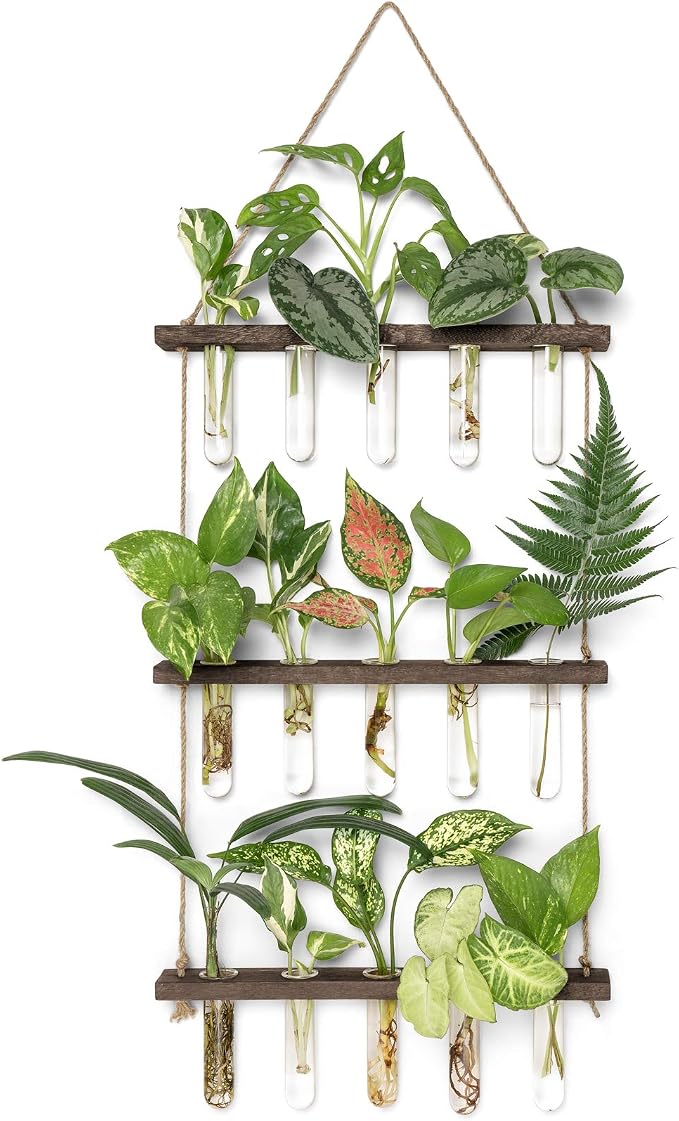 |
Mkono Plant Propagation Station | Check Price |
| 3 |  |
Tigvio Desktop Glass Plant Propagation Station | Check Price |
| 4 |  |
wangsdjy Glass Plant Propagation Stations | Check Price |
| 5 |  |
BROPGOD Mushroom Vases Plant Propagation Stations Jars Colored Set | Check Price |
Renmxj Plant Propagation Station
The Renmxj station is a particularly approachable option for someone starting with water propagation. Three bulb-shaped borosilicate glass vases sit in a compact wooden frame, allowing you to keep different cuttings separated while watching root development through clear glass. That separation is useful when cuttings need different water-change schedules or when you simply want to identify each plant easily.
Its most practical detail is the open C-shaped metal support. Each vase can be lifted out independently for rinsing, refilling, or replacing a cutting. Compared with a holder that traps the containers in enclosed rings, this arrangement makes routine care less awkward. The included cleaning brush is also helpful for reaching inside the narrow vessels.
The station measures about 11 by 4 by 4.4 inches, so it suits a windowsill, shelf, office desk, or kitchen counter. The one-inch mouth opening works well for small stems from pothos, philodendron, ivy, lucky bamboo, herbs, and similar plants. It is not intended to hold large root balls or mature plants, and plants are not included.
Pros
- Three individually removable clear glass vases
- Compact wood-and-metal tabletop design
- Open holders simplify water changes and cleaning
- Includes a cleaning brush and assembly components
Cons
- Limited to three cuttings at a time
- Small openings are not suitable for thick stems or large plants
- Assembly is required
My Opinion
This is the strongest all-around pick for a beginner or casual plant parent who wants a tidy, functional display rather than a high-capacity propagation wall. Its removable-vase design gives it an everyday convenience advantage.
Mkono Plant Propagation Station
Mkono takes a very different approach: instead of placing a few vessels on a tabletop, it uses a three-tier wooden frame with 15 glass test tubes. The total height is approximately 35 inches, making it a prominent vertical display that can hold a large collection of cuttings while using only a narrow amount of floor or shelf space.
This capacity makes the station appealing to anyone who regularly propagates pothos, lucky bamboo, African violet, coin grass, moss, flowers, or herbs. The tubes are removable, so changing water does not require taking the entire wooden frame apart. You can also use colored water or small cobbles for a more decorative arrangement, although those additions are not included.
The trade-off is that a tall hanging arrangement needs a sensible installation point and careful setup. The wooden holders measure about 14.2 inches long, and the product uses rope suspension between tiers. The supplied instructions explain how to adjust the rope if the frame is not balanced, which is important before filling all 15 tubes. This is a display for committed propagation rather than a discreet desk accessory.
Pros
- Holds 15 removable test tubes
- Uses vertical space efficiently
- Three-tier design creates a distinctive wall display
- Includes a cleaning brush
Cons
- Approximately 35 inches tall
- Requires careful balancing and a suitable hanging location
- Plants and decorative props are not included
My Opinion
Mkono is the best capacity choice here, especially for a plant enthusiast with many small cuttings. I would favor it over a desktop station only when the buyer is comfortable with a tall, visually prominent installation.
Tigvio Desktop Glass Plant Propagation Station
The Tigvio desktop station occupies the middle ground between a small three-vase holder and a large wall display. Its five glass tubes provide room for a wider variety of cuttings while keeping the arrangement on a desk, shelf, counter, or windowsill. That makes it useful when wall mounting is inconvenient or when you want to move the propagation display from room to room.
The pine stand and clear glass create a vintage, understated look that can blend into living rooms, offices, kitchens, corridors, and other indoor spaces. The product description emphasizes high-boron-silicon glass with heat resistance, light transmission, and corrosion resistance. These qualities support clear observation and repeated water use, though the glass should still be handled as breakable household décor.
Five tubes can be a practical amount for someone propagating several plants at once without managing a large collection. Clear containers make it easier to monitor water condition and root progress, and the compact format avoids the installation concerns associated with a wall-hanging frame. Specific stand dimensions and tube dimensions are not supplied, so buyers with an unusually narrow shelf should confirm the listing measurements before ordering.
Pros
- Five-tube desktop format offers useful capacity
- Clear glass makes roots and water visible
- Natural pine stand suits multiple décor styles
- Works in spaces where wall mounting is not practical
Cons
- Glass still requires careful handling
- Exact overall dimensions are not provided in the supplied details
- Does not offer the capacity of a 15-tube station
My Opinion
Tigvio is a sensible compromise for buyers who want more than three propagation spaces but prefer a self-contained tabletop display. Its main advantage is format flexibility rather than specialized accessories.
wangsdjy Glass Plant Propagation Stations
This wangsdjy set stands apart because it provides four separate vases in two sizes: two large vessels measuring about 3.34 by 3.9 inches and two small vessels measuring about 2.55 by 3.9 inches. That mix gives you more flexibility than a uniform set when you are working with both delicate stems and somewhat larger cuttings.
The borosilicate glass is intended to provide clarity and durability while letting you see root growth. Because the containers are individual pieces rather than a fixed wooden station, they can be spaced across a windowsill, grouped as a centerpiece, or placed separately around a home office. This is useful for buyers who prefer a modular display instead of one permanent arrangement.
Its styling is minimalist and Nordic-inspired, so it can function as décor even when only a few cuttings are growing. The vases can also hold flowers, herbs, aquatic plants, or small decorative arrangements. The limitations are equally clear: there is no supplied frame mentioned, and individual glass vases may be easier to knock over if they are spread across a busy counter. The buyer must create a stable arrangement and choose locations carefully.
Pros
- Four vases in two useful sizes
- Clear borosilicate glass supports root visibility
- Flexible placement around a home or office
- Suitable for propagation and decorative arrangements
Cons
- No stand or fixed organizer is specified
- Separate vases need stable placement
- Individual containers can occupy more scattered space
My Opinion
This set is best for a buyer who values arrangement freedom and wants different vessel sizes. It is less convenient than a framed station if keeping everything organized in one compact unit is the main goal.
BROPGOD Mushroom Vases Plant Propagation Stations Jars Colored Set
The BROPGOD set of six mushroom-shaped glass vases is the most decorative option in the group. Coordinated colors and rounded shapes create a playful display for small flowers, green cuttings, daisies, herbs, or miniature arrangements. Six vessels also let you create a grouped centerpiece or distribute small propagation projects across several rooms.
Each vase has a spout about 0.8 inch in diameter, which provides enough room to add water and insert smaller stems. The mushroom profile is intended to resist tipping better than a very narrow container, though the vessels should still be placed on a level surface away from busy edges. Their appearance also makes them useful beyond propagation, including micro-landscapes, shelf décor, and alternative containers for aromatherapy sticks.
The set is made from thickened glass and packaged in a protective expandable polyethylene sleeve inside a five-layer corrugated box. That packaging attention may be reassuring for a multi-piece glass order. However, the colored design is more specific than the neutral wood-and-glass look of the other choices, and the narrow spouts are better for small stems than chunky cuttings or large plant material.
Pros
- Six coordinated vases provide strong decorative flexibility
- Spouts suit small flowers, herbs, and cuttings
- Thickened glass and protective packaging support ownership convenience
- Can be used for propagation, arrangements, or décor
Cons
- Colored mushroom styling may not suit every room
- 0.8-inch spouts limit thicker stems
- Individual vases require careful placement and cleaning
My Opinion
BROPGOD is a fun choice for someone who wants propagation to look like a colorful décor project. It offers the most pieces, but buyers seeking a restrained or highly organized station may prefer Renmxj or Tigvio.
How I Selected These Plant Propagation Stations
The selection focused first on whether each item supports water-based propagation with clear vessels and practical access to cuttings. I then compared capacity, placement style, vessel size, material information, cleaning convenience, and the kind of display each product creates. Customer feedback signals were considered alongside the supplied product details, but they were not treated as proof that every buyer will have the same experience.
Brand diversity also mattered. A compact framed station, a tall wall display, a five-tube desktop unit, a loose set of varied vases, and a colorful six-piece collection solve different problems. Comparing those formats is more useful than ranking five nearly identical holders.
The most useful distinction is not simply the number of vases. Decide whether you want one organized station, a vertical high-capacity display, or individual containers that can be rearranged whenever your plants and décor change.
Material details were included only when supplied, such as borosilicate glass, pine wood, removable tubes, or protective packaging. Where measurements or accessories were not provided, I have pointed that out rather than filling the gap with assumptions.
A good propagation station should make routine care easier. Easy access for water changes and stable placement often matter more over time than decorative appearance alone.
How to Choose the Best Plant Propagation Station
Start with your propagation habits rather than the visual style. A person rooting two or three occasional cuttings needs a different setup from someone who trades plants, grows herbs, or wants to fill every tube with a new experiment. The best selection should fit both the available surface and the amount of maintenance you are willing to perform.
- Choose capacity based on the number of active cuttings you normally manage.
- Prioritize removable vessels if frequent water changes and cleaning are important.
- Measure the shelf, windowsill, or wall area before buying.
- Match the opening size to the stems you plan to propagate.
- Select a neutral or colorful design that you will enjoy keeping visible.
Capacity and spacing
Three vessels are enough for a small starter collection, while five or six provide room for more experiments without becoming a major installation. Fifteen tubes offer the greatest capacity but also create more water levels to monitor. Remember that capacity is only helpful if you can reach every container comfortably.
Desktop or wall-mounted placement
Desktop stations are simpler for renters, children, offices, and anyone who likes to relocate plants. Wall-hanging designs save surface area, but they need a secure position, enough vertical clearance, and careful balancing. A tall station may also be more noticeable than expected in a small room.
Vase opening and plant compatibility
Narrow test tubes and small spouts are suitable for thin stems, small flowers, herbs, and many common vine cuttings. Wider openings are more forgiving when inserting cuttings or arranging several small stems. No station replaces the need to match the cutting to a plant that can root successfully in water.
Materials and visibility
Clear glass makes it easier to observe water clarity, root growth, and changes in the cutting. Borosilicate glass appears in several options and is described as durable or heat-resistant, but it should still be treated as breakable. Wood adds warmth and structure, while individual vases offer more freedom but less built-in organization.
Setting Up a Propagation Station
Begin by assembling the stand or adjusting the hanging frame on an empty surface. Check that the base sits evenly or that the suspension is balanced before adding water. For a loose vase set, arrange the containers with enough space to lift each one without knocking its neighbors.
Use clean containers and fill them only enough to cover the appropriate node or lower stem area. Leaves should generally remain above the water rather than sitting submerged. Place the station in bright, indirect light unless the plant has different care needs. Direct hot sun through glass can warm the water and stress delicate cuttings.
Using Water Propagation Effectively
Choose healthy cuttings with suitable nodes and remove any leaves that would sit below the waterline. Keep different plants in separate vessels when possible so you can observe them individually. Clear glass is especially useful because it reveals whether roots are forming or whether the water has become cloudy.
Propagation is not improved by filling every container simply because space is available. Leave enough room to handle each cutting, and replace a cutting that becomes visibly unhealthy rather than allowing it to affect the rest of the display. Some plants root readily in water, while others transition more successfully through a different method.
Cleaning and Maintenance
Regular cleaning helps keep the display attractive and makes it easier to identify changes in the roots or water. Lift removable vases or test tubes from their holders, empty the old water, and rinse away residue. The Renmxj and Mkono products include cleaning brushes, which are particularly useful for narrow vessels.
Wipe wooden components with a lightly damp cloth rather than soaking them. Dry glass before returning it to a wooden holder, and check metal supports or ropes for proper positioning during routine care. A loose or uneven frame should be corrected before the containers are refilled.
Making a Glass Propagation Station Last Longer
Handle every glass vessel over a clear, stable surface and avoid placing cold glass directly into very hot water. Although some supplied descriptions mention heat-resistant or durable glass, these are still decorative household containers. Do not stack loose vases unless the product specifically supports stacking.
Keep stands away from constant splashes and wipe up spills promptly around wood. If a station is moved, empty the containers first. Carrying a full wooden frame or a cluster of filled vases increases the chance of tipping, uneven strain, or accidental breakage.
Common Mistakes to Avoid
Most problems come from choosing a station that does not fit the intended location or from treating water propagation as maintenance-free. Small details such as submerged leaves, unstable placement, and neglected water can quickly reduce the usefulness of an otherwise attractive display.
- Do not place a tall wall station where it can be bumped by doors or traffic.
- Do not submerge leaves along with the cutting stem.
- Do not overfill narrow vessels or make them difficult to lift out.
- Do not assume every plant roots equally well in water.
- Do not leave cloudy or stale water unattended for long periods.
- Do not use loose decorative stones that prevent you from cleaning the vessel.
Choosing a Safe Location
A bright windowsill can be convenient, but a location with intense direct sun may overheat clear containers. Desks and shelves should be level and strong enough for the combined weight of glass and water. Keep the display away from electronics, books, and surfaces that could be damaged by a spill.
For a hanging station, confirm that the mounting point can support the setup and that the lowest tier will not be struck during normal movement. A visually attractive arrangement is not practical if it is constantly in the way or difficult to reach.
When to Move Rooted Cuttings
Once a cutting has developed a healthy root system, decide whether it should remain in water or move to another growing medium according to that plant’s needs. Avoid waiting until roots become tangled through the vessel or neighboring cuttings. A removable vase makes this transition easier because the cutting can be lifted without disturbing an entire display.
Before moving a rooted cutting, prepare the next container or growing medium so the roots do not remain exposed longer than necessary. Clean the propagation vessel afterward, especially if the cutting showed discoloration or poor water quality.
FAQS About Best Plant Propagation Station
What is the best plant propagation station for a beginner?
The Renmxj station is the most beginner-friendly choice in this comparison because it has three separate vases, a compact footprint, visible roots, and removable holders for easier cleaning and water changes.
How many cuttings should a propagation station hold?
That depends on your routine. Three vessels suit occasional propagation, five or six work for a growing collection, and the 15-tube Mkono model is better for someone who manages many cuttings at once.
Are glass propagation stations better than plastic ones?
Glass provides clear visibility and a decorative appearance, which is valuable when monitoring roots and water. It is also breakable, so buyers should balance visibility and style against the need for careful handling.
Can a propagation station be used for herbs?
Yes, the supplied product details identify herbs as suitable for several options. Choose a vessel opening that accommodates the stem and provide the light and water conditions appropriate for the particular herb.
Is a wall-mounted propagation station better than a desktop station?
Wall-mounted designs save surface space and can hold many tubes, while desktop models are easier to move and usually simpler to access. The better format depends on available wall support, vertical clearance, and desired capacity.
How often should propagation station water be changed?
Check the water regularly and change it when it becomes cloudy, develops an odor, or contains visible residue. The exact schedule depends on the cutting, container size, room conditions, and water quality.
Final Thoughts
The best plant propagation station for most beginners is the Renmxj Plant Propagation Station, thanks to its compact three-vase layout and easy individual access. Choose the Mkono Plant Propagation Station for maximum capacity and the Tigvio Desktop Glass Plant Propagation Station for a balanced five-tube tabletop display. Together, these three cover the clearest choices for convenience, volume, and flexible desktop use.

I’m Maya L. Greenwood, a lifelong plant lover who believes anyone can grow something beautiful with the right guidance. After years of testing soil mixes, pruning methods, irrigation tricks, and pest-safe solutions, I started EasyGardenTips.com to turn hard-won lessons into step-by-step advice. From seed starting and container gardens to composting and seasonal checklists, my goal is to make gardening simple, sustainable, and fun.