How to Plant Cucumbers in Raised Beds: Spacing and Trellis Tips
To plant cucumbers in raised beds, choose a sunny location, prepare loose and well-drained soil, and sow seeds about ½–1 inch deep after the last frost when the soil is warm. Space trellised cucumber plants approximately 12–18 inches apart, provide sturdy vertical support, and water consistently to keep the root zone moist without becoming waterlogged.
Raised beds are particularly useful for cucumbers because their soil often warms faster in spring and drains more efficiently than poorly prepared in-ground gardens. They also make it easier to manage weeds, irrigation, and vine growth in a limited space.
However, successful cucumber planting requires more than putting seeds into the soil. Vining varieties can quickly overcrowd a small bed, while inadequate moisture or poor pollination may reduce fruit production.
The University of Minnesota Extension recommends direct-seeding cucumbers once soil temperatures reach approximately 70°F for dependable germination.
In this article, I explain how to plant cucumbers in raised beds step by step, including selecting varieties, preparing soil, determining plant spacing, and installing trellises. You’ll also learn how many plants fit in common raised-bed sizes, how to water and fertilize them, when to expect cucumbers, and how to prevent common growing problems.
How to Plant Cucumbers in Raised Beds Step by Step
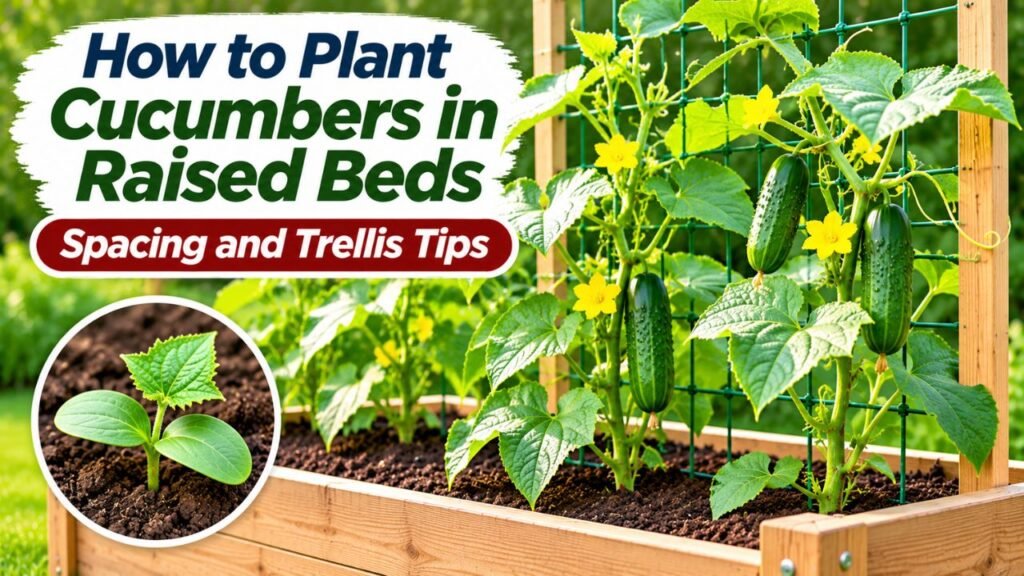
Cucumbers are warm-season vegetables that grow best in fertile soil with consistent moisture and ample sunlight.
Follow these steps to establish healthy plants.
Step 1: Choose the Right Raised-Bed Location
Select a location that receives at least 6 hours of direct sunlight per day, preferably 8–10 hours.
Cucumbers use sunlight to support vine growth, flowering, and fruit production.
A bed receiving inadequate sunlight may produce long, weak vines with relatively few cucumbers.
Choose a location that also provides:
- Good drainage
- Easy access to water
- Space for a trellis
- Adequate airflow
- Protection from damaging winds
Avoid placing the raised bed beneath large trees or structures that block sunlight for much of the day.
If possible, position tall trellises along the northern side of the bed in the Northern Hemisphere to reduce shading of shorter vegetables.
Step 2: Select a Suitable Cucumber Variety
Not all cucumber plants grow the same way.
Some varieties produce long vines, while others have compact or bushy growth habits.
For small raised beds, choosing the right variety is particularly important.
Vining cucumbers are useful when you have a sturdy trellis.
Bush cucumbers are better suited to gardeners who prefer compact plants and less vertical training.
Common cucumber categories include:
| Cucumber type | Growth habit | Raised-bed suitability |
| Slicing cucumbers | Often long-vining | Excellent with a trellis |
| Pickling cucumbers | Bush or vining, depending on variety | Excellent |
| Bush cucumbers | Compact, shorter vines | Good for small beds |
| English-style cucumbers | Often vigorous vines | Suitable with support |
| Mini cucumbers | Varies by cultivar | Often suitable for trellising |
| Parthenocarpic cucumbers | Depends on cultivar | Useful where insect pollination is limited |
Read the seed packet to identify mature plant size, disease resistance, and whether the variety needs pollination.
For beginners, a compact bush variety or disease-resistant trellising variety is a practical starting choice.
Step 3: Prepare the Raised-Bed Soil
Cucumbers prefer soil that holds adequate moisture while allowing excess water to drain.
According to Virginia Tech Cooperative Extension, cucumbers grow well in fertile, well-drained soil with a pH of approximately 6.0–6.5.
Before planting:
- Remove weeds and old crop debris.
- Check that water can drain through the growing area.
- Loosen compacted soil if necessary.
- Incorporate finished compost when soil conditions warrant it.
- Level the planting surface.
- Water lightly if the soil is dry.
Avoid using unfinished compost or large amounts of fresh manure.
Fresh manure may contain harmful microorganisms and can create additional weed problems.
If the bed already contains fertile soil, you may not need substantial amendments.
A soil test can help determine nutrient and pH requirements.
Step 4: Wait Until the Soil Is Warm
Cucumbers are sensitive to frost and cold soil.
Planting too early can result in slow germination, seed rot, or damaged seedlings.
The University of Minnesota Extension recommends direct-sowing seeds once the soil reaches approximately 70°F at a depth of 1 inch.
For reliable establishment:
- Wait until frost danger has passed.
- Measure the soil temperature.
- Choose a period of consistently warm weather.
- Avoid planting in saturated soil.
Cucumber seeds can germinate at cooler temperatures, but establishment is generally faster and more reliable in warm soil.
In many U.S. regions, planting occurs during spring or early summer.
The exact date depends on local climate.
Step 5: Install the Trellis Before Planting
If you plan to grow vining cucumbers, install the trellis before sowing seeds or transplanting seedlings.
This helps prevent root damage later.
Position the trellis along one side of the bed.
For many home cucumber varieties, a sturdy support approximately 4–6 feet tall is practical, although the appropriate height depends on the variety and trellis design.
Make sure the structure is securely anchored.
Suitable materials include:
- Strong garden netting
- Wire mesh panels
- Cattle panels
- Wooden trellis frames
- Metal garden supports
Choose a structure with openings large enough for the vines to attach and for you to reach the developing fruit.
Avoid installing weak supports that may collapse under the weight of mature vines.
Step 6: Sow Cucumber Seeds at the Correct Depth
Direct-seeding is an excellent method for growing cucumbers.
Cucumber seedlings have sensitive roots, so sowing directly into the final growing area reduces transplant disturbance.
To plant:
- Mark the intended planting locations.
- Make small holes approximately ½–1 inch deep.
- Place two or three seeds at each planting location.
- Cover them lightly with soil.
- Gently firm the surface.
- Water carefully to maintain even moisture.
Do not bury seeds excessively deep.
The University of Illinois Extension recommends sowing cucumber seeds approximately ½–1 inch deep.
Once the seedlings emerge and establish, thin each location to the strongest plant.
Cut unwanted seedlings at soil level rather than pulling them out if their roots are close together.
Step 7: Space Cucumber Plants Properly
Plant spacing depends on whether cucumbers grow vertically or spread along the soil.
For trellised cucumbers, approximately 12–18 inches between plants is a useful starting range.
Some intensive trellised systems use closer spacing, but those require adequate soil fertility, irrigation, and air circulation.
Bush varieties may need more horizontal room than expected because their foliage spreads outward.
Avoid crowding several vigorous vines into a very small bed.
The University of Maryland Extension’s direct-seeding guide notes that trellised cucumber plants may be grown approximately 18 inches apart in intensive vegetable gardens.
Step 8: Water After Planting
After sowing, water gently to moisten the seed zone.
Keep the soil consistently moist while seeds germinate.
Avoid heavy streams of water that dislodge seeds or wash away the covering soil.
Once seedlings establish, begin watering more deeply according to soil moisture.
Cucumbers should not be left in persistently waterlogged conditions.
Step 9: Train the Young Vines
As cucumber plants begin producing tendrils, guide them toward the trellis.
Many varieties naturally attach themselves once their tendrils contact suitable supports.
You may need to direct young vines initially.
If necessary, use soft garden ties loosely around the stems.
Avoid tightly tying the vines because stems become thicker as they grow.
Continue checking the plants as they develop.
Key Takeaway: Plant cucumbers after frost danger passes, use warm soil, sow seeds ½–1 inch deep, and give vining varieties a sturdy trellis with sufficient spacing.
How Deep Should a Raised Bed Be for Cucumbers?
The required soil depth depends on whether the raised bed sits on natural ground or a hard surface.
A bed that is open to healthy soil beneath it provides more rooting space than a bed with a solid bottom.
Raised Beds on Natural Soil
A bottomless raised bed allows cucumber roots to extend into the underlying soil.
In this situation, an 8–12-inch raised-bed frame may be suitable if the native soil is healthy and well drained.
The raised-bed wall height does not represent the full available rooting depth.
Avoid placing an impermeable barrier beneath the bed.
Raised Beds on Concrete or Pavement
A raised bed placed on concrete must provide all of the plant’s rooting volume within the bed.
According to the University of Maryland Extension’s March 2026 raised-bed guidance, beds on hard surfaces should provide at least 8 inches of growing depth for cucumbers.
However, 12–18 inches can provide more useful moisture storage and rooting space, especially for vigorous vines or hot growing conditions.
The soil should drain freely.
Raised-Bed Depth Comparison
| Available soil depth | Suitability for cucumbers |
| 6 inches | Generally too limited as the entire root zone |
| 8 inches | Minimum suggested for beds on hard surfaces |
| 10–12 inches | Practical for many cucumbers with careful watering |
| 12–18 inches | Greater root volume and moisture storage |
| 18–24 inches | Suitable for larger plants and deeper contained beds |
These depths are general guidelines.
Total soil volume, plant size, irrigation, and drainage also influence success.
How Far Apart Should Cucumbers Be Planted in Raised Beds?
Plant spacing changes depending on whether the vines climb or spread.
Trellised Cucumber Spacing
For raised-bed cucumbers growing vertically, use approximately 12–18 inches between plants as a starting point.
Vigorous varieties may benefit from wider spacing.
Adequate room helps maintain airflow and reduces competition.
Bush Cucumber Spacing
Bush cucumbers have shorter vines, but they still develop substantial foliage.
Depending on the cultivar, approximately 18–24 inches or more may be appropriate.
Check the seed packet for mature plant spread.
Sprawling Cucumber Spacing
If cucumbers grow without a trellis, their vines need considerable ground area.
Traditional garden rows are commonly spaced about 4–6 feet apart to accommodate sprawling growth.
This is one reason vertical growing is particularly useful in small raised beds.
Cucumber Spacing Chart
| Growing method | Approximate plant spacing | Notes |
| Trellised cucumbers | 12–18 inches | Good for intensive raised beds |
| Vigorous trellised varieties | 18–24 inches | More room for foliage |
| Compact bush cucumbers | 18–24 inches or per cultivar | Require horizontal space |
| Sprawling vining cucumbers | About 12–18 inches within widely spaced rows | Vines need several feet to spread |
| Hill planting | Usually 2–3 plants per hill after thinning | Hills need substantial separation |
Plant spacing should reflect mature size, not the size of newly emerged seedlings.
How Many Cucumber Plants Fit in a 4×4 Raised Bed?
A 4×4-foot raised bed contains 16 square feet of growing space.
For trellised vining cucumbers, approximately two or three plants is a manageable starting point.
Recommended 4×4 Layout
Place a sturdy trellis along one edge.
Position two cucumber plants approximately 18–24 inches apart along the support.
A third plant may fit if the cultivar and spacing permit it.
Allow room for:
- Air circulation
- Root development
- Watering
- Harvesting
- Additional small crops, if desired
For compact bush cucumbers, one or two plants may be more practical depending on mature width.
Can You Grow Four Cucumbers in a 4×4 Bed?
Possibly, with suitable trellised varieties and careful management.
However, four vigorous plants can become crowded.
A beginner may find two or three plants easier to maintain.
More plants do not always mean more usable cucumbers.
How Many Cucumber Plants Fit in a 4×8 Raised Bed?
A 4×8-foot raised bed contains 32 square feet.
It can support several trellised cucumber vines.
For a beginner-friendly arrangement, approximately four or five trellised plants is a reasonable starting point.
Recommended 4×8 Layout
Install a trellis along the 8-foot edge.
Position the cucumber plants at suitable intervals, generally around 18–24 inches apart for a manageable layout.
This arrangement leaves more open growing space than planting unsupported vines throughout the bed.
Raised-Bed Cucumber Planting Capacity
| Raised-bed size | Practical starting number of trellised cucumbers |
| 2×4 feet | 1–2 plants |
| 3×3 feet | 1–2 plants |
| 4×4 feet | 2–3 plants |
| 3×6 feet | 2–4 plants |
| 4×6 feet | 3–4 plants |
| 4×8 feet | 4–5 plants |
| 4×10 feet | 5–6 plants |
These are illustrative layouts, not fixed maximum capacities.
Highly vigorous varieties may need fewer plants.
Compact cultivars and well-managed intensive systems may accommodate more.
Should You Grow Cucumbers Vertically in Raised Beds?
Yes. Vertical growing is generally the most efficient way to manage vining cucumbers in a small raised bed.
A trellis allows the vines to climb instead of spreading across the soil.
This provides several practical benefits.
Benefits of Trellising Cucumbers
A trellis can help:
- Save growing space
- Keep fruit off the soil
- Improve access for harvesting
- Reduce accidental vine damage
- Encourage straighter fruit
- Improve airflow around foliage
- Reduce some soil-contact fruit problems
The University of Maryland Extension’s cucumber-growing guide explains that trellising can improve yield per square foot and make cucumbers easier to harvest.
However, a trellis does not prevent every pest or disease.
Where Should the Trellis Go?
In the Northern Hemisphere, placing a tall trellis along the northern side of the bed often helps prevent it from shading shorter crops.
If the bed orientation doesn’t allow this, choose the side that receives suitable sunlight and permits easy access.
Secure the trellis before planting.
How Tall Should a Cucumber Trellis Be?
Many home gardeners use trellises approximately 4–6 feet tall.
The University of Minnesota Extension notes that 3–4-foot trellises can support cucumbers.
More vigorous varieties may benefit from taller or longer structures.
Choose the size according to the cucumber variety and available space.
Do Bush Cucumbers Need a Trellis?
Not necessarily.
Bush cucumbers develop shorter vines and are often grown without vertical support.
However, a small support may help manage some varieties.
Check the cultivar’s growth habit before installing a large trellis.
How Often Should You Water Cucumbers in Raised Beds?
Cucumbers require consistent moisture, especially during flowering and fruit development.
Raised-bed soil may dry faster than ordinary in-ground soil because it is elevated and often drains more freely.
How Much Water Do Cucumbers Need?
The University of Minnesota Extension recommends approximately 1 inch of water per week, including rainfall, as a general starting point.
However, requirements vary with temperature, soil depth, plant size, and growing conditions.
During hot, dry weather, cucumber plants may need more frequent watering.
Trellised vines and beds on pavement can also dry out faster.
How to Check Soil Moisture
Insert a finger approximately 1–2 inches into the soil.
If the upper root-zone soil feels dry, check whether watering is needed.
For established plants, also consider moisture deeper in the bed.
Avoid deciding based only on how the surface looks.
Best Watering Method
Drip irrigation and soaker hoses are practical options.
They deliver water directly to the soil near the roots.
This helps keep foliage relatively dry.
Water deeply enough to moisten the root zone.
Avoid consistently saturating the soil.
Why Inconsistent Watering Causes Problems
Irregular moisture can contribute to:
- Reduced plant growth
- Flower and fruit stress
- Misshapen fruit
- Increased bitterness in some varieties
- Lower productivity
Bitterness also depends on genetics and temperature.
Consistent watering helps reduce stress but does not guarantee that cucumbers will never taste bitter.
How to Fertilize Cucumbers in a Raised Garden Bed
Cucumbers require nutrients for healthy vine growth and fruit production.
However, excessive fertilizer can create problems.
Start With a Soil Test
A soil test can identify nutrient deficiencies and pH problems.
Avoid applying large amounts of fertilizer without considering existing soil fertility.
Many raised beds already contain substantial compost.
Add Compost When Necessary
Finished compost can contribute organic matter and nutrients.
However, compost should not be applied excessively year after year.
Repeated heavy applications may cause phosphorus and other nutrients to accumulate.
Follow soil test guidance when possible.
Fertilize During Active Growth
Cucumbers may benefit from supplemental fertilizer during the growing season when soil nutrients are insufficient.
The University of Maryland Extension recommends considering a side-dressing application approximately one week after flowering begins and another several weeks later if needed.
Use a fertilizer appropriate for edible vegetable crops.
Follow its label and soil test recommendations.
Avoid Too Much Nitrogen
Excessive nitrogen can encourage vigorous leaf and vine growth without proportional fruit production.
A healthy cucumber plant needs adequate nutrients, not unlimited fertilizer.
If plants produce abundant foliage but very few cucumbers, investigate pollination, temperature, and light before assuming more fertilizer is necessary.
How to Help Cucumber Plants Flower and Produce Fruit
Many conventional cucumber varieties have separate male and female flowers.
Both flower types may appear on the same plant.
Male vs. Female Cucumber Flowers
Male flowers usually appear on a thin stalk.
Female flowers have a small, cucumber-shaped ovary immediately behind the flower.
In standard varieties, pollen must move from a male flower to a female flower for successful fruit development.
Bees are important pollinators.
Why Are My Cucumbers Flowering but Not Producing Fruit?
Possible reasons include:
- Only male flowers have appeared so far.
- Pollinator activity is low.
- Weather is too cold or excessively hot.
- The plants are under water stress.
- The variety needs a compatible pollen source.
The first flowers on many standard cucumber plants are male.
This is normal and does not necessarily indicate a problem.
Do All Cucumbers Need Pollination?
No.
Parthenocarpic cucumber varieties can develop fruit without pollination.
These varieties are particularly useful in certain greenhouse or protected growing systems.
However, many conventional garden cucumbers require insect pollination.
Check the seed packet.
When Should You Remove Row Covers?
Row covers can help protect young cucumber plants from some insects and cool weather.
However, they can also prevent bees from reaching flowers.
For insect-pollinated varieties, remove or open the covers when flowering begins.
Some parthenocarpic varieties can be grown under protected conditions without insect pollination.
Follow the cultivar’s specific growing instructions.
Common Cucumber Problems in Raised Beds
Cucumbers can experience pests, diseases, and growing problems even in well-prepared raised beds.
Early monitoring helps prevent minor issues from becoming serious.
| Problem | Common causes | Recommended response |
| Seeds fail to germinate | Cold, wet soil or poor seed quality | Replant when soil is warm |
| Yellow leaves | Water stress, nutrient imbalance, or disease | Check soil moisture and plant symptoms |
| Flowers but no cucumbers | Pollination or weather problems | Identify flower types and pollination needs |
| Bitter cucumbers | Variety genetics and plant stress | Choose suitable varieties and maintain moisture |
| Powdery white leaf coating | Powdery mildew | Improve airflow and use resistant varieties |
| Sudden wilting | Water problems, root damage, or bacterial wilt | Diagnose the cause before treating |
| Beetles feeding on leaves | Cucumber beetles | Inspect plants and use appropriate management |
| Misshapen fruit | Incomplete pollination or uneven growth conditions | Improve pollination and plant care |
| Very small harvest | Insufficient light, water, nutrients, or pollination | Check growing conditions |
Cucumber Beetles
Cucumber beetles can damage leaves and transmit bacterial wilt.
Inspect young plants regularly.
Row covers may help protect seedlings before flowering.
Use pest-control methods appropriate for edible crops and local conditions.
Powdery Mildew
Powdery mildew produces a whitish coating on foliage.
Crowded growth and susceptible varieties can contribute to disease problems.
Choose resistant cultivars where available.
Maintain suitable spacing and remove severely affected material when appropriate.
Bacterial Wilt
Bacterial wilt can cause cucumber vines to wilt and eventually die.
Some cucumber beetles transmit the bacteria responsible.
Watering alone will not correct bacterial wilt.
Remove infected plants as appropriate and follow local Cooperative Extension guidance.
Root Problems
Poor drainage and prolonged saturated soil can damage cucumber roots.
Make sure the raised bed drains effectively.
Avoid placing an impermeable liner across the bottom without proper drainage.
When and How to Harvest Cucumbers From Raised Beds
Cucumbers are best harvested while they are young, firm, and appropriately sized for the variety.
Leaving them on the plant too long can reduce eating quality and may slow continued production.
How Long Do Cucumbers Take to Grow?
Many cucumber varieties begin producing harvestable fruit approximately 50–70 days after sowing under favorable conditions.
Some mature earlier or later.
Check the seed packet for the particular variety’s expected maturity period.
Best Cucumber Harvest Size
| Cucumber type | Typical harvest length |
| Pickling cucumbers | About 2–4 inches |
| Standard slicing cucumbers | About 5–8 inches |
| Mini cucumbers | According to cultivar |
| English-style cucumbers | According to cultivar, often longer |
The University of Maryland Extension recommends harvesting pickling cucumbers at approximately 2–4 inches and many slicing varieties at 5–8 inches.
Avoid allowing fruit to become yellow and overmature.
How to Harvest Without Damaging Vines
Hold the cucumber gently.
Use clean garden snips to cut the stem, leaving a small piece attached to the fruit.
This is often safer than pulling or twisting vigorously.
Avoid damaging the trellis or nearby developing cucumbers.
How Often Should You Harvest?
Check plants frequently once fruit production begins.
During warm, productive weather, cucumbers can enlarge quickly.
Harvesting every day or two may be appropriate for vigorous plants.
Regular picking helps prevent overmature fruit from remaining on the vine.
What Can You Plant With Cucumbers in a Raised Bed?
Cucumbers may share a raised bed with other vegetables if there is enough space.
However, vigorous vines can shade and crowd nearby crops.
Practical Companion Plants
Potential options include:
- Leaf lettuce during the early growing period
- Radishes harvested before vines spread
- Bush beans in a separate section
- Dill when adequate space remains
- Basil along a sunny edge
- Small flowering plants nearby
The main benefit of these combinations is often better use of space or increased plant diversity.
Do not assume that companion plants automatically repel pests or improve cucumber yields.
What Should You Avoid?
Avoid crowding cucumber vines with large pumpkins or vigorous squash in a small raised bed.
These plants have similar sprawling habits.
They also belong to the same botanical family and can share some diseases.
Large tomatoes may also compete heavily for light, water, and space when planted too closely.
If space is limited, dedicate the bed primarily to cucumbers.
Common Mistakes When Planting Cucumbers in Raised Beds
Several mistakes can reduce cucumber production.
Planting Before the Soil Warms
Cucumber seeds germinate poorly in cold, wet soil.
Wait until the weather and soil temperature are suitable.
Planting Too Many Vines
Young cucumber plants look small, but many grow rapidly.
Overcrowding restricts airflow and increases competition.
Follow variety-specific spacing guidance.
Installing the Trellis Too Late
Adding a large trellis after roots have developed can damage plants.
Install support before planting whenever possible.
Using a Weak Trellis
Mature cucumber vines can become heavy.
Choose materials and anchoring that can support the crop.
Letting the Soil Dry Repeatedly
Inconsistent moisture can stress cucumber plants.
Check soil moisture regularly, especially during hot weather.
Overfertilizing
Excess nutrients do not guarantee higher yields.
Use soil test results and appropriate fertilizer recommendations.
Keeping Row Covers Closed During Flowering
Standard cucumbers generally need pollination.
Remove or open protective covers when flowers need access to pollinators.
Waiting Too Long to Harvest
Overmature cucumbers may develop tougher skins, larger seeds, and poorer flavor.
Harvest at the size recommended for the variety.
Replanting Related Crops in the Same Bed Every Year
Cucumbers, squash, pumpkins, and melons belong to the cucurbit family.
Repeatedly growing related plants in the same bed can contribute to some pest and disease problems.
Rotate crop families when practical.
Conclusion
Learning how to plant cucumbers in raised beds begins with choosing a suitable variety, preparing loose and fertile soil, and waiting until the weather is warm.
Sow cucumber seeds approximately ½–1 inch deep after frost danger passes. For trellised varieties, start with about 12–18 inches between plants, adjusting for mature size and growing conditions.
A 4×4-foot raised bed can typically accommodate two or three manageable trellised cucumber plants, while a 4×8 bed may support four or five.
I recommend installing a sturdy trellis before planting because vertical growing makes vines easier to manage and fruit easier to harvest.
Maintain consistent soil moisture, fertilize according to soil needs, and monitor flowering and pollination.
Harvest cucumbers regularly while they are firm and appropriately sized.
With adequate sunlight, space, support, and watering, a raised garden bed can produce a useful cucumber harvest without requiring a large in-ground vegetable garden.
FAQs About How to Plant Cucumbers in Raised Beds
How Many Cucumber Plants Can You Grow in a 4×4 Raised Bed?
A 4×4-foot raised bed can generally accommodate two or three trellised cucumber plants when appropriately spaced and supported.
Compact bush varieties may need different spacing.
Check the variety’s mature growth habit before planting.
How Deep Should a Raised Bed Be for Cucumbers?
The University of Maryland Extension recommends at least 8 inches of growing depth for cucumbers in raised beds placed on hard surfaces.
A depth of 12–18 inches provides additional rooting volume and moisture storage.
Bottomless beds over healthy soil may allow roots to grow deeper than the raised-bed walls.
How Far Apart Should Cucumbers Be in a Raised Bed?
Trellised cucumber plants can commonly be spaced approximately 12–18 inches apart.
Vigorous varieties may need 18–24 inches.
Bush or sprawling varieties require sufficient room for their mature foliage.
Follow the cultivar’s spacing recommendations when available.
Should Cucumbers Be Grown on a Trellis in Raised Beds?
A trellis is highly useful for vining cucumbers in small raised beds.
It saves ground space, keeps fruit off the soil, and makes harvesting easier.
Bush varieties may not require a trellis.
Can You Plant Cucumber Seeds Directly in a Raised Bed?
Yes. Direct-seeding is often preferred because cucumber roots are sensitive to transplant disturbance.
Sow seeds approximately ½–1 inch deep after frost danger passes and the soil is warm.
Thin seedlings to the recommended final spacing.
How Often Should You Water Cucumbers in Raised Beds?
Cucumbers generally need about 1 inch of water per week as a starting point, including rainfall.
However, raised beds may dry quickly during hot weather.
Check soil moisture regularly and water the root zone whenever needed.
How Long Does It Take Cucumbers to Grow in a Raised Bed?
Many cucumber varieties reach harvest maturity approximately 50–70 days after sowing.
The exact timing depends on the variety, temperature, sunlight, and growing conditions.
Harvest regularly once fruits reach the recommended size.

I’m Maya L. Greenwood, a lifelong plant lover who believes anyone can grow something beautiful with the right guidance. After years of testing soil mixes, pruning methods, irrigation tricks, and pest-safe solutions, I started EasyGardenTips.com to turn hard-won lessons into step-by-step advice. From seed starting and container gardens to composting and seasonal checklists, my goal is to make gardening simple, sustainable, and fun.