How to Grow Zucchini Vertically in a Raised Bed: Step-by-Step
You can grow zucchini vertically in a raised bed by training its thick main stem against a sturdy stake and securing it with loose, soft ties as it develops. Most ordinary zucchini varieties are bush plants rather than natural climbers, so they need support and regular attention instead of simply gripping a trellis like pole beans.
Vertical training can help keep the plant more organized, improve access to fruit, and reduce the area occupied by sprawling foliage. However, it doesn’t eliminate zucchini’s need for root space, sunlight, moisture, or insect pollination. A poorly anchored stake or tightly tied stem can damage the plant as its leaves and fruit become heavier.
The easiest time to start is when the zucchini is young. Install a strong support before planting, then guide the stem upward gradually and remove only unnecessary lower leaves.
In this article, I cover how to grow zucchini vertically in a raised bed, including choosing varieties, installing stakes or cages, tying and pruning the stem, and spacing plants. You’ll also learn how to water, pollinate, harvest, and troubleshoot vertically trained zucchini without harming its growth.
Can You Grow Zucchini Vertically in a Raised Bed?
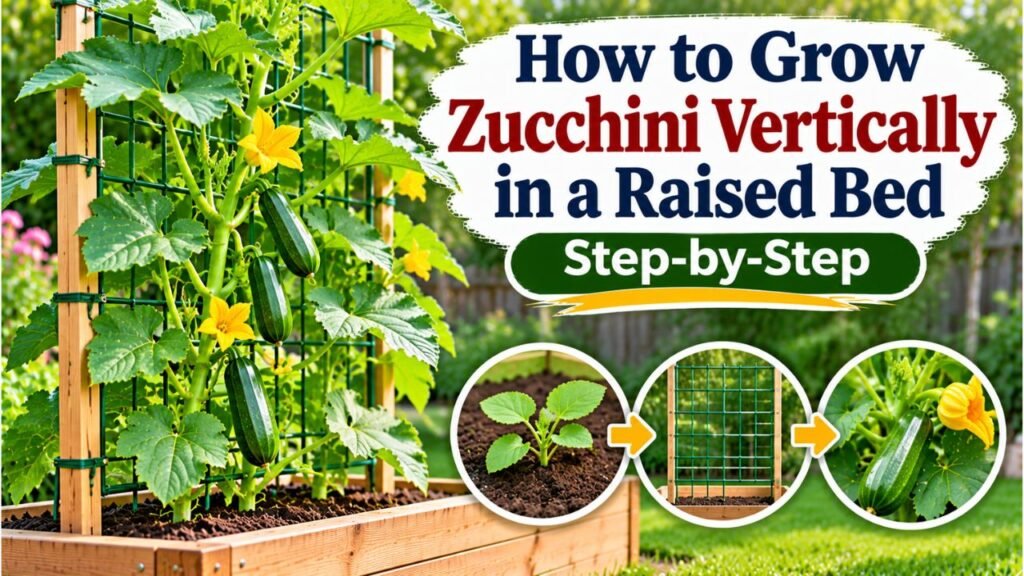
Yes, but the growing method depends on whether you have a bush-type or vining zucchini.
Most familiar green zucchini varieties have a compact, bushy growth habit. They develop a thick central stem with large leaves extending outward on long leaf stalks.
These plants don’t naturally climb a trellis.
However, their main stems can sometimes be trained upward and supported with stakes.
According to a University of Maryland Extension expert response on training zucchini, zucchini is generally considered a bush squash and isn’t ideally suited to vertical cultivation. The expert notes that some vining summer squash varieties are better suited to traditional trellising.
This distinction is important when planning your garden.
Bush Zucchini vs. Climbing Zucchini
| Feature | Bush Zucchini | Vining or Climbing Summer Squash |
| Natural growth | Compact, with a thick main stem | Longer trailing stems |
| Climbs independently | No | Usually needs guidance and support |
| Best vertical method | Strong stake or supportive cage | Sturdy trellis or fence |
| Needs regular tying | Yes | Usually yes |
| Pruning requirements | Selective lower-leaf removal | Depends on variety |
| Raised-bed suitability | Good with enough space | Good with suitable support |
| Space savings | Moderate | Can be substantial |
Key Takeaway: Standard bush zucchini can be staked upright, but this doesn’t turn it into a true climbing vine. For conventional trellising, select a variety specifically described as vining or suitable for vertical cultivation.
Benefits of Growing Zucchini Vertically
Vertical growing can make zucchini easier to manage in a limited garden space.
However, the benefits depend on plant variety, training technique, and support quality.
Saves Some Raised Bed Space
A mature zucchini plant can spread several feet across the soil.
Training the central stem upward may reduce how far the plant leans across the bed.
This can preserve access to surrounding vegetables and walking paths.
However, the leaves still extend outward, and the roots need adequate growing space.
Vertical training doesn’t mean several large zucchini plants can be crowded into a tiny bed.
Makes Harvesting Easier
Zucchini fruit can be difficult to see beneath large leaves.
Raising the main stem may make the developing fruits more visible.
This helps you harvest zucchini before it becomes oversized.
Regular harvesting is particularly useful because zucchini grows quickly under favorable conditions.
Improves Access for Pest Inspections
Squash bugs, cucumber beetles, and other pests can hide beneath dense foliage.
An upright plant may make it easier to inspect the leaves and stem.
However, vertical growing doesn’t automatically prevent pest infestations.
Can Improve Air Circulation
Keeping foliage more organized may improve airflow around the plant.
Better spacing and air movement can reduce some disease-conducive conditions.
However, powdery mildew can still develop on vertically trained zucchini, even when leaves are relatively dry.
Keeps Some Fruit Away From the Ground
An upright plant may produce fruit that hangs above the soil.
This can reduce direct contact with wet soil and make harvesting more convenient.
However, fruit weight can also place additional stress on the supporting stem.
Harvest regularly and support unusually heavy fruit when necessary.
What Do You Need to Grow Zucchini Vertically?
Most home gardeners can train zucchini with a few simple materials.
Essential Supplies
- Zucchini seeds or young transplants
- Raised garden bed
- Strong wooden or metal stake
- Soft plant ties or garden tape
- Compost or suitable raised-bed soil
- Pruning shears
- Mulch
- Watering can, soaker hose, or drip irrigation
- Optional heavy-duty tomato cage
A single sturdy stake is often the simplest option for bush zucchini.
A cage or trellis may be preferable when the plant requires additional lateral support.
What Size Stake Should You Use?
For many bush zucchini plants, a stake approximately 5–6 feet long provides a practical starting option.
The support doesn’t necessarily need to extend six feet above the soil.
Part of its length must be anchored below the surface or otherwise secured.
A 6-foot stake driven 18–24 inches into suitable ground leaves approximately 4–4.5 feet available for above-ground support.
The correct length depends on the cultivar and installation method.
What Kind of Plant Ties Work Best?
Use flexible material that doesn’t cut into the stem.
Suitable options include:
- Soft reusable plant ties
- Stretchable horticultural tape
- Wide fabric strips
- Purpose-made plant support clips
- Soft rubber-coated ties
Avoid thin wire or tightly pulled string.
Zucchini stems can become heavy and may be damaged by restrictive ties.
How to Grow Zucchini Vertically in a Raised Bed Step by Step
The most important part of vertical zucchini training is starting early.
Trying to straighten a large, mature plant after its stem has spread along the ground can cause breakage.
Step 1: Choose a Suitable Zucchini Variety
Start with a variety appropriate for your space and support system.
For a conventional upright-staking method, choose a bush zucchini with a relatively manageable growth habit.
For a true trellis, select a vining summer squash variety described as suitable for climbing.
Bush Zucchini Varieties
Many popular zucchini cultivars grow as bush plants.
Examples include:
- Black Beauty
- Raven
- Dunja
- Astia
- Other compact or patio zucchini cultivars
These varieties may be suitable for staking, but their final size and stem growth vary.
Don’t assume that every compact cultivar develops a tall main stem.
Vining Alternatives
Some specialty summer squash varieties develop longer stems that are easier to guide along a trellis.
For example, certain Black Forest and trailing courgette cultivars are sold for vertical cultivation.
Tromboncino is another vining squash often harvested young like zucchini, although botanically it is a different type of squash from standard zucchini.
Read the seed packet carefully to confirm the growth habit.
Best beginner choice: One healthy bush zucchini plant supported by a strong stake.
Step 2: Select the Right Raised Bed Location
Zucchini grows best in full sun.
Choose an area receiving at least six hours of direct sunlight daily.
Eight hours or more is preferable when conditions allow.
Avoid locations shaded by buildings, large trees, or tall neighboring crops.
The site should also have good air movement.
Don’t position tall supports where they create excessive shade over smaller vegetables.
Step 3: Prepare the Raised Bed Soil
Zucchini needs fertile, moisture-retentive, well-drained soil.
A raised bed can provide good growing conditions when filled with a balanced soil mixture.
For an open-bottom bed over suitable native soil, incorporating mature compost into the growing soil can improve fertility and structure.
Avoid filling the entire bed with pure compost.
How Deep Should the Raised Bed Be?
For a zucchini bed sitting directly on healthy ground, 12–18 inches of raised soil is a practical starting depth.
Roots may extend into the native soil below.
For a bed on concrete or another hard surface, 18–24 inches provides more room for roots and moisture storage.
A contained bed needs reliable drainage.
If the raised bed is open-bottomed and the native soil is suitable, a shallower frame may also work.
Soil pH and Fertility
Zucchini generally performs well in slightly acidic to near-neutral soil.
A pH around 6.0–6.8 is a useful target.
Use soil-test recommendations when adding fertilizers.
Excess nitrogen can encourage substantial foliage growth without necessarily improving fruit production.
Step 4: Install a Strong Stake Before Planting
Positioning the stake before planting helps prevent damage to established roots.
Use a sturdy wooden post, metal garden stake, or another support designed for outdoor use.
Avoid relying on a thin bamboo cane that bends easily under a mature plant.
How to Install the Stake
- Decide where the zucchini will grow.
- Mark a position approximately 3–6 inches from the future stem.
- Install the support vertically.
- Anchor it deeply enough for the soil and expected plant weight.
- Check that it doesn’t wobble.
- Reinforce it if necessary.
For open-bottom raised beds, a stake may extend into suitable native soil beneath the frame.
For a contained bed, don’t puncture its waterproof base or drainage components.
Instead, secure the support to the bed frame or use a properly anchored independent structure.
Important: The stake must support the mature plant in wind and rain, not merely stand upright when the zucchini is small.
Step 5: Plant the Zucchini Near the Stake
You can grow zucchini from seed or transplant a young seedling.
Planting From Seed
Wait until the danger of frost has passed and the soil has warmed.
A soil temperature around 70°F is favorable for reliable germination.
Sow seeds approximately one inch deep, following the cultivar’s packet instructions.
Place the planting location close enough to the stake for easy training without pressing the support against the stem.
Water gently.
If multiple seeds germinate in one planting position, thin to the strongest plant as appropriate for the chosen spacing.
Planting From Transplants
Choose a healthy, young seedling.
Handle the roots carefully.
Plant at the appropriate depth and water thoroughly.
Avoid burying the plant crown.
Unlike tomatoes, zucchini shouldn’t routinely be deeply buried along its stem.
Step 6: Allow the Plant to Establish
Don’t begin aggressive training immediately after germination.
Allow the seedling to develop a healthy root system and several true leaves.
Keep the soil consistently moist without waterlogging it.
As the plant grows, identify the thick central stem.
This is the part you will support.
Don’t confuse the central stem with the long leaf stalks extending outward.
Step 7: Tie the Main Stem to the Stake
Once the zucchini has developed enough stem length to guide safely, attach it to the support.
Use soft ties that allow room for growth.
How to Tie Zucchini Correctly
- Locate the main stem.
- Gently guide it toward the stake.
- Position a soft tie around the stem and support.
- Leave a little room for the stem to expand.
- Make sure the tie isn’t pressing against a leaf stalk or flower.
- Check that the stem remains comfortably supported.
A loose figure-eight tie can help keep the stem separated from the stake.
Don’t pull the stem tightly into an unnatural position.
If the plant is already leaning strongly, correct its angle gradually.
How Often Should You Add Ties?
Inspect the plant every few days during active growth.
Add a new support point whenever the main stem extends enough to lean away from the stake.
Spacing ties roughly 6–8 inches apart along an elongated stem can be a useful reference, but the correct placement depends on the plant’s shape.
Don’t add unnecessary ties to short, rigid stem sections.
The goal is stable support without constricting growth.
Step 8: Remove Selected Lower Leaves
As zucchini grows, some lower leaves may become damaged, yellow, or crowded near the soil.
Selective removal can improve access and keep the plant easier to manage.
However, zucchini needs healthy leaves for photosynthesis.
Removing too many can weaken the plant.
Which Leaves Can You Remove?
Consider removing leaves that are:
- Completely yellow
- Severely damaged
- Dying
- Resting against wet soil
- Interfering with necessary access or support
Avoid removing healthy leaves merely to create a bare stem.
How to Prune Lower Leaves
- Choose a dry day if possible.
- Clean your pruning tool.
- Identify the leaf stalk you want to remove.
- Cut it carefully near its attachment without injuring the main stem.
- Avoid tearing the leaf away by hand.
- Remove the discarded material from the bed.
Start conservatively.
Removing one or two unnecessary leaves at a time is generally safer than stripping most of the lower foliage.
Should You Remove All Leaves Below the Fruit?
No.
Some gardeners train zucchini into a palm-tree-like shape with an exposed lower stem.
However, aggressive leaf removal isn’t required for successful fruiting.
Healthy leaves are essential for energy production.
Retain a substantial, functioning canopy.
Key Takeaway: Tie the main stem loosely as it grows and prune only when necessary. Never remove the growing tip or strip healthy foliage simply to force a taller shape.
Step 9: Continue Training as the Plant Grows
Vertical zucchini requires regular maintenance.
Inspect the plant at least every few days during rapid growth.
Check for:
- Loose support ties
- Tight ties restricting the stem
- Leaning stems
- Heavy developing fruit
- Damaged leaves
- Pest activity
- Excessive crowding
Adjust the ties gradually.
If the central stem has become rigid, don’t bend it sharply.
A zucchini plant may not develop enough stem length to rise very high.
Some bush plants remain relatively short even when supported properly.
That’s normal.
The purpose of staking is to improve support and organization, not force every cultivar to reach a specific height.
Best Support Systems for Vertical Zucchini
Several structures can support zucchini.
The best choice depends on plant growth habit, available space, and how the raised bed is built.
Single Wooden or Metal Stake
A strong stake is useful for bush zucchini with one main stem.
Advantages include:
- Relatively inexpensive materials
- Simple installation
- Limited space requirements
- Easy access for tying
- Flexible placement
Its main disadvantage is the need for regular training.
The stake must also resist wind and plant weight.
Heavy-Duty Tomato Cage
A large tomato cage can support outward-growing foliage and help keep the plant organized.
Choose a sturdy model rather than a lightweight wire cone.
The cage should be wide enough to avoid crushing leaves.
This method can be practical for gardeners who prefer not to attach numerous individual ties.
Vertical Trellis
A trellis is more suitable for vining squash varieties.
A wooden or metal frame with appropriate mesh can support a trailing stem.
However, zucchini generally doesn’t climb independently like pole beans.
You must guide and secure the plant.
A-Frame Trellis
An A-frame provides support on two sloping sides.
It can be useful for longer-vining squash.
However, for ordinary bush zucchini, a simple stake or cage is often more practical.
Support System Comparison
| Support Type | Best For | Main Limitation |
| Single strong stake | Upright training of bush zucchini | Requires repeated tying |
| Heavy-duty tomato cage | Supporting bush foliage | Can become crowded |
| Flat vertical trellis | Vining squash | Needs anchoring and training |
| A-frame trellis | Longer vines | Uses more structural space |
| Bed-mounted support frame | Contained or elevated raised beds | Must be securely attached |
According to University of Vermont Extension’s plant support guidance, larger support structures should be installed before planting whenever practical. Supports must be firmly anchored, and plants that don’t cling naturally should be tied loosely to avoid stem damage.
How Many Zucchini Plants Fit in a 4×8 Raised Bed?
A 4×8 raised bed provides 32 square feet of soil surface.
For most conventional bush zucchini varieties, two plants are a comfortable starting arrangement, especially when both are trained upright.
However, spacing depends on cultivar size and the amount of surrounding foliage.
Recommended Spacing
University extension guidance commonly recommends approximately 2–3 feet between individual summer squash plants, with additional room between rows.
Vertical training can reduce some horizontal spread, but it doesn’t eliminate the plants’ root and leaf-space requirements.
For most home gardens, allow approximately 3 feet or more between vigorous zucchini plants when practical.
Example 4×8 Raised Bed Layout
| Position | Planting Arrangement |
| First half of bed | One zucchini plant |
| Second half of bed | One zucchini plant |
| Behind each plant | Strong individual stake |
| Along accessible edges | Optional compact flowers or early crops |
| Between plants | Open space for foliage and air circulation |
One simple arrangement places plant centers approximately 2 feet and 6 feet along the bed’s length.
This provides about 4 feet between the two plant centers.
Install a stake behind each plant.
In Northern Hemisphere gardens, placing tall supports toward the north side can help reduce shading of smaller nearby crops.
Can You Grow Three Zucchini Plants in a 4×8 Bed?
Some compact varieties may allow closer spacing.
However, three ordinary vigorous bush plants can become crowded even when staked.
If the seed packet indicates a mature spread of several feet, two plants are generally easier to manage.
More plants don’t necessarily mean a larger harvest if competition reduces their health.
What About a 4×4 Raised Bed?
One bush zucchini plant is a practical starting choice.
You can use the remaining space for a few compact flowers or early-harvest vegetables.
Don’t assume vertical training allows four large zucchini plants to grow comfortably in a 4×4 bed.
How Deep Should a Raised Bed Be for Vertical Zucchini?
Vertical support changes the way the stems grow, but it doesn’t eliminate the plant’s need for root space.
Open-Bottom Raised Beds
A depth of approximately 12–18 inches is a comfortable starting choice.
A shallower bed may work when it sits directly on healthy, well-drained native soil.
The roots can grow downward beyond the frame.
Raised Beds on Concrete
Choose approximately 18–24 inches when practical.
A contained bed over a hard surface cannot provide additional root space below.
It also needs adequate drainage.
Elevated Raised Beds
For an elevated planter with a solid bottom, consider both depth and total soil volume.
A large zucchini plant may dry out quickly if the container is narrow and shallow.
The support structure must also be firmly anchored without damaging the planter.
Is a Deeper Bed Necessary Because Zucchini Is Growing Vertically?
Not inherently.
The roots don’t become deeper simply because the main stem is trained upward.
However, a larger soil volume can improve moisture storage and provide more flexibility during warm weather.
How to Water Vertically Grown Zucchini
Zucchini grows rapidly and needs reasonably consistent moisture, particularly during flowering and fruit development.
Raised-bed soil may dry faster than surrounding native soil.
How Much Water Does Zucchini Need?
As a general starting point, established summer squash needs approximately one inch of water per week from rainfall and irrigation during typical growing conditions.
Hot weather, wind, and vigorous growth can increase water demand.
Some gardens may need closer to 1–2 inches weekly under higher-demand conditions.
Adjust according to soil moisture rather than applying a fixed amount automatically.
Is Drip Irrigation Good for Vertical Zucchini?
Yes.
Drip irrigation can deliver water close to the roots while minimizing unnecessary wetting of the foliage.
Position the emitters so the root zone receives adequate moisture.
Don’t direct all the water to one tiny spot beside the stem.
Zucchini roots spread outward as the plant grows.
How Long Should Drip Irrigation Run?
Run time depends on:
- Emitter flow rate
- Number of emitters
- Soil texture
- Bed size
- Weather
- Plant size
For example, one 1-GPH emitter delivers approximately half a gallon in 30 minutes under its rated operating conditions.
Two such emitters deliver approximately one gallon during the same period.
Neither amount is automatically sufficient for every mature zucchini plant.
Check the soil several inches deep to confirm that water reaches the active root zone.
Should You Water Every Day?
Not always.
Daily irrigation may be necessary in some hot, fast-draining raised beds.
However, moisture-retentive soil may need less frequent watering.
Check below the surface before watering again.
Use Mulch to Reduce Moisture Loss
A layer of suitable organic mulch can help conserve soil moisture.
Keep it away from direct contact with the plant crown.
Inspect beneath mulch for squash bugs and other pests.
Key Takeaway: Vertical zucchini needs consistent root-zone moisture, not constant saturation. Drip irrigation, soil checks, and mulch can help maintain suitable growing conditions.
How to Fertilize Zucchini Growing Vertically
Training zucchini upward doesn’t automatically increase its fertilizer requirement.
Nutrient needs depend on soil fertility, plant growth, and fruit production.
Prepare the Soil Before Planting
Mix suitable finished compost into the soil as needed.
If possible, have the soil tested.
Follow recommendations for nitrogen, phosphorus, potassium, and soil pH.
Avoid Excessive Nitrogen
Too much nitrogen can encourage large leaves and vigorous vegetative growth.
This may make the plant harder to manage on a stake.
Excess foliage doesn’t necessarily translate into more fruit.
Fertilize During Active Growth When Needed
If the soil test or plant growth indicates a nutrient shortage, use a fertilizer appropriate for vegetables.
Follow the product label.
Avoid applying fertilizer directly against the stem.
Water appropriately after application when instructed.
Can You Use Liquid Fertilizer?
Yes, suitable liquid fertilizers can be used when needed.
However, frequent feeding isn’t automatically better.
Base the amount on the product instructions and actual plant requirements.
How to Prune Zucchini for Vertical Growing
Pruning is often recommended for upright zucchini, but aggressive pruning can cause more harm than benefit.
The objective is to remove unnecessary foliage without reducing the plant’s ability to photosynthesize.
When Should You Start Pruning?
Wait until the plant has established a healthy leaf canopy.
Don’t remove most of the lower leaves from a small seedling.
As the plant grows, selectively remove leaves that are damaged, dying, or interfering with access.
Which Leaves Should You Remove?
Prioritize:
- Completely yellow leaves
- Dead leaves
- Severely damaged leaves
- Leaves resting on wet soil
- Selected crowded lower leaves when necessary
A healthy lower leaf doesn’t need to be removed simply because it sits below a developing fruit.
How Much Can You Prune at Once?
Use a conservative approach.
Remove only what is necessary.
Avoid stripping a large percentage of the foliage in a single session.
A zucchini plant needs adequate healthy leaves to supply energy for growth and fruit development.
Should You Cut the Main Stem?
No.
Don’t cut the main growing tip to force vertical growth.
Topping the plant can damage its normal growth pattern.
Support the existing stem instead.
Should You Remove Male Flowers?
No, not routinely.
Most conventional zucchini plants produce both male and female flowers.
The male flowers provide pollen needed for fruit development.
Removing too many can interfere with pollination.
How to Reduce Disease Spread While Pruning
Use clean, sharp tools.
Avoid pruning unnecessarily when the plant is wet.
Remove damaged or diseased material from the bed as appropriate.
Avoid tearing leaves from the main stem.
How to Pollinate Zucchini Growing Vertically
Vertical training doesn’t change the basic pollination requirements of zucchini.
Most conventional zucchini varieties produce separate male and female flowers on the same plant.
Pollen must move from the male flower to the female flower for normal fruit development.
How to Identify Male and Female Flowers
Male flowers grow on relatively long, slender stalks.
They contain the pollen-producing structures.
Female flowers have a small immature zucchini directly beneath the flower.
After successful pollination, that small fruit begins growing.
Do You Need Two Zucchini Plants?
No.
One ordinary zucchini plant can produce both male and female flowers.
It can set fruit when compatible flowers are available and pollen is transferred successfully.
Why Are Bees Important?
Bees commonly transfer pollen between squash flowers.
Squash bees and bumblebees can be particularly effective pollinators.
Keep flowers accessible.
Avoid spraying insecticides while bees are visiting blooms.
Can You Hand-Pollinate Zucchini?
Yes.
If pollinator activity is low, hand pollination may help.
How to Hand-Pollinate
- Identify a freshly opened male flower.
- Identify a freshly opened female flower.
- Use a clean, soft brush or carefully remove a male flower.
- Transfer pollen from the male flower’s anther to the female flower’s stigma.
- Avoid damaging the female flower.
- Repeat with other receptive flowers if needed.
Morning is often a useful time because squash flowers commonly open early and may close later in the day.
Why Are Small Zucchini Rotting Before Growing?
Poor pollination is one possible cause.
A developing zucchini may remain small, become misshapen, or begin to decay when pollination is inadequate.
However, environmental stress, disease, and moisture problems may cause similar symptoms.
Don’t assume every small rotting fruit indicates a lack of bees.
How to Support Zucchini Fruit When Growing Vertically
Most standard zucchini fruits can remain attached to the plant without an individual sling when harvested at normal edible size.
However, oversized fruit and certain specialty varieties can become heavy.
Do You Need a Sling for Every Zucchini?
No.
Regularly harvested zucchini is generally manageable on a healthy, well-supported plant.
However, individual fruits may need support if:
- They grow unusually large.
- The fruit-bearing stem is under strain.
- The plant leans excessively.
- You’re growing a larger-fruited vining squash.
- The trellis design places additional tension on the stem.
How to Make a Fruit Sling
For a fruit that genuinely needs extra support:
- Choose soft fabric or suitable mesh.
- Place it beneath the developing fruit.
- Support the weight without squeezing the fruit.
- Attach the sling securely to the trellis or frame.
- Leave room for further fruit growth.
- Check the sling regularly.
Attach the sling to the support structure rather than relying on a leaf stalk to hold the fruit.
Harvest Before Fruit Becomes Oversized
Regular harvesting usually reduces the need for additional fruit supports.
Many zucchini varieties have their best tender eating quality around 6–8 inches long, although preferences and cultivar characteristics vary.
When and How to Harvest Vertically Grown Zucchini
Zucchini can grow quickly once the plant begins producing fruit.
Check the plants frequently during peak production.
When Is Zucchini Ready?
Many zucchini varieties are harvested at approximately 6–8 inches long.
However, smaller fruit can also be tender and flavorful.
Check the seed packet for cultivar-specific harvesting guidance.
How to Harvest Without Damaging the Stake or Stem
Use clean pruning shears or a sharp knife.
Cut the fruit stem carefully.
Don’t twist or pull forcefully.
Strong pulling can damage the zucchini’s main stem or disrupt the support ties.
How Often Should You Harvest?
During active production, check plants daily or every other day.
Harvesting at the preferred size helps prevent fruit from becoming oversized.
It also reduces unnecessary weight on vertically trained stems.
What if the Zucchini Is Too Large?
Large zucchini may still be usable for certain recipes, depending on its condition.
However, mature fruit can develop tougher skin and larger seeds.
Remove oversized fruit carefully to reduce its weight on the plant.
Common Problems When Growing Zucchini Vertically
Vertical training introduces a few challenges beyond ordinary zucchini care.
Most involve support stability, stem growth, moisture, or pest management.
The Zucchini Stem Keeps Leaning
Possible causes include:
- Weak support
- Loose ties
- Too much distance between support points
- Heavy leaves or fruit
- Wind exposure
- A stem that has already developed a horizontal growth habit
Check the support structure first.
Add another loose tie if necessary.
Avoid forcing a rigid stem into a sharply different position.
The Main Stem Is Starting to Crack
Stop bending or repositioning the plant.
A cracked stem may result from excessive force or inadequate support.
Provide gentle stabilization without tightening the ties around the damaged section.
Severe damage may prevent the plant from recovering.
This is one reason to begin training while the plant is young.
The Leaves Are Turning Yellow
Yellowing leaves can result from:
- Normal aging
- Inadequate nutrients
- Excessive moisture
- Drought stress
- Root damage
- Disease
- Pest infestations
Older lower leaves sometimes yellow naturally.
Inspect the growing conditions before removing large amounts of foliage or adding fertilizer.
White Powder Is Appearing on Leaves
Powdery mildew is a common zucchini disease.
It produces white, powdery growth on leaf surfaces.
Improved spacing and airflow may help reduce disease-conducive conditions, but they don’t guarantee prevention.
Choose resistant cultivars when available.
Inspect plants regularly.
Use only treatments specifically labeled for the crop and disease when treatment is necessary.
The Plant Produces Flowers but No Zucchini
Possible causes include:
- Male flowers appearing before female flowers
- Inadequate pollination
- Extreme temperatures
- Plant stress
- Poor growing conditions
Male flowers commonly appear first.
Wait for female flowers and check pollinator activity.
Hand pollination may help when suitable flowers are open.
The Support Keeps Falling Over
A mature zucchini plant can become heavy.
A short, poorly anchored stake may not withstand wind or fruit weight.
Reinforce the support without damaging the roots.
For a contained raised bed, attach the support to a properly designed frame rather than relying on shallow soil alone.
Squash Bugs Are Damaging the Plant
Squash bugs can feed on zucchini and other cucurbits.
Inspect the undersides of leaves for egg clusters and the plant for adults and nymphs.
An upright plant may make inspections easier.
However, staking doesn’t prevent squash bugs from entering the bed.
Use appropriate integrated pest-management methods.
Squash Vine Borers Are Damaging the Main Stem
In areas where squash vine borers occur, larvae can enter the squash stem.
This may cause sudden wilting and stem damage.
Vertical training doesn’t eliminate the risk.
Inspect stems for damage and frass, and follow local university extension recommendations for prevention and management.
Vertical Zucchini vs. Traditional Growing: Which Is Better?
Both methods can produce healthy plants.
The choice depends on available space and how much training you’re willing to do.
Vertical vs. Ground Growing
| Feature | Vertical Zucchini | Traditional Ground-Grown Zucchini |
| Main growth habit | Stem trained upright | Natural bush shape |
| Support required | Yes | Usually not |
| Space occupied | Can reduce outward sprawl | Often wider |
| Maintenance | More tying and support checks | Less training |
| Harvest access | May be easier | Can be hidden under leaves |
| Pruning | Selective pruning often used | Usually minimal |
| Root-space needs | Still substantial | Substantial |
| Pollination needs | Generally unchanged | Generally unchanged |
| Pest protection | Not guaranteed | Not guaranteed |
| Best for | Smaller gardens needing organized plants | Gardens with ample space |
When Vertical Growing Is Better
Consider vertical training when:
- Raised-bed space is limited.
- You want easier access to fruit.
- You enjoy regular garden maintenance.
- You have a strong support structure.
- The selected cultivar can be trained safely.
When Traditional Growing Is Better
Allow zucchini to grow naturally when:
- Garden space is plentiful.
- You prefer less maintenance.
- The cultivar has a short, rigid bush habit.
- The plant is already mature and sprawling.
- Strong vertical supports aren’t available.
Key Takeaway: Vertical zucchini is a space-management technique, not a requirement for healthy growth. Traditional cultivation may be simpler, especially for compact bush varieties.
Can You Grow Zucchini Vertically in a Small Raised Bed?
Yes, but plan the space realistically.
Vertical growing reduces some outward spread without eliminating the need for roots and leaves to develop.
Zucchini in a 2×4 Raised Bed
One compact bush plant may be practical if its foliage has room to extend beyond the frame.
Use a strong support and keep nearby walking paths clear.
A vigorous, large variety may still overwhelm this bed.
Zucchini in a 3×6 Raised Bed
One bush zucchini plant is a comfortable starting point.
Depending on the cultivar and planting arrangement, there may also be room for small companion plants.
Avoid crowding the main stem.
Zucchini in a 4×4 Raised Bed
One bush zucchini plant is a practical choice.
Place its support where it won’t interfere with the mature leaves.
You can grow a few compact flowers near the edges if they have sufficient light.
Zucchini in a 4×8 Raised Bed
Two well-spaced bush zucchini plants are a useful starting arrangement.
Give each plant its own stake or suitable supporting cage.
Avoid placing additional vigorous cucurbits directly beside them.
Small Raised Bed Planting Guide
| Raised Bed Size | Practical Starting Arrangement |
| 2×4 ft | 1 compact zucchini plant, with outward leaf clearance |
| 3×6 ft | 1 zucchini plant |
| 4×4 ft | 1 zucchini plant |
| 4×6 ft | 1–2 plants, depending on cultivar |
| 4×8 ft | 2 plants |
| 4×10 ft | 2–3 plants, depending on spacing |
These are conservative planning examples rather than guaranteed maximum plant counts.
Always consider the mature cultivar size and the space available around the bed.
Best Companion Plants for Vertically Grown Zucchini
Vertical training may leave some accessible soil near the bed edges.
However, companion plants shouldn’t crowd the main zucchini stem or reduce airflow.
Sweet Alyssum
Sweet alyssum is a compact flowering plant that can attract beneficial insects.
It works well near raised-bed edges.
Marigolds
Compact marigolds provide flowers for visiting insects.
Place them near corners where they won’t block access to the zucchini.
Nasturtiums
Nasturtiums can provide flowering diversity and may offer some pest-management benefits.
Choose compact varieties or allow trailing stems to extend outside the bed.
Radishes
Radishes are useful as an early-season crop.
They can often be harvested before zucchini reaches full size.
Leaf Lettuce
Lettuce can occupy open soil early in the growing season.
Harvest it before the zucchini canopy becomes dense.
What Should You Avoid?
Avoid adding large, sprawling companions that compete for space.
Examples include vigorous pumpkins, multiple winter squash vines, or large cucumber plants in an already crowded bed.
The goal is to complement the zucchini, not fill every square inch of soil.
Mistakes to Avoid When Growing Zucchini Vertically
Several common mistakes can damage plants or make training unnecessarily difficult.
Treating Bush Zucchini Like a Climbing Vine
Bush zucchini doesn’t naturally attach itself to a trellis.
Provide support rather than expecting it to climb unaided.
Installing the Stake Too Late
Adding a stake beside a mature plant can damage established roots.
Install the support before planting whenever possible.
Using a Weak Bamboo Cane
A thin support may bend or break as the plant becomes heavier.
Choose a stake or cage strong enough to handle a mature zucchini plant.
Tying the Stem Too Tightly
Tight ties can restrict stem expansion and cause physical damage.
Use flexible materials and check them regularly.
Tying Leaf Stalks Instead of the Main Stem
Leaf stalks are not the primary structure to support.
Attach ties around suitable portions of the main stem without crushing foliage or flowers.
Forcing a Mature Stem Upright
Older zucchini stems may be difficult to reposition without cracking.
Train the plant gradually while it is young.
Removing Too Many Leaves
Aggressive pruning reduces the plant’s photosynthetic capacity.
Remove damaged or unnecessary leaves conservatively.
Overcrowding the Raised Bed
Staking doesn’t eliminate the need for plant spacing.
Allow room for roots, leaves, airflow, and harvesting.
Ignoring Watering Needs
Vertically trained plants still need sufficient moisture.
A raised bed can dry rapidly during hot weather.
Monitor the root zone rather than relying only on the appearance of the soil surface.
Letting Fruit Become Oversized
Large fruit increases the weight supported by the stem and stake.
Harvest regularly.
Conclusion
Learning how to grow zucchini vertically in a raised bed starts with understanding that most zucchini varieties are naturally bushy rather than true climbers.
You can support a conventional bush zucchini by installing a strong stake before planting, guiding the central stem upward, and attaching it loosely as it develops.
A 5–6-foot stake with adequate anchoring is a practical starting option, but the required height depends on the cultivar and support arrangement.
For a 4×8 raised bed, two well-spaced zucchini plants with individual supports are generally easier to manage than a crowded planting.
Prune conservatively, retain healthy foliage, provide regular water, and allow pollinators to reach the flowers.
Harvest young zucchini frequently to reduce unnecessary weight on the plant.
Vertical training can improve access and make better use of limited garden space, but it doesn’t guarantee higher yields or eliminate pests and diseases.
With a suitable variety, secure support, and consistent care, a raised bed can produce healthy zucchini while keeping the plants more organized throughout the growing season.
FAQs About How to Grow Zucchini Vertically in a Raised Bed
Can You Grow Regular Zucchini Vertically?
Yes. Many regular bush zucchini plants can be trained upright using a strong stake and soft ties.
However, they don’t naturally climb like pole beans.
Some bush varieties remain short and rigid, so not every plant is equally suitable for vertical training.
What Is the Best Trellis for Zucchini?
For ordinary bush zucchini, a strong single stake or heavy-duty tomato cage is often more practical than a flat trellis.
For vining summer squash, a sturdy wooden or metal trellis can work well.
In either case, secure the structure and guide the stems gently.
How Tall Should a Zucchini Trellis Be?
A support offering approximately 3–5 feet of above-ground height can be useful for many home-garden arrangements.
A 5–6-foot stake may provide sufficient height once part of it is anchored below the soil.
Some bush zucchini plants remain much shorter and won’t use the full support height.
How Do You Tie Zucchini to a Stake?
Use soft garden tape, flexible plant ties, or wide fabric strips.
Gently secure the main stem to the stake without tightening it.
Add support points as the plant grows and check the ties regularly for pressure or damage.
Should You Remove the Bottom Leaves of Zucchini?
You can remove selected lower leaves that are yellow, dead, damaged, or interfering with access.
However, avoid removing large amounts of healthy foliage.
Zucchini depends on its leaves for photosynthesis and fruit production.
How Many Zucchini Plants Can You Grow in a 4×8 Raised Bed?
Two vigorous bush zucchini plants are a comfortable starting arrangement.
Some compact varieties may allow different spacing.
Provide room for mature foliage, root growth, airflow, and harvesting.
Vertical training doesn’t eliminate these requirements.
Does Growing Zucchini Vertically Increase Yield?
Not necessarily.
Vertical growing may improve access, reduce some crowding, and make harvesting easier.
However, yields still depend on variety, sunlight, water, nutrients, pollination, and plant health.
Staking alone doesn’t guarantee more fruit per plant.
How Deep Should a Raised Bed Be for Vertical Zucchini?
A depth of approximately 12–18 inches is practical for an open-bottom bed over suitable native soil.
For a contained bed on concrete, 18–24 inches is a useful target.
Adequate overall soil volume and drainage are more important than height alone.
Can Zucchini Grow Vertically Without Pruning?
Yes, some plants can be supported upright with minimal pruning.
However, selective removal of damaged or crowded lower leaves may improve access.
Aggressive pruning isn’t required and can reduce healthy leaf area.
Do You Need to Support Zucchini Fruit on a Trellis?
Not usually when ordinary zucchini is harvested young and the plant is properly supported.
However, oversized fruit or larger-fruited squash may need additional support.
Harvesting regularly helps reduce weight on the stem.
Can You Grow Zucchini Vertically in Containers?
Yes, provided the container is large enough for the plant’s root system and has adequate drainage.
Choose a suitable compact variety, provide sturdy support, and monitor moisture carefully.
Containers may dry faster than larger raised beds.

I’m Maya L. Greenwood, a lifelong plant lover who believes anyone can grow something beautiful with the right guidance. After years of testing soil mixes, pruning methods, irrigation tricks, and pest-safe solutions, I started EasyGardenTips.com to turn hard-won lessons into step-by-step advice. From seed starting and container gardens to composting and seasonal checklists, my goal is to make gardening simple, sustainable, and fun.