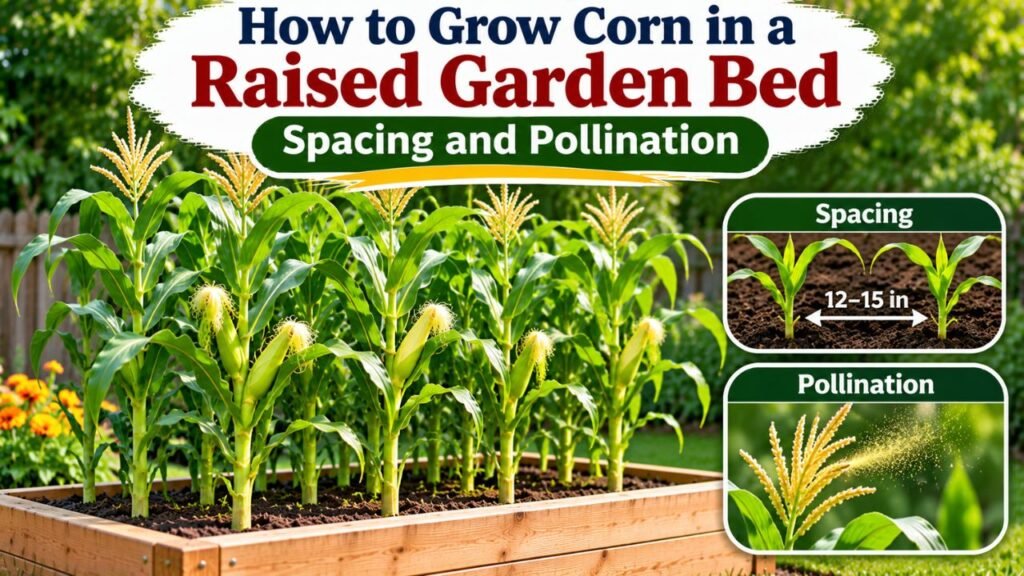
How to Grow Corn in a Raised Garden Bed: Spacing and Pollination
You can grow sweet corn in a raised garden bed by planting seeds in fertile, well-drained soil after the last frost, providing full sunlight, and keeping the soil consistently moist. For successful ear development, plant corn in a block of at least three or four short rows rather than one long row, and give each plant adequate space for roots and leaves.
Growing corn in raised beds can be rewarding, but it requires more planning than growing compact vegetables such as lettuce or radishes. Corn grows tall, consumes substantial nutrients, and depends on wind to transfer pollen from its tassels to the developing ears.
A single narrow raised bed may produce healthy stalks but poorly filled ears if too little pollen reaches the silks. Crowding the plants to improve pollination can create another problem by increasing competition for sunlight, water, and nutrients.
Fortunately, a suitable bed layout, proper watering, and occasional hand pollination can improve the chances of a productive harvest.
In this article, I explain how to grow corn in a raised garden bed step by step, including the best bed size, soil depth, seed spacing, planting time, watering, fertilizer, and pollination methods. You’ll also learn which sweet corn varieties suit smaller gardens, how to prevent common problems, and when to harvest fresh ears.
Can You Grow Corn in a Raised Garden Bed?
Yes. Sweet corn can grow successfully in raised beds, provided the plants have enough room, fertile soil, and reliable access to water.
Raised beds are particularly useful where the native soil is compacted, poorly drained, or difficult to cultivate.
However, corn is generally better suited to larger raised-bed areas than small individual planters.
A narrow bed with only a handful of plants may not provide enough pollen for reliable ear development.
Benefits of Growing Corn in Raised Beds
Raised beds offer several advantages:
- Better control over soil composition.
- Improved drainage when properly constructed.
- Reduced compaction from foot traffic.
- Easier access for planting and weeding.
- Faster soil warming in some spring conditions.
- Convenient use of drip irrigation.
- More organized garden space.
These advantages can support healthy corn growth.
However, a raised bed doesn’t eliminate the need for proper plant spacing or pollination.
Challenges of Growing Corn in Raised Beds
The main challenges include:
- Corn requires substantial growing space.
- Small plantings may experience poor pollination.
- Raised-bed soil can dry out quickly.
- Corn needs a dependable nutrient supply.
- Tall stalks may be vulnerable to strong winds.
- Mature plants can shade nearby vegetables.
Before planting, decide whether you have enough room for a useful block of corn.
Key Takeaway: Raised beds can support healthy corn, but planting layout and pollination are more important than simply choosing a deep container.
Corn Growing Requirements for Raised Beds
Sweet corn is a warm-season annual crop.
It grows best when sunlight, soil fertility, moisture, and temperature are appropriate.
Quick Corn Growing Guide
| Growing requirement | General recommendation |
| Sunlight | Full sun; preferably 8–10 hours daily |
| Soil temperature | At least about 60°F for dependable planting |
| Supersweet corn temperature | Preferably at least 65°F |
| Soil pH | Approximately 6.0–7.0 |
| Seed planting depth | About 1 inch |
| Plant spacing | Commonly 8–12 inches within rows |
| Row spacing | Generally 24–36 inches |
| Planting arrangement | Blocks of at least 3–4 rows |
| Raised-bed soil depth | Preferably 12–18 inches or access to deeper native soil |
| Water | Often at least 1 inch per week, depending on conditions |
| Fertilizer | Soil-test-guided; additional nitrogen commonly needed |
| Harvest time | Often 60–100 days, depending on variety and weather |
| Expected yield | Commonly about one good ear per plant |
These are general home-garden guidelines.
Actual requirements depend on the variety, climate, soil, and planting density.
The University of Maryland Extension’s sweet corn growing guide recommends full sun, fertile soil, and multiple rows planted together to improve pollination.
What Size Raised Bed Do You Need for Corn?
A larger bed or several adjacent raised beds is preferable for growing corn because the plants need space for both root development and wind pollination.
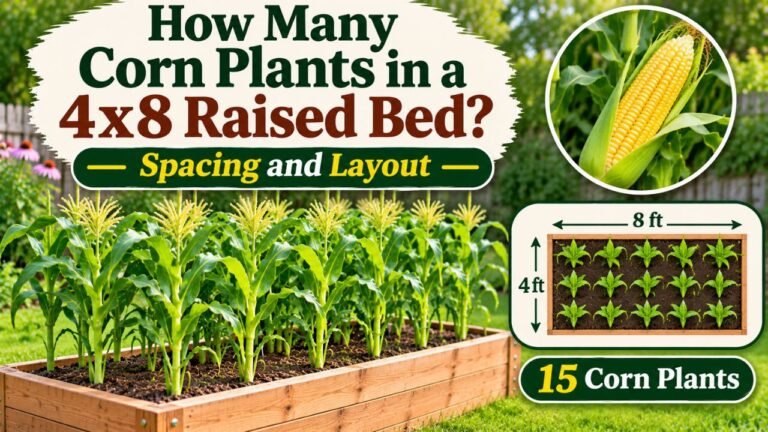
A 4 × 8-foot bed can support a small planting, but it may not provide the number of rows recommended for dependable pollination on its own.
Two neighboring 4 × 8-foot beds can form a more effective planting block.
Can You Grow Corn in a 4 × 4 Raised Bed?
Yes, but a 4 × 4-foot bed is quite small for conventional sweet corn.
At ordinary row spacing, it may accommodate only a few plants.
That creates several challenges:
- Limited pollen production.
- Greater risk of incomplete kernel development.
- Restricted space for mature leaves.
- Increased competition if plants are crowded.
- A relatively small harvest.
A few plants can grow successfully and may produce ears, particularly with careful hand pollination.
However, a 4 × 4 bed alone is not an ideal choice if your goal is a dependable sweet corn harvest.
Can You Grow Corn in a 4 × 8 Raised Bed?
Yes.
A 4 × 8-foot raised bed offers more room.
At conventional spacing, you can plan approximately two lengthwise rows with plants about 12 inches apart within each row.
This gives roughly 16 potential planting positions.
However, two rows still provide less reliable wind pollination than a larger four-row block.
For better results, consider growing corn in two adjacent beds.
Is an 8 × 8-Foot Growing Area Better?
Yes.
An 8 × 8-foot growing area offers more flexibility to arrange several short rows.
It can support a larger pollen-producing group while maintaining reasonable plant spacing.
However, an 8-foot-wide raised bed may be difficult to reach from the sides.
Rather than constructing one oversized bed, two accessible raised beds positioned close together are often more practical.
Raised-Bed Size Comparison
| Growing area | Practical arrangement | Pollination outlook |
| 4 × 4 feet | Small number of corn plants | Limited; hand assistance may help |
| 4 × 8 feet | About 2 rows with conventional spacing | Possible but less reliable |
| Two adjacent 4 × 8 beds | Approximately 4 rows total | Better for wind pollination |
| Approximately 8 × 8 feet | Multiple short rows | More suitable for block planting |
| Larger growing area | 4–5 or more short rows | Generally more dependable |
The plant numbers depend on the specific variety and spacing.
Important: Don’t reduce conventional row spacing to only a few inches simply to fit more rows into a small bed. Overcrowded corn may produce smaller or fewer ears.
Why Corn Should Be Planted in Blocks
Corn is primarily wind-pollinated.
Unlike many garden vegetables, it doesn’t depend mainly on bees or other insects to transfer pollen.
The male flowers produce pollen at the top of the stalk, while the female flowers develop into ears lower on the plant.
How Corn Pollination Works
A corn stalk has two important reproductive structures.
Tassel: The branching structure at the top of the plant that releases pollen.
Silks: The threadlike structures extending from developing ears.
Each potential kernel is connected to its own silk.
When pollen reaches a receptive silk, fertilization can occur.
If many silks don’t receive viable pollen, the ear may develop with missing kernels.
Why a Single Row Is Less Reliable
In a single row, wind may carry much of the released pollen away from neighboring plants.
A block planting places more tassels and silks within the same area.
This increases the opportunities for pollen to reach receptive silks.
According to Colorado State University Extension’s raised-bed block planting guide, at least three rows are recommended, with five rows providing better pollen distribution.
The guide also describes using two neighboring 4-foot-wide raised beds to create a four-row corn planting.
Best Corn Planting Layout for Raised Beds
For a practical two-bed arrangement:
- Position two 4 × 8-foot raised beds near each other.
- Leave a suitable walkway between them.
- Plant approximately two lengthwise rows in each bed.
- Maintain spacing appropriate for the corn variety.
- Plant the rows at approximately the same time.
- Allow the tassels to release pollen across the combined planting.
This arrangement creates a group of approximately four rows.
It doesn’t guarantee perfect pollination, but it generally offers a better arrangement than isolated plants.
Key Takeaway: Corn should be grown as a group. Several short rows offer a better chance of fully developed ears than one long row or a few isolated stalks.
How Deep Should a Raised Garden Bed Be for Corn?
Corn develops an extensive root system.
A shallow container may restrict root development, limit water availability, and make tall plants less stable.
Is a 12-Inch Raised Bed Deep Enough?
A 12-inch-deep raised bed can support corn when it has an open bottom and the roots can grow into suitable native soil beneath it.
However, a shallow enclosed planter may not provide enough root space for full-sized corn.
For a conventional ground-connected raised bed, approximately 12–18 inches of prepared growing medium is a practical starting depth.
The underlying ground should also permit root growth.
Is an 18-Inch Raised Bed Better?
An 18-inch bed provides additional prepared soil volume.
This may improve moisture and nutrient availability, especially where native soil quality is poor.
However, depth alone doesn’t determine success.
Corn still needs adequate plant spacing, drainage, sunlight, and pollination.
Can Corn Grow in a Raised Bed With a Bottom?
It is possible, but more demanding.
An enclosed planter should provide substantial soil volume, drainage openings, and enough stability for tall plants.
A depth of 18–24 inches or more may be preferable for a contained planting, but no single depth guarantees adequate root volume.
A bottomless bed over suitable soil is generally a better choice for a substantial sweet corn planting.
What Is the Best Soil for Corn in Raised Beds?
Corn prefers fertile, well-drained soil that supplies adequate moisture and nutrients.
It is a relatively heavy-feeding vegetable.
Ideal Soil Characteristics
A suitable growing medium should:
- Drain excess water.
- Retain enough moisture between watering sessions.
- Contain appropriate organic matter.
- Allow roots to grow freely.
- Provide adequate nitrogen and other nutrients.
- Have a suitable pH.
A soil pH around 6.0–7.0 is generally appropriate.
A soil test can identify whether amendments are needed.
What Soil Mix Should You Use?
For a bottomless raised bed, use a quality raised-bed soil mixture containing an appropriate mineral-soil component and finished compost.
The exact ratio depends on your existing soil and available materials.
Avoid filling the entire bed with compost.
Compost decomposes over time and may supply excessive nutrients or salts when used in very large quantities.
Should You Add Compost Before Planting Corn?
Finished compost can help improve soil structure and organic matter.
For an established bed, a modest addition may be appropriate if the soil needs it.
However, compost isn’t guaranteed to meet all the nitrogen needs of corn.
The Utah State University Extension sweet corn guide recommends using a soil test to determine fertilizer needs and emphasizes additional nitrogen during the growing season when appropriate.
When to Plant Corn in a Raised Garden Bed
Corn should be planted when the soil is warm enough for dependable germination and the danger of damaging frost has passed.
Planting too early can result in poor germination, seed rot, or stunted seedlings.
Ideal Soil Temperature for Planting Corn
For many sweet corn varieties, wait until soil temperature reaches at least approximately 60°F.
Supersweet varieties generally require warmer conditions.
A minimum around 65°F is commonly recommended for supersweet corn.
Use a soil thermometer rather than relying only on air temperature.
Measure at an appropriate planting depth, and check conditions over several days when the weather is variable.
Should You Plant Corn Before the Last Frost?
Generally, no.
Sweet corn is a warm-season crop.
Frost can damage young foliage.
Wait until the local frost risk has passed and the soil is sufficiently warm.
In warmer U.S. regions, suitable planting dates may arrive earlier.
In colder regions, planting may need to wait until late spring or early summer.
Can You Start Corn Indoors?
Yes, although corn is usually direct-seeded.
Corn seedlings can be sensitive to root disturbance.
If starting indoors:
- Use sufficiently deep individual cells.
- Avoid allowing plants to become rootbound.
- Transplant while seedlings are still young.
- Handle roots carefully.
- Harden seedlings off before outdoor planting.
Direct seeding into warm soil is generally simpler for most home gardeners.
How to Grow Corn in a Raised Garden Bed Step by Step
Once the bed is prepared and the weather is suitable, you can plant corn directly from seed.
Step 1: Choose a Suitable Sweet Corn Variety
Select a variety based on your growing season and available space.
For smaller gardens, consider early-maturing varieties with relatively compact growth.
Sweet corn varieties commonly fall into three groups:
| Type | Characteristics | Consideration |
| Standard sugary (su) | Traditional sweet corn flavor | Sweetness declines relatively quickly after harvest |
| Sugary enhanced (se) | Sweeter, often tender kernels | Suitable for many home gardens |
| Supersweet (sh2) | Very sweet kernels with slower sugar conversion | Requires warmer planting soil and isolation from incompatible types |
Check seed packets for mature height and days to harvest.
If growing multiple genetic types of sweet corn, follow isolation guidance to reduce unwanted cross-pollination.
For a small raised-bed planting, choosing one compatible variety simplifies management.
Step 2: Select a Sunny Location
Corn needs full sunlight.
At least six hours of direct sun is important, and 8–10 hours is preferable for strong growth and yield.
Avoid planting where trees, fences, or buildings create prolonged shade.
Corn can grow 6–8 feet tall or more, depending on variety.
Position it where mature stalks won’t shade shorter crops unnecessarily.
The northern side of a vegetable garden is often a practical location in the Northern Hemisphere.
Step 3: Prepare the Raised Bed
Remove weeds, rocks, and unwanted debris.
Check that water drains appropriately.
Loosen compacted soil when necessary.
Incorporate suitable compost or fertilizer based on soil condition and testing.
Level the soil before planting.
Avoid working the soil when it is saturated.
Step 4: Plan the Corn Planting Block
Mark the planting positions before sowing.
For conventional rows, a practical spacing range is:
- Approximately 8–12 inches between plants within rows.
- Approximately 24–36 inches between rows.
- At least three rows in a block, preferably four or more.
For specialized high-density planting, Utah State University Extension describes a 15 × 15-inch square arrangement.
However, high-density systems require suitable varieties, fertile soil, adequate moisture, and careful management.
They aren’t automatically the best option for beginners.
Step 5: Plant the Corn Seeds
Make planting holes or shallow furrows approximately 1 inch deep.
Place seeds at the planned positions.
Cover with soil and firm gently.
Water carefully.
Some gardeners sow extra seeds and thin seedlings after germination.
If you do this, remove unwanted seedlings without disturbing the roots of plants you intend to keep.
Step 6: Keep the Soil Moist During Germination
Corn seeds need moisture to germinate.
Keep the seedbed evenly moist but not waterlogged.
Avoid heavy watering that displaces seeds or creates soil crusting.
Germination time depends on temperature, moisture, variety, and seed condition.
Warm soil usually supports faster, more reliable emergence than cold soil.
Step 7: Thin Seedlings to Proper Spacing
If more than one seedling emerges at a planting location, thin to the intended number.
Don’t leave multiple plants tightly crowded together.
Crowding increases competition for water, nutrients, and sunlight.
It can also reduce ear size and overall productivity.
Step 8: Apply Mulch After the Soil Warms
Once seedlings establish, apply an appropriate organic mulch.
Suitable options include:
- Clean straw.
- Shredded leaves.
- Suitable grass clippings in thin layers.
- Other weed-free organic mulch.
A layer around 2 inches deep can help conserve moisture.
Keep mulch from accumulating tightly against the stalk bases.
Step 9: Water and Fertilize During Growth
Corn requires consistent moisture and a dependable nutrient supply.
Monitor the soil regularly.
Apply supplemental nitrogen when appropriate, according to soil tests and crop guidance.
Pay particular attention to watering as tassels and silks develop.
Step 10: Monitor Pollination and Harvest
Once tassels emerge, watch for pollen shedding and silk development.
If the planting is small, gentle hand-assisted pollination may help.
Continue watering consistently.
Harvest when the ears are plump and kernels reach the proper milk stage.
Key Takeaway: The basic planting process is simple. The difficult parts are maintaining enough plants for pollination, avoiding crowding, and supplying moisture and nutrients throughout growth.
How Far Apart Should You Plant Corn in a Raised Bed?
Spacing determines how much sunlight, water, and nutrients each plant can access.
Planting corn too closely may produce tall stalks with small or incomplete ears.
Standard Corn Spacing
For many home-garden sweet corn varieties:
- Space plants approximately 8–12 inches apart within rows.
- Space rows approximately 24–36 inches apart.
Smaller, early-maturing varieties may tolerate somewhat closer spacing than larger varieties.
Follow the seed packet when its instructions are more specific.
Can You Grow Corn 6 Inches Apart?
Six inches is generally too close for many conventional sweet corn varieties.
At this spacing, plants compete more strongly for resources.
A dense planting may produce weak stalks or reduced ear size.
Don’t confuse high-density block planting with crowding several plants into a single small hole.
Can You Grow Corn Using Square-Foot Gardening?
Corn can be grown in an intensive grid, but standard square-foot-gardening spacing for smaller vegetables doesn’t necessarily apply.
Utah State University describes a 15-inch-square high-density corn planting method.
That is substantially more space per plant than one corn plant in every 6-inch square.
For beginners, conventional spacing in a larger block is generally more forgiving.
How Often Should You Water Corn in Raised Beds?
Corn requires regular moisture throughout its growth.
Raised beds may dry out faster than surrounding ground because their sides are exposed and the soil mixture may drain rapidly.
How Much Water Does Corn Need?
A general starting point is approximately 1 inch of water per week, including rainfall.
However, corn may require more during hot, dry, or windy weather.
The exact need depends on:
- Soil texture.
- Raised-bed depth.
- Temperature.
- Wind exposure.
- Rainfall.
- Plant size.
- Growth stage.
Rather than watering strictly by the calendar, check the soil moisture.
How to Check Soil Moisture
Insert a finger or small trowel into the growing medium.
Check below the surface rather than judging from the appearance of the mulch.
If the upper soil is dry but the root zone remains adequately moist, immediate watering may not be necessary.
If the growing medium is drying through the active root zone, water deeply enough to replenish moisture.
Avoid keeping the bed constantly saturated.
When Does Corn Need the Most Water?
Water is especially important during:
- Seedling establishment.
- Rapid stalk growth.
- Tassel emergence.
- Silk development.
- Ear filling.
The tasseling and silking period is particularly sensitive to drought.
Water stress can delay silk emergence and interfere with pollen transfer.
This may produce ears with missing kernels.
Is Drip Irrigation Good for Corn?
Yes.
Drip irrigation can help deliver water near the root zone.
It is especially convenient in raised beds because watering can be controlled.
Position emitters so the growing area receives sufficient moisture.
Check the actual soil rather than assuming an irrigation timer always provides the correct amount.
How to Fertilize Corn in a Raised Garden Bed
Corn is a relatively heavy feeder, particularly of nitrogen.
However, the amount of fertilizer needed depends on existing soil fertility, compost applications, and crop growth.
What Nutrients Does Corn Need?
Corn requires several essential nutrients.
The three commonly listed on fertilizer labels are:
- Nitrogen (N): Supports leaf and stalk growth.
- Phosphorus (P): Supports energy transfer and root development.
- Potassium (K): Supports water regulation and plant processes.
Other essential nutrients are also required in smaller amounts.
A soil test can help identify phosphorus and potassium needs.
Should You Use 10-10-10 Fertilizer?
A balanced fertilizer may be suitable if the soil needs nitrogen, phosphorus, and potassium.
However, many garden soils already contain adequate phosphorus.
Repeatedly adding all three nutrients may be unnecessary.
Use the soil-test recommendations rather than choosing fertilizer based only on the N-P-K numbers.
When Should You Side-Dress Corn?
Side-dressing means applying fertilizer beside actively growing plants.
Corn often benefits from supplemental nitrogen during rapid growth.
Common application stages include:
- When plants have approximately 8–10 leaves or reach about 12–18 inches tall.
- Around tassel emergence or early reproductive development, when additional nitrogen is justified.
The Utah State University Extension sweet corn guide provides specific nitrogen recommendations for home gardens.
Those recommendations should be adapted to the fertilizer product, soil test, and growing area rather than copied indiscriminately into every raised bed.
How to Apply Side-Dress Fertilizer
- Select a suitable fertilizer.
- Measure the recommended amount for the bed area or row length.
- Place it several inches away from the stalks, according to the product instructions.
- Avoid direct contact with stems or leaves.
- Gently work it into the surface if directed.
- Water the growing medium afterward.
Avoid applying excessive fertilizer.
More nitrogen doesn’t guarantee more ears and may contribute to nutrient imbalances or unnecessary vegetative growth.
Key Takeaway: Corn often requires additional nitrogen, but the correct fertilizer rate depends on soil fertility and the product used. Test soil and follow appropriate recommendations.
How to Pollinate Corn in a Small Raised Bed
Pollination is one of the most important parts of growing corn in a limited space.
Small plantings produce less pollen than large blocks.
However, you can sometimes improve pollination by transferring pollen manually.
When Is Corn Ready for Pollination?
Corn is ready when the tassels begin releasing pollen and fresh silks are visible on developing ears.
Pollen is usually released during favorable, relatively dry conditions.
Silks must receive viable pollen for kernels to develop.
If tassels release most of their pollen before the silks emerge, fertilization may be incomplete.
How to Hand-Pollinate Corn
A simple method is:
- Wait until the tassels are actively shedding pollen.
- Identify ears with fresh, receptive silks.
- Gently shake a pollen-producing tassel over the silks.
- Alternatively, collect fresh pollen in a clean, dry container.
- Carefully transfer the pollen onto exposed silks.
- Repeat over several days while fresh pollen is available.
Do this when pollen is shedding and conditions are dry enough for it to transfer.
Avoid damaging the tassels or pulling silks from the ears.
Can You Pollinate Corn by Shaking the Stalks?
Yes, gently shaking tassels or stalks may help release pollen.
This is a simple supplemental method for small plantings.
However, it doesn’t guarantee that every silk will receive pollen.
A reasonably sized planting block remains preferable.
Can One Corn Plant Pollinate Itself?
A corn plant produces both male and female reproductive structures.
Its pollen can potentially fertilize its own silks.
However, wind and timing influence whether enough pollen reaches the developing ear.
One isolated corn plant may produce an ear, but reliable kernel development is less likely than in a group.
For practical gardening, grow multiple compatible plants together.
Can Different Corn Varieties Cross-Pollinate?
Yes.
Different types of corn can cross-pollinate if their pollen is released at overlapping times.
This can affect the eating quality of sweet corn kernels during the same growing season.
In particular, supersweet varieties may lose desirable sweetness when crossed with incompatible corn types.
To reduce this risk, grow one compatible sweet corn type or follow seed-supplier and local extension isolation recommendations.
Key Takeaway: Hand pollination can help small corn plantings, but a properly spaced block of several rows is still the more reliable growing arrangement.
How to Keep Corn From Falling Over in Raised Beds
Corn can grow several feet tall.
Strong winds may cause stalks to lean or lodge, particularly when roots are stressed.
Why Does Corn Fall Over?
Common contributing factors include:
- Strong winds or storms.
- Shallow or restricted rooting space.
- Saturated soil.
- Root damage.
- Weak stalk development.
- Inadequate plant nutrition.
Corn naturally develops brace roots near the stalk base.
These roots help provide stability.
Should You Stake Corn Plants?
Staking every corn plant is usually unnecessary in a healthy planting.
However, a small, exposed raised-bed block may benefit from temporary support.
University of Maryland Extension describes using sturdy string around the perimeter of a planting to reduce lodging during storms.
For a raised bed, you can install strong corner supports and run suitable garden twine around the outer stalks.
Avoid tightening twine directly against individual stalks.
Should You Hill Soil Around Corn?
A modest amount of soil around the base may improve support in some circumstances.
However, avoid burying stalks deeply or damaging roots.
Maintaining appropriate soil depth and strong root development is more important than repeatedly piling soil around the plants.
Common Pests and Problems When Growing Corn in Raised Beds
Raised beds make inspection easier, but they don’t prevent common corn pests or diseases.
Monitor plants regularly, especially during flowering and ear development.
Corn Earworms
Corn earworms are caterpillars that feed on developing ears.
They often enter near the silk end.
Signs include:
- Damaged ear tips.
- Chewed kernels.
- Caterpillars beneath the husk.
- Frass near the ear tip.
Preventive measures include selecting suitable varieties and monitoring ears.
Some locally approved control options may be available, but insecticide effectiveness depends on timing and product.
Always follow pesticide labels and local extension advice.
Cutworms
Cutworms may sever young seedlings near the soil surface.
Inspect damaged plants and surrounding soil.
Suitable protective collars and careful early-season monitoring may help.
Birds and Other Wildlife
Birds may pull newly planted seeds or damage seedlings.
Raccoons and other animals can damage mature ears.
Use appropriately installed barriers or fencing where necessary.
Avoid placing loose netting where wildlife can become entangled.
Poor Pollination
Ears with missing kernels may indicate inadequate pollen transfer.
Contributing factors include:
- Too few plants.
- Single-row planting.
- Drought during silking.
- Excessively hot or dry conditions.
- Poor tassel and silk timing.
- Plant crowding.
Improve block size and maintain sufficient moisture during flowering.
Yellow Corn Leaves
Yellow leaves can have several causes.
Possible explanations include:
- Nitrogen deficiency.
- Excessive watering.
- Poor drainage.
- Drought stress.
- Root damage.
- Disease.
Don’t automatically add fertilizer without checking soil moisture and other symptoms.
Small or Underdeveloped Ears
Small ears may result from:
- Crowded plants.
- Insufficient sunlight.
- Low soil fertility.
- Water stress.
- Poor pollination.
- Unsuitable growing conditions.
Address the underlying problem rather than assuming it is caused by a single nutrient deficiency.
Can You Grow Other Vegetables With Corn in a Raised Bed?
Yes, but companion planting requires careful planning.
Corn grows tall and can shade shorter plants.
It also uses considerable moisture and nutrients.
Can You Plant Beans With Corn?
Corn and beans are traditionally grown together in some Three Sisters gardening systems.
However, this arrangement requires sufficient space and appropriate timing.
Pole beans can climb corn stalks, but immature corn may not provide enough support.
Beans can also compete with corn for water and light.
In a small raised bed, separate plantings may be easier to manage.
Can You Plant Squash With Corn?
Squash can provide ground cover in a sufficiently large traditional Three Sisters planting.
However, squash vines can spread extensively.
In a small raised bed, they may cover corn seedlings or compete for growing space.
Avoid planting large squash varieties too close to young corn.
What Should You Avoid Planting Near Corn?
Avoid pairing corn with crops that require:
- Full sunlight in areas that will become shaded.
- Substantially different watering conditions.
- Large, overlapping root zones in a small bed.
- Significant additional space during the same growing period.
Tomatoes, pumpkins, and other large plants may create too much competition when crowded into a limited raised-bed area.
For a beginner, a dedicated corn bed is usually simpler.
How Long Does Corn Take to Grow in a Raised Bed?
Sweet corn commonly takes approximately 60–100 days from planting to harvest.
The actual time depends on variety and growing conditions.
Early varieties may mature sooner.
Some longer-season types require substantially more time.
Corn Growing Timeline
| Growth stage | Approximate timing |
| Planting | Day 0 |
| Germination | Often within 5–14 days in suitable conditions |
| Early vegetative growth | First several weeks |
| Rapid stalk growth | Middle of growing season |
| Tassel and silk development | Varies by variety |
| Ear filling | Approximately 2–4 weeks after silking |
| Harvest | Commonly 60–100 days after planting |
These are broad estimates rather than a fixed schedule.
Cool weather, drought, and nutrient limitations can delay growth.
Use the seed packet’s days-to-maturity information as a planning guide.
When and How to Harvest Raised-Bed Corn
Sweet corn should be harvested when the kernels reach the milk stage.
At this stage, the kernels are tender and contain milky liquid.
Signs That Corn Is Ready to Harvest
Look for:
- Full, rounded ears.
- Green husks.
- Brown or drying silks.
- Plump kernels.
- Milky liquid from a gently punctured kernel.
A common harvest window is approximately 17–24 days after silk emergence, depending on temperature and variety.
The Utah State University Extension harvesting guide uses these signs to identify sweet corn maturity.
How to Harvest Corn
- Hold the stalk steady.
- Grip the ear firmly.
- Pull the ear downward.
- Twist gently while pulling.
- Separate the ear from the stalk.
Avoid damaging nearby ears that are still developing.
How Many Ears Does One Corn Plant Produce?
For planning purposes, expect approximately one good ear per plant.
Some plants may produce a second harvestable ear, depending on variety and growing conditions.
However, secondary ears are often smaller.
For example, a bed containing 16 healthy plants might produce approximately 16 primary ears under favorable conditions.
That is an illustrative estimate, not a guaranteed harvest.
Poor pollination, crowding, pests, and water stress can reduce the number of usable ears.
How Should You Store Fresh Corn?
Sweet corn tastes best when used soon after harvest.
Its sugars gradually change after picking.
For short-term storage:
- Refrigerate the ears promptly.
- Keep the husks on until preparation.
- Avoid leaving freshly harvested corn in hot sunlight.
- Use the corn as soon as practical.
Modern supersweet varieties may retain sweetness longer than traditional sugary varieties, but prompt refrigeration is still useful.
Common Mistakes When Growing Corn in Raised Beds
Several mistakes can prevent corn from producing well-filled ears.
Planting Only One or Two Isolated Stalks
A small number of plants may not provide enough pollen.
Grow a block of compatible corn plants rather than isolated stalks.
Planting Corn Too Close Together
Crowding increases competition for sunlight, water, and nutrients.
Follow appropriate plant and row spacing.
Using a Shallow Enclosed Planter
Corn roots need substantial soil volume.
A shallow planter with a solid bottom can restrict growth and increase drying.
Choose a deeper planter or bottomless raised bed when possible.
Planting Before the Soil Warms
Cold, wet soil can slow germination and contribute to seed rot.
Wait for suitable soil temperatures.
Allowing Soil to Dry During Pollination
Drought stress during tasseling and silking can significantly reduce kernel development.
Keep the root zone adequately moist.
Adding Too Much Fertilizer
Excess fertilizer doesn’t guarantee a larger harvest.
Use soil tests and crop-specific recommendations.
Removing Side Shoots Automatically
Corn sometimes develops tillers or secondary shoots.
These aren’t necessarily harmful.
University of Maryland Extension notes that removing suckers is generally unnecessary and can sometimes reduce yield.
Leave them unless there is a specific management reason to remove them.
Growing Incompatible Corn Types Together
Cross-pollination between certain sweet corn genetic types may affect flavor and texture.
Choose compatible varieties or isolate their flowering periods appropriately.
Harvesting Too Early or Too Late
Immature ears may contain watery kernels.
Overmature sweet corn can become starchy and less tender.
Use the silk condition and milk-stage kernel test rather than relying only on the calendar.
Simple Raised-Bed Corn Growing Checklist
Use this checklist from planting through harvest.
- Choose a sweet corn variety suitable for the growing season.
- Select a location with at least 6 hours of sun, preferably 8–10.
- Prepare fertile, well-drained soil.
- Choose a large enough bed or several neighboring beds.
- Plan a block of at least 3–4 rows when possible.
- Wait until soil temperature reaches an appropriate level.
- Plant seeds approximately 1 inch deep.
- Maintain suitable plant and row spacing.
- Thin overcrowded seedlings.
- Water consistently throughout growth.
- Mulch after the soil warms.
- Apply fertilizer according to soil and crop needs.
- Monitor tassels, silks, and pollination.
- Inspect for pests and damaged ears.
- Harvest when kernels are plump and milky.
- Refrigerate harvested corn promptly.
Conclusion
Learning how to grow corn in a raised garden bed involves more than planting seeds in fertile soil. Successful production requires enough space for the plants, reliable moisture, adequate nutrients, and effective wind pollination.
Corn generally performs best when planted in blocks of several short rows rather than isolated plants or one long row.
A 4 × 8-foot raised bed can support a small planting, but two neighboring beds may provide a better arrangement for pollination. A bottomless bed with access to deeper soil also helps accommodate the corn’s extensive root system.
Plant seeds after frost danger has passed and the soil is sufficiently warm. Maintain appropriate spacing, water regularly, and provide supplemental nitrogen when needed.
Pay particular attention during tasseling and silking because poor pollination can cause ears with missing kernels.
I recommend growing one suitable sweet corn variety in a block of at least three or four rows, giving the plants full sunlight, and maintaining consistent soil moisture throughout the season.
The most important factors for raised-bed corn are adequate planting space, proper pollination, fertile soil, and regular watering—especially when the ears begin developing.
FAQs About How to Grow Corn in a Raised Garden Bed
Can Corn Grow in a 4 × 4 Raised Garden Bed?
Yes, but a 4 × 4-foot bed provides limited growing space.
Corn may produce healthy stalks, but the small number of plants can make wind pollination less reliable.
Hand pollination may improve results, although a larger block is preferable for a dependable harvest.
How Many Corn Plants Can You Grow in a 4 × 8 Raised Bed?
At approximately 12-inch spacing within two lengthwise rows, a 4 × 8-foot bed may accommodate around 16 plants.
However, the exact number depends on the variety and row spacing.
A two-row planting may need additional pollination assistance. Two adjacent beds can form a more effective four-row block.
How Deep Does a Raised Bed Need to Be for Corn?
Approximately 12–18 inches of prepared soil can be a practical starting point for a bottomless raised bed when roots can extend into suitable native ground.
An enclosed planter requires substantially more root volume and dependable drainage.
Larger, deeper beds are generally preferable for full-sized corn.
Can You Grow Corn in a Raised Bed Without Pollinating It by Hand?
Yes.
Corn naturally uses wind to transfer pollen from tassels to silks.
A block containing several rows of compatible plants generally provides better pollination than a single row.
Hand pollination is an optional supplement for small or poorly pollinated plantings.
Does Corn Need Full Sun in Raised Beds?
Yes.
Corn grows best in full sunlight.
At least six hours of direct sunlight is important, while approximately 8–10 hours is preferable for strong growth.
Insufficient light can reduce plant vigor and ear development.
How Often Should You Water Corn in Raised Beds?
Corn often needs approximately 1 inch of water per week as a starting point, including rainfall.
However, hot weather and fast-draining raised-bed soil may increase water demand.
Check the root-zone moisture and water more frequently when necessary, especially during tasseling, silking, and ear development.
Can You Grow Corn and Beans Together in a Raised Bed?
Yes, in a sufficiently large planting.
Corn and pole beans are traditionally combined in some Three Sisters gardening systems.
However, small raised beds can become crowded, and beans may compete with corn for water and sunlight.
A dedicated corn bed is usually simpler for beginners.
How Long Does It Take Corn to Grow in a Raised Bed?
Most sweet corn varieties take approximately 60–100 days from planting to harvest.
The exact time depends on variety and weather.
After silks emerge, ears commonly reach harvest maturity in approximately 17–24 days under suitable growing conditions.
How Many Ears of Corn Will One Plant Produce?
A practical expectation is approximately one good ear per plant.
Some varieties may produce a second harvestable ear, but it is often smaller.
The actual yield depends on pollination, spacing, sunlight, fertility, moisture, and pest pressure.

I’m Maya L. Greenwood, a lifelong plant lover who believes anyone can grow something beautiful with the right guidance. After years of testing soil mixes, pruning methods, irrigation tricks, and pest-safe solutions, I started EasyGardenTips.com to turn hard-won lessons into step-by-step advice. From seed starting and container gardens to composting and seasonal checklists, my goal is to make gardening simple, sustainable, and fun.