Can You Plant Perennials in Raised Beds? How to Grow Them Well
Yes, you can plant perennials in raised garden beds, and many flowers, herbs, and edible plants grow successfully in them when the soil, drainage, root space, and climate are suitable. Popular choices include coneflowers, black-eyed Susans, lavender, thyme, chives, strawberries, asparagus, and rhubarb.
Unlike annual plants that complete their life cycle in one growing season, perennials live for multiple years. Some remain evergreen, while others die back during winter and regrow from their roots or crowns in spring.
Raised beds offer several advantages for perennial gardening, including improved drainage, easier soil management, and accessible planting areas. However, they also create challenges. Soil in raised beds can dry out faster, and roots may experience colder winter temperatures than plants growing directly in the ground.
The type of raised bed matters. A bottomless bed connected to native soil generally provides more rooting space than an elevated planter with a solid bottom.
In this article, I explain how to plant perennials in raised beds, which flowers, herbs, and vegetables are suitable, and how deep the soil should be. You’ll also learn about spacing, soil preparation, watering, winter protection, and long-term maintenance so your perennial plants can return successfully year after year.
Can You Plant Perennials in Raised Beds Successfully?

Yes. Raised beds can be a practical growing environment for many perennial plants, particularly when the native garden soil is compacted or drains poorly.
However, success depends on the specific plant and how the bed is constructed.
Why Perennials Can Grow Well in Raised Beds
Raised beds allow gardeners to create a growing environment with suitable soil structure and drainage.
This can be beneficial for plants that dislike waterlogged roots.
For example, lavender, thyme, and certain ornamental perennials often perform better in well-drained soil than in heavy, persistently wet clay.
Raised beds can also provide:
- Better control over the initial soil mixture.
- Reduced compaction from foot traffic.
- Easier access for planting and maintenance.
- Improved drainage where excess water can escape.
- Defined growing areas.
- More convenient weed management.
The University of Georgia Cooperative Extension’s soil preparation guidance explains that raised beds can help ornamental plants grow in areas with poorly drained soil.
What Makes Perennials Different From Annuals?
Annuals complete their life cycle within one growing season.
Perennials survive for multiple years under suitable conditions.
This means perennials require more permanent planning.
You need to consider their:
- Mature height and width.
- Long-term root development.
- Winter hardiness.
- Drainage requirements.
- Sunlight preferences.
- Growth and spreading habits.
- Maintenance needs.
A raised bed that works well for lettuce or annual flowers may not automatically provide enough space for a mature rhubarb plant or perennial shrub.
Are Raised Beds Better Than In-Ground Beds for Perennials?
Not always.
A raised bed is useful when it corrects a specific problem, such as poorly draining soil.
However, traditional in-ground planting may provide better winter root protection in cold climates.
Perennials with large root systems may also benefit from unrestricted access to deeper soil.
Key Takeaway: Perennials can thrive in raised beds, but proper plant selection, adequate root space, and climate-appropriate winter care are essential.
Best Perennials to Plant in Raised Beds
Many perennial flowers, herbs, and edible plants are suitable for raised beds.
The best choices depend on your USDA Plant Hardiness Zone, sunlight, soil conditions, and available space.
Best Perennials for Raised Beds Compared
| Perennial plant | Sunlight | Space requirement | Main consideration |
| Coneflower | Full sun | Moderate | Needs suitable winter hardiness |
| Black-eyed Susan | Full sun | Moderate | Some varieties spread or self-seed |
| Coreopsis | Full sun | Small to moderate | Prefers good drainage |
| Yarrow | Full sun | Moderate | Can spread |
| Salvia | Full sun | Small to moderate | Hardiness varies by species |
| Lavender | Full sun | Moderate | Excellent drainage is important |
| Sedum or stonecrop | Full sun | Small to moderate | Avoid overly wet soil |
| Hosta | Partial to full shade | Moderate to large | Needs adequate moisture |
| Chives | Full sun to partial shade | Small | Suitable for compact herb beds |
| Thyme | Full sun | Small | Prefers well-drained soil |
| Oregano | Full sun | Moderate | May spread |
| Strawberries | Full sun | Moderate | Winter protection may be necessary |
| Asparagus | Full sun | Large | Needs permanent root space |
| Rhubarb | Full sun to partial shade | Large | Requires sufficient depth and width |
Not every plant listed is reliably perennial in every U.S. climate.
Always check the hardiness of the specific species or cultivar.
Best Perennial Flowers for Raised Garden Beds
Perennial flowers are a popular choice for raised beds because they can provide color and structure for several growing seasons.
Many also attract pollinators.
1. Coneflowers
Coneflowers, particularly Echinacea purpurea, are commonly grown as flowering perennials.
They produce daisy-like flowers and are attractive to many pollinating insects.
Coneflowers generally prefer:
- Full sun.
- Well-drained soil.
- Adequate room for mature growth.
- Moderate moisture during establishment.
They can work well in an open-bottom raised bed.
Choose a cultivar suited to your climate.
2. Black-Eyed Susans
Black-eyed Susans are known for their yellow flowers with dark centers.
Several Rudbeckia species and cultivars are used in perennial gardens.
They generally perform well in sunny locations.
However, certain types spread by self-seeding or underground growth.
Leave room for expansion, and choose a variety with an appropriate mature size.
3. Coreopsis
Coreopsis produces colorful flowers and is suitable for many sunny garden locations.
Some varieties remain relatively compact, making them useful for smaller raised beds.
Good drainage is especially beneficial.
Avoid selecting a variety based only on its nursery size.
Check how large it will become after several growing seasons.
4. Lavender
Lavender is a useful perennial for raised beds because it generally prefers well-drained soil.
It can struggle in heavy, wet ground.
A raised bed may help prevent water from remaining around the roots.
However, lavender isn’t equally winter-hardy in all climates.
It also dislikes persistently wet winter conditions.
Choose a suitable cultivar and avoid surrounding the crown with wet mulch.
5. Sedum or Stonecrop
Many perennial stonecrops tolerate relatively dry conditions.
They can be useful in sunny raised beds where drainage is good.
Some varieties grow low to the ground, while others develop taller flowering stems.
Choose the mature size appropriate for your planting design.
6. Hosta
Hostas are shade-tolerant perennials grown mainly for their foliage.
They can grow successfully in raised beds that provide adequate moisture and root space.
However, a dry, sunny raised bed may not be suitable.
Hostas generally need more moisture than Mediterranean herbs such as lavender and thyme.
Key Takeaway: Choose perennial flowers according to sunlight, mature size, drainage, and winter hardiness rather than planting every attractive variety together.
Best Perennial Herbs for Raised Beds
Perennial herbs are among the most practical plants for raised-bed gardens.
Many remain relatively compact and provide repeated harvests.
However, not all perennial herbs prefer identical growing conditions.
Chives
Chives are a useful choice for small raised beds.
They produce narrow, edible leaves and can regrow after cutting.
Chives generally prefer reasonably fertile, well-drained soil.
Their clumps can be divided when they become crowded.
Thyme
Thyme is a low-growing perennial herb that prefers sunlight and good drainage.
It can work well along raised-bed edges.
Avoid constantly wet soil, especially during cool weather.
Some thyme species spread outward and form attractive mats.
Oregano
Oregano is commonly grown as a perennial culinary herb in suitable climates.
It prefers sunny conditions and well-drained soil.
However, oregano can spread and occupy more space than expected.
Trim it regularly or assign it a defined section.
Sage
Common sage is a woody perennial herb in suitable climates.
It generally prefers full sun and well-drained soil.
Avoid excessive fertilizer and consistently wet conditions.
Sage plants may become woody with age, so pruning and occasional replacement can be appropriate.
Rosemary
Rosemary can be grown as a perennial in sufficiently mild climates.
However, it isn’t reliably winter-hardy in many colder U.S. regions.
In cold climates, growing rosemary in a movable container may be more practical than leaving it permanently in an exposed raised bed.
Should You Plant Mint in a Raised Bed?
Mint is a perennial herb, but it spreads aggressively through underground stems.
It can overtake neighboring plants.
For this reason, mint is usually better grown in its own container.
A bottomless raised bed doesn’t necessarily contain its spreading roots.
The University of Maryland Extension’s herb-growing guidance emphasizes the importance of well-drained soil for herbs and recommends raised beds when drainage is poor.
Can You Grow Perennial Vegetables in Raised Beds?
Yes. Some perennial vegetables are excellent candidates for long-term raised-bed gardening.
However, they often require more space than common annual vegetables.
Asparagus
Asparagus is a long-lived perennial vegetable.
A well-maintained asparagus planting can remain productive for many years.
It benefits from:
- Full sun.
- Deep, well-drained soil.
- Adequate spacing.
- Good weed control.
- A permanent planting location.
Asparagus produces extensive roots and shouldn’t be crowded into a shallow, small planter.
A bottomless raised bed with unrestricted soil below is generally more suitable than a shallow elevated container.
The University of Maryland Extension’s asparagus-growing guide recommends spacing crowns approximately 15–18 inches apart and provides guidance for long-term asparagus production.
Rhubarb
Rhubarb is another perennial vegetable that can grow in raised beds.
It benefits from good drainage and a permanent growing location.
A mature rhubarb plant can become quite large.
According to Illinois Extension’s rhubarb growing guidance, plants are commonly spaced 36–48 inches apart, and raised beds can help reduce crown rot where drainage is a concern.
Choose a large enough bed to accommodate the mature plant.
Also remember that rhubarb performs best in climates that provide suitable seasonal cold.
The leaf blades are toxic and should not be eaten; only properly harvested stalks are used as food.
Artichokes
Globe artichokes can be perennial in appropriate climates.
However, they may be grown as annuals where winters are too cold.
Artichokes can develop large foliage and require substantial space.
Choose a suitable variety and a raised bed that accommodates the mature plant.
Horseradish
Horseradish is a vigorous perennial grown for its roots.
It can be cultivated in a raised bed, but it spreads and may become difficult to remove.
A dedicated container or isolated growing area is often preferable.
Avoid planting it beside delicate perennial herbs or flowers.
Can You Grow Perennial Fruits in Raised Beds?
Some perennial fruiting plants are suitable for raised beds, particularly those that remain relatively compact.
However, larger fruiting shrubs require additional consideration.
Strawberries
Strawberries are one of the most practical perennial fruits for raised beds.
Raised soil can improve drainage and make fruit harvesting more convenient.
However, strawberries require adequate moisture and may experience winter injury in exposed beds.
Choose a variety suited to your growing region.
Allow enough room for runners if using a strawberry type that produces them.
Blueberries
Blueberries can grow in raised beds when soil conditions are suitable.
However, they have specialized requirements.
Blueberries generally need acidic soil, often around pH 4.5–5.5, depending on the species and local recommendations.
This is different from the preferred soil conditions of many vegetables and herbs.
A dedicated raised bed is often more appropriate than mixing blueberries with plants that need near-neutral soil.
Also consider the shrub’s mature root spread and long-term soil volume requirements.
Raspberries
Raspberries are perennial fruiting plants with long-lived root systems and typically biennial canes.
They can grow in raised beds, but their spreading habits and mature size make them less suitable for small mixed plantings.
A dedicated, sufficiently wide bed with appropriate support and root management is preferable.
In very cold climates, exposed raised-bed roots may need extra winter protection.
How Deep Should a Raised Bed Be for Perennials?
The required soil depth depends on the perennial’s root system and whether the bed is open to the ground beneath it.
A raised bed doesn’t have to be extremely tall if roots can extend into healthy native soil below.
However, a completely enclosed planter must contain enough growing medium to support the entire root system.
Recommended Raised-Bed Depths
| Perennial type | Practical starting soil depth | Important consideration |
| Small perennial flowers | About 8–12 inches | Deeper rooting may continue into native soil |
| Compact perennial herbs | About 8–12 inches | Drainage is especially important |
| Larger perennial flowers | About 12–18 inches | Allow sufficient root and crown space |
| Strawberries | About 12 inches or more | Winter protection and moisture matter |
| Rhubarb | About 18–24 inches in an enclosed planter | Also requires substantial width |
| Asparagus | Deep, unrestricted rooting area preferred | Bottomless beds are better for long-term growth |
| Berry shrubs | Often 18–24 inches or more in a contained planter | Mature root spread may require much more space |
These are practical planning ranges, not universal botanical minimums.
Some plants need less soil above the native ground because they can root into the soil underneath.
Others may require more depth than shown, especially in containers with solid bottoms.
Is a 6-Inch Raised Bed Deep Enough for Perennials?
It can be, if the raised bed is open to the ground and the soil beneath is suitable for root growth.
The Mississippi State University Extension guide to perennial gardens notes that a relatively shallow layer of improved soil can support many perennials when it is part of a larger ground-connected growing area.
However, a 6-inch-deep enclosed planter is generally too shallow for many long-lived perennials.
The key difference is whether roots can continue growing below the raised section.
Is a 12-Inch Raised Bed Deep Enough?
A 12-inch raised bed can support many compact herbs and perennial flowers.
It is especially useful when the bottom is open to the soil below.
However, 12 inches may not be enough for large perennial vegetables or shrubs growing in a completely enclosed planter.
Always consider both root depth and mature plant width.
Do Perennial Roots Grow Through the Bottom of Raised Beds?
They can when the bed is bottomless and placed directly over permeable ground.
The University of Maryland Extension’s raised-bed gardening guidance explains that roots can grow through raised-bed soil into the underlying ground.
This provides additional rooting depth.
However, if the bed sits on concrete or contains a solid bottom, roots cannot extend into the ground.
In that situation, the growing medium must provide all the root space and drainage the plant needs.
Key Takeaway: A bottomless raised bed can accommodate deeper roots even when the frame is relatively short. An elevated or enclosed planter needs more carefully planned soil volume.
What Soil Is Best for Perennials in Raised Beds?
Most perennial plants need a growing medium that provides good drainage while holding enough moisture and nutrients.
The exact composition depends on the plant.
Lavender and thyme generally prefer different conditions from hostas or blueberries.
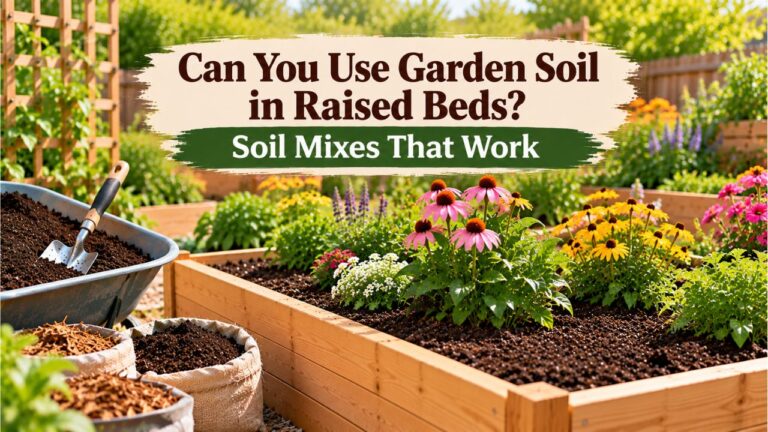
Use a Suitable Soil-Based Mix
For a permanent, open-bottom raised bed, a practical starting point is:
- Quality screened topsoil.
- Finished compost in a moderate amount.
- Additional amendments only when needed for drainage, structure, or soil chemistry.
Avoid filling a long-term perennial bed entirely with compost.
Compost decomposes and settles over time.
A stable mineral-soil component provides longer-term structure.
Should You Use Potting Soil?
A high-quality container growing medium is appropriate for elevated planters or raised containers with enclosed bottoms.
However, ordinary potting mixes may contain large amounts of organic materials that gradually break down.
Long-lived plants in contained planters may need occasional topdressing or repotting as the medium ages.
For a traditional raised bed connected to the ground, a suitable topsoil-based mixture is often more practical.
Test the Soil Before Planting
Perennials may remain in the same location for several years.
Correcting soil pH or nutrient problems becomes more difficult after their roots are established.
A soil test can help determine:
- Soil pH.
- Phosphorus availability.
- Potassium availability.
- Organic matter levels.
- Other nutrients measured by the laboratory.
Apply lime, sulfur, or fertilizer only when appropriate for the plant and test results.
Don’t Use Gravel as a Universal Drainage Fix
Placing gravel beneath soil in a solid-bottom planter doesn’t automatically improve drainage.
It can reduce the volume available for plant roots and create an unfavorable interface between materials.
Instead, provide suitable drainage outlets and an appropriate growing medium.
For bottomless raised beds, check whether the underlying soil allows water to move away.
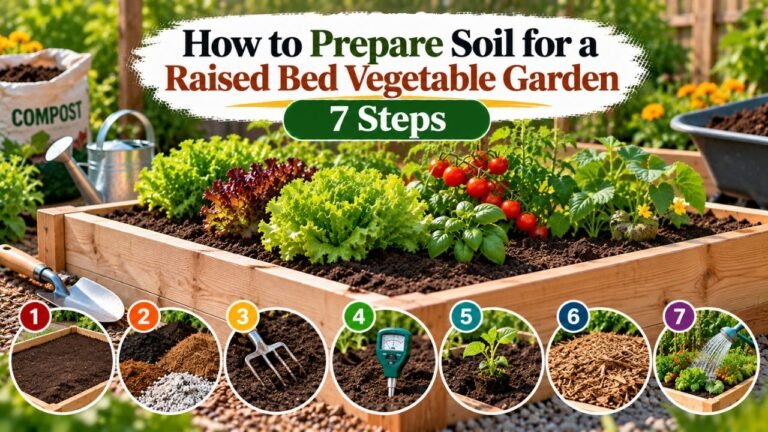
How to Plant Perennials in Raised Beds Step by Step
Once you’ve chosen suitable plants and prepared the bed, planting is straightforward.
However, perennial plants should be given enough space to grow for several seasons.
Step 1: Choose the Right Location
Check the plant’s sunlight requirements.
Many flowering perennials and culinary herbs need approximately six or more hours of direct sunlight each day.
Shade-loving plants such as hostas have different requirements.
Avoid locating a full-sun perennial bed in an area shaded by fences or buildings for most of the day.
Step 2: Select a Suitable Raised Bed
Choose a bed that provides:
- Sufficient rooting depth.
- Enough width for mature plants.
- Reliable drainage.
- Structural durability.
- Convenient watering access.
If the bed will hold large, long-lived plants, plan for future growth rather than the size of the nursery transplant.
Step 3: Prepare the Growing Medium
Remove weeds and debris.
Fill the bed with an appropriate soil mixture.
Check drainage before planting.
If necessary, incorporate finished compost or other amendments based on plant requirements.
Avoid working the soil when it is excessively wet.
Step 4: Plan the Spacing
Read each plant’s mature-size information.
A perennial that is only 6 inches wide in a nursery pot may become 2–3 feet wide after several growing seasons.
Leave enough space for foliage and roots.
For mixed flower beds, arrange taller varieties where they won’t shade smaller plants unnecessarily.
Step 5: Dig the Planting Holes
For container-grown perennials, dig a hole wide enough to accommodate the root ball.
A hole approximately twice the root ball’s width can help loosen the surrounding soil.
Plant most container-grown perennials at the same depth they were growing in their original containers.
However, some bare-root plants and crown-forming vegetables require specialized planting depths.
Follow species-specific instructions.
Step 6: Position the Plants
Carefully remove each plant from its container.
Inspect the roots.
If roots are tightly circling the container, loosen them gently as appropriate.
Position the plant so its crown is at the correct depth.
Avoid burying the crowns of plants that are sensitive to excess moisture.
Step 7: Backfill and Water
Return the growing medium around the roots.
Firm it gently to reduce large air pockets.
Water thoroughly after planting.
Allow excess water to drain.
Avoid compacting the soil heavily.
Step 8: Apply Mulch
Spread a suitable organic mulch over exposed soil.
For many perennial flower beds, a layer approximately 2–3 inches deep is a useful starting point.
However, keep mulch away from sensitive crowns and stems.
Moisture-loving plants and drought-tolerant Mediterranean herbs may require different mulching approaches.
Step 9: Monitor During Establishment
Newly planted perennials need more attention than established plants.
Check soil moisture regularly.
Water deeply enough to moisten the root zone, then allow the soil to dry to the degree appropriate for the plant.
The soil shouldn’t remain saturated.
Key Takeaway: Plant container-grown perennials at the appropriate crown depth, provide room for mature growth, and water consistently during establishment.
When Is the Best Time to Plant Perennials in Raised Beds?
Spring and early fall are often suitable planting periods.
However, the best timing depends on local temperatures, frost dates, and the species.
Planting Perennials in Spring
Spring is a convenient time because plants have the growing season to develop roots.
Wait until the soil is workable and conditions are appropriate for the selected plant.
Cold-hardy perennials may tolerate earlier planting than tender or frost-sensitive species.
In very cold climates, spring planting can provide more establishment time before winter.
Planting Perennials in Fall
Early fall can also be suitable.
Cooler temperatures may reduce heat stress, while the soil can remain warm enough for root development.
As a practical guideline, aim to plant roughly 4–6 weeks before the ground typically freezes, when the plant and local climate permit.
This is not a guarantee of winter survival.
Avoid late planting when roots won’t have enough time to establish.
Can You Plant Perennials in Summer?
Yes, but summer planting may require more careful watering.
Heat and dry conditions can stress newly transplanted plants.
If planting during hot weather, monitor moisture closely.
Avoid transplanting during extreme heat when possible.
Can Perennials Survive Winter in Raised Beds?
Yes, but winter survival is one of the biggest challenges of perennial gardening in raised beds.
Roots in exposed beds can become colder than roots protected by surrounding ground.
The risk increases when beds are elevated above the ground, narrow, shallow, or exposed to strong winter winds.
Why Raised Beds Can Be Colder in Winter
A traditional in-ground planting benefits from the insulating effect of the surrounding soil.
Raised beds have exposed sides.
These surfaces allow heat to move out of the growing medium more readily.
The University of Minnesota Extension’s guidance on perennials in raised beds specifically cautions that roots can freeze more quickly in raised beds, making perennial plants vulnerable in cold climates.
In regions with severe winters, in-ground planting may be preferable for perennials that are near the limit of their cold hardiness.
Choose Plants With Suitable Cold Hardiness
Use the USDA Plant Hardiness Zone Map as a starting point.
However, don’t assume that a perennial rated for your zone will automatically survive in an exposed raised planter.
The hardiness zone reflects average annual extreme minimum air temperatures, not the exact temperature experienced by roots inside a planter.
Soil volume, wind exposure, snow cover, and drainage also influence survival.
Choose more cold-tolerant varieties when winter conditions are severe.
Apply Winter Mulch
Organic mulch can help moderate soil temperature fluctuations.
Straw, shredded bark, and other suitable materials may protect root zones.
The appropriate depth and timing depend on the perennial.
Some plants benefit from mulch after entering dormancy.
Others, particularly species sensitive to crown rot, should not have thick, wet mulch piled directly against their crowns.
Give Strawberries Extra Protection
Strawberries in exposed raised beds may need substantial winter insulation.
Iowa State University Extension’s strawberry overwintering guide notes that raised strawberry plantings can experience colder root conditions than ground-level plantings.
For exposed strawberry pyramids and certain raised beds in cold climates, it recommends approximately 6–8 inches of suitable straw or chopped cornstalk mulch after plants have acclimated to cold weather.
This recommendation is specific to strawberry winter protection, not a universal mulch depth for all perennials.
Protect Elevated Planters
Elevated planters with solid bottoms expose more of their growing medium to cold air.
In severe winter climates, consider:
- Moving portable planters to a suitable sheltered location.
- Insulating exposed planter sides when appropriate.
- Choosing particularly cold-hardy plants.
- Keeping the growing medium from drying out completely.
- Maintaining drainage.
Even with protection, some perennials may not survive extreme winter exposure.
Key Takeaway: Perennials generally face greater winter risk in exposed raised beds than in ordinary ground-level soil. Winter hardiness and root insulation deserve special attention in cold regions.
How to Water Perennials in Raised Beds
Raised beds often dry faster than in-ground gardens.
Their exposed sides and well-draining growing medium can increase moisture loss.
However, watering requirements vary among plants and seasons.
Water Newly Planted Perennials More Frequently
New transplants need consistent moisture while their roots establish.
Check the growing medium regularly.
Water when the root zone begins drying to a level that requires irrigation for the particular plant.
Avoid shallow watering that wets only the surface.
Reduce Watering as Plants Establish
Established perennials may require less frequent irrigation.
However, large plants, shallow-rooted varieties, and those growing in small elevated planters can still need regular watering.
During hot, windy weather, check moisture more often.
Don’t Overwater Drought-Tolerant Herbs
Lavender, thyme, and some other Mediterranean herbs are sensitive to waterlogged conditions.
Allow the growing medium to drain and dry appropriately between watering sessions.
Hostas and other moisture-loving perennials may need a different schedule.
Use Drip Irrigation When Practical
Drip irrigation can deliver water near the root zone.
It can also reduce the amount of water landing on foliage.
Check that emitters are positioned correctly as perennial clumps expand.
Do not assume an automatic timer always provides the right amount of water.
Adjust irrigation according to rainfall, temperature, and soil moisture.
How to Maintain Perennials in Raised Beds Each Year
Perennials require ongoing care, but the work can be relatively manageable once the plants are established.
Add Compost When Needed
A modest layer of finished compost can replenish organic matter.
However, repeated heavy applications may increase phosphorus and soluble salts.
Avoid adding compost every year without considering existing soil fertility.
Fertilize According to Plant Needs
Some flowering perennials benefit from a light fertilizer application during active growth.
Others grow well without regular feeding.
The Mississippi State University Extension’s perennial maintenance guide recommends fertilizing sparingly and notes that additional feeding may not be needed when plants are growing well.
Too much nitrogen can produce excessive foliage and weaker growth in certain ornamental plants.
Divide Crowded Perennials
Some perennials gradually form large clumps.
When growth becomes crowded, division can restore space and vigor.
Suitable division timing depends on the species.
Spring and fall are common division periods for many herbaceous perennials, but some plants dislike frequent division.
Do not divide asparagus or other long-lived perennial vegetables routinely without a specific reason.
Prune and Deadhead When Appropriate
Deadheading removes spent flowers.
It can improve appearance and encourage additional flowering in some species.
Pruning needs vary.
Woody herbs such as lavender require different pruning methods from herbaceous plants that die back each winter.
Follow plant-specific recommendations.
Maintain the Raised-Bed Structure
Perennial plants may remain in place for years, so bed durability is important.
Inspect:
- Wooden boards for decay.
- Metal panels for corrosion or damage.
- Corner joints and fasteners.
- Drainage openings.
- Irrigation lines.
- Soil levels.
Repair structural problems before they become severe.
Replacing a raised-bed frame around mature perennial roots can be difficult.
Should You Mix Perennials and Annuals in the Same Raised Bed?
Yes, but the arrangement should account for the perennials’ permanent root systems and mature size.
Benefits of Mixing Plants
Annual flowers can provide seasonal color while perennial plants establish.
Certain annual vegetables may also fit between young perennial plants during their first growing season.
However, the available space decreases as perennials mature.
Keep Perennial Crowns Protected
Annual planting and removal can disturb perennial roots.
Avoid digging deeply near established crowns.
Leave adequate space around perennial plants.
Match Water and Fertilizer Requirements
A drought-tolerant perennial herb may not grow well beside a vegetable that requires consistently moist, nutrient-rich soil.
Group plants with similar needs when possible.
For example, thyme and lavender may be more compatible than lavender and a heavily irrigated leafy vegetable crop.
Avoid Aggressive Spreaders
Mint, horseradish, and some vigorous perennial ornamentals can spread beyond their original locations.
They may crowd out smaller annuals and perennials.
Use separate containers or dedicated planting areas where appropriate.
Common Mistakes When Growing Perennials in Raised Beds
Several planning mistakes can reduce the lifespan of perennial plantings.
Choosing Plants Without Checking Winter Hardiness
A perennial suitable for a warm climate may not survive an exposed raised bed in a cold region.
Check the plant’s hardiness and consider the additional winter exposure of the roots.
Using a Raised Bed That Is Too Shallow
A shallow, enclosed planter may restrict root development.
Choose enough soil depth and volume for the mature plant.
Planting Too Closely
Perennials expand over multiple growing seasons.
Crowded plants may compete for water, nutrients, and light.
Use mature spacing rather than the size of nursery transplants.
Filling the Bed Entirely With Compost
Compost decomposes and settles.
A growing medium containing suitable mineral soil or a well-formulated long-term container mix provides a more stable foundation.
Ignoring Drainage
Poor drainage can lead to root and crown problems.
This is particularly important for lavender, thyme, and other plants that dislike persistent wetness.
Overwatering Drought-Tolerant Plants
Not every perennial needs the same amount of water.
Adjust irrigation to the plant and growing conditions.
Forgetting Winter Protection
Exposed raised beds can cool rapidly during winter.
Choose suitable plants and protect vulnerable roots when needed.
Using Short-Lived Bed Materials for Permanent Plantings
A perennial bed should be built with long-term maintenance in mind.
A frame that deteriorates quickly may require reconstruction while mature roots are established.
Are Wooden or Metal Raised Beds Better for Perennials?
Both can work.
The best choice depends on durability, budget, climate, and garden design.
Wooden Raised Beds
Wooden beds are common because they are easy to build and customize.
Some naturally decay-resistant woods, such as cedar and certain redwood or locust products, may offer longer service life than less durable lumber.
However, all wood exposed to soil and moisture eventually requires maintenance or replacement.
Choose materials appropriate for the intended use.
Galvanized Metal Raised Beds
Galvanized metal beds are another option for perennial planting.
They can provide a durable structure when properly manufactured and installed.
However, exposed metal surfaces and shallow soil volumes can experience temperature changes.
For perennials, the more important factors are soil depth, drainage, plant hardiness, and root insulation.
Which Is Better for Long-Lived Perennials?
Choose a bed that can remain functional for the expected lifespan of the planting.
For large perennial vegetables or shrubs, a durable, bottomless bed may be particularly useful.
For small herbs and flowers, either material can work well when the growing conditions are appropriate.
Conclusion
So, can you plant perennials in raised beds? Yes. Many perennial flowers, herbs, vegetables, and fruiting plants can grow successfully in raised beds when their root space, soil conditions, and climate requirements are met.
Coneflowers, coreopsis, lavender, thyme, chives, and strawberries are practical options for many gardens. Larger plants such as asparagus and rhubarb can also grow in raised beds but need substantially more room.
A bottomless raised bed generally provides more flexibility for root growth than a shallow elevated planter. Soil drainage, mature plant spacing, and winter protection are equally important.
I recommend choosing perennials that match your local hardiness zone, preparing a well-drained soil mixture, and planning for mature growth before planting. In cold climates, pay particular attention to root insulation and the additional winter exposure created by raised beds.
The best perennial raised bed is one that provides enough long-term growing space and protects the roots through the changing seasons, allowing plants to return year after year.
FAQs About Can You Plant Perennials in Raised Beds?
Will Perennials Come Back Every Year in Raised Beds?
Many perennials can return each year when they receive suitable care and survive winter.
However, a plant’s ability to overwinter depends on its species, cultivar, hardiness, soil conditions, and the bed’s exposure.
Perennials in elevated or shallow beds may experience more root damage during freezing weather.
How Deep Should a Raised Bed Be for Perennials?
Many compact perennial flowers and herbs can grow in approximately 8–12 inches of suitable soil, especially when the bed is open to the ground.
Larger perennials may require 12–24 inches or more, particularly in enclosed planters.
Plants such as asparagus benefit from extensive, unrestricted rooting space.
What Perennials Grow Best in Raised Beds?
Good candidates include coneflowers, coreopsis, black-eyed Susans, thyme, chives, oregano, lavender, and certain sedums.
Strawberries and perennial vegetables can also grow well in suitable raised beds.
Choose plants according to your local climate, sunlight, drainage, and available space.
Can Perennials Survive Winter in Metal Raised Beds?
Yes, but winter survival depends on the plant and growing conditions.
Soil in an exposed metal raised bed may experience significant freezing and thawing.
Choose sufficiently hardy plants, provide adequate soil volume, and apply appropriate winter protection when needed.
Can You Plant Perennials in a Raised Bed With a Bottom?
Yes.
However, an enclosed raised planter must provide enough soil volume and drainage for the perennial’s entire root system.
Small herbs and compact flowers are often more suitable than large, deep-rooted perennial vegetables or shrubs.
Can You Plant Perennial Herbs Together in a Raised Bed?
Yes, provided they have compatible growing requirements.
For example, thyme, oregano, and sage often prefer sunny, well-drained conditions.
However, mint spreads aggressively and is generally better grown in a separate container.
Avoid grouping moisture-loving herbs with plants that prefer relatively dry soil.
Should You Cut Back Perennials in Raised Beds for Winter?
It depends on the species.
Some herbaceous perennials can be cut back after dormancy, while others benefit from retaining stems or foliage through winter.
Woody herbs require different pruning methods.
Follow plant-specific recommendations rather than cutting every perennial to ground level in fall.
Can You Grow Strawberries as Perennials in Raised Beds?
Yes.
Strawberries are perennial plants and can remain productive for multiple growing seasons.
However, raised strawberry beds may need additional winter protection in cold climates.
Use suitable mulch after plants have acclimated to cold weather, and uncover the crowns appropriately in spring.

I’m Maya L. Greenwood, a lifelong plant lover who believes anyone can grow something beautiful with the right guidance. After years of testing soil mixes, pruning methods, irrigation tricks, and pest-safe solutions, I started EasyGardenTips.com to turn hard-won lessons into step-by-step advice. From seed starting and container gardens to composting and seasonal checklists, my goal is to make gardening simple, sustainable, and fun.