Should I Put Straw in My Raised Garden Bed? Benefits and Risks
Yes, you can put straw in a raised garden bed, and it is often an excellent mulch for vegetables. A loose layer of clean, seed-free straw on top of the soil can conserve moisture, suppress weeds, reduce soil splashing, and protect the surface during hot or cold weather. For established plants, about 2–3 inches is a useful starting depth.
Where you place straw matters. It works best as a surface covering, not as a replacement for the fertile soil your crops need. Mixing large amounts of fresh straw into the root zone can temporarily reduce plant-available nitrogen as microbes break it down. Straw can also introduce weed or grain seeds, and material from certain treated fields may contain persistent herbicide residues.
Don’t rush to mulch very young seedlings or cold spring soil. A thick covering can delay warming or interfere with emerging plants, and damp straw may shelter slugs.
In this article, I explain when straw mulch makes sense, how to choose safe straw and spread it correctly, and whether to put it at the bottom of a raised bed. You’ll also learn the difference between straw and hay, what to do in winter, and how to avoid common problems.
Should I Put Straw in My Raised Garden Bed as Mulch?
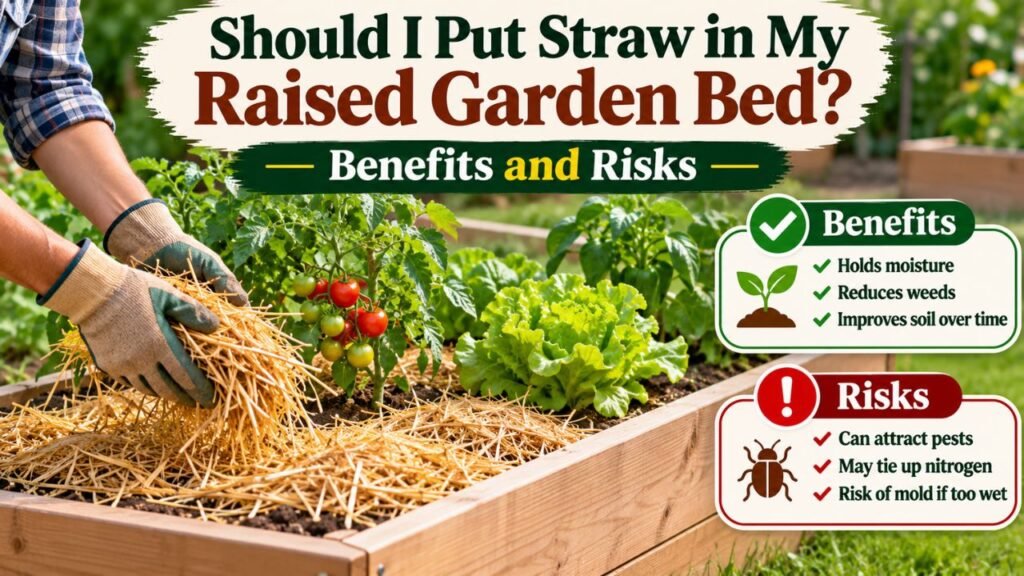
Yes. Straw is generally a good mulch for raised vegetable beds when it is clean, weed-free, and applied at an appropriate depth.
It is particularly useful in raised beds because their exposed soil surfaces can lose moisture through evaporation.
Straw creates a protective covering that reduces direct sunlight exposure, slows soil moisture loss, and helps prevent weed seeds from germinating.
As it gradually decomposes, it also contributes organic matter to the soil.
When Straw Is a Good Choice
Consider using straw mulch when:
- Your raised bed dries out quickly during summer.
- Weeds frequently grow between vegetable plants.
- Soil splashes onto leaves or fruit during watering.
- You want an inexpensive organic mulch.
- You grow tomatoes, peppers, strawberries, potatoes, or similar crops.
- You want to protect bare soil during winter.
- Your garden needs protection from surface erosion.
Straw is especially practical for raised beds containing established vegetable plants.
When You Should Avoid Using Straw
Straw may not be appropriate when:
- You cannot verify its source or herbicide history.
- The material contains numerous weed or grain seeds.
- Your plants have just been seeded and need to emerge.
- The soil is still cold and needs to warm up.
- Slugs or other pests are already causing significant problems.
- The bed is excessively wet or poorly drained.
- You intend to replace most of the planting soil with straw.
The goal is to protect the soil without creating additional problems.
Straw Mulch: Quick Benefits and Risks
| Factor | Potential Benefit | Possible Concern |
| Soil moisture | Reduces evaporation | Excess moisture in poorly drained beds |
| Weed control | Blocks sunlight from weed seeds | Contaminated straw may introduce seeds |
| Soil temperature | Moderates temperature changes | Can delay spring warming |
| Soil health | Adds organic matter as it decomposes | Fresh straw mixed into soil may tie up nitrogen |
| Plant cleanliness | Reduces soil splashing | Damp mulch can harbor pests |
| Cost | Often affordable and widely available | Quality and availability vary |
| Winter protection | Protects exposed soil | May shelter rodents or slugs |
Key Takeaway: Straw is a useful surface mulch for many raised beds, but choosing clean material and applying it at the right time are essential.
What Are the Benefits of Putting Straw in Raised Garden Beds?
Straw provides several advantages when used correctly.
Its main value is protecting the soil surface rather than directly fertilizing vegetables.
1. Straw Helps Retain Soil Moisture
Raised garden beds often dry out faster than surrounding ground-level soil.
Their elevated surfaces and well-draining soil mixtures can increase moisture loss during warm weather.
Straw helps reduce evaporation by shading the soil.
This may allow the soil to remain moist longer between watering sessions.
However, straw doesn’t eliminate the need for irrigation.
Check moisture beneath the mulch before deciding whether to water.
2. Straw Suppresses Weed Growth
Weed seeds often require favorable light and moisture conditions to germinate.
A sufficient layer of straw reduces the sunlight reaching the soil surface.
This can limit the growth of many annual weeds.
According to the University of Florida IFAS Extension’s guidance on mulching edible landscapes, vegetable gardens can be mulched with approximately 2–3 inches of straw.
However, mulch works best when existing weeds have already been removed.
It is less effective against established perennial weeds with extensive underground root systems.
3. Straw Helps Regulate Soil Temperature
A straw covering reduces direct sunlight exposure and moderates temperature changes near the soil surface.
During summer, it can help keep the upper soil layers cooler.
This may benefit vegetables growing during hot, dry weather.
In colder periods, straw can reduce abrupt temperature fluctuations.
However, it also slows soil warming in early spring.
For heat-loving vegetables, wait until the soil is adequately warm before applying a substantial layer.
4. Straw Protects Soil From Heavy Rain
Heavy rainfall and overhead watering can cause bare soil to splash onto vegetable leaves.
This can move soil particles and certain soilborne pathogens onto plant surfaces.
Straw forms a barrier between falling water and the soil.
It can reduce splashing and help protect the soil structure from surface crusting or erosion.
However, straw does not prevent every plant disease.
Proper spacing, airflow, and appropriate watering practices remain important.
5. Straw Keeps Some Fruits Off the Soil
Straw can help keep developing fruits from resting directly on damp soil.
This is particularly useful for:
- Strawberries
- Melons
- Certain squash varieties
- Low-growing vegetables
Keeping fruit separated from bare soil may reduce dirt accumulation and some moisture-related problems.
Inspect the fruit regularly because dense mulch can also remain damp.
6. Straw Gradually Adds Organic Matter
Straw is an organic plant material.
Over time, soil organisms break it down.
The decomposed material contributes organic matter that can support soil structure.
However, straw is not a complete fertilizer.
Its nutrient contribution is relatively slow, and it should not replace balanced soil fertility management.
Key Takeaway: The main benefits of straw mulch are moisture conservation, weed suppression, temperature moderation, reduced soil splashing, and gradual organic matter addition.
How Much Straw Should I Put in My Raised Garden Bed?
For established vegetable plants, a loose straw layer approximately 2–3 inches deep is a practical starting point.
The ideal depth depends on plant size, weather conditions, and the type of mulch.
Recommended Straw Mulch Depth
| Raised Bed Condition | Suggested Straw Depth |
| Newly emerging seedlings | Leave seed rows exposed |
| Small established seedlings | Up to about 1 inch initially |
| Established vegetable plants | Approximately 2–3 inches |
| Very hot, dry conditions | Around 2–3 inches, adjusted to soil moisture |
| Winter soil protection | Approximately 2–3 inches or as locally appropriate |
| Areas with frequent slug problems | Use less mulch or another suitable material |
These depths are guidelines rather than universal rules.
Straw settles over time, so a freshly applied layer may become thinner after rain and decomposition.
Why You Shouldn’t Apply Too Much Straw
A very thick, tightly packed layer can interfere with young plants.
It may:
- Block sunlight from emerging seedlings
- Delay soil warming
- Hold excess moisture near stems
- Make direct seeding difficult
- Create sheltered areas for slugs
- Interfere with monitoring soil conditions
Adding more straw isn’t automatically better.
Use enough to cover the exposed soil while keeping seedlings, stems, and planting rows accessible.
How Much Straw for a 4×8 Raised Garden Bed?
A raised bed measuring 4 feet wide and 8 feet long has 32 square feet of surface area.
For an evenly distributed layer:
- At 2 inches deep, you need approximately 5.3 cubic feet of loose straw.
- At 3 inches deep, you need approximately 8 cubic feet of loose straw.
This is the volume of the finished loose mulch layer, not the amount of compressed straw in a bale.
Actual bale coverage varies depending on how tightly the straw is packed and how much it expands after opening.
Subtract some volume if large plants occupy substantial portions of the bed.
How to Put Straw in a Raised Garden Bed Step by Step
Applying straw mulch is straightforward.
The most important steps are preparing the soil, choosing suitable material, and spreading it without burying your plants.
Step 1: Choose Clean, Seed-Free Straw
Select straw intended for garden mulching.
Look for products labeled:
- Weed-free straw
- Certified weed-free straw
- Seed-free straw
- Garden straw mulch
Whenever possible, verify that the straw is suitable for vegetable gardens.
Avoid bales that contain obvious weed seeds, excessive grain heads, or signs of contamination.
Also ask about herbicide use on the source field.
Step 2: Remove Existing Weeds
Before applying mulch, pull weeds from the raised bed.
Remove their roots when practical.
If you cover large established weeds with straw, some may continue growing through the mulch.
Removing them first improves weed suppression.
Step 3: Check Soil Moisture
Water the raised bed if the soil is dry and the plants need moisture.
Straw reduces evaporation, but it cannot restore water that is missing from the root zone.
Apply mulch over soil with suitable moisture conditions.
Avoid creating a saturated, poorly aerated bed.
Step 4: Spread the Straw Loosely
Separate the straw into loose handfuls.
Spread it evenly over the soil surface between plants.
For established vegetables, aim for approximately 2–3 inches.
Avoid pressing it into a tightly packed mat.
A loose covering allows water to move through while protecting the soil.
Step 5: Leave Space Around Plant Stems
Pull straw back slightly from the base of each plant.
For small vegetable plants, leaving approximately 1–2 inches of clear space around the stem is a useful starting point.
This can reduce constant moisture contact against sensitive stems.
Larger plants may require additional clearance.
Avoid burying leaves or covering the plant crown.
Step 6: Water and Check the Bed
After applying straw, water as needed.
Check that water reaches the soil underneath.
Some freshly applied straw may initially shed or slow water movement.
Inspect soil moisture below the mulch rather than judging by how dry the straw looks.
Step 7: Maintain the Mulch Layer
Straw gradually decomposes and compresses.
Inspect it periodically.
Add more clean straw when the layer becomes too thin to provide the desired coverage.
Remove any contaminated, excessively moldy, or heavily pest-infested material.
Key Takeaway: Remove weeds, apply 2–3 inches of loose straw around established plants, leave stems clear, and monitor soil moisture beneath the mulch.
Should You Put Straw at the Bottom of a Raised Garden Bed?
You can use straw as part of the lower filler material in some deep raised beds, but it shouldn’t replace the main planting soil.
This is different from using straw as surface mulch.
A raised bed must provide sufficient soil depth for healthy roots, moisture retention, drainage, and nutrients.
When Bottom Straw Filling May Make Sense
A tall raised bed may contain more total depth than the vegetables need for their main root zone.
In such cases, gardeners sometimes place biodegradable material in the lower section to reduce the amount of purchased soil required.
Possible materials include:
- Small untreated branches
- Wood chips
- Leaves
- Straw
- Other appropriate biodegradable plant material
An Oregon State University Extension article on garden soil and raised beds discusses using carbon-based materials, including straw, beneath a suitable loamy soil-and-compost mixture in deeper beds.
However, these materials decompose and settle over time.
They are not equivalent to permanent, stable growing soil.
Why You Shouldn’t Fill an Entire Raised Bed With Straw
Straw alone cannot provide the same growing conditions as a suitable raised-bed soil mixture.
It has a high carbon-to-nitrogen ratio, decomposes over time, and lacks the mineral structure and balanced nutrients of garden soil.
Using too much straw can create:
- Significant settling
- Uneven growing depth
- Temporary nitrogen competition during decomposition
- Inadequate root support
- Unpredictable moisture distribution
How Much Soil Should Be Above the Straw?
The answer depends on the crops and the type of raised bed.
For many common vegetables, aim to preserve at least approximately 12 inches of suitable growing medium above any bulky filler, with more depth for crops with extensive root systems.
This is a practical planning guideline rather than a universal requirement.
Deep-rooted crops, raised beds on concrete, and container-style elevated planters may need different soil depths.
For a shallow raised bed, filling the entire structure with suitable soil is usually preferable to adding a bulky straw layer at the bottom.
Does Straw at the Bottom Improve Drainage?
Not automatically.
Adding a separate straw layer doesn’t reliably solve drainage problems.
Good drainage depends on the entire soil profile, the bed’s outlet for excess water, and the surrounding conditions.
If a raised bed has poor drainage, investigate compacted soil, blocked drainage holes, or unsuitable soil mixtures rather than relying on straw as a drainage layer.
Key Takeaway: Straw may be used as a biodegradable filler in a sufficiently deep bed, but surface mulching is generally its more useful and predictable role.
Should You Mix Straw Into Raised Bed Soil?
Usually, leave fresh straw on the soil surface rather than mixing large amounts directly into the root zone.
Fresh straw contains substantial carbon relative to nitrogen.
As microorganisms break it down, they require nitrogen for growth.
When straw is incorporated into the soil, this process can temporarily reduce nitrogen availability to nearby plants.
Can Straw Cause Nitrogen Deficiency?
Yes, particularly when large amounts of fresh straw are mixed into the soil.
According to Washington State University Extension’s soil science guidance, high-carbon materials such as straw can temporarily immobilize nitrogen when incorporated into soil.
When these materials remain on the surface as mulch, nitrogen immobilization is generally much less significant.
This is an important distinction.
A straw mulch layer does not automatically rob the entire raised bed of nitrogen.
Can You Compost Straw First?
Yes.
Straw can be combined with nitrogen-rich materials in a compost pile.
After decomposition, finished compost can be used to improve raised-bed soil.
Proper composting helps produce a more uniform amendment.
However, composting isn’t a reliable way to guarantee that persistent herbicide contamination has been eliminated.
Know the source of your ingredients.
Should You Dig Old Straw Into the Bed?
It depends on how decomposed it is.
Partly decomposed straw can eventually contribute organic matter.
However, incorporating large amounts of recognizable fresh straw shortly before planting may temporarily affect nitrogen availability.
If you plan to incorporate straw, allow sufficient decomposition time and manage soil fertility appropriately.
In many raised beds, simply leaving straw on the surface to decompose gradually is easier.
Straw vs. Hay: Which Is Better for Raised Garden Beds?
Straw and hay look similar, but they come from different agricultural products.
They can also behave differently when used as mulch.
Straw vs. Hay Comparison
| Feature | Straw | Hay |
| Main source | Stalks remaining after grain harvest | Cut grasses or legumes used as animal feed |
| Typical seed content | Usually lower | Often higher |
| Weed introduction risk | Lower when certified weed-free | Often greater |
| Primary garden use | Mulch and soil protection | Mulch or compost when suitable |
| Decomposition | Generally slower than leafy hay | Often faster, depending on material |
| Nutrient contribution | Relatively low initially | May contain more nutrients |
| Best choice for raised beds | Usually preferred | Use cautiously |
Why Straw Is Usually Better
Straw is generally preferred because it contains fewer seeds than hay.
However, ordinary straw may still contain grain seeds or weeds.
Certified weed-free straw reduces the risk of introducing unwanted plants.
Can You Use Hay Instead?
Yes, but with caution.
Hay often contains viable seeds.
These can germinate in the raised bed and create additional weeding work.
Some hay materials can decompose relatively quickly and contribute nutrients.
However, the potential for seed contamination makes straw the simpler choice for many vegetable gardens.
What About Pine Straw?
Pine straw refers to fallen pine needles.
It is different from cereal straw.
Pine straw is widely used in ornamental landscapes and can work as mulch in certain garden settings.
However, its texture, breakdown rate, and ease of handling differ from wheat or oat straw.
For an annual vegetable bed, clean cereal straw is often easier to spread and manage.
Key Takeaway: Choose weed-free straw rather than ordinary hay when your priority is suppressing weeds without introducing additional seeds.
Is Straw Safe for Growing Vegetables?
Straw can be safe and useful for vegetable beds, but its source matters.
The biggest concern isn’t the straw itself.
It’s possible contamination from seeds, agricultural chemicals, or unsuitable handling.
Check for Herbicide Residues
Some agricultural fields receive herbicide treatments.
Certain herbicides can persist in crop residues and may damage sensitive garden plants.
The Colorado State University Extension guide to vegetable garden mulches specifically warns that herbicide residues may carry over into straw and affect vegetables.
Before purchasing straw, ask:
- What crop produced the straw?
- Was the source field treated with herbicides?
- Which products were applied?
- Is the straw suitable for vegetable gardening?
- Is it certified weed-free?
Certified weed-free does not necessarily mean herbicide-free.
These are separate concerns.
If the seller cannot provide useful information about treatment history, consider another source.
Avoid Straw With Many Seeds
Inspect the material before spreading it.
A few grain stalks aren’t necessarily a major problem, but heavily seeded straw may create unwanted growth.
If volunteer wheat, barley, or other grain plants begin growing, pull them while young.
Avoid Contaminated or Badly Stored Straw
Do not use straw that is contaminated with unknown chemicals, garbage, or other unsuitable materials.
Avoid bales with heavy mold growth, especially when handling them could expose you to airborne spores.
Store unused straw in a dry, protected location.
Is Organic Straw Better?
Straw from a verified organic source may reduce certain concerns about synthetic agricultural chemical use.
However, an organic label doesn’t guarantee that the material is free of seeds, pests, or every possible contaminant.
Choose a reputable supplier and inspect the straw regardless of its marketing description.
Which Vegetables Benefit Most From Straw Mulch?
Straw mulch works well around many established vegetable crops.
However, the timing and depth should match the crop’s growth stage.
Straw Mulch by Crop Type
| Crop | Is Straw Mulch Useful? | Main Consideration |
| Tomatoes | Yes | Keep mulch away from stems |
| Peppers | Yes | Apply after the soil warms |
| Cucumbers | Yes | Maintain airflow and soil moisture |
| Squash | Yes | Monitor moisture and pests |
| Strawberries | Yes | Helps separate fruit from soil |
| Potatoes | Yes | Can help cover developing tubers |
| Lettuce | Yes, carefully | Avoid covering small crowns |
| Carrots | Yes, after establishment | Keep seed rows clear during germination |
| Radishes | Sometimes | Thin mulch after seedlings emerge |
| Beans | Yes, after establishment | Avoid covering germinating seeds |
Is Straw Good for Tomatoes?
Yes.
Straw helps reduce soil splashing onto lower tomato leaves.
It also conserves moisture and suppresses weeds.
Apply the mulch after the soil is warm and the plants are established.
Keep the material away from the stems.
Is Straw Good for Strawberries?
Yes.
Straw is commonly used around strawberry plants.
It helps keep developing fruit off bare soil.
However, avoid burying the crowns.
Wet or excessively thick mulch can also create pest and moisture problems.
Can You Use Straw Around Potatoes?
Yes.
Straw can help shield developing potato tubers from light.
Exposure to sunlight can cause tubers to become green and increase the risk of elevated glycoalkaloids.
Keep tubers adequately covered.
However, straw doesn’t automatically replace all potato hilling or soil management requirements.
Should You Put Straw Around Newly Planted Seeds?
Avoid covering seed rows with thick straw before germination.
Small seedlings need light and space to emerge.
Wait until the plants are established, then carefully mulch between rows.
For small seedlings, use a light layer rather than immediately applying several inches.
When Is the Best Time to Put Straw in Raised Garden Beds?
The best timing depends on the season, soil temperature, and plant growth stage.
Spring: Wait for Soil to Warm
In early spring, exposed soil warms more quickly than heavily mulched soil.
For warm-season vegetables such as tomatoes and peppers, wait until the soil reaches a suitable planting temperature.
After the plants are established, apply straw.
For direct-seeded crops, keep the seed rows clear until seedlings emerge.
Summer: Use Straw to Conserve Moisture
Summer is often an excellent time for straw mulch.
A properly applied layer can reduce evaporation and moderate soil temperature.
This may be especially helpful during hot, dry weather.
However, continue checking moisture beneath the mulch.
Straw doesn’t eliminate the need for watering.
Fall: Protect Exposed Soil
After harvesting vegetables, you can leave clean straw over the soil surface.
This helps reduce exposure to rain and wind.
It may also limit some weed germination.
If the mulch contains substantial weeds or crop debris associated with disease problems, remove affected material before winter.
Winter: Cover Bare Raised Beds
Straw can protect bare soil during winter.
A loose covering may reduce erosion and moderate temperature changes.
However, straw can also provide shelter for slugs and rodents.
Monitor the bed and adjust the covering as needed.
When spring arrives, temporarily pull back thick straw if the soil needs to warm before planting.
Key Takeaway: Late spring and summer are practical times to mulch established vegetables. Winter straw can also protect bare soil, but thick spring mulch may delay warming.
Can Straw Mulch Attract Slugs, Mice, or Other Pests?
Straw mulch can provide shelter for certain organisms.
This doesn’t mean straw automatically causes pest infestations.
The risk depends on local conditions, mulch depth, moisture, and the existing pest population.
Slugs and Snails
Slugs prefer moist, sheltered conditions.
A thick layer of damp straw can create suitable hiding places.
If slugs are common in your garden:
- Avoid excessive mulch depth.
- Keep mulch away from tender stems.
- Water carefully to avoid prolonged surface wetness.
- Inspect plants in the evening.
- Remove hiding places where practical.
Consider alternative mulches if slug damage remains severe.
Rodents
Loose straw can provide shelter for small rodents, particularly in cool weather.
Avoid leaving large piles of straw around the bed.
Inspect for nesting activity.
Keep the surrounding garden area tidy.
If rodents are already a significant problem, straw may not be the most suitable mulch.
Fungal Growth
Straw is organic material, so fungi naturally participate in its decomposition.
Some fungal growth is part of normal breakdown.
However, persistently wet conditions and poor airflow can create plant health concerns.
Avoid placing dense, wet straw directly against plant stems.
Remove visibly contaminated material when necessary.
Key Takeaway: Straw can shelter pests in certain conditions. Monitor damp beds and avoid applying unnecessarily thick layers.
Common Mistakes When Using Straw in Raised Garden Beds
Several mistakes can reduce the benefits of straw mulch.
Using Straw Without Checking Its Source
Straw from an unknown field may contain unwanted seeds or herbicide residues.
Choose a reputable supplier whenever possible.
Applying Straw Too Thickly
Excess mulch can interfere with seedlings, soil warming, and moisture management.
Start with approximately 2–3 inches around established plants.
Mulching Before Seeds Germinate
A thick straw covering may prevent small seedlings from emerging successfully.
Keep seed rows uncovered until the plants are established.
Mixing Fresh Straw Deep Into the Soil
Large amounts of fresh straw can temporarily immobilize nitrogen during decomposition.
Use it as surface mulch instead.
Piling Straw Against Plant Stems
Constant moisture near a plant’s base can create unfavorable conditions.
Leave a small clear area around the stem or crown.
Assuming Straw Replaces Fertilizer
Straw is primarily a protective mulch.
It isn’t a complete plant nutrient source.
Maintain balanced soil fertility through appropriate soil testing, compost, and fertilization.
Ignoring Soil Moisture
The straw surface may look dry even when the soil underneath remains moist.
Check below the mulch before watering.
Using Straw to Fix Poor Drainage
Straw mulch does not correct compacted soil, blocked outlets, or standing water.
Address drainage problems directly.
Key Takeaway: Most straw-mulching problems result from poor sourcing, excessive depth, incorrect timing, or using straw as a substitute for proper soil management.
Best Alternatives to Straw Mulch for Raised Garden Beds
Straw isn’t the only material that can protect raised-bed soil.
Other organic mulches may be more suitable depending on your crops, climate, and available materials.
Straw Alternatives Compared
| Mulch Material | Main Benefit | Important Limitation |
| Shredded leaves | Adds organic matter and conserves moisture | Thick layers can mat |
| Finished compost | Supports soil improvement and moisture retention | Usually less effective at blocking weeds than a thick coarse mulch |
| Untreated dry grass clippings | Inexpensive and readily available | Thick or wet layers can mat |
| Pine straw | Loose, long-lasting covering | Handling and availability vary |
| Fine bark mulch | Slower decomposition | Can interfere with annual bed preparation |
| Wood chips | Long-lasting mulch, especially on paths | Less convenient for regularly replanted vegetable rows |
| Straw | Light, effective vegetable mulch | Seed, herbicide, and pest concerns |
When Shredded Leaves Are Better
Shredded autumn leaves can provide a convenient mulch when you have them available.
They gradually decompose and contribute organic matter.
However, thick layers of unshredded leaves may form a mat that restricts water movement.
When Compost Is Better
Finished compost is useful when the goal is improving the soil rather than creating a thick protective covering.
A light topdressing can add organic matter and contribute nutrients.
However, compost alone may not suppress weeds as effectively as a sufficient straw layer.
When Wood Chips Are Better
Wood chips are useful for paths between raised beds.
They help reduce mud and weeds in areas that receive foot traffic.
However, coarse wood chips are less convenient in beds that are frequently seeded and replanted.
They also decompose more slowly than straw.
When Grass Clippings Are Better
Clean, dried grass clippings can be an inexpensive mulch.
Apply them in thin layers to prevent matting.
Avoid clippings from lawns recently treated with herbicides that could harm vegetables.
Do not use unknown lawn clippings simply because they are free.
How to Maintain Straw Mulch Throughout the Growing Season
After applying straw, occasional inspection helps keep it effective.
Check the Mulch Thickness
Straw settles and decomposes.
If bare soil becomes exposed, add a little more clean straw.
Maintain enough coverage to protect the soil without burying the plants.
Watch for Weeds
Even weed-free straw doesn’t prevent every weed.
Remove emerging weeds before they flower or produce seeds.
If grain seedlings appear from the mulch, pull them while young.
Monitor Moisture Under the Straw
Move a small amount of mulch aside and check the soil.
If the root zone is still moist, additional watering may not be necessary.
If it is dry, water appropriately.
Replace the mulch after checking.
Inspect for Slugs and Other Pests
Look under damp straw where pests may shelter.
If pest problems increase, reduce the mulch depth or remove it temporarily from affected areas.
Replenish Straw When Needed
Organic mulch breaks down over time.
Add fresh, clean straw when the layer becomes too thin.
Avoid repeatedly adding new material without checking how much mulch is already present.
Manage Straw at the End of the Season
After harvest, you can leave clean straw on the soil surface for protection.
Alternatively, remove it for composting if the material is suitable.
If you plan to incorporate partly decomposed straw into the soil, consider its possible effect on nitrogen availability and allow adequate time before planting.
Conclusion
So, should I put straw in my raised garden bed? Yes, straw is a useful organic mulch for many raised vegetable beds when applied correctly.
A loose layer approximately 2–3 inches deep can conserve soil moisture, suppress weeds, moderate temperature changes, and keep soil from splashing onto vegetables.
However, choose clean, preferably certified weed-free straw and verify that it hasn’t been treated with herbicides that could harm garden crops.
Use straw mainly on the soil surface rather than mixing large amounts of fresh material into the planting zone.
For newly planted seeds, wait until seedlings have emerged and become established before applying substantial mulch.
Straw can also be used as a biodegradable filler in some deep raised beds, but it should not replace the suitable soil mixture needed for healthy root growth.
Pay attention to soil moisture, mulch depth, and pest activity throughout the season.
When used thoughtfully, straw provides an affordable way to protect your raised garden bed and support healthier growing conditions.
FAQs About Should I Put Straw in My Raised Garden Bed
Is Straw Good for Raised Garden Beds?
Yes. Clean, weed-free straw is a useful mulch for raised vegetable beds. It helps conserve moisture, suppress weeds, moderate soil temperature, and reduce soil splashing. Apply it mainly on the surface around established plants.
How Thick Should Straw Be in a Raised Garden Bed?
Approximately 2–3 inches of loose straw is a practical starting depth around established vegetables. Use less around small seedlings and avoid covering plant crowns or stems. Adjust the layer based on weather, soil moisture, and pest activity.
Should I Put Straw Under the Soil in My Raised Garden Bed?
Straw can be used as part of the biodegradable lower filler in some deep raised beds. However, preserve enough suitable growing soil above it for plant roots. In shallow beds, using a good soil mixture throughout is generally more practical.
Will Straw Take Nitrogen Away From My Raised Bed Soil?
Straw left on the soil surface generally causes little nitrogen immobilization in the underlying root zone. However, mixing substantial amounts of fresh straw into the soil can temporarily reduce available nitrogen as microorganisms decompose it.
Is Straw Better Than Hay for Raised Beds?
Straw is generally preferred because it usually contains fewer seeds. Hay is harvested for animal feed and may contain more viable weed or grass seeds. For vegetable beds, choose clean, certified weed-free straw when available.
Can I Put Straw Around Tomato and Pepper Plants?
Yes. Straw can help retain moisture, suppress weeds, and reduce soil splashing around tomatoes and peppers. Wait until the plants are established and the soil has warmed sufficiently. Keep mulch slightly away from the stems.
Should I Leave Straw in My Raised Garden Bed Over Winter?
Yes, clean straw can remain on the surface to help protect the soil from erosion and temperature fluctuations. Monitor for slugs and rodents. In spring, pull back thick mulch if needed to allow the soil to warm before planting.

I’m Maya L. Greenwood, a lifelong plant lover who believes anyone can grow something beautiful with the right guidance. After years of testing soil mixes, pruning methods, irrigation tricks, and pest-safe solutions, I started EasyGardenTips.com to turn hard-won lessons into step-by-step advice. From seed starting and container gardens to composting and seasonal checklists, my goal is to make gardening simple, sustainable, and fun.