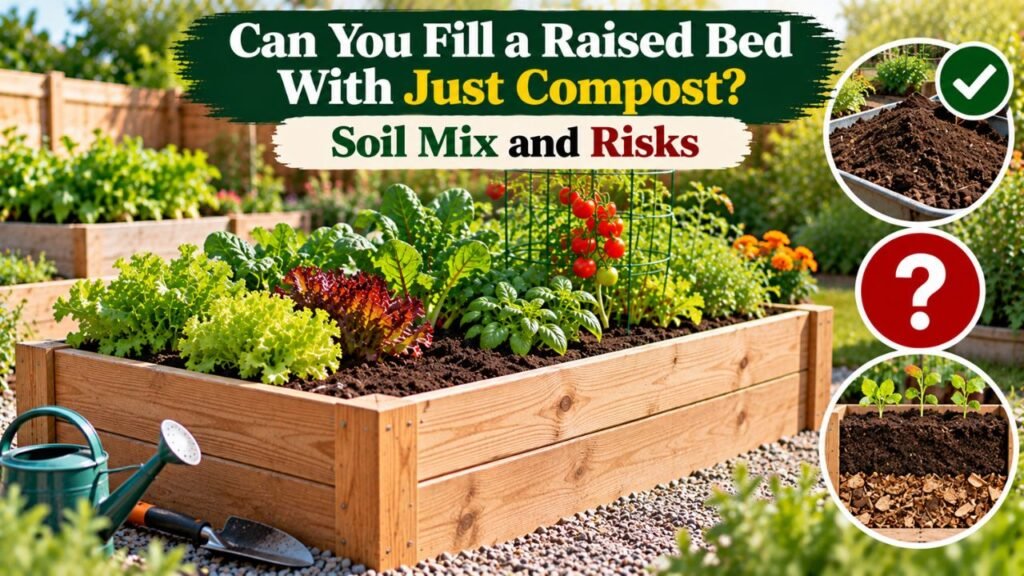
Can You Fill a Raised Bed With Just Compost? Soil Mix and Risks
Yes, you can fill a raised bed with just compost, but using 100% compost is generally not recommended for growing vegetables, herbs, or flowers. Although plants may grow in mature compost, a compost-only bed can develop problems with moisture retention, excessive nutrients, soluble salts, and soil settling.
Compost is an excellent soil amendment because it adds organic matter, supports soil organisms, and contributes plant nutrients. However, it does not provide the same stable mineral structure as a balanced mixture of topsoil and compost. Its properties also vary considerably depending on the materials used to produce it.
The biggest problem is assuming that more compost automatically means healthier plants. A bed filled entirely with compost may initially look rich and loose but become difficult to water or manage as the material dries and continues decomposing.
In this article, I explain what happens when you fill a raised bed with pure compost, the problems it can cause, and the soil-to-compost ratios that work better. I also cover suitable compost types, how to fill a new raised bed, and practical ways to correct an existing compost-only bed.
Can You Fill a Raised Bed With Just Compost and Grow Plants?
Plants can grow in properly finished compost because it contains organic matter, nutrients, and spaces that hold air and water.
However, successful plant growth in pure compost depends on the compost’s composition, maturity, salt concentration, moisture conditions, and the crops being grown.
A compost-only bed is not automatically incapable of supporting plants. The concern is that its growing conditions can be less predictable than those of a balanced soil mixture.
What Happens When You Plant Directly in Compost?
Freshly filled compost may initially feel soft, loose, and easy to work with.
Seeds may germinate, and transplants may establish roots if the material is mature, appropriately moist, and low in soluble salts.
However, several changes can occur as the growing season progresses.
The compost may:
- Dry unevenly and become difficult to rewet.
- Settle as organic materials continue decomposing.
- Supply excessive amounts of certain nutrients.
- Develop soluble salt concentrations that stress roots.
- Lose volume and require additional filling.
- Provide inconsistent nutrient availability.
These problems do not occur equally in every compost product.
A well-finished, low-salt plant-based compost can behave differently from manure-based compost or partially decomposed woody material.
Why Compost Is Better Used as a Soil Amendment
Compost is primarily a soil amendment, not a complete replacement for garden soil.
Its main purpose is to improve existing growing conditions by contributing organic matter and supporting soil structure.
When combined with suitable mineral soil, compost can help create a balanced growing medium.
Mineral soil contains sand, silt, and clay particles that contribute to water movement, nutrient retention, and physical stability.
Compost contributes organic matter that can improve aggregation and moisture management.
The combination is usually easier to maintain than either dense mineral soil or excessive compost used alone.
The Oregon State University Extension’s compost guidance specifically recommends filling framed raised beds with a soil mixture rather than compost alone.
Why Filling Raised Beds With 100% Compost Can Cause Problems
Although compost offers many benefits, filling an entire raised bed with it can create several disadvantages.
Understanding these problems helps explain why a mixed growing medium is generally preferable.
Pure Compost Can Dry Out and Become Difficult to Rewet
Compost contains organic materials with water-holding properties, but that does not mean it always retains moisture effectively.
Some composts become difficult to rewet after drying excessively.
When this happens, water may move through certain areas without evenly moistening the entire root zone.
The surface can appear wet while deeper sections remain dry.
This is particularly troublesome for vegetables that need consistent moisture, including tomatoes, peppers, lettuce, and cucumbers.
A mineral-soil-based mixture containing suitable organic matter can provide more predictable moisture management.
However, the outcome still depends on the soil’s texture, irrigation practices, and drainage.
Too Much Compost Can Create Excessive Nutrient Levels
Compost supplies plant nutrients, but their concentrations vary considerably.
Some products contain substantial amounts of phosphorus, potassium, calcium, and other minerals.
When the entire raised bed consists of compost, these nutrients may accumulate at concentrations greater than plants need.
Excessive nutrient levels can interfere with the uptake of other nutrients.
For example, high concentrations of certain elements can create nutrient imbalances even when the growing medium contains plenty of total nutrients.
Adding more fertilizer does not necessarily solve this problem.
A laboratory test is the most reliable way to identify excessive or deficient nutrient levels.
Soluble Salts Can Damage Plant Roots
High soluble salt concentration is a significant concern with some compost products, particularly certain manure-based and mushroom composts.
Soluble salts are dissolved mineral compounds.
When their concentration becomes excessive, plant roots can have difficulty absorbing water.
Potential symptoms include:
- Poor seed germination
- Slow seedling growth
- Brown or burned leaf edges
- Wilting despite moist growing material
- Stunted plants
- Reduced root development
These symptoms can also result from other growing problems.
Therefore, plant appearance alone cannot establish that excess salts are responsible.
Compost quality testing can help determine whether the material is suitable for direct planting or should be used at a lower proportion.
Compost Settles as Organic Matter Decomposes
Compost contains organic material that continues changing over time.
As decomposition progresses, the material can lose volume.
A raised bed filled entirely with compost may settle noticeably, particularly when the material contains incompletely decomposed components.
This can lower the growing surface and expose parts of plant root systems.
It can also create depressions where irrigation water collects.
Some settling occurs in ordinary raised-bed mixtures as well, but a bed containing a substantial mineral-soil component generally provides a more stable growing structure.
Compost Alone May Not Supply Balanced Nutrition
Compost contains nutrients, but those nutrients are not always present in the proportions plants require.
Nitrogen availability can be especially variable.
Some nitrogen is held in organic compounds and becomes available only through microbial decomposition.
The release rate depends on temperature, moisture, compost composition, and biological activity.
Certain unfinished, carbon-rich composts can also temporarily tie up available nitrogen during further decomposition.
A raised bed filled entirely with compost may therefore contain substantial total nutrients while still failing to supply the right nutrients at the right time.
What Is the Best Soil-to-Compost Ratio for Raised Beds?
For an ordinary open-bottom raised bed, a mixture of quality topsoil and finished compost is a practical choice.
A useful starting proportion is:
- Two parts loamy topsoil
- One part finished plant-based compost
This creates a mixture containing approximately 67% topsoil and 33% compost by volume.
The exact proportion should depend on the existing soil, the type of compost, and the crops being grown.
Recommended Soil Mix for a New Raised Bed
The University of Minnesota Extension’s raised-bed gardening recommendations describe a suitable mixture containing approximately one-half to two-thirds topsoil and one-third to one-half plant-based compost.
This means compost can form a meaningful part of a raised-bed growing medium without being the only ingredient.
For many home vegetable gardens, starting with approximately two-thirds quality topsoil and one-third finished compost is reasonable.
However, that does not mean every bed requires exactly 33% compost.
If the topsoil already contains substantial organic matter or high nutrient concentrations, less compost may be appropriate.
Comparing Different Raised Bed Soil Mixtures
| Soil Mixture | General Suitability | Main Consideration |
| 100% compost | Not generally recommended | Moisture, salt, nutrient, and settling problems |
| 75% topsoil / 25% compost | Suitable starting option | Useful where less compost is appropriate |
| 67% topsoil / 33% compost | Practical starting mixture | Balanced mineral soil and organic matter |
| 50% topsoil / 50% compost | Suitable in some situations | Compost quality and nutrient levels matter |
| 100% topsoil | Depends on soil quality | May need organic matter or structural improvement |
| Prepared raised-bed soil | Often convenient | Check ingredients and fertility |
These proportions are approximate recommendations rather than universal formulas.
Oregon State University Extension takes a more conservative approach in some soil-based raised-bed situations, recommending up to 25% compost by volume when filling with excavated soil.
This difference in recommendations reflects the importance of evaluating the existing material rather than following one fixed recipe.
Is Topsoil Necessary in Every Raised Bed?
Not every raised bed needs mineral topsoil.
An ordinary open-bottom bed placed over natural ground usually benefits from a soil-based mixture.
However, raised beds on concrete and elevated planters behave more like containers.
These systems may use a specially formulated soilless growing medium combined with suitable finished compost.
The important distinction is that a complete, engineered growing medium is not the same as filling a bed with pure compost.
An appropriate soilless mix can contain materials designed to maintain air space, manage moisture, and support roots.
How Much Compost Should You Add to a Raised Bed?
Calculate the total soil volume first, then determine how much compost belongs in the mixture.
The required quantity depends on the interior dimensions and desired fill depth.
For a rectangular raised bed:
Soil Volume (Cubic Feet) = Length (Feet) × Width (Feet) × Fill Depth (Feet)
If the depth is measured in inches, divide it by 12 before multiplying.
Example: Compost for a 4×8 Raised Bed
A raised bed measuring 4 feet wide, 8 feet long, and 12 inches deep requires:
4 × 8 × 1 = 32 cubic feet
Using a mixture containing approximately two-thirds topsoil and one-third compost:
| Material | Required Volume |
| Topsoil | 21.33 cubic feet |
| Finished compost | 10.67 cubic feet |
| Total mixture | 32 cubic feet |
The bed needs approximately 1.19 cubic yards of prepared material.
If purchasing compost separately in 2-cubic-foot bags, six bags would provide enough for the calculated compost portion.
These quantities assume the bed’s interior dimensions are exactly 4 by 8 feet and the full 12-inch depth is filled.
Compost Quantity for Different Raised Bed Sizes
The following table assumes a 12-inch fill depth and a mixture containing approximately one-third compost.
| Raised Bed Size | Total Soil Volume | Compost Volume |
| 3×3 feet | 9 cu. ft. | 3 cu. ft. |
| 3×6 feet | 18 cu. ft. | 6 cu. ft. |
| 4×4 feet | 16 cu. ft. | 5.33 cu. ft. |
| 4×6 feet | 24 cu. ft. | 8 cu. ft. |
| 4×8 feet | 32 cu. ft. | 10.67 cu. ft. |
| 5×5 feet | 25 cu. ft. | 8.33 cu. ft. |
These figures are planning estimates.
The actual quantity can change if the frame has thick walls, the soil is not filled to the top, or the existing ground already contributes part of the growing layer.
What Type of Compost Is Best for Raised Garden Beds?
Compost quality matters as much as the amount used.
Not every compost product is appropriate for vegetable growing, especially when it is added in substantial quantities.
Finished Plant-Based Compost
Finished compost made from leaves, grass clippings, plant residues, and other suitable organic materials is generally a good choice.
It contributes decomposed organic matter and some plant nutrients.
High-quality finished compost should have:
- An earthy smell
- A reasonably crumbly texture
- No substantial amount of recognizable food waste
- Few large undecomposed pieces
- No strong ammonia-like odor
- No obvious contamination
However, even plant-based compost can contain excessive nutrients or salts.
Check product information when buying large amounts, particularly for vegetable beds.
Composted Manure
Composted manure can contribute nutrients and organic matter, but it may contain relatively high concentrations of phosphorus and soluble salts.
This makes it unsuitable as the only material in a raised bed.
Repeated heavy manure-compost applications can lead to nutrient buildup.
Use manure-based compost according to soil-test results and product recommendations.
Fresh or insufficiently processed manure also creates food-safety concerns for edible crops.
Do not substitute fresh manure for finished compost in a bed intended for immediate vegetable production.
Mushroom Compost
Spent mushroom compost can be useful in raised beds when properly processed and suitable for the intended plants.
However, some mushroom compost products contain elevated soluble salts.
They may also have a relatively alkaline pH.
For these reasons, mushroom compost should generally be used as an amendment rather than as the entire growing medium.
The amount should depend on its composition and the existing soil conditions.
Homemade Compost
Finished homemade compost can be suitable for raised beds.
However, its composition depends on the materials used and the composting process.
Compost made primarily from leaves may differ significantly from compost containing substantial grass clippings, food scraps, or manure.
Avoid using unfinished material with a strong odor, large amounts of undecomposed scraps, or excessive heat.
If growing sensitive seedlings, consider using a known suitable seed-starting medium rather than relying on homemade compost alone.
How to Fill a Raised Garden Bed With Soil and Compost
A balanced mixture is easier to prepare when the bed is empty.
The following process applies primarily to open-bottom raised beds placed directly over suitable garden ground.
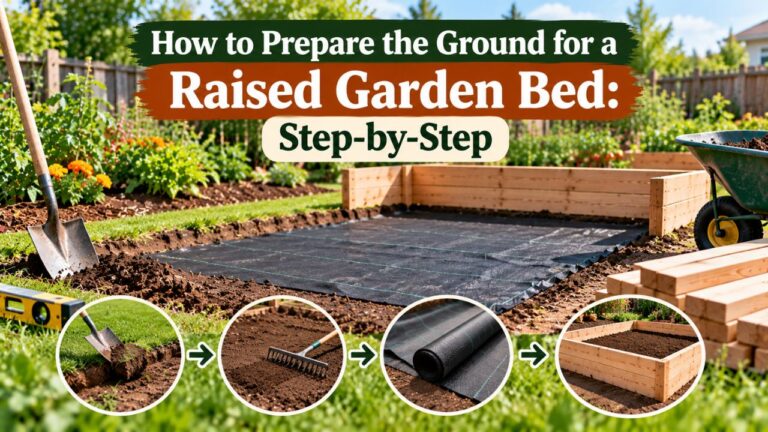
Step 1: Prepare the Ground
Remove persistent weeds, debris, and unwanted materials from the intended growing area.
If the existing ground is compacted, loosen it carefully with a garden fork.
Avoid disturbing excessively wet soil because working it can cause additional compaction.
For ordinary open-bottom beds, do not install an impermeable plastic sheet beneath the growing medium.
Roots and water need access to the underlying soil.
Step 2: Choose Quality Topsoil
Select loamy topsoil with suitable drainage and a reasonably crumbly structure.
Avoid material containing excessive sand, dense clay clumps, trash, or persistent weed roots.
When buying bulk topsoil, ask the supplier about its origin and whether compost or fertilizer has already been incorporated.
A prepared raised-bed mix may already contain the organic matter needed for planting.
Step 3: Add Finished Compost
Measure the required compost quantity according to the total bed volume and selected mixing ratio.
For a common two-to-one topsoil-and-compost mixture, use approximately one part finished compost for every two parts topsoil.
If the existing soil already contains abundant organic matter, a smaller compost addition may be appropriate.
Avoid automatically adding manure compost or other nutrient-rich amendments.
Step 4: Mix the Materials Evenly
Combine the topsoil and compost before filling the frame, or blend them in manageable batches inside the bed.
Use a garden fork or shovel to distribute the ingredients throughout the growing area.
Avoid leaving sharply separated layers of compost and topsoil.
A reasonably uniform mixture helps create consistent conditions for moisture movement and root development.
Step 5: Water and Check for Settling
After filling the raised bed, water the soil slowly.
Allow the moisture to penetrate below the surface.
The growing medium may settle as loose material becomes evenly distributed.
Add more prepared soil if the level drops substantially.
Keep enough space below the upper edge for normal watering and mulch.
Plant when the soil is appropriately moist and the growing conditions suit the intended crop.
How to Fix a Raised Bed Already Filled With Just Compost
If you have already filled a raised bed with pure compost, you do not necessarily need to discard all the material.
The appropriate correction depends on the compost’s condition, nutrient concentrations, and the plants already growing in it.
Step 1: Check Whether the Compost Is Finished
Inspect the compost’s texture and smell.
Properly finished compost is usually relatively uniform and earthy.
Large amounts of undecomposed materials, strong ammonia-like odors, or noticeable heat may indicate that decomposition is incomplete.
If the compost is unfinished, allowing additional processing or replacing part of the material may be necessary.
Do not plant sensitive seeds directly into questionable compost.
Step 2: Test the Growing Medium
If the bed contains substantial compost and plants are struggling, consider laboratory testing.
Ask whether the laboratory can evaluate the material for:
- Soil pH
- Soluble salts
- Available phosphorus
- Available potassium
- Other relevant nutrient concentrations
Because pure compost differs from mineral garden soil, ask the laboratory which testing method is appropriate.
The results can help distinguish a nutrient or salt problem from an issue caused by watering or drainage.
Step 3: Replace Part of the Compost With Topsoil
If the bed is empty and the compost is suitable for reuse, remove enough material to create room for mineral topsoil.
For example, suppose a 4×8 raised bed contains 32 cubic feet of pure compost.
To create a mixture containing approximately one-third compost:
- Remove about 21.33 cubic feet of compost.
- Leave approximately 10.67 cubic feet inside the bed.
- Add about 21.33 cubic feet of suitable topsoil.
- Mix the materials evenly.
- Water and check the final soil level.
This creates an approximate two-to-one topsoil-and-compost mixture.
The calculation assumes the original bed contains the full 32 cubic feet and that the material volume remains reasonably consistent during mixing.
The removed compost can be used appropriately elsewhere if it is mature and does not contain excessive salts, contaminants, or other unsuitable materials.
Step 4: Adjust the Mixture According to Test Results
If the compost contains unusually high phosphorus or soluble salts, simply mixing in a modest amount of topsoil may not adequately correct the problem.
More substantial replacement or professional soil-management guidance may be necessary.
Do not add fertilizer automatically to a struggling compost-only bed.
If the issue involves excessive nutrients, additional fertilizer could make conditions worse.
Likewise, adding lime or sulfur without testing can create unwanted pH changes.
Step 5: Protect Established Plant Roots
If vegetables are already growing in the compost-only bed, avoid aggressively digging through their roots.
Inspect their growth and moisture conditions first.
Where plants are healthy, it may be reasonable to maintain them through the season and improve the mixture after harvest.
If plants show severe stress, evaluate whether the problem involves salts, watering, root damage, or nutrients before deciding how to proceed.
In some cases, removing sensitive plants and rebuilding the growing medium may be preferable to disturbing a large, established root system.
Can You Use Compost Alone on Top of Raised Bed Soil?
Yes. A layer of finished compost on top of existing garden soil is different from filling the entire raised bed with compost.
This method is often called top-dressing.
The compost can gradually contribute organic matter and nutrients to the growing area.
However, the amount should be appropriate for the soil’s existing fertility.
Using Compost as a Soil Amendment
For an established raised bed, a modest layer of finished compost may be beneficial when additional organic matter is needed.
Compost can be spread across the soil surface and gently incorporated where appropriate.
In beds managed with minimal soil disturbance, suitable compost may also remain on the surface.
Avoid burying fresh, unfinished materials around established roots.
Is a Thick Compost Layer Always Better?
No. Repeated heavy applications can contribute excessive nutrients.
This is particularly concerning when using manure-based compost.
The original growing soil may already contain enough phosphorus and potassium.
A soil test can help determine whether additional compost is needed or whether a more targeted fertilizer would be appropriate.
Should You Add Compost Every Year?
Not necessarily.
Compost can be useful for maintaining soil organic matter, but it should not be applied automatically in large amounts every season.
Consider the existing soil condition, crops grown, and previous amendment history.
A raised bed that has received substantial compost for several years may need little additional organic matter.
Does Pure Compost Work Better in Deep Raised Beds?
A deeper raised bed does not automatically make 100% compost a better growing medium.
In fact, filling a large, deep structure entirely with compost can magnify some problems.
Deep Beds Contain More Decomposable Material
A 4×8 raised bed filled to a depth of 24 inches requires 64 cubic feet of growing material.
If all 64 cubic feet consist of compost, there is a substantial volume of organic material that may continue decomposing and settling.
As the bed loses volume, additional material may be required.
Using a suitable soil mixture creates a more stable growing environment.
Deep Beds May Need Different Filling Strategies
Very tall raised beds can be expensive to fill with purchased soil.
However, replacing the growing medium with pure compost is not necessarily an economical long-term solution.
A gardener may instead choose suitable mineral soil, finished compost, and other components appropriate for the bed’s design.
Some deep beds also use woody materials in lower portions, but these can cause additional settling and changes in nitrogen availability as they decompose.
The upper root zone should contain enough suitable growing medium for the intended plants.
Beds on Concrete Need a Different Approach
A raised bed installed on concrete behaves more like a large container because roots cannot enter the ground below.
These beds may use a formulated soilless growing medium combined with suitable finished compost.
The growing medium needs enough air space and drainage to prevent roots from remaining saturated.
Avoid assuming that ordinary topsoil or pure compost is appropriate for every contained bed.
The bed’s drainage design, depth, and crop requirements determine the better choice.
Conclusion
So, can you fill a raised bed with just compost? Yes, plants may grow in properly finished compost, but using it as the entire growing medium is generally not recommended for ordinary raised garden beds.
Pure compost can develop moisture problems, contain excessive soluble salts or nutrients, and settle as its organic materials continue decomposing.
A balanced mixture of quality topsoil and finished compost is usually the better option.
For many open-bottom vegetable beds, approximately two parts topsoil and one part finished compost provides a practical starting point, although the exact proportion should match the soil and compost quality.
If your raised bed already contains only compost, test the material and consider replacing part of it with suitable topsoil rather than adding more fertilizer or compost.
The goal is not to maximize the amount of compost in the bed. It is to create a stable, well-drained growing medium that supplies the air, water, and nutrients plants need.
FAQs About Can You Fill a Raised Bed With Just Compost
Can Vegetables Grow in 100% Compost?
Yes, some vegetables can grow in mature, suitable compost. However, pure compost may cause problems with moisture, soluble salts, nutrient balance, and settling. A mixture of quality topsoil and finished compost generally provides more predictable growing conditions.
Is Too Much Compost Bad for Raised Beds?
Yes. Excessive compost can contribute high nutrient levels, soluble salts, and moisture-management problems. Manure-based composts may be particularly rich in phosphorus. The appropriate amount depends on compost quality and the existing soil.
Can You Fill a Raised Bed With Mushroom Compost Alone?
Using only mushroom compost is generally not recommended. Some spent mushroom compost products contain elevated soluble salts and may be relatively alkaline. Use suitable, properly weathered mushroom compost as an amendment and consider testing unfamiliar material before planting.
Is 50% Compost Too Much for a Raised Bed?
Not always. Some university extension recommendations include mixtures containing up to 50% compost by volume. However, this amount may be excessive when the compost is nutrient-rich or the existing soil already contains substantial organic matter. A soil test helps determine whether a lower proportion is preferable.
Can You Mix Compost With Regular Garden Soil?
Yes. Suitable garden soil can be combined with finished compost to improve the growing medium. For an open-bottom raised bed, quality loamy soil and plant-based compost often work well together. Avoid using contaminated, heavily compacted, or otherwise unsuitable soil.
What Happens if You Plant Seeds Directly in Compost?
Seeds may germinate in mature, low-salt compost, but results can be inconsistent. Excessive soluble salts can interfere with germination, while moisture problems may prevent seeds from establishing healthy roots. A suitable seed-starting mix or balanced growing medium is generally more dependable.
Do You Need Fertilizer if Your Raised Bed Has Compost?
Not necessarily. Compost supplies some nutrients, but the amounts and release rates vary. A bed containing suitable topsoil and compost may already have adequate fertility. Use soil testing and crop-specific requirements to determine whether supplemental fertilizer is needed.

I’m Maya L. Greenwood, a lifelong plant lover who believes anyone can grow something beautiful with the right guidance. After years of testing soil mixes, pruning methods, irrigation tricks, and pest-safe solutions, I started EasyGardenTips.com to turn hard-won lessons into step-by-step advice. From seed starting and container gardens to composting and seasonal checklists, my goal is to make gardening simple, sustainable, and fun.