Can I Use Pine Wood for Raised Beds? Safety, Cost, and Lifespan
Yes, you can use pine wood for raised beds, including vegetable gardens. Untreated pine is an affordable, easy-to-work-with material that does not require chemical preservatives to be used around edible plants. Its main disadvantage is that it rots faster than naturally decay-resistant woods such as cedar and redwood.
Pine is especially useful for gardeners who want to build inexpensive raised beds using standard lumber from a hardware store. It can be cut with common woodworking tools, assembled into different sizes, and replaced without major construction work.
However, pine’s durability depends on whether the wood is untreated or pressure-treated, its thickness, and the amount of moisture it absorbs. Boards in constant contact with wet soil generally deteriorate faster than those that dry regularly.
Modern pressure-treated pine can provide better resistance to decay, but gardeners should understand the preservative type before using it around vegetables.
In this article, I cover the safety of untreated and pressure-treated pine, how long pine raised beds can last, which board sizes work best, how to build a sturdy pine frame, and practical ways to reduce rot and maintenance costs.
Can I Use Pine Wood for Raised Beds Safely?
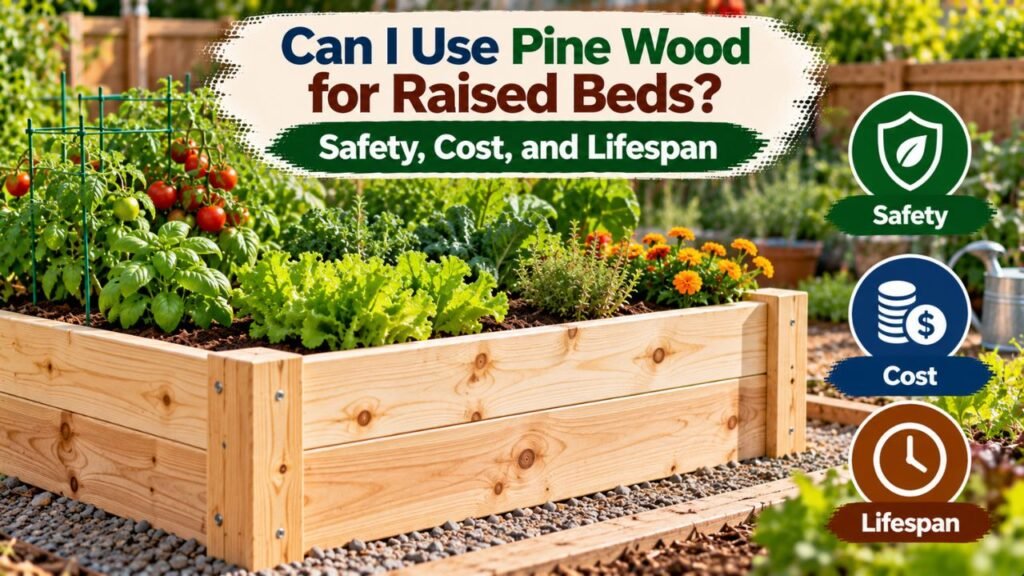
Untreated pine lumber is generally safe for raised vegetable and flower beds because it does not contain added pressure-treatment preservatives.
Pine is a natural softwood commonly used for residential construction, furniture, shelving, and outdoor projects.
When the lumber is new, untreated, and free from questionable coatings or contamination, it is a reasonable material for containing garden soil.
However, untreated pine should not be confused with pressure-treated pine.
The two products have different durability characteristics and material considerations.
Is Untreated Pine Safe for Growing Vegetables?
Yes. Clean, untreated pine can be used around vegetables, fruits, herbs, and flowers.
Suitable crops include:
- Tomatoes and peppers
- Lettuce and spinach
- Carrots and radishes
- Beans and peas
- Strawberries
- Basil and parsley
- Annual and perennial flowers
The wood itself does not prevent vegetables from growing.
Plant health depends primarily on suitable soil, adequate sunlight, water, drainage, and nutrients.
Untreated pine will eventually decompose as it remains exposed to soil moisture, but ordinary wood decay is not the same as contamination from industrial chemicals.
Does Pine Wood Contain Harmful Chemicals?
Natural pine contains substances such as resins and other compounds produced by the tree.
These are normal components of pine wood.
They are not the same as the chemical preservatives used in pressure treatment.
New, untreated pine lumber is generally suitable for ordinary vegetable gardening.
However, avoid using wood with an uncertain history.
Examples include pine boards that may have been exposed to:
- Industrial chemicals
- Motor oil or fuel
- Unknown preservatives
- Lead-containing paint
- Creosote
- Unidentified wood treatments
A board’s original species does not establish that it remains safe after unknown chemical exposure.
Can You Use Pine Wood Without Sealing It?
Yes. Untreated pine can be used without paint, stain, or sealer.
This is one of the simplest options for gardeners who prefer an untreated wooden frame.
However, the boards will be exposed directly to rain, irrigation water, sunlight, and damp soil.
Without protective treatment, pine generally deteriorates sooner than more naturally durable woods.
If you want a temporary or inexpensive raised bed, this may be an acceptable tradeoff.
Key Takeaway: New, untreated pine is a practical choice for growing vegetables. Its primary weakness is limited resistance to moisture-related decay, not ordinary food-garden safety.
How Long Does Pine Wood Last in Raised Garden Beds?
Untreated pine raised beds commonly last for several growing seasons, but their actual lifespan varies considerably.
Some beds deteriorate relatively quickly in humid environments, while others remain functional longer in drier conditions.
There is no single guaranteed lifespan for all pine species and growing conditions.
Expected Lifespan of Untreated Pine
A rough planning range of several years is reasonable for ordinary untreated pine used in direct contact with garden soil.
However, results depend on:
- Pine species
- Lumber quality
- Board thickness
- Local rainfall and humidity
- Soil moisture
- Drainage
- Construction methods
- Exposure to wood-decay organisms
The University of Maryland Extension’s raised-bed gardening guidance identifies untreated spruce-pine-fir lumber as an economical construction option while distinguishing it from naturally decay-resistant woods.
For a garden in a consistently wet climate, it is sensible to plan for earlier board replacement.
A bed in a relatively dry location may remain structurally sound longer.
Why Pine Rots in Raised Beds
Wood decay occurs when fungi break down the material under suitable environmental conditions.
Pine does not have the same natural decay resistance as cedar or redwood heartwood.
The greatest deterioration often occurs where the wood stays damp.
Common problem areas include:
- Bottom edges resting against moist ground
- Inside surfaces touching wet growing soil
- Corners where water collects
- Board ends exposed to repeated wetting
- Areas with poor airflow
- Weak joints that retain moisture
The bottom few inches of the frame may deteriorate before the upper boards.
This is why a pine raised bed can look relatively sound from the outside while showing substantial damage near the soil line.
Does Pine Last Longer in Dry Climates?
Generally, yes.
Wood-decay fungi require suitable moisture conditions.
Pine that dries regularly tends to experience less favorable conditions for decay than pine that remains wet for extended periods.
However, a dry climate does not eliminate all maintenance concerns.
Sunlight, repeated wetting and drying, and temperature changes may contribute to splitting, warping, and surface weathering.
Does Thicker Pine Last Longer?
Thicker boards can provide greater structural strength and may remain useful longer as deterioration begins.
For example, a nominal 2-inch-thick board generally offers a more substantial wall than a thin fence board.
However, thickness alone does not prevent rot.
A thick pine board exposed to constant moisture can still decay.
Use an appropriate combination of board thickness, wall bracing, and moisture management.
Key Takeaway: Untreated pine is best viewed as a relatively affordable raised-bed material that may eventually require board replacement. Moisture exposure, lumber quality, and construction have a major influence on its service life.
Untreated vs. Pressure-Treated Pine for Raised Beds
Both untreated and modern pressure-treated pine can be used for raised bed construction, but they offer different advantages.
The right choice depends on whether you prioritize avoiding added preservatives or improving resistance to decay.
| Feature | Untreated Pine | Modern Pressure-Treated Pine |
| Added wood preservatives | No | Yes |
| Suitable for vegetable beds | Generally yes | Generally yes, when appropriately treated for residential use |
| Natural resistance to rot | Relatively low | Improved by preservatives |
| Initial cost | Usually lower | Usually higher |
| Expected durability | Shorter in wet soil | Generally longer |
| Maintenance | More frequent inspections and possible replacement | Less frequent replacement, but periodic inspection is still necessary |
| Best application | Budget beds and untreated-material preference | Longer-term outdoor frames |
Is Pressure-Treated Pine Safe for Vegetable Gardens?
Modern pressure-treated pine commonly uses copper-based preservatives.
Examples include:
- Micronized copper azole (MCA)
- Copper azole (CA)
- Alkaline copper quaternary (ACQ)
These products differ from older lumber treated with chromated copper arsenate (CCA).
CCA contains arsenic, chromium, and copper and was phased out for most residential consumer uses at the end of 2003.
When buying pressure-treated pine for a garden, choose identifiable lumber approved for residential ground-contact applications.
Avoid using unidentified older treated lumber.
What Does Research Say About Treated Wood?
Researchers at Oregon State University studied raised vegetable beds made from untreated Douglas-fir and copper-azole-treated Douglas-fir.
The Oregon State University Extension research report describes four growing seasons of soil and plant testing.
Researchers found increased copper concentrations in soil immediately next to the treated wood, but they did not find increased copper concentrations in the vegetables and herbs grown in the beds.
The report also describes substantial decay in the untreated wooden boxes by the sixth growing season, while the treated boxes remained much more intact.
This study involved Douglas-fir and a particular copper-based treatment under Oregon growing conditions.
Its findings should not be treated as an exact lifespan prediction for every pine species or preservative.
However, the results help explain why modern residential pressure-treated lumber is considered a reasonable option by some university extension programs.
Should You Choose Treated or Untreated Pine?
Choose untreated pine if you want:
- Lumber without added preservatives
- A lower initial material cost
- A straightforward DIY project
- A garden bed that may be replaced or redesigned later
Choose modern residential ground-contact-rated pressure-treated pine if you want:
- Better decay resistance
- Less frequent board replacement
- A longer-term wooden frame
- A cost-effective alternative to cedar
If you prefer avoiding wood preservatives entirely, untreated pine is suitable, provided you accept its shorter expected service life.
Key Takeaway: Untreated pine is simple and inexpensive, while appropriately rated modern pressure-treated pine generally provides better durability. Avoid unidentified older treated lumber and industrially preserved wood.
Pine vs. Cedar for Raised Garden Beds
Cedar is often considered a premium wood for raised beds because many cedar species contain naturally decay-resistant heartwood.
Pine is generally less expensive but more vulnerable to rot.
Is Cedar Better Than Pine?
Cedar is usually better when the primary goal is long-term durability without added preservatives.
Pine is often better when the priority is a low initial cost.
| Feature | Pine | Cedar |
| Typical price | Lower | Higher |
| Natural decay resistance | Lower | Higher in suitable heartwood |
| Ease of cutting | Easy | Easy |
| Suitable for vegetables | Yes, when untreated and clean | Yes, when untreated and clean |
| Availability | Widely available | Varies by region |
| Maintenance needs | More frequent replacement may be needed | Generally longer-lasting |
| Best choice | Budget DIY gardens | Longer-term untreated wooden beds |
Neither material is guaranteed to last a fixed number of years.
Cedar performance also varies by species, grade, and heartwood content.
Is Pine More Affordable Than Cedar?
Pine is usually the less expensive option.
For example, a simple raised bed made from ordinary untreated pine may cost substantially less in lumber than the same design built from cedar.
However, local prices change, and lumber grades differ.
A lower purchase price does not necessarily mean the lowest long-term cost.
If you must rebuild the pine bed several times, the total cost may eventually exceed the price of a more durable material.
Which Wood Is Better for Beginners?
Pine is an excellent beginner-friendly material because it is easy to find and work with.
It allows gardeners to experiment with different bed sizes without committing to expensive materials.
Cedar becomes more attractive when the garden layout is permanent and minimizing replacement work matters more than the initial price.
Key Takeaway: Pine offers better initial affordability, while cedar generally offers better natural decay resistance. Both can be practical materials for vegetable gardening.
What Size Pine Boards Should You Use for Raised Beds?
The best board size depends on the desired bed height, the length of the walls, and the soil pressure the frame must resist.
For a conventional wooden raised bed, nominal 2-inch-thick dimensional lumber is a practical starting choice.
Pine Board Size Comparison
| Nominal Lumber Size | Actual Board Height | Typical Use |
| 2×6 | 5½ inches | Low borders or stacked courses |
| 2×8 | 7¼ inches | Shallow raised beds |
| 2×10 | 9¼ inches | Standard low raised beds |
| 2×12 | 11¼ inches | General-purpose raised beds |
| Two stacked 2×10 boards | 18½ inches | Taller raised beds |
| Two stacked 2×12 boards | 22½ inches | Deep raised beds with appropriate bracing |
These dimensions reflect common dressed dimensional lumber in the United States.
Actual dimensions should be checked before cutting.
Is 2×6 Pine Good for Raised Beds?
Yes, but a single 2×6 board creates a relatively shallow frame.
That can work over suitable natural ground because plant roots may grow into the soil underneath.
However, a single-course 2×6 bed is less suitable when plants depend entirely on the contained growing medium, such as on a concrete patio.
Stacking boards can create a deeper bed.
Is 2×12 Pine Better for Raised Beds?
A 2×12 board is a popular option for a standard raised garden bed.
One course provides approximately 11¼ inches of frame height.
This is enough to create a substantial layer of improved growing soil over natural ground.
It also avoids the extra joints needed when stacking narrower boards.
However, an 8-foot-long board may bow outward as wet soil pushes against it.
Use suitable corner supports and intermediate bracing.
Should You Use Pine Plywood?
Ordinary interior plywood, particleboard, medium-density fiberboard (MDF), and oriented strand board (OSB) are generally poor choices for direct, continuous contact with wet growing soil.
They may swell, delaminate, or lose strength.
Some exterior-rated plywood products resist moisture better, but that does not make them ideal for unsupported raised bed walls.
Solid dimensional pine lumber is usually simpler to build with and easier to replace.
Key Takeaway: Nominal 2×10 and 2×12 pine boards are practical choices for many raised beds. Use thicker, adequately braced construction rather than relying on thin panels to retain wet soil.
How to Build a Raised Garden Bed With Pine Wood
A simple 4-by-8-foot raised bed can be built from standard pine lumber using basic tools.
This example uses one course of 2×12 boards and creates an open-bottom frame suitable for placement over safe, well-drained garden ground.
Materials Needed for a 4-by-8-Foot Pine Raised Bed
Prepare:
- Three untreated 2×12×8-foot pine boards
- Four short 2×4 corner supports
- Additional supports or braces for the long sides
- Exterior-rated corrosion-resistant wood screws
- Measuring tape
- Carpenter’s square
- Circular saw or handsaw
- Drill and suitable bits
- Level
- Safety glasses and work gloves
- Suitable topsoil and finished compost
Use sound lumber without significant structural damage.
Avoid boards with extensive rot, large cracks, or severe warping.
Step 1: Cut the Pine Boards
Leave two 8-foot boards at their full 96-inch length.
These form the long sides.
Cut two 45-inch pieces from the third board.
When those pieces fit between the two long boards, and the actual board thickness is 1½ inches, the assembled frame will have outside dimensions of approximately 8 by 4 feet.
Measure the lumber before cutting to confirm the dimensions.
Step 2: Prepare the Corner Supports
Cut four corner supports to fit inside the frame.
They should not extend unnecessarily above the finished top edge.
Position the supports so the long and short boards can be securely joined.
A 2×4 support provides more fastening area than a small, thin piece of wood.
Predrill where necessary to avoid splitting.
Step 3: Assemble the Frame
Place the cut boards on a level surface.
Position the short end boards between the long boards.
Check the corners with a carpenter’s square.
Fasten the boards securely to the corner supports.
Use exterior-rated screws of suitable length.
Avoid fasteners that extend through the support and leave exposed sharp points.
Step 4: Reinforce the Long Sides
An 8-foot wall can bow outward under the pressure of wet soil.
Add suitable intermediate supports or structural bracing.
The exact reinforcement depends on the wall height and construction.
For deeper or taller beds, more substantial bracing may be required.
A bed that appears straight while empty may change shape after it is filled.
Step 5: Prepare the Ground
Select a location with adequate sunlight and suitable drainage.
Remove unwanted vegetation.
If the ground is compacted, carefully loosen the soil beneath the bed.
Place the frame in its intended position and check that it sits evenly.
An open-bottom raised bed generally does not need a solid wooden floor when installed over suitable natural soil.
Step 6: Fill the Bed With Growing Soil
Use a suitable growing mixture rather than filling the bed entirely with uncomposted material.
For a conventional open-bottom bed, a practical starting blend is:
- Two parts suitable loamy topsoil
- One part mature plant-based compost
Adjust the mixture according to existing soil conditions.
Avoid adding excessive compost without considering nutrient levels.
For a 4-by-8-foot frame made from one course of nominal 2×12 lumber, the usable volume is smaller than a full 32 cubic feet because the lumber occupies space and the soil usually stops below the rim.
With the described construction, filling to about 1 inch below the upper edge requires approximately 25 cubic feet of growing medium before allowing for settling.
Step 7: Water and Inspect
Water the growing medium evenly.
Allow it to settle naturally.
Check for:
- Loose screws
- Bowing sidewalls
- Unstable corners
- Excessive movement
- Drainage problems
Make any necessary repairs before planting.
Step 8: Plant and Mulch
Plant vegetables according to their recommended spacing and growing requirements.
Apply a suitable layer of organic mulch to reduce moisture loss.
Keep mulch from piling tightly against plant stems.
During the growing season, periodically inspect the lower pine boards for signs of deterioration.
Key Takeaway: A 4-by-8-foot pine raised bed can be built from three standard 2×12×8-foot boards, but proper corner supports and long-side bracing are important for keeping the frame stable.
How to Protect Pine Wood in Raised Garden Beds
Pine lasts longer when unnecessary moisture exposure is reduced.
However, no simple treatment can guarantee that untreated pine will remain rot-free.
The best approach is to combine good construction with practical maintenance.
Should You Seal Pine Wood Before Building?
Sealing is optional.
An appropriate exterior wood finish may reduce moisture absorption and surface weathering.
However, the effectiveness depends on the finish, application, and environmental conditions.
If you want to use a finish:
- Choose a product suitable for the intended outdoor application.
- Check the manufacturer’s instructions regarding contact with garden soil.
- Apply it to clean, dry lumber.
- Pay particular attention to exposed end grain.
- Allow the finish to dry or cure fully before assembling or filling the bed.
- Reapply only as directed by the manufacturer.
Avoid unidentified industrial wood preservatives or coatings not intended for residential gardening.
Should You Line Pine Raised Beds With Plastic?
A sidewall liner can reduce direct contact between wet soil and the pine boards.
However, it is not necessary for every raised bed.
A liner may also retain moisture against the wood if installed poorly.
If you use one, choose a durable material suitable for the application and install it so that water cannot become trapped between the liner and frame.
Leave the bottom open when the bed sits over suitable natural ground.
Do not create a waterproof basin that prevents drainage.
Does Landscape Fabric Prevent Pine From Rotting?
Landscape fabric does not completely prevent moisture from reaching wood.
Most landscape fabrics are designed to allow water to pass through.
They may help separate soil particles from other materials, but they are not reliable waterproof barriers.
For a pine raised bed, proper drainage and allowing the wood to dry are more important than assuming fabric will stop decay.
Should You Put Gravel Under Pine Boards?
A gravel base may be useful beneath certain landscaping structures, but it is not automatically necessary for a simple raised garden bed.
Placing gravel beneath the growing soil does not improve drainage in the way many gardeners assume.
For a standard open-bottom bed, the soil should drain into suitable ground beneath it.
If the site regularly floods or holds standing water, address the drainage problem rather than relying on a gravel layer.
Can You Paint Pine Raised Beds?
Yes, with a suitable exterior paint.
Exterior latex paint is one option discussed in university extension guidance for protecting wooden raised beds.
However, painted surfaces can still weather, crack, and require maintenance.
If the bed contains edible plants, check the finish manufacturer’s instructions before using it on surfaces that will contact the growing medium.
Painting the exterior may improve appearance and reduce weather exposure without requiring direct contact between the coating and garden soil.
Key Takeaway: Pine lasts longer when the frame drains properly, structural joints remain secure, and moisture exposure is managed. Sealers and liners are optional precautions, not permanent solutions to wood decay.
Common Problems With Pine Raised Garden Beds
Pine is easy to work with, but several problems can develop over time.
Identifying them early helps prevent a minor repair from becoming a complete rebuild.
Pine Boards Rotting at the Bottom
The lower boards often remain damp for longer periods than the upper surfaces.
This encourages fungal decay.
Inspect the inside and outside of the frame near the soil line.
If the wood feels soft, crumbles easily, or loses structural strength, replacement may be necessary.
A surface stain or sealer cannot restore wood that has already lost substantial strength.
Pine Boards Bowing Outward
Wet soil exerts pressure against the frame.
Long, unsupported pine boards may bend outward over time.
Prevent this by using adequate board thickness and properly positioned braces.
If a wall begins bowing significantly, inspect it before adding more soil.
Wood Splitting Around Screws
Pine can split when fasteners are installed too close to board ends.
Predrill where appropriate and use suitable exterior-rated screws.
Avoid overtightening.
Check corner joints periodically as the wood expands and contracts with changing moisture conditions.
Mold Growing on the Wood Surface
Surface mold can develop on damp wood.
It does not automatically mean the board has lost structural strength.
However, persistent moisture conditions can also encourage decay.
Improve drainage and airflow where practical.
If the wood becomes soft or structurally damaged, replace the affected sections.
Pine Boards Warping
Pine boards may twist or cup as their moisture content changes.
Select reasonably straight lumber and install it with adequate support.
Avoid storing boards directly on wet ground before construction.
If severe warping develops after installation, evaluate whether the frame remains structurally stable.
Key Takeaway: The most important warning signs are soft lower boards, significant bowing, failing joints, and structural cracks. Inspect pine frames regularly and replace deteriorated components before they fail.
Is Pine Wood Good for Different Types of Raised Beds?
Pine works well for many simple garden projects, but its suitability changes according to the bed’s design.
Pine for Vegetable Raised Beds
Untreated pine is a practical choice for vegetables when the bed is placed over suitable natural ground.
The frame contains the improved soil while roots may grow deeper into the soil below.
This makes pine useful for tomatoes, greens, beans, peppers, and many other garden crops.
Pine for Raised Flower Beds
Pine can also be used for annual flowers and ornamental plants.
It is especially convenient when creating temporary seasonal flower displays.
A painted or stained exterior can provide a decorative finish, provided the product is appropriate for the application.
For permanent perennial gardens, naturally decay-resistant wood may be worth the additional cost because replacing a deteriorated frame can disturb established roots.
Pine for Elevated Raised Beds
An elevated bed is different from an ordinary ground-supported raised bed.
The soil and water must be carried by a raised bottom and supporting legs.
Pine may be used in an elevated planter, but the entire structure must be designed to support the weight of wet growing medium.
Do not assume that ordinary pine boards and a few screws can safely support a large elevated garden.
Use a properly designed support system, especially for wide or deep elevated beds.
Pine for Raised Beds on Concrete
Pine can be used on a concrete patio, but the bed needs sufficient contained soil depth and an effective drainage system.
The concrete surface prevents roots from growing into natural ground.
The frame may also remain damp near the bottom if runoff cannot escape.
For this application, consider a suitably designed planter or a frame that manages drainage without trapping water against the wood.
Key Takeaway: Pine is especially useful for ordinary ground-supported vegetable and flower beds. Elevated and hard-surface installations require additional attention to structural support and drainage.
When Should You Avoid Pine for Raised Garden Beds?
Pine is not always the best choice.
Other materials may provide better value when longevity, maintenance, or structural requirements are more important than initial cost.
When You Want a Permanent Low-Maintenance Bed
Untreated pine is likely to require replacement sooner than quality galvanized steel or naturally durable wood.
If you want to install a bed and avoid rebuilding it for many years, cedar, suitable pressure-treated lumber, or metal may be more practical.
When the Garden Stays Wet
Locations with persistent standing water create unfavorable conditions for untreated pine.
Improving the site’s drainage should come before building the frame.
Where prolonged moisture exposure cannot be avoided, choose a material with better resistance to deterioration.
When the Wood Has an Unknown Treatment History
Do not use pine boards if you cannot establish whether they were exposed to industrial preservatives, chemicals, or unsuitable paint.
New, identifiable lumber is preferable for food gardens.
When Building a Very Tall Bed
Tall raised beds hold considerable soil weight and exert more pressure on the frame.
Pine can be used in properly engineered taller designs, but ordinary thin boards and basic corner screws may not provide enough support.
Use a structural design suitable for the bed height and soil load.
Key Takeaway: Untreated pine is a good budget material, but it is less attractive for permanently wet sites, very tall unsupported frames, or gardens where frequent repairs would be inconvenient.
Pine Raised Bed Maintenance Tips
Regular maintenance can extend the useful life of a pine garden bed.
The goal is to notice deterioration before structural failure occurs.
Spring Maintenance
Before planting:
- Inspect the bottom edges for rot.
- Check corner joints and fasteners.
- Look for bowed or cracked boards.
- Confirm that drainage remains effective.
- Repair or replace damaged components.
- Refresh the growing soil as needed.
Avoid adding fresh soil against a wall that is already failing.
Summer Maintenance
During hot weather, maintain suitable soil moisture for the plants.
Avoid unnecessary overwatering that keeps the growing medium saturated.
Check whether mulch or soil has accumulated against exposed exterior surfaces.
Inspect the frame periodically after heavy irrigation or rainfall.
Fall and Winter Maintenance
Remove unwanted plant debris from around the outside walls.
Check for persistent moisture and blocked drainage.
In cold climates, inspect the structure after freeze-thaw cycles and seasonal ground movement.
Do not leave a weakened frame holding a large volume of saturated soil through winter.
When Should You Replace Pine Boards?
Replace boards when they are no longer structurally sound.
Warning signs include:
- Deep fungal decay
- Soft or crumbling wood
- Large structural splits
- Loose connections that cannot be repaired securely
- Severe outward bending
- Significant loss of wood around fasteners
Do not wait for a complete wall collapse.
If a bed contains established plants, plan repairs carefully to avoid damaging their roots.
Conclusion
Yes, you can use pine wood for raised beds, and it is one of the more affordable options for building a simple vegetable or flower garden.
New, untreated pine is generally suitable for edible gardening and can be assembled using ordinary woodworking tools. Its main drawback is that it does not naturally resist decay as well as cedar or redwood.
Modern residential pressure-treated pine can last longer, but gardeners should verify the preservative type and intended ground-contact use before buying.
For a basic DIY garden, sturdy 2×10 or 2×12 pine boards with adequate corner supports and bracing provide a practical starting point. Proper drainage, suitable fasteners, and regular inspections help reduce premature deterioration.
If your goal is an inexpensive raised bed that can be repaired or replaced later, untreated pine is a sensible choice. If you want a more permanent structure with less maintenance, cedar, properly rated treated lumber, or galvanized steel may provide better long-term value.
FAQs About Can I Use Pine Wood for Raised Beds
Is untreated pine safe for raised vegetable beds?
Yes. New, clean, untreated pine is generally safe for raised vegetable beds. It does not contain added pressure-treatment preservatives and can be used around tomatoes, lettuce, carrots, herbs, and other edible crops. Avoid salvaged pine with unknown chemical exposure or coatings.
How many years will untreated pine last in a raised bed?
Untreated pine can last several growing seasons, but its lifespan depends on the pine species, board thickness, climate, soil moisture, and construction. It usually deteriorates faster than cedar or suitable pressure-treated wood, particularly when the lower boards remain wet.
Is pine or cedar better for raised beds?
Cedar is generally better for natural decay resistance and longer-term use. Pine is typically less expensive and easier to justify for temporary or budget projects. Both are suitable for growing vegetables when the lumber is clean and appropriate for the application.
Should I line a pine raised garden bed with plastic?
A plastic sidewall liner is optional. It may reduce direct soil contact with the wood, but poor installation can trap moisture. For a standard raised bed over natural ground, leave the bottom open for drainage and root growth.
Can I use pressure-treated pine for vegetable raised beds?
Yes, modern residential pressure-treated pine rated for ground contact is considered a reasonable option by several university extension programs. Choose lumber with a known preservative treatment and avoid older CCA-treated wood or industrially preserved materials.
Do I need to seal pine wood before making a raised bed?
No. Untreated pine can be used without sealing. However, a suitable exterior finish may reduce weathering and moisture absorption. Choose products appropriate for the intended application, follow the manufacturer’s instructions, and allow coatings to cure before use.
What thickness of pine is best for raised beds?
Nominal 2-inch-thick pine lumber is a practical choice for many DIY raised beds. A 2×12 board provides approximately 11¼ inches of frame height. Longer or taller beds may need additional supports to prevent their walls from bowing under wet soil pressure.

I’m Maya L. Greenwood, a lifelong plant lover who believes anyone can grow something beautiful with the right guidance. After years of testing soil mixes, pruning methods, irrigation tricks, and pest-safe solutions, I started EasyGardenTips.com to turn hard-won lessons into step-by-step advice. From seed starting and container gardens to composting and seasonal checklists, my goal is to make gardening simple, sustainable, and fun.