What Size Wood for Raised Garden Bed? Board Thickness and Height
For most DIY raised garden beds, 2×10 or 2×12 lumber is a practical choice because the boards are approximately 1½ inches thick and provide enough height for a useful planting area. A single 2×12 board creates a frame about 11¼ inches tall, while stacking two boards produces a deeper bed. For shorter raised beds, 2×6 or 2×8 lumber can also work.
Choosing the right wood dimensions matters because the frame must support the pressure of moist soil without bowing, splitting, or coming apart. Boards that are too thin may require additional bracing, while unnecessarily thick lumber increases construction costs.
The ideal size depends on the bed’s length, desired soil depth, wood species, and whether plants can extend their roots into the ground beneath the frame.
Wood measurements can also be confusing. A board sold as 2×12 does not actually measure 2 inches thick or 12 inches wide.
In this article, I compare common lumber sizes, explain actual versus nominal board dimensions, recommend corner posts and support spacing, and provide a practical cutting plan for a 4×8 raised garden bed.
What Size Wood for Raised Garden Bed Construction?
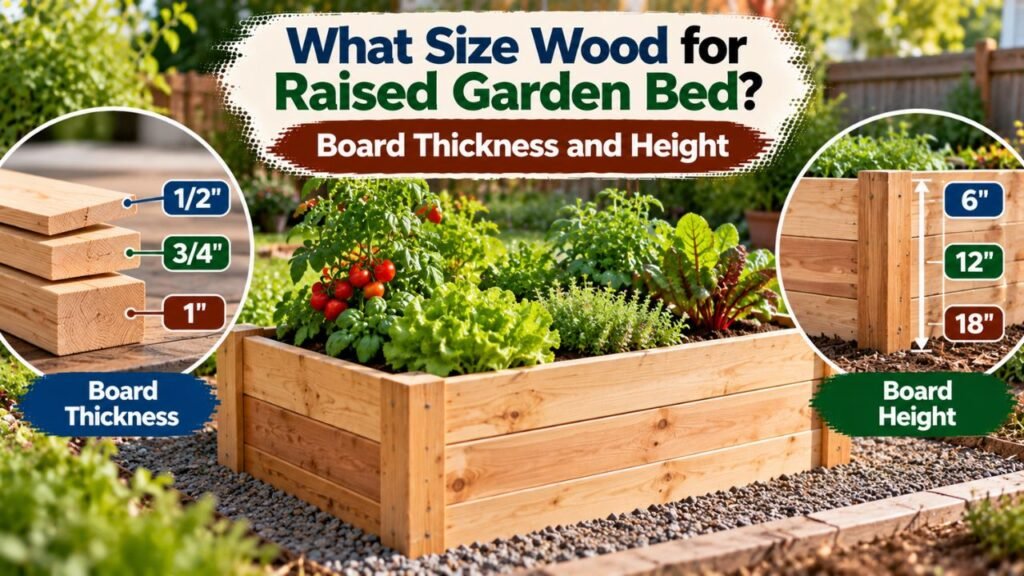
The most common lumber choices for wooden raised garden beds are nominal 2×6, 2×8, 2×10, and 2×12 boards.
These boards provide different frame heights while maintaining the same standard nominal thickness.
Raised Garden Bed Wood Size Chart
| Lumber Size | Actual Thickness | Actual Board Height | Best Application |
| 2×6 | 1½ inches | 5½ inches | Shallow raised beds |
| 2×8 | 1½ inches | 7¼ inches | Low vegetable beds |
| 2×10 | 1½ inches | 9¼ inches | General-purpose raised beds |
| 2×12 | 1½ inches | 11¼ inches | Deeper single-board beds |
| 4×4 post | 3½ inches | 3½ inches | Corners and structural support |
| 2×4 | 1½ inches | 3½ inches | Bracing and corner supports |
These are standard actual dimensions for commonly available surfaced dimensional lumber in the United States.
Rough-sawn lumber may have different measurements.
For a typical 4×8 vegetable bed, nominal 2×12 boards with properly secured corners and long-side reinforcement provide a useful starting design.
However, a taller or unusually long bed may require additional structural support.
Is 2×6 Wood Thick Enough for a Raised Bed?
Yes. Nominal 2×6 lumber is thick enough for many shallow raised beds when properly assembled.
A single 2×6 board provides approximately 5½ inches of frame height.
This may be suitable for a low bed installed directly over healthy, well-drained garden soil.
Plant roots can extend below the frame when the existing ground is loose and suitable for growing.
However, 5½ inches of raised soil alone may be insufficient for many vegetables when the bed has a solid bottom or sits on pavement.
If you want a deeper planting area, consider stacking boards or choosing wider lumber.
Is 2×8 Wood Good for Raised Garden Beds?
Yes. Nominal 2×8 lumber is a practical option for a modestly elevated garden bed.
Its actual height is approximately 7¼ inches.
This size provides more space for added growing medium than a single 2×6 board without requiring as much soil as a taller frame.
It works well for open-bottom beds where vegetable roots can continue growing into the ground.
However, an enclosed bed built with only one 2×8 board may not provide sufficient growing depth for larger crops.
Is 2×10 Wood a Good Choice?
Nominal 2×10 lumber provides a frame height of approximately 9¼ inches.
It offers a useful balance between wood cost, soil capacity, and bed height.
A 2×10 frame can work for many home vegetable gardens, especially when the underlying soil provides additional rooting depth.
If you prefer a frame close to 12 inches tall, a single 2×12 board may be more convenient than stacking narrower boards.
Is 2×12 Wood Better for Raised Garden Beds?
For many standard wooden raised beds, 2×12 lumber is an excellent all-around choice.
A single board provides approximately 11¼ inches of wall height.
This creates a relatively deep planting area without requiring multiple horizontal courses of boards.
Advantages include:
- Fewer horizontal joints.
- Straightforward assembly.
- Good wall thickness.
- Useful soil depth.
- Convenient construction with standard lumber lengths.
However, a 2×12 board is not automatically stronger in every installation simply because it is wider.
Long spans can still bow outward under soil pressure.
Proper posts and bracing remain important.
How Thick Should Wood Be for a Raised Garden Bed?
For many DIY raised beds, nominal 2-inch lumber, with an actual thickness of approximately 1½ inches, is a practical choice.
This thickness generally provides more resistance to bending and splitting than thin boards of similar material and span.
Is 1-Inch Wood Too Thin?
Nominal 1-inch boards, usually about ¾ inch thick after surfacing, can be used in some small or heavily supported raised-bed designs.
However, they generally require more frequent bracing.
Thin boards are more likely to flex or bow when they span long distances without support.
The University of Georgia Extension’s raised garden bed dimensions guide explains that lumber only 1 inch thick requires vertical support at approximately 4-foot intervals.
For a larger bed, thicker sidewalls can simplify construction and improve resistance to soil pressure.
Is 2-Inch Lumber Strong Enough?
Nominal 2-inch lumber is commonly used for DIY raised-bed frames.
Its approximately 1½-inch actual thickness provides a practical balance of strength, weight, availability, and price.
However, strength also depends on:
- Wood species.
- Board grade and condition.
- Length between supports.
- Frame height.
- Fastener selection.
- Quality of the corner connections.
- Moist soil pressure.
A long 2×12 board without intermediate support can still bow outward.
The thickness of the lumber should be considered together with the entire frame design.
Should You Use 4×4 Lumber for the Walls?
Solid 4×4 timbers can be stacked to create raised garden bed walls.
However, this generally requires more material than a conventional board frame.
Because 4×4 lumber measures approximately 3½ inches by 3½ inches, multiple courses are needed to build a taller structure.
The additional weight and material costs may not be justified for a basic vegetable bed.
For most small rectangular raised beds, using 2×10 or 2×12 sideboards with properly installed corner supports is simpler.
How Tall Should Wooden Raised Garden Beds Be?
The frame height determines how much raised soil can be added and how accessible the growing surface will be.
However, the frame doesn’t necessarily need to contain the plant’s entire root system.
Wood Sizes for Different Raised Bed Heights
| Wood Arrangement | Approximate Frame Height |
| One 2×6 board | 5½ inches |
| One 2×8 board | 7¼ inches |
| One 2×10 board | 9¼ inches |
| One 2×12 board | 11¼ inches |
| Two stacked 2×6 boards | 11 inches |
| Two stacked 2×8 boards | 14½ inches |
| Two stacked 2×10 boards | 18½ inches |
| Two stacked 2×12 boards | 22½ inches |
These heights represent the combined actual board widths when the boards are stacked without gaps.
They are not necessarily the final soil depth because gardeners often leave some space below the top rim.
Low Raised Beds for Existing Garden Soil
A single course of 2×6 or 2×8 lumber may be suitable when the raised bed sits directly on good garden soil.
The added growing layer can improve planting conditions while allowing roots to continue into the soil beneath.
However, if the underlying soil is heavily compacted or rocky, it may restrict root development.
Prepare the existing soil when necessary rather than assuming the raised layer alone will support every crop.
Medium-Height Raised Beds for Vegetables
A frame built with one 2×12 board or two stacked 2×6 boards provides approximately 11 inches of height.
This is a practical starting point for many vegetable gardens.
The University of Georgia Extension guidance linked earlier notes that most garden crops benefit from at least 10 inches of soil and recommends loosening the ground below shallower beds.
For tomatoes, carrots, peppers, and other crops requiring substantial root space, a deeper total root zone is beneficial.
Tall Raised Beds for Easier Access
Taller raised beds can reduce bending while planting, weeding, and harvesting.
For example, two stacked 2×12 boards create a frame approximately 22½ inches tall.
However, increasing the height also increases the amount of growing medium and the pressure against the walls.
A taller wooden bed needs appropriately sized posts, reinforcement, and secure connections.
A bed designed for standing or seated access may require additional engineering, particularly if it has an elevated bottom supported by legs.
What Size Corner Posts Should You Use?
Corner posts help connect the sideboards and prevent the frame from separating.
The best post size depends on the bed height, construction method, and expected loads.
2×4 Corner Supports
Nominal 2×4 lumber can be used as interior corner cleats or supports in some shallow raised-bed designs.
A 2×4 has actual dimensions of approximately 1½ by 3½ inches.
It provides a surface for fastening adjoining sideboards.
For a small, low raised bed, properly secured 2×4 corner supports may be adequate.
However, taller beds and longer walls may need more substantial framing.
4×4 Corner Posts
Nominal 4×4 posts are a practical choice when building a sturdy wooden frame.
Their actual dimensions are approximately 3½ by 3½ inches.
Advantages include:
- A substantial fastening surface.
- Support for adjoining sideboards.
- Compatibility with stacked board construction.
- Greater rigidity than small corner cleats in many designs.
The posts should be properly connected to the boards using suitable exterior-rated structural fasteners.
If the design relies on posts extending into the ground, the embedment depth and support requirements depend on the bed size and soil conditions.
Simply driving short posts into the ground does not guarantee that a tall raised bed will resist outward pressure.
How Long Should Corner Posts Be?
For a simple open-bottom rectangular bed, interior corner posts can be cut to approximately the frame height or slightly shorter, depending on the connection design.
For example, a single-course 2×12 bed has an approximate wall height of 11¼ inches.
Interior corner blocks might be cut slightly shorter so they do not project above the top edges.
For stacked boards, corner supports should provide secure attachment for every course.
If the posts are designed to extend below the frame for anchoring, additional length is required.
The exact dimensions should follow the selected construction design rather than a universal post-length rule.
What Size Wood Should You Use for a 4×8 Raised Garden Bed?
A 4×8 raised garden bed is a common backyard size because it provides 32 square feet of planting space while allowing access from both long sides.
For a straightforward single-level frame, nominal 2×12 lumber is a useful choice.
Lumber List for a 4×8 Raised Bed
The following example assumes a finished outside length of 96 inches, outside width of 48 inches, and a single course of 2×12 boards.
| Material | Quantity | Purpose |
| 2x12x8-foot boards | 3 | Side and end walls |
| 4×4 lumber | Enough for 4 corner blocks | Corner connections |
| Additional support lumber | As required | Long-side reinforcement |
| Exterior-rated structural fasteners | As specified | Secure frame connections |
The three 8-foot boards provide enough lumber for two long sides and two short end pieces.
This estimate assumes straight, usable boards without significant defects.
Additional material may be needed for intermediate supports or a different joint design.
How to Cut the Wood for a 4×8 Raised Bed
For an exact 4×8-foot outside footprint using a butt-joint layout with the end boards placed between the full-length sideboards:
- Cut two long sideboards to 96 inches.
- Cut two end boards to 45 inches.
- Prepare four corner support blocks sized for the frame.
- Add intermediate supports according to the structural design.
Why are the end boards only 45 inches long?
Because each long sideboard is approximately 1½ inches thick.
48 inches − 1½ inches − 1½ inches = 45 inches
This makes the total outside width approximately 48 inches.
If you instead cut both end boards to 48 inches and place them outside the long sideboards, the overall dimensions change.
Measure the actual lumber thickness and decide how the corners will join before cutting.
How Much Soil Does This Wooden Frame Hold?
The example frame has approximate interior dimensions of:
- Length: 93 inches.
- Width: 45 inches.
- Frame height: 11¼ inches.
If you fill it with 10 inches of growing medium, the volume is:
93 × 45 × 10 ÷ 1,728 = approximately 24.2 cubic feet
That equals about 0.90 cubic yards.
The volume differs from a full 4×8 interior planting area because the wooden walls occupy part of the outside footprint.
Actual requirements also depend on the final soil depth and frame construction.
How Many Boards Do You Need for Different Raised Bed Sizes?
The amount of lumber depends on the dimensions, number of board courses, and construction method.
For a simple rectangular frame, calculate the total perimeter first.
Perimeter = 2 × Length + 2 × Width
This provides a starting estimate of the linear feet of wall boards required per course.
Raised Garden Bed Lumber Quantity Chart
| Outside Bed Size | Approximate Lumber Per Course | Typical Board Arrangement |
| 3×3 feet | 12 linear feet | Four wall sections |
| 3×6 feet | 18 linear feet | Two long and two short sections |
| 4×4 feet | 16 linear feet | Four wall sections |
| 4×6 feet | 20 linear feet | Two long and two short sections |
| 4×8 feet | 24 linear feet | Two long and two short sections |
| 4×10 feet | 28 linear feet | Two long and two short sections |
These are nominal perimeter lengths for planning.
Actual cut lengths depend on whether boards overlap at the corners, fit between adjoining boards, or use other joint systems.
Purchasing quantities must also account for available board lengths, cutting waste, and defects.
How Many Boards for a 12-Inch-High Bed?
A single 2×12 course provides approximately 11¼ inches of height.
For a standard 4×8 outside footprint, three 8-foot 2×12 boards can supply the four walls using the cutting arrangement described earlier.
Additional lumber is needed for posts and bracing.
How Many Boards for a 24-Inch-High Bed?
Two stacked courses of 2×12 lumber provide approximately 22½ inches of total wall height.
For the same 4×8 footprint, the basic wall lumber requirement doubles to six 8-foot 2×12 boards.
This does not include additional corner framing, intermediate supports, or reinforcement.
A raised bed this tall needs a more substantial structural design than a simple low frame.
How to Reduce Cutting Waste
Plan bed dimensions around commonly available lumber lengths.
For example, 8-foot boards are convenient for 4×8 beds.
The University of Georgia Extension recommends considering standard 8-, 10-, and 12-foot lumber lengths when planning raised-bed dimensions to reduce unnecessary cutting and material waste.
Other ways to reduce waste include:
- Planning corner joints before purchasing boards.
- Using shorter offcuts for suitable bracing.
- Checking available lumber lengths locally.
- Measuring every component before cutting.
- Allowing for damaged or unusable wood sections.
How Far Apart Should Raised Bed Wood Supports Be?
Long wooden walls need enough support to resist outward pressure from the growing medium.
The necessary spacing depends on lumber thickness, frame height, soil conditions, and the support system.
When Do Raised Bed Walls Need Extra Bracing?
According to the Oregon State University Extension’s raised-bed gardening guide, beds longer than 6 feet or taller than approximately 18 inches should be reinforced to help prevent soil pressure from pushing the walls outward.
Possible reinforcement methods include anchored supports, cross ties, and other suitable structural connections.
This recommendation is particularly relevant to common 4×8 beds and taller stacked-board designs.
Intermediate Supports for an 8-Foot Bed
For an 8-foot-long raised bed, placing an intermediate support near the middle of each long side is a practical starting arrangement for many designs.
This divides the nominal 8-foot wall length into shorter unsupported sections.
However, the number and type of supports depend on the full frame design.
For example, a single-course 2×12 bed may need a different support arrangement from a 24-inch-tall bed constructed with stacked boards.
A tall frame may require cross ties connecting opposite walls to prevent outward bowing.
Do not assume that one center stake is adequate for every bed height.
Why Longer Boards Are More Likely to Bow
The soil inside a raised bed exerts lateral pressure against the sidewalls.
As the distance between supports increases, a board has a greater unsupported span over which it can bend.
Moisture changes can also cause wood movement.
Using thicker boards, reducing unsupported spans, and providing appropriate bracing help control these effects.
However, structural performance depends on the complete assembly rather than board thickness alone.
What Type of Wood Is Best for Raised Garden Beds?
Wood species affects cost, durability, workability, and resistance to decay.
The ideal choice depends on your budget and how long you expect the raised bed to remain in place.
Cedar Lumber
Cedar is a popular choice for raised vegetable beds because some cedar species contain naturally decay-resistant heartwood.
It is generally easy to cut and assemble.
Cedar is often more expensive than ordinary pine, but its resistance to outdoor deterioration can make it suitable for long-term garden structures.
Durability varies by cedar species, grade, and the proportion of heartwood.
Not every board sold as cedar has identical rot resistance.
Pine Lumber
Pine is commonly available and usually less expensive than naturally decay-resistant hardwoods and cedars.
Untreated pine can be used for raised garden beds.
However, it may deteriorate more quickly when exposed to prolonged moisture and soil contact.
For a temporary or low-cost garden project, pine can be reasonable if you accept that the boards may need replacement sooner.
Use sound lumber with minimal structural defects.
Redwood Lumber
Redwood is another option with naturally decay-resistant heartwood.
It can be suitable for long-term outdoor garden structures.
However, availability and price vary considerably by region.
The resistance to decay also depends on lumber grade and whether the boards contain heartwood or sapwood.
Douglas Fir and Other Softwoods
Douglas fir and other common construction softwoods can be used for raised garden beds.
They are often accessible and reasonably easy to work with.
However, untreated wood species differ in their natural resistance to soil moisture and fungal decay.
If using a less decay-resistant species, consider the likely maintenance and replacement requirements when comparing costs.
Can You Use Pressure-Treated Wood for Raised Garden Beds?
Modern pressure-treated lumber is not identical to older pressure-treated wood.
The treatment chemistry, intended use, and product labeling matter.
Older Pressure-Treated Wood
Some older pressure-treated lumber contained chromated copper arsenate (CCA), an arsenic-containing preservative.
CCA-treated lumber is not a recommended material for new home vegetable raised beds.
Avoid using railroad ties treated with creosote or reclaimed wood with an unknown chemical treatment history.
Do not assume that an old board is suitable simply because its surface looks clean.
Modern Pressure-Treated Lumber
Many modern residential pressure-treated products use copper-based preservatives rather than CCA.
Examples include alkaline copper quaternary (ACQ) and copper azole treatments.
Their permitted uses and chemical retention levels depend on the specific product.
When considering pressure-treated lumber, verify that it is approved for the intended application and follow the manufacturer’s handling instructions.
For direct soil contact, the appropriate treatment rating is particularly important.
Gardeners who prefer to minimize contact between preservatives and vegetable-growing soil may choose untreated, naturally decay-resistant wood instead.
A sidewall liner can provide some separation where appropriate, but it should not be treated as a way to make unknown or hazardous reclaimed wood acceptable.
Which Wood Is the Safest Choice for Vegetable Beds?
For gardeners seeking a straightforward material choice, new untreated cedar or another suitable naturally decay-resistant wood is generally a dependable option.
Avoid:
- Railroad ties containing creosote.
- Wood with unknown industrial treatments.
- Painted or chemically contaminated scrap lumber.
- Rotten or structurally damaged boards.
- Used pallets with an unverifiable treatment or cargo history.
The wood should be both suitable for growing food nearby and strong enough for the planned frame.
What Size Screws Should You Use for Raised Bed Lumber?
Fasteners must secure the boards and supports without splitting the wood or failing under outdoor conditions.
The appropriate size depends on board thickness, connection details, and fastener type.
Exterior-Rated Screws
For many nominal 2-inch lumber assemblies, exterior-rated structural or appropriate deck screws are commonly used.
A screw around 3 inches long may be suitable for some connections through 1½-inch-thick boards into substantial corner posts.
However, the correct length and diameter depend on the joint and required penetration.
Follow the fastener manufacturer’s specifications.
Choose screws designed for exterior moisture exposure.
Ordinary drywall screws are not an appropriate substitute for fasteners intended to withstand outdoor structural loads.
Fasteners for Cedar and Treated Lumber
Cedar can react with certain metals and may develop staining around unsuitable fasteners.
Stainless steel or appropriately corrosion-resistant fasteners are often preferred.
Pressure-treated lumber may require fasteners and connectors specifically rated for contact with its preservative chemistry.
Check compatibility before purchasing screws, bolts, or brackets.
Preventing Wood Splitting
Wood can split when screws are installed too close to board ends or edges.
To reduce this risk:
- Mark fastener locations before drilling.
- Keep screws a suitable distance from board ends.
- Drill pilot holes when recommended for the wood and fastener.
- Align boards before tightening.
- Avoid overtightening.
- Inspect the connection for cracks.
Pre-drilling can be particularly helpful in dense wood or near board ends.
How to Build a Raised Bed With the Correct Wood Sizes
Once you’ve chosen the lumber dimensions, the assembly process should preserve the frame’s shape and provide suitable structural support.
Step 1: Choose the Bed Dimensions
Decide on the length, width, and height.
A 4-foot width is useful when the bed is accessible from both sides.
Choose a narrower design if you can reach the bed from only one side.
Measure the available garden space, including walking paths.
Step 2: Select the Wall Lumber
For a typical open-bottom vegetable bed, consider nominal 2×10 or 2×12 boards.
Choose the height according to the growing conditions and desired soil depth.
If stacking boards, calculate the combined actual widths to determine the finished frame height.
Step 3: Cut the Boards and Posts
Measure each piece carefully.
Use a square to mark straight cutting lines.
Cut the sideboards and end boards to suit the intended corner-joint arrangement.
Prepare the corner posts and any intermediate supports.
Wear suitable eye protection and follow power-tool safety instructions.
Step 4: Assemble the Corners
Position the boards on a level working surface.
Attach them to properly sized corner posts or supports using appropriate fasteners.
Check the frame for square by comparing its diagonal measurements.
For a rectangular frame, equal diagonals indicate that the corners are square when the opposite sides have the intended lengths.
Step 5: Add Intermediate Supports
Install the necessary side supports and cross bracing.
The bracing design should match the bed’s length and height.
Pay particular attention to long walls and stacked-board construction.
Do not leave tall unsupported walls that may bow outward after filling.
Step 6: Position and Level the Frame
Move the frame to the prepared garden location.
Confirm that the ground is stable and drains appropriately.
Level the frame before filling.
For an open-bottom bed, remove unwanted vegetation and prepare the underlying soil as needed.
Step 7: Fill and Inspect the Raised Bed
Add an appropriate growing medium.
Avoid dumping large amounts of soil against one unsupported side.
Fill gradually and check the walls for movement or bowing.
After watering, inspect the joints and supports again.
If any part of the frame shifts or becomes distorted, correct the structural issue before continuing to use the bed.
Raised Garden Bed Wood Size Mistakes to Avoid
Selecting suitable lumber is only part of building a dependable wooden raised bed.
Several construction mistakes can reduce durability or make the bed difficult to maintain.
Confusing Nominal and Actual Lumber Measurements
A nominal 2×12 board is not 12 inches wide after standard surfacing.
Its actual width is approximately 11¼ inches.
This difference affects the frame height, cutting measurements, and soil volume.
Always calculate using actual dimensions when precision matters.
Using Thin Boards Without Enough Support
Thin lumber may bow or split if it spans too far without reinforcement.
This becomes more likely as the frame height increases.
Use appropriate wall thickness and bracing rather than assuming that extra screws alone will prevent bending.
Making the Bed Too Wide
A wide raised bed can be difficult to reach across.
Gardeners may need to step on the soil to maintain plants near the center.
For many adult gardeners, a width of approximately 3–4 feet is practical when both sides are accessible.
A narrower bed may be better when access is limited to one side.
Building Tall Walls Without Cross Bracing
Stacked 2×12 boards can produce a frame more than 22 inches tall.
The additional height increases soil pressure against the walls.
Use a suitable structural design with appropriately sized supports and ties.
Tall enclosed planters or beds built above ground level may need additional engineering.
Ignoring Wood Rot and Ground Contact
Even naturally decay-resistant wood can deteriorate under unfavorable conditions.
Keep the bed properly drained and inspect boards periodically.
Replace damaged wood before the frame becomes unstable.
Avoid relying on coatings or liners to compensate for severely deteriorated lumber.
Conclusion
Choosing what size wood for raised garden bed construction depends on the desired height, length, available budget, and expected structural loads.
For many DIY vegetable beds, nominal 2×10 or 2×12 lumber with an actual thickness of approximately 1½ inches is a practical choice.
A single 2×12 board creates a frame approximately 11¼ inches tall, while stacked boards provide additional height.
For a typical 4×8 bed, use suitable corner posts and reinforce the long walls to reduce bowing.
Untreated cedar is a good option when natural decay resistance is important, while ordinary pine can work for lower-cost projects with potentially shorter service life.
Measure the actual lumber dimensions, plan the corner joints, and select suitable fasteners before cutting.
A properly sized and supported wooden frame can provide a stable growing area without using unnecessarily heavy or expensive lumber.
FAQs About What Size Wood for Raised Garden Bed
Is 2×6 or 2×12 Better for a Raised Garden Bed?
A 2×12 board is generally better when you want a deeper single-course raised bed.
It provides approximately 11¼ inches of height, compared with 5½ inches for a 2×6.
However, 2×6 boards can work for shallow open-bottom beds or can be stacked to create taller walls.
Can I Build a Raised Garden Bed With 1×6 Boards?
Yes, but nominal 1×6 boards are relatively thin and may need frequent supports to resist bending.
They can work for small or properly reinforced designs.
For larger raised beds, nominal 2-inch lumber is generally more practical because of its greater wall thickness.
Are 4×4 Posts Necessary for Raised Garden Beds?
Not always.
Small, low raised beds can use suitable 2×4 corner cleats or other approved connections.
However, 4×4 posts offer a more substantial fastening surface and are useful in many taller or reinforced designs.
The appropriate support depends on the complete frame structure.
How Many 2×12 Boards Do I Need for a 4×8 Raised Bed?
For a single-course frame with exact outside dimensions of 4 feet by 8 feet, three 8-foot 2×12 boards can provide the four wall sections when the corners use a suitable butt-joint arrangement.
Two boards create the long sides, and the third supplies the two shorter ends.
Additional lumber is needed for corner posts and intermediate bracing.
Can I Stack 2×8 Boards for a Taller Raised Bed?
Yes. Two stacked nominal 2×8 boards create a wall approximately 14½ inches tall.
Three stacked boards create a wall approximately 21¾ inches tall.
Use appropriately sized posts and connections to secure every course, and add structural reinforcement where required.
Is Untreated Pine Strong Enough for a Raised Garden Bed?
Yes. Sound untreated pine lumber can provide adequate structural strength when correctly sized and supported.
However, pine is generally less resistant to prolonged soil moisture than naturally durable cedar heartwood.
Its expected service life depends on the wood quality, climate, drainage, and construction.
Do Raised Garden Bed Boards Need to Be 2 Inches Thick?
No. Raised beds can be built from thinner or thicker materials when the structure is designed appropriately.
However, nominal 2-inch lumber, approximately 1½ inches thick, is a useful standard choice for many DIY wooden raised beds.
Thinner boards generally require closer support or additional reinforcement.

I’m Maya L. Greenwood, a lifelong plant lover who believes anyone can grow something beautiful with the right guidance. After years of testing soil mixes, pruning methods, irrigation tricks, and pest-safe solutions, I started EasyGardenTips.com to turn hard-won lessons into step-by-step advice. From seed starting and container gardens to composting and seasonal checklists, my goal is to make gardening simple, sustainable, and fun.