How to Build a Raised Garden Bed on Concrete With Good Drainage
You can build a raised garden bed directly on concrete by installing a sturdy, open-bottom frame, providing a route for excess water to drain, and filling it with a growing mixture deep enough for your plants. You usually don’t need to drill into the concrete, but you must prevent water from becoming trapped beneath the growing soil.
Unlike raised beds installed over natural ground, beds on concrete cannot provide additional rooting space beneath the frame. Vegetables depend entirely on the growing medium inside the bed for moisture, nutrients, and root development.
Concrete can also absorb and reflect heat, increasing water loss during hot weather. Poor drainage may leave roots saturated or cause water to collect against nearby structures.
Fortunately, a properly designed wooden or metal raised bed can turn an unused patio or paved area into a productive vegetable garden.
In this article, I cover how to choose the right bed dimensions, prepare the concrete, build a sturdy frame, install drainage and a suitable liner, calculate soil requirements, and protect your patio while growing vegetables.
Can You Put a Raised Garden Bed Directly on Concrete?
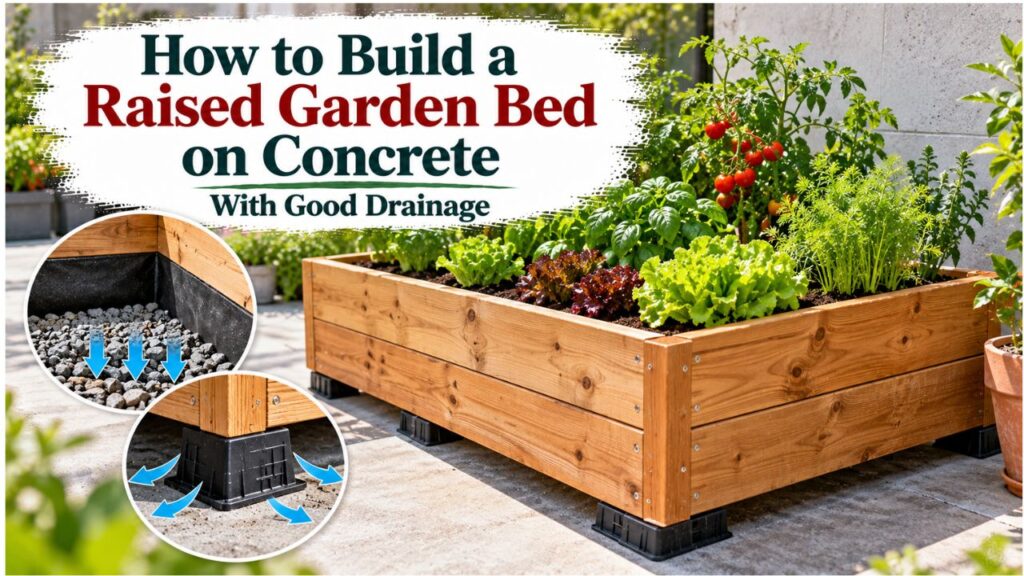
Yes, a raised garden bed can sit directly on concrete, provided the structure allows excess water to escape and contains enough growing medium for the selected plants.
Concrete does not prevent vegetables from growing. However, it changes how the raised bed functions.
A traditional raised bed installed over natural soil allows roots and water to move downward into the ground. A bed on concrete acts more like a large container because its growing depth is limited by the hard surface underneath.
This creates three important requirements:
- Adequate soil depth: Plants need enough contained growing medium for root development.
- Effective drainage: Excess water must have a clear path out of the bed.
- Structural stability: The frame must safely contain the weight of the wet growing medium.
The location also matters. A concrete patio that slopes gently away from a house may be suitable, while a poorly drained area where water regularly accumulates can create problems.
Do Raised Beds on Concrete Need a Bottom?
Not necessarily.
A raised bed placed directly on a ground-level concrete slab can use an open-bottom design with the concrete serving as the underlying surface.
However, an open-bottom frame does not automatically provide adequate drainage.
Water must be able to move sideways and exit through gaps or drainage openings near the bottom of the frame.
A water-permeable fabric liner can help contain the growing medium while allowing water to pass through.
A completely enclosed planter is another option, but it needs a properly designed bottom and drainage outlets.
Will a Raised Bed Damage Concrete?
A raised garden bed can leave stains, discoloration, or moisture marks on the concrete.
Water draining from the soil may contain fine particles, dissolved minerals, and organic material.
Constant moisture against painted or coated surfaces can also affect some finishes.
Before installation, examine the condition of the concrete and determine where runoff will travel.
A freestanding planter with controlled drainage may be preferable when protecting the patio surface is a major priority.
How to Build a Raised Garden Bed on Concrete Step by Step
Building a raised bed on concrete is similar to constructing an ordinary wooden garden frame, but drainage and growing depth require additional attention.
The following method uses a freestanding, open-bottom wooden frame.
It is intended for a sound, ground-level concrete patio or slab, not a suspended balcony or rooftop.
Materials and Tools Needed
For a small rectangular raised bed, gather the following:
Building materials
- Cedar, redwood, or suitable exterior-rated lumber
- Wooden corner posts or structural supports
- Exterior-rated corrosion-resistant screws
- Water-permeable landscape fabric or geotextile
- Suitable fasteners or staples for the liner
- Durable support or drainage components, if required by the design
- Finished compost
- Suitable soilless growing medium
- Optional drip irrigation equipment
- Organic mulch
Tools
- Measuring tape
- Carpenter’s square
- Level
- Drill and screwdriver bits
- Saw
- Staple gun, if using a fabric liner
- Shovel or garden trowel
- Work gloves
- Safety glasses
A prefabricated galvanized steel raised bed kit can replace the wooden frame if you prefer a modular design.
Choose a kit that is suitable for installation on a hard surface and allows drainage to be managed properly.
Step 1: Choose a Suitable Concrete Location
Start by selecting a location that receives adequate sunlight.
Most fruiting vegetables, including tomatoes and peppers, perform best with approximately 6–8 hours of direct sunlight daily.
Leafy greens may tolerate less direct sun, particularly in hot climates.
Inspect the concrete for:
- Large cracks or unstable sections
- Areas where water regularly collects
- Uneven or damaged surfaces
- Nearby doors and walking paths
- Drainage openings that must remain clear
- Water runoff directed toward the house
Do not install the bed where it blocks a patio drain or creates an obstruction.
A slight slope away from buildings can help water move away from the growing area.
However, a significantly uneven slab may require a different bed location or a properly designed leveling system.
Step 2: Decide the Raised Bed Dimensions
For a small concrete patio, a bed approximately 2 feet wide and 4 feet long is a manageable starting point.
A larger garden area may accommodate a 3-by-6-foot or 4-by-8-foot design.
Keep the width narrow enough to reach the center without stepping into the growing soil.
Practical dimensions include:
| Measurement | Suggested Size |
| Width with access from one side | About 2 feet |
| Width with access from both sides | 3–4 feet |
| Length | 4–8 feet |
| Soil depth for shallow-rooted crops | At least 8 inches |
| Soil depth for many larger vegetables | 12–24 inches |
| Example patio bed | 2 × 4 feet, approximately 18 inches tall |
For a small patio vegetable garden, an 18-inch-tall frame provides useful contained soil depth while keeping the footprint manageable.
The best depth still depends on which crops you intend to grow.
Step 3: Prepare and Clean the Concrete
Remove loose dirt, leaves, weeds, and other debris from the installation area.
Sweep the slab thoroughly.
If necessary, rinse the concrete with clean water and allow the surface to dry.
Avoid leaving chemical cleaning residues where they could enter the growing soil.
Check how water moves across the slab by pouring a small amount onto the surface.
If water flows toward the house or becomes trapped in a low spot, reconsider the location or plan a controlled drainage route.
You should also verify that the bed can sit securely without rocking or shifting.
Step 4: Build the Wooden Raised Bed Frame
A basic wooden frame uses four sides connected with corner supports.
For an approximately 18½-inch-high frame, two stacked courses of nominal 2×10 lumber can be used.
Standard dressed 2×10 boards are typically about 9¼ inches wide, giving two courses a combined height of approximately 18½ inches.
For a nominal 4-by-2-foot outside footprint:
- Cut four long side boards to 48 inches.
- Cut four end boards to approximately 21 inches when using lumber that is 1½ inches thick and placing the ends between the long sides.
- Cut four corner supports to fit within the frame.
- Arrange the first course of boards in a rectangle.
- Check the corners with a carpenter’s square.
- Secure the boards to the corner supports using suitable exterior-rated screws.
- Attach the second course above the first.
- Check alignment and install additional bracing if required.
This example produces outside dimensions of approximately 48 by 24 inches. The inside dimensions are smaller because of the board thickness.
Actual lumber sizes should be measured before cutting.
Use appropriate fasteners and predrill near board ends when necessary to prevent splitting.
Important: Do not assume the frame must be anchored into the concrete. A suitable freestanding design can often be used without drilling, although the assembled frame must remain stable and resist movement.
Step 5: Create Drainage Openings at the Bottom
This is one of the most important differences between building over concrete and building over natural ground.
Concrete is not a substitute for a functioning drainage system.
In an open-bottom wooden bed, water moves downward through the growing medium until it reaches the slab.
From there, it needs an exit.
Depending on the frame design, suitable drainage arrangements may include:
- Small drainage notches along the lower edges of the frame
- Purpose-designed gaps that allow water to escape from beneath the walls
- A properly supported raised base with drainage outlets
- A contained planter bottom that directs water to an appropriate discharge point
For a wooden frame, small drainage notches can be incorporated near the bottom edge without cutting away major structural sections.
The notches should face an appropriate runoff direction.
If you use a manufactured metal bed, follow its installation instructions rather than cutting or drilling the coated panels without authorization.
Do not allow the frame to form a sealed basin.
Step 6: Install a Water-Permeable Bottom Liner
A permeable liner can help retain growing medium while allowing water to pass through toward the drainage openings.
The University of Minnesota Extension’s raised-bed gardening guidance recommends a water-permeable material, such as landscape fabric, rather than impermeable plastic when lining a raised bed installed on a patio or other non-soil surface.
To install the liner:
- Measure the inside length and width of the bed.
- Cut a piece of water-permeable landscape fabric large enough to cover the bottom.
- Extend the fabric a short distance up the inside walls.
- Secure it where necessary without blocking drainage outlets.
- Check that the material lies flat and does not form a sealed pocket.
The purpose is to reduce soil loss, not to create a waterproof bottom.
Landscape fabric is not a reliable way to prevent all moisture or staining on concrete.
If keeping the surface dry is essential, choose a planter with a supported, contained base and a controlled drainage outlet.
Step 7: Fill the Raised Bed With Suitable Soil
A raised bed on concrete needs a growing medium that retains moisture while allowing excess water to move through it.
A heavy layer of ordinary garden soil alone may not provide suitable conditions, especially inside a shallow or enclosed structure.
For hard-surface raised beds, a useful growing mixture is:
- 50% finished compost
- 50% suitable soilless growing medium
The soilless portion may contain materials such as coir, peat-based growing media, and other ingredients intended for container growing.
Use mature compost rather than raw or unfinished organic material.
For deeper beds, a limited amount of topsoil may also be appropriate.
Avoid filling the lower part of the bed with gravel simply to create a drainage layer. Gravel does not replace a proper outlet and takes space away from the growing medium.
Step 8: Water the Soil and Test the Drainage
After filling, water the growing medium evenly.
Observe what happens at the bottom of the bed.
Excess water should have a visible route out of the frame rather than accumulating against the lower walls.
Check for:
- Water draining from the intended openings
- Soil escaping with the runoff
- Water collecting beside the house
- Persistent puddles around the frame
- Movement or instability of the structure
Adjust the drainage arrangement if necessary.
The growing medium should remain moist without staying saturated.
Step 9: Plant Vegetables and Apply Mulch
Once the soil has settled enough for planting, add seeds or transplants according to their recommended spacing and depth.
For a small patio bed, choose crops that fit the available growing area.
Lettuce, spinach, radishes, herbs, compact peppers, and selected bush beans can be practical choices.
Larger vegetables may require more soil volume and additional supports.
After planting, apply an appropriate layer of organic mulch to help reduce evaporation.
Avoid piling mulch tightly against plant stems.
How Deep Should a Raised Garden Bed Be on Concrete?
A raised bed on concrete should provide at least 8 inches of growing medium for certain smaller or shallower-rooted vegetables, while many larger crops benefit from 12–24 inches.
The depth matters because roots cannot penetrate the concrete below.
According to the University of Maryland Extension’s guidance on growing vegetables in raised beds, beds on hard surfaces should contain at least 8 inches of growing medium for leafy greens, beans, and cucumbers, and 12–24 inches for peppers, tomatoes, and squash.
The guidance also notes that these beds can experience additional heat stress and dry out more quickly because roots cannot reach moisture in the ground below.
Recommended Soil Depth for Common Vegetables
| Vegetable | Practical Soil Depth |
| Lettuce | At least 8 inches |
| Spinach | At least 8 inches |
| Radishes | 8–12 inches |
| Bush beans | At least 8 inches |
| Cucumbers | At least 8 inches, with adequate total root volume |
| Carrots | 12–18 inches for many full-length varieties |
| Peppers | 12–24 inches |
| Tomatoes | 12–24 inches |
| Squash | 12–24 inches |
These depths are planning guidelines rather than guarantees of successful growth.
The total soil volume, plant variety, moisture availability, and growing conditions also matter.
For example, a tomato plant may need more total growing medium than a shallow lettuce planting, even when both receive sufficient sunlight.
Is a 12-Inch Raised Bed Deep Enough on Concrete?
A 12-inch-deep bed can support many vegetables.
It is especially practical for leafy greens, radishes, herbs, and some compact crops.
However, larger plants may benefit from additional depth and soil volume.
If you plan to grow tomatoes, peppers, or squash regularly, an 18–24-inch frame may provide more flexibility.
Is a 6-Inch Raised Bed Deep Enough?
A 6-inch growing depth is generally too restrictive for an all-purpose vegetable raised bed on concrete.
It may support selected shallow-rooted plants under carefully managed conditions, but it provides limited water storage and root space.
Unlike an open-bottom bed over natural soil, plants cannot extend their roots below the frame.
For most gardeners, using a deeper bed is a more practical choice.
Best Soil Mix for a Raised Garden Bed on Concrete
The ideal growing medium for a hard-surface raised bed is not necessarily the same as the mixture used over natural ground.
An open-bottom bed over healthy soil can take advantage of native mineral soil beneath it.
A bed on concrete must provide all the required growing space within the frame.
Compost and Soilless Growing Medium
An equal-volume combination of finished compost and suitable soilless growing medium is one recommended option.
For example, a batch could contain:
- 5 cubic feet of finished compost
- 5 cubic feet of suitable soilless growing medium
This produces approximately 10 cubic feet of combined ingredients before settling.
The final volume can vary slightly as materials are mixed and watered.
The quality of the ingredients matters.
Compost that is excessively salty or nutrient-rich may create problems, particularly when added repeatedly.
Choose a growing medium designed for garden containers or raised beds and check whether fertilizer is already included.
Can You Use Topsoil on Concrete?
Yes, but it should be used appropriately.
University of Maryland Extension permits up to 20% topsoil by volume in its recommended mixture for hard-surface beds that are at least 16 inches deep.
For example, a mixture for a sufficiently deep bed could contain:
- 40% finished compost
- 40% soilless growing medium
- 20% suitable topsoil
This is an illustrative variation within that recommendation.
Avoid using dense clay-heavy topsoil as the only growing material.
The bed needs a balanced mixture that provides air spaces and holds appropriate moisture.
Should You Add Gravel Under the Soil?
No gravel layer is required simply because the bed sits on concrete.
A coarse layer beneath finer growing media does not automatically improve drainage.
It can reduce the effective growing depth and may create an abrupt boundary that affects water movement.
Focus instead on suitable growing medium and drainage openings that let excess water leave the bed.
Can You Fill the Bottom With Logs or Branches?
Large logs, branches, and other bulky organic materials are sometimes used in deep garden beds to reduce the amount of purchased soil.
However, this approach is less attractive for a shallow bed on concrete.
Bulky materials reduce the space available for roots and may settle as they decompose.
They can also make moisture management less predictable.
For a small concrete patio bed, it is usually more practical to fill the intended root zone with a suitable growing medium.
How Much Soil Do You Need for a Raised Bed on Concrete?
Calculate the soil volume before purchasing materials.
Unlike an open-bottom bed over natural ground, a raised bed on concrete cannot depend on the soil underneath for additional root space.
For a rectangular bed:
Soil Volume (Cubic Feet) = Inside Length (Feet) × Inside Width (Feet) × Soil Depth (Feet)
If the depth is measured in inches, divide it by 12 first.
Soil Volume for Common Raised Bed Sizes
| Inside Bed Dimensions | Soil Depth | Calculated Soil Volume |
| 2 × 4 feet | 12 inches | 8 cu. ft. |
| 2 × 4 feet | 16 inches | 10.7 cu. ft. |
| 3 × 4 feet | 16 inches | 16 cu. ft. |
| 3 × 6 feet | 18 inches | 27 cu. ft. |
| 4 × 8 feet | 18 inches | 48 cu. ft. |
| 4 × 8 feet | 24 inches | 64 cu. ft. |
These calculations use inside dimensions, not outside frame measurements.
The actual soil quantity may be lower if the walls occupy part of the stated footprint or if space is left below the upper rim.
Example: Soil for a 2-by-4-Foot Patio Bed
Suppose the bed has these inside dimensions:
- Length: 4 feet
- Width: 2 feet
- Soil fill depth: 16 inches
Convert the depth to feet:
16 ÷ 12 = 1.333 feet
Calculate the volume:
4 × 2 × 1.333 = approximately 10.7 cubic feet
For a 50/50 compost and soilless growing medium blend, the calculated ingredient quantities are approximately:
- 5.35 cubic feet of compost
- 5.35 cubic feet of soilless growing medium
If purchasing 1.5-cubic-foot bags of premixed growing medium, eight bags would provide 12 cubic feet, allowing some extra material for settling.
Remember the Weight of Wet Soil
Soil weight is an important consideration for raised beds installed on concrete.
The total weight depends on:
- Soil volume
- Mineral soil content
- Compost and other ingredients
- Moisture content
- Frame weight
- Additional water held in the growing medium
A large raised bed containing several cubic yards of material can be extremely heavy when wet.
For a ground-supported patio slab, check that the concrete is sound and suitable for the proposed load.
For a suspended deck, balcony, rooftop, or other elevated concrete structure, do not install a large soil-filled bed without confirming its load capacity with an appropriately qualified structural professional.
Wood vs. Metal vs. Concrete Blocks for a Raised Bed on Concrete
The frame material affects durability, weight, installation, and long-term maintenance.
Each option can work when the bed is designed appropriately.
Wooden Raised Beds
Cedar and redwood are common choices for DIY raised beds.
Their advantages include easy cutting, straightforward assembly, and the ability to create custom sizes.
However, wood can deteriorate from prolonged moisture exposure.
A wooden frame on concrete may have limited drying at the bottom edge, especially where water collects.
Use decay-resistant lumber and appropriate drainage details.
Galvanized Metal Raised Beds
Galvanized steel raised bed kits offer an alternative to wooden construction.
They are usually lightweight before filling and are available in different shapes and heights.
Protective coatings help resist corrosion.
However, metal beds still require an effective drainage route when placed on concrete.
Some manufacturers provide specific instructions for installation on patios or hard surfaces.
Follow those instructions rather than modifying the panels in ways that may damage the protective coating.
Concrete Block Raised Beds
Concrete blocks can also be used to create a raised garden bed on an existing slab.
They offer a solid, permanent appearance and avoid the decay concerns associated with wood.
However, the blocks are heavy and may require more careful construction.
A low, appropriately designed block border may be relatively simple.
Taller retaining walls need suitable structural design and support.
Do not assume that loosely stacked blocks can safely contain a deep volume of wet soil.
Which Material Is Best for a Concrete Patio?
| Material | Main Advantage | Main Limitation |
| Cedar | Easy to build and customize | Can deteriorate with moisture |
| Redwood | Natural decay resistance | Often expensive |
| Galvanized steel | No wood rot and convenient modular kits | Coating and drainage require attention |
| Concrete blocks | Durable and permanent appearance | Heavy and difficult to move |
| Composite boards | Moisture resistance in suitable products | Some products need substantial bracing |
For most small DIY patio beds, cedar or a suitable galvanized steel kit is a practical choice.
Use a freestanding design where possible so the bed can be removed without permanently altering the concrete.
How to Protect Concrete Under a Raised Garden Bed
Building the bed properly can reduce avoidable damage, but no simple liner can guarantee that the concrete will remain unstained.
The primary concerns are moisture, organic runoff, weight, and surface coatings.
Avoid Blocking Existing Patio Drainage
Before placing the frame, identify how rainwater normally leaves the patio.
Do not position the bed over a floor drain or directly in a critical drainage channel.
Water from the raised bed should not collect against a house foundation, doorway, or neighboring property.
If the slab lacks a safe runoff route, use a planter designed to collect and direct drainage water.
Use a Permeable Liner When Appropriate
A water-permeable landscape fabric can retain soil while allowing water movement.
However, it does not prevent dissolved minerals or organic staining from reaching the slab.
Do not use an impermeable plastic sheet beneath an otherwise open-bottom frame without providing a separate drainage system.
Trapped water can create an unhealthy root environment.
Avoid Unnecessary Concrete Drilling
Most small freestanding raised beds do not require anchors drilled into the concrete.
Drilling may damage waterproof coatings or membranes and can affect a surface that was not designed for penetrations.
This is particularly important on balconies, rooftops, and suspended slabs.
Do not drill into a structural or waterproofed concrete surface without confirming that the modification is permitted and appropriate.
Consider a Raised Planter With Controlled Drainage
When staining or water runoff must be tightly controlled, a planter with a supported bottom and drainage outlet may be preferable.
Such a design can direct excess water toward an appropriate collection or discharge location.
However, it must still drain properly.
A watertight container without a suitable outlet is not an appropriate substitute for a free-draining vegetable bed.
Best Vegetables to Grow in a Raised Bed on Concrete
Vegetable selection should match the depth and total volume of the growing medium.
Compact crops are often easier to manage in small patio beds.
Leafy Greens
Lettuce, spinach, kale, and other leafy vegetables are practical choices.
They can grow in comparatively shallow beds when moisture and nutrient conditions are suitable.
Their compact growth also works well for narrow raised beds.
Avoid crowding plants beyond their recommended spacing.
Radishes and Carrots
Radishes can be suitable for smaller raised beds because many varieties mature quickly and do not require extensive root depth.
Carrots need a loose growing medium without stones or dense obstructions.
Choose carrot varieties that match the available soil depth.
Long-rooted varieties need more vertical growing space than short or round types.
Herbs
Basil, parsley, chives, and many other culinary herbs can grow well in raised patio beds.
However, water requirements vary.
Basil generally prefers consistent moisture, while rosemary and thyme need a growing medium that does not remain waterlogged.
Group plants with compatible growing requirements.
Tomatoes and Peppers
Tomatoes and peppers can be grown on concrete when the raised bed provides sufficient soil depth and total rooting volume.
Compact varieties are often more practical in limited spaces.
Larger tomato plants may need sturdy supports and more frequent watering.
Do not assume that the minimum recommended depth alone provides enough soil volume for several mature plants.
Cucumbers and Squash
Cucumbers can grow in raised beds on concrete, but many varieties need substantial water and adequate space.
A trellis can help manage climbing varieties.
Squash plants may spread widely and require more growing area than expected.
Choose compact varieties when patio space is limited.
How to Water a Raised Garden Bed on Concrete
Raised beds on concrete often need more frequent moisture checks than traditional ground-level beds.
Because their roots cannot grow beneath the concrete, plants depend entirely on the moisture stored inside the growing medium.
The surrounding paved surface may also increase heat exposure.
Check Moisture Below the Surface
Do not water only because the top of the soil looks dry.
Use a finger or small trowel to inspect moisture a few inches below the surface.
For deeper-rooted crops, check farther into the growing medium when possible.
The goal is to maintain adequate moisture without keeping the soil saturated.
Install Drip Irrigation or a Soaker Hose
Drip irrigation can make watering more consistent.
It delivers water close to the root zone rather than spraying the entire patio.
This may also reduce the amount of water running off surrounding hard surfaces.
Adjust irrigation according to weather, plant size, and actual soil moisture.
Use Organic Mulch
A suitable mulch layer can help reduce evaporation from the growing medium.
Possible materials include clean straw and shredded leaves.
Avoid placing thick mulch directly against plant stems.
Mulch can be particularly useful where concrete reflects heat toward the bed during summer.
Monitor Heat During Summer
Concrete surfaces may become warm during prolonged sunlight.
Plants near exposed edges can experience higher temperatures than those in shaded parts of the bed.
Consider a location with appropriate sunlight and some protection from extreme afternoon heat when growing sensitive crops.
The correct approach depends on the climate and vegetable variety.
Common Mistakes When Building Raised Beds on Concrete
Several construction and planting mistakes can cause avoidable problems.
Building a Bed Without Drainage Openings
An open-bottom frame placed directly on concrete may still trap water if the walls block every possible exit.
Provide a suitable route for runoff before adding soil.
Using a Waterproof Plastic Bottom
A solid plastic sheet can create a water-holding basin beneath the growing medium.
Unless the bed includes a properly designed outlet, this may lead to waterlogging.
Use permeable fabric for soil retention or a purpose-built drainage system.
Making the Bed Too Shallow
A shallow bed may not contain enough soil for larger vegetables.
Choose the depth according to the crop rather than assuming every plant can grow in the same small amount of soil.
Filling the Bed With Heavy Garden Soil Alone
Dense garden soil can become compacted inside a restricted container.
Choose a suitable growing mixture with good aeration and moisture management.
For hard-surface beds, a compost-and-soilless-media blend is an established option.
Forgetting About Soil Weight
A large, deep raised bed can contain a substantial weight of wet growing medium.
This is especially important on elevated structures.
Confirm the surface is appropriate before filling the bed.
Placing the Bed Against a House Wall
Water draining from the bed may collect near the building.
Leave suitable clearance for drainage, inspection, and maintenance.
Avoid locations where runoff could enter doors, damage finishes, or create persistent moisture against the structure.
Choosing a Frame That Is Difficult to Maintain
A bed that is too wide can make harvesting and weeding uncomfortable.
Keep the growing area within reach.
For most gardeners, a width of 2 feet is practical when access is limited to one side, while 3–4 feet can work when both sides are accessible.
How to Maintain a Raised Garden Bed on Concrete
A properly built raised bed still requires seasonal care.
The most important maintenance tasks involve water management, soil condition, and frame inspection.
Inspect Drainage Regularly
Check drainage openings after heavy rainfall and periods of frequent irrigation.
Remove soil or debris that blocks the outlets.
If water begins collecting around the frame, investigate the cause before it creates a persistent problem.
Replenish Settled Growing Medium
Compost and other organic components can settle as they decompose.
When the soil level drops, add an appropriate growing mixture or amendment based on the existing soil condition.
Avoid adding fertilizer-rich compost automatically every season.
Soil testing can help determine whether additional nutrients are needed.
Check the Frame for Damage
Inspect wooden boards for decay, loose screws, and bowing.
For metal beds, check fasteners, protective coatings, and any damaged edges.
Correct structural problems before the growing medium places additional pressure on weakened sections.
Adjust Care During Winter
In freezing climates, raised beds on concrete may experience greater root-zone temperature fluctuations than beds connected to natural ground.
This matters particularly for perennial plants.
Choose crops appropriate for the local climate and provide seasonal protection when needed.
During winter, keep drainage routes open and avoid leaving the growing medium waterlogged.
Conclusion
Knowing how to build a raised garden bed on concrete makes it possible to turn a patio, driveway section, or other suitable paved area into a productive growing space.
The most important steps are choosing a sound location, constructing a stable frame, providing an effective drainage route, and using enough suitable growing medium for the intended vegetables.
For many small patio gardens, a 2-by-4-foot bed approximately 18 inches tall is a practical starting design. Larger beds can work well, but they require more soil and careful consideration of weight and drainage.
Use a permeable liner only where it serves a clear purpose, avoid sealing the bottom without drainage, and keep water runoff away from buildings and walkways.
For a simple DIY project, a cedar frame or suitable galvanized metal kit can provide a manageable solution. With proper construction, watering, and maintenance, a concrete surface can support a useful raised vegetable garden without requiring the removal of the existing slab.
FAQs About How to Build a Raised Garden Bed on Concrete
Do I need to drill holes in concrete for a raised garden bed?
No. Most small freestanding raised beds can be installed without drilling into the concrete. Drainage should be provided through the bed’s design, such as suitable openings near the bottom or a controlled planter drainage system. Drilling into a patio is usually unnecessary.
Can I put a wooden raised bed directly on concrete?
Yes. A wooden raised bed can sit on a suitable concrete slab. Choose durable lumber, provide drainage openings, and avoid trapping water against the bottom edges. Periodically inspect the wood for signs of moisture damage.
Should I put gravel at the bottom of a raised bed on concrete?
No. A gravel layer is not necessary for proper drainage and can reduce the available soil depth. The more important requirement is that excess water can leave the bed through an appropriate drainage route.
Can I build a raised bed on concrete without a bottom?
Yes. An open-bottom raised bed can be placed on a ground-level concrete slab. However, drainage must still be managed because the concrete underneath is impermeable. A permeable fabric liner may help retain growing medium without intentionally sealing the base.
Can I grow tomatoes in a raised bed on concrete?
Yes. Tomatoes can grow in raised beds on concrete when there is sufficient soil depth, total growing volume, water, nutrients, and sunlight. A growing depth of 12–24 inches is a useful starting range, with larger plants generally benefiting from more root space.
Can a raised garden bed on concrete cause water damage?
It can cause moisture staining or create drainage problems if runoff is poorly managed. Keep drainage water away from walls and doorways, avoid blocking existing drains, and consider a contained planter with controlled drainage where surface protection is particularly important.
Is it safe to build a raised bed on a concrete balcony?
Only after confirming that the balcony can safely support the total wet weight of the raised bed, growing medium, water, and plants. Concrete balconies vary in structural capacity and may contain waterproofing systems that must not be penetrated. Obtain qualified structural guidance before installing a large or heavy planter.

I’m Maya L. Greenwood, a lifelong plant lover who believes anyone can grow something beautiful with the right guidance. After years of testing soil mixes, pruning methods, irrigation tricks, and pest-safe solutions, I started EasyGardenTips.com to turn hard-won lessons into step-by-step advice. From seed starting and container gardens to composting and seasonal checklists, my goal is to make gardening simple, sustainable, and fun.