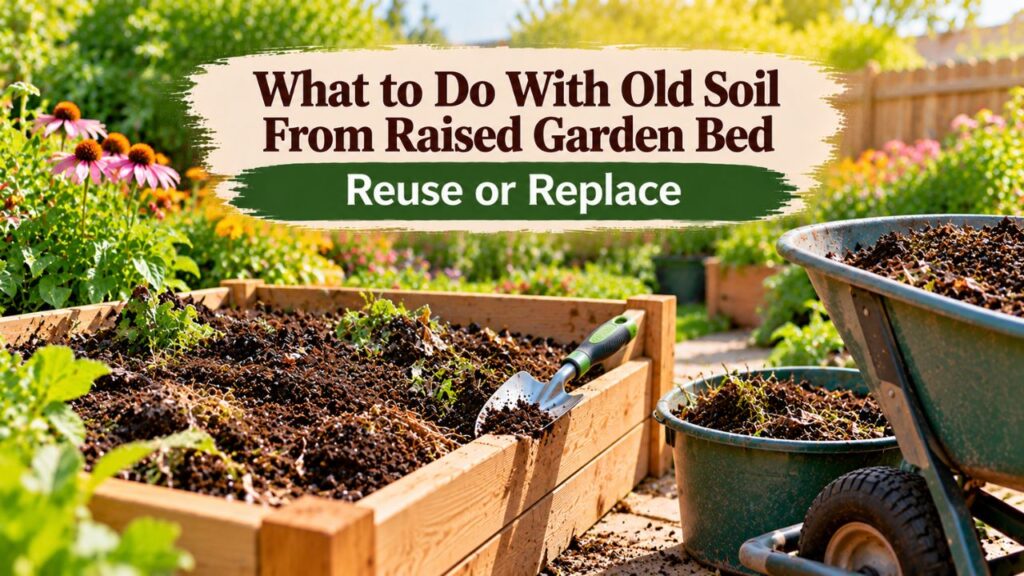
What to Do With Old Soil From Raised Garden Bed: Reuse or Replace
You can usually reuse old soil from a raised garden bed instead of throwing it away. Remove weeds and spent plants, check the soil’s condition, add finished compost or other amendments as needed, and use it for another growing season. Healthy raised-bed soil can remain productive for many years with proper care.
If you’re dismantling a raised bed or replacing part of its growing medium, you can also reuse suitable soil in other garden beds, flower borders, or landscaping projects.
However, not all old soil should be moved or reused without checking it first. Soil affected by serious plant diseases, chemical contamination, excessive salts, or severe drainage problems may require special attention.
Another common mistake is assuming that soil becomes useless simply because vegetables have grown in it for several seasons. In most cases, the soil’s mineral components remain, while its organic matter, nutrient availability, and physical structure may change.
Understanding how to assess, refresh, and reuse old raised-bed soil can save money and help maintain healthy growing conditions without unnecessary replacement.
What to Do With Old Soil From Raised Garden Bed After Harvest
The best option depends on the soil’s condition and whether you plan to continue using the raised bed.
For healthy soil, leaving it in place is generally the easiest and most practical solution.
You usually don’t need to remove all the soil after harvesting vegetables or flowers.
Best Ways to Handle Old Raised-Bed Soil
| Soil Condition | Recommended Action |
| Healthy but nutrient-depleted | Test and amend as needed |
| Soil level has settled | Add suitable soil or finished compost |
| Compacted soil | Gently loosen and improve organic matter |
| Extra clean soil from a dismantled bed | Reuse in another suitable garden area |
| Soil with persistent weeds | Remove weeds and manage regrowth |
| Soil affected by a serious root disease | Identify the disease before moving soil |
| Soil with suspected chemical contamination | Test and assess before reuse |
A soil mixture that looks dry, faded, or less fluffy than when first purchased is not necessarily unusable.
The important questions are whether it drains adequately, supports healthy roots, contains suitable nutrients, and is free from harmful contamination.
Why Old Raised-Bed Soil Can Still Be Productive
Garden soil contains mineral particles, organic matter, water, air, and living organisms.
The sand, silt, and clay components do not disappear after a growing season.
However, plants remove nutrients as they grow, organic matter gradually decomposes, and repeated watering can change the soil’s structure.
These changes may affect plant growth, but they do not mean the entire soil mixture needs replacement.
For a healthy raised bed, refreshing the existing soil is usually better than starting over.
How to Refresh Old Soil in a Raised Garden Bed
Refreshing soil means improving its growing conditions without removing and replacing the entire mixture.
For an established raised bed, focus on cleaning, checking soil condition, correcting nutrient deficiencies, and protecting the surface.
Step 1: Remove Old Plants, Weeds, and Garden Debris
After the growing season, remove spent vegetable plants, weeds, and unwanted debris.
Pay particular attention to plants showing unusual wilting, root decay, or other possible disease symptoms.
Healthy plant residues can be composted when appropriate.
However, avoid casually composting diseased plant material unless the composting process is suitable for destroying the particular pathogen.
You can leave some healthy roots in the soil to decompose naturally, but remove large root masses when they interfere with future planting.
Remove persistent perennial weeds and as much of their underground root systems as practical.
Step 2: Inspect the Soil’s Texture and Drainage
Take a small handful of moist soil and examine its texture.
Healthy garden soil generally has a crumbly structure that allows water and air to move between particles.
Look for these conditions:
- Hard, compacted soil: May restrict root growth and water movement.
- Waterlogged soil: Can indicate poor drainage or excessive watering.
- Very sandy soil: May drain quickly and require more frequent watering.
- Sunken soil level: Often results from settling and decomposition of organic materials.
- Unpleasant, stagnant smell: May indicate prolonged saturation and poorly aerated conditions.
A visual inspection cannot identify every soil problem, but it can help determine what needs attention.
Do not work the soil aggressively when it is saturated. Wet soil can compact and smear when handled.
Step 3: Test the Old Raised-Bed Soil
A laboratory soil test can identify nutrient levels, soil pH, and other properties relevant to plant growth.
Testing is particularly useful when plants have been growing poorly or when the same raised bed has been used for several seasons.
The University of Minnesota Extension’s raised-bed gardening guidance recommends testing raised-bed soil every two to three years and applying fertilizers or other amendments according to the results.
A standard soil test can help determine whether the bed needs additional nutrients or adjustments to its pH.
If contamination is suspected, request the appropriate specific tests. Ordinary fertility testing does not necessarily identify lead, pesticide residues, or other contaminants.
Avoid applying lime, sulfur, or large quantities of fertilizer without understanding the soil’s actual needs.
Step 4: Add Finished Compost Where Needed
Finished compost can help maintain soil organic matter and support a suitable growing structure.
For established garden beds, the Oregon State University Extension’s compost guidance recommends a yearly compost application of approximately ¼–1 inch, with additional amendments based on soil test results.
Spread compost evenly across the growing surface.
You can gently incorporate it into the upper soil where appropriate, or use it as a surface application when minimizing soil disturbance.
For an existing raised bed, start with the amount justified by its condition rather than automatically adding several inches of compost every season.
Excessive compost applications can contribute to nutrient imbalances and soluble salt buildup.
Important: Compost is not a substitute for every fertilizer. Its nutrient content varies, so a soil test remains useful when deciding what additional nutrients are needed.
Step 5: Loosen Compacted Soil Without Overworking It
If the soil has become compacted, gently loosen the affected area using a garden fork or similar hand tool.
Work when the soil is moist enough to crumble but not wet enough to form sticky clumps.
Avoid repeatedly turning the entire raised bed when the soil already has a healthy structure.
Excessive disturbance can break apart soil aggregates and bring buried weed seeds closer to the surface.
Where compaction is limited to the upper growing layer, shallow loosening may be sufficient.
Adding suitable organic matter and keeping foot traffic out of the bed can help prevent the problem from returning.
Step 6: Restore the Soil Level
Raised-bed soil often settles over time.
This is especially noticeable when the original mixture contains substantial compost, bark, leaves, or other decomposable materials.
Measure how far the soil surface has dropped below the intended level.
Add suitable raised-bed growing mix or quality topsoil as needed.
Do not automatically use pure compost to replace several inches of missing soil.
A balanced soil mixture helps maintain more consistent physical properties and nutrient levels.
Step 7: Protect the Soil Before the Next Growing Season
If the raised bed will remain unused for several months, cover the soil surface.
Suitable options include clean shredded leaves, straw, and other appropriate organic mulches.
You can also plant a cover crop if the season and local climate allow it.
Surface protection helps reduce erosion, suppress some weeds, and moderate soil temperature and moisture changes.
Before planting again, move aside any thick mulch that would interfere with seeding or transplanting.
How Much Compost Should You Add to Old Raised-Bed Soil?
The quantity depends on the bed’s surface area and how much organic matter the soil needs.
For established beds, a thin compost application is often more appropriate than replacing a large portion of the growing medium.
Compost Quantity for Common Raised Bed Sizes
The following estimates show how much compost is needed for a uniform ½-inch surface layer.
| Raised Bed Size | Compost Volume |
| 3 × 3 feet | 0.38 cubic feet |
| 3 × 6 feet | 0.75 cubic feet |
| 4 × 4 feet | 0.67 cubic feet |
| 4 × 8 feet | 1.33 cubic feet |
| 5 × 5 feet | 1.04 cubic feet |
| 8 × 8 feet | 2.67 cubic feet |
These are volume calculations, not fixed annual compost requirements.
For example, a 4×8 raised bed has 32 square feet of growing area.
A ½-inch compost layer equals approximately 0.0417 feet.
32 × 0.0417 = approximately 1.33 cubic feet of compost.
If a soil test shows high nutrient levels, particularly phosphorus, adding more compost may not be appropriate.
Should You Mix Compost Into Old Soil?
You can gently mix finished compost into the upper portion of the soil when improvement is necessary.
However, incorporating compost deeply every year is not always beneficial.
For healthy, established raised beds, surface applications can help reduce unnecessary soil disturbance.
Where the soil is severely compacted or poorly structured, more targeted improvement may be necessary.
Avoid mixing large quantities of unfinished compost, fresh manure, or undecomposed woody materials directly into the vegetable root zone.
Other Ways to Reuse Old Soil From a Raised Garden Bed
If you’re dismantling a raised bed or have extra growing medium, suitable old soil can be reused elsewhere in the garden.
Before moving it, confirm that it is free from known contamination and serious soilborne disease problems.
Reuse Old Soil in Another Raised Bed
Healthy soil from one raised garden bed can be transferred to another.
This works especially well when both beds use similar growing media.
Remove weeds, rocks, and unwanted debris before transferring the soil.
If necessary, blend it with an appropriate growing mix to restore the desired volume and structure.
However, avoid moving soil from a bed affected by a known soilborne disease into a clean growing area.
Add Old Raised-Bed Soil to an In-Ground Garden
Suitable mineral-based raised-bed soil can be incorporated into existing garden areas.
This may be useful when expanding a vegetable garden or improving the depth of a planting area.
Check the soil’s texture before combining large quantities with existing ground.
For example, adding a heavy clay-rich mixture to an already poorly draining area may not improve growing conditions.
Small additions of suitable soil can be useful, but they should complement the existing soil rather than create an unfavorable layer.
Use Old Soil in Flower Beds
Healthy raised-bed soil can be reused in outdoor flower borders.
This is a practical option when you no longer need the original vegetable bed.
Remove weeds and inspect the soil for signs of poor drainage.
If necessary, incorporate suitable amendments before planting flowers.
Choose a location where the soil’s texture and drainage characteristics match the plants’ requirements.
Use Old Soil for Landscaping and Leveling
Clean, suitable soil can also be useful for minor landscaping projects.
Possible applications include:
- Filling shallow depressions in planting areas.
- Restoring soil levels in ornamental beds.
- Creating small planting mounds.
- Improving the depth of existing garden borders.
- Replacing soil lost through erosion in landscaped areas.
Avoid using contaminated or disease-affected soil as general landscape fill.
Also avoid creating deep soil layers over established tree roots or piling soil against tree trunks, foundations, or building siding.
Can You Reuse Old Raised-Bed Soil in Pots?
Sometimes, but traditional raised-bed soil is generally not the best material for ordinary plant pots.
Many raised-bed mixtures contain substantial natural topsoil, which can become heavy and compacted inside containers.
Potted plants usually benefit from a lightweight growing medium specifically formulated for container drainage and root aeration.
If the old raised-bed mixture is a lightweight soilless product labeled for containers, it may be usable after checking its condition.
For small pots, indoor houseplants, and seed-starting trays, fresh appropriate potting media are generally more reliable.
When Should You Avoid Reusing Old Raised-Bed Soil?
Some problems require more than ordinary soil refreshing.
Known contamination and certain soilborne diseases are especially important when deciding whether to move or reuse old soil.
Soil With Serious Soilborne Diseases
If vegetables suffered from a confirmed soilborne disease, avoid transferring that soil into healthy growing areas.
Some disease-causing organisms can survive in soil or infected plant debris beyond the growing season.
Examples include certain pathogens responsible for vascular wilts and root rots.
However, not every plant disease means the soil must be discarded.
Leaf diseases and problems caused mainly by weather or watering do not automatically make the entire bed unusable.
Identify the cause before making a replacement decision.
Do not spread potentially infected soil between raised beds while the problem remains unidentified.
Soil With Suspected Chemical Contamination
Soil may become contaminated through certain pesticides, industrial residues, treated materials, or other sources.
If contamination is suspected, do not move the soil into another food-growing area.
A laboratory test may be necessary to identify the specific substances involved.
Adding compost does not reliably eliminate heavy metals or persistent chemical contamination.
If harmful contamination is confirmed, seek local environmental or agricultural guidance on appropriate management and disposal.
Soil With Excessive Salt Buildup
Repeated fertilizer applications, some composts, and saline irrigation water can contribute to soluble salt accumulation.
High salt levels may interfere with plant water uptake and damage roots.
A laboratory electrical conductivity test can help identify this problem.
Depending on the severity, soil type, and drainage conditions, corrective measures may include improving drainage and carefully leaching excess salts with suitable water.
Severe problems may require a more specialized management plan.
Simply adding additional fertilizer or compost can make salt-related problems worse.
Soil With Persistent Weed Problems
Old soil containing weed seeds or persistent underground roots can remain difficult to manage.
However, the presence of ordinary weeds does not automatically require replacing the soil.
Remove perennial weed roots carefully and avoid allowing weeds to produce new seeds.
Use mulch or suitable cover crops to reduce future growth.
If the soil contains invasive weeds capable of spreading through root fragments or rhizomes, avoid moving it to other locations until the problem is properly controlled.
Can Old Raised-Bed Soil Be Reused After Plant Disease?
The answer depends on the specific disease and how it spreads.
A plant showing yellow leaves, weak growth, or wilting is not enough evidence to conclude that the soil is infected.
Similar symptoms can result from drought, overwatering, nutrient deficiencies, root damage, or disease.
Identify the Disease Before Replacing Soil
Begin by examining the affected plants and roots.
Record which crops were affected and when the symptoms appeared.
A local cooperative extension service or plant diagnostic laboratory may be able to identify the problem.
For diseases that primarily affect leaves, removing infected plant debris and improving garden sanitation may be sufficient.
For persistent soilborne pathogens, management may involve crop rotation, resistant varieties, or avoiding susceptible crops in that bed.
Replacing soil without correcting the underlying problem may not prevent the disease from returning.
Rotate Vegetable Crops When Practical
Crop rotation can help manage certain soilborne disease problems.
For example, tomatoes, peppers, potatoes, and eggplants belong to the same plant family.
Repeatedly growing these crops in the same bed can favor certain pests and pathogens associated with that plant family.
Where possible, avoid planting members of the same family in the same bed for approximately three to four years when managing relevant soilborne diseases.
However, some pathogens survive longer, so crop rotation alone is not a universal solution.
In small gardens, using several raised beds can make crop rotation easier.
Should You Put Diseased Soil in the Compost Bin?
Avoid placing soil known to contain persistent plant pathogens into a home compost pile without guidance specific to that pathogen.
Ordinary backyard compost piles do not always maintain uniform temperatures high enough to eliminate every disease-causing organism.
Moving infected soil through compost can potentially spread a problem to previously unaffected areas.
The proper response depends on the organism involved.
If the disease is serious or uncertain, obtain local diagnostic advice before composting, relocating, or disposing of the affected material.
How to Improve Old Raised-Bed Soil That Has Become Hard
Raised-bed soil can lose its loose structure after repeated watering, foot traffic, or changes in organic matter.
The correct solution depends on whether the problem is surface crusting, deeper compaction, or poor drainage.
Fix Surface Crusting
If the upper layer becomes hard after watering, gently break the crust with a hand cultivator when the soil is workable.
Avoid disturbing roots of established plants.
A suitable organic mulch can help protect the surface from direct rainfall and reduce repeated crust formation.
If the problem continues, assess the soil texture and organic matter content.
Improve Compacted Growing Soil
For compacted soil, use a garden fork to gently loosen the affected area.
Avoid walking or placing heavy objects on the planting surface.
Add finished organic matter when appropriate and maintain soil cover.
Do not assume that adding a small amount of sand to clay-rich soil will solve compaction. Depending on the proportions and particle sizes, the result may remain poorly structured.
Correcting the underlying cause is more effective than repeatedly digging the same soil.
Correct Poor Drainage
If the soil stays saturated, determine whether water can leave the bed.
Check for blocked drainage outlets in enclosed raised planters.
For open-bottom beds, examine whether compacted underlying ground or unsuitable soil layers are restricting water movement.
Avoid adding a gravel layer as a general drainage solution.
Gravel does not automatically improve drainage and can reduce the space available for a suitable growing medium.
Improving the soil structure and drainage pathway is usually more useful.
How to Store Old Raised-Bed Soil for Later Use
If you’re removing soil temporarily while rebuilding a raised bed, proper storage can help preserve its condition.
Choose a Clean Storage Location
Place healthy soil on a clean tarp or in a suitable storage container.
Avoid mixing it with construction waste, contaminated ground, or chemicals.
Keep different soil types separate when their compositions or uses differ.
Protect the Soil From Excess Rain
Cover stored soil to reduce nutrient runoff, weed growth, and erosion.
However, avoid leaving the material waterlogged in a sealed container.
Provide appropriate protection against heavy rainfall while preventing prolonged saturation.
Keep Soil Free From Unwanted Materials
Remove large weeds, unwanted roots, and other debris before storage.
Avoid adding raw kitchen waste or fresh manure to stored soil.
When you’re ready to reuse the material, inspect its moisture, texture, and condition.
If needed, conduct a soil test and add suitable amendments before planting.
When Is It Better to Replace Raised-Bed Soil Completely?
Complete replacement is rarely necessary simply because the soil is several years old.
However, it may be reasonable in certain situations.
Examples include:
- Confirmed contamination that cannot be safely managed in place.
- A persistent soilborne disease for which replacement is part of an appropriate control strategy.
- Severely degraded growing media that cannot be restored economically.
- Major reconstruction requiring a different growing-medium composition.
- An enclosed raised planter containing a worn-out soilless mix that has lost much of its original structure.
Even in these situations, replacement should address the specific problem rather than rely on the soil’s age alone.
If the bed has drainage problems, for example, installing fresh soil without correcting drainage may produce the same symptoms.
Similarly, a disease may return if contaminated tools, infected plants, or other sources introduce it again.
For ordinary nutrient depletion, settling, or minor compaction, improving the existing soil is generally more practical.
Conclusion
Deciding what to do with old soil from raised garden bed depends on its condition, not how many growing seasons it has been used.
Healthy raised-bed soil can usually remain in place. Remove unwanted plant debris, test the soil periodically, add appropriate amendments, and restore the soil level when necessary.
If you have extra soil from a dismantled bed, reuse it in another suitable garden bed, flower border, or landscaping area, provided it is free from significant contamination and serious soilborne disease.
Avoid throwing away an entire bed of soil simply because it looks old or plants have grown in it for several years.
For most established raised gardens, regular maintenance, careful nutrient management, and protection against compaction can keep the existing soil productive without the cost of complete replacement.
FAQs About what to do with old soil from raised garden bed
Does Raised Garden Bed Soil Need to Be Replaced Every Year?
No. Healthy mineral-based raised-bed soil usually does not need annual replacement.
It can remain productive for many years when nutrients, organic matter, and soil structure are properly maintained.
Periodic soil testing helps identify which amendments are actually needed.
Can I Mix Old Raised-Bed Soil With New Soil?
Yes. Healthy old raised-bed soil can be combined with new, suitable growing medium.
This can be useful when the original soil level has settled or when expanding an existing bed.
Choose a compatible mixture and avoid adding unnecessary amounts of compost or fertilizer.
Can I Use Old Raised-Bed Soil to Fill Holes in My Yard?
Yes, clean and suitable old soil can be used for minor leveling in landscaped areas.
However, avoid burying established turf under thick layers of soil or changing drainage patterns toward buildings.
Do not use contaminated or seriously disease-affected soil as general fill.
Can I Reuse Raised-Bed Soil After Growing Tomatoes?
Yes, if the tomatoes were healthy and the soil has no known serious disease or contamination problem.
Remove plant debris, assess nutrient needs, and prepare the bed for the next crop.
Where possible, rotate to a different vegetable family, particularly if disease management is a concern.
Should I Add Fertilizer to Old Raised-Bed Soil Before Planting?
Fertilizer may be necessary if the soil is deficient in nutrients, but it should not be applied automatically.
A soil test can help identify which nutrients are needed and whether the soil pH requires adjustment.
Excess fertilizer can create salt buildup and nutrient imbalances.
Can I Leave Old Raised-Bed Soil Outside During Winter?
Yes. Established raised-bed soil can remain outside through winter.
Covering it with suitable mulch or growing a cover crop can help protect against erosion, weed growth, and exposure to severe weather.
There is generally no need to remove the soil simply because the growing season has ended.

I’m Maya L. Greenwood, a lifelong plant lover who believes anyone can grow something beautiful with the right guidance. After years of testing soil mixes, pruning methods, irrigation tricks, and pest-safe solutions, I started EasyGardenTips.com to turn hard-won lessons into step-by-step advice. From seed starting and container gardens to composting and seasonal checklists, my goal is to make gardening simple, sustainable, and fun.