How to Turn Garden Soil Into Raised Bed Soil That Drains Well
You can turn garden soil into raised bed soil by loosening the existing soil, mixing in finished compost, and making sure the mixture drains properly. If your garden soil is clean, reasonably fertile, and suitable for growing vegetables, you usually don’t need to replace it with expensive commercial raised bed soil.
However, not all garden soil behaves the same way. Heavy clay can hold too much water, sandy soil may dry out quickly, and compacted soil can restrict root growth. Simply moving these soils into a raised garden bed won’t automatically improve their structure.
The goal is to create a balanced growing medium that holds enough moisture and nutrients while allowing excess water to drain. Existing mineral soil provides a useful foundation, while organic matter helps improve its structure and support healthy plant growth.
The process depends on your soil’s current condition, the raised bed’s depth, and the vegetables or flowers you plan to grow. With the right preparation, even ordinary backyard soil can become a productive raised bed growing medium.
How to Turn Garden Soil Into Raised Bed Soil Step by Step
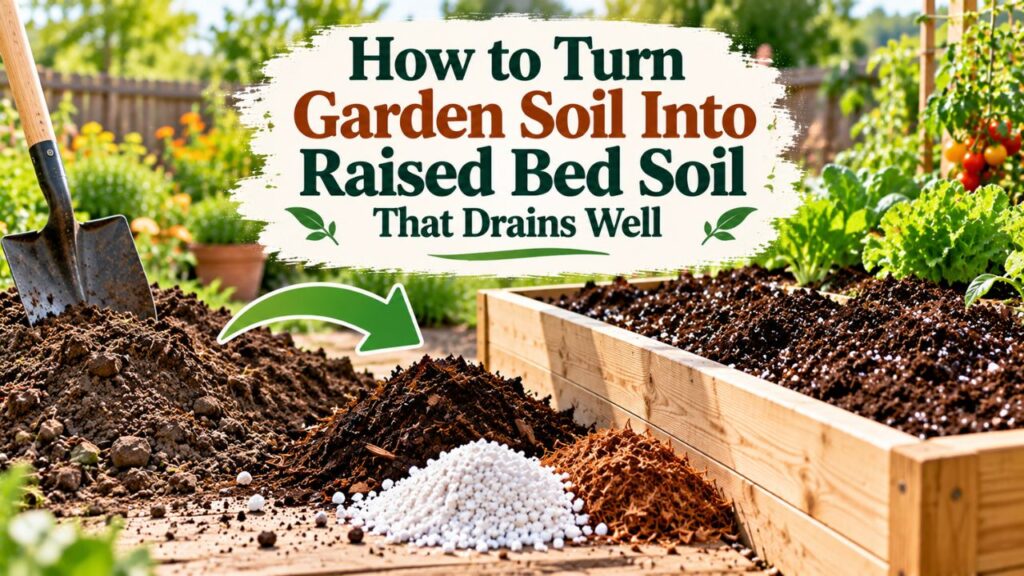
Converting existing soil into a raised bed mix involves checking its condition, improving its structure, and preparing a suitable environment for plant roots.
The following steps work best for raised beds built directly over natural ground.
Step 1: Check Your Existing Garden Soil
Start by examining the soil you plan to use. Its texture, drainage, fertility, and history determine which improvements are necessary.
Take a handful of slightly moist soil and squeeze it gently.
- Loamy soil: Forms a loose ball that crumbles under light pressure. It usually offers a useful balance of drainage and moisture retention.
- Clay soil: Feels sticky when wet and may form a dense lump. It can become hard when dry.
- Sandy soil: Feels gritty and falls apart easily. Water often moves through it quickly.
- Compacted soil: Feels hard, resists digging, and may prevent water from soaking in evenly.
These simple observations help identify texture problems, but they cannot reveal nutrient deficiencies or contamination.
For vegetable gardens, consider a laboratory soil test before making major amendments. A basic test can measure soil pH and important nutrients.
The University of Maryland Extension’s raised bed soil guidance recommends soil testing and specifically checking for lead when growing food. Lead testing may need to be requested separately from a standard fertility test.
Important: Avoid using soil of uncertain safety from industrial areas, heavily contaminated sites, or locations with a history of hazardous chemicals. Adding compost does not make contaminated soil safe for growing vegetables.
Step 2: Remove Weeds, Grass, and Unwanted Materials
Before blending garden soil with amendments, remove anything that could interfere with root development.
Clear away:
- Established weeds and their roots
- Grass clumps and underground runners
- Large stones and construction debris
- Plastic, glass, and other foreign materials
- Diseased plant debris that may carry persistent pathogens
Small stones generally don’t need to be removed, but large rocks can make digging and planting difficult.
If you’re collecting soil from an existing vegetable garden, take care not to mix large amounts of weed roots into the new bed.
Soil can also contain dormant weed seeds. Removing visible weeds helps, but some seeds may germinate after the soil is disturbed.
Step 3: Loosen the Soil Beneath the Raised Bed
A raised bed placed directly on the ground can benefit from the soil underneath it.
Before adding the new mixture, use a garden fork or spade to loosen approximately 6–8 inches of the underlying soil.
Push the fork into the ground and gently rock it backward and forward. Repeat across the bed’s footprint.
This process helps reduce compaction without unnecessarily turning over every layer of soil.
Loosening the base can:
- Improve the connection between the raised bed mix and native ground
- Allow roots to grow deeper when conditions permit
- Improve water movement into the underlying soil
- Reduce resistance to developing roots
Avoid working clay-heavy soil when it’s saturated. Wet clay can become more compacted and form hard clumps after drying.
If the native ground has severe drainage problems, loosening alone may not solve them. The site may need a drainage correction before installation.
Step 4: Mix Finished Compost With Garden Soil
Compost is one of the most useful amendments for improving ordinary garden soil.
Finished compost adds organic matter that helps improve soil structure, moisture retention, and nutrient availability.
For a new raised bed that requires additional soil, a practical starting mixture is:
- 2 parts clean, good-quality garden soil
- 1 part mature compost
These proportions are measured by volume, not weight.
For example, combining two buckets of garden soil with one equally sized bucket of compost produces a mixture containing approximately two-thirds soil and one-third compost.
This is a starting option rather than a universal requirement.
For existing soil that’s already in good condition, a lighter amendment may be sufficient.
Rutgers Cooperative Extension’s Soil for Raised Beds guide recommends using native mineral soil when suitable and describes incorporating approximately 1–2 inches of compost into the upper 6 inches of soil as a general improvement method.
When selecting compost, look for material that is:
- Fully decomposed and mature
- Dark and relatively crumbly
- Free from excessive undecomposed scraps
- Free from strong ammonia or rotten odors
- Obtained from a reliable source
Avoid filling a permanent raised garden bed entirely with compost. Organic material continues decomposing, and a compost-only mixture can lose volume and develop undesirable growing conditions over time.
Step 5: Blend the Soil and Compost Evenly
Once the materials are ready, combine them thoroughly.
If you’re preparing the mixture outside the raised bed, spread the garden soil over a tarp or clean working area.
Add the compost in layers, then use a shovel or garden fork to turn the materials together.
Continue until the mixture has a reasonably uniform appearance.
If you’re amending soil already inside a raised bed, spread the compost across the surface and gently incorporate it into the appropriate depth.
Avoid leaving a thick, sharply separated layer of compost over compacted mineral soil when preparing a new bed.
Gradually blending the materials helps create a more consistent growing environment and reduces the chance of abrupt changes in water movement.
Keep in mind: Don’t repeatedly work the mixture until it’s powdery. The goal is loose, stable soil with small aggregates, not finely pulverized material.
Step 6: Fill the Raised Bed and Check Drainage
Transfer the prepared soil into the raised bed.
Spread it evenly with a rake, breaking apart large clumps as necessary.
Allow room near the top for watering and mulch. Avoid pressing the soil firmly into place.
After filling, water the surface gently and observe how the soil behaves.
Healthy raised bed soil should absorb water without prolonged surface pooling while retaining enough moisture for plant roots.
Some settling is normal, particularly when the mixture contains compost. Add more prepared soil if the level drops substantially.
Once the bed is ready, plant your vegetables or flowers and apply a suitable layer of organic mulch around established plants.
How to Improve Different Types of Garden Soil for Raised Beds
The correct soil amendment depends on whether your existing soil is clay-heavy, sandy, compacted, or already well structured.
Adding the same materials in identical amounts to every soil type can create unnecessary problems.
Turning Clay Garden Soil Into Raised Bed Soil
Clay soil contains very small mineral particles that can hold considerable moisture. When compacted, it may drain slowly and provide limited air space around roots.
To improve clay-heavy garden soil:
- Loosen the soil when it’s moist but not sticky.
- Remove large compacted clods where practical.
- Incorporate mature compost to improve soil structure.
- Use clean, good-quality loamy topsoil as part of the new raised bed fill if the native clay is extremely dense.
- Maintain an open connection with the loosened soil underneath the bed.
Avoid adding small amounts of ordinary sand as a quick solution. Sand doesn’t automatically correct clay drainage problems, and the amount and particle size needed to change soil texture depend on the original soil.
For particularly heavy clay, building the raised bed higher and using a well-structured topsoil-and-compost mixture above the loosened ground may be more practical than relying entirely on the existing clay.
Turning Sandy Garden Soil Into Raised Bed Soil
Sandy soil generally allows water to move through quickly, but it may struggle to retain moisture and some nutrients.
Compost helps improve water retention and supports the soil’s ability to hold nutrients.
Mix mature compost into the sandy garden soil, making sure it is distributed throughout the growing layer rather than concentrated in one location.
After planting, apply mulch to reduce moisture loss from the surface.
Sandy raised beds may still require more frequent watering than beds containing well-structured loam.
Monitor moisture below the surface instead of assuming the soil is wet because the top appears damp.
Improving Compacted Garden Soil for Raised Beds
Compacted soil contains fewer large pore spaces, which restricts drainage, air movement, and root development.
The first improvement should be physical loosening rather than adding large amounts of fertilizer.
Use a garden fork to gently relieve compaction, then incorporate organic matter where appropriate.
Avoid stepping inside the raised bed after preparation. Repeated foot traffic can compress the soil again.
For permanent beds, keep the growing area narrow enough that you can comfortably reach the center from the sides.
Using Already Fertile Garden Soil
If your existing garden soil is loose, dark, crumbly, well-drained, and productive, it may need only minor changes.
A modest compost application can help maintain organic matter, but there’s no reason to add excessive quantities.
Use the soil test results to determine whether fertilizer or pH adjustments are needed.
Good garden soil does not need to be completely rebuilt simply because it is being used in a raised bed.
How Much Garden Soil and Compost Should You Mix?
The amount depends on the volume you’re preparing and the condition of the original soil.
A two-parts-soil-to-one-part-compost mixture can serve as a starting point for filling a new raised bed when the garden soil is suitable and additional organic matter is needed.
However, a bed built over an already healthy vegetable garden may require only a compost amendment rather than an entirely new mixture.
Example: Preparing Soil for a 4 × 8-Foot Raised Bed
Suppose you want to fill a raised bed measuring:
- Length: 8 feet
- Width: 4 feet
- Soil fill depth: 9 inches (0.75 feet)
Calculate the volume:
8 × 4 × 0.75 = 24 cubic feet
Using a 2:1 soil-to-compost mixture gives the following approximate quantities:
| Material | Amount |
| Existing garden soil | 16 cubic feet |
| Finished compost | 8 cubic feet |
| Total mixture | 24 cubic feet |
This example assumes the full 9-inch depth needs to be filled.
If the bed already contains usable soil, calculate only the additional volume needed. Soil may also settle after filling, so the final volume can change slightly.
Should You Add Perlite or Vermiculite?
Perlite and vermiculite are common ingredients in container growing mixes, but neither is essential for every raised bed.
Perlite is a lightweight, porous material that can improve air space in certain growing media.
Vermiculite is another lightweight mineral material that can retain moisture.
For a permanent, open-bottom raised bed containing well-structured mineral soil, compost and suitable topsoil are often sufficient.
Adding perlite or vermiculite may increase costs without providing a meaningful improvement.
These materials become more relevant when designing specific lightweight growing mixtures for planters or other contained systems.
Can You Use Regular Garden Soil Alone in a Raised Bed?
Yes, you can use regular garden soil alone if it’s clean, fertile, well structured, and drains adequately.
Natural mineral soil already contains sand, silt, clay, organic matter, and organisms involved in nutrient cycling.
Its suitability depends on the balance of those components and the conditions in which plants will grow.
However, using unamended garden soil can cause problems when the existing material is:
- Extremely compacted
- High in dense clay
- Very low in organic matter
- Poorly drained
- Deficient in important nutrients
Adding a raised bed frame does not automatically correct these conditions.
It’s also important to distinguish natural garden soil from products sold in bags under similar names.
Some packaged products labeled garden soil or topsoil contain mostly composted materials, bark, peat, or other organic ingredients rather than mineral soil.
Check the ingredients before deciding how much of a packaged product to mix with your existing soil.
Mistakes That Can Reduce Raised Bed Soil Quality
Even suitable garden soil can perform poorly when it’s prepared incorrectly.
Adding Too Much Compost
Compost improves soil, but excessive amounts can create problems.
Large quantities may contribute excessive nutrient levels, salt accumulation, or significant settling as the material continues decomposing.
Use compost to correct a specific need rather than assuming that more will always produce better results.
Mixing Soil While It’s Too Wet
Working saturated soil can damage its structure.
This is especially noticeable with clay, which may form dense clumps when handled while very wet.
Wait until the soil is moist enough to crumble but not so wet that it smears or sticks heavily to tools.
Adding Fertilizer Without Checking Nutrient Levels
Compost and existing garden soil may already provide significant nutrients.
Applying additional fertilizer without knowing the soil’s nutrient status can produce imbalances.
A laboratory test offers better guidance than choosing fertilizer amounts based only on appearance.
Creating Separate Layers of Different Soils
Placing a thick layer of unfamiliar soil directly over a compacted base can create an abrupt boundary that affects water movement and root penetration.
When feasible, loosen the underlying mineral soil and blend a shallow transition zone before adding the remaining raised bed mixture.
This is particularly useful when combining imported topsoil with existing native ground.
Using Fresh Manure Instead of Finished Compost
Fresh manure isn’t a direct substitute for mature compost.
It can contain weed seeds, excessive soluble nutrients, and pathogens that create food safety concerns.
For vegetable raised beds, choose properly processed, mature compost from a trustworthy source.
How to Tell When Your Raised Bed Soil Is Ready for Planting
The finished mixture should have a workable texture, allow water to enter the soil, and provide sufficient air and moisture for growing roots.
Several simple checks can help assess its condition.
Check the Soil Texture
Pick up a handful of slightly moist soil.
It should feel relatively loose and form aggregates that break apart under gentle pressure.
Some clay-rich soils naturally hold together more strongly than sandy soils, so the goal isn’t to make every mixture feel identical.
Look for a texture that can be worked without excessive force or dense, hardened clods.
Observe How Water Moves Through the Soil
Water a small section slowly.
The surface should absorb water rather than remaining covered by puddles for extended periods.
If water consistently pools, check for compaction, saturated underlying soil, or inadequate drainage.
If water runs straight through and the soil dries rapidly, the mixture may need better moisture management.
A newly prepared bed can also behave differently after settling and several watering cycles.
Confirm Soil Fertility and pH
Good texture doesn’t guarantee that the soil contains balanced nutrients.
Review laboratory soil test results for pH and nutrient recommendations.
Most common vegetables grow well in moderately acidic to near-neutral soil, although individual crops have different preferences.
Add lime, sulfur, or fertilizer only when appropriate for the crop and supported by the soil conditions.
Once the structure, drainage, and fertility are suitable, the bed can be planted.
How to Maintain Garden Soil After Converting It Into Raised Bed Soil
Raised bed soil needs ongoing care, but that doesn’t mean replacing the entire mixture every year.
Compost continues decomposing, plants remove nutrients, and regular watering can influence soil conditions.
A few maintenance habits help protect the improvements made during preparation.
Add Compost When the Soil Needs It
After harvesting, inspect the soil’s structure and organic matter condition.
If additional organic matter is needed, spread a modest layer of mature compost over the surface.
Established beds can often be maintained with surface applications rather than repeated deep digging.
Avoid automatically repeating the full initial compost ratio every growing season.
Keep the Raised Bed Mulched
Organic mulch helps protect the soil surface from drying, crusting, and erosion.
Suitable options include clean straw and shredded leaves.
Apply mulch around plants while keeping it away from direct contact with stems.
As organic mulch decomposes, it also contributes material to the soil surface.
Avoid Repeated Soil Compaction
Keep walking paths outside the raised bed.
Use hand tools gently when preparing the surface for new crops.
Leaving deeper soil layers relatively undisturbed can help preserve soil structure and root channels.
Monitor Soil Nutrients Over Time
Vegetables use nutrients as they grow, especially in beds that produce several crops per year.
Use changes in plant growth, crop demands, and periodic soil testing to guide fertility management.
Healthy raised bed soil is maintained through appropriate watering, organic matter management, and targeted nutrient additions rather than replacing soil unnecessarily.
Conclusion
Understanding how to turn garden soil into raised bed soil can help reduce gardening costs while making good use of existing materials.
The most practical approach is to start with clean, suitable garden soil, loosen compacted areas, and incorporate finished compost according to the soil’s actual condition.
Clay-heavy soil may need additional structural improvement, while sandy soil often benefits from better moisture retention. Already fertile loam may require very little amendment.
For a permanent raised garden bed, preserving a healthy mineral soil foundation is usually more sustainable than replacing it entirely with lightweight organic growing media.
Focus on good drainage, balanced organic matter, and adequate fertility. These qualities create a reliable growing environment for vegetables, herbs, and flowers.
FAQs About How to Turn Garden Soil Into Raised Bed Soil
Can I Use Soil From My Backyard to Fill a Raised Bed?
Yes, backyard soil can be used if it’s clean, structurally suitable, and free from concerning contamination. Remove weeds and debris, assess drainage, and add finished compost if the soil needs more organic matter.
How Much Compost Should I Add to Regular Garden Soil?
For a new raised bed that requires additional fill, approximately two parts suitable garden soil to one part finished compost is a reasonable starting mixture. If you’re improving soil that’s already fertile and well structured, a smaller compost amendment may be sufficient.
Can I Turn Clay Soil Into Raised Bed Soil Without Buying New Soil?
Yes, moderately clay-rich soil can often be improved by loosening compacted areas and incorporating mature compost. Extremely dense clay may benefit from additional clean, loamy topsoil, especially when filling a taller raised bed.
Can I Plant Immediately After Mixing Garden Soil and Compost?
Yes, planting can usually begin after blending the soil with fully mature compost, provided the soil is suitable for the intended crops. If a soil test calls for lime or other amendments that need time to react, follow the laboratory’s recommendations.
Do I Need to Replace Raised Bed Soil Every Year?
No, permanent raised bed soil generally doesn’t need complete replacement every year. Maintain it by checking fertility, adding compost when appropriate, reducing compaction, and replenishing soil lost through settling or erosion.
Is Garden Soil Better Than Potting Soil for Raised Beds?
For permanent raised beds built directly on the ground, good-quality mineral garden soil amended with compost is often a practical, long-lasting choice. Potting soil is designed mainly for containers and may contain a high proportion of lightweight organic materials that settle or change structure over time.

I’m Maya L. Greenwood, a lifelong plant lover who believes anyone can grow something beautiful with the right guidance. After years of testing soil mixes, pruning methods, irrigation tricks, and pest-safe solutions, I started EasyGardenTips.com to turn hard-won lessons into step-by-step advice. From seed starting and container gardens to composting and seasonal checklists, my goal is to make gardening simple, sustainable, and fun.