3 Best Long Lasting LED Light Bulbs for Years of Reliable Use
Replacing a light bulb should not feel like a regular household chore. The best long lasting LED light bulbs combine a high rated operating life with efficient wattage, useful brightness, dependable E26 compatibility, appropriate color temperature, and the right design for the fixture where they will actually operate.
Rated life is only part of the story. Heat buildup, enclosed fixtures, incompatible dimmers, poor electrical connections, and excessive ambient temperature can all shorten real-world LED life, so I would choose a bulb based on rated hours, fixture compatibility, actual watts, lumens, dimming support, CRI, and thermal conditions rather than simply buying the bulb with the biggest lifespan claim.
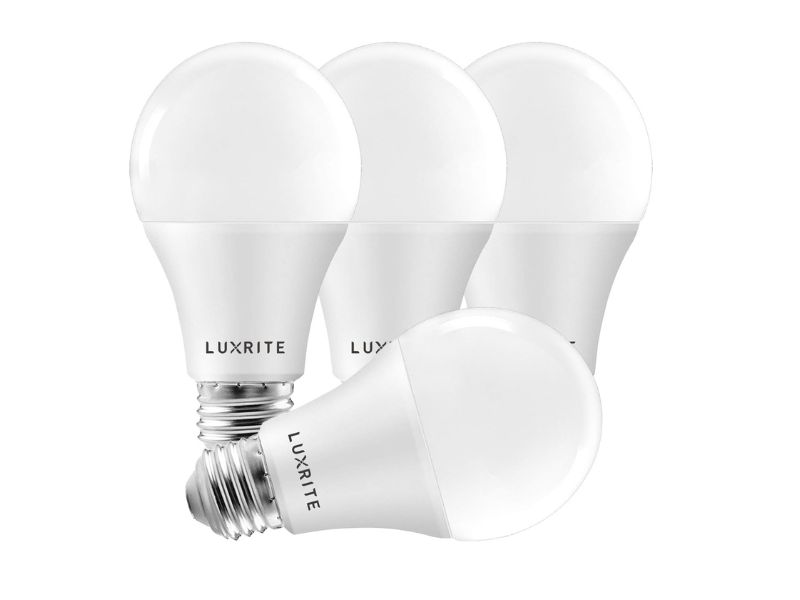
My primary recommendation is the LUXRITE A19 100W Equivalent Dimmable LED Bulbs. I would choose them when I need strong general-purpose illumination because the current four-pack combines 1,600 lumens, 15W actual consumption, 100W-equivalent brightness, 4000K cool white output, 100–10% dimming, enclosed-fixture compatibility, and a 25,000-hour rated life.
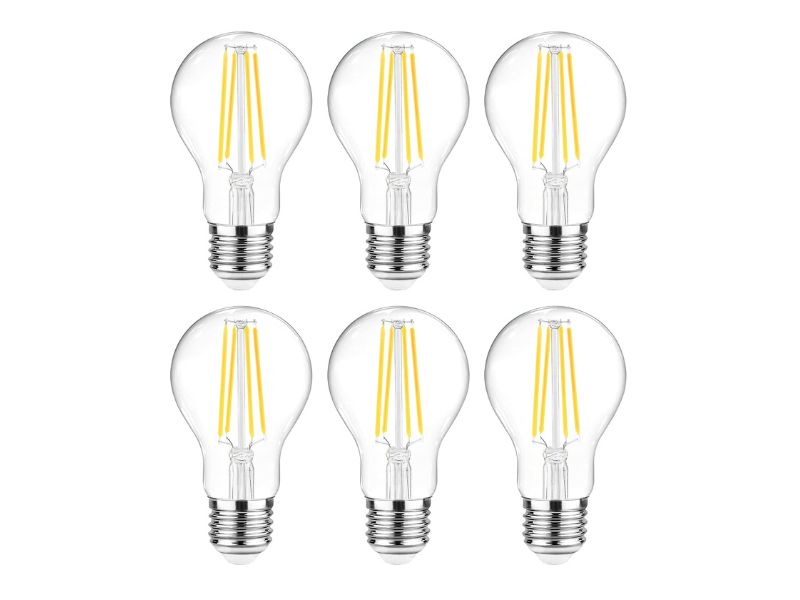
I would choose the Ascher A19 60W Equivalent LED Filament Bulbs when lower power consumption and a visible clear-filament design matter more than dimming. The selected 4000K model uses 6W, produces 750 lumens, fits a standard E26 base, has a 280-degree beam angle, and carries a 20,000+ hour lifespan specification.
For kitchens, offices, bathrooms, and other areas where I want brighter daylight color and better color rendering, I would choose the Feit Electric A19 60W Equivalent Daylight LED Bulbs. This eight-pack provides 800 lumens, 5000K daylight, 90+ CRI, 8.8W consumption, dimming, damp-location suitability, and up to 25,000 hours of rated life.
3 Best Long Lasting LED Light Bulbs
1. LUXRITE A19 100W Equivalent Dimmable LED Bulbs
Key Features
- 25,000-hour rated lifespan
- 1,600 lumens
- 15W actual power
- 100W incandescent equivalent
- 4000K cool white
- E26 medium base
- Dimmable from approximately 100% to 10%
- Enclosed-fixture compatible
- Damp-location rated
- ENERGY STAR listed on the current product page
- Four bulbs in the selected package
The LUXRITE A19 is my primary recommendation because it combines long rated life with considerably more brightness than a conventional 60W-equivalent household LED.
The current Amazon listing specifies 1,600 lumens from 15W, while positioning the bulb as a replacement for a traditional 100W incandescent. It also lists a 25,000-hour lifespan and support for enclosed fixtures.
That combination makes it particularly useful in spaces where one bulb needs to provide substantial illumination.
I would consider it for:
- Kitchens
- Garages
- Workshops
- Larger bedrooms
- Living rooms
- Hallways
- Ceiling fans
- Floor lamps
- Utility spaces
- Covered outdoor fixtures where the fixture and installation permit it
The 1,600-lumen output is the first major advantage.
A long-lasting bulb is not especially useful if it leaves a room too dim.
Many common 60W-equivalent LEDs sit around the 800-lumen class.
This LUXRITE version approximately doubles that brightness while remaining far below the 100W consumption associated with the incandescent bulb it is intended to replace.
Actual consumption is 15W.
That means replacing a 100W incandescent with one of these reduces nominal lighting power by:
100W – 15W = 85W
for every hour the lamp is operating.
The manufacturer describes this as roughly an 85% energy reduction versus the incandescent equivalent.
The 25,000-hour rated life is the bigger reason it belongs in this guide.
At three hours per day:
25,000 ÷ 3 = 8,333 days
which is approximately:
22.8 years
That familiar “22 years” figure assumes only about three hours of daily operation.
If the bulb runs much longer, calendar life naturally becomes shorter.
At eight hours per day:
25,000 ÷ 8 = 3,125 days
or roughly:
8.6 years.
At twelve hours daily:
25,000 ÷ 12 ≈ 2,083 days
or approximately:
5.7 years.
This is why I prefer talking about rated operating hours rather than saying a bulb will definitely last a certain number of years.
How many years you actually get depends on use.
Dimming is another strong feature.
The current bulb is designed to reduce output from approximately 100% down to 10% when used with compatible controls.
That makes the 1,600-lumen maximum more manageable.
You can use full brightness for:
- Cleaning
- Cooking
- Detailed work
then lower it for:
- Evening lighting
- Watching television
- Relaxing
- Lower ambient illumination
A dimmable 100W-equivalent bulb therefore provides more flexibility than buying a permanently lower-output lamp.
The 4000K color temperature falls between warm residential light and cooler daylight.
I generally think of 4000K as a useful neutral-to-cool option.
It works particularly well where visual clarity matters.
Compared with 2700K, it appears cleaner and less yellow.
Compared with 5000K, it usually feels somewhat less stark.
That makes it a good compromise for:
- Kitchens
- Utility rooms
- Work areas
- Modern living spaces
The ability to operate in enclosed fixtures is another detail I would pay attention to when longevity matters.
LED electronics are sensitive to heat.
Placing a bulb that is not approved for enclosed use inside a sealed globe can trap heat around the driver and LEDs.
That can shorten operating life.
LUXRITE specifically lists this bulb for enclosed fixtures.
That does not mean heat is irrelevant.
It means the bulb is designed and rated for that application.
I would still avoid installing LEDs in conditions that exceed the manufacturer’s temperature or fixture requirements.
The current product page also lists damp-location suitability and UL-related safety information.
That adds flexibility for places such as bathrooms or appropriately protected exterior fixtures.
What I Like
- Excellent 25,000-hour rated life
- High 1,600-lumen output
- Only 15W actual consumption
- Dimmable
- Works in enclosed fixtures
- Useful 4000K color temperature
- Damp-location compatibility
- Strong option for high-output household lighting
What I Do Not Like
- 1,600 lumens can be excessive for small bedside lamps
- 4000K may feel too cool for buyers who prefer very warm evening light
- Compatible dimmer quality matters
- Higher-output LEDs can still build heat in poorly ventilated fixtures
The LUXRITE A19 100W Equivalent is the bulb I would choose when long life and strong general-purpose brightness are equally important. Its 25,000-hour rating, enclosed-fixture support, dimming, and 1,600-lumen output make it especially versatile for high-use household fixtures.
2. Ascher A19 60W Equivalent LED Filament Bulbs
Key Features
- 20,000+ hour rated lifespan
- 6W actual consumption
- 60W incandescent equivalent
- 750 lumens
- 4000K daylight white
- Standard E26 base
- Clear filament design
- 80+ CRI
- 280-degree beam angle
- Non-dimmable
- Six bulbs in the selected pack
The Ascher A19 is a different kind of long-lasting bulb.
Instead of hiding the LEDs inside a heavily frosted housing, it uses a clear filament-style construction intended to resemble a traditional incandescent bulb.
The current Amazon listing specifies 6W input, 750 lumens, 4000K output, an E26 base, 80 CRI, a 280-degree beam, and over 20,000 hours of rated life.
That makes it particularly attractive for fixtures where the bulb itself remains visible.
Examples include:
- Chandeliers
- Pendant lights
- Clear glass fixtures
- Wall sconces
- Decorative lamps
- Open ceiling fixtures
- Cafés or dining-style fixtures
The 6W electrical draw is impressively low for a bulb positioned as a 60W incandescent replacement.
At 750 lumens, it is slightly below the approximately 800-lumen level commonly associated with a 60W-equivalent LED, but it remains suitable for many household applications.
The rated life is 20,000 hours.
At three hours per day:
20,000 ÷ 3 ≈ 6,667 days
or about:
18.3 years.
At eight hours per day:
20,000 ÷ 8 = 2,500 days
or approximately:
6.8 years.
Again, those are mathematical conversions of rated operating hours—not guarantees of exact calendar life.
The 20,000-hour specification is shorter than the 25,000-hour ratings of the LUXRITE and Feit bulbs in this guide.
Why consider Ascher at all?
Because longevity is only one buying factor.
The Ascher offers:
- Low 6W draw
- Decorative clear glass
- Wide beam spread
- Six bulbs in the selected set
- Simple E26 installation
The 280-degree beam angle is useful in decorative fixtures because it allows light to spread broadly rather than behaving like a directional spotlight.
This matters with chandeliers and pendant lamps.
The fixture often depends on several bulbs illuminating:
- Downward
- Sideways
- Toward the ceiling
A very narrow LED beam can look strange in that kind of fitting.
The filament design also resembles the visible structure people expect from classic incandescent bulbs.
That makes Ascher easier to use in fixtures where appearance matters.
The selected version is 4000K.
That gives it a cooler appearance than a traditional warm filament bulb.
Ascher also lists a 2700K warm-white option on the same product family, but the exact selected recommendation here is the 4000K version.
I would use 4000K where I want a cleaner neutral look.
For dining rooms or bedrooms where warmth is the priority, the warm-white variant may be visually preferable.
One major limitation is dimming.
The selected bulb is not dimmable, and the listing specifically warns against using it with a dimmer switch.
That is important.
Using a non-dimmable LED on an active dimming circuit can cause:
- Flickering
- Buzzing
- Unstable operation
- Failure to turn off correctly
- Potentially shortened life
If the existing wall switch is a dimmer, I would choose one of the dimmable alternatives instead.
The 80 CRI rating is also adequate rather than exceptional.
For basic residential lighting, that can be perfectly acceptable.
If accurate color rendering matters—for artwork, makeup, photography, clothing selection, or food preparation—I would prefer the 90+ CRI Feit.
What I Like
- More than 20,000 hours rated life
- Very low 6W power draw
- Classic clear filament appearance
- Wide 280-degree beam
- Standard E26 installation
- Useful for chandeliers and pendants
- Six bulbs in the selected pack
What I Do Not Like
- Shorter rated life than the two 25,000-hour selections
- Non-dimmable
- 80 CRI is ordinary rather than premium
- 750 lumens is slightly below many 60W-equivalent LEDs
The Ascher A19 is the bulb I would choose when long life needs to coexist with a traditional clear-bulb appearance. It is particularly well suited to visible decorative fixtures where a bulky frosted LED would look out of place.
3. Feit Electric A19 60W Equivalent Daylight LED Bulbs
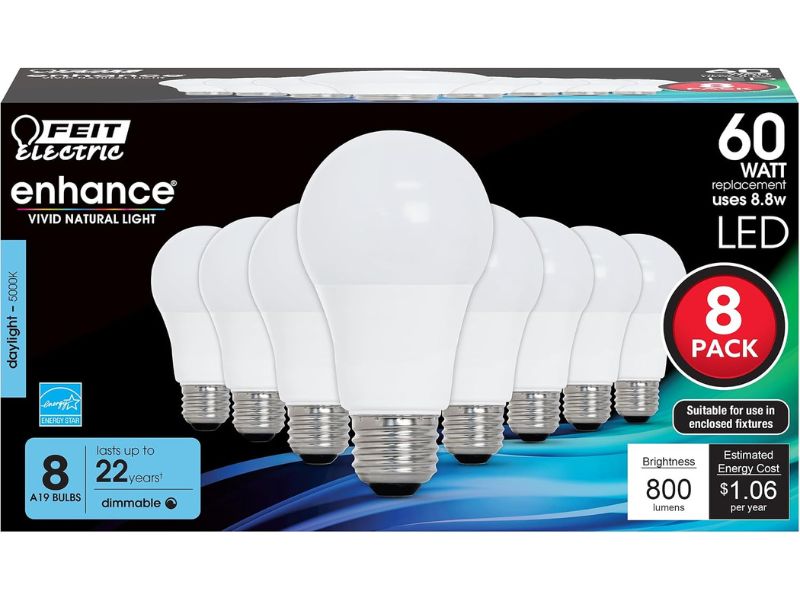
Key Features
- 25,000-hour rated lifespan
- 8.8W actual input
- 60W incandescent equivalent
- 800 lumens
- 5000K daylight
- 90+ CRI
- E26 medium base
- Dimmable
- Damp-location rated
- ENERGY STAR specification
- Eight bulbs in the selected pack
The Feit Electric A19 is the model I would choose when long service life and color quality matter together.
The current Amazon listing specifies 800 lumens, 5000K daylight, 90+ CRI, an 8.8W input, dimming, damp-location compatibility, and a 25,000-hour rated life.
Those characteristics make it a strong fit for:
- Kitchens
- Bathrooms
- Home offices
- Utility rooms
- Work areas
- Closets
- Laundry rooms
- Garages
- Craft spaces
The 800-lumen output is the familiar brightness class used for many 60W incandescent replacements.
But it consumes only 8.8W.
That is roughly:
51.2W less electrical input
than the nominal 60W incandescent it replaces.
For one lamp, that may feel small.
Across ten bulbs used for many hours every day, it becomes much more significant.
The 25,000-hour rated life matches the LUXRITE’s lifespan specification.
Again, the manufacturer’s “22.8 years” framing assumes approximately three hours of operation per day.
At three hours:
about 22.8 years
At six hours:
about 11.4 years
At twelve hours:
about 5.7 years
The bulb does not know how many calendar years have passed.
LED service life is fundamentally tied to operating hours and conditions.
The 90+ CRI is one of Feit’s most useful advantages.
CRI, or Color Rendering Index, describes how accurately colors appear under a light source relative to a reference.
A 90+ CRI lamp can make:
- Food
- Skin tones
- Clothing
- Artwork
- Interior finishes
look more natural than a lower-CRI bulb.
That is why I particularly like this model for kitchens and bathrooms.
The 5000K color temperature is much cooler than traditional soft-white residential lighting.
It produces a crisp daylight appearance.
That can be excellent for:
- Reading
- Cleaning
- Detailed work
- Office tasks
- Utility lighting
but potentially harsh for relaxed evening use.
I would not automatically install 5000K bulbs throughout every bedroom and living room.
Color temperature should match the space.
Typical practical choices are:
2700K: warm and relaxed
3000K: slightly cleaner warm white
4000K: neutral/cool
5000K: crisp daylight
None is universally superior.
Feit’s daylight version simply works particularly well where high visibility is the goal.
Dimming is another advantage over the Ascher.
You can reduce the output when the full 800 lumens are unnecessary, provided the bulb is paired with a compatible LED dimmer.
Dimming compatibility is worth checking carefully because not all wall dimmers were designed for low-wattage LED loads.
A fixture can technically accept the bulb while the old dimmer still produces flicker.
The bulb is also damp rated, making it better suited to humid household spaces such as bathrooms when installed according to fixture and electrical requirements.
Damp-rated does not mean suitable for direct water exposure.
A bathroom bulb still needs an appropriate fixture and installation.
What I Like
- 25,000-hour rated lifespan
- High 90+ CRI
- 800-lumen everyday brightness
- Only 8.8W
- Dimmable
- Damp-location rated
- Crisp 5000K daylight
- Eight bulbs in the selected package
What I Do Not Like
- 5000K can feel too cool for bedrooms and cozy living rooms
- Compatible LED dimmer required for best dimming performance
- Less bright than the 1,600-lumen LUXRITE
The Feit Electric A19 is the bulb I would choose when long life, efficient 60W-equivalent brightness, and accurate color rendering are the main priorities. Its 25,000-hour rating and 90+ CRI make it particularly useful in kitchens, offices, and task-oriented rooms.
Long Lasting LED Light Bulbs Comparison
| Product | Rated Life | Actual Power | Brightness | Color Temperature | Dimmable | Best Use |
| LUXRITE A19 100W Equivalent | 25,000 hr | 15W | 1,600 lm | 4000K | Yes | Bright general lighting |
| Ascher A19 60W Equivalent | 20,000+ hr | 6W | 750 lm | 4000K | No | Decorative fixtures |
| Feit Electric A19 60W Equivalent | 25,000 hr | 8.8W | 800 lm | 5000K | Yes | Task/daylight lighting |
The LUXRITE provides the most brightness, Ascher has the lowest electrical draw and decorative filament design, while Feit combines a 25,000-hour life rating with 90+ CRI and conventional 60W-equivalent output.
How to Choose the Best Long Lasting LED Light Bulbs
Start With Rated Operating Hours
Long-life LEDs are commonly specified by hours.
The selected bulbs here are rated around:
- 20,000+ hours
- 25,000 hours
Do not interpret a “22-year” statement as an unconditional 22-year warranty.
That calendar estimate typically assumes only a few operating hours each day.
25,000 Hours in Real Life
At three hours per day:
25,000 hours ≈ 22.8 years
At six hours:
≈ 11.4 years
At eight hours:
≈ 8.6 years
At twelve hours:
≈ 5.7 years
A hallway bulb used briefly each day may therefore last many calendar years.
A lamp operating all night can reach the same number of operating hours much sooner.
20,000 Hours in Real Life
At three hours daily:
≈ 18.3 years
At eight hours:
≈ 6.8 years
At twelve hours:
≈ 4.6 years
The gap between 20,000 and 25,000 rated hours is meaningful, but it should not be the only purchase criterion.
Heat Is a Major Enemy of LED Longevity
LED emitters are efficient, but the electronics still create heat.
A bulb contains:
- LEDs
- Driver electronics
- Heat-management components
Excess heat can accelerate component degradation.
That is why enclosed-fixture compatibility matters.
Check Enclosed-Fixture Ratings
Some LED bulbs are not intended for fully enclosed fixtures.
A sealed glass globe can trap heat around the bulb.
LUXRITE specifically lists the selected 100W-equivalent model as suitable for enclosed fixtures.
If your fixture is enclosed, verify this specification rather than assuming every LED is safe for the application.
Dimming Compatibility Can Affect Reliability
A dimmable LED should be used with a compatible LED dimmer.
An old incandescent-only dimmer may cause:
- Flicker
- Buzzing
- Limited dimming range
- Unstable startup
If you do not need dimming, a straightforward non-dimmable circuit is simpler.
If you do need it, choose a bulb specifically rated for dimming.
Never Put a Non-Dimmable Bulb on an Active Dimmer
The selected Ascher bulb is explicitly non-dimmable.
I would install it only on standard on/off circuits.
LUXRITE and Feit are better choices when brightness control is required.
Choose Lumens Before Equivalent Watts
“60W equivalent” and “100W equivalent” are convenience labels.
Lumens are more useful for comparing brightness.
The selected bulbs provide:
- 750 lumens — Ascher
- 800 lumens — Feit
- 1,600 lumens — LUXRITE
If your room feels dark, choose based on lumens rather than assuming all LED bulbs are similarly bright.
800 Lumens vs 1,600 Lumens
An 800-lumen bulb is suitable for many everyday lamps and ceiling fixtures.
A 1,600-lumen bulb provides roughly twice as much luminous output.
That makes the LUXRITE better for spaces where one socket needs to illuminate a larger area.
It may be unnecessarily bright for a bedside lamp.
Actual Watts Matter for Electricity
The three selections consume approximately:
- Ascher: 6W
- Feit: 8.8W
- LUXRITE: 15W
Lower wattage generally means less electricity consumed, but it also needs to be considered alongside brightness.
A 6W 750-lumen bulb and a 15W 1,600-lumen bulb are performing different jobs.
Understand Lumens per Watt
A simple efficiency comparison can be calculated.
Ascher:
750 ÷ 6 = 125 lm/W
Feit:
800 ÷ 8.8 ≈ 91 lm/W
LUXRITE:
1,600 ÷ 15 ≈ 107 lm/W
These are simple calculations from listed values, not laboratory verification.
They illustrate why actual output should be considered alongside wattage.
Choose the Right Color Temperature
2700K
Warm, traditional incandescent-like appearance.
Good for:
- Bedrooms
- Living rooms
- Dining rooms
3000K
Still warm, but slightly cleaner.
Useful for:
- Kitchens
- Bathrooms
- General residential use
4000K
Neutral-to-cool.
Useful for:
- Work spaces
- Kitchens
- Utility rooms
- Modern interiors
5000K
Bright daylight appearance.
Useful for:
- Offices
- Garages
- Workshops
- Detailed tasks
Color temperature does not determine lifespan.
Choose it for comfort and function.
CRI Matters When Colors Need to Look Natural
The Feit Electric bulb has a 90+ CRI specification, while Ascher lists CRI around 80.
Higher CRI is useful in:
- Bathrooms
- Kitchens
- Closets
- Craft rooms
- Studios
where accurate color perception matters.
Best Long Lasting LED Bulb for a Living Room
For a bright modern living room, I would consider the LUXRITE 100W Equivalent.
Its dimming capability lets you use 1,600 lumens when needed and reduce output later.
If you strongly prefer warm lighting, select an appropriate warmer color-temperature variant rather than defaulting to 4000K.
Best Long Lasting LED Bulb for a Bedroom
I would generally prefer a warm-color version of a long-life A19.
Brightness usually matters less than comfort in a bedroom.
The selected 4000K and 5000K products are better suited to brighter, task-oriented spaces unless you personally prefer cooler light.
Best Long Lasting LED Bulb for a Kitchen
I would choose Feit Electric when color clarity matters.
Its 5000K output and 90+ CRI provide crisp illumination for:
- Food preparation
- Cleaning
- Reading labels
- General visibility
For a kitchen that needs significantly more brightness per socket, the LUXRITE 1,600-lumen bulb is the stronger option.
Best Long Lasting LED Bulb for a Garage
I would choose LUXRITE.
A garage often benefits from higher lumens more than warm ambiance.
Its 1,600-lumen output provides considerably more illumination from one socket.
Best Long Lasting LED Bulb for a Chandelier
I would choose Ascher.
Its clear filament appearance and 280-degree beam make it better suited to fixtures where the bulbs remain visible.
Just remember that the selected version is non-dimmable.
Best Long Lasting LED Bulb for a Bathroom
Feit Electric is particularly practical because it is damp rated and provides 90+ CRI.
That can help skin tones and colors look more natural around mirrors.
The fixture itself must still be appropriate for the bathroom location.
Best Long Lasting LED Bulb for an Enclosed Fixture
LUXRITE explicitly lists enclosed-fixture compatibility for the selected model.
I would verify this rating every time I install a high-output LED inside a sealed globe.
Are LED Lifespan Claims Guaranteed?
No.
Rated life is an expected performance specification under defined operating conditions.
A specific individual bulb can fail earlier.
Operating environment matters.
Factors that may affect life include:
- Heat
- Voltage quality
- Switching cycles
- Fixture ventilation
- Driver quality
- Dimmer compatibility
Does Turning LEDs On and Off Reduce Their Life?
LEDs generally tolerate switching much better than some older lighting technologies.
However, all electronic components experience electrical and thermal cycling.
There is usually no reason to leave an LED running unnecessarily simply to avoid switching it.
Turn lights off when they are not needed.
Does Dimming Make LEDs Last Longer?
Potentially, because reduced power can reduce thermal and electrical stress.
However, actual life depends on driver design and dimmer compatibility.
I would use dimming primarily for desired brightness and energy reduction, not as a guaranteed lifespan-extension method.
Do LEDs Burn Out Like Incandescent Bulbs?
Sometimes they fail suddenly, but LEDs can also gradually lose light output over time.
The LED emitters themselves may remain functional while:
- Driver electronics fail
- Capacitors degrade
- Connections fail
- Thermal damage develops
That is why bulb build quality matters in addition to diode lifespan.
Why Do Some LED Bulbs Fail Early?
Common contributors can include:
Excessive Heat
Especially in inappropriate enclosed fixtures.
Poor Dimmer Compatibility
Can create unstable electrical operation.
Voltage Problems
Spikes or poor supply quality can stress electronics.
Cheap Driver Components
The driver may fail before the LED chips.
High Ambient Temperatures
Hot attics, garages, or enclosed fixtures can accelerate degradation.
Is a 25,000-Hour Bulb Worth It?
For difficult-to-reach fixtures, yes.
Long rated life is particularly attractive for:
- High ceilings
- Stairwells
- Exterior fixtures
- Ceiling fans
- Frequently used rooms
because replacing a bulb can require more effort than the bulb itself.
LED Bulb Energy Use Example
Consider one 15W LED operating five hours daily:
0.015 kW × 5 = 0.075 kWh/day
Over 365 days:
27.375 kWh/year
A 100W incandescent operating for the same period would use:
0.1 × 5 × 365 = 182.5 kWh/year
That illustrates why LED efficiency can matter substantially over a long operating life.
Do Long-Life LEDs Need Special Fixtures?
Usually not if they use a standard E26 base and the fixture meets the bulb’s requirements.
The selected products all use common E26-style household bases.
But check:
- Physical bulb size
- Maximum fixture wattage
- Enclosed-fixture rating
- Damp/wet rating
- Dimmer compatibility
before installation.
Common Long-Lasting LED Bulb Buying Mistakes
Choosing Only by Rated Years
Compare operating hours instead.
Ignoring Enclosed-Fixture Compatibility
Trapped heat can matter.
Buying the Wrong Color Temperature
Long life does not help if you dislike the light.
Choosing Equivalent Watts Instead of Lumens
Lumens tell you brightness more directly.
Using Non-Dimmable LEDs With Dimmers
Match bulb and control system.
Assuming Every E26 LED Fits Every Fixture
Physical size and fixture ratings still matter.
Ignoring CRI
Color quality can matter just as much as brightness.
Buying Excessive Brightness
A 1,600-lumen bulb is not appropriate everywhere.
Frequently Asked Questions
What are the best long lasting LED light bulbs?
LUXRITE A19, Ascher A19, and Feit Electric A19 are my three current choices.
They offer rated lives from more than 20,000 hours to 25,000 hours while covering high-output, decorative, and high-CRI household applications.
Which long-lasting LED bulb is my primary recommendation?
LUXRITE A19 100W Equivalent is my primary recommendation for bright general household lighting.
It combines 1,600 lumens, 15W consumption, dimming, enclosed-fixture compatibility, and a 25,000-hour rated lifespan.
How long do good LED bulbs last?
High-quality household LEDs commonly advertise tens of thousands of operating hours.
The selected products here publish ratings of approximately 20,000 to 25,000 hours. Actual life can vary with usage and operating conditions.
How many years is 25,000 hours?
About 22.8 years at three hours per day, or 8.6 years at eight hours.
The number of calendar years depends entirely on how many hours the bulb operates each day.
How many years is 20,000 hours?
About 18.3 years at three hours daily or 6.8 years at eight hours.
A heavily used bulb reaches its rated operating hours much sooner than one used briefly each evening.
Which bulb here has the longest rated life?
LUXRITE and Feit Electric both publish up to 25,000 hours.
Ascher publishes more than 20,000 hours for the selected filament model.
Which bulb is brightest?
The LUXRITE 100W Equivalent is the brightest at 1,600 lumens.
That is approximately twice the output of Feit’s 800-lumen 60W-equivalent bulb.
Which LED bulb uses the least electricity?
The selected Ascher uses only 6W while producing 750 lumens.
It is intended as a 60W incandescent replacement.
Which LED bulb is best for accurate colors?
Feit Electric is my choice because the selected bulb has a 90+ CRI specification.
That makes it particularly useful in kitchens, bathrooms, offices, and other areas where color clarity matters.
Which long-lasting bulb is best for enclosed fixtures?
LUXRITE specifically lists the selected A19 as compatible with enclosed fixtures.
That makes it my first choice among these three when heat-trapping fixture designs are unavoidable.
Which bulb is best for chandeliers?
Ascher is particularly well suited to visible chandeliers because of its clear filament design.
Its broad 280-degree light distribution also works naturally in decorative fixtures.
Are these bulbs dimmable?
LUXRITE and Feit are dimmable; the selected Ascher bulb is not.
Always pair dimmable LEDs with compatible LED dimmers.
Does dimming help LED bulbs last longer?
Lower output may reduce heat and stress, but longer life is not guaranteed.
The dimmer and bulb must also be electrically compatible.
Why do LED bulbs sometimes fail before their rated lifespan?
Heat, driver failure, voltage problems, and poor fixture compatibility can shorten service life.
Rated life is an expected operating specification rather than a promise that every individual bulb will reach the exact number.
Are LED bulbs good for fixtures left on all day?
Yes, efficient LEDs are particularly useful in high-hour applications.
Just remember that higher daily runtime means the rated lifetime is consumed more quickly in calendar terms.
Is 4000K good for home lighting?
Yes, 4000K provides a clean neutral-to-cool appearance suitable for many work-oriented rooms.
Both LUXRITE and the selected Ascher version use 4000K output.
Is 5000K too bright?
5000K describes color appearance, not brightness.
Feit’s 5000K bulb produces 800 lumens; it simply looks cooler and more daylight-like than a 2700K bulb.
Is 90 CRI better than 80 CRI?
A 90+ CRI bulb generally renders colors more accurately than an 80-CRI bulb.
That difference is especially useful around food, clothing, skin tones, art, and detailed work.
Do LED bulbs save electricity?
Yes, these bulbs provide incandescent-equivalent brightness using a fraction of the electrical wattage.
For example, LUXRITE produces 100W-equivalent brightness from 15W, while Ascher’s selected 60W-equivalent bulb uses 6W.
What should I look for besides lifespan?
Check lumens, actual watts, color temperature, CRI, dimming, base type, and fixture rating.
A slightly shorter-lived bulb that perfectly matches the fixture can be a better purchase than a longer-rated model used incorrectly.
Which long lasting LED bulb should I buy?
Choose LUXRITE for brightness, Ascher for decorative fixtures, or Feit for daylight color quality.
All three serve different household needs, so the best choice depends on the socket and room rather than lifespan alone.
Conclusion
The best long lasting LED light bulbs should combine a genuinely useful rated lifespan with the brightness, color, controls, and fixture compatibility required by the room. A 25,000-hour rating is valuable, but I would also check lumens, actual wattage, E26 compatibility, enclosed-fixture approval, CRI, dimming support, and operating temperature before making a final choice.
The LUXRITE A19 100W Equivalent remains my primary recommendation. Its 25,000-hour rated life, 1,600-lumen output, 15W consumption, dimming, 4000K color, and enclosed-fixture compatibility make it the strongest all-around option for bright household lighting.
The Ascher A19 60W Equivalent is my choice for decorative fixtures. Its clear filament construction, 6W power draw, 750 lumens, 280-degree beam, and 20,000+ hour rated life work particularly well in chandeliers, pendants, and other visible-bulb applications.
The Feit Electric A19 60W Equivalent is the better choice for task-oriented rooms. Its 25,000-hour lifespan, 800 lumens, 8.8W consumption, 5000K daylight output, 90+ CRI, dimming, and damp rating make it particularly suitable for kitchens, bathrooms, and offices.
For strong general illumination, I would choose LUXRITE. For decorative fixtures, I would choose Ascher. For high-CRI daylight lighting, I would choose Feit Electric.

I’m Maya L. Greenwood, a lifelong plant lover who believes anyone can grow something beautiful with the right guidance. After years of testing soil mixes, pruning methods, irrigation tricks, and pest-safe solutions, I started EasyGardenTips.com to turn hard-won lessons into step-by-step advice. From seed starting and container gardens to composting and seasonal checklists, my goal is to make gardening simple, sustainable, and fun.