5 Best 150 Foot Garden Hose: Long-Reach Heavy-Duty Picks
Are you looking for the best 150 foot garden hose because a standard 50- or 100-foot hose cannot reach the far end of your yard? At this length, choosing the right hose matters more because water-flow loss, weight, kinking, fitting durability, abrasion resistance, and storage become much more noticeable.
My primary recommendation is the Bionic Steel 150 Ft Metal Garden Hose with Sprayer Nozzle. Its 5/8-inch configuration, 304 stainless-steel exterior, non-expanding construction, crush-resistant fittings, kink-resistant design, and 500 PSI burst-pressure specification make it especially attractive for large yards and rough outdoor use.
I would choose the SPECILITE 150ft 304 Stainless Steel Metal Garden Hose when puncture resistance and easy movement around trees, landscaping, gravel, and other obstacles are the priorities. Its flexible metal construction is particularly useful for homeowners tired of conventional hoses folding over themselves.
For buyers who prefer a more conventional 5/8-inch flexible hose, the FITT Force Pro 150-Foot x 5/8-Inch Heavy-Duty Water Hose is my preferred alternative. Its lightweight TPV construction, NTS PLUS anti-torsion reinforcement, abrasion resistance, and commercial-duty design make it easier to handle than many traditional long hoses.
Best 150 Foot Garden Hose
| Image | Product Name | Check Price |
|---|---|---|
Best Choice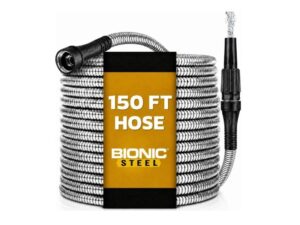 | Bionic Steel 150 Ft Metal Garden Hose with Sprayer Nozzle- Best Overall | Check Price |
Second Best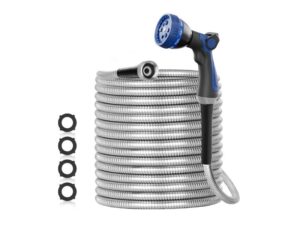 | SPECILITE 150ft 304 Stainless Steel Metal Garden Hose– Best Kink Resistant | Check Price |
Third Choice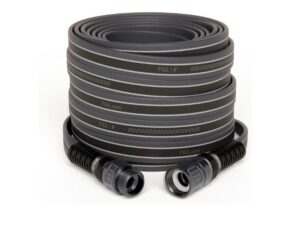 | FITT Force Pro 150-Foot x 5/8-Inch Heavy-Duty Water Hose- Best Lightweight Heavy Duty | Check Price |
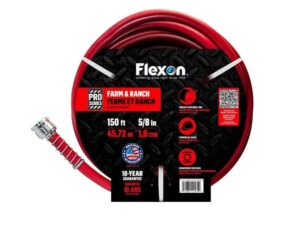 | Flexon 5/8 x 150ft Farm & Ranch Garden Hose- Best for Farm and Ranch Use | Check Price |
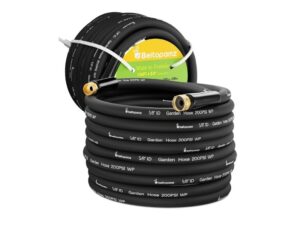 | Beitopamz 150 ft 5/8-Inch Heavy-Duty Hybrid Garden Hose- Best Flexible Hybrid | Check Price |
Best 150 Foot Garden Hose Reviews
1. Bionic Steel 150 Ft Metal Garden Hose with Sprayer Nozzle- Best Overall
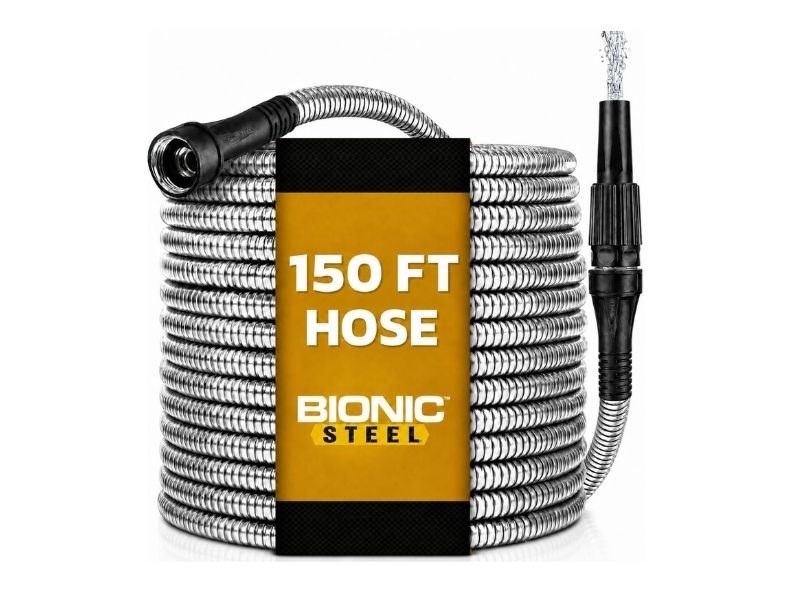
Key Features
- 150-foot length
- 5/8-inch hose configuration
- 304 stainless-steel outer construction
- Non-expandable design
- 500 PSI burst-pressure rating
- Crush-resistant metal fittings
- Stabilizer collar
- Kink- and tangle-resistant construction
- Included sprayer nozzle
- Designed for all-weather outdoor use
The Bionic Steel takes my first position because a 150-foot hose is constantly being dragged across more ground than a normal backyard hose, and its metal outer construction directly addresses that wear.
A conventional vinyl hose may work perfectly when it stays on soft turf. Once you drag 150 feet around concrete corners, gravel, shrubs, patio furniture, driveway edges, and rough landscaping, abrasion becomes much more important.
The interlocking 304 stainless-steel exterior protects the inner water tube from many of those hazards.
That makes this a particularly good choice for properties containing:
- Gravel paths
- Concrete patios
- Long driveways
- Stone borders
- Thorny landscaping
- Outdoor workshops
- Pet areas
- Multiple watering zones
Full 150-Foot Reach
The hose is non-expandable, so its operating length does not depend on water pressure.
That matters if you plan to connect a sprinkler at the far end.
Expandable hoses can be wonderfully compact, but their effective length and behavior depend partly on internal pressure. A fixed-length hose gives you predictable reach before turning on the faucet.
With 150 feet available, you can often cover a large residential property from one spigot rather than connecting multiple shorter hoses.
Fewer connections also mean fewer potential leak points.
5/8-Inch Flow Capacity
The 5/8-inch hose size is another reason I prefer the Bionic Steel for long-distance watering.
Pressure loss increases with hose length because water experiences friction as it moves through the tube.
A 150-foot hose therefore needs adequate internal flow capacity if you want to operate:
- Sprinklers
- Watering wands
- Spray nozzles
- Lawn irrigation attachments
- Car-washing equipment
A 5/8-inch garden hose generally provides a better balance of flow and handling than very narrow lightweight hoses.
Kink Resistance
Kinking becomes especially irritating with a 150-foot hose.
If the line folds 100 feet behind you, you may have to walk almost the entire length of the yard to restore water flow.
The stainless-steel shell helps prevent the tube from sharply collapsing.
No flexible hose should be treated as literally impossible to obstruct, but this structure is considerably less prone to traditional flat-fold kinking than basic vinyl.
Crush-Resistant Connections
The connection between hose and fitting is one of the most common failure locations on any garden hose.
Bionic Steel uses reinforced metal fittings and a stabilizer collar around the connection zone.
That is useful when the hose repeatedly bends sharply near the faucet.
A built-in shutoff at the hose end also makes attachment changes more convenient.
You can interrupt flow near the nozzle rather than walking 150 feet back to the spigot.
Metal Hose Tradeoffs
A stainless-steel exterior is exceptionally durable, but it does not behave exactly like a soft rubber hose.
It has a different feel when pulled over decks and delicate surfaces.
It may also make more noise as the steel jacket moves over pavement.
If you primarily want the softest possible hose for frequently coiling by hand, the FITT or Beitopamz may feel more traditional.
What I Like
- Excellent protection against abrasion and punctures
- True 150-foot reach
- Strong 5/8-inch water-flow potential
- Highly kink-resistant construction
- Crush-resistant fittings
- Useful included nozzle
- Excellent around rough terrain
- Easy to coil compared with many stiff conventional hoses
What I Do Not Like
- Metal exterior feels different from a conventional hose
- More substantial than lightweight fabric hoses
- Not designed for hot-water applications
- May be unnecessary for a small unobstructed lawn
For a large property where one hose may be dragged over many different surfaces, the Bionic Steel is my primary recommendation. Its combination of reach, steel protection, flow capacity, and kink resistance is particularly well suited to the demands of a 150-foot hose.
2. SPECILITE 150ft 304 Stainless Steel Metal Garden Hose– Best Kink Resistant
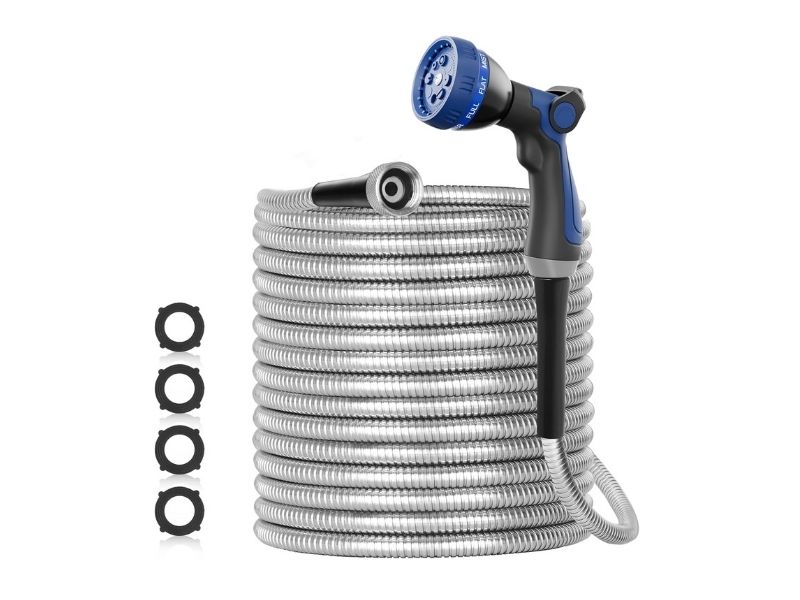
Key Features
- 150-foot length
- 304 stainless-steel construction
- Multi-layer flexible inner tube
- Puncture-resistant outer shell
- Kink- and tangle-resistant layout
- Flexible interlocking metal design
- Included spray nozzle
- Suitable for yards, gardens, and outdoor washing
- Compact coiling compared with many traditional hoses
The SPECILITE takes second place because it delivers many of the benefits of metal construction while emphasizing flexibility.
Its stainless-steel exterior is made from interconnected sections rather than one rigid pipe.
That allows the hose to bend around trees, corners, planters, and garden structures while protecting the inner tube.
Excellent for Complicated Yard Layouts
A 150-foot hose is rarely pulled in one perfectly straight line.
In a real yard, it may need to go around:
- The corner of a house
- Raised garden beds
- Trees
- Patio furniture
- Planters
- Outdoor kitchens
- Fencing
Traditional long hoses can twist as you make these turns.
A metal hose with low coil memory can be easier to reposition because the outer structure does not want to hold a tight folded shape.
Puncture Protection
The stainless-steel shell is particularly useful if your property contains sharp hazards.
Thorns, rough landscaping rocks, and abrasive concrete can gradually damage softer hose covers.
The SPECILITE creates a physical metal barrier around its inner water-carrying layer.
That does not make the hose indestructible. Fittings, internal tubing, seals, and other components can still wear.
But the outer jacket is much more resistant to common surface damage.
Lighter Handling Than Traditional Heavy Hose
A major concern with any 150-foot product is total weight.
Even a small weight difference per foot becomes significant when multiplied by 150.
Metal garden hoses often use a relatively narrow flexible inner tube surrounded by thin interlocking stainless steel, which can make them easier to drag than very thick traditional rubber hoses.
The tradeoff is flow.
If maximum flow volume for several demanding sprinklers is your top priority, compare the hose’s internal bore carefully rather than looking only at its outer size.
No Traditional Flat Kinks
The metal exterior resists the classic garden-hose problem where a loop suddenly folds flat and stops the water.
That feature becomes increasingly useful as length increases.
With a 25-foot hose, fixing a kink takes seconds.
With 150 feet stretched through landscaping, it can interrupt your entire watering routine.
What I Like
- Strong 304 stainless-steel exterior
- Excellent puncture resistance
- Resists traditional flat kinking
- Flexible around obstacles
- Good for rough yards
- Included nozzle
- Compact storage for its length
What I Do Not Like
- Internal water passage is not as large as every conventional 5/8-inch hose
- Metal exterior can scrape noisily across hard surfaces
- Solid-metal construction may be unnecessary for gentle lawn use
I recommend the SPECILITE for homeowners whose biggest problems are kinks, punctures, rough landscaping, pets, or dragging a long hose around numerous obstacles.
3. FITT Force Pro 150-Foot x 5/8-Inch Heavy-Duty Water Hose- Best Lightweight Heavy Duty
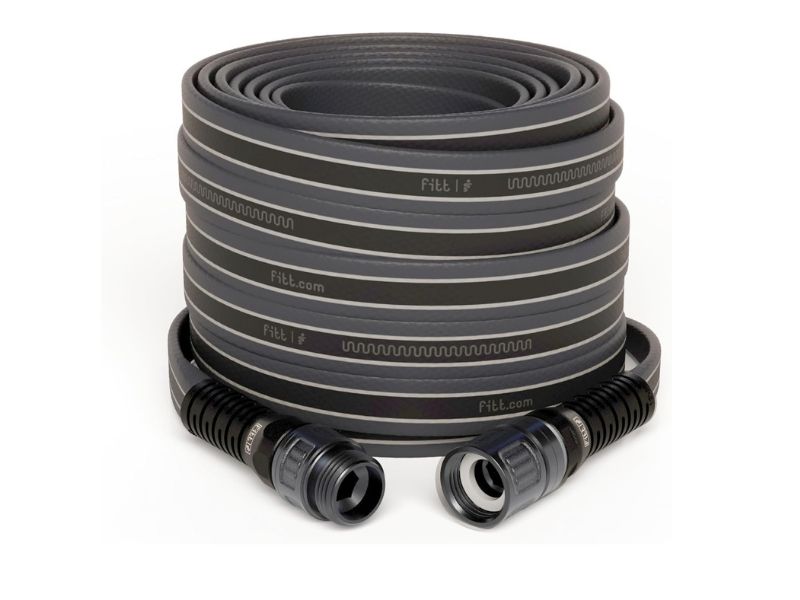
Key Features
- 150 feet × 5/8 inch
- Heavy-duty commercial-grade design
- Lightweight TPV construction
- PVC-free formulation
- Double NTS PLUS mesh reinforcement
- Abrasion- and puncture-resistant design
- Flexible in low temperatures
- Crush-resistant fittings
- High-pressure construction
- Compact flat-style storage
The FITT Force Pro is my favorite choice for someone who wants 150 feet of reach but does not want to drag an especially bulky traditional hose around the property.
Its construction is quite different from both the metal hoses and conventional round PVC options.
FITT uses advanced thermoplastic vulcanizate (TPV) materials and reinforcement to provide strength while reducing unnecessary bulk.
Why Weight Matters at 150 Feet
A 150-foot garden hose is a large object.
Before adding water, you already have to:
- Carry it from storage
- Uncoil it
- Pull it across the lawn
- Reposition it
- Coil it again
Once filled, the water inside adds considerable temporary mass.
A lighter hose body therefore has real practical value.
This is one reason a premium lightweight material can be more useful at 150 feet than at 25 feet.
NTS PLUS Reinforcement
FITT uses its NTS PLUS no-torsion reinforcement to reduce twisting, tangling, and kinking.
Long hoses naturally develop loops.
As you pull from one end, those loops can tighten and rotate.
A reinforced construction that resists torsion helps maintain a more consistent internal passage.
That means fewer interruptions from collapsing sections.
5/8-Inch Diameter
The 5/8-inch size is ideal for most large residential yards.
It gives enough internal area to support normal sprinklers and spray attachments while keeping the hose lighter than many 3/4-inch commercial alternatives.
At 150 feet, pressure drop will still occur.
The exact amount depends on:
- Faucet pressure
- Flow rate
- Hose diameter
- Nozzle restriction
- Elevation
- Fittings
For ordinary residential irrigation, 5/8 inch is generally the sweet spot.
Abrasion Resistance
Lightweight does not have to mean fragile.
The Force Pro is designed for demanding outdoor use and incorporates protection against puncture and abrasion.
I still would not intentionally drag any hose across sharp metal or leave it where vehicles can repeatedly run over it, but this is much more substantial than an inexpensive lightweight vinyl hose.
Easy Storage
Flat, flexible construction can also make a 150-foot hose easier to fit on a reel.
Storage is a serious consideration at this length.
If you do not already own a hose reel, check its capacity before buying.
A reel that comfortably stores 100 feet of 5/8-inch hose may not accept 150 feet.
What I Like
- True 150 ft × 5/8 in configuration
- Much easier to handle than many traditional long hoses
- Strong anti-torsion reinforcement
- Good abrasion resistance
- Commercial-duty construction
- Flexible in cold conditions
- Good combination of water flow and portability
What I Do Not Like
- Flat-style hose feels different from conventional round rubber
- Needs careful initial uncoiling
- Premium construction may be unnecessary for occasional watering
The FITT Force Pro is my choice for buyers who want full-size 5/8-inch water delivery without the bulk normally associated with a 150-foot heavy-duty hose.
4. Flexon 5/8 x 150ft Farm & Ranch Garden Hose- Best for Farm and Ranch Use
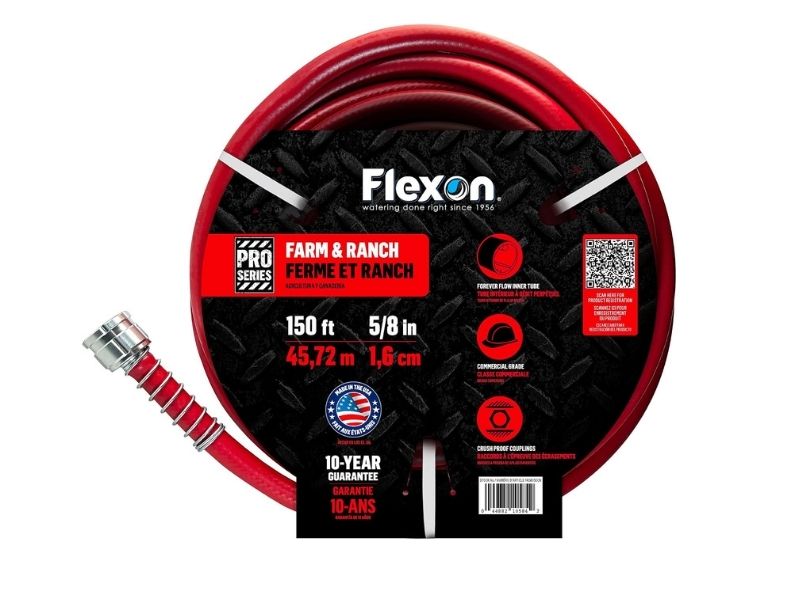
Key Features
- 5/8-inch × 150-foot size
- Heavy-duty conventional construction
- Designed for farm and ranch applications
- Kink-resistant design
- Reinforced couplings
- High-visibility red exterior
- Suitable for large-area watering
- Made in the USA with globally sourced components
- Traditional fixed-length hose
Flexon is the product I would choose when you prefer a familiar conventional garden hose rather than metal or flat-style construction.
The Farm & Ranch model prioritizes toughness and water delivery over minimum weight.
Built for Large-Property Work
Its 150-foot length is useful for jobs such as:
- Watering livestock areas
- Washing outdoor equipment
- Reaching distant garden beds
- Filling containers
- Cleaning patios
- Connecting sprinklers
- General large-yard watering
The bright red exterior also provides useful visibility.
A green or black hose can disappear surprisingly well in tall grass.
On a larger property, high visibility reduces the chance of forgetting where the hose is stretched.
Reinforced Couplings
A long hose puts substantial pulling force on the faucet-side fitting.
When the far end catches on a corner and you continue pulling, that force transfers down the entire 150-foot length.
Reinforced couplings therefore matter more here than on a small patio hose.
The Flexon’s heavier-duty fitting construction is one of its strongest practical features.
Traditional Hose Feel
Some homeowners simply prefer a conventional round hose.
It works naturally with:
- Hose reels
- Sprinklers
- Spray nozzles
- Hose carts
- Splitters
- Timers
There is no expansion or contraction behavior to account for.
Turn on the faucet and use it exactly like a traditional garden hose.
The Tradeoff: Bulk
Heavy-duty conventional construction can become tiring at 150 feet.
If you expect to move the hose around the yard every day, a lightweight design such as the FITT may be more comfortable.
If the hose normally remains stretched through a farm, barn, garden, or work area, the Flexon’s heavier construction becomes less problematic.
What I Like
- True 5/8 × 150-foot size
- Conventional dependable construction
- Reinforced couplings
- High-visibility color
- Designed for demanding outdoor work
- Good for sprinklers and equipment cleaning
What I Do Not Like
- Heavier and stiffer than lightweight alternatives
- Long conventional hoses can still require careful uncoiling
- Not my first choice if you move and coil the hose every day
The Flexon is best for large properties where durability, visibility, reach, and traditional hose construction are more important than achieving the lowest possible weight.
5. Beitopamz 150 ft 5/8-Inch Heavy-Duty Hybrid Garden Hose- Best Flexible Hybrid
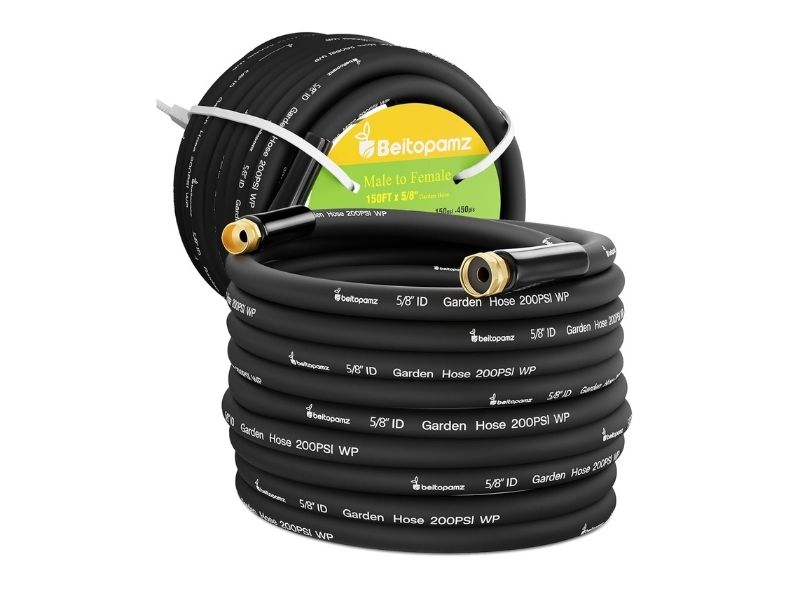
Key Features
- 150-foot length
- 5/8-inch hose diameter
- NBR + PVC hybrid construction
- Polyester-fiber reinforcement
- 3/4-inch brass fittings
- Flexible lightweight design
- Wide operating-temperature specification
- High burst-pressure specification
- Non-expandable format
- Designed to resist cracking and leakage
The Beitopamz provides a useful middle ground between metal and traditional heavy-duty hoses.
Its body combines NBR rubber, PVC, and polyester reinforcement, creating a flexible hose designed to handle changing outdoor conditions without becoming excessively bulky.
Flexible Hybrid Construction
NBR, or nitrile butadiene rubber, is commonly used where flexibility and resistance to wear are important.
Combined with PVC and fabric reinforcement, the material can produce a hose that feels softer than rigid conventional vinyl while remaining lighter than many thick rubber designs.
That is especially helpful at 150 feet.
Brass Fittings
The hose uses 3/4-inch brass fittings at the connection points.
Brass is a good material for garden-hose couplings because it provides strong threads and good corrosion resistance.
Connection quality matters because a leak at the faucet wastes water throughout the entire watering session.
Use a good hose washer and tighten by hand before reaching for tools. Excessive wrench force can damage fittings and washers.
Broad Temperature Capability
The hose is designed for a broad outdoor temperature range.
That makes it appealing for homeowners in climates that experience both freezing winters and hot summers.
Even so, I recommend draining any garden hose before freezing weather.
Water expands as it freezes, and trapped water can damage fittings or internal layers regardless of how durable the exterior material is.
Good Everyday Choice
The Beitopamz is well suited to:
- Lawn watering
- Garden irrigation
- Washing vehicles
- Patio cleaning
- Sprinklers
- General household outdoor use
It does not provide the extreme surface protection of stainless steel, but its softer body is more familiar to homeowners accustomed to a conventional hose.
What I Like
- 150 ft × 5/8 in dimensions
- Flexible hybrid construction
- Brass fittings
- Polyester reinforcement
- Good all-weather usability
- Easier handling than many traditional heavy hoses
What I Do Not Like
- Less puncture-resistant than stainless-steel options
- Newer product than several established hose designs
- Long flexible hoses still need a properly sized reel
The Beitopamz is a good option when you want traditional hose flexibility, brass connections, and full 5/8-inch flow without choosing a metal exterior.
150 Foot Garden Hose Comparison
| Product | Length | Diameter | Construction | Kink Resistance | Fittings | Best Use | Main Tradeoff |
| Bionic Steel Metal Garden Hose | 150 ft | 5/8 in | 304 stainless steel | Excellent | Metal, reinforced | Rough yards | Metal feel |
| SPECILITE Metal Garden Hose | 150 ft | Narrow metal-hose format | 304 stainless steel | Excellent | Metal | Obstacles and puncture resistance | Lower-flow style than full 5/8 hose |
| FITT Force Pro | 150 ft | 5/8 in | Reinforced TPV | Excellent | Crush-resistant | Lightweight heavy-duty use | Flat-style handling |
| Flexon Farm & Ranch | 150 ft | 5/8 in | Heavy-duty conventional | Good | Reinforced | Farm/ranch use | Heavier |
| Beitopamz Hybrid Hose | 150 ft | 5/8 in | NBR + PVC hybrid | Very good | Brass | General long-reach watering | Less puncture protection |
For most large-yard homeowners, the Bionic Steel offers the strongest overall durability package.
The FITT is more attractive if you move the hose frequently, while Flexon makes sense when you prefer a conventional heavy-duty hose that may stay deployed around a farm, garden, or work area.
How to Choose the Best 150 Foot Garden Hose
A 150-foot hose should not simply be a longer version of whatever 50-foot hose is cheapest.
Length changes the way the entire system performs.
The most important factors are diameter, pressure loss, weight, flexibility, fitting quality, material, and storage.
Choose 5/8 Inch for Better Long-Distance Flow
For most homes, 5/8 inch is the most useful garden-hose diameter.
A narrow hose is lighter, but it creates greater resistance to flowing water.
Over 150 feet, that pressure loss can become noticeable.
This is especially important when using:
- Oscillating sprinklers
- Impact sprinklers
- High-flow nozzles
- Multiple watering attachments
- Long watering wands
A 5/8-inch hose gives you a good compromise between water volume and manageable size.
Will You Lose Water Pressure Through 150 Feet?
Yes, some pressure and flow are lost as water travels through a long hose.
The effect becomes greater when you increase flow.
For example, a spray nozzle producing a small gentle stream may work well at the far end because relatively little water is moving.
A high-flow sprinkler creates more friction loss through the same hose.
You can reduce the problem by:
- Choosing adequate diameter
- Avoiding unnecessary connectors
- Straightening severe bends
- Keeping fittings unrestricted
- Using an appropriate nozzle
For very demanding high-flow irrigation, a 3/4-inch hose may be worth considering, but it will also be heavier.
Metal vs. Rubber vs. Hybrid Hose
Stainless-Steel Hose
Choose stainless steel when abrasion and puncture resistance are highest priorities.
Advantages:
- Excellent surface durability
- Strong kink resistance
- Low coil memory
- Good protection against animal damage
Disadvantages:
- Different handling feel
- Can make noise across pavement
- Internal bore may differ from conventional hose sizing
Rubber or Rubber-Hybrid Hose
Choose a rubber or hybrid hose when flexibility and traditional handling matter.
Advantages:
- Soft and flexible
- Easy nozzle compatibility
- Good all-weather performance
- Familiar coiling behavior
Disadvantages:
- Can become heavy at 150 feet
- Softer covers are more vulnerable to abrasion than steel
Lightweight TPV Hose
Modern thermoplastic elastomer hoses provide another option.
They can significantly reduce weight while maintaining good pressure and abrasion performance.
FITT is the best example among these five.
Do You Need an Expandable 150-Foot Hose?
Expandable hoses become very small when empty, making storage convenient.
However, I generally prefer a non-expandable hose when 150 feet is genuinely required.
Fixed hoses provide:
- Predictable reach
- More consistent internal diameter
- Better sprinkler compatibility
- Less dependence on water pressure for extension
Expandable hoses make more sense when compact storage and very low carrying weight are the primary priorities.
How Heavy Is a 150-Foot Garden Hose?
Weight varies significantly with construction.
Traditional heavy rubber or PVC hoses can become substantial.
Lightweight TPV and metal designs may reduce empty weight.
Also remember that the water itself adds weight.
A 5/8-inch hose filled with water contains a meaningful volume, so you should not expect to lift and carry the entire pressurized hose comfortably.
Instead, drag or reel the hose appropriately.
What Hose Reel Size Do You Need?
Never assume a reel marked “large” will accept 150 feet.
Look for a specific rating such as:
150 ft of 5/8-inch hose
A reel capable of holding 150 feet of 1/2-inch hose may not accommodate the same length of thicker 5/8-inch hose.
For a 150-foot setup, I prefer:
- Large wall-mounted reels
- Four-wheel hose carts
- Heavy-duty crank reels
- Wide free-standing reels
A good reel can make a bigger difference to everyday usability than a small change in hose material.
How to Prevent a 150-Foot Hose From Kinking
Start by fully uncoiling a new hose before regular use.
Do not pull loops directly off a tightly wound package.
Lay the hose on the ground, connect it, and allow water pressure to help straighten it.
When storing, use large loops rather than tight bends.
A hose reel is even better because it creates uniform coils.
Avoid folding a hose sharply at the faucet.
A bend restrictor or reinforced collar helps protect this vulnerable area.
How to Maintain a Long Garden Hose
Drain It After Use
Shut off the water and release pressure through the nozzle.
For long-term storage, drain as much water as practical.
Protect It From Freezing
Even an all-weather hose can be damaged by frozen trapped water.
Drain it and store it appropriately in freezing climates.
Avoid Vehicle Traffic
A crush-resistant fitting does not mean the entire hose should be repeatedly driven over.
Route it away from driveways when possible.
Check Washers
A worn washer is one of the simplest causes of faucet leaks.
Replace inexpensive washers before assuming the hose fitting is defective.
Store Out of Direct UV When Practical
Sunlight and heat accelerate aging in many polymers.
Metal jackets provide excellent protection, but internal tubing and seals still benefit from sensible storage.
Common Mistakes When Buying a 150-Foot Hose
Choosing Length Without Considering Diameter
A tiny internal diameter can produce disappointing flow at 150 feet.
Ignoring Storage
Make sure your reel or hanger can actually hold the hose.
Buying the Heaviest Hose Possible
Maximum thickness is not automatically better if you struggle to move it.
Assuming “Kink Free” Means Impossible to Restrict
Any flexible water line can become twisted or improperly routed.
Better construction reduces the problem; it does not eliminate basic physics.
Leaving the Hose Pressurized Constantly
Turn off the faucet when finished.
This reduces unnecessary stress on the hose, fittings, nozzle, and connected accessories.
Frequently Asked Questions
What is the best 150 foot garden hose?
The Bionic Steel 150 Ft Metal Garden Hose is my best overall choice for long-reach outdoor watering.
Its 5/8-inch configuration, stainless-steel exterior, kink-resistant construction, reinforced connections, and high-pressure design make it especially suitable for large yards. FITT is a better choice when low weight matters more, while Flexon suits traditional heavy-duty applications.
Is a 150-foot garden hose too long?
No, 150 feet is practical when your farthest watering point genuinely requires that reach.
For smaller yards, extra hose only adds weight and pressure loss. Measure from your outdoor faucet to the farthest area you routinely water before choosing length.
Does a 150-foot hose lose pressure?
Yes, longer hoses experience more friction loss, especially at high flow rates.
A 5/8-inch diameter helps maintain better water delivery than narrower hoses. Faucet pressure, elevation, fittings, and nozzle type also affect performance.
Is a 5/8-inch hose good for 150 feet?
Yes, 5/8 inch offers an excellent balance of water flow, weight, and compatibility at 150 feet.
It is suitable for most residential watering, cleaning, and sprinkler applications without becoming as heavy as a comparable 3/4-inch hose.
Is a 3/4-inch hose better for 150 feet?
A 3/4-inch hose can deliver more water with less friction loss, but it is substantially heavier.
Choose it for demanding irrigation or high-flow commercial work. For ordinary residential watering, 5/8 inch is generally easier to manage.
Is a metal garden hose better than rubber?
Metal hoses offer superior puncture resistance, while rubber and hybrid hoses usually provide softer traditional handling.
Metal is excellent around gravel, thorns, and rough surfaces. Rubber or hybrid materials may be preferable when you frequently coil the hose by hand.
Do stainless-steel garden hoses kink?
Their interlocking metal exterior strongly resists the flat-fold kinks common with vinyl hoses.
They can still become tangled or improperly routed, but complete flow-stopping folds are much less common.
Can I connect two 75-foot hoses instead?
Yes, but every additional coupling creates another potential leak and a small additional flow restriction.
A single 150-foot hose is usually cleaner and more convenient when that length is routinely required.
Can a 150-foot hose run a sprinkler?
Yes, provided your faucet pressure, hose diameter, and sprinkler flow requirement are compatible.
A full-size 5/8-inch hose is generally preferable for sprinkler use over a narrow expandable design.
What type of hose is easiest to move at 150 feet?
Lightweight TPV or carefully designed metal hoses are generally easier to move than thick traditional rubber hoses.
The FITT Force Pro is particularly appealing when handling weight is a major concern.
What is the most durable 150-foot hose material?
Stainless-steel outer jackets provide excellent protection from abrasion, punctures, thorns, and rough surfaces.
Heavy rubber also performs well and offers greater softness. Durability at the fittings remains important regardless of hose material.
Should I use a hose reel with a 150-foot hose?
Yes, a properly sized reel makes storage, deployment, and kink prevention significantly easier.
Make sure it is rated specifically for at least 150 feet of your hose diameter.
Can I leave a garden hose outside in winter?
It is better to drain and protect the hose before freezing weather.
Water expands as it freezes and can damage internal tubing, fittings, and attached nozzles even when the exterior material is weather resistant.
Can a 150-foot garden hose be used with a pressure washer?
Only if the hose and pressure washer manufacturer specifications are compatible.
The garden hose supplies inlet water; it does not carry the washer’s high-pressure output. Make sure the inlet flow remains sufficient across the long run.
Is a 150-foot hose difficult to coil?
It can be, which is why a large-capacity hose reel is strongly recommended.
Lightweight and low-memory materials make the job easier, but manually coiling 150 feet will always require more effort than managing a 50-foot hose.
Conclusion
The best 150 foot garden hose needs more than extra length. At this distance, flow rate, hose diameter, kink resistance, fitting strength, abrasion protection, weight, and storage capacity all become major buying factors.
My primary recommendation is the Bionic Steel 150 Ft Metal Garden Hose with Sprayer Nozzle. Its 5/8-inch configuration, 304 stainless-steel protection, non-expanding design, reinforced fittings, and strong kink resistance make it an excellent match for large residential properties and rough outdoor environments.
The SPECILITE 150ft 304 Stainless Steel Metal Garden Hose is another strong choice when puncture resistance and maneuverability around obstacles are the priorities.
For homeowners who prefer a lightweight conventional-feeling 5/8-inch hose, the FITT Force Pro 150-Foot Heavy-Duty Water Hose is particularly attractive. Its TPV construction and anti-torsion reinforcement reduce much of the handling burden associated with extra-long hoses.
The Flexon Farm & Ranch suits rugged traditional use, while the Beitopamz hybrid hose offers a flexible middle ground with brass fittings.
For most large yards, I would start with Bionic Steel and pair the hose with a properly sized 150-foot 5/8-inch hose reel for easier daily use and storage.

I’m Maya L. Greenwood, a lifelong plant lover who believes anyone can grow something beautiful with the right guidance. After years of testing soil mixes, pruning methods, irrigation tricks, and pest-safe solutions, I started EasyGardenTips.com to turn hard-won lessons into step-by-step advice. From seed starting and container gardens to composting and seasonal checklists, my goal is to make gardening simple, sustainable, and fun.