5 Best Grow Lights for House Plants: Products and Buying Guide
The guide below compares all five options, explains who each one suits, and covers placement, brightness, timers, safety, maintenance, and common beginner mistakes so you can choose with greater confidence. When comparing best grow lights for house plants, I look at how each option fits a real buying need, where it performs well, and which trade-offs matter.
My first choice is GooingTop Grow Light. Its 6000K light uses 10 red and 74 white LEDs, while the 4-, 8-, and 12-hour timer makes consistent daily lighting simple.
My second choice is LEOTER Grow Light. Its four-head design offers full-spectrum, red, and blue modes, 10 intensity levels, and a 3-, 9-, or 12-hour cycling timer.
My third choice is yadoker Full Spectrum 6.3 Halo Plant Light. Finding the best grow lights for house plants means balancing light coverage, brightness control, timer convenience, installation, and the size of your growing space. A small tabletop lamp may be perfect for one pothos, while a tall halo light may suit a larger planter or a group of plants.
Below, I compare the selected best grow lights for house plants options, explain the strengths and trade-offs of each one, and cover the buying factors plus practical setup, use, compatibility, maintenance, longevity, safety, troubleshooting, storage, and common mistakes that matter before choosing.
Best Grow Lights for House Plants
I selected these products for their relevance to indoor plant lighting, practical controls, installation flexibility, and clearly supplied specifications. Customer-feedback evidence and brand diversity also helped separate compact clamp lamps from freestanding halo lights without claiming hands-on testing.
| # | Image | Product | Price on Amazon |
|---|---|---|---|
| 1 |  |
GooingTop Grow Light | Check Price |
| 2 |  |
LEOTER Grow Light | Check Price |
| 3 |  |
yadoker Full Spectrum 6.3 Halo Plant Light | Check Price |
| 4 |  |
Aokrean Grow Lights | Check Price |
| 5 |  |
Kullsinss 6.3in Grow Lights | Check Price |
GooingTop Grow Light
The GooingTop is a compact clamp-style lamp built for tabletop pots, shelves, and individual plants. Its 6000K white light is supplemented by 10 red LEDs, creating a daylight-like output that should look more natural in a living space than a strongly purple grow lamp. A color-rendering index of up to 95 also makes it practical as a soft reading light, although its primary purpose is plant illumination.
Placement is one of its strongest advantages. The flexible gooseneck can turn through 360 degrees, and the sturdy clamp lets you aim the light toward foliage rather than illuminating the wall behind it. USB or AC power gives you some flexibility around desks, counters, and bookshelves. Because the lamp draws about 10 watts, it is a sensible choice for someone who wants supplemental light without adding a high-power fixture.
The built-in timer cycles on a 24-hour schedule at 4, 8, or 12 hours. That removes much of the guesswork for beginners, though the shorter maximum setting may not suit plants that need a long daily photoperiod. The clamp format also means it is better for one small area than for a broad collection of plants. GooingTop lists a 365-day warranty and customer service support, which adds useful ownership reassurance.
Pros
- Flexible 360-degree gooseneck and strong clamp
- Natural-looking 6000K light with red LEDs
- Low approximately 10-watt power draw
- 4-, 8-, and 12-hour timer settings
- USB and AC power options
Cons
- Best suited to a small area or individual plant
- Timer choices are narrower than some competing models
- Clamp placement may not work on every shelf or planter
My Opinion
This is the most balanced pick for a typical houseplant owner who needs simple supplemental light, easy aiming, and modest energy use. Choose it when compact coverage matters more than lighting several large plants at once.
LEOTER Grow Light
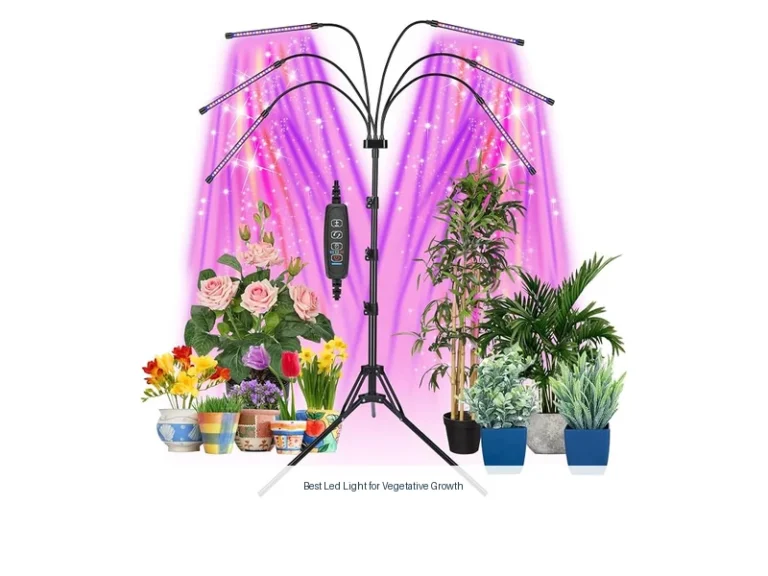
LEOTER takes a more adjustable approach than a basic single-head lamp. Its 80 LEDs combine red, blue, yellow, and white diodes, and the three switch modes let you choose full-spectrum lighting or a red-and-blue combination. That gives a plant owner more ways to match the lamp to different growth stages, while the full-spectrum option remains the most convenient everyday setting for mixed houseplants.
The four-head arrangement can spread light across more foliage than a single narrow beam. Each head sits on a flexible gooseneck, so you can angle the output around leaves or direct more light toward a taller central stem. Ten dimming levels are useful when moving a plant closer to the fixture, since you can reduce intensity instead of making a drastic placement change.
Its circular memory timer turns the lamp on and off daily at 3, 9, or 12 hours, but the supplied information notes that the timer must be reset if the light loses power. That matters if the lamp is connected to a switched outlet or unplugged during cleaning. USB connectivity and the included AC adapter make it suitable for desks and shelves, while the heat sink and temperature-control design are intended to help manage warmth.
Pros
- Four adjustable light heads provide flexible coverage
- Full-spectrum, red, and blue lighting modes
- Ten brightness levels for gradual adjustment
- Automatic 3-, 9-, and 12-hour daily timer
- USB connection with AC adapter included
Cons
- Timer needs resetting after power interruption
- Multiple controls may feel less simple to first-time users
- Clamp installation still limits it to suitable furniture edges
My Opinion
LEOTER is a strong fit when one lamp needs to serve several plants or changing growth stages. I would choose it over GooingTop when four-head coverage and fine brightness control are more important than the simplest possible setup.
yadoker Full Spectrum 6.3 Halo Plant Light
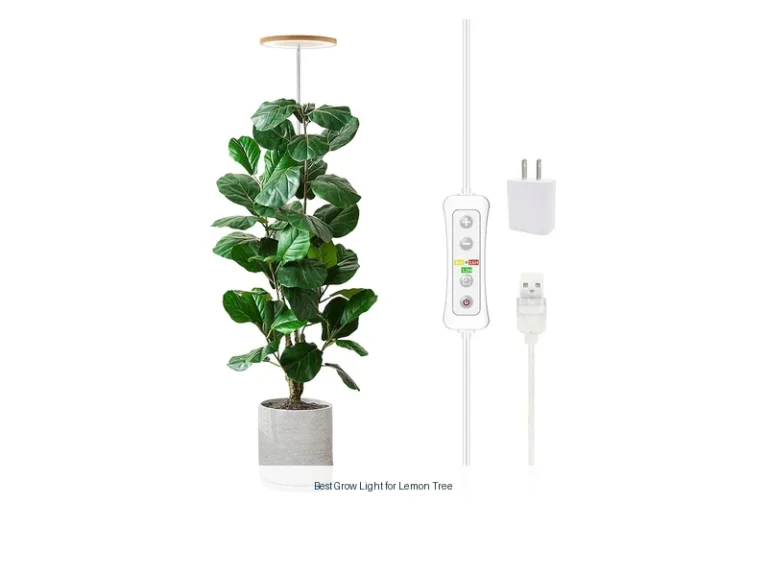
The yadoker halo light is made for a different kind of setup: a plant standing on the floor, in a large planter, or in a group where a clamp would be awkward. Its telescoping pole extends from 13.7 to 61.1 inches, allowing the light to remain above a plant as it grows. Fully extended, the wide 6.3-inch disc can also cover a broader area than a small desk lamp.
Its 72 LEDs cover the 380nm–800nm range and combine cool white, warm white, red, and blue diodes. That mix should look less harsh than a red-blue-only fixture while still providing a broad spectrum for foliage and flowering stages. Ten brightness settings are a useful safeguard against placing a young or shade-tolerant plant directly under maximum output.
The 8-, 12-, and 16-hour timer gives this model the longest daily schedule among the first three choices. That is helpful for a dim room or a plant receiving very little window light. The long cord makes placement easier across a room, and its 5V USB power is designed for low-voltage use. However, confirm that your intended power arrangement is compatible before ordering, and remember that a tall pole needs a stable planter or surface.
Pros
- Height adjusts from 13.7 to 61.1 inches
- Halo disc can cover a larger plant area
- Ten brightness levels and broad full-spectrum range
- 8-, 12-, and 16-hour automatic timer
- 5V USB power and long cord
Cons
- Requires a planter or arrangement that can support the stake
- USB power compatibility should be confirmed before purchase
- May be excessive for a single tiny tabletop plant
My Opinion
This is the most practical choice for tall plants, floor planters, and grouped containers. Its adjustable height gives it more room to grow with a plant, but it needs a stable installation site rather than a simple shelf clamp.
Aokrean Grow Lights
Aokrean stands out because it offers two installation methods. You can insert the pole into soil or use the included stand, making it easier to adapt the light to different planters and furniture arrangements. The important limitation is that the stand needs to be pressed down by the flower pot to remain stable, so it should not be treated as a completely free-standing lamp.
Three lighting modes—white, warm white and red, and mixed light—provide a straightforward way to change the appearance and spectral balance. Ten brightness levels allow smaller adjustments than simply switching between modes. For a beginner, that combination is useful because a low setting can be a gentler starting point, while brighter settings can support plants in darker locations.
The pole telescopes and can rotate 90 degrees, reaching up to 26 inches and helping the lamp cover more than one nearby plant. Its automatic timer offers 3-, 9-, and 12-hour cycles. This is a convenient range for routine supplemental lighting, though it does not provide the longer 16-hour schedule available from some halo competitors. The compact styling also makes it easier to keep in a living room or office where appearance matters.
Pros
- Can be installed in soil or with a pot-supported base
- Three lighting modes and ten brightness settings
- Adjustable height and 90-degree rotation
- Automatic 3-, 9-, and 12-hour timer
- Suitable for many home locations
Cons
- Base must be stabilized by the flower pot
- Maximum height is shorter than the yadoker and Kullsinss models
- Not wireless
My Opinion
Aokrean is a sensible middle ground for buyers who want a halo-style appearance and flexible installation without needing a very tall pole. Use the soil method for a secure planter setup, or make sure the pot fully supports the base.
Kullsinss 6.3in Grow Lights
Kullsinss combines a decorative faux woodgrain finish with a tall halo design, so it is aimed at buyers who want plant equipment to blend into a room. The finish is presented as more durable than bamboo alternatives that may crack or fall apart. That appearance is not a substitute for useful lighting, but it can make the fixture easier to live with in an exposed corner or main living area.
Its 80 LEDs cover 380nm–760nm and are intended to provide broad-spectrum light from germination through flowering and fruiting. Five dimming levels and three modes—white, warm white plus red, and mixed light—keep the controls relatively approachable. The 6-, 12-, and 16-hour timer also gives more scheduling flexibility than many compact lamps, especially for plants in rooms with very little natural light.
The pole adjusts from 10 to 65 inches, making this the tallest option in the group. That range can suit large indoor plants, but the product is supplied without a base and must be inserted into soil. Buyers should therefore check that the planter is deep and stable enough to hold the stake. Kullsinss also emphasizes heat dissipation and provides customer service support, but placement should still allow airflow around the fixture.
Pros
- Decorative faux woodgrain design
- Height adjusts from 10 to 65 inches
- 80 LEDs with broad full-spectrum coverage
- 6-, 12-, and 16-hour timer options
- Useful for tall or large indoor plants
Cons
- No base is included
- Must be inserted into suitable soil
- Only five brightness levels
My Opinion
Kullsinss is the best fit for a tall planter where a decorative, high-reaching light is preferable. Its lack of a base is the key compatibility issue, so confirm the pot can hold the stake before choosing it.
How I Selected These Indoor Plant Lights
I compared the products by looking at the factors that most affect everyday ownership: light type, adjustment range, timer choices, installation method, power arrangement, coverage, and stated heat-management features. I also considered whether each model serves a distinct use case, from a single tabletop plant to a tall floor planter.
Light controls matter because the most powerful-looking lamp is not automatically the most useful one. A dimmer, adjustable height, and timer can make a modest fixture easier to use correctly.
Customer-feedback evidence was part of the ranking context supplied for these products, but it was not treated as proof of plant performance under every condition. Specifications were kept separate from assumptions: a timer can automate a schedule, for example, but it cannot guarantee that a particular plant receives the right intensity at every distance.
Installation is a major selection factor. Clamp lamps need a suitable edge, while halo lamps need stable soil or a pot-supported base.
How to Choose the Right Indoor Plant Light
When comparing the best grow lights for house plants, start with the plant’s location and size rather than the number of LEDs alone. A desk lamp is convenient for one small pot, while a height-adjustable halo is usually easier to position over a tall plant or several grouped containers.
- Choose a clamp lamp for shelves, desks, and individual plants.
- Choose a halo pole for floor planters, tall specimens, or grouped pots.
- Look for dimming when plants have different light tolerances.
- Use a timer to keep the daily schedule consistent.
- Check the power connection and installation requirements before ordering.
Match coverage to the plant arrangement
One narrow light head may illuminate a small foliage plant effectively, but leaves outside the main beam may receive less useful light. Multi-head lamps can spread illumination around a wider canopy. Halo discs provide a more centralized overhead pattern and can work well when the plant grows upward from a single pot.
Consider height and distance
Adjustability is valuable because the correct distance changes with plant growth and lamp intensity. A fixture that can move upward gives you more room as stems extend. If the pole is short, it may eventually sit too close to the leaves or require a different placement strategy.
Think about spectrum and appearance
Full-spectrum white light is generally easier to live with in a home because it looks more like ordinary daylight. Red and blue modes can provide additional control, but they may create a more noticeable colored glow. For a living room or office, a natural-looking mixed or white mode may be the most comfortable daily choice.
Evaluate timer behavior
Timer labels do not all mean the same thing. Some models use a repeating 24-hour cycle, while others require a reset after losing power. Set the schedule at a convenient time and avoid connecting the lamp to an outlet that is regularly switched off unless the timer behavior supports that arrangement.
Setting Up a Grow Light for the First Time
Begin by placing the fixture where it can illuminate the plant without being blocked by shelves, curtains, or dense leaves. Secure a clamp firmly, press a pot-supported base into position, or insert a stake deeply enough for stability. Then aim the light toward the canopy rather than directly at only one leaf.
Start at a moderate brightness and observe the plant over several days. If the foliage appears stressed or the soil dries unusually fast, reduce intensity, increase distance, or shorten the schedule. If growth remains weak and the plant is otherwise healthy, a gradual increase may be appropriate.
For a timer, choose a consistent start time that fits your household routine. Keep the cord away from watering areas, and leave enough slack that the connector is not pulled when the plant or pot is moved.
How Long Should an Indoor Plant Light Run?
There is no single schedule that fits every houseplant, room, or lamp. Use the available timer settings as a starting point, then consider how much natural window light the plant receives. A dim corner may need a longer schedule than a bright room, while a plant receiving direct sunlight may need less supplemental lighting.
The listed products provide different choices: GooingTop offers 4, 8, or 12 hours; LEOTER and Aokrean offer 3, 9, or 12 hours; yadoker provides 8, 12, or 16 hours; and Kullsinss provides 6, 12, or 16 hours. Longer settings are not automatically better, so avoid assuming that maximum time is the safest option.
Placement, Heat, and Household Safety
Keep the lamp positioned so leaves are not pressed against the light head or pole. Although the supplied products emphasize LED efficiency, low-voltage operation, or heat dissipation, good airflow is still sensible. Do not cover the fixture with fabric, place it where water can splash directly onto the controls, or route the cord through a location where it can be pinched.
With clamp lamps, confirm that the clamp is gripping a solid surface rather than a thin decorative panel. With stake lights, check the soil and pot stability after watering, since softened soil may hold a stake less securely. For a base model, make sure the pot actually presses down on the base as required.
Using Timers and Brightness Controls Effectively
A timer is most useful when it creates a repeatable routine. Set the light to begin during the same general part of the day, and check that the indicator or control settings behave as expected after the first cycle. If a model loses its schedule after power interruption, reset it rather than assuming the previous program remains active.
Brightness controls should be used gradually. A newly purchased lamp does not need to start at full power, particularly when it is placed close to leaves. Increase brightness only when the plant’s location and condition suggest it needs more light, and keep the lamp aimed evenly across the canopy.
Cleaning and Long-Term Ownership
Dust can collect on LED covers and reduce the amount of light reaching foliage. Unplug the fixture before cleaning, then use a dry or lightly damp soft cloth according to the product’s safe handling instructions. Keep moisture away from USB connectors, switches, and inline controllers.
Inspect the gooseneck, clamp, pole, and cord occasionally. A loose clamp can change the light angle, while a bent or unstable stake can cause a halo to tilt into the foliage. Do not force telescoping parts or rotate a joint beyond its intended movement.
As plants grow, reposition the light rather than leaving it aimed at the original small canopy. Tall plants may eventually outgrow a short Aokrean setup, while the extended yadoker or Kullsinss poles provide more room. If a plant collection expands, reassess coverage instead of simply increasing the brightness of one small lamp.
Common Mistakes to Avoid
Most disappointing results come from setup errors rather than from choosing the wrong brand. A light that is too far away, aimed at a wall, or left on an inconsistent schedule may provide little practical benefit even when its specifications look appealing.
- Do not assume more hours always means better growth.
- Do not place a stake light in loose or unstable soil.
- Do not rely on a clamp attached to a fragile shelf edge.
- Do not ignore the timer’s power-loss behavior.
- Do not judge light coverage by brightness in the room alone.
- Do not let cords or controllers sit where watering can reach them.
Choosing Between a Clamp and Halo Design
A clamp model is usually the more compact answer for one plant near a desk, bookcase, or counter. It is easy to redirect and remove, but it depends on having a suitable edge and may not cover a wide canopy evenly.
A halo model creates a cleaner overhead arrangement and can follow a plant’s vertical growth. It takes more attention to stability, especially when the design uses a soil stake or a base that must be held down by the pot. For a large planter, that trade-off is often worthwhile.
FAQS About Best Grow Lights for House Plants
What type of grow light is best for a single houseplant?
A compact clamp light is usually the simplest option for one small or medium plant. GooingTop is particularly straightforward, while LEOTER adds more coverage and control through its four adjustable heads.
Are full-spectrum grow lights suitable for house plants?
Full-spectrum lights are a practical choice for many indoor plants because they provide a broad range of light while often appearing more natural than strongly colored red-blue lighting. The correct distance and schedule still matter.
Should a houseplant grow light have a timer?
Yes, a timer can make the daily schedule more consistent and reduce the need to switch the lamp manually. Check whether the selected model repeats its schedule after a power interruption or needs to be reset.
Are halo grow lights better for tall indoor plants?
They can be, because adjustable poles place the light above a taller canopy and may cover a broader area. Yadoker and Kullsinss offer substantially more height than the compact clamp-style options, while Aokrean reaches up to 26 inches.
Can an indoor plant light replace sunlight completely?
A grow light can provide supplemental or artificial illumination, but the result depends on intensity, distance, schedule, plant type, and overall care. Product descriptions alone do not establish that every plant will thrive without natural sunlight.
What should I check before buying an indoor plant light?
Check the coverage area, height range, mounting method, timer cycle, brightness controls, power connection, and whether the fixture includes or requires a stable base. These details determine whether the lamp will work in your specific room and planter.
Final Thoughts
The best grow lights for house plants depend on your setup, but GooingTop Grow Light 6000K Full Spectrum Indoor Plant Growing Lamp is my strongest all-around choice for compact, simple supplemental lighting. Choose LEOTER Grow Light for more spectrum and brightness control, or yadoker Full Spectrum 6.3″ Halo Plant Light for taller plants and broader overhead coverage.

I’m Maya L. Greenwood, a lifelong plant lover who believes anyone can grow something beautiful with the right guidance. After years of testing soil mixes, pruning methods, irrigation tricks, and pest-safe solutions, I started EasyGardenTips.com to turn hard-won lessons into step-by-step advice. From seed starting and container gardens to composting and seasonal checklists, my goal is to make gardening simple, sustainable, and fun.