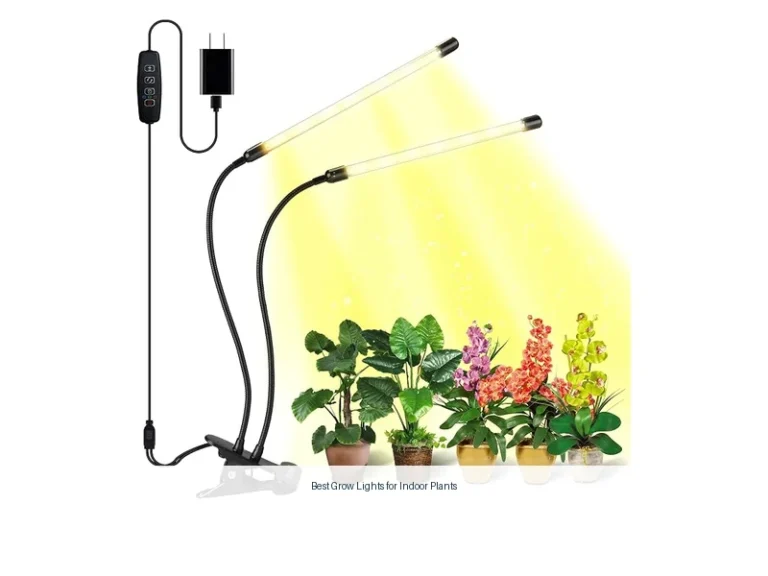
5 Best Grow Light for Lemon Tree: Compared With Buying Guide
Finding the best grow light for lemon tree indoors is not simply a matter of choosing the brightest lamp. A lemon tree needs dependable coverage, a workable height, an appropriate daily schedule, and enough flexibility to match its size as it grows.
My first choice is yadoker Grow Lights. The 13.7- to 61.1-inch height range and USB-powered 5V design also make it easy to fit into a home growing area.
My second choice is LBW Grow Lights. Its 214 LEDs, six brightness levels, 27.8- to 68-inch adjustment range, and hanging option provide more placement flexibility as a citrus plant becomes larger.
My third choice is Barrina T10 Vertical Grow Light. Barrina T10 Vertical Grow Light ranks third because its 4-foot upright format is particularly useful for tall plants and side coverage. The 42W full-spectrum lamp, high-PPFD positioning, and daylight-white 5000K output make it a practical choice when a small halo light cannot cover the tree evenly.
This guide compares all five options, explains which plant sizes and room layouts each one suits, and covers placement, scheduling, safety, maintenance, and common mistakes. The buying sections also clarify how to match light coverage and intensity to an indoor lemon tree rather than choosing by LED count alone.
Best Grow Light for Lemon Tree
I selected these products for their relevance to indoor citrus growing, useful height and placement controls, spectrum information, timers, coverage potential, and available customer-feedback evidence. The list also includes several formats—halo, tripod, vertical floor lamp, and dual-head lamp—so the comparison is useful for different lemon tree sizes and room layouts without claiming hands-on testing.
| # | Image | Product | Price on Amazon |
|---|---|---|---|
| 1 |  |
yadoker Grow Lights | Check Price |
| 2 |  |
LBW Grow Lights | Check Price |
| 3 |  |
Barrina T10 Vertical Grow Light | Check Price |
| 4 |  |
FECiDA 76″ Floor Lamp Grow Light | Check Price |
| 5 |  |
GLOWRIUM Tall Plant Grow Light | Check Price |
yadoker Grow Lights
The yadoker is a compact halo-style light that sits directly in the planter, making it a natural fit for a young lemon tree in a pot. Its 72 LEDs combine white, warm-white, red, and blue diodes across a stated 380nm-800nm range. That full-spectrum approach is useful when the lamp must support ongoing foliage growth rather than serve only as a short-term seedling light.
Its telescoping pole adjusts from 13.7 to 61.1 inches, which gives this small fixture more growing room than its footprint suggests. A low setting can sit close to a tabletop citrus plant, while a fully extended pole can reach above a taller container. The halo shape should spread light around the upper canopy, although it will not cover a very wide or densely branched tree as evenly as a larger panel or two-head lamp.
Ten brightness settings allow gradual adjustment instead of forcing a young plant to accept maximum output immediately. The 8-, 12-, and 16-hour timer is especially convenient for maintaining a consistent schedule. It runs from 5V USB power and includes a long cord, but buyers should confirm that the required USB power arrangement is suitable for their outlet and setup. The low-voltage design is convenient for long daily use, though it is not a substitute for proper placement away from water.
Pros
- Adjustable 13.7- to 61.1-inch pole suits changing plant height.
- Ten dimming levels and three timer choices offer fine control.
- Compact halo format is easy to place in a single planter.
- Full-spectrum LED mix supports year-round indoor growing.
Cons
- The small halo may not evenly cover a mature, wide lemon tree.
- USB 5V power requires a compatible power source and outlet arrangement.
- A stake-in-soil design is less suitable for unstable or very crowded pots.
My Opinion
This is the most balanced starting point for a beginner with a young or medium potted lemon tree. I would choose it when compact placement, simple controls, and adjustable height matter more than maximum canopy coverage.
LBW Grow Lights
LBW takes a more substantial tripod-and-panel approach. Its 214 LEDs use a mix of cool white, warm white, red, and natural-light diodes, and the widened 10.9-by-4.6-inch panel is intended to illuminate a broader area than a small planter stake. That makes it more appealing for a lemon tree with several developing branches or for a grow corner containing more than one plant.
The included 1.5-meter tripod adjusts from 27.8 to 68 inches, so the lamp can remain above a young tree as it gains height. A hanging sling adds another installation option when a floor tripod would take up too much space. This versatility comes with a little more setup and floor-space demand than the yadoker halo, and the tripod should be positioned where it will not be bumped by pets, children, or passing foot traffic.
Six dimming levels let the owner reduce intensity while a plant acclimates or increase it as the canopy expands. Its 4-, 8-, and 12-hour timer choices are useful, although the shorter maximum schedule gives less flexibility than products offering 16 or 20 hours. The aluminum light panel and reserved rear ventilation space are sensible construction details for regular operation. Buyers seeking a very precise citrus setup should still judge the result by plant response and coverage rather than assuming a high LED count alone guarantees adequate light at the leaves.
Pros
- 214-LED panel offers broad illumination for multiple branches.
- Tripod height reaches 68 inches and can be replaced by hanging installation.
- Six brightness levels provide useful adjustment.
- Aluminum panel and rear ventilation space support practical everyday use.
Cons
- The tripod needs more floor space than a planter-mounted light.
- The timer tops out at 12 hours.
- Six brightness steps are less precise than stepless dimming.
My Opinion
LBW is a strong alternative for a taller indoor lemon tree or a small plant collection. Its larger panel and dual installation methods justify choosing it over a compact halo when coverage and height are the main concerns.
Barrina T10 Vertical Grow Light
The Barrina T10 is built around vertical coverage rather than a light positioned directly above the pot. Its 4-foot upright lamp sends illumination from the side, which can help reach the height of a lemon tree and brighten foliage along the trunk and outer branches. This format is especially interesting for a plant that has outgrown a small tabletop lamp but does not have room for a broad overhead fixture.
The 42W lamp uses a 5000K full-spectrum daylight-white output and is described as offering high PPFD. Its CRI of 96 also produces a bright, natural-looking light that is easier to live with in a living room, sunroom, or office. A vertical design does not automatically provide equal intensity at every leaf, however. The lamp should be placed close enough to the canopy for useful coverage while leaving room for the tree to grow and avoiding contact between foliage and the light.
Assembly is straightforward: connect the stand, plug in the unit, and position it beside the plant. The package includes a tripod, hanging clips, and a hex wrench. Those hanging clips add flexibility if the standing arrangement is not ideal. The manufacturer specifically notes that loose base hex screws can make the tripod unstable, so checking and tightening the base is an important ownership step. This product is less feature-rich in the supplied information than the timer-equipped lamps, meaning a separate outlet timer may be needed for automatic scheduling.
Pros
- 4-foot vertical format suits tall or large potted plants.
- 42W, 5000K full-spectrum output provides bright daylight-style illumination.
- Side lighting can reach foliage that an overhead halo may miss.
- Includes standing and hanging installation hardware.
Cons
- The supplied information does not identify a built-in timer.
- Side lighting may require careful positioning for even canopy coverage.
- Loose base screws can affect tripod stability.
My Opinion
Barrina is the best fit here for a taller lemon tree when vertical side coverage matters more than compact controls. I would pair it with an outlet timer and inspect the tripod base before placing it near a valuable plant.
FECiDA 76″ Floor Lamp Grow Light
FECiDA is the furniture-style option in this group, with a stable base and an adjustable height from 40 to 76 inches. That range makes it suitable for a large lemon tree, tall bonsai-style citrus, or a plant that has already outgrown a stake light. Its floor-lamp design can sit in a living room corner without looking like a temporary seed-starting rig, which may matter when the light needs to run throughout winter.
The lamp uses 208 LEDs and produces 2,000 lumens, described as equivalent to a 200W incandescent lamp. Its full-spectrum mix includes 3000K, 5000K, 660nm, and UV-IR LEDs. The combination is intended to resemble natural sunlight, but the warm and cool components may create a more noticeable room glow than a narrow plant lamp. Buyers should also remember that lumens describe visible brightness to people, not the complete measurement of useful plant light, so canopy distance and leaf response still matter.
A five-mode timer provides 4-, 8-, 12-, 16-, or 20-hour choices, including combined-button settings for the two longest schedules. The direct home-plug design avoids a separate adapter, and the daisy-chain input and output can connect up to three units using one wall socket. That is helpful for a larger indoor collection, although connected lamps should be arranged safely and kept away from watering splash. The stable base is a meaningful advantage over a narrow stake when a tall tree could pull on the fixture.
Pros
- 40- to 76-inch height range works for tall citrus plants.
- Stable floor base is better suited to living spaces and larger pots.
- Offers five timer choices, including 16- and 20-hour schedules.
- Daisy-chain function can simplify multi-lamp arrangements.
Cons
- Floor base requires dedicated space beside the tree.
- Its 2,000-lumen specification does not alone indicate plant-usable intensity.
- Warm and cool light may be more visually prominent in a room.
My Opinion
FECiDA is a sensible choice when a lemon tree is tall, the lamp must look at home in a living area, and stability matters. Its extensive height and timer options are particularly useful for seasonal indoor citrus care.
GLOWRIUM Tall Plant Grow Light
GLOWRIUM offers a dual-head floor lamp with a 70.9-inch maximum height, making it a flexible option for a tall lemon tree or a pair of nearby plants. Each 7.87-inch lamp head uses an independent 360-degree gooseneck, so the owner can angle light toward the top, side, or opposite branches instead of illuminating only one central point.
The 48W lamp contains 268 LEDs and provides dedicated Seedling, Vegetative, and Flowering spectrum modes. For a citrus grower, that gives a straightforward way to change the light profile as the plant moves from new growth toward blooming. Six preset brightness levels range from 10% to 100%, and press-and-hold stepless dimming offers finer control. The stated PPFD reaches up to 280 micromoles per square meter per second at six inches, but distance is critical; moving the heads farther away will reduce the intensity reaching the leaves.
Its timer cycles are 3, 9, 12, and 16 hours, providing useful automation without requiring a separate outlet timer. The 5.29-pound metal base and aluminum pole should provide a reassuring foundation for adjustable heads, while the included power adapter, controller, and manual make the kit complete. The 50,000-hour lifespan and two-year warranty add ownership reassurance, though buyers should still avoid bending the goosenecks repeatedly beyond comfortable positioning or allowing water to reach the controls.
Pros
- Dual independently adjustable heads can target different parts of a canopy.
- Three spectrum modes cover seedling, vegetative, and flowering stages.
- Provides both preset and stepless dimming options.
- Includes a 2-year warranty and a weighted metal base.
Cons
- Two heads and a floor base require more space than a single stake lamp.
- The maximum stated PPFD applies at a six-inch distance, not every placement.
- The shortest timer choices may not suit every preferred schedule.
My Opinion
GLOWRIUM is the most adjustable choice for a branching lemon tree or two plants sharing one growing area. It ranks fifth mainly because its customer-feedback sample is much smaller than the higher-ranked options, not because its control set is weak.
How I Selected These Best Grow Light for Lemon Tree Options
The selection centers on the needs of indoor citrus: a light must reach the plant’s canopy, remain usable as the tree changes size, and support a repeatable daily routine. I gave weight to adjustable height, spectrum information, brightness control, timer choices, stability, coverage style, and whether the fixture can work in a home rather than only in a dedicated grow tent.
I also considered the differences between a young lemon tree and a mature container tree. A planter-mounted halo can be excellent for a compact plant but may become inadequate as branches spread. Conversely, a tall floor lamp can solve coverage problems while taking more room and adding visual presence. The rankings therefore reflect practical fit, not a single specification such as LED count or wattage.
For indoor citrus, usable coverage and consistent placement matter more than choosing the lamp with the largest-sounding LED number.
Customer ratings and the number of available customer responses supplied with the product information were additional context, not proof that any one lamp will perform identically in every room. The descriptions also do not provide a complete PPFD map for every product, so the guide avoids pretending that one advertised number can replace careful positioning and observation.
A timer is valuable because a repeatable schedule is easier to maintain than manually switching a lamp on and off every day.
How to Choose the Best Grow Light for Lemon Tree
The right lamp depends first on the tree’s current height and canopy width. A young citrus plant in a small pot can use a compact adjustable halo, while a taller tree usually benefits from a broad panel, vertical lamp, or dual-head fixture. Exact keyword phrase is addressed here naturally: choosing the best grow light for lemon tree means matching the lamp to the leaves, not merely matching it to the pot.
- Measure the tree and the available floor or tabletop space before ordering.
- Favor adjustable brightness and height so the lamp can change with the plant.
- Choose a timer that matches the daily schedule you can maintain consistently.
- Look for coverage from more than one angle when the canopy is tall or wide.
- Check the power arrangement, base stability, and distance from water.
Match the light format to the tree
A halo stake is compact and easy to center over one young tree. A tripod panel gives more overhead coverage and can be moved away as the plant grows. A vertical lamp is useful when the tree is tall and its side leaves need attention. Dual heads are helpful when branches spread in different directions or when two nearby plants share a station.
Think about height and distance
The lamp should be close enough that the foliage receives useful light, but not so close that the leaves become excessively warm or the fixture interferes with watering and pruning. Adjustable poles and goosenecks make this easier. Recheck the distance whenever the tree produces a flush of new growth, because the upper leaves may gradually approach the lamp.
Consider the room, not just the plant
A floor lamp needs a stable location and enough clearance for its base. A hanging panel may save floor space but requires a secure overhead support. USB-powered fixtures can be convenient around a desk or shelf, whereas direct-plug floor lamps may be simpler beside a living-room tree. The best choice is one that can remain correctly positioned without becoming a trip hazard or an eyesore that gets switched off.
How Much Light Does an Indoor Lemon Tree Need?
Lemon trees naturally prefer strong light, and indoor conditions are often much dimmer than they appear to human eyes. A grow lamp should supplement a bright window or provide the main light source when natural light is limited. Start with a moderate brightness setting and observe the plant rather than assuming maximum output is always better.
Use the timer every day at a consistent time. A schedule in the range supported by the chosen product can be adjusted according to natural window light, seasonal conditions, and the plant’s response. Avoid leaving the light on continuously; the tree benefits from a regular dark period as part of its daily cycle.
How to Set Up a Grow Light Beside a Lemon Tree
- Place the pot on a stable, level surface with room for watering and pruning.
- Position the lamp so the main foliage—not just the topmost leaf—receives illumination.
- Secure a tripod, tighten base hardware, or press a stake firmly into suitable soil.
- Begin at a moderate brightness and use the timer from the first day.
- After several days, check whether the canopy is evenly lit and adjust height or angle.
For a broad tree, rotate the pot occasionally if one side receives much more light than the other. With a dual-head model, aim one head toward the upper canopy and the other toward a darker side branch. With a vertical lamp, move the fixture as the tree expands instead of allowing only the outermost leaves to receive light.
Using Timers and Dimming Controls Correctly
Timers are most useful when the lamp starts at the same time each day. Follow the specific controller sequence for the chosen model and confirm that the light actually returns to the intended cycle after a power interruption. If the product lacks a built-in timer, an appropriate outlet timer can provide automation, provided the lamp’s power requirements are compatible.
Dimming is helpful during the transition from a bright outdoor location to an indoor station or when a new lamp is placed close to foliage. Increase brightness gradually rather than changing every setting at once. If leaves appear stressed, move the lamp farther away or reduce intensity while checking watering and room conditions as well.
Coverage, Canopy Shape, and Placement
A lemon tree’s leaves do not form a flat, uniform surface. Branches shade one another, and the top of the tree can receive much more light than the interior. A single small halo can be adequate for a narrow young plant but may leave lower or outer leaves underlit as the canopy widens.
Use the light’s adjustable features to create more even exposure. A panel can sit above the tree, a vertical fixture can stand beside it, and two flexible heads can target separate zones. Keep the lamp aligned with the active foliage, and do not judge coverage only by how bright the room looks.
Power, Water, and Stability Safety
Keep cords and controllers away from the saucer, drainage water, and wet hands. Water the tree with the lamp switched off if the fixture is close enough to be splashed. Let excess water drain fully before returning the pot to its growing position.
Check that a planter stake is not leaning and that a tripod’s legs are fully spread. For the Barrina model, loose hex screws can contribute to instability, so inspect the base during assembly and after moving it. A heavy or stable floor base is preferable when pets, children, or frequent foot traffic make tipping likely.
Cleaning and Maintenance Tips
Dust on a light panel can reduce the amount of light reaching the plant and can collect around ventilation openings. Unplug the lamp, allow it to cool, and wipe the surfaces with a dry or barely damp soft cloth according to the care instructions. Never spray cleaner directly onto LEDs, controllers, plugs, or electrical connections.
Every few weeks, inspect the pole, goosenecks, tripod joints, base screws, and power cord. Remove dead leaves from around the fixture and make sure the lamp is not being pulled sideways by its cord. These small checks are especially worthwhile when the lamp is adjusted frequently as the lemon tree grows.
Common Mistakes When Lighting a Lemon Tree
Many disappointing results come from inconsistent placement rather than a defective lamp. A buyer may choose a powerful-looking fixture but position it too far away, light only the top of the tree, or forget that a timer can reset after an outage.
- Do not choose by LED count alone; coverage and distance affect the leaves more directly.
- Do not place a narrow halo over a wide canopy and assume every branch is equally lit.
- Do not run the lamp all day and night without a regular dark period.
- Do not let leaves touch a hot or poorly positioned fixture.
- Do not hide cords beneath wet saucers or place controllers where watering can reach them.
- Do not ignore a leaning stake, loose tripod screw, or unstable floor base.
- Do not change light intensity and watering dramatically at the same time if you want to identify the cause of plant stress.
When to Upgrade or Add a Second Light
Consider an upgrade when the lemon tree has grown beyond the lamp’s height adjustment, when new branches extend outside the illuminated area, or when the fixture must be placed so far away that the leaves no longer receive useful intensity. Yellowing or leaf drop can have many causes, so check watering, pests, temperature, and root health before blaming the light alone.
A second fixture can help when the tree is wide, the room has a deep shadow on one side, or several plants compete for one small lamp. The FECiDA model’s daisy-chain capability may simplify a multi-lamp arrangement, while the GLOWRIUM’s dual heads can solve smaller coverage gaps without adding another base.
FAQS About Best Grow Light for Lemon Tree
What type of grow light is best for an indoor lemon tree?
A full-spectrum adjustable LED is a practical choice because it can provide broad support for foliage and flowering while using dimming and height controls to match the tree’s size. The best format depends on the canopy: a halo suits a young plant, while a panel, vertical lamp, or dual-head fixture is better for a taller or wider tree.
Can a grow light replace sunlight for a lemon tree?
A suitable grow light can provide the main indoor light source when natural sunlight is weak, but its success depends on coverage, distance, intensity, and schedule. Place the lamp so the active canopy receives light rather than illuminating only the room or the top leaf.
How far should a grow light be from a lemon tree?
Use the distance recommended for the specific fixture and begin conservatively, especially with a bright lamp. Adjustable height and dimming allow gradual changes. Watch the leaves for signs of excessive intensity or inadequate coverage, and remember that a stated PPFD value applies only at its listed distance.
How long should a grow light run for an indoor lemon tree?
Use the product’s timer to create a consistent daily schedule and include a regular dark period. The appropriate duration depends on how much window light the tree receives and which timer choices the lamp provides. Start with a moderate setting and adjust based on the plant’s response.
Is the yadoker grow light suitable for a lemon tree?
It is a good fit for a young or medium lemon tree in a pot. Its adjustable 13.7- to 61.1-inch pole, halo shape, ten brightness levels, and 8-, 12-, and 16-hour timer make it easy to position and automate. A mature, wide tree may need broader coverage.
Which grow light is best for a tall lemon tree?
The Barrina vertical lamp, FECiDA floor lamp, and GLOWRIUM dual-head lamp are the strongest tall-tree candidates in this list. Barrina emphasizes side coverage, FECiDA offers a 76-inch maximum height and stable base, and GLOWRIUM combines a 70.9-inch pole with two flexible heads.
Final Thoughts
The best grow light for lemon tree care depends on the tree’s size and the room available. yadoker Grow Lights is my top overall choice for compact, adjustable everyday use; LBW Grow Lights is the better alternative for broader tripod coverage; and Barrina T10 Vertical Grow Light suits taller plants that need side illumination. Choose the format you can position consistently, automate, and maintain safely.

I’m Maya L. Greenwood, a lifelong plant lover who believes anyone can grow something beautiful with the right guidance. After years of testing soil mixes, pruning methods, irrigation tricks, and pest-safe solutions, I started EasyGardenTips.com to turn hard-won lessons into step-by-step advice. From seed starting and container gardens to composting and seasonal checklists, my goal is to make gardening simple, sustainable, and fun.