How Many Plants Fit in a Grow Tent (2×2/2×4/3×3/4×4/4×8/5×5)
One of the first questions every indoor gardener asks is, “How many plants can I fit in my grow tent?” It’s a simple question, but the answer isn’t as straightforward as choosing a number based on the tent’s dimensions.
Many beginners assume a larger plant count automatically leads to a bigger harvest. In reality, overcrowding can reduce airflow, block light from reaching lower leaves, increase humidity, and make routine maintenance much more difficult. In many cases, growing fewer plants with proper spacing produces better results than trying to fill every inch of available space.
Plant capacity depends on several factors, including the size of your grow tent, the mature size of your plants, the type of containers you use, your training method, and the amount of space required for lighting and ventilation equipment. Two gardeners using the same 4×4 grow tent may end up growing completely different numbers of plants because their setups and growing goals are different.
Research from the University of Florida’s Institute of Food and Agricultural Sciences (UF/IFAS) highlights that proper plant spacing is essential for maximizing light interception, improving air circulation, and reducing the risk of plant diseases. Those same principles apply to indoor gardening, where limited space makes efficient planning even more important.
In this guide, I’ll show you how many plants fit in each grow tent size, from 2×2 to 4×8 and 5×5. I’ll also explain the factors that influence plant capacity, discuss realistic yield expectations, and share practical tips to help you choose the right number of plants for your grow tent without overcrowding your indoor garden.
How Many Plants Can Fit in a Grow Tent?
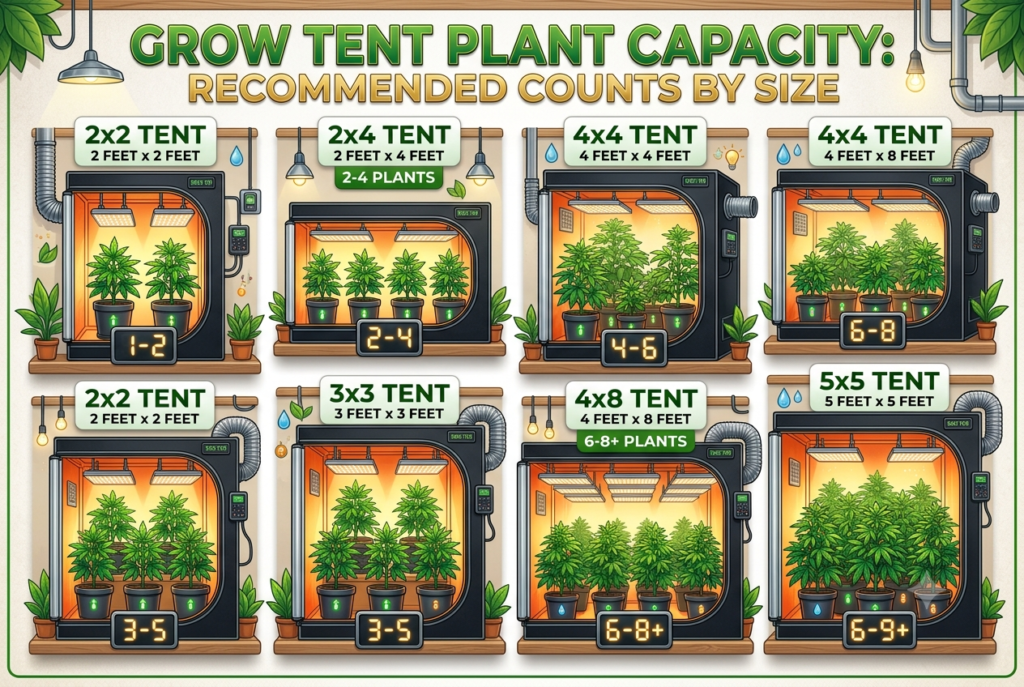
The table below provides a general estimate of how many medium-sized plants can fit comfortably in the most common grow tent sizes.
Keep in mind that these numbers are guidelines, not fixed limits. The actual plant capacity depends on factors such as plant size, pot size, training techniques, and how much space you leave for airflow and maintenance.
| Grow Tent Size | Recommended Plant Capacity |
| 2×2 ft | 1 to 2 plants |
| 2×4 ft | 2 to 4 plants |
| 3×3 ft | 3 to 5 plants |
| 4×4 ft | 4 to 8 plants |
| 5×5 ft | 6 to 10 plants |
| 4×8 ft | 8 to 16 plants |
These recommendations assume you’re growing healthy plants with enough room for proper light coverage, air circulation, and routine maintenance.
For example:
- A 2×2 grow tent is ideal for one large plant or two smaller plants.
- A 3×3 grow tent offers enough space for three to five medium-sized plants.
- A 4×4 grow tent can comfortably accommodate four to eight plants, making it one of the most popular choices for home growers.
- A 4×8 grow tent is better suited for larger indoor gardens where additional lighting and ventilation equipment are available.
If your plants grow large, use bigger containers, or require more training, you’ll likely need to reduce the number of plants. On the other hand, compact plants grown in smaller pots may allow you to fit a few more.
Instead of trying to maximize plant count, focus on giving each plant enough room to receive adequate light and airflow. Healthy, well-spaced plants often produce better growth and higher-quality harvests than an overcrowded tent.
Next, I’ll explain the key factors that determine plant capacity so you can decide how many plants your grow tent can realistically support.
What Determines Plant Capacity?
Two growers can use the exact same grow tent and end up with completely different plant counts. That’s because plant capacity depends on much more than the tent’s floor space.
Before deciding how many plants to grow, consider the following factors.
Plant Size
Not all plants grow to the same size. Some remain compact throughout their life cycle, while others develop wide canopies and require much more room.
As plants become larger, they need additional spacing to ensure adequate light exposure and healthy airflow.
Pot Size
Container size has a direct impact on how many plants fit inside a grow tent.
Larger pots take up more floor space and allow plants to develop larger root systems. Smaller pots save space but may limit plant growth if they’re too small for the species you’re growing.
For example, a tent that comfortably fits four plants in 5-gallon pots may hold six or more plants if you’re using smaller containers.
Read Full Guide : How Many Pots Fit in a Grow Tent? Capacity by Pot Size
Plant Training Method
Training techniques can significantly change the number of plants your tent can support.
Some methods encourage plants to spread outward, while others are designed to maximize production from fewer plants.
Common training methods include:
- Natural growth
- Low Stress Training (LST)
- Topping
- Screen of Green (SCROG)
- Sea of Green (SOG)
Depending on the technique, you may choose to grow fewer large plants or more compact ones.
Grow Light Coverage
Your grow light should cover the entire plant canopy evenly.
If you place too many plants under a single light, those around the edges may receive less light, leading to uneven growth. Matching your plant count to your light’s coverage area helps maximize efficiency.
Airflow and Ventilation
Plants need enough space for air to move freely between them.
Overcrowded tents trap heat and humidity, increasing the risk of mold, mildew, and pest problems. Leaving adequate spacing improves air circulation and creates a healthier growing environment.
Room for Maintenance
Don’t forget about yourself.
You’ll need space to water plants, inspect leaves, prune branches, and clean the tent. Packing plants too closely together makes these routine tasks more difficult and increases the chance of accidentally damaging your plants.
Ultimately, the ideal plant count is the one that allows every plant to receive enough light, fresh air, and room to grow. A well-planned layout almost always outperforms a crowded grow tent.
Next, I’ll break down the plant capacity for each grow tent size, starting with the compact 2×2 grow tent and working up to larger models.
Plant Capacity by Grow Tent Size
Now let’s look at each grow tent size in more detail. The recommendations below assume you’re growing medium-sized plants under proper lighting with enough room for airflow and maintenance.
Remember, these are general guidelines. Your actual plant count may be higher or lower depending on the plant species, pot size, and growing method.
How Many Plants Fit in a 2×2 Grow Tent?
A 2×2 grow tent provides 4 square feet of growing space.
For most setups, it’s best to grow:
- 1 large plant, or
- 2 small to medium-sized plants
This size is ideal for beginners, herbs, leafy greens, seedlings, and gardeners with limited space.
If you’re using large containers or training a single plant to fill the canopy, one plant is usually the better choice.
How Many Plants Fit in a 2×4 Grow Tent?
A 2×4 grow tent offers 8 square feet of floor space, making it one of the most versatile options for home growers.
Most gardeners can comfortably grow:
- 2 to 4 medium-sized plants
This tent provides a good balance between growing space and efficient light coverage, making it suitable for vegetables, herbs, and many flowering plants.
How Many Plants Fit in a 3×3 Grow Tent?
A 3×3 grow tent has 9 square feet of growing space.
A practical recommendation is:
- 3 to 5 medium-sized plants
Many indoor gardeners choose this size because it provides enough room for healthy airflow while still fitting comfortably in most homes.
How Many Plants Fit in a 4×4 Grow Tent?
A 4×4 grow tent is one of the most popular sizes for indoor gardening.
With 16 square feet of floor space, it can typically accommodate:
- 4 to 8 medium-sized plants
The exact number depends on your growing style. Fewer plants allow more room for training and maintenance, while smaller plants can be grown in higher numbers.
How Many Plants Fit in a 5×5 Grow Tent?
A 5×5 grow tent provides 25 square feet of growing space.
It’s generally suitable for:
- 6 to 10 medium-sized plants
This size is a great choice for experienced growers who want larger harvests while maintaining good airflow and easy access to their plants.
How Many Plants Fit in a 4×8 Grow Tent?
A 4×8 grow tent offers 32 square feet of growing space and is commonly used for larger indoor gardens.
Most setups can comfortably support:
- 8 to 16 medium-sized plants
Because of its larger footprint, this size usually requires multiple grow lights and a more powerful ventilation system to maintain consistent growing conditions.
These recommendations provide a solid starting point, but plant count is only one part of the equation. The amount you harvest depends on many other factors, including lighting, genetics, environmental conditions, and your overall growing technique.
Expected Yield by Grow Tent Size
One of the biggest misconceptions about indoor gardening is that a larger grow tent automatically produces a larger harvest. While a bigger tent gives you more growing space, your final yield depends on many factors besides tent size.
Some of the most important include:
- Plant genetics
- Grow light quality and intensity
- Temperature and humidity
- Watering and nutrients
- Pot size
- Training techniques
- Grower’s experience
Because of these variables, it’s impossible to guarantee a specific harvest. However, the table below shows realistic yield ranges for well-maintained indoor gardens using efficient LED grow lights.
| Grow Tent Size | Typical Dry Yield Range* |
| 2×2 ft | 100 to 300 g |
| 2×4 ft | 200 to 500 g |
| 3×3 ft | 300 to 600 g |
| 4×4 ft | 450 to 900 g |
| 5×5 ft | 600 to 1,200 g |
| 4×8 ft | 900 to 2,000+ g |
*These figures are estimates only. Actual yields vary depending on the plants, equipment, and growing conditions.
How Much Can a 2×2 Grow Tent Produce?
A well-managed 2×2 grow tent can typically produce 100 to 300 grams of dried harvest.
Smaller tents are often more efficient because they’re easier to control. With proper lighting and environmental management, even a compact setup can deliver impressive results.
How Much Yield Can a 4×4 Grow Tent Produce?
A 4×4 grow tent is one of the most productive options for home gardeners.
Under good growing conditions, it’s common to harvest 450 to 900 grams, although experienced growers using high-quality equipment may achieve even better results.
Rather than focusing solely on maximizing yield, aim to create a healthy growing environment with proper spacing, consistent lighting, and stable temperature and humidity. Those factors usually have a much bigger impact on harvest quality than simply increasing the number of plants.
Next, I’ll explain why growing more plants doesn’t always lead to higher yields and how overcrowding can actually reduce your overall harvest.
More Plants Doesn’t Always Mean Higher Yield
It’s easy to assume that doubling the number of plants will double your harvest. In reality, that’s rarely how indoor gardening works.
Every plant needs enough light, fresh air, root space, and room to develop a healthy canopy. When too many plants are packed into a grow tent, they begin competing for these resources.
Here are some of the problems caused by overcrowding:
- Poor airflow between plants
- Uneven light distribution
- Higher humidity levels
- Increased risk of mold and mildew
- Greater chance of pests spreading
- More difficult watering and maintenance
- Smaller plants with lower overall productivity
For example, imagine placing eight large plants inside a 4×4 grow tent. As they mature, their leaves will overlap, blocking light from reaching the lower canopy. Air circulation also becomes restricted, creating pockets of warm, humid air that can encourage disease.
Now compare that to growing four well-spaced plants in the same tent. Each plant receives better light coverage, stronger airflow, and more room to grow. In many cases, those four healthy plants can produce a harvest that’s equal to or even greater than an overcrowded setup.
The goal isn’t to fit as many plants as possible. The goal is to maximize the performance of each plant.
A well-planned grow tent with proper spacing is easier to maintain, healthier for your plants, and often delivers better yields than one that’s packed to capacity.
Plant Count by Pot Size
Pot size has a direct impact on how many plants you can fit in a grow tent. Larger pots take up more floor space, which means you’ll usually grow fewer plants. Smaller pots require less space and allow for a higher plant count.
As a general rule:
| Pot Size | Plant Capacity |
| 1 to 3 gallons | More plants |
| 5 gallons | Moderate plant count |
| 7 to 10 gallons | Fewer plants |
There’s no universal answer because the ideal pot size depends on the plant species, grow tent size, and your growing method.
If you’re unsure which container size is right for your setup, check out my complete guide on choosing the right grow pot size, where I’ll explain how pot size affects plant growth, root development, watering frequency, and overall yield.
Plant Count by Growing Method
The way you train your plants can significantly affect how many will fit inside a grow tent. Some growing methods use a few large plants, while others rely on many smaller ones.
Here’s a quick comparison:
| Growing Method | Typical Plant Count | Space Required |
| Natural Growth | Moderate | Moderate |
| Topping | Moderate | Moderate to High |
| Low Stress Training (LST) | Fewer | High |
| SCROG (Screen of Green) | Few | High |
| SOG (Sea of Green) | More | Low per plant |
For example, growers using SCROG often train one to four plants to fill the entire canopy, while SOG setups may use a larger number of smaller plants to maximize space.
There’s no single “best” method. The right choice depends on your growing goals, available space, and experience level.
If you’d like to learn more, I’ll cover each training technique in separate guides, including when to use it, its advantages and disadvantages, and how it affects plant spacing and yield.
Next, let’s look at a simple checklist you can use to estimate how many plants your grow tent can realistically support.
Quick Plant Capacity Checklist
If you’re still unsure how many plants your grow tent can hold, use this simple checklist before making your decision.
1. What Size Is Your Grow Tent?
Start with the tent’s floor space. Larger tents can accommodate more plants, but only if the rest of your setup can support them.
2. How Large Will Your Plants Grow?
Compact plants require much less space than large, bushy ones. Always estimate your plants’ mature size, not their current size.
3. What Pot Size Will You Use?
Larger pots reduce the number of plants that can fit inside a tent, while smaller pots allow for a higher plant count.
4. Will You Train Your Plants?
Training methods such as LST or SCROG require additional canopy space, which usually means growing fewer plants.
5. Do You Have Enough Room for Equipment?
Leave space for grow lights, fans, ducting, and other equipment. A tent that’s completely filled with plants can restrict airflow and make maintenance more difficult.
6. Can You Easily Access Every Plant?
Make sure you can reach every plant for watering, pruning, and routine inspections. If access is difficult, consider reducing your plant count.
By answering these questions, you’ll have a much better idea of how many plants your grow tent can realistically support without becoming overcrowded.
Conclusion
There’s no universal answer to how many plants fit in a grow tent. The ideal number depends on your tent size, plant size, pot size, training method, and the space needed for lighting and ventilation.
While general recommendations provide a helpful starting point, it’s usually better to prioritize healthy spacing over maximizing plant count. Well-spaced plants receive better light, improved airflow, and are easier to maintain, which often leads to healthier growth and better harvests.
If you’re planning your indoor garden, use the recommendations in this guide as a baseline, then adjust your plant count based on your specific setup and growing goals. Giving each plant enough room to thrive will almost always produce better results than trying to fill every available inch of your grow tent.

I’m Maya L. Greenwood, a lifelong plant lover who believes anyone can grow something beautiful with the right guidance. After years of testing soil mixes, pruning methods, irrigation tricks, and pest-safe solutions, I started EasyGardenTips.com to turn hard-won lessons into step-by-step advice. From seed starting and container gardens to composting and seasonal checklists, my goal is to make gardening simple, sustainable, and fun.